The integration of action
research and project
management in the
implementation of two strategic
work based learning projects
(strategic asset management and
carbon reduction) in a large
institution; resulting in a
contribution to strategic goals,
and an increased understanding
of institutional portfolios and
their interdependencies.
A thesis submitted to the University of
Southern Queensland in partial fulfilment
of the requirements for the degree of
Doctor of Professional Studies
David Povey W0096092
Abstract
This Work Based Learning (WBL) doctoral thesis, describes a study undertaken by the Author as a mature student with significant knowledge and background in Property and Facilities Management, performing in a senior executive role as the Director of Facilities at the University of Southern Queensland (USQ) in Australia.
At the outset I was seeking an appropriate opportunity to re-‐engage with structured learning that would deliver not just personal knowledge, growth and development but also add value to the workplace by creating opportunities to apply the academic dimensions in an operational setting and leveraging off those synergies, thereby enhancing divisional performance and project outcomes. That opportunity presented as the Doctor of Professional Studies (DPST) program at USQ.
The DPST program required the identification of suitable workplace projects as a platform for undertaking the program. As a result of my early analysis I had identified professional, personal and institutional contexts influencing the mapping of my doctoral journey. The congruence of these contexts produced a ‘common ground’ and it was there that I identified two significant, strategic issues at the University that required addressing. The literature associated with contemporary Facilities Management indicated that these remain fundamental issues for the FM body of practice and face all FM practitioners to a greater or lesser extent.
The work based projects undertaken were; the development of an institutional Strategic Asset Management capability to enable the alignment of the institution’s property portfolio with the strategic goals and operational needs of the institution (SAM Project), and; the management and reduction of the institution’s carbon emissions in support of increasing sustainability drivers and responsibilities (Carbon Reduction Project).
touched staff and students at every level of the organisation and indeed extended beyond the boundaries of the organisation in the case of the Carbon Reduction Project.
The study was undertaken using action research methodology to provide the overarching academic environment, with formal project management methodology applied as a way of governing and managing project implementation across the multiple dimensions of the projects. The integration of these approaches resulted in a series of academic papers at the start and conclusion of each project and the use of regular project reporting (reflecting both operational and academic progress) and the maintenance of a Learning Journal as part of my own reflective learning development. The various dimensions of both projects are fully described, as are the key outcomes and learning.
This thesis provides a case study of each project and further makes a contribution to professional practice and the body of knowledge through: the implementation frameworks developed and adopted through the study; through the outcomes and knowledge developed through the project implementations including a discussion of ‘portfolio mindedness’, through the integration of action research and project management methodologies, through my reflections and learning as a researcher practitioner seeking to affect significant change in a large institution, and; as an exponent of WBL undertaking a personal learning journey.
The key artefacts from this study have been included within the thesis as embedded content. In this way they reflect the chronology of the work and also provide substantive content for the thesis. The term ‘artefact centric’ has been used to describe this form of thesis and is one of the generally accepted formats for a WBL thesis.
As a result of the SAM and Carbon Projects, the USQ has gained a significant understanding of the footprint of its physical portfolio, and the effect of that portfolio on the organisation’s bottom line. Further it has adopted a carbon reduction strategy that will achieve 64% reductions against the 2009 carbon emissions baseline (if fully implemented).
and understanding, beyond that which might have been attained from a traditional operational delivery model, including increased reflective practice competency. Part of that knowledge and learning relates to the concept of portfolio mindedness, and the importance of such a holistic approach to the appreciation and management of institutional portfolios. In summary, the thesis describes a portfolio-‐focused approach to carbon emissions and strategic asset management, linking the two portfolios as one representation of the institutional footprint, and then expanding that concept to acknowledge the relationships which exist between institutional portfolios, and the consequent benefit for institutions and practitioners in adopting a portfolio minded approach in order to maximise the contribution to the organisation’s strategic goals.
Table of Contents
Abstract ... iii
Figure Descriptions ... x
Artefact Descriptions ... xi
Acknowledgements ... xii
Certification of Dissertation ... xiii
1 Overview – Introducing and positioning the thesis ... 14
1.1 Chapter outline ... 14
1.2 Introduction ... 14
1.3 Thesis content ... 15
1.4 Thesis framework ... 17
1.5 Thesis Context ... 18
1.5.1 Institutional Context ... 19
1.5.2 Professional Context ... 22
1.5.3 Personal Context ... 23
1.6 Approach ... 25
1.7 Format ... 31
1.8 Rich modelling ... 35
1.8.1 The Learning Journey ... 35
1.8.2 Structure ‘prompt’ ... 35
1.8.3 The Projects ... 36
1.8.4 The Project Phases ... 36
1.8.5 The presence of artefacts ... 36
1.8.6 Figures versus charts versus tables ... 37
1.8.7 Learning Journal excerpts ... 37
1.9 Summary ... 37
2 Pre-‐project – Reflecting on my learning journey and mapping the way forward ... 40
2.1 Chapter outline ... 40
2.2 Introduction ... 40
2.3 The integration of artefacts ... 41
2.4 Reflecting on my learning and development, and Artefact 1 ... 41
2.4.1 Artefact 1 ... 43
2.5 Linking the historical with the aspirational, and Artefact 2 ... 79
2.5.1 Artefact 2 ... 80
2.6 Developing a model of the elements, their relationships and Artefact 3 ... 94
2.6.1 Artefact 3 ... 96
2.7 The context for my projects ... 102
3 Project Implementation -‐ Strategic Asset Management (SAM) ... 105
3.1 Section outline ... 105
3.2 Project introduction ... 106
3.3 Environmental context and constraints ... 108
3.4 The integration of artefacts ... 108
3.5 The role of annexes, extracts and critical commentary ... 109
3.6 SAM Project ‘establishment’ phase ... 110
3.6.1 Introduction ... 110
3.6.2 Getting Started and Artefact 4 ... 113
3.6.3 Artefact 4 ... 115
3.6.4 Mapping the elements of SAM and Artefact 5 ... 124
3.6.5 Artefact 5 ... 125
3.6.6 SWOT analyses and Artefact 6 ... 128
3.6.7 Artefact 6 ... 130
3.6.8 Embedding an Action Learning approach and Artefacts 7 & 8 ... 131
3.6.9 Artefact 7 ... 133
3.6.10 Artefact 8 ... 134
3.6.11 Phase conclusion ... 135
3.7 SAM project ‘implementation’ phase ... 136
3.7.1 Introduction ... 136
3.7.2 The Project Plan and Artefact 9 ... 136
3.7.3 Artefact 9 ... 138
3.7.4 The Governance Group ... 153
3.7.5 The Working Group ... 153
3.7.6 The Project Schedule and Artefact 10 ... 154
3.7.7 Artefact 10 ... 156
3.7.8 Project Baseline ... 158
3.7.9 Academic Reporting and Artefact 11 ... 159
3.7.10 Artefact 11 ... 161
3.7.12 Operational Reporting ... 164
3.7.13 Phase conclusion ... 166
3.8 SAM Project closing phase ... 167
3.8.1 Introduction ... 167
3.8.2 Operational outcomes ... 168
3.8.3 Strategic outcomes ... 169
3.8.4 Academic Outcomes ... 169
3.8.5 Vice Chancellor’s Committee Discussion Paper and Artefact 12 ... 169
3.8.6 Artefact 12 ... 171
3.8.7 Project Closure Report and Artefact 13 ... 190
3.8.8 Artefact 13 ... 191
3.9 SAM Project conclusion ... 199
4 Project Implementation -‐ Carbon Reduction ... 205
4.1 Section outline ... 205
4.2 Project introduction ... 206
4.3 Context and constraints ... 207
4.4 The integration of artefacts ... 208
4.5 Carbon Project ‘establishment’ phase ... 209
4.5.1 Introduction ... 209
4.5.2 Getting Started and Artefact 14 ... 214
4.5.3 Artefact 14 ... 216
4.5.4 The Project framework and Artefact 15 ... 229
4.5.5 Artefact 15 ... 231
4.5.7 Embedding an Action Learning approach and Artefacts 16, 17 and 18 ... 237
4.5.8 Artefact 16 ... 239
4.5.9 Artefact 17 ... 240
4.5.10 Artefact 18 ... 241
4.5.11 Phase conclusion ... 242
4.6 Carbon Project ‘implementation’ phase ... 243
4.6.1 Introduction ... 243
4.6.2 The Project Plan and Artefact 19 ... 244
4.6.3 Artefact 19 ... 245
4.6.4 The Governance Group and Artefact 20 ... 260
4.6.5 Artefact 20 ... 262
4.6.6 The Working Group and Artefact 21 ... 264
4.6.7 Artefact 21 ... 266
4.6.8 The Project Schedule and Artefact 22 ... 267
4.6.9 Artefact 22 ... 268
4.6.10 Project Baseline and Artefact 23 ... 269
4.6.11 Artefact 23 ... 274
4.6.12 The Campus Ecological Transformation Sub-‐project (CETS) and Artefact 24 . 275 4.6.13 Artefact 24 ... 277
4.6.14 Academic Reporting and Artefact 25 ... 278
4.6.15 Artefact 25 ... 280
4.6.16 Operational Reporting and Artefact 26 ... 282
4.6.17 Artefact 26 ... 285
4.6.18 Phase conclusion ... 286
4.7 Carbon Project closing phase ... 287
4.7.1 Introduction ... 287
4.7.2 Operational outcomes ... 288
4.7.3 Strategic outcomes ... 288
4.7.5 Project Closure Report and Artefact 27 ... 289
4.7.6 Artefact 27 ... 291
4.7.7 Vice Chancellor’s Committee Discussion Paper and Artefact 28 ... 298
4.7.8 Artefact 28 ... 300
4.7.9 Phase conclusion ... 309
4.8 Carbon Reduction Project conclusion ... 311
5 Post-‐project – Summary of Learning and reflecting on my contribution ... 318
5.1 Chapter outline ... 318
5.2 Introduction ... 318
5.3 Recapping the thesis thus far ... 319
5.4 Bringing it all together ... 321
5.5 The ‘Knowledge’ strand ... 322
5.5.1 SAM academic paper and Artefact 29 ... 322
5.5.2 Artefact 29 ... 324
5.5.4 Carbon academic paper and Artefact 30 ... 343
5.5.5 Artefact 30 ... 344
5.5.6 Other ‘knowledge’ arising from the projects ... 379
5.5.7 Format, title and portfolio mindedness ... 381
5.6 The ‘Action’ strand ... 386
5.7 The ‘Learning’ strand ... 390
5.7.1 Learning Portfolio ... 390
5.7.2 Learning Plan ... 391
5.7.3 Learning Journal and Quality Review ... 392
5.7.4 Thesis Structure and Content ... 394
5.7.5 Personal Learning ... 395
5.8 Contribution ... 397
References ... 405
Bibliography ... 411
Annexures ... 418
Annex A – Learning Journal ... 418
Annex B – Quality Review Template ... 571
Annex C – SAM Working Group Agenda ... 572
Annex D – SAM Project Control Group Agenda ... 573
Annex E – VCC Sustainability Presentation ... 574
Annex F – Carbon Reduction Working Group Agenda ... 576
Annex G – Summary of Environmental Initiatives ... 577
Annex H – SAM Paper for EmeraldInsight Publication ... 580
Annex I – Summary of Key SAM Initiatives ... 595
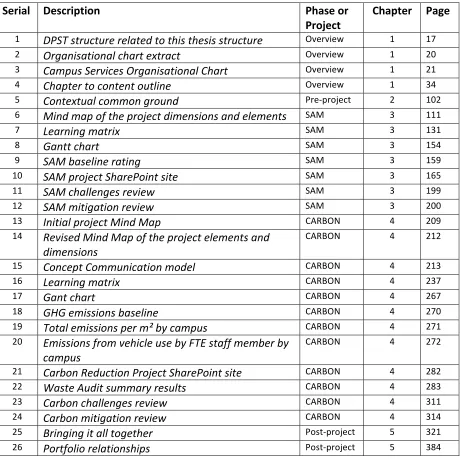
Figure Descriptions
Serial Description Phase or
Project Chapter Page
1 DPST structure related to this thesis structure Overview 1 17
2 Organisational chart extract Overview 1 20
3 Campus Services Organisational Chart Overview 1 21
4 Chapter to content outline Overview 1 34
5 Contextual common ground Pre-‐project 2 102
6 Mind map of the project dimensions and elements SAM 3 111
7 Learning matrix SAM 3 131
8 Gantt chart SAM 3 154
9 SAM baseline rating SAM 3 159
10 SAM project SharePoint site SAM 3 165
11 SAM challenges review SAM 3 199
12 SAM mitigation review SAM 3 200
13 Initial project Mind Map CARBON 4 209
14 Revised Mind Map of the project elements and
dimensions
CARBON 4 212
15 Concept Communication model CARBON 4 213
16 Learning matrix CARBON 4 237
17 Gant chart CARBON 4 267
18 GHG emissions baseline CARBON 4 270
19 Total emissions per m² by campus CARBON 4 271
20 Emissions from vehicle use by FTE staff member by
campus
CARBON 4 272
21 Carbon Reduction Project SharePoint site CARBON 4 282
22 Waste Audit summary results CARBON 4 283
23 Carbon challenges review CARBON 4 311
24 Carbon mitigation review CARBON 4 314
25 Bringing it all together Post-‐project 5 321
26 Portfolio relationships Post-‐project 5 384
[image:10.595.70.530.170.629.2]
Artefact Descriptions
Serial Description Phase or
Project Chapter Page
1 Learning Portfolio Pre-‐project 2 43
2 Learning Plan Pre-‐project 2 80
3 DPST Getting Started Pre-‐project 2 96
4 SAM Getting Started Paper SAM 3 115
5 SAM Elements SAM 3 125
6 SWOT Analyses SAM 3 130
7 Quality Review Template SAM 3 133
8 Learning Journal Extract SAM 3 134
9 Project Plan SAM 3 138
10 Project Schedule SAM 3 156
11 Academic Reporting SAM 3 161
12 Vice Chancellor’s Committee Discussion Paper SAM 3 171
13 Project Closure Report SAM 3 191
14 Getting Started Paper Carbon 4 214
15 Project Framework – Academic Paper Extract Carbon 4 231
16 Quality Review Template Carbon 4 239
17 Learning Journal Extract Carbon 4 240
18 Action Research Applied -‐ Academic Paper Extract Carbon 4 241
19 Project Plan Carbon 4 245
20 Project Control Group Minutes Carbon 4 262
21 Working Group Minutes Carbon 4 266
22 Project Schedule Carbon 4 268
23 Environmental Audit Proposal Extract Carbon 4 274
24 Campus Ecological Transformation Proposal Extract Carbon 4 277
25 Academic Reporting Carbon 4 278
26 Media Release Carbon 4 285
27 Project Closure Report Carbon 4 291
28 Vice Chancellor’s Committee Reduction Strategy
Paper
Carbon 4 300
29 SAM academic paper Post
project 5 324
30 Carbon academic paper Post
project
5 344
Acknowledgements
To Professor Ken Stott, through your enthusiasm and vision for the Professional Studies Program at the University of Southern Queensland you were the catalyst which started me on this journey; thank you.
To Dr. Neil Peach, your mentoring and guidance over the past four years have kept me focused, motivated and on track. Your contribution has been invaluable. Your ability to understand the way that I perceive the world and to communicate within that frame of reference, whilst simultaneously challenging and expanding it, has been greatly appreciated. You were always able to see through the undergrowth at the times when I had lost the path and was hacking at the bushes. I acknowledge the extraordinary role you have played in my learning journey; thank you.
To friends and colleagues, who have made contributions to my journey and perhaps revisited their own professional and learning aspirations and activities; thank you and good luck on your own journeys. I particularly thank the staff of Facilities Management at every level, who understood and engaged with not just the tasks and goals of the projects undertaken, but also the philosophy that underpins them. They are a credit to themselves and the USQ and are a truly professional community.
To my wife and children, who have sustained me in this journey through their direct support, understanding, faith and sacrifice and in particular their acceptance of a part time father and husband. Thank you. I will make it up to you.
To my parents who constantly expressed a sense of pride, excitement and confidence in my undertakings; thank you. Your unwavering support means a lot to me.
In closing the acknowledgements, I thank the University of Southern Queensland, for supporting my activity and recognising the learning and organisational value of the projects undertaken.
Certification of Dissertation
I certify that the ideas, experimental work, results, analyses, software and conclusions reported in this dissertation are entirely my own effort, except where otherwise
acknowledged. I also certify that the work is original and has not been previously submitted for any other award, except where otherwise acknowledged.
Signature of Candidate Date:
ENDORSEMENT
Signature of Supervisor Date: