All organisations receive complaints – even learning providers. But it’s not the number of complaints an organisation receives that matters; what is impor tant is how it treats dissatisfied customers. Consultancy for free: making the most of complaintsgives guidance to colleges on how to put in place an effective complaints procedure that will meet the needs of your customers: learners, their parents, employers and funders. Topics include developing and implementing the complaint process, management style and making your organisation more accessible to customers, plus there’s a step-by-step guide to dealing with
complaints. Find out how to see complaints as an oppor tunity to improve processes, rather than as a threat, and discover why it’s impor tant to deal with complaints swiftly and efficiently.
consultancy
for free
making the most
of complaints
consultancy
for free
consultancy
for free
Published by the Learning and Skills Development Agency
www.LSagency.org.uk
Feedback should be sent to Information Services, Learning and Skills Development Agency,
3 Citadel Place, Tinwor th Street, London SE11 5EF
Tel 020 7962 1066 Fax 020 7962 1258 [email protected]
Registered with the Charity Commissioners
Editor: Jackie Mace
Designers: Dave Shaw and Tania Field Printer: Newnor th Ltd, Bedford
ISBN 1 85338 637 5
A1021/04/01/3000
© Learning and Skills Development Agency 2001
You are welcome to copy this publication for internal use within your organisation. Other wise, no par t of this publication may be reproduced, stored in a retrieval system, or transmitted in any form or by any means, electronic, electrical, chemical, optical, photocopying, recording or other wise, without prior written permission of the copyright owner.
Raising Quality and Achievement Programme
Run by the Learning and Skills Development Agency in par tnership with the Association of Colleges (AoC).
● We aim to reach all colleges and all levels of staff.
● We offer extra suppor t to colleges that are receiving
Standards Fund money to improve their practice.
● All our activity themes are backed by a programme of research and evaluation.
● The Raising Quality and Achievement Programme is sponsored
by the DfEE and all activities are subsidised.
Note
Contents
1 Introduction 1
2 Who is the customer? 3
3 Whose fault is it? 5
4 Management style 6
5 Consequences of inaction 7
6 Developing the complaints process 9
7 Dealing with complaints 11
8 Using complaints to improve performance 29
9 Citizen’s Charter Complaints Task Force 33
10 Views from outside the sector 35
11 Handling complaints – dos and don’ts 37
12 Ten steps to dealing with complaints 39
13 Questions to ask as part of a complaints procedure audit 40
References 44
About the author
Jane Owen is a development adviser for the Raising Quality and Achievement Programme, with responsibility for the benchmarking and information strand.
Acknowledgements
1
Introduction
Things go wrong
There are ver y few people who go to work to do a bad job.
Ver y few processes are designed primarily to frustrate the customer – even if our experiences tell us other wise. It’s just that despite all the good intentions of those concerned the service fails.
We have all experienced bad service, sometimes from the most reputable organisations. What tends to separate good-quality organisations from poor-quality organisations is the way they deal with service failures.
Organisations that genuinely put their customers at the centre of their business are likely to have three things in common:
● they have systems in place to do things right the first time
● if things go wrong, they have systems in place to put them right
● they learn from their mistakes.
Learning providers are no different to any other organisation. They need to know who their customers are, understand their needs, provide services that meet those needs and, should the service fail, have a system in place that will allow them to put things right and learn from the problem. In fact, the Learning and Skills Council requires organisations to have these mechanisms in place.
Consultancy for free
Organisations pay large amounts of money to consultants to find out how to improve their services. However, there is a pool of information available to ever yone on what processes need improvement and how to improve them. All we have to do is ask our customers. By setting up systems that capture good-quality information from our customers we can, to an extent, get consultancy for free.
2
Who is the customer ?
‘Customer’ is a term that has been increasingly used and abused in all sectors over recent years. However, the term an organisation uses to describe the people it serves is not impor tant. What is impor tant is how it treats people.
Most of us have been called a customer while clearly not being treated as one. For example, announcements that tell overheated, delayed passengers to make room for other ‘customers’ do not make them feel like valued customers. In fact, such announcements can make them feel annoyed or patronised, especially when the service or the attitude of staff does not match the words.
There is emerging evidence that overusing the term customer can alienate the ver y people you are tr ying to serve. A recent National Health Service survey showed that people receiving treatment wanted to be called patients, not customers. However, they still expect to be
treatedlike customers.
It is easy to get hung up on customer service terminology. Customers are simply people to whom we provide a service, be they learners, employers or funders, regardless of whether they pay directly or indirectly for the service. Each group will have its own needs and expectations, and the service we give them has to reflect this. It is our responsibility to ensure that we provide a service for each group and individual that is of the same or higher quality than we would expect to receive if we were the customer.
Colleagues as customers
We all have customers though not all of us deal with external customers. A good indicator of how well an organisation will treat its external customers is how well it treats its internal customers.
[image:9.420.91.332.131.290.2]Generally speaking, satisfied and motivated staff will create satisfied customers. It is par t of the vir tuous circle of quality.
FIGURE 1
The virtuous circle of quality
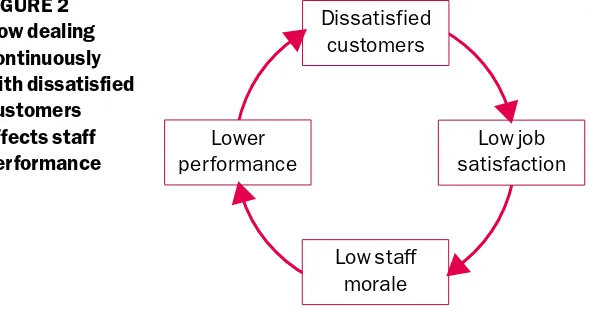
Conversely, dealing continuously with dissatisfied customers will have a detrimental effect on staff morale and, hence, performance.
[image:9.420.37.332.347.502.2]3
Whose fault is it ?
When things do go wrong it is almost a reflex reaction to ask, ‘whose fault is it ?’ This guide opened with the asser tion that people
do not go to work to do a bad job. Most service failures tend to be caused by inadequate systems and processes that do not suppor t high-quality service deliver y.
Staff often comment that the structure of the organisation and their lack of empowerment make it difficult to resolve customer complaints quickly. As with many elements of good customer service, a successful complaints system often depends on an open management style within the whole organisation.
No blame culture
If complaints systems are to be effective staff need to feel it is safe to repor t service failure. A no blame culture does not allow staff to abdicate responsibility for service deliver y but does mean that service processes and their deliver y can be easily reviewed.
Most problems are caused by processes and not by people. Even the few problems that are caused by people not following procedures may not necessarily be the ‘fault’ of those involved. Consideration needs to be given to why procedures haven’t been followed. Is it because those involved don’t know the procedures, because they haven’t been trained, or because they don’t have the time or resources to do what needs to be done?
Finally, a no blame culture is not an excuse for staff doing their job badly if they have the tools, resources and training to do it well.
5
Consequences
of inaction
Referrals
Most commercial organisations survive or fail depending on whether or not their customers make a repeat purchase and recommend them to others. At first glance this concept does not appear to apply to learning providers. However, many learners have the power to influence whether or not other people attend a college.
A bad experience at a college that is unresolved could have a significant detrimental effect on whether or not a learner’s siblings, parents, children or friends attend the same college. This means that many learners, although perhaps not in a position to walk away from the college when they are dissatisfied, can have a negative effect on student numbers in later years by telling others of their experience. This is par ticularly true when there are other institutions in the area where people can study. Satisfied learners often return to a college themselves to take fur ther courses.
The following examples show the damaging impact of not responding adequately to complaints.
● A complaint to a London company was greeted with a poor
response. The complainant was so annoyed that they posted a letter on the Evening Standard(a London newspaper) website. The company eventually dealt with the complaint, but by then a huge number of people had been made aware of its poor service.
● A warning e-mail to a transpor t company about a potential safety
issue was answered threateningly. As a result, the complainant copied the e-mail and the response to government depar tments, consumer groups and the company’s head office.
Turning a customer mistake
into a customer complaint
It is surprising how often an organisation can turn a customer mistake into a justifiable customer complaint.
Getting it wrong
A customer left his bag on a bus. He called the bus company but the telephone system was down. A driver on another bus radioed through to the controller who said he would put out an urgent call to all buses. The call didn’t go out until 15 minutes later.
Eventually, a call came back asking for more details of the bag. The customer was told his bag had been found and was sent on a long journey around various bus routes for several hours to collect it. When he finally located the bag it proved to be the wrong one and did not fit the original description in any way. In addition, it meant that whoever did have the bag had also had access to his house keys and credit cards for several hours.
The initial customer mistake turned into a major customer complaint.
Complaints procedure
An effective complaints procedure should:
● allow customers to let an organisation know when things go wrong
● give the organisation an oppor tunity to put things right.
The work that is put into developing a complaints procedure at the outset will pay dividends later.
What do your customers need ?
The complaints procedure you devise must meet the needs of your customers. It should make it easy for your customers to contact your organisation and for them to let you know what problems they have had. Don’t put unnecessar y barriers in the way.
Ask your customers how they would prefer to contact you and how they would like you to deal with their complaints. Show your complaints procedure to your customers, eg learners, employers and parents. Find out from them whether it would meet their needs and what improvements you could make to it.
Getting it wrong
One organisation offering a wide range of services on several sites allowed staff to develop their own local complaints procedures. As a result, customers had to negotiate a complex web of contacts and ver y few complaints were ever received.
6
Developing the
What does your organisation need ?
Your complaints procedure is a valuable management tool, so make sure it meets the needs of your organisation as well as your customers. Complaints should be recorded in such a way that they can be readily fed into the management review process and into the day-to-day operation of the organisation.
Complaints coordination
Make a specific member of staff responsible for recording and assigning complaints. Appoint an extra person who can deputise for them in their absence.
Consult your staff
The complaints procedure will not function properly without suppor t from the whole staff – how they feel about it will be crucial to its success.
Having a complaint made about your work is not a pleasant experience. Even though you know the complaint is not a personal slur, it is difficult not to become defensive and take it personally.
Staff need to know how management will deal with a complaint and feel reassured that they will not be blamed for problems with processes. Let staff know that the organisation wants to encourage customer feedback to improve services, not to appor tion blame. Consult with your staff. Ask them what would make it easier for them to deal with complaints, how best to empower them to improve services and what information they need from the complaints procedure.
Use a representative group of staff to review the procedure that you are proposing. Remember that frontline staff will be more familiar with the types of complaints that are made and the difficulties that they cause to both customers and to the organisation.
Keep it simple (the quality
KISS
)
What is a complaint ?
A complaint could be described as any expression of dissatisfaction from a customer. Generally speaking, if a customer believes they are making a complaint then it is a complaint.
For ever y person who makes a complaint there are approximately another 20 dissatisfied people who will not complain, but will either stop using your service or stay dissatisfied with you. So, if a person has gone to the trouble of making a complaint they usually feel genuinely disgruntled.
When dealing with complaints it is impor tant not to become too concerned about customer service terminology. Some organisations can over-complicate their complaints procedure by grouping complaints into categories such as minor, formal, informal, verbal and written complaints.
Complaints should be coded, as coding is an impor tant means of identifying root causes of problems. However, this is an internal process – it is not something that customers need to know about.
It’s not what you do ...
Things do go wrong. However well an organisation plans and delivers a service, systems can still fail.
How an organisation recovers from service failure is one of the most impor tant aspects of its service deliver y. Research conducted by TARP, a customer satisfaction and loyalty measurement company, has shown that customers who complain and have their problems resolved quickly are more likely to make a repeat purchase than customers who had no problems with the service or organisation. Although it is best to get things right first time, a well-handled complaint can leave customers feeling more satisfied with an organisation than if the service had not failed at all.
It’s the way that you do it
Organisations that make good use of customer feedback share the following principles.
Access and information
How easy is it for your customers to tell you when something goes wrong ? An organisation that boasts of very low complaint rates might not be deliver-ing a first-class service; its complaints procedure could be inaccessible. Make it easy for your customers to let you know that something has gone wrong and consider how they prefer to communicate with you.
Getting it right
The FEFC Circular 00/25 requests colleges to ‘ensure that the description of their own procedures refers to the role of the Council and that they provide information as to how the Council can be contacted where necessar y’.
Verbal complaints
If somebody makes a verbal complaint it is always better to deal with it immediately, rather than fur ther irritate the complainant by insisting that they contact you in writing before you will deal with it.
Getting it wrong
An organisation insisted that all complaints had to be put in writing. To ensure that this did not discriminate against those with literacy or language difficulties, it would dispatch somebody to the home of the person making the complaint to help them to write the letter, rather than allowing staff to take and log verbal complaints.
Forms
Many people do not feel comfor table writing formal letters but would still like to put a complaint in writing. Producing a simple complaint/comment form will make this easier. It will also ensure that your customers give you all the information that you need to investigate the complaint without you having to go back to them for additional information.
Although you can encourage customers to use forms by
explaining that it is a good way of speeding up the complaint process, don’t insist that they complete one. Some people do not like completing forms, but you can increase their use by making them user friendly. Only ask for information that is needed, not information that is just of interest, and make the forms available where customers are most likely to need them.
Getting it right
Helping us t
o get it righ
t
The college’s quality promise The college is committed to pr
oviding high quality services
for all our customers: lear
ners, employers and the community
in general. But only our customers can tell us if the ser vices
we provide are quality ser vices.
We need to work with you to impr
ove our ser vices.
If you are unhappy with the ser
vices that you receive
we need to know so that we can put things right.
If you are unsure about a pr oblem
Contact the college and tell us about it. Our staf
f will be happy
to talk to you and usually your pr
oblem will be sorted out
immediately. If, however
, you are still not satisfied you
can make a complaint.
How to make a complaint
You can make a complaint in whatever way you pr efer:
in writing, by phone or in person.
It is best to complain to the person who pr
ovides the
ser vice that you are unhappy with, but if you ar
e not sure
who that is, or if you would rather complain to somebody else, please contact the college’
s complaints coordinator at:
[college address] [telephone number] Getting it right
FIGURE 3
What we will do to help
We will do everything that we can to r
esolve your complaint
and to make sure that the pr
oblem doesn’t happen again.
All complaints that we receive are recor
ded and monitored
by our complaints coordinator.
We aim to deal with your complaint within two weeks but some complaints, especially if they ar
e complex,
may take longer. If it is going to take longer than two weeks to deal with your complaint we will let you know and keep
you informed of progress.
If you are not satisfied with the r
esult of the complaint
If you are not happy with the r
esponse to your complaint,
you can ask for the complaint to be escalated to a manager who will investigate the complaint for you and let you know
what the outcome is.
If you are still not happy, you can ask for the complaint to be escalated to the College Complaint Review Gr
oup.
Your complaint will then be looked at by a gr
oup of people who
are not directly involved in the ser
vice that you are unhappy
with, and they will send you a letter on the outcome. If you are still not happy
, you can refer your complaint
to the Learning and Skills Council.
The complaints coordinator will be able to help you with the escalation of complaints or r
eferral to the College
Complaint Review Group or the Lear
ning and Skills Council.
Finally ...
We hope that most of the time we do get it right.
We welcome your comments on the quality of our ser vice,
your suggestions on how we can impr
ove them and the services
Advocates
There are some people who are not able or confident enough to put across their complaint themselves. Complaints procedures should be accessible to advocates and social workers. Let your customers know that you welcome this.
Encourage feedback
Some customers may fear that they will be victimised if they make a complaint. This can be a problem, par ticularly if they are vulnerable or cannot take their custom elsewhere.
Getting it right
One organisation that provides services to deaf people found it did not receive complaints from them. The organisation made a signed video for its customers explaining how to make a complaint and reassuring them that they would not get into any trouble if they did complain.
Customers with particular needs
It is inevitable that many learning providers will have customers whose first language is not English or who find it difficult to access complaints systems. There are a number of ways that you can enable these customers to access the complaints procedure:
● produce complaint information leaflets in plain English
● ensure that there is a direct telephone number connected
to a Textphone, and that staff are trained to use it
● identify interpreters who can be called upon. There are also organisations that provide over-the-phone interpreting services
● provide leaflets in languages that reflect the local community
● train staff in deaf awareness and basic sign language
Getting it right
One organisation with widely dispersed franchises produced a training video for staff who could not attend a training session to help them communicate with people who do not have English as a first language.
If you are not sure how best to give your customers access to your organisation, don’t be afraid to ask them. For example, it might be more useful to provide interpreters than translated written information. There are also a number of national and local organisations that will be able to help you.
Staff knowledge and access
Publicising the complaints procedure should not be confined to customers – staff should be made aware of it too. Clearly, even the most well thought-out and accessible complaints process will fall down if the staff do not know how it works and do not have access to the process and resources to make it work.
Getting it right
FIGURE 4
Staff guide to complaints –
an example of a satisfaction guide for college staff
Introductio
n by the princ
ipal
Complaints are out there. All or
ganisations, public or private,
have them. The better or
ganisations find ways to get their
customers to tell them when they ar
e not happy. It follows that
a cer tain level of complaints indicates a healthy or
ganisation.
I want complaints to be seen as an oppor
tunity. They are one
of the most important areas of customer feedback, and if dealt with quickly and fairly can leave customers with a better opinion of the college than befor
e they complained.
There is a lot to be gained fr
om dealing with customer complaints
properly, and your suppor
t in making this happen is essential.
Many ser vices in this college ar
e delivered to a large number
of people, by a wide range of employees. With this in mind, there will be people who ar
e not satisfied or happy with college
ser vices, the way we deliver these ser
vices, the lack of services
or the college’s policies. Ther
e will be occasions when the college
has failed to deliver a ser
vice, or has delivered it badly, or has
developed policies that ar
e not popular with the public. On the
other hand, there may be things that people ar
e particularly happy
with that they want to tell us about. We need to provide an easy
, quick, honest, fair and
user-friendly way for customers to expr
ess this satisfaction
or dissatisfaction. The college pr
ocedure aims to provide this.
This guide aims to provide all staf
f with a basic understanding
of the college’s procedures for dealing with complaints. W e want
to move away from a blame cultur
e and instead see complaints
as a source of free information which will help us to continually improve our services, help us tar
get our resources and review
Why have a complaints p
rocedure?
We benefit in several ways fr
om having a complaints pr
ocedure:
● we can find out if we ar
e not per forming as well as we want to
●we can resolve complaints befor
e they cause serious problems
● we can learn from our mistakes
● it gives our customers confidence in us ● by knowing what steps to take when we r
eceive complaints,
we will find it easier to resolve them.
Complaint or question?
Not all customers’ comments ar
e complaints. Often a customer
will contact us with a question, which may not be a complaint about the service that we pr
ovide. If we answer their question
helpfully and quickly, the quer y will not tur
n into a complaint.
A question only becomes a complaint if the customer is not happy with our response.
A question
A prospective student tells us she has not r
eceived
the documentation she was expecting.
We check the facts and explain that she has not told us of her change of address. We send another copy out to her new addr
ess.
A complaint
An employer rings to say that a member of staf
f at the college
has been rude to him.
We tell him that we are sorr y he is unhappy with our ser vice
How to deal with a comp
laint effectively
When people receive a complaint their first r
eaction is very
impor tant. It is easy to feel defensive, but this will not help to resolve the complaint. By focusing on the complaint, and not on the person making it, you should be able to r
emain calm,
which will help you to focus on the complaint in a pr
oductive way.
It is impor tant to be polite to the customer
, even if you do
not agree with the complaint being made. T
reat the customer
in the way you would like to be tr
eated if you made a complaint.
This includes keeping in contact with the customer fr om
the beginning of their complaint, telling them who you ar e
and what your position is, and acknowledging that they have a complaint you will listen to.
It also means reacting immediately
to their complaint, finding somewher
e private for you to
discuss the complaint if they ar
e complaining in person,
and taking the time to listen if they ar
e complaining by phone.
Whether the complaint is made on the phone or in person, get all the relevant facts. This is so that you do not have to
contact the customer repeatedly. If it is a written complaint, respond immediately with a phone call if a number is given,
and by letter if no number is given. Nobody likes being passed fr
om person to person,
especially when they are already unhappy
, so you need to
be prepared to take the initial r
esponsibility for dealing with
a complaint, even if it is not about your ar
ea of work. Do this
by acknowledging the complaint, telling the customer that you want to take down the details and that these will be
passed on to the relevant person who will deal with the pr oblem.
Give the complainant your name. Getting it right
How to deal with an an
gry or frustrated custo mer
Some customers may feel fr
ustrated or angry about a complaint.
It is ver y important that you stay calm and don’t get involved in an argument. Angry people need space and time to let of
f steam.
Encourage them to talk by actively listening and summarising what they are saying.
If a customer becomes violent, explain that you feel thr
eatened
by their behaviour, being as specific as possible about what it is they are doing that you find thr
eatening, and ask them to stop
that behaviour. If you feel in danger
, leave the situation immediately .
It is impor tant to let your line manager as well as the complaints coordinator know if you have had to deal with an aggressive or thr
eatening customer.
Communicating with the custome r
Complaints can take a while to r
esolve. Remember to let the
customer know what is happening. Y
ou may be working hard
to solve a problem for the customer
, but they’ll feel that their
complaint has been ignor
ed if you don’t keep them infor med.
Sometimes your investigations will show that the college was not at fault. If the complaint was a r
esult of the customer making
a mistake or not understanding something, don’t make them feel foolish. Instead, thank them for taking an inter
est in
the college – that way they will feel mor
e confident about
approaching the college in the futur e.
If you can’t resolve the c
omplaint
It may not always be possible for you to r
esolve a complaint,
par ticularly if it does not fall within your ar
ea of responsibility.
If you need help from a more senior member of staf f, your
complaints coordinator will be able to find the cor
rect person
and work with you to get a r
esolution.
Equally, if the customer is not happy with the outcome of their complaint let the complaints coor
dinator know, and if necessar y
the complaint can be passed to a mor
e senior member of staf f.
Remember to tell the customer that this has happened. Keep a record of all that you do to r
Getting it right
FIGURE 5
Contents page of a metropolitan borough staff guide to complaints
Staff guides need to reflect the needs of the organisation. The headings shown here formed the basis of a metropolitan borough staff guide.
What is a complaint?
When is a ‘complaint’ not a complaint and what do you do if you receive one?
Moans and grumbles
What can customers complain about ?
How can customers complain ?
What if a customer cannot speak English ?
What if a customer has a hearing or speech impair ment ?
What do you do when the customer has left or put the phone down?
What are our standards?
What if you can’t respond within the deadlines ?
What if the complaint is about mor
e than one service?
What if the customer wishes to complain about another ar ea ?
What does the customer expect/want ?
What if we’ve got it wrong ?
What if the customer is not happy with the r eply?
Where do I get complaints leaflets, for
What can’t the compliments, comments and complaints procedure deal with?
What about training?
What role do councillors have ?
What about insurance claims ?
Where does the ombudsman fit into all this ?
Why do people complain ?
What do people expect out of complaining ?
What prevents people fr
om complaining?
How should employees deal with complaints ?
A few tips – some dos and don’ts Who do I ask if I have any fur
ther questions?
Ser vices provided by ar ea
Logging, assigning and acknowledging complaints
Although complaints are best handled at a local level it is impor tant that a central record is kept. Any complaint received should be logged and assigned to the person who will be dealing with it as quickly as possible. The speed of response can make the difference between a satisfied customer and a dissatisfied customer.
Many organisations have a complaints coordinator who is responsible for ensuring that complaints are assigned, resolved and repor ted on. This person is not responsible for resolving the complaint themselves, but can act as an internal champion for the customer.
The complaint log should cover the following details, as a minimum:
● customer name
● customer address
● customer telephone number/e-mail address
● complaint number
● nature of complaint
● complaint code
● name of the person dealing with the complaint
● date complaint received
● date complaint assigned
● date complaint acknowledged
● details of resolution
● date complaint closed.
There are a number of software packages available for managing complaints, but many organisations use their own spreadsheets.
Keep copies of all correspondence and details of telephone calls at a central location. This will make it easier to progress the complaint if the person dealing with it is not available, or if the customer later queries the way that the complaint has been handled.
Let the customer know that the complaint has been received and is being dealt with. Send them details of your complaints procedure so they know what to expect and when to expect it.
Getting it right
FIGURE 6
Example acknowledgement letter
Getting it right
The FEFC Circular 00/25 states that ‘colleges should apologise promptly where errors have been made on programme deliver y and administration’.
Dear [name]
Thank you for your recent letter telling us about the pr
oblems
you have had.
I am sorr y that you are unhappy with the ser
vice you received.
The college always appr
eciates feedback and your complaint
has now been passed to [name] who will look into your complaint. Your complaint reference number is [r
ef number].
We hope to resolve your complaint within two weeks but if the issues are complex it may take longer
. If your complaint is likely
to take longer to resolve, [name] will contact you to infor m you
of progress. Please contact [name] on [telephone number/ e-mail address] if you need to discuss your complaint fur
ther.
I have enclosed a leaflet about our complaints pr
ocedure
for your information.
Saying what you can’t do
There will be times when you cannot do what your customer wants you to do to resolve a complaint. If this happens, you should always be willing and able to explain why you cannot comply with their wishes. There is nothing more likely to infuriate a customer who is making a complaint than a ‘jobs wor th’ attitude. Responses such as ‘it’s not our policy’ or ‘it’s not my job’ are more likely to exacerbate the situation than explaining why something cannot be done. Instead, make a useful suggestion about an alternative service or action.
Complaint review
Inevitably, some customers will not be satisfied with the result of their complaint. It is impor tant that you have a complaints review process should this situation arise.
The complaints review process should be separate from line manage-ment and should be seen as independent by both staff and customers. It could be a panel drawn from both staff and customer groups, or you could choose to use people from outside the organisation.
Give an under taking to act on the recommendations of the panel. If the recommendations cannot be acted on, provide the panel and the customer with a repor t explaining why.
Reporting
What you repor t and who you repor t it to both send out strong messages about the seriousness given to successful complaint handling.
Beware of using the number of complaints received as a performance indicator. If staff feel they will be penalised for repor ting complaints made about themselves or their services it becomes easier not to repor t them. A low number of logged complaints is as likely to be caused by the inaccessibility of the complaint process as by high satisfaction levels.
Managers must take care not to interpret a low volume of complaints as evidence that ever ything is all right ... it is often a sign that access to the complaints system is poor.
(National Consumer Council, 1996)
The Office of the Minister for the Civil Service, confirming that the most commonly quoted indicator of performance is the volume of complaints received, argues that although it may be an indicator, it may not always be an accurate one:
The number of letters to MPs complaining about the ser vice provided by the DHSS, Unemployment Benefit Offices and Inland Revenue are few in relation to their ‘customers’. But this could be because the public are resigned to a lower level of ser vice than they would like, or because they doubt MP’s power to improve matters.
(National Consumer Council, 1996)
Some alternative performance indicators are:
● time taken to initially respond to complaints
● time taken to resolve complaints
● complaint type
● corrective action (apology, thankyou letter, compensation, etc)
● improvements made as a result of complaints
● number of complaints that are referred to the review panel
● satisfaction with complaint response.
Repor ting on complaints should be par t of the organisation’s
Staff training
The best way to ensure that complaints are dealt with well is to recruit staff with good communication skills and to train staff in how to deal with difficult situations.
Dealing with aggressive or difficult customers
By the time somebody makes a complaint they may have had a number of problems and be feeling ver y frustrated. Staff should be equipped to defuse these situations while still being empowered not to accept abuse.
Getting it right
One organisation puts all staff who have to deal with external customers through a one-day training course in handling potentially aggressive customers. This trains them in how to make the best use of body language and to take into account cultural issues.
The training also promotes the safety of staff in all situations, including giving abusive callers the warning, ‘I’m sorr y I cannot deal with you when you use language like that or when you shout at me that way.’ If the caller continues to be abusive the staff member says, ‘I am ending the call now.’
Customer care
Customer care skills are essential for staff at all levels, regardless of whether they are dealing with internal or external customers.
Remember, we all have customers. Training can include communication skills, letter writing, disability awareness or sign language.
What is the root cause of the complaint ?
The priority when dealing with complaints is to put things right for the customer. However, for learning providers, identifying the root cause of the problem is by far the most useful aspect of the complaints process. By investigating what went wrong, learning providers can improve processes and prevent the problem recurring.
Don’t rely solely on senior management or single department expertise to both identify causes and solutions. Quality groups drawn from across college depar tments to include teaching and non-teaching staff will add new perspectives to the process.
There are a number of useful tools that can be used by quality groups when investigating complaints.
Brainstorming
Brainstorming is a simple technique used by groups to generate ideas and solve problems. Members of the group call out ideas either in turn or at random. Nobody is allowed to criticise and unconventional suggestions are encouraged as they can often spark more practical ideas.
A facilitator writes down each of the ideas on a flipchar t or wipeboard.
8
Using complaints to
u
Cause and effect
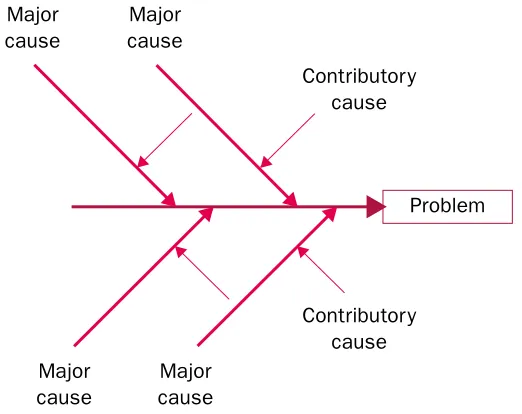
The cause and effect diagram, sometimes called an Ishikawa diagram, is a graphical representation of the likely causes of problems in a process. Because of the shape of the diagram it is also sometimes referred to as fish bone analysis.
[image:35.420.39.300.188.395.2]Major causes of a problem are drawn against a branch that leads to the problem being investigated. Contributor y causes are then drawn alongside the major causes.
FIGURE 7
A cause and effect diagram
The diagram is usually drawn up by a group of people who are involved in the process being examined. As with brainstorming, the method is guided by a facilitator who ensures that ever yone can contribute to the discussion.
Major cause
Major cause
Major cause
Contributor y cause Contributor y
cause Major
cause
u
u
u
u
u
u
u
Pareto analysis
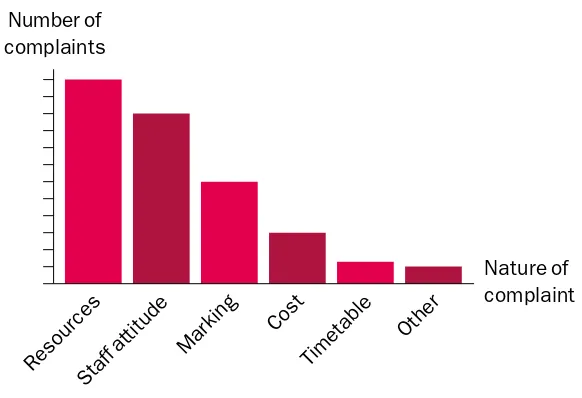
[image:36.420.83.374.184.383.2]The theor y behind Pareto analysis is that 80% of problems result from 20% of causes. By using the Pareto method to analyse the root cause of complaints, organisations can focus on the processes which, with improvement, will make the biggest difference to service deliver y. The causes of complaints are either placed in order of the number received, or according to the cost of putting them right.
FIGURE 8
A Pareto bar chart showing the nature and number of complaints received
Customer groups
If you want to know what to do to improve your service provision or why customers complain about specific aspects of any of the services that your organisation provides – ask !
Customer focus groups can give an amazing amount of information in a ver y shor t period of time and at relatively low cost.
Number of complaints
Nature of complaint
Res our
ces Staf
f atti tude
Ma rkin
g Cost
Time tabl
e Othe
The following rules are useful when running a customer focus group:
● do not be afraid to ask different groups of customers
(learners, parents, suppliers, etc) for their views, but it might be better for them to meet separately
● make sure that you have a good facilitator to run the group
● be specific about what you will do with the information
● assure confidentiality
● feed back what changes you have made as a result of the group meeting
● keep to a reasonably shor t timetabled schedule – finish the meeting on time
9
Citizen’s Charter
Complaints
Task Force
In 1995, the Citizen’s Char ter Complaints Task Force produced a repor t,
Putting things right, which recommends that organisations consider the following points when handling complaints:
● Complaints systems must not only be fair but must also be perceived to be fair.
● The key to effective systems is the attitude of the organisation and staff.
● Complaints made in person or on the phone should be given the same weight as written complaints.
● A member or members of staff should be responsible for helping customers through the complaints process as par t of their other duties.
● Organisations should have formal written guidance on how to deal with complaints and this should be reviewed regularly.
● Standards for dealing with complaints should be publicised to customers.
● All staff should have a suitable knowledge of the complaints procedure and be trained in how to deal with complaints.
● Complaints procedures should be separate from disciplinar y procedures.
● Chief executives should be held personally responsible for effective complaints handling.
● Systems should be established to capture and record all complaints
Consumers’ Association recommendations
The Consumers’ Association (the publisher of Which?magazine) is used to dealing with poor service on behalf of consumers. One area that customers often raise with the Association is the way that organisations deal with complaints.
Letters
Customers complain to the Association about impersonal standard letters that fail to answer specific queries or problems.
Telephones
Customers tend to complain about the way organisations deal with customers on the telephone. The main issues are people taking calls and promising to return them but never doing so, and automated telephone answering services that can take a long time to get you through to the right person.
Tips
● Ensure that staff are well informed, polite and attentive.
● Introduce customer-friendly, after-sales service.
● Make sure that phone lines are easy to get through to.
● If you are using a phone queuing system, let the callers know how many people are being kept waiting ahead of them.
10
Views from
● If you are using a char ter or a pledge, avoid putting disclaimers in the small print.
● Always keep people informed about how their complaint
is progressing.
● Ensure that phone calls are returned and letters answered.
These tips help to meet the needs of many customer groups and almost mirror the expectations of bank retail customers (Zemke and Bell, 2000).
The
US
Government
The US Government has an ongoing process of improvement for public service provision. Its findings and recommendations can be found on the internet (www.npr.gov).
Some useful ideas from its Resolving customer complaints
pages are:
● If you make it easy for your customers to complain, they will
make it easy for you to improve.
● Deal with complaints quickly and politely, and use common sense.
● Most dissatisfied customers do not complain.
● Train and empower your staff to resolve as many complaints
as possible at the first contact point.
● Consider complaints as feedback and oppor tunities to improve.
Questions to ask
● How do you make sure that you listen to your customers?
● How does the management of the organisation view complaints?
● How do you make it easy for customers to complain?
Do
✓
✓
Give your name✓
Get the person’s details, eg name, address, telephone number, and note any significant dates✓
Get the facts/make notes✓
Listen✓
Take the person seriously✓
Be honest✓
Let the person have their say✓
Accept complaints, even if they are not about your section/depar tment✓
Stay calm, even if the person gets angr y✓
Be sympathetic✓
Let the person decide if they wish to pursue their complaint as a complaint✓
Tell the person what will happen next and about the stages of the complaints procedure✓
Act quickly once the complainant has left11
Handling complaints
–
Don’t
✗
✗
Argue with the complainant✗
Get angr y✗
Get into a blame conversation✗
Undermine the organisation✗
Pass the complainant on to another officer✗
Accept abuse from a complainant, eg swearing✗
Ask them to complain in writing or in person, or to come back later✗
Deter people from making a complaint✗
Consider the complaint as a personal criticism1. Make sure there is a system in place for dealing with customers’ complaints.
2. Make the system accessible to your customers.
3. Train your staff so that they can deal with complaints quickly and efficiently.
4. Acknowledge the complaint. You don’t have to admit that you are at fault to make the customer feel better. Use a line like, ‘I am sorr y you are not happy with the service you received.’
5. Get as much information about the service failure as you can. Ask open questions and be willing to listen.
6. Deal with the complaint swiftly. The speed at which you rectify the problem is almost as impor tant as how you put the problem right.
7. Let the customer know if there are going to be any delays in rectifying the problem.
8. Keep the customer informed of progress.
9. If you were at fault, offer some form of redress – this does not have to be a huge financial payment. A proper apology is often wor th more to a customer than a refund given grudgingly.
10. Put the process right. If as a result of the complaint you can make improvements to your process, let the customer know what you have done.
12
Ten steps to dealing
13
Questions to ask as part of
Questions
How easy is it for your customers to complain about the service you provide ?
Do you require customers to put complaints in writing ?
Are the staff empowered to deal with complaints or do they need to refer them to their line manager ?
What propor tion of your complaints are resolved within two working weeks?
How do you monitor your complaints?
a complaints procedure audit
Questions
How do you analyse the cause of complaints?
Is there a process set up to allow you to change and improve your processes quickly as a result of complaints?
Do you let your customers know if you make changes to your processes?
How do you know that your customers are happy with the way you dealt with their complaint ?
Does handling complaints form a par t of all staff induction?
How do you give customer feedback to your staff ?
Are staff trained in problem-solving techniques,
References
Citizen’s Char ter Complaints Task Force. Putting things right – main repor t. HMSO, 1995.
Fur ther Education Funding Council. Complaints to the Council (Circular 00/25). FEFC, 2000.
Leabeater D and Mulcahy L. Putting it right for consumers: review of complaints and redress procedures in the public sector. National Consumer Council, 1996. Zemke R and Bell CR. Knock your socks off ser vice recover y. Amacom, 2000.
Further information
Further reading
Karr R and Blohowiak D. The complete idiot’s guide to great customer ser vice.
Alpha Books, New York, 1999.
Leland K and Bailey K. Customer ser vice for dummies. IDGBooks Worldwide, Inc, Foster City CA, 1995.
Service First. How to deal with complaints.Service First, Cabinet Office, 1999. Useful organisations
Institute of Quality Assurance
12 Grosvenor Crescent, London SW1X 7EE
Tel 020 7245 6722 Fax 020 7245 6755 E-mail [email protected]
Useful websites
e-Satisfy (formerly TARP) www.e-satisfy.com
Institute of Quality Assurance www.iqa.org
Learning and Skills Development Agency www.LSagency.org.uk
Raising Quality and Achievement Programme www.rqa.org.uk
Service First www.cabinet-office.gov.uk/servicefirst
All organisations receive complaints – even learning providers. But it’s not the number of complaints an organisation receives that matters; what is impor tant is how it treats dissatisfied customers. Consultancy for free: making the most of complaintsgives guidance to colleges on how to put in place an effective complaints procedure that will meet the needs of your customers: learners, their parents, employers and funders. Topics include developing and implementing the complaint process, management style and making your organisation more accessible to customers, plus there’s a step-by-step guide to dealing with
complaints. Find out how to see complaints as an oppor tunity to improve processes, rather than as a threat, and discover why it’s impor tant to deal with complaints swiftly and efficiently.
consultancy
for free
making the most
of complaints
consultancy
for free