1
SCAFFOLDING DISTANCE LEARNING IN MATHEMATICS FOR
ENGINEERING: IDENTIFYING KEY TROUBLESOME KNOWLEDGE
ABSTRACT
Mathematics skills are critical in engineering, yet many
students enter university without sufficient proficiency. At the
University of Southern Queensland (USQ), the Faculty of
Engineering and Surveying (FoES) has a large number of
external mature age students, many of whom have forgotten or
never learnt these skills. We aim to improve students’
completion and satisfaction rates in mathematics-based
courses in first year engineering by incorporating more
scaffolded learning into the materials. The specific objective of
the research related to this paper is to identify forgotten
concepts, troublesome knowledge, threshold concepts and
“stuck places” (Meyer & Land 2005, 2006) in mathematics. A
survey of 31 staff in the Faculty of Engineering and Surveying
described the relationships among the key mathematics areas
and the USQ FoES courses. A focus group session with 16
mathematics staff identified the topics and concepts that the
instructors thought were crucial. Individual interviews with
four introductory mathematics instructors confirmed the
results of the survey and focus group, and characterized the
underlying threshold concepts of select topics. The results of
this data will be used to develop learning objects and
materials.
Keywords: Mathematics, Engineering, Threshold Concepts, Scaffolded Learning.
INTRODUCTION
Mathematics and statistics are critical in many careers, particularly engineering. However high levels of mathematics is struggling to attract interest even at the school level. Each year at the University of Southern Queensland (USQ), over 1000 students take some form of mathematics in an undergraduate degree. A similar number take mathematics in
Linda Galligan
University of Southern Queensland [email protected]
Andrew P. Wandel
University of Southern Queensland [email protected]
one of the Open Access Programs. The majority of these students are external and many of the courses experience lower than average completion rates. While the reasons for this low completion are complex, one is the nature of learning mathematics itself and the necessity for a curriculum that gets broader and deeper while still relying on previous knowledge. Our objective is to support these students through materials that target essential but troublesome or forgotten knowledge. Enhancing their understanding of these troublesome knowledge areas will improve retention, completion and satisfaction rates and encourage more students to undertake mathematics at the undergraduate and graduate level.
We aim to improve student understanding, satisfaction and completion rates by incorporating more scaffolding into these mathematics courses. The USQ Faculty of Engineering and Surveying has a large number of mature-age external students, who have forgotten, or never really learned, many of the high-school mathematics principles that university courses assume all high school graduates have readily accessible. Previous student feedback indicated that providing additional completely worked solutions for most problems, including a step-by-step process, facilitated learning of prerequisite knowledge. Discussions with lecturers suggest that even this level of scaffolding may not be enough, and that greater scaffolding around these concepts may be necessary.
In 2009 a team of seven lecturers from the Mathematics & Computing Department, the Faculty of Engineering, the Open Access College (OAC) and the Learning and Teaching Support Unit (LTSU) obtained a Learning and Teaching Performance Fund grant to scaffold distance learning in mathematics and statistics. The three main objectives in this project were:
1. to identify and characterize forgotten concepts, threshold concepts and “stuck places” (Meyer & Land, 2005, 2006) across the various strands of mathematics with a particular emphasis on the 1st year experience in engineering and
science, and bridging courses. These concepts need to be scaffolded to improve student understanding and to lay the foundation for deep learning.
2. to develop learning objects, such as screen casts and videos, which will be incorporated into the learning material to serve as scaffolds. The learning objects will be developed with the support of Media and Multimedia and Web
Development Services, utilising the unique features of Tablet PCs and graphics tablets or pens (i.e. their ability to allow the user to easily write symbolic and graphical forms of communication electronically).
3. to redevelop the courses using Meyer and Land's nine considerations for course design and evaluations which include "redesigning activities and sequences, through scaffolding, through provision of support materials and technologies or new conceptual tools, through mentoring or peer collaboration, to provide the necessary shift in perspective that might permit further personal development" (Meyer & Land, 2006, p. 204).
This paper will report the results obtained in addressing the first objective, particularly in the area of 1st year Engineering.
The Faculty of Engineering and Surveying (FoES) has 4 major disciplines: Agricultural, Civil (CIV) and Environmental (ENV) Engineering; Electrical and Electronic (ELE) Engineering; Mechanical and Mechatronic (MEC) Engineering; and Surveying and Spatial Sciences (SVY). In addition, there is an Engineering Studies (ENG) discipline, which contains courses that are common to all the major disciplines. There are 3 major undergraduate degrees offered by FoES:
a. Associate Degree (AD): 2 years full-time
b. Bachelor of Engineering Technology (BETC) or Bachelor of Spatial Science Technology (BSST): 3 years full-time
3
There are 4 courses run by the Mathematics Department for the FoES undergraduate cohort, of which students are required to complete up to 3, depending on their program:
i. Engineering Fundamentals: ENG1500 (AD); 1st year
ii. Engineering mathematics 1:MAT1500 (BETC, BSST, BEng, BSPS); 1st year iii. Engineering mathematics 2: MAT1502 (BEng, BETC elective); 2nd year iv. Engineering Mathematics 3: MAT2500 (BEng, BETC elective); 2nd year. LITERATURE REVIEW
Today student populations are more diverse than ever before, especially at USQ where the majority of our students are not recent school leavers, and are studying via some distance mode. One repercussion of this diversity is the concern about academic preparedness (McInnis, James & Hartley, 2000). Many universities have addressed this diversity with strategies, including upfront bridging courses, parallel support in courses where it is integrated into the teaching (e.g., Taylor, Mander, & McDonald, 2004) and one-to-one support. Often this support includes testing students on specific mathematics skills where early detection may bridge perceived deficiencies (Egea, Dekkers &
Flanders, 2004; Wilson & MacGillivray, 2007).
While a deep knowledge of basic mathematical is essential as it underpins much of the engineering curriculum (Froyd & Ohland, 2005; Jeschke et al., 2008), students now come to Engineering at USQ with less mathematics experience than the past. The proportion of students completing Mathematics C, the highest level of mathematics at school in
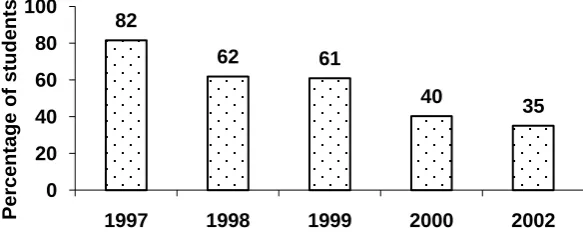
[image:3.595.103.395.408.528.2]Queensland, has been steadily declining from a high of 82% in 1997 when it was a prerequisite, to only 35% in 2002 (Figure 1).As a consequence, more students are struggling with the basic concepts that they would have been exposed to in Mathematics C. Many tertiary courses, such as engineering, contain, as Forman and Steen (1995) said “a rich source of higher order thinking based on lower order mathematics” (p. 221).
Figure 1: Number of students who studied Mathematics C prior to enrolling in B Engineering at USQ (Taylor & Galligan, 2005)
Threshold concepts (Meyer & Land, 2005, 2006) is a useful theoretical framework for examining the basic mathematics knowledge necessary to succeed in tertiary programs like engineering. Threshold concepts are conceptual gateways that lead to previously inaccessible and troublesome ways of thinking. These gateways may be
“transformational (occasioning a significant shift in perception of the subject), irreversible
(unlikely to be forgotten), and integrative (exposing the previously hidden interrelatedness of something)”. They may also be bounded (bordering with new conceptual spaces) and
troublesome (Meyer & Land, 2005, pp. 373-374). Meyer and Land present several examples of mathematical threshold concepts including; depreciation in accounting, the central limit theorem in statistics, and a mathematical “limit”. The limit concept is a threshold, they argue, as it is a gateway to mathematical analysis, even though the concept of a limit may not be troublesome in itself.
Mathematical concepts are troublesome to many learners. Meyer and Land call this troublesome space „states of liminality‟, a term adopted from seminal ethnographic
82
62 61
40 35
0 20 40 60 80 100
1997 1998 1999 2000 2002
P
er
ce
n
tage
o
f stu
d
ent
studies of Turner (1969, in Meyer & Land, 2005). It is this state of liminality that we will be investigating in further stages of this research.
Threshold concepts research in engineering is emerging (Prusty, 2010; Foley, 2010), but to date there have been few studies on the possible mathematics concepts underpinning these issues. Worsley, Bulmer and O‟Brien (2008) examined threshold concepts in a second level mathematics course for engineering (and other) students. They suggested ordinary differential equations, the technique of substitution, and multiple integration as threshold concepts. In this Worsley study it was interesting to note that while students found hyperbolic functions troublesome, it was the technique of substitution that was identified as threshold, not only to this hyperbolic concept, but to other concepts in mathematics.
Threshold concepts are not just being investigated at higher levels of mathematics. Long (2009) believes that fractions, ratio, proportion and percent are all threshold concepts as they provide the conceptual gateway to higher mathematics. Fractions (Brown & Quinn, 2006; Tariq, 2008); ratio and proportion (Lawton, 1993); percentages (Parker &
Leinhardt, 1995); and algebraic reasoning (Tariq, 2008) are all aspects of mathematics that are known to cause difficulty to schools students. However, a different approach may be needed for students at university taking into account adult learning theories,
highlighting the sociocultural context for example, as a key to understanding the nature of adult learning (Merriam, 2008). Underneath these concepts may be broader concepts of multiplicative thinking (Siemon, Izard, Breed & Virgona, 2006), and relational
understanding (Skemp, 1976). RESEARCH DESIGN
We used a cycle of evaluation developed by Taylor and Galligan (2002). This plan is based on four stages of evaluation: pre-program; program design; program delivery; and program conclusion. The first cycle of program evaluation was undertaken in the late 1990‟s when an overview of the mathematics in engineering occurred. This paper reports on the second evaluation cycle which began in 2009. The overall evaluation includes quantitative and qualitative strategies with students and academic staff reflecting on forgotten or troublesome knowledge, "stuck places", and possible threshold concepts and how the design of learning objects can facilitate learning of these concepts. These strategies include a survey, a focus group, and interviews, typical of many mixed method approaches (Morgan, 1997).
The voluntary survey of 31 engineering staff covered 63 courses, which provided an overview of the mathematics areas needed at the program level. The survey helped to guide the focus group which in turn guided the analysis of the interviews. The survey was developed after an audit of the study materials in engineering to identify mathematical topics. The survey was emailed to all engineering staff (in 149 courses) to complete on a voluntary basis; they identified whether the mathematics topic was used in their course or not.
As part of a whole day retreat on “Troublsome Knowledge” in mathematics at USQ, a focus group of 16 academic staff analysed the mathematical issues at the course level. The participants consisted of 10 staff from the mathematics department (from a total of 12), three from OAC, one from LTSU, one from the engineering department, and a reaseach assistant. Issues were identified, discussed, summarized by a scribe and disseminated after the meeting to check for tentative conclusions (Morgan, 1997). Individual interviews with four experienced lecturers who teach mathematics for
5 RESULTS AND DISCUSSION
Survey
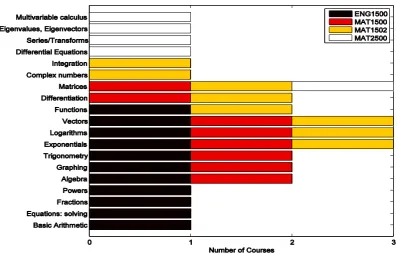
[image:5.595.99.497.248.502.2]Nineteen major topics from the four mathematics courses in Engineering were identified (Figure 2). Note that while there is some repetition, in general the complexity of the topics progresses with each course, and the mathematics component of ENG1500 is
approximately two-thirds of the course.
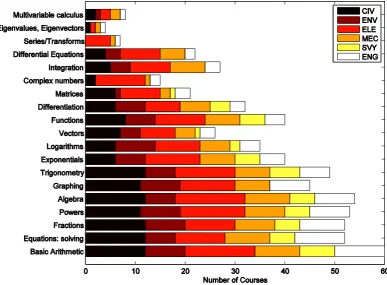
[image:5.595.139.442.565.623.2]Staff from FoES were surveyed to determine which of the topics listed in Figure 2 were used in their courses. Of the 149 courses in the faculty (many of which are not technical), responses were received for 63 that contain mathematics content and two which (both CIV) contained none (Table 1).
Figure 2: Major mathematics topics associated by engineering mathematics course.
Table 1: Number of courses by FoES discipline.
Discipline CIV ENV ELE MEC SVY ENG
Number of survey responses 14 8 14 10 7 10
Total number of courses 19 12 32 23 20 43
Figure 3: Major mathematics topics associated by courses in FoES disciplines
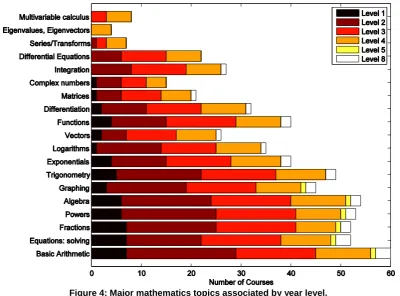
[image:6.595.104.492.155.440.2]The usage of topics by year level is represented in Figure 4; note that levels five and eight are Master‟s level courses. The response rate is listed in Table 2 (level nine is also Master‟s level). Many of the first-year courses are common, so fewer topics are used in total, and are limited to the more basic topics until students‟ knowledge has advanced.
Table 2: Number of courses by level.
Course Level 1 2 3 4 5 8 9
Number of survey responses 7 23 17 12 1 3 0
7
Figure 4: Major mathematics topics associated by year level.
Most of the technical courses are second- and third-level, to provide the foundational material required to attempt advanced synthesis courses such as the final-year project. The proportion of courses requiring specific mathematics topics is always higher for third- and fourth-level courses, as these build upon the fundamental topics to use the advanced topics for the higher-level engineering courses. It is also unsurprising that second-level courses rarely use the highest-level mathematics topics. Most of the Master‟s level courses returned in the survey are preparatory in nature and so require little mathematics content.
It can be seen that understanding of the basic mathematical concepts is essential to be able to attempt the advanced engineering courses. Conversely, the understanding of mathematics can develop in the student by encountering the mathematics in engineering contexts. Seeing it in use results in appreciation of its power.
Figure 5 combines the data in Figures 1 and 2 to determine the number of times each mathematics course is used by a FoES course. Because the staff who were surveyed selected their response based on topic, many of which are built upon throughout the progression of mathematics courses (Figure 2), there is potentially an
Figure 5: Mathematics courses associated by courses in FoES disciplines.
Figure 6: Mathematics courses associated by year level.
The distribution of these results supports anecdotal evidence of stereotypes. Surveying students tend to be most practical-based. Of the engineering disciplines, civil engineering students show a distinct dislike for advanced mathematics, while electrical engineering students are most likely to engage positively with the advanced mathematics. The danger is that because of these stereotypes, the focus of teaching over-compensates, attempting to engage the surveying and civil engineering students as much as possible, while neglecting the electrical engineering students.
The two topics in Figures 3 and 4 which are covered in the most courses are indicative of the topics that are most critical to threshold concepts for engineering students. These are: algebra, underpinned by basic arithmetic. A good understanding of concepts within these topics should lead the student to become better equipped to tackle the more advanced mathematical concepts. We therefore need to understand more clearly what these concepts are and why they may be threshold or troublesome.
These results provide a good starting point for identifying where the mathematics topics are predominantly used. It is therefore possible to create a strategy for improving the teaching of the topics in the engineering mathematics courses and also how these topics are presented in the engineering courses. We will come back to these results later in our research when we scaffold learning in the material.
Focus group
[image:8.595.101.496.259.387.2]9
An agreed list was compiled at each level consisting of possible areas of learning where troublesome knowledge, and stuck places was evident. Many emerged at multiple levels. The group also identified thinking mathematically (such as connections in mathematics, pattern recognition, „what is algebra‟), and connections to context, particularly the engineering context, as issues to be further explored. From that list, we agreed to concentrate on 11 content areas, identify particular concepts within these areas to be scaffolded, and then develop learning objects around these in the context of specific courses. Within these, the issues of thinking mathematically and connection to context are planned to be addressed.
1. Order of operations (level 1 and statistics)
2. Equations to stories; stories to equations (all levels) 3. Rearranging equations (levels 1, 2 & 3)
4. Fractions, decimals, multiplicative thinking (level 1)
5. Graphing (drawing & interpreting, slope and intercept) (levels 1& 2 and statistics)
6. Basic integration (level 3)
7. Substitution (inc function of a function) (all levels) 8. Negatives (level 1)
9. Trigonometry (level 3; especially linked to engineering) 10. Vectors (level 3; especially linked to engineering) 11. Hypothesis testing (statistics)
Although these areas were identified, we realized that we needed to know what it was about these concepts within these areas that were troublesome. Members of this group have had regular meetings throughout 2010 to discuss this issue and what the learning objects would look like in different contexts such as engineering, bridging courses and statistics. These discussions are ongoing and will be reported in future publications. Staff interviews
The troublesome knowledge topics that apply to first year mathematics courses were characterized using in-depth qualitative interviews of four first year mathematics instructors. As the survey suggested, the topics that have the greatest impact on engineering education are addressed primarily in the first year courses. Although the focus group, and to some extent the survey, were able to identify troublesome knowledge topics from across the university, an in-depth characterization of the topics and their importance required a more focused, qualitative approach.
On a superficial level, the interviews confirmed the troublesome knowledge topics identified in the focus group, as well as their application in those programs requiring first year mathematics courses, including all engineering programs. The topics volunteered by the instructors as being the most important for their courses were all found in levels 1 and 2 derived from the focus group. The instructors also confirmed that overcoming each topic was essential for learning many subsequent concepts and operations.
and integration into previous learning before their meaning can be grasped, and c) to be necessary to understand subsequent lessons. They also appeared to be troublesome. For example, many of the algebra, trigonometry, calculus and general functions topics that were listed seem to be based on the inability of the students to understand that mathematical expressions are symbolic notations of relationships. For example, different instructors made the following comments:
Understanding what those algebraic words mean, like solve, simplify, factorize, is one issue, but also seeing connections between different procedures. The quadratic equation is a classic (example). I find that every student that comes in here knows the quadratic formula...but if you give them “(x+2)(x-1)”[=0] and tell them to solve, they don‟t think either that factor or that factor has to be zero ... I‟ve had students that expand that expression, plug it into the quadratic formula, take half a page and come out with the answer.
Students having a problem with understanding what an equation really means. ... Because they haven‟t conceptualized that equation, then they don‟t know how those numbers they‟ve been given relate to it. It‟s almost like they randomly want to take a number, and „where does it fit into the whole here‟. Rather than saying this is a succinct form of a logical relationship between different quantities.
One troubling topic was function of a function. For example, one instructor explained that when many students see: , they are unable to understand that by considering the relationship between this equation and a quadratic function
of a second function they can more easily work with the
equation. On a superficial level it would appear that the students have not memorized the rules for the composition of functions, but on deeper reflection, the instructor recognized that the students do not understand that functions are symbolic representations of relationships, and that compound functions are simply relationships among other relationships. Although memorizing the rules of functions would help the student answer those specific questions on the exam, the true threshold concept appeared to be the deeper understanding of the nature of mathematical expressions.
Another more basic threshold concept discussed by the instructors was the students‟ misconception that „expert‟ mathematicians solve problems by „knowing the answer‟. A couple of the instructors speculated that prior to university, most students learned mathematics by memorizing the answers or procedures for solving problems.
Having a conceptual framework to plug things into rather than memorizing this process, this process, this process ... What I would like for them to do is to utilize the most appropriate method for each problem.”
Part of the culture is engrained into them (the students) that in maths there is only one right way to get one right answer, but in reality there are a whole lot of different ways of arriving at the same point. They get nervous at doing the first step because they think if they make a mistake there it is going to be there, whereas if they try something they‟ll get more experience and know what to look out for.
I think in high school they get it drummed into them that it is right angles, and they don‟t see the extension. ... I expect what they are doing is trying to learn it (applying sine and cosine rule to non-right angle triangles) by rote, and they don‟t really understand what it applies to. It is an understanding issue.
11
Even when faced with a familiar complex mathematical problem, the instructors described the process in their minds as that of suggesting possible solutions and checking which might be reasonable before they proceed. This „trial and error‟ method happens very quickly and is mostly internal. To the student, the instructor appears to have memorized the right answer and is merely recalling it at the board. Even when the instructor chooses the wrong solution and has to start again, the student considers it a faulty memory rather than part of the problem solving process.
The students don‟t realize that we (the teachers) can make a wrong choice, or we can do a problem 2 or 3 ways, but a couple of them we don‟t want to do because they are messier.
They don‟t understand that if you aren‟t getting how to handle an algebraic problem, you can go back to a number problem and get a feel for it.
When the student looks at a complex problem and is unable to recall the correct solution, they will often assume that they have not „learned‟ the right answer, and may feel
frightened, ashamed, or insecure. These negative feelings can then prevent the student from trying the methods they do know, from asking questions about the problem, and even from studying at all. According to the interviewed instructors, until students learn how to break complex problems down into simpler parts, and are willing to attempt a problem even when the solution isn‟t self-evident, a true threshold exists in the level of complexity the student will be able to achieve.
The examples given above and other similar threshold concepts evident in the instructor interviews indicate that although the list of troubling knowledge topics is quite long, the teaching and scaffolding strategies for overcoming them may need to focus on a deep understanding of the nature of mathematics and mathematical thinking rather than on memorizing large numbers of rules or simply providing worked solutions to problems. A couple of instructors mentioned students using technology such as computers and calculators as a crutch that inhibits them from exploring the underlying concepts of the problem they are facing, and facilitates memorization of rote procedures. Many of the concepts suggested by the instructors could be overcome if the students understood that algebra (as well as most areas of mathematics) isn‟t a long list of rote procedures that solve problems, but rather a system that allows the student to rearrange relationships in different ways to find more useful forms. Most of the instructors also mentioned topics around the ability to judge whether an answer was reasonable or to estimate an answer without solving the entire problem. Overcoming these threshold concepts, while requiring more in-depth teaching, might pave the way for much more efficient learning in the more advanced courses.
CONCLUSION
It is relatively easy to embed learning objects on how to solve certain problems in mathematics into our courses (Galligan, Loch, McDonald & Taylor 2010). Incorporating these fundamental threshold concepts in how to see and solve mathematics will be more challenging. Research literature at the school level has highlighted these same content topics, and has offered approaches to scaffold understanding at the school level. Meyer & Land‟s (2006) nine considerations provides a frame for these scaffolds, most of which align with an adult learning approach. However specific attention to a sociocultural context (Merriam, 2008) approach, for example, will be important in developing learning objects.
In addition to recording a person solving problems in these learning objects, we hope to include what the solver is thinking: the hesitations, the uncertainty and the error analysis within the authentic context of engineering. These cues and dialogues are currently missing from their external experience, but may be fundamental to these students understanding the mathematics needed to become good engineers.
ACKNOWLEDGEMENTS
The authors acknowledge the support for this project from the Learning and Teaching Performance Fund granted in 2009. Other members of the team include Robyn Pigozzo, Anita Frederiks, Christine McDonald, Taryn Swan and Birgit Loch (now at Swinburne University of Technology).
The second author is grateful to the Engineering Education Research Group (EERG) at USQ for financial assistance in attending the conference.
REFERENCES
Brown, G., & Quinn, R. J. (2006). Algebra students' difficulty with fractions : An error analysis.
Australian Mathematics Teacher, 26(4), 28-40.
Egea, K., Dekkers, A., & Flanders, M. (2004). An undergraduate course design to address the limitations in mathematical knowledge of entry level students in Information Technology. Paper presented at the Building Foundations 2004 National Conference of Enabling Educators. Retrieved 10 January, 2010, from http://www.pco.com.au/Foundations04/.
Foley, B. (2010). Threshold concepts and disciplinary ways of thinking and practicing: modelling in electronic engineering. Paper presented at the Third Biennial Threshold Concepts Symposium, Sydney.
Forman, S., & Steen, L. A. (1995). Mathematics for work and life. In I. M. Carl (Ed.), Prospects for school mathematics: Seventy five years of progress. Reston, VA: National Council of Teachers of Mathematics.
Froyd, J.E., & Ohland, M.W. (2005). Integrated engineering curricula. Journal of Engineering Education, 94(1), 147-164.
Galligan, L., Loch, B., McDonald, C., & Taylor, J. A. (2010). The use of tablet and related technologies in mathematics teaching. Australian Senior Mathematics Journal, 24(1), 38-51. Jeschke, S., Wilke, M., Kato, A., Pfeiffer, O., & Zorn, E. (2008). Early bird: Preparing engineering
freshmen for engineering challenges. Proceedings of the 38th Frontiers in Education Conference, (pp. T2D-1–T2D-5). ASEE.
Lawton, C. (1993). Contextual factors affecting errors in proportional reasoning. Journal for Research in Mathematics Education, 24(5), 460-466.
Long, C. (2009). The coherence of theory and measurement: the application of the Rasch measurement model to the investigation of ratio, and related concepts. Paper presented at the European Educational Research Association. Retrieved 07 January 2010, from
http://www.eera-ecer.eu/ecer-programmes-and-presentations/conference/ecer-2009/contribution/2308/?no_cache=1.
McInnis, C., James, R., & Hartley, R. (2000). Trends in the first year experience in Australian universities. Canberra: Australian Department of Education, Training, and Youth Affairs. Meyer, J. H. F., & Land, R. (2005). Threshold concepts and troublesome knowledge (2):
Epistemological considerations and a conceptual framework for teaching and learning. Higher Education, 49(3), 373-388.
Meyer, J. H. F., & Land, R. (Eds.). (2006). Overcoming barriers to student understanding, threshold concepts and troublesome knowledge. London and New York: Routledge.
13
Merriam, S. B. (2008). Adult learning theory for the twenty-first century. New Directions in Adult and Continuing Education, 119(Fall), 93-98.
Morgan, D. L. (1997). Focus groups as qualitative research (2nd ed.). Newbury Park, CA: Sage. Parker, M., & Leinhardt, G. (1995). Percent: A privileged proportion. Review of Educational
Research 65(4), 421-481.
Patton, M. (1990). Qualitative evaluation and research methods (2nd ed.). Newbury Park, CA USA: Sage Publications, Inc.
Prusty, G. (2010). Teaching and assessment of mechanics courses in engineering, which encourage and motivate students to learn threshold concepts effectively. Paper presented at the Third Biennial Threshold Concepts Symposium. Sydney.
Siemon, D., Izard, J., Breed, M., & Virgona, J. (2006). The derivation of a learning assessment: Framework for multiplicative thinking. In J. Novotna, H. Moraova, M. Kratka & N. Stehlikova (Eds.), Proceedings of the 30th Conference of the International Group for the Psychology of Mathematics Education – Mathematics in the Centre. (pp. 113-120). Prague, Czech Republic: PME.
Skemp, R. (1976). Relational understanding and instrumental understanding. Mathematics Teaching, 77, 20-26.
Tariq, V. N. (2008). Defining the problem: mathematical errors and misconceptions exhibited by first-year bioscience undergraduates. International Journal of Mathematical Education in Science and Technology, 39(7), 889-904.
Taylor, J., & Galligan, L. (2002). Relationship between evaluation and program development: case studies from mathematics support. In J. Webb & P. McLean (Eds.), Academic skills advising: Evaluating for program improvement and accountability (pp. 133-166). Melbourne, Victoria: Victorian Language and Learning Network.
Taylor, J. A., & Galligan, L. (2005). Do high school students need mathematics to prepare for the academic numeracy demands of university? Paper presented at the Building Connections: Research, Theory and Practice: 28th Annual Conference of the Mathematics Education Group of Australasia, Melbourne.
Taylor, J. A., Mander, D., & McDonald, C. (2004). Transition to engineering mathematics: Issues and solutions. Paper presented at the Creating Flexible Learning Environments: 15th Australasian Conference for the Australasian Association for Engineering Education, Toowoomba.
VanRooy, W. (1998). Addressing possible problems of validity and reliability in qualitative
educational research. Paper presented at the Austailian Association for Research in Education. Retrieved from http://www.aare.edu.au/98pap/van98355.htm
Wilson, T., & MacGillivray, H. (2007). Counting on the basics: Mathematical skills among tertiary entrants. International Journal of Mathematical Education in Science & Technology, 38(1), 19-41.
Worsley, S., Bulmer, M., & O‟Brien, M. (2008). Threshold concepts and troublesome knowledge in a second-level mathematics course. In A. Hugman & K. Placing (Eds.) Symposium