This is a preprint of a chapter whose final and definitive form has been published in Son, J.-B. (Ed.). (2014). Computer-assisted language learning: Learners, teachers and tools (pp. 122-149). APACALL Book Series Volume 3. Newcastle upon Tyne, UK: Cambridge Scholars Publishing.
Chapter Six
Moving beyond Basics: From CALL
Coursework to Classroom Practice and
Professional Development
Jeong-Bae Son
University of Southern Queensland, Australia
Abstract
Keywords: Computer-assisted language learning, postgraduate coursework, language teacher education, professional development, technology integration
Introduction
While there are a number of publications (e.g., Atkins & Vasu, 2000; Ertmer, Addison, Lane, Ross, & Woods, 1999; Hargrave & Hsu, 2000; Johnson, 1999; Milbrath & Kinzie, 2000; Walker, 1994; Yildirim, 2000) describing and examining what occurs in teacher education technology courses or programs, only few studies look at transfer from the practical content of technology courses for teacher education to the classroom, particularly in the area of computer-assisted language learning (CALL). Thus, there is a gap in the literature specific to CALL teacher education and a need for exploring the transfer of CALL coursework to the language classroom further. The study reported in this chapter attempts to address the gap and the need. It aims to examine how language teachers apply their knowledge and skills gained from CALL coursework to their teaching practice and investigate ways in which teachers continue their professional development for CALL.
CALL teacher training and practice
the use of CALL activities in the classroom and colleagues are the most common resource for finding out about new CALL activities.
Similarly, Ebsworth, Kim and Klein (2010) looked into the expectations and experiences of pre- and in-service language teachers in incorporating technology in their classrooms. From the results of questionnaires completed by 90 participants and interviews with 9 participants, they found that their participants came to a technology-enhanced language learning (TELL) course with different levels of TELL knowledge and goals. They also found that the pre-service teachers and in-service teachers had somewhat different expectations from the TELL course, particularly in the use of videos in lessons, the use of software and the evaluation of Internet resources. The participants recommended to improve the TELL course by reflecting their current teaching environments, including their target language and grade level, and pointed out that limited access to resources is a major barrier to the use of computer technology in the classroom.
In a different context, Kessler (2007) investigated the relationship between CALL teacher preparation and teacher attitude toward technology and found that informal CALL preparation is more closely related to teachers’ attitudes toward technology than formal CALL preparation. Based on the results of a web-based survey completed by 108 graduates of Teachers of English to Speakers to Other Languages (TESOL) masters degree programs, he argued that the respondents’ degree programs did not prepare them effectively to use computer-based materials for teaching speaking skills and to create computer-based audio materials for instruction in particular and recommended formal language teacher preparation programs to include a CALL component, which addresses the changing needs of language teachers.
In a way to add more insight into the link between CALL teacher training and classroom practice, this chapter explores the use of CALL by in-service language teachers who had previously completed a formal CALL course offered as an optional course for postgraduate students. It specifically examines how the teachers use CALL in their teaching contexts and how they continue their professional development in CALL after the CALL course.
Participants
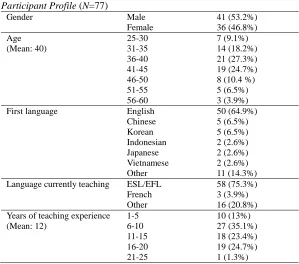
Participants were those who had completed a CALL course as postgraduate students at an Australian university in the past five years. Through the CALL course, the teachers were introduced to CALL and given opportunities to understand key aspects of CALL and gained a basic knowledge of the practical use of computer technology in language instruction in terms of observation, design, implementation, evaluation and management. Among 306 teachers who were contacted and invited to participate in the study via email, a total of 77 teachers responded to the invitation and filled in a consent form. Table 1 shows demographic information on the 77 teachers. Out of the 77 teachers who completed a questionnaire employed for the study, 53 teachers participated in email interviews.
Table 1
Participant Profile (N=77)
Gender Male
Female 41 (53.2%) 36 (46.8%) Age (Mean: 40) 25-30 31-35 36-40 41-45 46-50 51-55 56-60 7 (9.1%) 14 (18.2%) 21 (27.3%) 19 (24.7%) 8 (10.4 %) 5 (6.5%) 3 (3.9%) First language English
Chinese Korean Indonesian Japanese Vietnamese Other 50 (64.9%) 5 (6.5%) 5 (6.5%) 2 (2.6%) 2 (2.6%) 2 (2.6%) 11 (14.3%) Language currently teaching ESL/EFL
French Other
58 (75.3%) 3 (3.9%) 16 (20.8%) Years of teaching experience
[image:4.420.59.358.283.547.2]26-30 2 (2.6%) Years of computer experience
(Mean: 15) 1-5 6-10 11-15 16-20 21-25 26-30 4 (5.2%) 21 (27.3%) 21 (27.3%) 20 (26%) 9 (11.7%) 2 (2.6%) Current place of residence Australia
Korea China Japan New Zealand Thailand Canada Indonesia Qatar Taiwan Vietnam Other 17 (22.1%) 15 (19.5%) 11 (14.3%) 10 (13%) 3 (3.9%) 3 (3.9%) 2 (2.6%) 2 (2.6%) 2 (2.6%) 2 (2.6%) 2 (2.6%) 8 (10.4%) Current teaching level
(multiple responses) Pre-school Year 1-6 Year 7-9 Year 10-12 College/University Adult group 3 (3.9%) 16 (20.8%) 10 (13%) 11 (14.3%) 46 (59.7%) 28 (36.4%)
Data collection
The teachers were invited to complete a questionnaire, which was developed on the basis of a literature review and the content of the CALL course. The questionnaire consisted of four sections (i.e., profile, learning experience, teaching experience and professional development) and contained questions that asked the teachers to identify: (1) which CALL activities they had before/during the CALL course, have had after the CALL course and are using in their current teaching situations; (2) where they learn more about CALL activities after the CALL course; and (3) what factors affect the use of CALL activities in their teaching. The results of the questionnaire are analysed and reported through statistical analyses of numerical data and qualitative analyses of textual data.
respondents to clarify, explain and supply additional information on their CALL experience. Responses to the interview are compiled and analysed to respond to the following questions: (1) Has your CALL coursework influenced your teaching practice? If yes, how? If no, why not?; (2) Has the CALL course been relevant to your career? If yes, how? If no, why not?; (3) Do you currently use CALL? If yes, how? If no, why not?; (4) Do you continue to develop your professionalism in CALL? If yes, how? If no, why not?; (5) What factors do you think affect your use of CALL?; and (6) Please make comments on your experience in/with CALL. Patterns that emerge from the interview data are grouped into categories that address the issues raised in these questions.
Results
Questionnaires
This section presents data collected from the seventy seven questionnaires. It addresses the teachers’ reasons for taking the CALL course, their level of expertise in CALL activities and their level of competence in using computer technologies. When the teachers were asked why they enrolled in the CALL course, first, the most common responses were for self-development and a personal interest in CALL. As shown in Table 2, gaining competence in using computer technologies and employment opportunities were also strong motivators.
Table 2
Reasons for Taking the CALL Course
Reason Number* Percentage
Self-development 70 90.9
Personal interest in CALL 67 87
Competence in using computer technologies
50 64.9
Employment opportunities 35 45.5
Easy access to CALL materials at work
13 16.9
Advice of others 9 11.7
Demand from schools 9 11.7
The teachers had a wide range of prior computer knowledge, abilities and experiences. As shown in Table 3, nearly all teachers had had a basic level of computer expertise before the CALL course: word processing (94.8%), communicating by email (96.1%) and using web search engines (88.3%). Many teachers also stated that they were experienced in using online dictionaries (76.6%), giving PowerPoint presentations (66.2%), text chatting (64.9%) and using databases (59.7%). However, the teachers were least experienced in reviewing web-based language learning sites (14.3%) and CALL software (9.1%). In addition, only a small number of teachers had had a more advanced levels of competency and experience in computer technology, which is reflected in the low proportion of teachers who stated that they were experienced in using wikis (20.8%), developing CALL lesson plans (16.9%) or using blogs (15.6%) prior to undertaking the CALL course.
Table 3
Learning Experience CALL activity Had
previous experience before the CALL course Learnt from the CALL course for the first time Attempted after the CALL course Never actually experienced No response Using Word processing programs 73 (94.8%)
2 (2.6%) 1 (1.3%) 0 (0.0%) 1 (1.3%)
Communicating via e-mail
74 (96.1%)
1 (1.3%) 0 (0.0%) 1 (1.3%) 1 (1.3%)
Text chatting 50 (64.9%)
11 (14.3%)
8 (10.4%)
7 (9.1%) 1 (1.3%)
Voice chatting 32 (41.6%)
7 (9.1%) 11 (14.3%) 25 (32.5%) 2 (2.6%) Video conferencing 24 (31.2%)
5 (6.5%) 15 (19.5%)
30 (39%) 3 (3.9%)
Participating in online discussion groups 32 (41.6%) 34 (44.2%)
4 (5.2%) 5 (6.5%) 2 (2.6%)
Using language software CDs 44 (57.1%) 15 (19.5%) 8 (10.4%)
9 (11.7%) 1 (1.3%)
Using multimedia authoring tools 26 (33.8%) 21 (27.3%)
10 (13%) 18 (23.4%) 2 (2.6%) Giving PowerPoint presentations 51 (66.2%)
1 (1.3%) 10 (13%) 13 (16.9%) 2 (2.6%) Creating Web pages 28 (36.4%) 14 (18.2%) 12 (15.6%) 21 (27.3%) 2 (2.6%) Creating Web-based language learning activities 16 (20.8%)
20 (26%) 6 (7.8%) 33 (42.9%) 2 (2.6%) Using Web-based language learning activities
30 (39%) 25 (32.5%)
10 (13%) 11 (14.3%) 1 (1.3%)
Developing CALL lesson plans 13 (16.9%) 34 (44.2%) 12 (15.6%) 16 (20.8%) 2 (2.6%) Reviewing CALL software
7 (9.1%) 55 (71.4%)
5 (6.5%) 8 (10.4%) 2 (2.6%)
Reviewing Web-based language learning sites 11 (14.3%) 54 (70.1%)
7 (9.1%) 3 (3.9%) 2 (2.6%)
Concordancing 17 (22.1%)
19 (24.7%)
4 (5.2%) 30 (39%) 7 (9.1%)
Using databases 46 (59.7%)
10 (13%) 4 (5.2%) 13 (16.9%) 4 (5.2%) Using online dictionaries 59 (76.6%)
4 (5.2%) 9 (11.7%) 2 (2.6%) 3 (3.9%)
Using graphic programs
42 (54.5%)
4 (5.2%) 10 (13%) 17 (22.1%)
4 (5.2%)
Using Blogs 12 (15.6%)
7 (9.1%) 24 (31.2%)
29 (37.7%)
5 (6.5%)
Using Wikis 16 (20.8%)
4 (5.2%) 18 (23.4%) 36 (46.8%) 3 (3.9%) Using Web search engines 68 (88.3%)
3 (3.9%) 2 (2.6%) 1 (1.3%) 3 (3.9%)
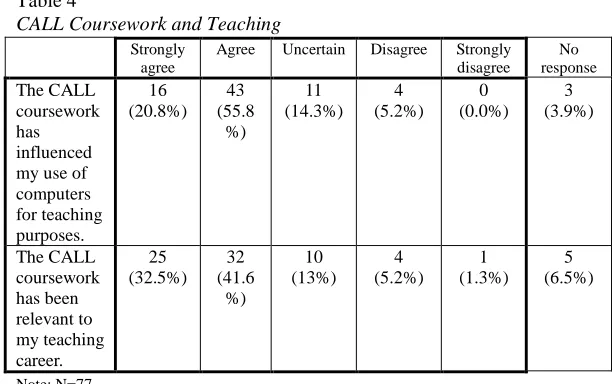
As shown in Table 4, the majority of the teachers agreed that the CALL coursework has influenced their use of computers for teaching purposes (76.6%) and the CALL coursework has been relevant to their teaching career (74.1%).
Table 4
CALL Coursework and Teaching
Strongly agree
Agree Uncertain Disagree Strongly disagree No response The CALL coursework has influenced my use of computers for teaching purposes. 16 (20.8%) 43 (55.8 %) 11 (14.3%) 4 (5.2%) 0 (0.0%) 3 (3.9%) The CALL coursework has been relevant to my teaching career. 25 (32.5%) 32 (41.6 %) 10 (13%) 4 (5.2%) 1 (1.3%) 5 (6.5%) Note: N=77.
Table 5 shows that most teachers are using word processing programs, communicating via email, using online dictionaries and searching the web in their teaching situations. It also shows that the CALL course had a significant impact on the intended future use of CALL activities by the teachers in the language classroom. What is significant to note is the increased interest in exploring the more creative use of CALL activities following the CALL course. When questioned about their future intentions, there was a strong interest in creating web-based language learning activities (44.2%), using blogs (37.7%), creating web pages (36.4%) and using web-based bulletin boards (35.1%) in the future.
Table 5
Use of CALL Activities
CALL activity Currently try
Plan to try Do not know
Using Word processing programs
69 (89.6%) 4 (5.2%) 2 (2.6%) 2 (2.6%)
Communicating via E-mail
66 (85.7%) 6 (7.8%) 3 (3.9%) 2 (2.6%)
Text chatting 38 (49.4%) 18 (23.4%) 16 (20.8%) 5 (6.5%) Voice chatting 23 (29.9%) 23 (29.9%) 27 (35.1%) 4 (5.2%) Video
conferencing
17 (22.1%) 24 (31.2%) 30 (39%) 6 (7.8%)
Participating in online discussion groups
43 (55.8%) 21 (27.3%) 11 (14.3%) 2 (2.6%)
Using Web-based bulletin boards
29 (37.7%) 27 (35.1%) 17 (22.1%) 4 (5.2%)
Using language software CDs
43 (55.8%) 15 (19.5%) 14 (18.2%) 5 (6.5%)
Using multimedia authoring tools
28 (36.4%) 23 (29.9%) 22 (28.6%) 4 (5.2%)
Giving PowerPoint presentations
53 (68.8%) 13 (16.9%) 8 (10.4%) 3 (3.9%)
Creating Web pages
33 (42.9%) 28 (36.4%) 14 (18.2%) 2 (2.6%)
Creating Web-based language learning activities
23 (29.9%) 34 (44.2%) 14 (18.2%) 6 (7.8%)
Using Web-based language learning activities
50 (64.9%) 19 (24.7%) 4 (5.2%) 4 (5.2%)
Developing CALL lesson plans
35 (45.5%) 24 (31.2%) 12 (15.6%) 6 (7.8%)
Reviewing CALL software
26 (33.8%) 23 (29.9%) 21 (27.3%) 7 (9.1%)
Reviewing Web-based language learning sites
38 (49.4%) 18 (23.4%) 17 (22.1%) 4 (5.2%)
Concordancing 17 (22.1%) 19 (24.7%) 32 (41.6%) 9 (11.7%) Using databases 36 (46.8%) 16 (20.8%) 19 (24.7%) 6 (7.8%) Using online
dictionaries
61 (79.2%) 8 (10.4%) 5 (6.5%) 3 (3.9%)
Using graphic programs
35 (45.5%) 16 (20.8%) 20 (26%) 6 (7.8%)
Using Web search engines
66 (85.7%) 3 (3.9%) 4 (5.2%) 4 (5.2%)
Note: N=77.
[image:11.420.56.359.70.94.2]The teachers’ responses to the questionnaire also provided an insight into the main reasons why they do not use CALL activities in their classrooms (see Table 6). The reasons included a lack of confidence (76.6%), a lack of time (64.9%) and a lack of flexibility in the curriculum to incorporate CALL activities (45.5%).
Table 6
Reasons for Not Using CALL Activities
Reason Number Percentage
Lack of confidence 59 76.6
Lack of time 50 64.9
Lack of flexibility in the curriculum 35 45.5
Lack of support from schools 30 39
Lack of facilities 29 37.7
Lack of skills using CALL 28 36.4
Poor quality of facilities 26 33.8
Administrative restrictions 26 33.8
No need for using CALL 17 22.1
Lack of ideas using CALL 16 20.8
Lack of knowledge about CALL 13 16.9
Lack of personal interest 7 9.1
Lack of student interest 5 6.5
Table 7
Factors Affecting Greater Use of CALL
Factor Number Percentage
More time 52 67.5
Better facilities 44 57.1
More support from schools 41 53.2
More flexibility in the curriculum 38 49.4
More skills using CALL 36 46.8
More ideas using CALL 34 44.2
More facilities 33 42.9
Less administrative restrictions 28 36.4
More knowledge about CALL 26 33.8
Great need for using CALL 24 31.2
More confidence 18 23.4
More student interest 16 20.8
More personal interest 15 19.5
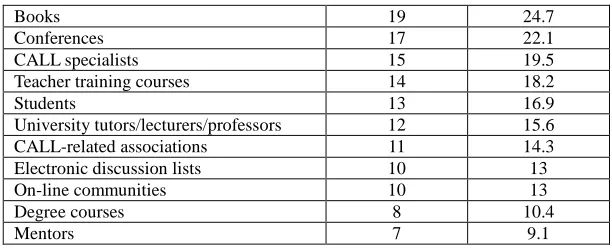
The teachers were also questioned about their methods of learning more about CALL after completing the CALL course. The majority of the teachers have adopted an informal approach to improving their professionalism in CALL. As highlighted in Tables 8 and 9, the most common methods cited by the teachers were the use of web sites (70.1%) and learning new ideas about CALL from colleagues (54.5%). It is interesting to note here that many teachers (49.4%) also intended to continue their professionalism in CALL by learning-by-doing (i.e., learning from their experiences by implementing CALL activities). As the teachers cite time as the lead factor limiting further use of CALL, these methods of improving their CALL knowledge and skills are both understandable and realistic. The low level of participation in more formal methods of professional development in CALL can be also explained by another fact that, as many teachers pointed out, there is a lack of institutional support for CALL.
Table 8
Learning More about CALL
Source Number Percentage
Web sites 54 70.1
Colleagues 42 54.5
Books 19 24.7
Conferences 17 22.1
CALL specialists 15 19.5
Teacher training courses 14 18.2
Students 13 16.9
University tutors/lecturers/professors 12 15.6
CALL-related associations 11 14.3
Electronic discussion lists 10 13
On-line communities 10 13
Degree courses 8 10.4
[image:13.420.53.359.69.193.2]Mentors 7 9.1
Table 9
Ways of Further CALL Teacher Development
Action Number Percentage
By visiting Web sites 55 71.4
By having conversations with colleagues 49 63.6 By teaching students with computers 38 49.4
By reading journals 31 40.3
By interacting with students 28 36.4
By attending teacher training courses 28 36.4
By reading books 22 28.6
By attending conferences 21 27.3
By joining CALL-related associations 19 24.7 By participating in on-line community activities 18 23.4 By communicating with university lecturers 13 16.9
By contacting CALL specialists 11 14.3
By subscribing to electronic discussion lists 11 14.3
By meeting with mentors 10 13
By taking degree courses 6 7.8
Interviews
Q1. Has your CALL coursework influenced your teaching practice? If yes, how? If no, why not?
The teachers’ responses to this question were overall positive: 44 teachers (83%) – yes; 9 teachers (17%) – no. Many teachers commented that the CALL course provided them with the necessary knowledge and skills to evaluate and use CALL activities:
Teacher 3: The course that I had taken has given me a lot of theoretical as well as practical knowledge about CALL.
Teacher 12: The CALL course has positively affected my attitudes toward using computers in language classrooms; and I feel myself more confident of using technology in my classroom.
Teacher 27: It influenced the way I approach CALL classes. It gave me a basis to start from, and gave me a sense of where CALL was headed, and what the possibilities are.
Teacher 31: It has definitely influenced my teaching practise in that I now consider another tool for language learning which I did not do so previously. It has also made me more critical and aware of the design of websites and the suitability of their use for any lesson I might be designing.
Teacher 41: Yes, as part of the assessment was to critique language learning websites, it made me actually look at a variety of sites and made me see how much was actually available. In turn, I have been able to utilise some of these sites in classroom teaching.
Teacher 44: It has greatly influenced my teaching. First of all, it has influenced my choice of electronic materials. I used to download materials from the Internet for my teaching without careful conscious thinking of the real value and reliability of these materials/websites. After completing the course, I started to select Internet materials from a more professional perspective.
Teacher 47: The lessons learnt in the course have contributed enormously to equip me with the ability to evaluate CALL material for my students and for upgrading my teaching approaches.
Teacher 13: I have developed and taught a course on learning English on the Internet. I have also designed a website for the university that I teach at, which students use for self-study.
Teacher 14: I learnt that computers and education can work together and the techniques can be very helpful to students.
Teacher 19: I have tried to use CALL in the classroom in a reading activity as I have learned about the benefits of online reading resources to help ESL learners.
Teacher 34: It has furthered my understanding of the importance of CMC in language learning and has motivated my exploration of the teaching of a language.
Teacher 37: I realised whilst doing the CALL course, how much potential there was for using computer activities with ESOL students.
Teacher 43: Now, I am exploring ways of giving CALL a more central role in my teaching. One of the things I am working on is using CALL to develop my learners’ listening skills.
Teacher 52: CALL coursework opened up new prospects for me. It gave me new options to explore. I also learned about balancing CALL and incorporating it into class work, rather than letting it sit on its own.
Those teachers who indicated that the CALL coursework did not influence their teaching practice confessed that they do not use CALL because they have issues mainly with facilities, school administration or job requirements:
Teacher 5: There was just one computer. I didn’t try to use it.
Teacher 6: At the moment, no because the school administration is having some problems running the IT infrastructure in the school.
Teacher 16: One problem is that my university does not brief foreign teachers on how to use the electronic classroom software.
Teacher 32: No, not my teaching practice at this stage. … At present there is no perceived need to do it.
Most teachers (83%) felt that the CALL course was relevant and beneficial to their teaching career. The course provided both theoretical and practical knowledge of CALL, which the teachers have been able to apply in their teaching situations:
Teacher 3: Yes, it absolutely has. I have been actively using CALL in my career for the past 2 years. Everything that I do in my job now is directly related to various aspects that I studied in the course.
Teacher 6: I would say yes as it opens up new possibilities for teaching and learning. I now have more resources to rely on in my teaching practice and more modes of teaching my students.
Teacher 10: This course has inspired me a lot in my teaching areas. Because of this course taken, I learn to create an online program for my language teaching.
Teacher 12: Yes definitely. … It is possible to teach a foreign language without using computers but I believe that language teachers need to have knowledge on how to integrate computer-based activities into their classrooms in order to facilitate their students’ L2 learning process and enhance their students’ learning.
Teacher 19: I see CALL becoming an integral part of ESL teaching in general. I wouldn’t want to be left behind in my knowledge in modern approaches to ESL teaching. I think the CALL course may help me in getting another job.
Teacher 26: Yes, absolutely. The most valuable experience I gained from the CALL course was learning how to create my own online interactive language exercises for students and also how to create basic web pages with interactive exercises. This in turn led me to develop a website for my business.
Teacher 27: On the basis of my CALL experience in the course, I was able to apply for a CALL position at the English Language Institute at my work.
Teacher 50: The CALL course was very helpful for the development of my teaching career. It provided me with new ways of teaching a language and creative ideas of using materials and resources through the Web.
Those teachers (17%) who responded “no” to Question 2 indicated that the course had not been relevant for them either because of inadequate facilities in their workplace or a lack of opportunity to implement CALL in their teaching practice. However, they expressed a hope that they could apply the knowledge in the future:
Teacher 1: Not yet. It has helped me do my work … but no progress on the job/salary front in that respect.
Teacher 7: So far, I haven’t had many opportunities to implement CALL in my job, but I would like to in the future.
Teacher 15: The unit itself so far hasn’t helped me in my career but it was good knowledge.
Teacher 24: Not yet, I work at a college with less than adequate facilities.
Q3. Do you currently use CALL? If yes, how? If no, why not?
A significant proportion (69.8%) of the teachers said that they are currently using CALL in a variety of ways in their teaching situations. Their uses range from using CALL as a means for communication between the teacher and students, such as e-mail and blogging, as a means of undertaking task-based research by searching for information online, and as a valuable resource to encourage self-access language learning to using CALL for teaching writing:
Teacher 3: Yes, I am currently offering an advanced level EAP course on an open-source course management system called Moodle.
Teacher 6: I use some aspects of CALL like e-mails, web-resources for students with Internet access from home for more advanced practice. … I am also trying to create a blog site as another way of engaging my students.
Teacher 7: I am currently developing some Moodle content for my oral English classes. … I teach a class in ‘Internet English’ in which students use the Internet for research on given topics and use a blog to present information found.
Teacher 16: I encourage students to do PowerPoint presentations when they have to do an individual or group presentation.
Teacher 17: I use PowerPoint for my lectures as well as the Internet for realia in the classroom. I also use a collaborative website for all homework activities and the school’s ‘cyber campus’ site for announcements and communication with my students.
Teacher 20: I currently use CALL in my writing classes (managed with the help of Moodle).
Teacher 41: I use e-mail and web-chatting as a means of communicating with my students.
Teacher 45: I utilize a discussion board and chat function in my current courses. Further, I employ a video element, where students are taped and then they review their presentation on the web via an Internet portal.
Teacher 52: I use some CALL resources in a self-access center that I run for my students. … In other classes, I use web quests a lot.
For teachers who are not using CALL, a number of reasons have been given. These include a lack of computer resources, curriculum restrictions, no requirement for CALL, and a lack of institutional support for the use of CALL:
Teacher 15: I would love to but so far there hasn’t been any need for it.
Teacher 21: Present teaching curriculum does not include using CALL.
Teacher 22: There is no support at my school.
Teacher 23: No, because my college classes don’t have computers.
Teacher 32: No time in syllabus with present coursework load.
Teacher 36: Our course co-ordinator does not use CALL at all.
Q4. Do you continue to develop your professionalism in CALL? If yes, how? If no, why not?
knowledge and skills, including reading journals, blogs, attending conferences, collaborating with colleagues and doing CALL activities with their students.
Teacher 2: Yes, online websites and discussion groups.
Teacher 7: I have attended conferences. … I like to read about new developments and possibilities.
Teacher 10: I am trying to co-operate with co-workers who are good at computer programming to create a more friendly language learning environment.
Teacher 11: I am an avid reader of educational blogs and resources regarding CALL and other methodology.
Teacher 12: I regularly read articles about how to use CALL effectively and search web-based activities and tasks which can be useful for my students.
Teacher 13: I’m developing my computer skills more in order to design more interactive materials.
Teacher 19: I am always willing to share information at staff meetings about good websites and activities. I also get good recommendations in return.
Teacher 26: Yes, simply by viewing language learning websites and looking at their language exercises and evaluating how effective the exercises would be for our students.
Teacher 39: I familiarise myself with new software programs that can be used in self-access situations.
Teacher 47: By further reading CALL documents and applying my little experiences into practice.
Teacher 49: I read journals and review courseware.
Time is a significant factor for many teachers who do not continue to develop their professionalism in CALL. Other reasons cited included poor facilities and a lack of information about where and how to access further information on CALL:
seminars. I would very much like to, however, but I just don’t know where I can access to such resources.
Teacher 8: I hope so. But, due to the lack of facilities, I am afraid that I cannot continue to develop my professionalism in CALL.
Teacher 41: Not in my current position as there is not the range of facilities available to utilise CALL a lot.
Teacher 44: Not really, because I am restricted by various aspects such as my weak computer skills, and time pressure in addition to the availability of equipment for teaching.
Q5. What factors do you think affect your use of CALL?
It was found that the key factor that determines the teachers’ use of CALL in the classroom is access to computers. In situations where teachers and students have access to computers both on campus and at home, teachers seem to be more easily able to incorporate CALL lessons into the curriculum.
Teacher 2: Access to sufficient computers in the classroom.
Teacher 8: The facility offered in my workplace.
Teacher 10: No doubt, without computers or internet access students are hard to involve in my CALL program.
Teacher 14: Lack of facilities.
Teacher 17: Factors such as classroom resources, applications and logistics are keys.
Teacher 19: Accessibility to the computer lab – can’t use it if they don’t have it. In addition, many students don’t have computers at home. I work in a lower income catchment area. I also need to update my knowledge more on how to use online or CALL materials.
Teacher 20: First, having access to a computer lab (or at least a facility where learners can plug in their laptops and access the Internet). Second, having an awareness of how CALL can/should be integrated into the curriculum.
Teacher 34: The main factor which affects my use of CALL is the lack of facilities at my university to apply CALL and therefore the difficulty to integrate CALL activities into my existing language programs.
Teacher 48: Availability (or lack of) CALL facilities at my institution.
Time for developing CALL activities and professionalism is found to be another significant factor, which can hinder the use of CALL by teachers. It is difficult for many teachers to find the time in busy curriculum to improve their skills in CALL, develop new materials and teaching plans and incorporate CALL into existing language programs:
Teacher 4: Time and the direction of my career.
Teacher 9: Availability of time and management support.
Teacher 24: Time, class aims and objectives, texts used and facilities.
Teacher 25: Time constraints, workload and limited time per week spent in the computer lab.
Teacher 32: What affects my use is the time constraint chiefly. As an organisation we have little time to make additions to courses ‘on the fly’ and would not be valuable from a pedagogical point of view.
Teacher 35: Getting free time in the computer room.
Teacher 43: Another important factor is time. I am not a computer wiz, so it sometimes takes longer for me to prepare materials, etc., for a CALL activity than it does for a similar non-CALL activity. However, if I think that the time investment required to prepare things with CALL has a sufficient benefit, I will make the effort to do the CALL activity.
Teacher 52: Equipment, budget and time are the big 3 factors for me. One of the lessons I learned in CALL was that time on the computers has to be linked to the in-class curriculum for it to be valuable. Finding class time to make the links is quite a challenge some times.
Along with access and time constraints, technical support is another important factor which could influence the success of a CALL program. The teachers expressed frustration when faced with technical difficulties and lack of institutional support to keep computer facilities functioning:
Teacher 16: The lack of institutional support, the lack of a maintenance program (we have CALL labs but only 50% of the computers ever work) ….
Teacher 42: Computers are too slow, and not well maintained, learners are unable to print off from computers and there are not enough of them for a whole class.
Support from institutions for CALL and recognition of its benefits in language learning are seen as critical to the successful implementation of CALL. In situations where there are a number of teachers teaching the same core content, there needs to be consistency and the ability for all teachers to be able to provide CALL lessons. This requires administrative leadership in order to introduce CALL and to provide the necessary professional development in CALL for teaching staff.
Teacher 6: To use it in school, it would have to have administrative support.
Teacher 7: Support from co-workers and department.
Teacher 13: My computer skills, and the openness to CALL of the university that I work for.
Teacher 17: The factor which overwhelmingly (other than teacher motivation) determines CALL use is the administration and its attitude/approach.
Teacher 27: The minimal support for CALL approaches at the institution I work at has a significant effect.
When there is little understanding of CALL by administrators, decisions can have a detrimental effect on CALL use by teachers:
Teacher 16: The president of our university, a pharmacist, decided which CALL suite of software the university would use without consulting the English Department, or apparently anybody with any knowledge of CALL.
Teacher 27: At the institution I work at the uptake of CALL is slow. A few of us are interested, but we rarely get the broader support needed to initiate new programs, or even organise effective professional development sessions around CALL.
with CALL.
Q6. Please make comments on your experience in/with CALL.
While access to computers, time to prepare CALL materials and technical and administrative support can impact the use of CALL in language classrooms, the most significant factor influencing the use of CALL seems to be the teachers themselves. When teachers believe in the pedagogical benefits of CALL, they strive to be innovative and find ways to incorporate CALL into language learning. Other teachers who may lack confidence in computer literacy or effective CALL methodology are more likely to cite barriers as to why they do not incorporate CALL into their teaching or have limited CALL usage.
Teacher 5: I still have some kind of fear for them and this prevents me from actively using them.
Teacher 17: I believe in CALL but many teachers do not. … I will continue to develop my understanding and indeed, my hope in the potential of CALL through the practical realization of its uses for everyday teachers.
Some teachers (20.8%) commented that, as society becomes more technologically advanced, it is essential that the language teaching profession should also ‘get on board’ and integrate new technologies and ideas into the language classroom:
Teacher 12: I believe that it is necessary for language teachers to integrate new and advanced technologies into their syllabus in order to support their current teaching practices and provide more effective lessons. … In today’s world, technology is a valuable tool for language teachers and they need to know how to use technology in an effective way.
Teacher 19: I think it is my professional duty to develop my skills through learning new teaching and learning techniques. … I see CALL becoming an integral part of ESL teaching in general. I wouldn’t want to be left behind in modern approaches to ESL teaching.
Teacher 51: Although it is tough for me, I have to learn and teach myself about using CALL in my profession throughout my working life.
There is also some apprehension about using CALL and concern that it may take over regular classroom teaching:
be used very carefully to ensure that it does not replace up-front classroom “human” teaching. … I would not like to see CALL taking priority over classroom-based teaching with a skilled language teacher.
Teacher 32: We lack the incentive to evaluate the use of CALL and implement pilot projects. I think this is partly due to our aging teachers who are not comfortable with technology and are resistant to change.
Another area of concern for the teachers is their lack of knowledge of effective CALL methodology. While they support the use of CALL in the classroom, they felt they needed more information about how to use CALL in their classrooms. When they encountered technical problems or had negative experiences, they were likely to give up:
Teacher 49: I believe that teaching with CALL is more interesting if we know how to use it, otherwise it will just give us a headache.
Teacher 50: Other teachers who are not confident in their computer skills tend to be frustrated and give up using computers in the classroom.
The teachers recognised the importance of ongoing skill development in CALL and expressed an interest in learning how to develop their own CALL resources. They also felt the need for professional development in CALL.
Teacher 25: I would like to do more professional development in this field but time constraints and workload prevent this.
Teacher 49: My suggestion is that since CALL is an unavoidable life phenomenon, teachers should be happy with the presence and the use of CALL, learn it and get used to using it.
Many teachers (45.3%) spoke enthusiastically about CALL and its potential in the language classroom:
Teacher 3: I am truly enjoying my work in CALL. I want to continue in this area of teaching.
Teacher 20: My experience with CALL has largely been positive. … I have found CALL to be highly effective in getting my students to engage more deeply in the writing process through the use of brainstorming programs and word processing software.
Teacher 44: My learning experience with CALL has been very impressive and exciting. It overcame barriers of time and space, making learning very flexible and convenient, and allowing students to work at their own pace.
Another factor, which has a strong influence on the success of a CALL program, seems to be the computer literacy of students. Not all students have experience using computers and, when combined with limited second language skills, the language learning focus of the CALL lesson can be lost.
Teacher 7: It has been difficult as times giving instructions to students unfamiliar with computers, who also have varying levels of English ability. Initial classes with CALL are therefore difficult but gradually get easier and more productive.
Teacher 43: Students forget passwords, or in some cases lack sufficient computer literacy to do what has been asked of them in class, etc. These can also be sources of frustration. Problems like these haven’t led me to give up on CALL, but occasionally do make me hesitate when deciding whether to use CALL in a class or not.
While many teachers are keen to integrate CALL into their language teaching programs, some teachers (13.2%) were unable to do it because of the highly structured and exam focused curriculum, which does not allow time for CALL activities:
Teacher 21: Present teaching curriculum does not include using CALL.
Teacher 32: The courses are highly structured and syllabus driven and need to be revised carefully to include CALL.
Teacher 50: The restricted school curricula and evaluation system (testing of student progress) prevent me from the use of CALL.
to increase the level of CALL use, many teachers have underlined the need for ongoing professional development in CALL to learn more effective methods of integrating CALL into the language classroom.
Discussion
The transfer of CALL coursework to classroom practice has been varied among the teachers who participated in the study. For the majority of the teachers, computers have become an integral part of their teaching life in researching learning materials and tools on the Internet and preparing their own teaching materials. However, not all teachers have made the leap to utilising computers for language teaching. There are many reasons for the slow transfer from the staffroom to the classroom. The primary reasons mentioned by the teachers are the lack of time, which was similarly found in Egbert, Paulus and Nakamichi (2002), and access to computer facilities, which was similarly reported in Ebsworth, Kim and Klein (2010). Without time and facilities, it must be difficult for teachers to implement CALL lessons as a regular component of their language teaching programs.
The teachers valued the skills they gained in the CALL coursework as it has opened their eyes to the potential of CALL in the classroom and helped them evaluate CALL materials effectively. For those teachers who had positive attitudes toward the use of computers, which was emphasised in Kessler (2007), the coursework has inspired them to explore innovative ways of using CALL in the classroom. This has involved moving beyond the entry level of CALL activities such as Internet research tasks, written assignment preparation and PowerPoint presentations to more creative uses of CALL such as developing online discussion forums, using web-based language learning activities and providing students in foreign language environments with more authentic language learning resources.
teachers on the use of CALL.
It was also found that a number of teachers face difficulties using CALL in their teaching situations because their curriculum is too restrictive – the focus of the curriculum is on following the prescribed text and preparing students for language examinations. Therefore, there was little room in their teaching schedule for experimentation with CALL. Some institutions also showed a lack of awareness of the potential for CALL and consequently did not provide any support for teachers to implement CALL or to gain further knowledge on CALL. For teachers to be able to influence administrative policy, they would need a deeper understanding of effective CALL activities and methodologies. CALL teachers’ online communities of practice might allow further sharing of ideas and activities and provide teachers with methods of developing their confidence and professionalism in CALL.
Conclusion
As society becomes more technologically connected, the use of computers becomes a natural part of learning and teaching. Language learning is one area where computers can bring various benefits to learners in all skill areas. It can be expected that CALL will grow in importance in language programs further and teachers need to be able to take advantage of new technology and its application in the language classroom. The results of this study suggest that, in order for teachers to use the knowledge they receive during coursework, the content of a CALL course needs to provide a balance between CALL awareness and knowledge and guidance on effective CALL methodology and tools (e.g., Son, 2011) for teachers to develop CALL resources and activities to suit their own teaching context. By building these components into CALL coursework, the CALL course will improve teachers’ confidence and competence in the use of CALL.
teachers to outline effective methods for implementing CALL and provide novice teachers with a way of asking for help and gaining practical assistance with pedagogical and technical issues. To improve classroom practice and professional development in CALL, further research is recommended to identify effective methods of integrating CALL into the language classroom and guiding teachers to be active and creative in the use of CALL. This will ensure that future CALL teacher training not only informs teachers about CALL but also meets the practical needs of language teachers.
Acknowledgement
The author would like to thank Rowena Turton for her assistance with the analysis of data for the study.
References
Atkins, N., & Vasu, E. (2000). Measuring knowledge of technology usage and stages of concern about computing: A study of middle school teachers. Journal of Technology and Teacher Education, 8(4), 279-302.
Ebsworth, M. E., Kim, A. J., & Klein, T. J. (2010). Projections: From a graduate TELL class to the practical world of L2 teachers. CALICO Journal, 27(2), 349-375.
Egbert, J., Paulus, T. M., & Nakamichi, Y. (2002). The impact of CALL instruction on classroom computer use: A foundation for rethinking technology in teacher education. Language Learning & Technology, 6(3), 108-126. Retrieved from
http://llt.msu.edu/vol6num3/egbert/default.html
Ermter, P., Addision, P., Lane, M., Ross, E., & Woods, D. (1999). Examining teachers’ beliefs about the role of technology in the elementary classroom. Journal of Research on Computing in Education, 32(1), 54-72.
Hargrave, C., & Hsu, Y. (2000). Survey of instructional technology courses for preservice teachers. Journal of Technology and Teacher Education, 8(4), 303-314.
CALICO Journal, 25(2), 175-188.
Johnson, M. (1999). CALL and teacher education: Issues in course design. CALL-EJ Online, 1(2). Retrieved from http://callej.org/journal/1-2/johnson.html
Kessler, G. (2007). Formal and informal CALL preparation and teacher attitude toward technology. Computer Assisted Language Learning, 20(2), 173-188.
Luke, C. L., & Britten, J. S. (2007). The expanding role of technology in foreign language teacher education programs. CALICO Journal, 24(1), 253-267.
Milbrath, Y., & Kinzie, M. (2000). Computer technology training for prospective teachers: Computer attitudes and perceived self-efficacy. Journal of Technology and Teacher Education, 8(4), 373-396.
Slaouti, D., & Motteram, G. (2006). Reconstructing practice: Language teacher education and ICT. In P. Hubbard & M. Levy (Eds.), Teacher education in CALL (pp. 81-97). Amsterdam: John Benjamins.
Son, J.-B. (2002). Computers, learners and teacher: Teamwork in the CALL classroom. English Language Teaching, 14(2), 239-252. Son, J.-B. (2011). Online tools for language teaching. TESL-EJ, 15(1).
Retrieved from
http://www.tesl-ej.org/wordpress/issues/volume15/ej57/ej57int/
Walker, B. (1994). EFL teachers’ attitudes about CALL. CAELL Journal, 5(3), 12-15.