Marketing Communications
With the proliferation of digital and social media, there has never been a more dynamic time to engage with marketing communications - and never has the integration of marketing communications (marcoms) principles into a strategic marketing plan been more challenging. Even the best product in the world won't sell without the right reach to your potential customers and the right message to engage them.
This textbook applies a uniquely practical approach to the topic so that, whilst a structured overview of planning, development, implementation and evaluation of marketing communications is in place, the detailed cases made available by the Institute for Practitioners in Advertising (IPA) show how actual challenges faced by professionals in the field were addressed. This book will help you to develop the skills you need to tum theory into the right integrated communication plan, in order to succeed in an increasingly competitive environment.
Aided by a veritable wealth of pedagogical features, Marketillg Communicatiolls will be essential reading for both students and professionals in marketing, communications and public relations. This textbook also benefits from a companion website which includes: a comprehensive instructor's guide, PowerPoint slides, testbank questions and answer checklists.
Lynne Eagle holds a PhD from the University of Auckland in her native New Zealand. She is currently Professor of Marketing and Associate Dean - Research for the Faculty at James Cook University in Australia.
Stephan Dahl holds a PhD in Cross-Cultural Psychology (University of Luton, UK). He is currently Senior Lecturer in Marketing at Hull University Business School, UK.
Barbara Czarnecka holds a PhD in Marketing (Middlesex University, London, UK) and currently she is Senior Lech!rer of Marketing at the University of Bedfordshire, UK.
Marketing Communications contributes to a wider understanding of how digital and social media is now a crucial basis for any successful marketing plan. Students and industry professionals can benefit from the practical approach of the book, and its supporting real life industry case studies, while also facing the ethical issues that surround social media.
Jo Bates, Lecturer, University College Birmingham, UK
This text is a truly holistic approach to marketing communications learning, with the provision of unique opportunities to implement the presented concepts and frameworks in practice.
Marketing
Communications
Lynne Eagle, Stephan Dahl,
Barbara Czarnecka and Jenny Lloyd
First published 20]5 by Routledge
2 Park Square, Milton Park. Abingdon, Oxon OXI4 4RN
and by Routledge
711 Third Avenue, New York, NY 10017
ROlltledge is all imprilll o/ tlle Taylor & Francis Grollp, all iII/orilla business
"2015 Lynne Eagle, Stephan Dahl, Barbara Czarnecka and Jenny Lloyd The right of Lynne Eagle, Stephan Dahl, Barbara Czarnecka and Jenny Lloyd to be identified as authors of this work has bcen asscrted by them in accordance with sections 77 and 78 of the Copyright, Designs and Patcnts Act 1988. All rights reserved. No part of this book may be reprinted or reproduced or utilised in any form or by any electronic, mechanical, or other means, now known or hereafter invcnted, including photocopying and recording, or in any information storage or retrieval system, without pemlission in writing from the publishers.
Every effort has been made to contact copyright holders for their permission to reprint material in this book. The publishers would be grateful to hear from any copyright holder who is not here acknowledged and will undertake to rectify any errors or omissions in futurc editi ons of this book.
Trademark Ilolice: Product or corporate names may be trademarks or registered tr.ldemarks. and are used only for identification and explanation without intent to infringe.
British Library Cataloglling ill Publication Data
A catalogue record for this book is available from the British Library Library o/Col/gress Cataloging in PublicatiOIl Data
Eagle, Lynne.
Marketing communications/Lynne Eagle, Stephan Dahl, Barbara Czamecka, Jenny Lloyd. - First Edition.
pages em
Includes bibliogra{i1ical references and index.
I. Communication in marketing. 2. Advertising. 1. Title. HF5415.123.E24 2014
658.8'02-<1c23 20 14002230
ISBN: 978-0-415-50770-7 (hbk) ISBN: 978-0-4 I 5-50771-4 (pbk) ISBN'. 978-1-3 I 5-77886-0 (cbk)
Typeset in Times New Roman and Helvetica by Florence Production Ltd. Stood leigh, DeVOll, UK
IJ
FSC --MIX p,ptrlr"", ... pon.ibII).-e..
FSC- C013604 Printed and bound ill Great Britain by
Contents
List of figures List of tables About the authors Acknowledgements
1 Marketing communications as a strategic marketing tool
Introduction
Environmental turbulence: the effect oj !lew media forms Changes to marketing communications over time
Barriers to successful integration oj marketing communications elements
Retailer influence, product, services, business-ta-business and social marketing
SummGlY
Revielv questions Recommended reading
Case study 1.1: Graduates Yorkshire recruitment Notes
2 Introducing communication
introduction
What is communication?
How does communication work? Communication in a mass market
Messages, media alld marketing communications: getting it right Markets: more than just consumers and customers!
Getting the target market's attention Creating messages that mean something Consumers as co-producers of meaning Noise as a disruptor of communication SummGlJ'
Review questions Recommended reading
VI Contents
3 Ethical issues and current challenges 46
introductioll 47
Marketing communications alld children 48 Communication with consumers wilh low literacy levels 52
Ethics, regulation Gild communication 53
Special challenges of social marketing communications 55
Summmy 57
Review questions 57
Recommended reading 58
Case study 3.1: SKC1N (Karell Clifford Skill Callcer Charity) 58 Case study 3.2: Political advertising -back to the jilture 63 Case study 3.3: Communication controversy: regarding
direct-la-consumer advertising of prescription medicines 63
Notes 65
4 Analysing the integrated marketing communications environment 69
introduction 70
The first steps: selling clear objectives 71
Understanding the lMC environment 75
The macro fMC environment 75
Market conditions 78
Analysing the micro fMC environment 81
Making effective use of the envirollmental allalysis 84
The belle fits alld pitfalls q{ fMC environmental analysis 85
SummGlY 85
Review questions 86
Recommended reading 86
Case study 4.1: Elephant Chakki Gold 86
Case study 4.2: The lipS and downs a/recession 90
Notes 92
5 Creativity and creative tactics 93
inlroductiOll 94
What is 'creativity'? 94
The role alld importance oj creativity 96
Creative tactics 97
Generating creative ideas 105
The cllOlienges and pitfalls of creativity 107
SUmma1)' 109
Review questions 109
Recommended reading 109
Case study 5.1: Using creativity to drive brand success 110 Case stlldy 5.2: Creativity throllgll the lise of lion-conventional media 118
Notes 120
6 The IMC client-agency relationship 122
Introduction 123
The client-side management structure Agencies and their management structure
The client-agency process
Challenges associated with the management of the client-agency relationship
Overcoming the challenges of the client-agency relationship SU111malY
Review questions Recommended reading
Case study 6.1: Saatchi and Saotchi: when bigger isn't always better Notes
7 IMC and branding
Introduction Defining 'brands'
Why brands matter: fMC and the jilllction of brands Creating and maintaining brand equity
Creating brand identity
Brand portfolios and managing the brand architecture SummalY
Review questions Recommended reading
Case study 7.1: Ginsters: brand identity repositioning Case study 7.2: Repositioning the brand and refreshing the
cider market Notes
8 Traditional media
Introduction Media choices
Media strengths and weaknesses Simultaneous media use
Media context SummGlY
Review questions Recommended reading
Case study 8.1: Anceslly.co.uk
Case study 8.2: Watch your own heart attack (British Heart Foundation)
Case study 8.3: DWP/COf- giving it to you straight Case study 8.4: Novartis: tissue overload
Case study 8.5: Road safety strategies Notes
9 Electronic, new and social media
Introduction Online advertising eCommerce/mCommerce
Contents Vll
viii Contellts
SMS/MMS/WAP/i-mode and mobile Internet 206
NFC, Bluetooth and location-based services 207
Viral marketing/blogs/social media and social networks: web 2.0 208 Measuring ejJectiveness and return on investment 210
Ethical issues 211
Sll1llmalY 212
Review questions 213
Recommended reading 214
Case study 9.1: Marmite 214
Case study 9.2: BT - bringing it all together ill digital 217
Notes 226
10 Emerging, hybrid media and experiential marketing 227
Introduction 228
Drivers of hybrid media development 228
Concerns regarding hybrid media 229
Product placementsljoint promotions 230
Product placement ill video games {'advergames J 233
Experiential marketing 234
Augmented reality marketing 235
EjJectivenesslpre-testinglmeasuring return 011 investment 235
Ethical issues 235
SummalY 236
Review questions 236
Recommended reading 237
Case study 10.1: Bebo's Kate Modern: using online product
placement to monetize social networking websites 237
Notes 240
11 Integrated campaign development: advertising 244
Introduction 245
What is advertising? 245
How does the process of advertising ·work? 245
What makes advertising effective? 249
The importance of 'ad likillg '? 255
The role of the creative brief in effective advertising 256
Evaluation of an advertising campaign 257
Legal limitations, industlY guidelines and ethical issues 258
SummalY 259
Review questions 259
Recommended reading 259
Case study 11.1: Taxi insurance 260
Case study 11.2: Key 103 - radio station 267
Notes 279
12 Integrated campaign development: sales promotion 281
Introduction 282
13
14
15
Contents IX
Strategic and tactical considerations 285
Advantages and disadvantages of sales promotions 286
Manufacturer and retailer perspectives 287
Competitor response 287
Ethical issues in sales promotional activity 288
Summwy 288
Review questions 290
Recommended reading 290
Case study 12.1.' Thomas Cook 290
Notes 295
Integrated campaign development: direct and database marketing,
outdoor and point of purchase 297
Introduction 298
Strengths and weaknesses of direct and database marketing 300
Tools used 302
Permission marketing 306
Measuring effectiveness of direct and database marketing 306
Ethical considerations 308
Outdoor advertising as a direct contact pOint 308
Point-aI-purchase advertising 309
Summmy 310
Review questions 310
Recommended reading 310
Case study 13.1.' Using outdoor advertising to change perceptions
of the National Trust in Northern Ireland 311
Case study 13.2: Hastings Hotel Group 313
Notes 317
Integrated campaign development: marketing PR and sponsorship 319
introduction 320
General PR and marketing PR 320
Reactive versus proactive MPR 322
Publicity and media relations 324
Lobbying 325
Word of mouth (WOM) and astro-tllljing 326
Sponsorship 327
Ethics ill PR alld sponsorship 329
Measuring results 329
SummmJ' 329
Review questions 330
Recommended reading 330
Case study 14.1.' Stanley Tools 331
Notes 344
Integrated campaign development: personal selling and sales
management, retail key account liaison, exhibitions and shows 346
Introduction 347
x Contents
Retailer dominance 352
Growth of retailer hotlse brands 352
Key account management 354
Role of in-store merchandisers 354
Internet sales 354
Exhibitions and shows 355
Summmy 356
Review questions 356
Recommended reading 357
Case study 15.1: Hiho Silver 357
Notes 363
16 Evaluation and control: evidence of effectiveness and the challenge
of measuring return on investment 366
Introduction 367
Defining marketing effectiveness and return on investment 367
The value of evaluation 370
The process of evaluation 370
Taking the long-term view 374
Concerns and challenges associated with measuring fMC effectiveness
and return on investment (ROI) 374
Summlll}, 378
Review questions 378
Recommended reading 379
Case study 16.1: Cali/amicalion 379
Case study 16.2: Measuring Mastercard's ROI ... priceless? 387
Notes 390
Glosslll}' and key terms 391
Index 413
Figures
1.1 Traditional marketing management decisions 2
1.2 Traditional promotional mix decisions 2
2.1 Shannon and Weaver's Model of Communication 27
2.2 An amended version of the Westley and MacLean (1957)
Model of Mass Communication 28
2.3 The four basic types of communication strategy 30
2.4 Christopher et al.'s Six Markets Model 34
2.5 The spectrum of high and low involvement processing 35
2.6 Three types of reference groups 36
2.7 Newcomb's ABX Balance Theory (1953) 39
4.1 The layers of organizational objective 72
4.2 The integrated marketing communications environment 75
4.3 The 'SPENT' factors 75
4.4 Key dimensions of an IMC market analysis 78
4.5 Forces in the micro environment 82
4.6 TOWS diagram 84
5.1 The components of 'divergence' 95
5.2 An example of Zwicky's 'box' or 'matrix' 108
5.3 Smoothie and baby food sales in Sainsbnry's
(February 2006-January 2009) 114
5.4 Smoothie and baby food rate of sale in Sainsbury's
(February 2006-January 2009) 115
5.5 Smoothie and baby food rate of sale in Sainsbury's, year on year
change (February 2006-January 2009) 115
6.1 The client-side management roles associated with the integrated
marketing communications process 124
6.2 Agency departments that work on client accounts 126
6.3 A typical agency account management structure 127
7.1 An illustration of the variety of 'selves' identified in academic literature 144
7.2 Aaker's (1997) Dimensions of Brand Personality 146
7.3 Methods of measuring brand equity 150
7.4 Aaker and Joachimsthaler's Model of Brand Identity 152
7.5 A variety of automotive brands mapped onto a perceptual map 152
7.6 Riezebos' (2003) Model of Brand Architecture 153
8.1 Communications model 181
8.2 Agreement that 'Every heart attack is different, there is a variety
xu Figures
8.3 Pre- and post-wave awareness of heart attack symptoms 183 8.4 Concern over heart attack by agreement with statements,
pre- and post-wave 183
8.5 Agreement with statements relating to importance of knowledge
of heart attack symptoms 184
8.6 Further action taken following film 184
8.7 Google Keyword Analytics for 'heart attack', UK only 185
8.8 PSA target was met I year early 190
8.9 Value market share for total Otrivin brand per market 192 8.10 ROI road deaths and serious injuries without seatbelts pre- and
post-damage/selfish/get it on - compared Republic of Ireland 198
9.1 Flat and declining traffic on BT. com 218
9.2 'Nimble' process 219
9.3 Results of the BT Vision re-Iaunch 222
9.4 Packages orders 223
9.5 Broadband sales 224
9.6 Results: conversion rates 225
10.1 The Theory of Reasoned Action 233
11.1 The AIDA model 246
11.2 Traditional media associated with advertising 250 11.3 Advertising tactics to engage message involvement 253 11.4 Calculating the size of an advertising campaign 255
11.5 The scale of our challenge 268
11.6 What makes people switch radio stations? 269
11.7 Three Key 103 campaign schedule 270
11.8 Weekly competition phone-in volumes 272
11.9 Weekly web visitor volumes 272
11.10 Building our audience against key demographics 273 11.11 Outperforming the market quarter on quarter 273
11.12 Outperforming the market year on year 274
11.13 Clear evidence of strong awareness 274
11.14 Strong evidence of correct attribution 275 11.15 Evidence the campaign was driving engagement with the station 275 11.16 Comparison web traffic growth against Forth One 275 11.17 Key 103 's continuing success through the rest of2008 277 13.1 Number of hotel bedrooms in Northern Ireland (1995-2005) 313 13.2 Percentage of out-of-state visitors to NI and ROI by purpose
of visit (2004 --2005) 314
14.1 2007 hand tool professional tradesmen market share showing
dominance of Stanley and the share of Irwin, Draper and own labels 332
14.2 Knife professional tradesmen market share 332
14.3 Tapes professional tradesmen market share 333
14.4 Channel specialities structure 335
14.5 Stanley unprompted brand awareness 340
14.6 Combined knives and tapes sales for FatMax and FatMax XL 341 14.7 Combined level and hammer sales for FatMax and FatMax XL 342 14.8 Incremental profit ( marginal contribution) over the campaign
key periods 343
16.2 16.3 16.4
Figures Xlll
The four key stages in the evaluation of an IMC campaign McDonalds' three levels of marketing evaluation and analysis
Three factors impeding accurate measurement of effectiveness or return on investment ofIMC Activity
370 375
Acknowledgements
While the authors assume the full responsibility for the content of this book, important parts of it could not have been written without the help and support of the following people and organizations.
For providing the case studies for this textbook, we would like to thank:
• World Advertising Research Centre (W ARC) • Institute of Practitioners of Advertising (IPA) • Design Business Association (DBA)
Account Planning Group (APG) • Meg Carter (www.megcarter.com).
1
Marketing communications as
a strategic marketing tool
Introduction
Environmental turbulence: the effect of new media forms Changes to marketing communications over time
Barriers to successful integration of marketing communications elements
Retailer influence, product, services, business-ta-business and social marketing
Summary
Review questions Recommended reading
Case study 1.1: Graduates Yorkshire recruitment Notes
After studying this chapter, you will be able to:
2
3 7
9
11 13 14 14 15
20
• Provide an overview of the role of marketing communications within the overall
marketing mix
• Provide a brief overview of the development of, and controversy surrounding, the
concept of integrated marketing communications (lMC)
• Review the major barriers to successful integration of marketing communications • Discuss the marketing communications challenges presented by services and
social marketing compared to tangible products
• Debate the impact of new and emerging media forms on traditional marketing
2 Marketing communications as a strategic tool
Introduction
Marketing communications does not occur in isolation, but rather is part of a wider overall marketing mix. 1 It has traditionally been portrayed under the tenn promotion as a part of the '4Ps of marketing management', as shown in Figure 1.1.
Marketing decisions
I
Product Pricing Promotion Place
(distribution)
decisions decisions decisions
[image:17.595.106.547.157.317.2] [image:17.595.108.545.595.757.2]decisions
Figure 1.1 Traditional marketing management decisions2
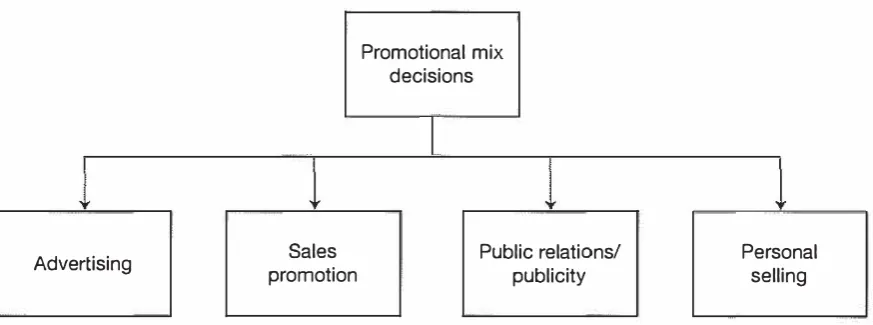
Promotion in its tum is usually shown as in Figure 1 .2, with separate functions that reflect the reality of distinct, independent organizations perfonning specialist functions without significant coordination of their activity. Thus it is possible for advertising to attempt to project an exclusive, quality-based image while at the same time price-based sales promotions could be used; the two communication activities projecting very different images to consumers and often occurring without linkages to other marketing activity, including packaging.3 This separation of function and activity ignores the fact that consumers integrate information, including marketing communications and infonnation from other sources including the media and via retail outlets where a manufacturer may have limited control over marketing communications. This will occur whether the market ing or adveltising organization makes a conscious effort to integrate messages from sources under their direct control or not, with the result that messages can be put together in unexpected ways - which may even be hannful to the brand4
Promotional mix decisions
I
Advertising Sales Public relations! Personal
promotion publicity selling
Marketing communications as a strategic tool 3
[image:18.596.62.507.198.385.2]To be fully effective, integration starts at !be initial strategic planning level and is far more than jnst ensuring a common look or feel to messages sent via different channels. Figures 1.1 and 1.2, however, are overly simplistic in that they do not reflect the com plexities of the processes involved. Even within the promotional mix decision process, Figure 1.2 implies that each of the four subsets are separate activities and does not capture instances where there may be considerable overlap between the functions, such as when advertising may be the vehicle by which sales promotion activity is communicated, or the use of the Internet for far more than just advertising messages.
THINK BOX
Marketing communications and product types
Using Figures 1 . 1 . and 1 .2, map out the marketing communications activity of:
1.
2. 3. 4.
a 'fast moving consumer good' (FMCG) product such as bread;
a soft drink such as Coca-Cola or Pepsi against bottled water and energy drinks; a durable product such as a refrigerator;
a service provider such as an airline or an organization offering packaged holidays. [n what ways are their marketing communications strategies likely to be similar and in what ways are they likely to be different - and why?
Environmental turbulence: the effect of new media forms
Most importantly, the functions shown in Figure 1.2 do not reflect the reality of communi cation vehicles today, particularly interactive media fonns. Among these are hybrid media forms such as advergames that reflect a blurring between entertainment and persuasion in which branded products or services are frequently an integral component of a (usually) Internet-based game.5 The aim is to offer entertainment, interaction and emotional connection between the game and the brand featured within it in a way that traditional mass media cannot do.6 Figure 1.2 also does not capture the way social media function (see Chapter 9 for a detailed discussion). In addition, the effects and effectiveness of the growing use of product placements in television programmes and in movies (see Chapter 10 for a discussion of hybrid media fonns) have yet to be detennined across product and service categories.
The promotional mix shown in Figure 1.2 needs to be re-conceptualized to show the changing nature of the marketing communications vehicles that may be considered. Direct and database communication methods need to be considered as a distinct fmm of communication, as do Internet-based and interactive media fonns. New communication fonns will continue to evolve and any diagrammatic presentation of the promotional mix options is likely to be subject to regular revision. However, with this must come a greater understanding of what the message receiver does with the various messages received; this area remains significantly under researched.7
4 Marketing communications as a strategic tool
MINI CASE: RADLEY
Source: Institute of Practitioners in Advertising: Best Small Budget & Silver, rPA Effectiveness Awards 2008. Case material provided by the World Advertising Research Centre (WARC) www.warc.com.
Radley is a relatively small brand of handbags with a small advertising budget in a fragmented and fickle fashion market. It has a small base of loyal purchasers but faced major challenges in increasing market share, particularly given the perceptions of their bags being functional and good quality but not stylish.
Share of voice was unlikely to be more than 3 per cent, so a truly original idea was needed to help the brand stand out from its much larger competitors such as Dolce & Gabbana and Gucci. The focus of the creative activity from 2007 onwards was chosen as:
"Truly Radley Deeply"
Distinctive advertisements such as those shown on page 5 ran in colour newspaper supplements, weekly women's magazines such as Grazia and fashion magazines such as Vogue.
As new designs were introduced, they were supported by distinctive advertisements, all linked by the common "Truly Radley Deeply" line. Two examples are shown on page 6.
A major initiative was the development of a feature window display in branches of the John Lewis department store chain, the first time such a campaign had been approved by the chain.
Sales increased three times faster than the overall handbag market and the value of the company itself tripled.
The total advertising budget was £800,000, with the advertising directly credited with increasing the value of the company by at least £3.75 million. The campaign paid for itself 5.7 times, one of the highest returns on marketing investment achieved.
Questions to consider
Try to evaluate this case using the material covered in this chapter, particularly Figures 1 .1 and 1.2. Also think about how Radley might change their marketing mix in the future, including how they might use electronic media.
Specifically focus on the following questions:
1. Discuss the arguments for and against continuing to run this style of advertising. 2. Assume you are one of Radley's major competitors:
a. how would you counter their marketing communications?
b. what are the arguments for and against undertaking a similar store promotion with another retailer (e.g. Harvey Nichols, Debenhams, House of Fraser)?
3. If you were the marketing manager of one of these department stores, what would you recommend be done regarding promoting Radley and/or its competitors in store?
Photo l.la
Photo 1.2a
Marketing communications as a strategic tool 7
Changes to marketing commnnications over time
As the academic literature shows, much of the emphasis up to the early 1 980s was on how individual communications fonus worked, with emphasis on mass media communi cation, particularly television advertising, which was seen as being somewhat passively received by consumers. A re-examination of the role and effectiveness of advertising as a marketing communications tool began in the late 1980s, and accelerated through the early 1990s. Long standing assumptions about 'what advertising does' were questioned and rephrased as what people did with the advertising to which they chose to pay attention.8 Mass media began to fragment, with increasing numbers of television channels, radio stations and print media competing for a share of advertising alongside less prominent media such as cinema and a range of outdoor advertising options.
This was followed by the emergence, and growth, of new media forms, particularly those using electronic technology such as the Internet.' These new media changed consumers' access to, and control over, marketing communications in major markets. At the same time, there was an increasing awareness that most markets were not homogeneous, but rather made up of distinct segments with diverse interests, attitudes and media usage habits.lO
Concerns were raised regarding the impact of clutter within mass media, i.e., many advertisements competing for a share of attention II and attempts to stand out from competitors and rise above the clutter which, to some observers, seemed to lead to less emphasis on product or service attributes, and more on providing entertainment, at the risk of being different rather than relevant to the consumer.12 Unsurprisingly, a greater emphasis on determining the return on investment from marketing activity also occurred, leading to a focus on the measurement of the impact of marketing communications activity which continues in the current era.13
These pressures lead to considerable interest in the way in which marketing com munications activity occurred and the way in which synergies could maximise their individual aud combined efforts under the banner of integrated marketing communica tions (IMC). This inevitably led to considerable debate as to whether IMC was merely a management fad,14 whether it offered anything new or merely reflected best practice and calls for a precise definition as to what IMC actually was. I'
One of the most widespread definitions is:
a concept of marketing communications planning that recognizes the added value of a comprehensive plan that evaluates the strategic roles of a variety of communications diSciplines, e.g. general adveliising, direct response, sales promotion and public relations - and combines these disciplines to provide darity, consistency and maximum communication impact.
(American Association of Advertising Agencies quoted in Duncan and Everett)I' (p. 31)
It is also suggested that a key addition to the above definition is synergy,
meaning the individual efforts are mutually reinforcing with the resulting effect being greater than if each functional area had selected its own targets, chosen its own message strategy, and set its own media schedule.15
(p. 32)
8 Marketing communications as a strategic tool
in the past but now functions through an increasingly diverse range of channel options, is important in positioning the brand in consumers' mindsI6
The question implied but rarely explicitly stated in the advertising/marketing com munications literature is as follows. Marketing communications can be considered to have a positive effect on brand equity/evaluation if the brand's value and changes in that value over time are measurable and ifmarketing communications can be shown to be a major contributor to that change.
While a significant role for integrated communication in influencing brand equity is claimed by several authors, usually on the logical grounds of ensuring consistency of messages to customers and synergy of efforts,17 actual evidence of a cause-effect relationship appears to be somewhat elusive. The influence ofIMC on brands and branding is discussed in more detail in Chapter 7.
THINK BOX
Sales promotion
Assume you are the marketing manager for an electronics company. Your marketing communications has historically been centred on high quality and technical innovation. Your sales are now sluggish and your advertising agency has recommended a major price discount-based sales promotion.
Discuss the positives and negatives of this move, the likely impact on sales and on the way consumers perceive your brand.
What action might your competitors take if you maintain your current marketing communications approach OR if you change to a price discount-based strategy? Use Rgures 1.1 and 1.2 to map out what information you would need to determine which option is likely to be the better choice. Justify your decisions.
While it would appear self-evident that no-one would argue against integrating communication,18 there is clear evidence not only that integration was rarely operational ized in the past,19 but there is evidence that some sectors of the communications industry, most notably public relations, actively opposed integration on several grounds, including that some public relations activity focussed on corporate rather than specific brand issues.2o The move by traditional advertising agencies to embrace IMC principles appears to have originated from the recognition that communication agencies were losing budget share as funds were increasingly moved from traditional marketing communication activities to a range of newer fonns and competition increased among potential providers of expertise for these new activities,'! Expenditure allocations across media have changed significantly over time as shown in Table 1 . 1 .
MINI CASE: ADVERTISING RIP?
Marketing communications as a strategic tool 9
Table 1.1 United Kingdom: advertising expenditure currency: £, million
Year Total News- Magazines Tele- Radio Cinema Outdoor internet
papers vision
1999 11302 4474 1922 3672 464 123 595 51
2000 12495 5014 2020 3950 534 128 697 153
2001 11896 4896 1980 3525 487 164 678 166
2002 11941 4808 1873 3690 492 180 702 197
2003 12374 4864 1832 3722 526 180 786 465
2004 13372 5107 1901 3955 545 192 848 825
2005 13866 4906 1892 4097 521 188 897 1366
2006 14045 4695 1828 3905 480 188 933 2016
2007 14947 4680 1758 4016 497 207 976 2813
2008 14420 4118 1584 3819 454 205 939 3300
Change: -3.5% -12.0% -9.9% -4.9% -8.5% -0.9% -3.8% 17.3% 08-07
Sot/rce: The Advertising Association, World Advertising Research Centre (WARC). Reproduced with pennission.
1 . Why might the 1 994 prediction have been overly pessimistic about traditional media? 2. Why have some traditional media continued to increase advertiSing revenue while
others have declined?
3. What do you believe the likely pattern of advertiSing spend might be in the next 5 years and the next 1 0 years?
4. Do you believe that advertising as we currently know it will eventually die? Justify your responses to each question.
Barriers to successful integration of marketing communications elements
It was evident from the early 1990s that a focus on integrating communication activity would change the roles and accountability relationships between marketers and their specialist communication suppliers, \0 with a number of barriers to effective and efficient integration evident. These included organizational structures, the need for functional specialists to broaden their appreciation of other communication roles and of emerging technologies, turf battles, and issues surrounding who should ultimately coordinate or control activity.23
Several studies have focussed on attempting to prove how a specific discipline, such as public relations, exhibit marketing or trade shows added value,'4.25.26 or on attempting to challenge perceptions regarding the strategic versus tactical use of activities such as sales promotions.27 A number of more macro-focussed shldies have shown managerial support for the principles of [Me.28 There is also evidence that there is a correlation between levels of integration and sales, market share and profitability, however the direction of the relationship and the factors underpinning it remain unclear."
1 0 Marketing communications as a strategic tool
the complexities of detennining the effects of any individual marketing communications device, such as advertising or public relations, and of then identifYing the synergistic impact of all communication fonns used.
These effects are likely to vary according to the specific market conditions, making generalized principles difficult. In addition, external and largely uncontrollable factors such as relevant news media coverage may also impact on communication effectiveness.3! Further, there may be time lags between exposure to marketing communications and purchase initiation .'2 Current techniques for evaluating ROI are discussed in more detail in Chapter 16.
Linking communication data to actual purchases, or other measurable behavioural outcomes such as reduced dangerous alcohol consumption or reductions in road traffic accidents as would be expected from social marketing activity (see p. 1 2 for a discussion of the latter) is also problematic. Historically, primarily transactional data (e.g. sales) has been collected, emphasizing a product rather than consumer focus; while there is a growing awareness of the importance of developing and maintaining long-tenn customer relationships, the ways in which that relationship might be measured requires fmiher investigation.33
This is particularly acute in relation to new media fonns and to the overall issue of the contribution of marketing communications to brand equity34 and to perfomlance-based remuneration, which has become a common component of client-communication agency supplier relationships .'5
An added problem is that of detennining exactly what contribution was made by each marketing communications element. For example, a purchase decision may be made in store, or the purchaser may take leaflets away to read before returning to the store, visiting other stores - or making the final purchase online. What was the individual or collective contribution of each piece of marketing communications? How to measure retum on investment from marketing communications investments remains one of the major challenges facing marketers.
THINK BOX
Measuring the impact of marketing communications
A person may see an advertisementfor a package holiday on television, hear part of the sound track on the radio, seek more information. on the Internet, but then go to a conventional retail outlet such as a travel agency (where they will see point-of-sale material such as posters, DVDs and brochures) to examine and compare different options. For products such as electroniC goods, a similar process may be followed, with the added option of being able to possibly trial the product in store and compare it to competing brands on offer.
How do you then measure the impact each of these communication elements had on final purchase decisions?
Marketing communications as a strategic tool 1 1
Retailer influence, product, services, business-to-business and social marketing
The IMC literature has tended to focus on products, particularly those in the fast moving consumer goods (FMCG) sector, yet there are a number of significant sectors that warrant more detailed examination as their characteristics are substantially different from FMCG goods and thus the decision processes (and thus the communication needs) of the target markets may also be different.
Retailer illfluence
The growth in retailer-owned house brands that compete alongside manufacturer brands also warrants consideration as these brands may hold up to 20 per cent of overall retail sales and are often in the top three brands of 70 per cent of supermarket product categories.36 There is no data on how market share or house brand strength varies across product categories. The strength of house brands varies across countries; 2002 data suggests that house brands accounted for almost 20 per cent of retail grocery revenue in the UK, 27 per cent in Belgium, 24 per cent in Gennany and between 16 and 2 1 per cent in the US retail grocery market,37 with steady growth reported.38 Within the UK's three largest supennarkets, it is suggested that retailer house brands may account for 50-60 per cent of sales.39 In telIDS of specific product categories, data from the mid-I 990s indicates that house brands accounted for 6 1 per cent of supennarket wine sales, 5 1 per cent of dry pasta, 47 per cent of jam and 41 per cent of potato chips 40 More recent data from the UK indicates that nearly 40 per cent of total retail sales in 2012 were represented by sales of house brands.4l
House brands tend to receive little promotional support and what is provided is generally price-based; the impact of this on manufacturer-brand promotional activity has not been researched 4' Indeed, the impact of the retailer environment and promotional activity on manufacturer-originated IMC programmes, irrespective of the presence or othelwise of house brands remains yet another area in need of research investment.
MINI CASE: HOUSE BRANDS
Imagine you are the Brand Manager of a large multi-national fast moving consumer goods company. You have been asked to write a report on the potential threat house brands present to your own brands across various countries.
1 . What may account for the difference in popularity of house brands across countries? What are the implications for manufacturers whose brands are sold in these coun tries?
2. What are the pros and cons of your own company producing house brands for a major retailer? This house brand would be priced lower than your brands and sold alongside them.
1 2 Marketing communications as a strategic tool
Services
The IMC literature has tended to over-emphasise tangible products rather than services, in spite of the fact that service provision now dominates most developed economies43 and the significant differences between service and products which may make it difficult to project and maintain a consistent image. Services are intangible, less readily standardized than products, perishable (airline seats cannot be stockpiled for future use) and often depend on the customer or end-user as part of the production process (the benefits of belonging to a fitness centre are not dependent just on the provision of facilities, but also on the effort of the client). There is a need for further research into IMC in this area.
Business-to-business
Also under-researched is the role of IMC in the business-to-business sector which tends to rely on more rational/ less emotional buying processes and longer-tenn relationships between buyer and seller, together with a greater complexity in product or service characteristics and group rather than individual decision making,'4 yet there are few studies comparing the marketing communications tools and processes that may be effective for this sector.
Socia/ marketing
A key area in which there needs to be a review of the role of marketing communications is social marketing, a concept that has existed since the early 1970s45 but which has received renewed focus internationally in the last few years.46.4' Social marketing is not a specific theory per se, but rather a process, that draws on the theories and concepts of commercial marketing (such as market segmentation and exchange theory) to develop interventions aimed at improving health and well-being of entire populations48 (such as encouraging physical activity) or specific segments within popUlations (such as anti smoking interventions). While health-related issues are a major focus, social marketing also encompasses activity such as environmental protection, disaster preparedness, sustainable transp0l1, recycling and energy conservation.
Thus, there is no specific 'sales' point as for tangible goods and services. Additionally, the factors such as attitudes and beliefs underlying behaviours are complex and may be resistant to change, particularly in relation to addictive behaviours such as smoking. There are few studies49 that have specifically examined the use ofIMC principles within social marketing and this remains yet another area in need of research investment. Interestingly, one study into advertising for environmental issues suggests that there is a lack of integration in this area.50
Marketing communications as a strategic tool 1 3
M I N I CASE: CHANGING BEHAVIOUR
There are numerous examples of people being aware of health risks from their behaviours (such as unprotected sex, excessive sunbed use and unwise alcohol consumption). Attempts to address these problems have often resulted in increased awareness levels - but not in behaviour change.
1 . Explain why this problem might occur.
2. Select a health-based marketing communications campaign and critique it.
S. Outline what research might be needed to understand the problem and to identify strategies that might be successful in changing behaviour.
ETHICAL ISSUE TO CONSIDER
Considerable efforfand expenditure is needed to treat health problems brought about by unwise lifestyle and behaviour choices made by individuals. For example, an unhealthy diet, lack of physical exercise, sll1oking or eXCeSS alcohol con sumption have all been shown to link to potentially serious health problems.
1 .
2.
S.
4.
5.
What role do marketers play in reinforcing consumption decisions that might not be in the best interest of people's long-term health?
What actions should marketers take to minimise any harm that may result from their activity?
What role is there for legislation versus personal choice?
How would you respond to the suggestion that people whose health is affected by poor consumption or lifestyle decisions should not expect others to pay for their treatment?
How would you respond to the suggestion that there should be increased taxes on products such as alcohol or foods deemed to be of low nutritional value in order to treat those whose health has been affected, even if it was their personal choice that led to their subsequent health problems?
A number of these issues are discussed in more detail in Chapter 3.
Summary
14 Marketing communications as a strategic tool
Review questions
1 . Define what is meant by 'integrated marketing communications' (IMC).
2. What are the advantages of employing an integrated approach to a marketing campaign? 3. Is integrated marketing communications as simple as ensuring that there is a conunon
'look' to all forms of communication? Justify your response.
4. What are the potential barriers faced by marketers when seeking to implement an integrated approach to their marketing communications campaigns?
5. Could it ever be argued that all aspects of marketing communications should not be integrated?
6. Assume you are the Marketing Director for a FMCG company with multiple divisions and products that carry several different brand names. How can you ensure that all marketing communications activity is coordinated?
7. Cornelissen and Locke, suggested in 200014 that integrated marketing communications is merely a management fad. Critically evaluate this view.
8. Critique the suggestion that the Internet is just another media tool.
9. Many social marketing texts suggest that planning social marketing communications campaigns should use the 4Ps in the same way as planning product marketing com munications campaigns. Critique this suggestion, using examples to illustrate your answer.
10. 'Brands are rarely created by marketing communications alone.' Discuss this statement with special reference to the role that IMC might play in the communication of brand values.
Recommended reading
Caaiin, G. (2008). Integrated online marketing communication: implementation and management. Journal oj CommrmicatioJl Management, 12(2), 1 69-84.
Danaher, P.l, and Rossiter, l.R. (201 1). Comparing perceptions of marketing communication channels. European Journal of Marketing, 45(1-2), 6--42.
Finne, A., and Gronroos, C. (2009). Rethinking marketing communication: from integrated marketing communication to relationship communication. Journal of Marketing Communications, 15(2-3),
179-95.
liang, P., and Chia, S.-L. (2010). Developing integrated marketing communication (IMC) in online communities: a conceptual perspective from search, experience and credence segmentation. International Journal of Internet Marketing and Advertising, 6(1), 22--40.
ReinoId, T., and Tropp, 1 (2012). Integrated marketing communications: how can we measure its effectiveness? Journal of Marketing Communications, 18(2), 1 13-32.
Smith, B.G. (2013). The internal forces on communication integration: co-created meaning, interaction, and postmodernislTI in strategic integrated comlTIunication. International Journal of Strategic Communication, 7(1), 65-79.
CASE STUDY 1 .1
Graduates Yorkshire recruitment
Campaign designed by Honey Creative
Marketing communications as a strategic tool 1 5
As the following case shows, successful marketing communications does not depend on large budgets. This case illustrates how an integrated marketing communications approach led to very successful outcomes for a regional recruitment organization.
Introduction
Graduates Yorkshire (GY) is the leading recruitment brand primarily aimed at graduate employers in the Yorkshire and Humber region. GY's parent company is Yorkshire Univer sities, a membership organization owned by all ten Higher Education Institutions (HEI) in the Yorkshire region. Working in partnership with the university careers services, GY operates an online recruitment service matching primarily but not exclusively graduates from Yorkshire universities with Yorkshire employers. Previously known as Graduate Link, it's a web-driven service managed out of Sheffield, Leeds and York.
The brief incorporated five strands:
• Create a brand that is capable of smoothly transitioning the service from a free one to
a service that levies a fee on what it does. In other words, the resulting brand had to reflect a professionalism and gravitas that would set it apart from the competition and that establishes the business as the authority on graduate recruitment in the region.
• Provide strategic and commercial consultancy to help facilitate the brand's migration
from a university 'internal service' to a stand-alone social enterprise model.
• Formulate a communications strategy that is flexible enough to enable GY to engage
with a wide range of stakeholders: for example, business leaders to graduates; universities to local enterprises.
• Validate or generate a new name (formerly known as 'Graduate Link').
• Apply new branding across all touch points including: website, marketing com
munications (including new digital platform), advertising, exhibitions and recruitment tools.
Overview of market
Each year in Yorkshire, around 40,000 new undergraduates leave the region's H Els rising to around 55,000 when postgraduate qualifications are included. Many of these graduates leave the area to return home or to work but, three years after graduation, research shows around half of all graduates from Yorkshire universities are settled in the region. The area also sees an influx of graduates from other regions each year as many return home after studying away.
I n Yorkshire, the majority of graduate employers are SMEs and Public Sector Organiza tions. Nationally, prior to the recession, the graduate recruitment market has seen a steady year-on-year growth; however, various agencies are reporting between a 5 per cent and a
1 2 per cent decline in the availability of graduate jobs since the beginning of 2009.
1 6 ... Marketblg communications as a strategic tool
Outline of design solutions
All of GY stakeholders had a strong affinity for the existing Graduate Link brand, so any change had to be done well and managed effectively. Therefore Honey used the re-branding process to enable GY to engage key stakeholders in the design process to build ownership and buy-in.
Working closely with the client, Honey helped develop the business and marketing strategy, starting with a robust process for change. With these in place, we were able to create a unique and flexible brand identity that reflects the business and which enables GY to communicate clearly with a broad range of very different audiences from graduates to employers and local development agencies and Government.
Clearly with a name like 'Graduates Yorkshire', the resulting brand identity had to have a regional 'edge' that was achieved by basing the logo on the shape of Yorkshire itself, with dots representing graduates and businesses being drawn together on their respective journeys. For the graduate, that journey begins as a student, moving through graduation through to prospective employee. The service has been designed to follow this journey and offer benefit at each touch paint. The role of design was to communicate the brand's offering across this life cycle.
However, at the outset it was clear that the business model could eventually be taken into new regions, both in the UK and overseas, so it was important that the identity was sufficiently flexible to allow for expansion into new areas without compromiSing on its integrity.
Honey developed the brand's multi-channel marketing campaign that could last for several years with a 'Put Yourself in the Picture' theme, this enables graduates to picture themselves in their dream job and employers to picture the ideal candidate for their graduate position.
The identity has now been rolled out across all marketing communications, including corporate literature, website, exhibition materials, direct mail and advertising.
In respect of the website, as this is central to all GY activities, it was particularly important to get this right both visually and technically. In this respect, Honey developed the site to engage with the different users from the start, the home page directs employers and graduates to different areas of the site with tailored information for each. All this whilst maintaining the consistent brand message.
This exercise culminated in a launch event that saw every member of careers staff gathered at an event in Leeds. This event was a watershed moment, and culminated in the 'reveal' of the new brand on a large exhibition stand. Delegates were given bags full of GY branded gifts that continue to be prominent in offices around the region today. Honey also ran a workshop at this event explaining design rationale, and further helping to root the new brand in the consciousness of this key group of stakeholders.
Increase in sales
The period immediately following the re-brand, April to September 2008, saw impressive trading results, in terms of client wins, incoming revenue and growth in the customer base:
Photo l.3a
Photo l.3b
Marketing communications as a strategic tool 1 7
Gra d uates
Yorkshire
o Forecasted sales for year three (2009/1 0) is up 44 per cent.
o A revenue was achieved against the soft launch in October 2007 when the new brand
identity was applied to the existing web technology and original copy.
o In April 2008, an 88 per cent uplift in sales was achieved in the six months following
the full re-branding of the website, working with a new technology and enhanced web 'look and feel' design by Honey.
o A revenue has been delivered through the creation and delivery of internship pro
1 8 Marketing communications as a strategic tool
- the reason GY was awarded the contract was because they, clients such as local governments, were so impressed with the quality of the overall branding and the design of marketing and web materials.
• A further income has been generated this year through the provision of consultancy
services in the year 2008/09. The reason behind the decision to diversify in this way was the prediction that the recruitment market would be adversely affected by the downturn - so additional revenue streams would need to be found - and the realization that GY's intelligence on the youth market could be translated into a valuable resource for local employers. Building on the now trusted GY brand, Honey created a set of sales tools that clearly articulated GY's insights into the youth market. Their first target was the Government Office for Yorkshire & The Humber (GOYH) who immediately com missioned GY to undertake a research programme to establish what perceptions graduates and the younger employment market had in respect of working for local governmental offices. Local students were recruited to undertake the research, the results of which were tremendously illuminating in respect of GOYH's need to under take a recruitment campaign to replace its ageing workforce with fresh young recruits with a contemporary outlook and specialist training.
• Following the research GOYH commissioned GY to write a strategy paper on the
recruitment campaign itself, and Honey is now working with them on the development of a business plan that will lead to the creation of a new brand, e-channel and marketing communications.
• What is particularly rewarding about this initiative is that the very first client that GY
targeted with the consultancy offering, has already returned a significant ROI.
• Meanwhile, plans to franchise the business to other regions in the UK are already being
received positively with a contract about to be signed. This particular opportunity was recognized in the early planning stages of the business which means that the branding and web technology that GY and Honey developed together has been designed to enable expansion into new regions without compromising the brand 'look and feel' and integrity.
• As a result of the exceptional success of the relationship between Honey and GY, they
are now seen to be the experts in their field which has lead to a number of interesting brand extensions:
o further franchising o pportunities both in the UK and overseas;
o delivery of under/post-graduate programmes such as 'Careers Guidance', 'Grad uate Enterprise' (providing advice on setting up a business) and, most recently, an internship proposition that will support graduates and businesses. This latest initiative is expected to drive a revenue over the next three years.
This was all achieved thanks to the smart and powerful design and multi channel branding created by Honey.
Martin Edmondson, CEO, Graduates Yorkshire
Marketing communications as a strategic tool 1 9
O n a lighter note, £480 has been made from sales of GY branded 'Made in Yorkshire' t-shirts that have become a bit of a legend in the region! (40 x £12 t-shirts sold and a new
order of 100 t-shirts has been placed,)
This period saw a number of unprecedented achievements for GY. Historically the client base had been SMEs and some public sector, with minimal blue chip business. In this period GY won large contracts with HBOS, Asda and signed a deal with NHS Yorkshire and Humber to advertise all their graduate level roles (up to 2,000 jobs). This was down to the improved
brand kudos and credibility. These relationships have continued to develop and GY is now seeing repeat business from them.
Improvements in staff morale and changes in staff behaviour productivity
As the business goes from strength to strength, employees are becoming increasingly aware of the power of their brand and are looking for every opportunity to bring it to the forefront of everyone's mind:
The new brand gives me the confidence to approach HR Directors from some of the region's biggest companies such as PWC, the UK's largest graduate employer, and succeed. We are no longer just another place to advertise roles but the place graduate employers in Yorkshire need to be seen.
John Cusworth, Business Development Manager
I have always been really proud of the work we do. Now I'm really proud of the brand we've created too, and love to show it off whenever possible!
Natalie Emmanual, Client Services and Operations Manager Graduates Yorkshire is a brand with a real personality. I spend a lot of my time on the road taking our 6ft long stand (or the 'beast', as it's affectionately known) to universities and events across Yorkshire. I get to see first-hand how people react to us, how we've gone from being a well kept secret to a company identifiable by our green trade mark, and how our new branding seems to warm people to us and encourage them to approach us more easily.
Imogen Hesp, Marketing Officer
Changes in perception
When GY moved from a free service to a business that levied a fee on what it did, it managed to retain most of its original clients. This was because although GY was now being perceived as a commercial entity, it was still regarded as part of the 'university family'. It is fair to say that Honey's design played a large part in this by delivering a brand identity that was immediately engaging and approachable.
Graduates Yorkshire is a fantastic, reliable and efficient way for local employers to meet their recruitment needs in the most effective manner. I would have no hesitation recommending this site to other employers, keep up the good work.
20 Marketing communications as a strategic tool
Post re-brand, GY's standing with Yorkshire Forward - the local RDA - is sud that GY tendered and won an innovative, high profile Internship Programme in 2009.
Finally, the re-brand has given GY and its stakeholders the confidence to launch , focussed NPD programme, with a view to launching GY Consulting and a Graduat, Placement scheme in 2009/1 0 all designed by Honey.
Research resources
The project team used:
• published data
• quantitative and qualitative research
• focus groups.
Other influencing factors
The service existed in exactly the same format as it is now before the re-branding programme - the only real change being that the services provided are no longer free.
Immediately following the re-branding, the spend on advertising was reduced by 35 per cent so the successes have been almost entirely as a result of the re-branding and the optimization of the web technology developed in conjunction with Honey.
CASE STUDY QUESTIONS
Drawing on the material in the chapter, discuss the following questions:
1. Critique this case. What were the challenges faced by the campaign and how well do you believe that campaign addressed them?
2. Use Figures 1 . 1 . and 1.2 to review the activity. Are there elements of the marketing communications mix you believe should have been used differently? What changes to the combination of communications forms do you recommend be considered for the future? Justify your answers.
3. Specifically focus on the brand identity created - how would you recommend that this be maintained or reinforced in the future? Justify your response.
4. What factors may impact on the future success of the GY organization? What contingency plans should be put in place and why?
5. How would you expect their competitors to respond? How should GY prepare to respond to competitor activity?
6. Could the same prinCiples be used in other regions within the UK, either by GY or other organizations? Justify your response and develop guidelines for organizations in other regions that might consider this approach.
Notes
Borden, N. (1962). 'The Concept of the Marketing Mix'. In George Schwartz (ed.) Science in Marketing, New York: Wiley and Sons, 386-97.
Marketing communications as a strategic tool 2 1
3 Englis, B.G., and Solomon, M.R. (1996). Using consumption constellations to develop integrated communications strategies. Journal 0/ Business Research, 37(3), 183-91.
4 Schultz, D.E. (1996). The inevitability of integrated communications. Journal of Business Research, 37(3), 139-46.
5 Grigorovici, D.M., and Constantin, C.D. (2004). Experiencing interactive advertising beyond rich media. Impacts of ad type and presence on brand effectiveness in 3D gaming immersive virtual environments. Journal of Interactive Advertising, 4(3), 1-26.
6 Arnold, C. (2004). Just press play. Marketing News, 38(9), 1-15.
7 McAllister, M.P., and TUfOW, 1. (2002). New media and the commercial sphere: two intersecting trends, five categories of concern. Journal 0/ Broadcasting & Electronic Media, 46(4), 505. 8 Lannon, 1. (1996). Integrated communications: advertising and the wider communication mix.
Admap, 31(3), 83-6.
9 Gronstedt, A, and Thorsen, E. (1996). Five approaches to organise an integrated marketing communications agency. Journal 0/ Advertising Research, March/April, 48�58.
10 Beard, F. (1996). Integrated marketing communications: new role expectations and performance issues in the client-ad agency relationship? Journal 0/ Business Research, 37(3), 207-15. 11 Dilenschneider, R.L. (1991). Marketing communications in the post-advertising era. Public
Relations Review, 17(3), 227-36.
12 Domfield, S. (1997). What's wrong with this ad? The disease of 'creatosis'. The Florida Business Journal. Online. Available HTTP: <http://www.bizjoumals.com/southfloridaJstories/1997/07/ 21focus3.html?page�all>.
13 Briggs, R. (2006). Marketers who measure the wrong thing get faulty answers. Journal oj Advertising Research, 46(4), 462-8.
14 Cornelissen, 1.P., and Lock, AR. (2000). Theoretical concept or management fashion? Examining the significance of IMC. Journal of Advertising Research, 40(5), 7-15.
15 Duncan, T.R., and Everett, S.E. (1993). Client perceptions of integrated marketing com munications. Journal of Advertising Research, MaylJune, 30-9.
16 Aaker, D.A. (1997). Should you take your brand to where the action is? Harvard Business Review, 75(5), 135-43.
17 Madhavaram, S., Badrinarayanan, V., and McDonald, R.E. (2005). Integrated marketing com munication (IMC) and brand identity as critical components of brand equity strategy. Journal of Advertising, 34(4), 69-80.
18 Hutton, J.G. (1996). Integrated marketing communications and the evolution of marketing thought. Journal of Business Research, 37(3), 155-62.
19 De Pelsmacker, P., Geuens, M., and Van den Bergh, 1. (2001). Marketing Communications, Harlow: Pearson Education.
20 Grunig, lE., and Grunig, L.A (1998). The relationship between public relations and marketing in excellent organizations: evidence from the IABC study. Journal o/Marketing Communications, 4, 141-62.
21 Miller, D.A, and Rose, P.B. (1994). Integrated communications: a look at reality instead oftheory. Public Relations Quarterly, 39(1), 13-16.
22 Rust, R.T., and Oliver, R.W. (1994). The death of advertising. Journal of AdvertiSing, 23(4), 71-7.
23 Hartley, B., and Pickton, D. (1999). Integrated marketing communications requires a new way of thinking. Journal of Marketing Communications, 5(2), 97-106.
24 Harris, T.L. (1993). How MPR adds value to integrated marketing communications. Public R elatiolls Quarterly, 38(2), 13-18.
25 Pitta, D.A., Weisgal, M., and Lynagh, P. (2006). Integrating exhibit marketing into integrated marketing communications. loumal a/Consumer Marketing, 23(3), 156-66.
26 Smith, T.M., Gopalakrishna, S., and Smith, P.M. (2004). The complementary effect of trade shows on personal selling. International Journal of Research ill Marketing, 21(1), 61.