Int. J. Electrochem. Sci., 14 (2019) 2216 – 2223, doi: 10.20964/2019.03.02
International Journal of
ELECTROCHEMICAL
SCIENCE
www.electrochemsci.org
Short Communication
Effect of Flow Rate on Corrosion Behavior and Hydrogen
Evolution Potential of X65 Steel in 3.5% NaCl Solution
Weiwei Kang, Zhiming Gao*, Yingjie Liu, Liqin Wang
School of Material Science and Technology, Tianjin University, Tianjin, 30072, China *E-mail: [email protected]
Received: 19 March 2017 / Accepted: 29 December 2018 / Published: 7 February 2019
Effect of flow rate on the cathodic reaction as well as hydrogen evolution potential of X65 steel in 3.5% NaCl solution were investigated using Electrochemical impedance spectroscopy (EIS) and potentiodynamic polarization. It is observed that, compared with static conditions, the charge transfer resistance values Rt decreases significantly under the condition of flowing, and the cathodic diffusion limiting current density increases with the increasing of the flow rate. In addition, the polarization curve under static conditions appears a typical hydrogen evolution potential turning point while the polarization curve under flowing condition does not. The determination of hydrogen evolution potential by means of measuring EIS under different cathodic potentials shows that the hydrogen evolution potential of X65 shifts positively to different degrees with the increasing of flow rate.
Keywords: flow rate; cathodic protection; hydrogen evolution potential; X65 steel. 1. INTRODUCTION
to the surface of a metal under cathodic polarization in seawater is important [15]. For the materials covered with coatings, with the increase of flow rate, the problem of coating degradation become more and more serious and the corrosion rate is growing [16]. However, previous works mainly focused on flow rate effects on the cathodic electrochemical behavior, limited investigations have been conducted focusing on the flow rate effects on the hydrogen evolution potential. Therefore, studies of effect of flow rate on the hydrogen evolution potential are relatively lack and urgently needed to explore. In this work, X65 steel is used for research. We mainly discuss the effect of flow on the cathodic reaction and whether it will affect the hydrogen evolution potential.
2. EXPERIMENTAL
2.1 Materials and Preparation
[image:2.596.45.548.475.507.2]The material used for research is X65 steel, and its chemical composition is shown in Table 1. A specimen of 10×10 mm in side length and 2 mm in thickness was used. The specimens were connected to a copper wire at one side to provide electrical contact and then embedded in epoxy resin, with the working area of 1 cm2. The surface of the specimens were abraded with carbide paper (from 100# to 1500#) then washed by distilled water, degreased by ethanol and dried by cool air. The experiment medium was 3.5% NaCl solution. Experiments were carried out at 2 m/s, 4 m/s and 6 m/s, respectively. All the experiments were performed with a self-made recycling jet device at the room temperature.
Table 1 Chemical composition (wt. %) of X65 steel
C Mn Si Cr P S Ni Cu Mo
0.05 1.51 0.23 ≤0.25 ≤0.02 ≤0.04 ≤0.30 ≤0.30 ≤0.30
2.2 Polarization Curve Measurement
The potentiodynamic polarization curves were measured by the PARSTAT 2273 electrochemical system. A three-electrode configuration was used for the experiment. The specimen was the working electrode, platinum sheet was the counter electrode and a saturated calomel electrode (SCE) with a salt bridge was the reference electrode. The cathodic polarization curves of X65 steel in different flow rate were performed from open circuit potential (OCP) to-0.60 V (VS.OCP) at a scan rate of 0.166 mV/s.
2.3 Electrochemical Impedance Spectroscopy Measurement
frequency range were 100 KHZ-10 MHZ. The test started from the open circuit potential and then negative shift of 50 mV of cathodic protection potential one after another. Each constant potential should be pre-polarized for 10 minutes before the EIS test. What is more, each test was repeated three times to ensure the accuracy of data. At last, with selected proper equivalent circuit, the test data was fitted and analyzed by the Zsimpwin software to get the electrochemical parameters, such as charge transfer resistance Rt and so on.
3. RESULTS AND DISCUSSION
3.1 Polarization curve Measurements
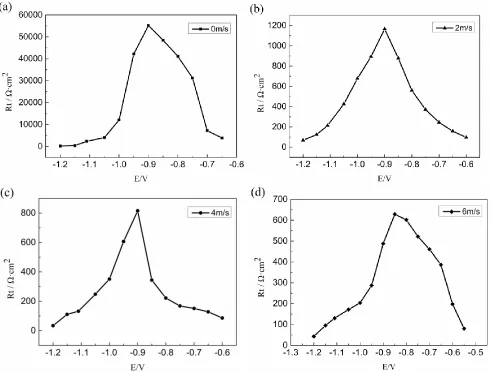
The cathodic polarization curves of X65 steel at different flow rates are shown in Fig.1. Compared with the static conditions, there is a significant increase of limiting diffusion current density under the flowing conditions, from 4.217×10⁻⁵ A·cm-2 increases to 1.26×10⁻³A·cm-2. It also has a small increase with the increasing of flow rate under flowing conditions. The values of limiting diffusion current density are shown in table 2. In addition, Fig.3 shows that the maximum of Rt has a great decrease under flowing conditions compare to that under static conditions, from 55200 Ω·cm2 reduces to 628.70 Ω·cm2 which can be seen in R
[image:3.596.91.489.440.699.2]t-E curves. Above phenomena indicate that with the increasing of the flow rate, the corrosion rate of X65 steel accelerates. This phenomenon is consistent with previous studies of other steels, which also shows that the increase of the flow rate weakens the effect of cathodic protection and increases the density of protective current [17, 18].
[image:4.596.52.552.308.677.2]
As we can see from the Fig.1, the cathodic polarization curve of X65 steel has the typical characteristics under static condition. The hydrogen evolution potential turning point is obvious, which is about -1.00 VSCE. However, the hydrogen evolution potential is not particularly obvious at three kinds of flow rate. It is difficult to determine the hydrogen evolution potential based on the polarization curve. Therefore, we need to obtain the hydrogen evolution potential at different flow rates by EIS [19].
Table 2. Limiting diffusion current density at different flow rates
Flow rate (m/s) 0 2 4 6
Current density(A·cm-2) 4.217×10⁻⁵ 1.26×10⁻³ 1.32×10⁻³ 2.05×10⁻³
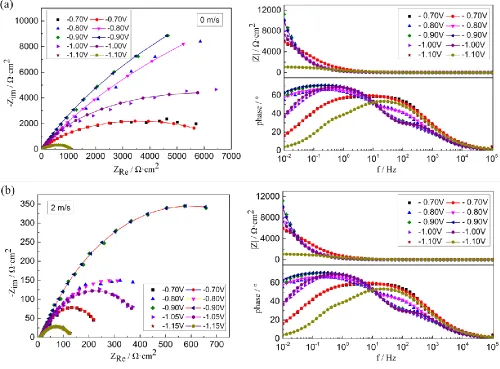
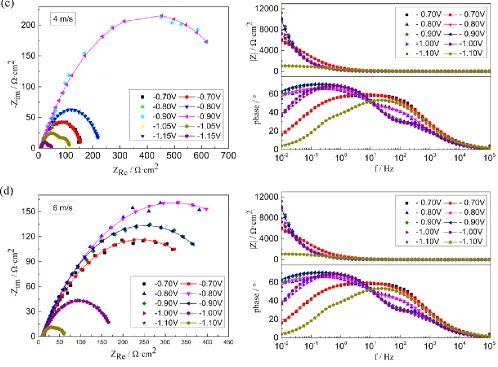
Figure 2. Electrochemical Impedance Spectroscopy measured at the flow rate of 0m/s (a), 2m/s (b), 4m/s (c) and 6m/s (d).
[image:5.596.51.549.77.444.2]
Figure 3. The trend of Rt as a function of E at the flow rates of 0m/s (a), 2m/s (b), 4m/s (c) and 6m/s (d).
According to the relevant theory [20, 21], the surface of X65 steel occur two kinds (anodic and cathodic reaction) of reactions simultaneously. Therefore, the EIS measured in cathodic polarization potential is the comprehensive response to the anodic and cathodic reaction. Thus the expression of charge transfer resistance of the impedance at the mixed potentials can be written as follows:
c
t 1/ 1/
/
1 R = Rta+ Rt
Where Rta is the transfer resistance of anodic reaction and Rtc is the transfer resistance of
cathodic reactions. When applying cathodic polarization potential to the X65 steel, the anodic reaction will be suppressed, so Rta increases with the potential negatively shifting. While Rtc reduces as a result of the cathode reaction performs more easily. When Rta is much larger than Rtc, cathode reaction is the main reaction which occurred on the electrode surface.
When the cathodic polarization potential moved to a certain negative potential, except for the oxygen reduction reaction, the hydrogen evolution reaction also occurs. The expression of charge transfer resistance Rtc can be written as follows:
H
o Rt
Rt
R 1/ 1/
/
[image:6.596.52.543.70.442.2]
Where Rto is the transfer resistance of oxygen reduction reaction and RtH is the transfer resistance of hydrogen evolution reaction. When the cathodic polarization potential just reaches the critical potential of hydrogen evolution reaction, it has a weak impact on the whole system, so RtHcan
be considered to be infinite, so Rtc is approximately equal to Rto. But with the electrode potential becoming negative, Rtcwill decrease. When hydrogen reaction is obvious, RtH will become smaller and smaller as well as has an effect on Rtc together with Rto. The decline of RtH would account for the decline of Rtc, when the potential loss to a certain value, there will have a turning point in the Rt~E curve. The cathode potential of the turning point is considered to be the hydrogen evolution potential. The hydrogen evolution potentials obtained by the Rt~E curves are shown in Table.3.
Table 3. Hydrogen evolution potential obtained by electrochemical impedance spectroscopy measurement
Flow rate (m/s) 0 2 4 6
Hydrogen evolution potential (V) -1.05~-1.00 -1.05~-1.00 -1.00~-0.95 -0.95~-0.90
Under the static conditions, according to the cathodic polarization curves in Fig.1, the hydrogen evolution potential of X65 steel in 3.5% NaCl solution is about -1.00 VSCE. It is similar with that obtained by EIS, which is shown in Table.3. However, the hydrogen evolution potential at a flow rate of 2 m/s, 4 m/s and 6 m/s is -1.05~-1.00 VSCE, -1.00~-0.95 V and -0.95~-0.90 VSCE respectively. It shows that with the increase of flow rate, the hydrogen evolution potential of X65 steel shifts positively to different degrees. This phenomenon can be explained by the following reason. It is known that the hydrogen evolution reaction has three steps [22-24], where hydrogen ion becomes hydrogen atomand comes together as a hydrogen molecule is the determining step of the hydrogen evolution reaction dynamic behaviors. Because the existence of flow rate will promote the diffusion of hydrogen molecule from the metal surface to solution, the concentration of the hydrogen molecule on the electrode will be reduced, and accordingly the hydrogen partial pressure decreases. Therefore, the potential that hydrogen atom comes together to a hydrogen molecule requires will reduce, which means polarization potential shift less positively to maintain it. The greater the flow rate, the more obvious the trend. From this phenomenon, we can infer that if the same protection potential as static condition is also applied at high flow rate, the risk of hydrogen embrittlement will rise. Therefore, it is necessary to reduce the protection potential to avoid hydrogen embrittlement occurring at high flow rate.
4. CONCLUSIONS
(2) The flow rate also effects the hydrogen evolution potential. With the increasing of the flow rate, the hydrogen evolution potential of X65 steel shifts positively to different degrees.
(3) If the same protection potential as static condition is also applied at high flow rate, the risk of hydrogen embrittlement will rise. Therefore, It is necessary to reduce the protection potential to avoid hydrogen embrittlement occurring at high flow rate.
ACKNOWLEDGEMENTS
This research is supported by National Natural Science Foundation of China (No.51371124,
No.51671144,), the Supporting Plan Project of Tianjin City (16YFZCGX00100) and Natural Science Foundation of Tianjin (No. 17JCTPJC47100).
References
1. L. Bertolini, F. Bolzoni, P. Pedeferri, L. Lazzari and T. Pastore, J. Appl. Electrochem., 28 (1998) 1321.
2. S. Eliassen, Corros.Eng.Sci.Techn., 39(2004) 31.
3. C.F. Dong, A.Q. Fu, X.G. Li and Y.F. Cheng, Electrochim. Acta, 54 (2008) 628. 4. Z.Y. Liu, X.G. Li, C.W. Du, L. Lu and Y.R. Zhang, Corros. Sci., 51 (2009) 2242. 5. M. Javidi and S. BahalaouHoreh, Corros.Sci., 80 (2014) 213.
6. Seong-Jong Kim, Seok-Ki Jang and Jeong-Il Kim, Met. Mater. Int., 11 (2005) 69.
7. Z.M. Gao, X.B. Lu, D.H. Xia, L.X. Yang, R.K. Zhu and Y. Behnamian, Electrochemistry, 84 (2016) 585.
8. D.G. Enos, A.J. Williams and J.R. Scully, Corrosion, 53 (1997) 891. 9. S.J. Kim, S.K. Jang and J.I. Kim, Met. Mater. Int.,11 (2005) 63.
10. T.M. Zhang and W.M. Zhao, J. Chin. Soci. Corros. Prot., 34 (2014) 315. 11. S. Martinez, Mater. Chem. Phys., 77 (2003) 97.
12. J. Konys, W. Krauss, H. Steiner, J. Novotny and A. Skrypnik, J. Nucl. Mater., 417 (2011) 1191. 13. D.K. Kim and S. Muralidharan, Electrochim. Acta, 51 (2006) 5259.
14. T. Hong, Y.H. Sun and W.P. Jepson, Corros. Sci., 44 (2002) 101. 15. S.W. Smith, K.M. McCabe and D.W. Black, Corrosion, 45 (1989) 790. 16. M. Ferry and W.B. Nik, Mech. Mater. Eng., 55 (2014) 218.
17. F.Q. Fan, J.W. Song, C.J. Li and M. Du, J. Chin. Soci. Corros. Prot., 34 (2014) 550. 18. X. Tang, J. Wang and Y. Li, Marine Sci., 29 (2005) 26.
19. Z.M. Gao, X.Y. Liu, L.J. Wen and W.W. Kang, Int. J. Electrochem. Sci., 11 (2016) 3007. 20. J.J. M. Jebaraj, D.J. Morrison and I.I. Suni, Corros. Sci., 80 (2014) 517.
21. C.N. Cao, Corrosion Electrochemistry Principles, Chemical Industry Press, (2008) Beijing, China. 22. W.Y. Chu, Hydrogen embrittlement and stress corrosion cracking, science press, (2013) Beijing,
China.
23. D.H. Xia, S.B. Wu, Y. Zhu, Z.Q. Wang, Y.H. Sun, R.K. Zhu and J.L. Luo, Electrochemistry, 84 (2016) 238.
24. D.H. Xia, Y. Song, S. Song, S. Wu and C. Ma, J. Tianjin Univ. (sci. tech.), (2018) accepted for publication. DOI:10.11784/tdxbz201711023.

![Figure 1. Polarization curves measured at different flow rates [0 m/s (black), 2 m/s( red), 4 m/s(blue), 6 m/s(pink)]](https://thumb-us.123doks.com/thumbv2/123dok_us/1757738.129362/3.596.91.489.440.699/figure-polarization-curves-measured-different-rates-black-blue.webp)