Int. J. Electrochem. Sci., 11 (2016) 6138 – 6148, doi: 10.20964/2016.07.54
International Journal of
ELECTROCHEMICAL
SCIENCE
www.electrochemsci.org
MnO
2Density - Dependent Supercapacitive Characteristics of
SiO
2/MnO
2Core-shell Nanostructure
Zhi Qiang Zhang1,*, Cheng Chen1, Cong Cong Ma1, Min Li2, Hao Chen1, Zheng Guo Shang2 1
College of Materials Science and Engineering, Chongqing University, Chongqing 400044, PR China 2
College of Optoelectronic Engineering, Chongqing University, Chongqing 400044, PR China *
E-mail: [email protected]
Received: 7 March 2016 / Accepted: 6 June 2016 / Published: 4 June 2016
A simple approach has been developed to fine-tune SiO2 spheres into low-density SiO2 spheres with the total volume increased by etching in a NaBH4 solution, followed by the preparation of the SiO2/MnO2 and low-density SiO2/MnO2 core-shell nanocomposites. The core-shell nanocomposites with uniform diameters from 200 to 350nm can be observed on scanning electron microscopy (SEM) and transmission electron microscopy (TEM). With the reaction time increasing, the thickness of manganese oxide shells around the silica core thickens, while the electrochemical properties are observed to present a parabola style. Interestingly, the low-density SiO2/MnO2 core-shell nanocomposites deliver the maximum specific capacitance of 298.3 F g-1 far more than the SiO2/MnO2 core-shell nanocomposites (179.8 F g-1), and possess desirable electrochemical stability (5000 cycles retained 86.3%). All of these findings indicate that the low-density SiO2/MnO2 core-shell nanostructures appear to be a promising electrode material for supercapacitors application.
Keywords: nanocomposites; silica; manganese dioxide; core-shell structure; supercapacitor
1. INTRODUCTION
preferred, owing to their low internal resistance that contributes to high power output [10-14]. Particularly, as a pseudocapacitive electrode material, MnO2 manifests outstanding merits on account of its apparent advantages, such as abundance, high theoretical capacity (~1370 F g-1), environmental friendliness and wide potential range in mild electrolyte [15-17].
Recently, there has been extensive interest in the architecture and fabrication of core-shell materials, because of their unique chemical and physical properties and potential applications [18-20]. The coating of shells on cores would alter the charge, functionality and reactivity of the cores and enhance their stability and compatibility, which might provide an available vehicle to obtain hybrid multifunctional materials [21-23]. Silica (SiO2), easy to form uniform spheres with tunable sizes coated with other materials, is a classic combination which is widely used in many fields [24, 25]. As a matter of fact, silica possess many favorable properties when used in core-shell structures. Firstly, the size of the electro-active materials can be controlled by the sizes of the silica cores. Secondly, the non-agglomerated particles, narrow size distribution and spherical shape offer many sites for the reduction reactions of the electro-active material [26].
Herein, silica via a modified stöber method [25-27] and low-density silica spheres through effective self-templated approach which involves the dissolution of silica cores in a NaBH4 solution and redeposition of the silicate species back onto the colloid surfaces have been synthesized [27]. Using SiO2 and low-density SiO2 spheres as templates respectively, we successfully report the synthesis of SiO2/MnO2 and low-density SiO2/MnO2 core-shell nanocomposites through a facile hydrothermal method. At the same time, the morphology, structure and electrochemical properties of SiO2/MnO2 and low-density SiO2/MnO2 core-shell nanocomposites are investigated, respectively. Remarkably, the electrode of low-density SiO2/MnO2 core-shell nanocomposites demonstrates high supercapacitive performance.
2. EXPERIMENTAL SECTION
2.1 Materials
All the chemical reagents used in the experiments were purchased from Alfa Aesar, which were of analytical purity and used without any further purification.
2.2 Synthesis of SiO2/MnO2 core-shell nanocomposites
few minutes. To yield a Si(OH)2 gel, the silica colloid was centrifuged and washed with ethanol for several times and then dried at 65 oC overnight to obtain SiO2 spheres.
Successively, the silica spheres (0.2 g) were dispersed into the KMnO4 solution (60 mL, 0.05 M) to form a homogeneous precursor. And then, the mixture was poured into a Teflon-lined 100-mL capacity stainless steel autoclave, maintaining at 160 ºC for different reaction time (6 h, 12 h and 24 h, respectively). Finally, the samples were removed, washed with distilled water and ethanol, and dried at 60 ºC to obtain the SiO2/MnO2 core-shell nanocomposites.
2.3 Synthesis of low-density SiO2/MnO2 core-shell nanocomposites
The silica spheres (0.3 g) and PVP (Polyvinyl Pyrrolidone, 0.25 g) were dispersed into 10 mL deionized water by ultrasonic in a 50-mL beaker. Then NaBH4 powder (0.6 g) was added into the solution. After fully dispersed, the beaker was sealed with sealing membrane and heated in a water bath to maintain at 51 ºC for 6 h to obtain the low-density silica spheres. The resulting products were collected and washed with water and ethanol, finally dried at 65 ºC overnight [27]. The synthesis of low-density SiO2/MnO2 core-shell nanocomposites is the same as above.
2.4 Characterization
The crystallographic information of the as-prepared products was established by powder X-ray diffraction (XRD, D/max 2500, Cu Kα) at a scan rate of 0.05º s-1 from 5º to 80º. The morphology and structure of the products were carried out with focused ion beam scanning electron microscopy (FIB/SEM, Zeiss Auriga) and transmission electron microscopy (TEM, Zeiss Libra 200).
2.5 Electrochemical measurements
spectroscopy (EIS) was conducted in the frequency range between 100 kHz and 0.01 Hz with a perturbation amplitude of 5 mV versus the open-circuit potential.
3. RESULTS AND DISCUSSION
3.1 Structure and morphology
[image:4.596.204.395.199.350.2]Figure 1. XRD patterns of SiO2 spheres, SiO2/MnO2 and low-density SiO2/MnO2 core-shell nanocomposites.
[image:4.596.79.519.416.728.2]
The composition and crystallite phase purity of silica spheres, SiO2/MnO2 and low-density SiO2/MnO2 core-shell nanocomposites are illustrated in Fig. 1. The as-prepared SiO2 spheres show a non-crystalline character and there is only one obvious characteristic peak at 21.98o which could be assigned to the (101) planes of the cristobalite SiO2 (JCPDS file number 39-1425). It can be observed in the XRD pattern of the SiO2/MnO2 and low-density SiO2/MnO2 core-shell nanocomposites that the diffraction peaks at about 12.5º, 25.2º, 36.6º and 65.6º, assigning to the (001), (002), (-111) and (020) planes respectively, agree well with the standard XRD pattern of birnessite-type manganese oxide crystal (JCPDS 80-1098) [28]. No peaks of impurities can be observed, suggesting the high phase purity of the as-prepared products.
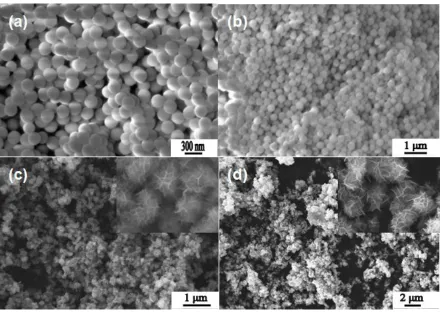
From Fig. 2a we can see that all the SiO2 spheres enjoy a uniform morphology with diameter of ~250 nm and possess a favorable dispersion in the space. By hydrothermally treating KMnO4 suspension with SiO2 spheres dispersed at 160 oC for 6 h, 12 h and 24 h, brown intermediate sediment with SiO2/MnO2 core-shell nanocomposites were obtained (Fig. 2b-d). Just as depicted in Fig. 2b, there are few MnO2 nanosheets loaded on the SiO2 surface after 6 h reaction. However, as the response time extends, SiO2 spheres are coated with more and more MnO2 nanosheets, revealing that the SiO2 spheres could serve as templates to form SiO2/MnO2 core-shell nanocomposites very well. The insets of Fig. 2c and d present the detailed morphologies of the as-prepared SiO2/MnO2 core-shell nanospheres with intersected nanosheets comprised loosely and distributed homogenously of 12 h reaction and with nanosheets dense packing and bonded together of 24 h reaction time, respectively. Such type of surface morphologies (Fig. 2c) with high specific surface area and pore could greatly enhance the intercalation of the electrolyte ions and ensure sufficient Faradaic reactions [29,30].
After mixing with NaBH4 at the appropriate concentration at 51oC for 6 h, all SiO2 spheres (250 nm) are converted into well-defined low-density SiO2 spheres with a diameter of ~200 nm, as shown in Fig. 3a. Although the low-density SiO2 spheres can be produced without the involvement of any surfactants, PVP is usually added to the reaction system to help prevent interparticle aggregation. Fig. 3b-d exhibit the MnO2 nanosheets coating on low-density SiO2 spheres which are reacted at 160 o
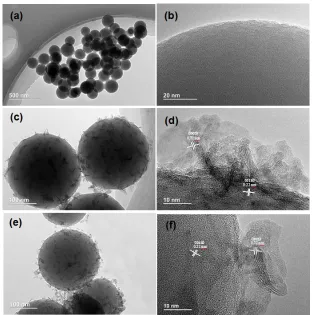
C for 6 h, 12 h and 24 h to form low-density SiO2/MnO2 core-shell nanocomposites. A low-magnification SEM image of these core-shell nanocomposites (Fig. 3) clearly suggests a narrow size distribution. From Fig. 3b-d, one can see that surface of low-density SiO2 spheres are uniformly covered by close-packed MnO2 nanosheets and the nanosheets are thicker and thicker with the reaction time increasing due to the Ostwald ripening process. It is worth noting that the diameters of low-density SiO2/MnO2 core-shell nanocomposites are changing from 200 nm to 350 nm after loading MnO2 nanosheets with the increase of reaction time.
planes of the birnessite-type MnO2. After reaction with the NaBH4 solution, both the size and density decreased which can increase the specific capacitance of unit mass.
[image:6.596.146.453.119.336.2]Figure 3. SEM images of (a) low-density SiO2 spheres; low-density SiO2/MnO2 core-shell nanocomposites obtained at 160 oC (b) 6 h; (c) 12 h; (d) 24 h. The inset is the higher magnification.
[image:6.596.142.454.404.719.2]
3.2 Electrochemical properties
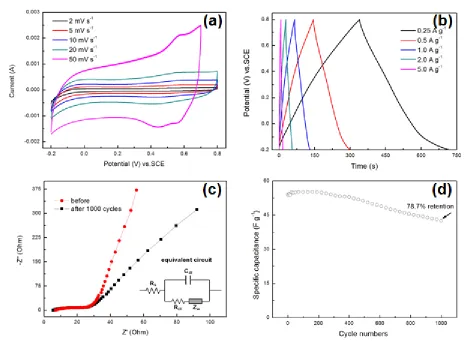
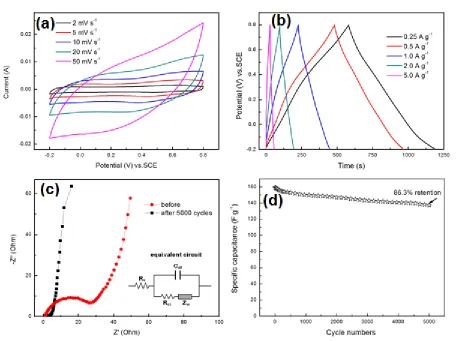
Manganese oxides with various valence states and crystalline structure are currently investigated for electrochemical electronic, catalytic and other applications. Extensive studies have suggested that manganese oxides are promising electrode materials for electrochemical supercapacitors. To evaluate the potential applications in electrochemical capacitors, SiO2/MnO2 and low-density SiO2/MnO2 core-shell nanocomposites obtained at different reaction time were used to make supercapacitor electrodes in a three-electrode configuration (Fig. 5 and Fig. 6). Cyclic voltammetry is a paramount tool to investigate the capacitive behavior of materials. The CV curves of the SiO2/MnO2 and low-density SiO2/MnO2 core-shell nanocomposites electrodes with various scan rates ranging from 5 to 50 mV s-1 are shown in Fig. 5a and Fig. 6a, which are obtained in a NaSO4 (1 mol L-1) solution. It is clear that the CV curves deviate from the ideal rectangle without distinct redox peaks in the range between -0.2 V and 0.8 V. Notably, from Fig. 5a and Fig. 6a, one can see that the CV curves of the samples obtained at 12 h are larger than that obtained at 6 h and 24 h, manifesting more pleasurable capacitive behavior of the samples obtained at 12 h.
[image:7.596.65.534.332.673.2][image:8.596.77.533.70.411.2]
Figure 6. (a) Cyclic voltammograms of low-density SiO2/MnO2 core-shell nanocomposites at different scan rate (2, 5, 10, 20 and 50 mV s-1) in a 1 M Na2SO4 aqueous electrolyte; (b) charge-discharge curves of low-density SiO2/MnO2 core-shell nanocomposites electrodes at different current densities (0.25, 0.5, 1, 2 and 5 A g-1); (c) the electrochemical impedance spectrum of the electrodes at open circuit potential in the frequency range from 0.01 Hz to 100 kHz; (d) cycling performance of low-density SiO2/MnO2 core-shell nanocomposites at a current density of 2 A g-1.
Additionally, to further examine the electrochemical performance of the SiO2/MnO2 and low-density SiO2/MnO2 core-shell nanocomposites electrode, galvanostatic constant current charge-discharge curves (Fig. 5b and Fig. 6b) at various current densities were performed with an electrochemical window of -0.2 to 0.8 V. According to the charge/discharge curves, the specific capacitance (Cm) of electrodes can be calculated according to the following equation:
m
I t C
m V
[image:9.596.85.512.391.548.2]
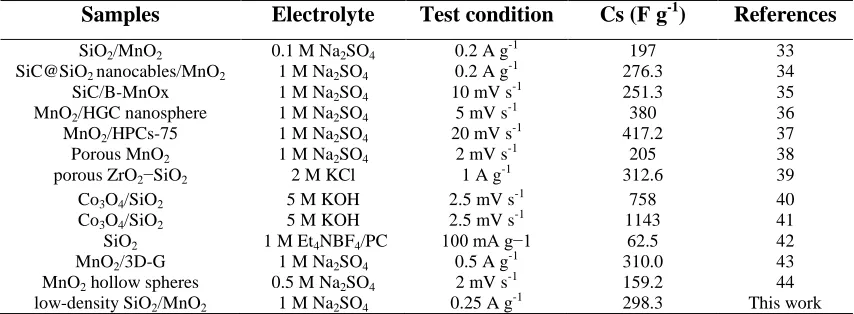
The remarkable electrochemical characteristic is attributed to the nanostructured electrode materials, which generates a high electrode/electrolyte contact area and short path lengths for electronic transport and electrolyte ion. While, it is clearly that both the SiO2/MnO2 and low-density SiO2/MnO2 core-shell nanocomposites made at 12 h (Fig. 5b and Fig. 6b) have longer charge-discharge time than the samples prepared at 6 h and 24 h, respectively. We also compared the specific capacitance with the similar results from previously reported publications (Table 1). Low density SiO2/MnO2 displayed superior electrochemical performance may be due to the several aspects: (i) based on the mechanism of pseudocapacitance, ion intercalation is one of reaction during charging and/or discharging for MnO2. Thus, the path of ion transportation does not need long enough. i.e., long path will be difficult for ions to accelerate moving in and moving out. Herein, we tune the loading and density of MnO2 nanosheets to investigate the optimal ion intercalation effect for pseudocapacitance. (ii) NaBH4 was used to reduce few of silica to silicon and increase the conductivity of composites without removing SiO2 core. (iii) the present findings have proved that the low-density SiO2/MnO2 core-shell nanocomposites deliver the maximum specific capacitance of 298.3 F g-1 far more than the SiO2/MnO2 core-shell nanocomposites (179.8 F g-1), and have desirable electrochemical stability (5000 cycles retained 86.3%).
Table 1. Comparison with the other reported results.
Samples Electrolyte Test condition Cs (F g-1) References
SiO2/MnO2 0.1 M Na2SO4 0.2 A g-1 197 33
SiC@SiO2 nanocables/MnO2 1 M Na2SO4 0.2 A g
-1
276.3 34
SiC/B-MnOx 1 M Na2SO4 10 mV s-1 251.3 35
MnO2/HGC nanosphere 1 M Na2SO4 5 mV s
-1
380 36
MnO2/HPCs-75 1 M Na2SO4 20 mV s-1 417.2 37
Porous MnO2 1 M Na2SO4 2 mV s
-1
205 38
porous ZrO2−SiO2 2 M KCl 1 A g-1 312.6 39
Co3O4/SiO2 5 M KOH 2.5 mV s
-1
758 40
Co3O4/SiO2 5 M KOH 2.5 mV s-1 1143 41
SiO2 1 M Et4NBF4/PC 100 mA g−1 62.5 42
MnO2/3D-G 1 M Na2SO4 0.5 A g-1 310.0 43
MnO2 hollow spheres 0.5 M Na2SO4 2 mV s-1 159.2 44
low-density SiO2/MnO2 1 M Na2SO4 0.25 A g-1 298.3 This work
stability, while low-density SiO2/MnO2 core-shell nanocomposites shows a retention of 86.3 % after 5000 cycles which suggested the moderate stability toward long time charge–discharge applications and further confirming the excellent supercapacitive and superior electrochemical reversibility, indicating that the controllable synthesis of low-density SiO2/MnO2 core-shell nanocomposites structure is a promising material for electrochemical capacitors application.
4. CONCLUSIONS
In summary, a flexible, cost-effective and green approach has been established to manufacture SiO2/MnO2 and low density SiO2/MnO2 core-shell nanocomposites. Compared with the specific capacitance of SiO2/MnO2 core-shell nanocomposites (179.8 F g-1), the low density SiO2/MnO2 core-shell nanocomposites deliver higher capacitance of 298.3 F g-1. The SiO2/MnO2 and low density SiO2/MnO2 core-shell nanocomposites show retention of 78.7 % after 1000 cycles, and 86.3 % after 5000 cycles, respectively, indicating a desirable electrochemical stability. These findings indicate that the low density SiO2/MnO2 core-shell nanocomposites could be a promising and cost-effective active material in electrochemical stable supercapacitors for practical application.
ACKNOWLEDGEMENTS
The authors gratefully acknowledge the financial supports provided by Project No.CDJXY120002 supported by the Fundamental Research Funds for the Central Universities.
References
1. P. Simon, Y. Gogotsi, Nat. Mater., 7 (2008) 845.
2. L. Dimesso, S. Jacke, C. Spanheimer, W. Jaegermann, J. Alloys Compd., 509 (2011) 3777. 3. M. Winter, R.J. Brodd, Chem. Rev., 104 (2005) 4245.
4. R.R. Salunkhe, K. Jang, H. Yu, S. Yu, T. Ganesh, J. Alloys Compd., 509 (2011) 6677. 5. Q.T. Qu, L. Li, S. Tian, W.L. Guo, Y.P. Wu, J. Power Sources, 195 (2010) 2789.
6. J.X. Zhu, W.H. Shi, N. Xiao, X.H. Rui, Q.Y. Yan, ACS Appl. Mater. Interfaces, 4 (2012) 2769. 7. M. Huang, Y.X. Zhang, F. Li, Q. Liu, Sci. Reports, 4 (2014) 4518.
8. Z.X. Song, W. Liu, M. Zhao, Y.J. Zhang, J.S. Qiu, J. Alloys Compd., 560 (2013) 151.
9. Z.Q. Zhang, C.C. Ma, M. Huang, F. Li, Y.X. Zhang, J. Mater. Sci: Mater. Electron., 6 (2015) 4212.
10.S.Q. Ci, Z.H. Wen, Y.Y. Qian, J.H. Chen, Sci. Reports, 119 (2015) 19.
11.L. Li, R.M. Li, S.L. Gai, Y.J. Chen, P.P. Yang, J. Mater. Chem. A, 3 (2015) 15641. 12.M. Lee, S.K. Balasingam, H.Y. Jeong, Y. Jun, Sci. Reports, 5 (2015) 8151.
13.C. Feng, J.F. Zhang, Y. He, C. Zhong, W.B. Hu, L. Liu, Y.D. Deng, ACS Nano, 9 (2015) 1730. 14.C.C. Zhang, C.J. Peng, B. Gao, X. Peng, X.M. Zhang, J.J. Fu, J. Nanomater., 2015 (2015) 7. 15.X.J. Ma, W.B. Zhang, L.B. Kong, Y.C. Luo, L. Kang, New. J. Chem., 39 (2015) 6207.
16.C. Choi, S.H. Kim, H.J. Sim, J.A. Lee, A.Y. Choi, Y.T. Kim, S.J. Kim, Sci. Reports, 5 (2015) 9387.
17.L. Li, Z.A. Hu, N. An, Y.Y. Yang, Z.M. Li, H.Y. Wu, J. Phys. Chem., 118 (2014) 22865. 18.F. Caruso, Adv. Mater., 12 (2001) 11.
20.A.L. Yarin, E. Zussman, J.H. Wendorff, A. Greiner, J. Mater. Chem., 17 (2007) 2585. 21.X.D. Su, J.Z. Zhao, X. Zhao, Z.C. Wang, Nanotechnology, 19 (2008) 365610.
22.Z.Q. Zhang, C.C. Ma, L. He, M. Huang, L. Yu, Y.X. Zhang, Ceram. Int., 40 (2014) 10309. 23.J. Yu, H.Y. Chen, M.H. Chen, N. Liu, Q.W. Li, ACS Appl. Mater. Interfaces, 5 (2013) 3408. 24.S.H. Ryu, S.G. Hwang, S.R. Yun, K.K. Cho, K.W. Kim, K.S. Ryu, Bull. Korean. Chem. Soc., 32
(2011) 2683.
25.G.A.M. Ali, O.A. Fouad, S.A. Makhlouf, M.M. Yusoff, K.F Chong, Adv. Engineering, 18 (2014) 2505.
26.G. Lia, Z. Wanga, M. Yua, Z. Quana, J. Lin, J. Solid. State. Chem., 179 (2006) 2698.
27.T. Zhang, Q. Zhang, J.P. Ge, J. Goebl, M.W. Sun, Y.S. Yan, Y.S. Liu, C.L. Chang, Y.D. Yin, J. Phys. Chem. C, 113 (2009) 3168.
28.Y.X. Zhang, M. Huang, F. Li, X.L. Wang, Z.Q. Wang, J. Power Sources, 246 (2014) 449.
29.S. Peng. L. Li, H. Tan, S. Ramakrishna, M. Srinivasan, Q. Yan, J. Mater. Chem. A, 1 (2013) 7630. 30.Y.X. Zhang, M. Kuang, J.J. Wang, CrystEngComm., 16 (2014) 492.
31.Y. Cheng, H. Zhang, S. Lu, C.V. Varanasi, J. Liu, Nanoscale, 5 (2013) 1067. 32.J. Li, H, Xie, Mater. Lett., 78 (2012) 106.
33. S. Ryu, S. Hwang, S. Yun, K. Cho, K. Kim, K. Ryu, Chem. Soc., 8 (2011) 2683. 34. Y. Zhang, J. Chen, H. Fan, K. Chou, X. Hou,Dalton Trans., 44 (2015) 19974. 35. M. Kim, J. Kim, ACS Appl. Mater. Interfaces, 6 (2014) 9036.
36 J. Lv, X. Yang, H. Zhou, L. Kang, Z. Lei, Z. Liu, Materials Research Bulletin, 73 (2016) 429. 37. H. Li, L. Jiang, Q. Cheng, Y. He, V. Pavlinek, P. Saha, C. Li, Electrochimica Acta, 164 (2015)
252.
38. C. Wan, L.Yuan, H. Shen, Int. J. Electrochem. Sci., 9 (2014) 4024.
39. G. H. Jeong, H. Lee, J. Kang, H. Lee, C. Kim, J. Lee, J. Kim, S. Kim, ACS Appl. Mater. Interfaces, 6 (2014) 20171.
40. G. A. M. Ali, O. A. Fouad, S. A. Makhlouf, M. M. Yusoff, K. F. Chong ,Adv. Mat. Res., 1133 (2016) 447.
41. Gomaa A. M. Ali , Osama A. Fouad, Salah A. Makhlouf, Mashitah M. Yusoff, J. Solid. State. Electrochem., 18 (2014) 2505.
42. X. Du, C. Wang, T. Li, M. Chen, Ionics, 15 (2009) 561.
43. S. Sun, P. Wang, S. Wang, Q. Wu, S. Fang, Mater. Lett., 145 (2015) 141. 44. H. Z. Chi, S. Yin, H. Qin, K. Su, Mater. Lett., 162 (2016) 131.