L I F E -
E n v i r o n m e n t
European Commission
2002
The LIFE Regulation
LIFE is the European Union's Financial Instrument for the Environment. Launched in 1992, its overall objec-tive is to contribute to the development and imple-mentation of EU environmental policy through the financing of specific actions. LIFE has three distinct components -- LIFE-Environment, LIFE-Nature and LIFE-Third countries – and co-finances environmental initiatives for environmental and nature conservation projects throughout the EU, in participating candi-date countries and certain third countries bordering on the Mediterranean and the Baltic Sea.
LIFE has been implemented in phases: EUR 400 mil-lion were allocated for the first phase (1992-1995) and approximately EUR 450 million for the second phase (1996-1999). For the period 2000 – 2004, LIFE III has a total proposed budget of EUR 640 million Euro, 47% of which is earmarked for LIFE-Environment projects in the European Union.
LIFE-Environment is open to any natural or legal per-son established in the European Union and the par-ticipating Candidate Countries (Estonia, Hungary, Latvia, Romania, Slovenia), however it is addressed in particular to the industrial sector and public authori-ties.
Environment projects funded under LIFE III
To contribute to the development of integrated and innovative techniques and methods and to further the development of Community environment policy, LIFE focuses on encouraging and facilitating the implementation of demonstration projects.
Demonstration projects must seek to develop and test an innovative solution to an environmental prob-lem and lead to concrete, practical results. They must be implemented at a scale which allows for evalua-tion of the technical and economic viability of the solution on a large scale.
As the purpose of the programme is to bridge the gap between research and development results and their large-scale application, LIFE-Environment does not finance research or investment in existing technolo-gies or infrastructure. To this end, demonstration proj-ects based on the results of research projproj-ects which have been supported in the past, or technological research and development programmes are encour-aged.
The LIFE III Regulation identified the following 5 areas for LIFE-Environment funding:
• Land use development and planning: integrating environment and considerations on sustainable development in land-use development and plan-ning, including in urban and coastal areas, or
• Water management: promoting the sustainable management of groundwater and surface water, or
• Impacts of economic activities: minimising the environmental impacts of economic activities, par-ticularly through the development of clean tech-nologies and by placing the emphasis on preven-tion, including the reduction of emission of gases having a greenhouse effect, or
• Waste management: preventing and or reusing, recovering and recycling waste of all kinds and ensur-ing the sound management of waste streams, or
• Integrated production policy: reducing the environ-mental impact of products through an integrated approach to production, distribution, consumption and handling at the end of their life-time, including the development of environmentally-friendly products.
These five priority areas are in line with The Sixth Environment Action Programme of the European Community 2001-2010, which provides the strategic direction for the Commission’s environmental policy for the next decade. The Sixth Environment Action Programme stresses the need for Member States to better implement existing environmental laws, work with businesses and consumers to achieve more envi-ronmentally friendly forms of production and con-sumption, and continue to integrate environmental considerations into other policies such as transport, energy and agriculture and the importance of spatial planning and action at the local and regional level to promote sustainable development.
Funding under LIFE-Environment III
The European Union has allocated approximately EUR 300 million for LIFE-Environment for the period 2000-2004. The rate of Community co-financing can be up to 30% of eligible costs for projects having the potential to generate income or reduce operational costs, or as high as 50% in other cases. Eligible costs are those which are provided for in the original budg-et, are directly necessary to the project and are incurred during the lifetime of the project. Ineligible costs include land purchase, research and technolog-ical development activities and costs for intellectual property rights protection.
Applications
The deadline for applications for 2002 pilot projects was 30 November 2001. An Application Guide with application forms was produced and made available on the LIFE-Environment web site. The guide pre-sented a detailed explanation on how to apply. The application forms were also included and both the guide and forms were provided in PDF format for easy downloading.
By 30 November 2001, a total of 479 applications from the 15 EU Member States and five Candidate Countries were submitted to the Commission.
Selection procedure
The applications submitted underwent the following five stages:
• Receipt of projects by the Member States
• Admissibility check
• Evaluation of projects by assessment using estab-lished selection criteria
• Classification and pre-selection of projects at Commission level
• Revision phase (where necessary)
• Consultation of Member States
• Decision by the Commission on the projects to be cofunded
• Informing the applicants
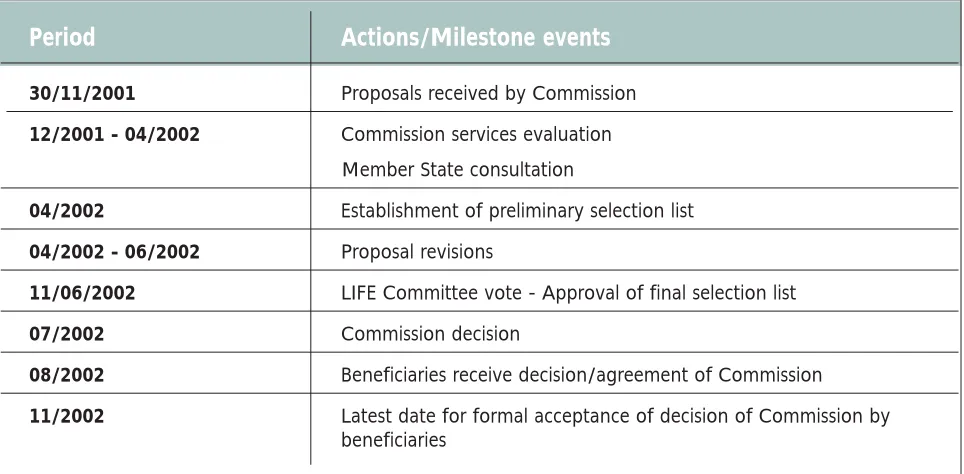
The dates for the various stages of the selection process are outlined in Table 1.
Reception by the Member States
Each of the Member States set their deadline for the LIFE 2000-2001 proposal submission. The Member State authorities had to transmit the proposals to the Commission (DG ENV D.1) by 30 November 2001. At this stage the proposals were registered and checked for admissibility, an administrative step to be sure that, they were in compliance with the given require-ments.
Evaluation of projects
At this stage the project proposals were first checked for formal eligibility, i.e.financial and technical sound-ness. The eligible projects were then evaluated by the Commission desk officers, technical units and inde-pendent experts, according to the following technical and thematic criteria:
Technical criteria:
• coherence
• organisation, i.e. partnerships, roles, management
• planning
• durability
• overall quality
• possibility of integration
• demonstration, possibility of dissemination
Thematic criteria
• community interest
• environmental problem
• geographical extent
• cooperation
• transferability
• innovative nature
• cost/benefit ratio
Classification and pre-selection of projects
The projects were listed in order of merit according to the total scores allocated by the evaluators for each of the evaluation and bonus criteria. In the case of equal scores between one or several proposals, the score obtained on criterion 5 for "Community inter-est and environmental problem" was used to decide between the proposals.
According to the available budget, the proposals were ranked on merit and were classified either as "preliminary selected" or "preliminary reserved".
Revision phase
The Commission services then revised the project proposals and worked with potential beneficiaries to improve the overall quality of the proposal, as need-ed. This process led to the establishment of a draft list of selected projects and a list of projects in reserve.
The LIFE Committee is the regulatory committee attached to the LIFE programme. Its role is to enable the Commission to establish a dialogue with nation-al administrations before adopting implementing measures.
Composed of representatives of the 15 Member States and of observers coming from the accessing countries eligible to LIFE, the LIFE Committee takes the final decision on the selection of projects to be selected for LIFE-Environment. The Committee was consulted on the draft list of projects to be selected and met on 11 June 2002 in Madrid to vote on the final selection list and a list of projects in reserve. After the LIFE Committee meeting, the Commission began the formal administrative procedure leading to the final written decision.
Informing the applicants
After the adoption of the Commission decision, indi-vidual decisions were communicated to the success-ful beneficiaries, who were invited to formally accept the decision or countersign the agreement within 90 days following the date of notification of the deci-sion.
LIFE-Environment projects funded for 2002
Sustainable management of water resources is the theme of the largest proportion of projects selected and the EU funding allocated (30 projects, EU contri-bution EUR 20.4 million, which represents 29% of the total). There are 25 projects on minimising the impact of economic activity (EU contribution EUR 15.7 mil-lion), which cover clean technologies, integrated envi-ronment management (Eco-Management and Audit Scheme - EMAS etc), sustainable tourism and the reduction of greenhouse gas emissions. Twenty three projects, funded by EUR 15.7 million, relate to the area of preventing, recycling and re-using waste, mainly dealing with packaging and plastics, haz-ardous or problematic waste or waste important in volume. Twenty two projects for co-financing in the amount of EUR 13.5 million relate to the theme of promoting the integration of environmental consider-ations, whether in the urban environment, in coastal zone management, other areas of land-use develop-ment and planning, including projects which target the quality of air and noise abatement. Finally, EUR 4.4 million has been allocated to nine projects which focus on promoting an integrated product pol-icy though eco-design, eco-labelling and green finan-cial products.
28%
23% 21%
20%
8%
Water
Impact of
economic activities
Waste
Integration of environmental consideration
Integrated product
Geographical distribution of projects
The Commission approved 111 projects selected from the 479 proposals submitted by organisations from the fifteen EU Member States and the five Candidate Countries participating in the programme, i.e. Estonia, Hungary, Latvia, Romania, and Slovenia. Spain was awarded the highest number of grants, for 27 projects; Italy, 16 projects; France, 8; The Netherlands, 9, Finland, 8; Germany, 7; Greece, 7; United Kingdom, 6; Hungary, 3; Austria, 3; Belgium, 2; Denmark, 3; Sweden, 4; Estonia, 2; Latvia, 2; Portugal, 2; Romania, 2.
Beneficiaries of LIFE
Among the 111 projects selected, over half involve public authorities or public institutions as their main beneficiaries, followed by private bodies (43%), small and medium-sized enterprises and finally non-gov-ernmental organisations.
A one page description in English of the 111 projects follows. This document is also available on the LIFE-Environment home page at:
[image:5.595.72.554.335.572.2]http://europa.eu.int/comm/life/home.htm
Table 1. Timetable of the evaluation-selection procedure LIFE-Environnement 2002
Period
Actions/Milestone events
30/11/2001 Proposals received by Commission
12/2001 - 04/2002 Commission services evaluation Member State consultation
04/2002 Establishment of preliminary selection list
04/2002 - 06/2002 Proposal revisions
11/06/2002 LIFE Committee vote - Approval of final selection list
07/2002 Commission decision
08/2002 Beneficiaries receive decision/agreement of Commission
11/2002 Latest date for formal acceptance of decision of Commission by beneficiaries
Note for the reader
Location Projects number Title of project
AUSTRIA LIFE02 ENV/A/000282 Cleaning up the river Liesing LIRILI
LIFE02 ENV/A/000284 Teaching environmental studies in an eco-classroom UT-HALLE
LIFE02 ENV/A/000285 Timber building conforming to “passive house” standards BBMPASSIV
BELGIUM LIFE02 ENV/BE/000333 Testing the benefits of using “vacuum evaporation”
ZEWADI in the plating industry
LIFE02 ENV/B/000341 An integrated approach to remove TBT from the marine environment
DENMARK LIFE02 ENV/DK/000150 Optimised recycling of organic household waste by SHORT-CIRCUIT establishing a close relation between the sources,
households, and the end users
LIFE02 ENV/DK/000151 Using permanently mounted sensors for monitoring oil
OSIS spills at sea
LIFE02 ENV/DK/000155 Thermal hydrolysis of PVC and recycling of the reaction
PVC HYDROLYSIS products
ESTONIA LIFE02 ENV/BE/000338 Democratic Urban Planning Using eTechnology RE-USE WORKS
LIFE02 ENV/EE/000424 Controlling pollution from the oil-shale processing industry HASCO
FINLAND LIFE02 ENV/FIN/000319 Mobilising stakeholders to manage the “Green Valley” of Salo GREEN VALLEY – E SALON
LIFE02ENV-FIN-000320 Finnish know-how to increase the number of ENVEDU EMAS-registered schools and colleges
LIFE02 ENV/FIN/000321 User-friendly and inexpensive environmental
EMSS FOR SMES management tool for SMEs on the web
LIFE02 ENV/FIN/000322 Educating citizens about the food chain, environment and
ECO LEARN sustainable development
Location Projects number Title of project
FINLAND LIFE02 ENV/FIN/000324 Rokua – eco-friendly tourist resort
ROKUA LIFE
LIFE02 ENV/FIN/000328 Handling waste from stone wool production in a less PAROC-WIM costly and more environmentally friendly way
LIFE02 ENV/FIN/000329 Keeping roads in good shape with waste materials KUKKIA CIRCLET
LIFE02 ENV/FIN/000331 Demonstrating eco-efficiency in the Kymenlaakso region ECOREG
FRANCE LIFE02/ENV/F/000289 Mobilising local population to minimise greenhouse gas
PRIVILEGES emissions
LIFE02/ENV/F/291 Managing water pollution from former mining sites in
DIFPOLMINE France and Hungary
LIFE02/ENV/F/295 Software tool for noise evaluation and management GIPSYNOISE
LIFE02/ENV/F/297 Monitoring municipal activities from an environmental
FEAT viewpoint
LIFE02/ENV/F/000301 Environmentally friendly management of plastic waste
PLASTAGRI on the farm
LIFE02/ENV/F/000303 New treatment system for waste water in a rural community LILIPUB
LIFE02/F/000305 Mobilising users for a pollution prevention approach ECO SEN
LIFE02/ENV/F/000307 Recycling scrubbing sludge from the quarry industry into
ARGIMIWE expanded clay pellets
GERMANY LIFE02 ENV/D/000398 Economical and ecological recycling of all polyurethane
RECYPOL plastics
LIFE02 ENV/D/000399 More efficient management of storm water HYDROSTYX
LIFE02 ENV/D/000403 Producing smoked sausages in an CIRCO-CLEAN environmentally friendly way
LIFE02ENV/D/000404 Advanced technology for cleaning up waters ULTRASCHALLREINIGUNG
LIFE02 ENV/D/000406 Sound and cost-effective non-thermal plasma NT-PLASMA plants for purifying waste air
LIFE02 ENV/D/000408 Geothermal heating for students in Aachen SUPERC
Location Projects number Title of project
GREECE LIFE02/ENV/GR/000359 Promoting clean vehicle technologies in Thessaloniki IMMACULATE
LIFE02/ENV/GR/000360 Innovative collection system and Life Cycle Assessment for
ICOL waste lube oils
01/GR/000362 Climate Alliance for Mediterranean Cities MEDCLIMA
LIFE02/ENV/GR/000363 Implementing EMAS at the University of Macedonia EMAS-EDIN
LIFE02/ENV/GR/000371 Producing soil from municipal sewage sludge Humification of sludge STP
LIFE02/ENV/GR/000373 Development of a Pilot Separate Collection and Management Green Batteries Scheme in Crete for Batteries and Accumulators
LIFE02/ENV/GR/000392 Greening cultural events in Ancient Olympia GREENCULT
HUNGARY LIFE02 ENV/H/000435 Adding value to the treatment of spent pickling acid
UTILISATION OF HAZARDOUS WASTE
LIFE 02 ENV/H/000442 Innovative and environmentally friendly technology for EPS-RECYCLING collecting and recycling expanded polystyrene-type plastics (EPS)
LIFE02/ENV/H/000443 Development of a reed-bed wastewater treatment system RHIZOSPHERIC-WETLAND through the recultivation of a decommissioned landfill site
ITALY LIFE01 ENV/IT/000015 Environmentally friendly policy and management in Tuscan ports EMAS.PO.LI
LIFE02 ENV/IT/00017 The P.A.T.T.E.R.N. get into the park The P.A.T.T.E.R.N
LIFE02ENV/IT/000018 Methodological tool for health impact assessment
VISP in urban environment
LIFE02 ENV/IT/00019 Decision Support System for environmental planning SFIDA
LIFE02 ENV/IT/0023 Green purchasing for public administrations GPP NET
LIFE02 ENV/IT/00034 Using wood as a source of energy in mountain areas WARM-WOOD
LIFE02 ENV/IT/000049 Testing an innovative state-of-the-art numerical model WAMARIBAS in three river basins of Central and Southern Italy
LIFE02 ENV/IT/0052 Environmentally friendly ceramics micro-finishing MICROFINISHING
LIFE02 ENV/IT/0064 Using solar energy to power trains PVTRAIN
LIFE02 ENV/IT/00065 Mobilising all stakeholders to manage the environment
Location Projects number Title of project
ITALY LIFE02 ENV/IT/000079 Natural techniques for reducing pollution in three Italian lakes TRELAGHI
LIFE02 ENV/IT/0089 Sustainable and innovative management of vegetable
FERTILIFE waste biomass
LIFE01 ENV/IT/000092 Environmental management systems certification CER-COM+ EMAS II
LIFE02 ENV/IT/00106 Instilling the sense of a “quality of life” culture in
RAVE a medium-sized town
LIFE02 ENV/IT/00111 Introducing EMAS to Tuscia Romana NEW TUSCIA
LIFE02 ENV/IT/000112 Proactive approach to managing rubbish on the Riviera GIDUT
LATVIA LIFE02 ENV/LV/000478 Energy Labelling of Apartment Buildings ENERLAB
LIFE02 ENV/LV/000481 Elaboration of a new comprehensive Ziemelsuseja ZIEMELSUSEJA River Basin Management System
NETHERLANDS LIFE02/ENV/NL/000114 New integrated wastewater treatment system for tanneries TANEFTREAT
LIFE02/ENV/NL/000116 Saving natural ecosystems through improved wastewater
ALTWA management
LIFE02/ENV/NL/000117 The application of Membrane Bioreactor technology to MEMBRANE BIOREACTOR large-scale effluent treatment
LIFE02/ENV/NL/000118 Sustainable horticultural production: replacing pesticides
BIOCONTROL with biocontrol
LIFE02/ENV/NL/000124 New environmental friendly cargo handling and fumigation plant ECON-tainer
LIFE02/ENV/NL/000128 Residual municipal waste as fuel for power stations BIOFUEL
LIFE02/ENV/NL/000130 Recovery of sand and inert fibres from digested paper SORDISEP
LIFE02/ENV/NL/000133 New “Wadden Water House” demonstrates state-of-the-WADDEN WATER HOUSE art energy-saving and sustainable construction
PORTUGAL LIFE02 ENV/P/000416 Crystal clear: Eco-friendly wastewater management ECORIVER
Location Projects number Title of project
ROMANIA LIFE02 ENV/RO/000461 New ecological product for purifying gases and water ENVACTCARB
LIFE02 ENV/RO/000462 Eco food markets for Bucharest ECOMARKET
SPAIN LIFE02/ENV/E/000164 Organic agricultural production: A pilot programme in
PAEGA Galicia, Spain
LIFE02/ENV/E/000176 Information and sustainable development in urban
DIVERS environments
LIFE02/ENV/E/000177 Hidden hazards: A pilot project for separate collection, TRAGAMÓVIL disposal and recycling of discarded mobile phones
LIFE02 ENV/E/000180 Integrated environmental management system for
TRAMA farm cooperatives
LIFE02/ENV/E/000182 Innovative methods to treat residual urban water MACROPHYTES
LIFE02/ENV/E/000183 Good water resources management: A challenge DROPAWATER for the Spanish Autonomous City of Ceuta
Life02/ENV/E/000186 Integrated residual water treatment in the canning industry URGARBI
LIFE02/ENV/E/000187 Safe disposal and recycling of animal sub-products ENERWASTE
LIFE02/ENV/E/000194 Eco-degreasing: A new take on an old tradition ECO-Degreasing
LIFE02/env/e/000198 Sustainable urban design for open public spaces ECO-VALLE
LIFE02/ENV/E/000200 Peri-urban renewal: Getting a diffused city into shape GALLECS
LIFE02/ENV/E/000201 Sustainable tourism in Sanabria Park SOSSANABRIA
LIFE02/env/e/000210 Self-management irrigation tools for over-utilised water systems HAGAR
LIFE02/ENV/E/000216 Eco-friendly hide tanning techniques in Murcia, Spain AFINO CONDUCTIVIDAD
LIFE02/ENV/E/000222 An ecologically safe grazing model for livestock DEHESAS
LIFE02/ENV/E/000223 Traction fire engine beats forest fires VELIF
LIFE02/ENV/E/000236 An eco-conscious alternative for the hide tanning industry RECYCLING OF GREASE
LIFE02/ENV/E/000237 Transforming dangerous industrial waste into valuable
Location Projects number Title of project
SPAIN LIFE02/ENV/E/000241 Best foot forward: Eco-concious footwear for Europe’s citizens ECOFOOT
LIFE02/ENV/E/000242 Solvent-free: Using safe adhesives in shoe manufacturing CALSINDIS
LIFE02/ENV/E/000253 Getting the oil out: Recycling cooking oil into
environment-ECOBUS friendly fuel
LIFE02/ENV/E/000255 Safe substitutes for insecticides in rice production ENVACIO
LIFE02ENV/E/000263 Enchanted forest: Bringing Bosc de Tosca back to life PARPEDRA TOSCA
LIFE02/ENV/E/000269 Staying power: An automatic waste recovery system AUTOREWASTE extends plastic’s shelf life
LIFE02ENV-E-000274 “Dust-free”: A project for clean air in Spain’s port zones HADA
SWEDEN LIFE02 ENV/S/000344 REduction of SOLVents in the European newspaper printing
RESOLVE industry
LIFE02 ENV/S/000349 Better and more cost effective water quality monitoring EASYMONITOR
LIFE02 ENV/S/000351 New integrated eco-efficiency evaluation of products DANTES
LIFE02 ENV/S/000355 Integrated management of coastal woodlands COASTAL WOODLANDS
UNITED 02/ENV/UK/136 Clean Accessible Transport for Community Health
KINGDOM CATCH
02/ENV/UK/140 Finding innovative solutions for water management in
INWATCO coal mining areas
02/ENV/UK/143 Improving environmental performance through EMAS REMAS
02/ENV/UK/144 Cleaning up the river Tame SMURF
02/ENV/UK/146 Filtering drinking water with a new product made from
AFM waste glass
L I F E 0 2 E N V / A / 0 0 0 2 8 2 L I R I L I
Official title
Living River Liesing
Demonstrative Ecological Reconstruction of a Heavily Modified Waterbody in an Urban Environment
Background
The River Engineering Department of the City of Vienna is responsible for water management plan-ning, hydrology, river monitoring, flood protection and river restoration for the preservation and improvement of the ecological status of rivers within the border of the City of Vienna. The river Liesing in Vienna has been heavily modified for the purpose of flood protection measures, its use as a watercourse for a water treatment plant and by an increased river-side population. The “LiRiLi” project covering 5,5 km of the river will be part of a large–scale restoration project for the entire river Liesing. It will be the first river of this size to be restored in an urban area. The River Engineering department is experienced in this field as a similar project was implemented on the River Wien.
Project Objectives
The objective of the pilot project is to maximise the “ecological potential” of the River Liesing, in confor-mity with the Water Framework Directive and specif-ically with regard to “heavily modified water bodies”1
A canal-like concrete channel over 5.5km in length and located in an urban area will be re-designed into a semi-natural river meeting the relevant flood pro-tection requirements.
The “LiRiLi” project also aims at an improvement of the water quality (from quality class IV to quality class II of the saprobic system) by restoring the river conti-nuity and different flow conditions.
The flora and fauna will be improved and high quali-ty public recreational areas will be established. Finally, information on the project will be disseminated on a large scale.
1. A body of surface water, which, as a result of physical alter-ations by human activity, is substantially changed in character, as designated by the Member State in accordance with the pro-visions of Annex II of the Water Framework Directive (2000/60/EC of 23 October 2000).
Cleaning up the river Liesing
Beneficiary:
Type of beneficiary
public authority
Name of beneficiary
Stadt Wien, Magistratsabteilung 45 Wasserbau
Postal address
Wilhelminenstr. 93 A-1160 Wien AUSTRIA
Tel.: 00 43 1 4000 965 71 Fax: 00 43 1 4000 999 657 1 E-mail: [email protected]
Name of contact person
Herr Dipl.-Ing. Gernot LADINIG
Duration of project:
From October 2002 to January 2002
Total budget in euro:
2,017,350
EC contribution in euro with %:
770,500 (49.99% of eligible costs)
Priority theme covered by the project:
L I F E 0 2 E N V / A / 0 0 0 2 8 4 U T- H A L L E
Official title
Environmental Engineering hall for the High School for environment and economics
Background
The municipality of Yspertal as the beneficiary of this project is, in partnership with the local High School for the Environment and Economics, involved in construction of a teaching hall for environmental engineering purposes. The municipality and High School will capitalise on their experience in project management and technical know-how to erect the hall in a sustainable way.
Project Objectives
The environmental engineering teaching hall will be used as a demonstration hall for the pupils of the High School in Yspertal as well as of partner schools from other European countries. It is planned to give lessons in applied environmental studies there.
The total annual energy consumption will be less than 60 kWh/m by an innovative energy, insulation- and lighting-concept. Renewable energy resources from the region (wood, straw, and hemp) will be used in the construction and heating facilities. The hall will be approximately 18m x 35m in size and will rely on wood chips for heating.
Compared to a conventionally erected hall the CO2 emissions will be reduced, as CO2 neutral resources will be applied for both the erection and the energy demand. It is also the aim of this project to quantify the reduction of CO2 emission by monitoring mea-surements carried out by students of applied studies.
Teaching environmental studies
in an eco-classroom
Beneficiary:
Type of beneficiary
public authority
Name of beneficiary
Marktgemeinde Yspertal, Gemeindeamt
Postal address
Altenmarkt 100 A-3683 Yspertal AUSTRIA
Phone: 00 43 7415 6767 Fax: 00 43 7415 6767 24 E-mail: [email protected]
Name of contact person
Herr Bürgermeister Karl MOSER
Duration of project:
From November 2002 to March 2006
Total budget in euro:
659,760
EC contribution in euro with %:
152,734 (50% of eligible costs)
Priority theme covered by the project:
L I F E 0 2 E N V / A / 0 0 0 2 8 5 B B M PA S S I V
Official title
Multifunctional company and administration building with logistics and
cultural centre in passive house standard in sustain-able timber construction
Background
The project promoter BBM and its parent company MIVA work in the field of development co-operation for the Catholic Church. Over the past 12 years, BBM has implemented projects in over 100 countries world-wide, including ecology and energy projects.
The administrative building in “passive house”1 stan-dards resulting from this project will be a demonstra-tion object for visitors from abroad as well as an example of innovative construction developed by the Catholic Church in Austria.
Project Objectives
The main goal of the “BBMpassiv” project is the eco-design and eco-construction of a multifunctional company and administration building in sustainable timber construction according to “passive house” standards. The annual energy demand for heating purposes will be less than 15kWh. Innovative con-cepts in energy consumption, heating and aeration will be developed.
The beneficiary will organise a cost management workshop for non-profit organisations from the can-didate countries in order to find ways of making this technique affordable. International experts from the EU Member States, the candidate countries and the Third World countries will also be involved in the planning, realisation and maintenance of the project to encourage mutual learning. This house will be pre-sented as a reference project for other new buildings of the Catholic Church and related organisations.
1. A Passive House is a building with an extremely low heating energy demand. The term "Passive House" refers to a construc-tion standard. The standard can be met using a variety of tech-nologies, designs and materials.
Timber building conforming to
“passive house” standards
Beneficiary:
Type of beneficiary
non-profit organisation
Name of beneficiary
Beschaffungsbetrieb der MIVA, BBM
Postal address
Maximilian-Pagl-Strasse 5 A-4651 Stadl-Paura AUSTRIA
Phone: 00 43 7245 28636 0 Fax: 00 43 7245 28636 30
Name of contact person
Herr Direktor Franz X. KUMPFMÜLLER
Duration of project:
From December 2001 to December 2003
Total budget in euro:
2,149,749
EC contribution in euro with %:
780,241 (50% of eligible costs)
Priority theme covered by the project:
L I F E 0 2 E N V / B E / 0 0 0 3 3 3 Z E W A D I
Official title
ZEWADI - Implementation of “Vacuum Evaporation” to obtain “Zero Waste Discharge” and “Energy Recovery”
Background
To meet the demands of European Directives on clean water, integrated water management will be an environmental priority. In this context, the plating industry cannot continue to dump chemicals, heavy metals, and metal-containing wastes without any treatment.
Furthermore, several factors call for a change in the way waste from the plating industry is managed:
• The progressive increase in the cost of destruc-tion of toxic waste such as metal hydroxide sludge.
• A decrease in the number of disposal sites for heavy metal sludge, which leads to a radical increase in disposal costs.
• A progressive enforcement of local, national and international laws which contribute to the quali-ty of industrial waste water.
In this context, the “evaporation technology” is a very promising alternative to reduce the environmental impact of the processes used in the plating industry, especially the treatment of waste water containing chemicals and heavy metals.
Project Objectives
The proposed “vacuum evaporation” technology ensures the total treatment of all waste water streams, the recuperation of rinsing water and at the same time the production of electricity. The objective of the “ZEWADI” project is to implement a prototype which treats the waste water streams produced by the electroplating plant of the private company and beneficiary of the project, STC. Because of the com-position of the waste waters (emulsion or metal-con-taining), the streams will be divided into two separate systems with different prototypes.
After the adjustment of the equipment on site, the prototypes will be tested under real conditions with
the emulsion- and metal containing waste waters of the end-user followed by a complete evaluation of the concept and the international exploitation of the new environmental system.
The closed-loop system using evaporating tech-niques, proposed by this project, will make it possible to obtain a zero waste discharge and should prove to be cost-efficient and environmentally sound. Since there will be a big demand for such technology in the near future, the technical, ecological and economic benefits of the technique will be investigated within this project.
Testing the benefits of using
“vacuum evaporation” in the
plating industry
Beneficiary:
Type of beneficiary
Private structure
Name of beneficiary
Surface Treatment Company nv
Postal address
Schurhovenveld 4077 B-3800 Sint-Truiden BELGIUM
Tel.: 00 32 011 67 29 01 Fax: 00 32 011 67 33 93
E-mail: [email protected]
Name of contact person
Bernard VANDEWIELE
Duration of project:
From September 2002 to October 2004
Total budget in euro:
1,983,624
EC contribution in euro with %:
482,775 (30% of eligible costs)
Priority theme covered by the project:
L I F E 0 2 E N V / B / 0 0 0 3 4 1
Official title
Development of an integrated approach for the removal of tributyltin (TBT) from waterways and har-bours: prevention, treatment and reuse of TBT cont-aminated sediments.
Background
Tributyltin (TBT) is an aggressive biocide that has been used in anti-fouling ship paints since the 1970s. The toxicity of TBT prevents the growth of algae, barnacles and other marine organisms on the ships’ hull.
However, TBT leaches from the paint and enters the marine environment ; it accumulates in the sediment, especially in areas with a high density of ship move-ments like harbours and ports. From 1 January 2003 the use of TBT in anti-fouling systems on ships will be banned, following a decision taken by the International Maritime Organisation (IMO) and a EC Directive (Commission Directive 2002/62/EC of 9 July 2002 on organostannic compounds). In order to prevent the desorption from sediments reintroducing TBT into the marine environment, effective removal and treatment methods for TBT contaminated sediments need to be implemented.
This project aims at demonstrating an integrated approach to eliminate TBT from the marine environ-ment: prevention, removal, treatment and finally reuse.
Project Objectives
The overall objective of the project is to provide an inte-grated solution for the permanent removal of TBT from waterways near harbours and inland ship repair yards.
Specific objectives include the following:
• assess the environmental impact of already avail-able alternatives for TBT;
• evaluate the release of TBT from sediments into the aquatic environment during dredging opera-tions;
• test on a pilot-scale several treatment technologies for TBT contaminated sediments;
• identify possibilities for the reuse of treated sedi-ments.
The following specific results can be expected:
• a list of environmental friendly alternatives to TBT in anti-fouling systems;
• a turbidity limit that can be imposed during dredg-ing operations in order to prevent the release of TBT from sediments;
• the presentation of dredging techniques minimiz-ing TBT release from sediments;
• an integrated treatment technology for TBT cont-aminated sediments, according to the BATNEEC principle;
• reuse possibilities for treated sediments.
An integrated approach to
remove TBT from the marine
environment
Beneficiary:
Type of beneficiary
Public authority
Name of beneficiary
Gemeentelijk Havenbedrijf Antwerpen
Postal address
Entrepotkaai 1 B-2000 Antwerpen BELGIUM
Tel.: 00 32 03 205 23 16 Fax: 00 32 03 205 20 32
E-mail: [email protected]
Name of contact person
Eddy BRUYNINCKX
Duration of project:
From October 2002 to October 2004
Total budgetin euro:
3,222,366
EC contribution in euro with %:
1,335,495 (44.83% of eligible costs)
Priority theme covered by the project:
L I F E 0 2 E N V / D K / 0 0 0 1 5 0 S H O R T- C I R C U I T
Official title
Short circuiting the carbon and nutrient cycle between urban and rural districts by establishing three new systems for source separation, collection and composting of organic waste in the greater Copenhagen area
Background
The Community Strategy for Waste Management states that recycling activities should be promoted all over the Community, but that this requires the public to be convinced of the health, safety and environ-mental benefits of the recycled products. Composting is mentioned as an important tool for recycling biodegradable municipal waste for agricultural use, leading to a saving of resources by substituting for commercial fertilisers. The LIFE-Environment Programme outlines in detail the main priorities regarding Community waste management projects: Next to the prevention of waste generation, projects promoting recycling – including composting have the highest priority. The need for projects focusing on source separation of biodegradable waste and improving compost quality is stressed.
The “SHORT-CIRCUIT” project should be seen as contributing to optimising the Community strategy for recycling nutrients and organic carbon from organ-ic waste. It should go some way towards meeting the European strategy on waste management as put for-ward in the draft proposal for a composting Directive which could include mandatory source separation of biodegradable material, and limits on contaminants in composted material and also targets for composting. It will also be in accordance with the impending Community regulation on animal by-products.
Project Objectives
The “SHORT-CIRCUIT” project will develop and demonstrate to the public three new full-scale source separation and composting systems (involving
11,400 households within the greater Copenhagen area) which are designed to optimise the recycling of organic household waste by establishing a close rela-tion between the sources, households, and the end users, mainly farms and market gardens.
The project will attempt to maximise public participa-tion, thereby maximising the amount of organic waste source separated and simultaneously minimis-ing the amount of contaminants.
It also aims to evaluate the three systems by using a computerised systems analysis to compare recycling efficiency, environmental impacts and costs between the three systems, and also make the comparison with more conventional, centralised systems.
Optimised recycling of organic
household waste by establishing a
close relation between the sources,
households, and the end users
Beneficiary:
Type of beneficiary
Public institution
Name of beneficiary
The Danish Forest and Landscape Research Institute
Postal address
Hoersholm Kongevej 11, Hoersholm DK-2970
DENMARK
Tel.: 00 45 45 17 82 63 Fax: 00 45 45 76 32 33 E-mail: [email protected]
Name of contact person
Ulrik REEH
Duration of project:
From October 2002 to October 2005
Total budget in euro:
1,987,171
EC contribution in euro with %:
783,903 (49.94% of eligible costs)
Priority theme:
L I F E 0 2 E N V / D K / 0 0 0 1 5 1 O S I S
Official title
Sensor for identification of oil spills from offshore installations
Background
Ships and offshore installations are the most common sources of more than 500,000 tons of oil spilled into the marine environment every year. The Convention for the Protection of the Marine Environment of the Northeast Atlantic (the OSPAR Convention), which entered into force in March 1998 and includes the participation of the EU, will develop new pro-grammes and measures required to identify, prioritise and monitor the emissions, discharges and losses of substances, which reach or could reach the marine environment.
A comprehensive feasibility study, carried out by the Danish Environmental Protection Agency, concluded that the technology required for the successful enforcement and implementation of the OSPAR strategies and action plans is not currently available. Existing methods employing airplanes, inspection teams and satellite surveillance are not sufficient to ensure mandatory continuous surveillance and are also expensive and unreliable. The feasibility study did nevertheless reveal that the appropriate technol-ogy to expose polluters could be developed in time to meet the Danish regulatory requirements and could be run as a successful business venture in the future.
Project Objectives
The objective of the “OSIS” project is by 2004 to develop and test a technical solution for implementing and enforcing the programmes and measures adopted according to the strategy established by the OSPAR Convention and, hence, also provide the required tool for the implementation of the Community environ-ment policy and Danish legislation on the protection of the naval environment.
The OSIS concept is to create permanently mounted sensor system technology that will permit continuous online remote monitoring of offshore installations in any location, using the latest generation of satellite and Internet communication options. The project will demonstrate the viability of such technology for con-tinuous, immediate and accurate detection of oil spills from offshore installations to the sea areas, which are identified as “Special Areas” by the International Maritime Organization, and will thus provide a poten-tial solution to a widespread problem of international concern.
Using permanently mounted
sensors for monitoring oil
spills at sea
Beneficiary:
Type of beneficiary
Micro enterprise (<10 empl.)
Name of beneficiary
OSIS International Ltd
Postal address
Tirsbaekvej 131, Vejle DK-7120
DENMARK
Tel.: 00 45 21 25 19 88. E-mail: [email protected]
Name of contact person
Peter MOELLER-JENSEN
Duration of project:
From January 2002 to December 2004
Total budget in euro:
3,360,087
EC contribution in euro with %:
867,392 (25.82% of eligible costs)
Priority theme:
L I F E 0 2 E N V / D K / 0 0 0 1 5 5 P V C H Y D R O LY S I S
Official title
Innovative demonstration project for chemical recy-cling of PVC waste through the use of thermal hydrolysis
Background
PVC waste is one of the focal points of the EU environ-mental policy for a number of reasons. The incineration of PVC waste constitutes a recognised environmental problem because it results in dioxin formation. The quantity of PVC waste generated annually in the EU Member States is significant and it is important to avoid depositing such waste in landfills and to find other sustainable solutions to treat it.
The European PVC industry has identified two process-es to recycle PVC waste:
• “Mechanical recycling” consists of specific meth-ods, whereby one pure type of PVC waste is recy-cled to produce the goods that generated the waste, and;
• “Feedstock recycling” in which PVC waste of mixed types is converted to other useful chemical products that may be recycled in turn.
The PVC hydrolysis concept is one of four techniques used in feedstock recycling and is considered to be potentially the most promising by the European PVC industry.
Project Objectives
The objective of this innovative project is to study the continuous thermal hydrolysis of PVC waste and the recycling of the reaction products. The project also aims to establish if this recycling process can be achieved at a relatively low cost in a treatment facility with a capacity of around 60,000 metric tons of PVC waste per year.
Thermal hydrolysis of PVC
and recycling of the reaction
products
Beneficiary:
Type of beneficiary
Private enterprise
Name of beneficiary
RAASTOF OG GENANVENDELSE SELSKABET AF 1990 A/S
Postal address
Selinevej 4, Copenhagen DK-2300
DENMARK
Tel.: 00 45 58 19 10 33 Fax: 00 45 58 19 13 03 E-mail: [email protected]
Name of contact person
Jan PROCIDA
Duration of project:
From September 2002 to June 2004
Total budget in euro:
12,725,905
EC contribution in euro with %:
3,605,597 (30% of eligible costs)
Priority theme:
L I F E 0 2 E N V / B E / 0 0 0 3 3 8 R E - U S E W O R K S
Official title
e-System for Real Time Democratic Land-Use Planning of Urban Environment – Pilot Action in Narva Community
Background
In the wider environment, urban planning in the past has not always contributed to the potential of cities and of neighbourhoods to provide various functions simultaneously. Monofunctional areas have emerged, catering for specific elements of human life (work, shopping, leisure, living). Such areas reduce the potential of cities to become a space where people can develop their lives to the fullest. Development is needed in urban planning to allow for greater sustainability, mix and diversity, and to restore the role of the city as a lively meeting place for all activi-ties at all times of the day.
The expanding economic growth in Eastern Europe, especially in the EU candidate countries, contributes significantly to global climate change. These coun-tries are experiencing rapid increases in the emission of greenhouse gases. The key reason for this trend is the ongoing urbanisation.
It is clear that new efforts are necessary to strength-en or restore the role of Europe’s cities as places of social and cultural integration, as sources of econom-ic prosperity and sustainable development, and as the bases of democracy.
Project Objectives
The objective of the “eCommunity” project is to promote sustainable and democratic urban planning by using opportunities offered by information tech-nology and the World Wide Web. The aim is to apply innovative web-based software solutions, which will promote the concept of e-democracy by enabling an exchange of opinions and information. That will help raise public awareness. The aim is to produce results that can be reproduced in spatial planning and poli-cymaking processes at a local level. The final goal of the project is to demonstrate the system as a tool for urban planning in the EU.
Democratic Urban Planning
Using eTechnology
Beneficiary:
Type of beneficiary
Public authority
Name of beneficiary
Narva Municipality
Postal address
Peetri Plats 5, Narva ESTONIA
Tel.: 00 37 250 388 72 Fax: 00 37 235 990 51 E-mail: [email protected]
Name of contact person
Mr. Rauno SCHULTS
Duration of project:
From September 2002 to August 2005
Total budget in euro:
1,591,010
EC contribution in euro with %:
768,205 (48.77% of eligible costs)
Priority theme covered by the project:
L I F E 0 2 E N V / E E / 0 0 0 4 2 4 H A S C O
Official title
Oil- shale semi-coke processing into soil improver, which is used to stabilize slurry and restore damaged soils for afforestation with hybrid aspen
Background
Ida-Virumaa, the most north eastern county of Estonia, has large-scale oil-shale processing industries (> 10 million tonnes/year) and, as a result, suffers from a depletion of oxygen.
The coking of oil-shale by the companies Viru Keemia Grupp and Kiviõli Keemiatööstuse OÜ leads to the production of oil, and harmful solid waste (semi-coke). Currently, the waste is stored in hills situated nearby the enterprises (the amount of semi-coke in these hills is approximately 85 million tonnes, and is increasing by 1 million tonnes annually). Semi-coke is an extremely alkaline (pH = 12,8), porous substance, containing toxic sulphides, phenols, polycyclic aromatic hydrocarbons and other harmful compo-nents.
On the other hand, non-stabilized slurry is a point source of water pollution, whereas semi-coke, pre-treated with peat, is an excellent absorber and stabilizer of slurry, having the ability to stop odour emission.
The “HASCO” project aims to stop, or reduce considerably, the pollution in Ida-Virumaa and return the damaged or poor soils to efficient use. Solving the environmental problems in this area which has one of the highest unemployment rates in Estonia will encourage a positive attitude among the local popu-lation.
Project Objectives
In general terms, the project will lead to an improve-ment of the environimprove-mental situation of Ida-Viru County and considerably reduce pollution into the Baltic Sea. It will allow for atmosphere CO2binding and a decrease in greenhouse gas emissions. The recycling of oil-shale processing solid waste will lead to the development of an environmentally friendly by-product – an organic
fertilizer to stabilize polluting slurry. Soils damaged by the oil-shale industry will be restored and subsequently planted with hybrid aspen. Existing jobs will be main-tained and new jobs will be created. Demonstration pilot areas proving the efficiency of the utilisation of the recycled toxic semi-coke and slurry to restore damaged soils will be set up.
Controlling pollution from
the oil-shale processing industry
Beneficiary:
Type of beneficiary
Public authority
Name of beneficiary
Sonda Parish
Postal address
Lembitu 46, Sonda ESTONIA
Tel.: 00 37 233 740 02 Fax: 00 37 233 740 02 E-mail: [email protected]
Name of contact person
Mr. Erm PEEDU, Chairperson of the parish
Duration of project:
From February 2002 to December 2004
Total budget in euro:
3,560,000
EC contribution in euro with %:
1,264,985 (50% of eligible costs)
Priority theme covered by the project:
L I F E 0 2 E N V / F I N / 0 0 0 3 1 9 G R E E N VA L L E Y – E S A L O N
Official title
Operation model of environmental management in Salo region
Background
The “Green Valley – eSalon” project is part of a larg-er development project for the Salo region in north western Finland. Information services, administrative methods, planning, projects, which have an impact on the environment and overall attitudes, could be affected by this ambitious project to create a better environmental culture in the Salo region.
Project Objectives
The overall aim of the “Green Valley – eSalon” pro-ject is to develop an operational model of environ-mental management which involves a wide range of stakeholders, both public, private and civil society organisations.
As the starting point, information on environmental programmes will be collected from the municipalities and other operators in the region and a regional envi-ronmental strategy will be developed. This strategy will inspire the preparation of an operational model for environmental management in the region. The model will be tested as a tool for ecological sustain-able planning in Viitannummi, a new residential area of the city of Salo. The Salo region is considered to be one of the most remarkable cultural landscapes in Finland. The project also aims therefore to promote the respect of the region among the local citizens and improve their awareness of the cultural landscape. Guidelines for landscape management and the advancement of biodiversity in the cultural environ-ment of the region will be elaborated. Developenviron-ment and training programmes in environmental manage-ment systems and environmanage-mental technology will be offered to private companies and civic organisations. Finally, an environmental platform – eSalon – will be developed as a general web site to promote environ-mental services in the region. Information will be pre-sented in a user interface based on the Geographical Information System. The environmental database would be accessible for local citizens, entrepreneurs, schools and people moving into Salo from other regions.
The municipalities could present their services, assets and other information and citizens would have access to administrative information, formulas and regula-tions concerning the environment sector i.e. environ-ment permits, decisions of environenviron-mental authorities etc.
Mobilising stakeholders to manage
the “Green Valley” of Salo
Beneficiary:
Type of beneficiary
Public authority
Name of beneficiary
City of Salo
Postal address
Tehdaskatu 1 P.O. Box, Salo FINLAND
Tel.: 00 358 027 781 Fax: 00 358 027 782 014 E-mail: [email protected]
Name of contact person
Mr. Mika ILOMÄKI
Duration of project:
From August 2002 to December 2004
Total budgetin euro:
498,600
EC contribution in euro with %:
229,050 (50% of eligible costs)
Priority theme covered by the project:
L I F E 0 2 E N V- F I N - 0 0 0 3 2 0 E N V E D U
Official title
Creation of environmental evaluation system for educational establishments
Background
The new Eco-Management and Audit Scheme (EMAS) of the European Communities (Regulation EC 761/2001) aims to promote improvements in the environmental performance of European organisa-tions in all sectors, including the public sector. Furthermore, the Fifth Environmental Action Programme of the European Community obliged every educational institution to incorporate sustain-able development in its activity. However, in Europe the implementation of environmental management systems (EMS) and the number of EMAS-registra-tions has been very limited in the education sector.
In Finland, although a recent report published by the National Board of Education has pointed to the effec-tiveness of sustainable development training for per-sonnel, there are no EMAS-registered educational institutions in the country. Furthermore, less than 10 educational institutions have received an ISO 14001 certificate, which deals with the environmental man-agement of organisations.
Project Objectives
The aim of the “ENVEDU” project aims to support the incorporation of sustainable development in the management, teaching and maintenance activities of educational institutions in Finland. It will develop an environmental evaluation system that will provide a step-by-step path towards EMAS-registration. The system will be structured according to the criteria of the Environmental Certification Applying to Education, and will be subject to a network of qualified auditors for the public sector. It will also include training supports for educational establishments. The model developed in the project will be disseminated through-out Europe and should go some way towards address-ing the limited number of EMAS-registered education-al establishments of which there are only twenty three so far (Germany: 18, Sweden: 3, Austria: 2).
Finnish know-how to increase the
number of EMAS-registered
schools and colleges
Beneficiary:
Type of beneficiary
Public authority
Name of beneficiary
HYVINKAEAE-RIIHIMAEKI VOCATIONAL ADULT EDUCATIONAL CENTRE
Postal address
Torikatu 18
P.O. Box 67, Hyvinkaeae, 05800 FINLAND
Tel.: 00 358 197 782 359 Fax: 00 358 197 782 310 E-mail: [email protected]
Name of contact person
Mr. Erkka LAININEN
Duration of project:
From December 2001 to November 2004
Total budget in euro:
1,071,979
EC contribution in euro with %:
534,891 (49.91% of the eligible costs)
Priority theme covered by the project:
L I F E 0 2 E N V / F I N / 0 0 0 3 2 1 E M S S F O R S M E S
Official title
Tool for small and medium sized transportation companies to improve their environmental perfor-mance
Background
According to recent research, companies all over the world have started setting up systems to manage the environmental aspects of their business. Generally large, well-resourced firms have implemented Environmental Management Systems (EMSs). However, small and medium-sized enterprises (SMEs) have not adopted these management practices to the same degree, although research shows that their managers have positive attitudes towards environ-mental issues. The main reason is the lack of resources they have at their disposal to build up their environmental systems. SMEs would be willing to develop and implement EMSs, if they had a practical tool to conduct the process, and, therefore, they need a tailored approach to the development of EMSs. This tool should be preferably accessible on the internet, user-friendly, inexpensive and have low maintenance costs, so that significant resources are not diverted from production and service expenses.
Project Objectives
The aim of this project is to produce a web-based tool and an environmental training programme for small and medium sized transportation companies. This tool will help them to manage and monitor their envi-ronmental performance. A firm will input its opera-tional data into the application, which in turn will generate different kinds of reports e.g. the Eco-management and Audit Scheme (EMAS) Statement and documentation for the environmental manage-ment systems. The web-tool can also be integrated as part of an environmental management system for large companies.
User-friendly and inexpensive
environmental management tool
for SMEs on the web
Beneficiary:
Type of beneficiary
Public institution
Name of beneficiary
Helsinki University of Technology, Lifelong Learning Institute of Dipoli
Postal address
Otakaari 24 Espoo FINLAND
Tel.: 00 358 945 153 70 Fax: 00 358 945 140 68 E-mail: [email protected]
Name of contact person
Tuula POHJOLA
Duration of project:
From September 2002 to August 2004
Total budget in euro:
1,119,674
EC contribution in euro with %:
558,462 (50% of the eligible costs)
Priority theme covered by the project:
L I F E 0 2 E N V / F I N / 0 0 0 3 2 2 E C O L E A R N
Official title
Integrated management of rural based environmen-tal education – relations of environment, food chain and sustainable development
Background
The citizens’ awareness of key environmental issues regarding food production and food sustainability is not at a level that would enable them to effectively participate in decision-making on agri-environmental and integrated product policy and general environ-mental policy. They lack knowledge about the production of food and the food chain (from raw material to food and the return flow of nutrients through waste material back to nature). Furthermore, consumers do not receive sufficient information concerning the impact of the food industry on the environment. Therefore, relations between food production and the natural resources, as well as food services and the rural-urban interaction are becoming more and more obscure as the majority of citizens have lost direct contact with the production process.
Project Objectives
The aim of the ECO LEARN project is to create a management plan for rural-based environmental education which will clarify the links between the envi-ronment, the food chain and sustainable development. A series of tools will be developed, including agri-envi-ronmental educational programmes, materials and thematic actions for schools, training for teachers, advisors and other stakeholders, experimental learn-ing, networks of service providers and an IT portal for connecting customers and providers. Agropolis Oy, a development company operating in the agricultural and food sectors, is leading the “ECO-LEARN” project.
Educating citizens about the food
chain, environment and
sustainable development
Beneficiary:
Type of beneficiary
Small and medium size
Name of beneficiary
Agropolis Oy
Postal address
Keskuskatu 29 Jokioinen FINLAND
Tel.: 00 358 341 861 Fax: 00 358 341 867 382
E-mail: [email protected]
Name of contact person
Juha PIRKKAMAA
Duration of project:
From October 2002 to September2005
Total budget in euro:
1,142,092
EC contribution in euro with %:
562,001 (50 % of eligible costs)
Priority theme covered by the project:
L I F E 0 2 E N V / F I N / 0 0 0 3 2 4 R O K U A L I F E
Official title
Ecologically Sound Tourism in Rokua Area
Background
Rokua, an area with a rich natural environment in the northern part of Ostrobothnia, attracts considerable numbers of tourists. However, the natural environ-ment, mostly comprising barren forest types, cannot support large numbers of tourists and still remain pleasant and in its natural state. The lichen heaths are particularly vulnerable to damage. When the vegeta-tion protecting the ground surface gets damaged the rain and the wind begin to drive the sand underlying the hills thus causing drastic erosion.
In order to prevent erosion and other environmental damages in Rokua and in northern areas in general, special attention must be paid to the “environmental bearing capacity”. While the environment is highly vulnerable, the recovery from damage is an extreme-ly slow process. The condition of the nature in the Rokua area has been deteriorating as a consequence of several factors related to the activities taking place in the area such as tourism, area planning, construc-tion and forestry. The impacts of these economic activities usually conflict with the conservation objec-tives unless they are taken into consideration at an early stage in the planning process. The seasonal nature of tourism in the area also puts pressure on the environment due to short peaks of use.
Project Objectives
The objective of the “ROKUA LIFE” project is to devel-op and coordinate the know-how and expertise in different fields to demonstrate how an ecologically sound nature tourist resort can operate in practice. The local environmental Management system, which is certified according to the EN ISO 14001 standard, will serve as a starting point for the project.
An ecological administration model and environmental-ly friendenvironmental-ly administration practices will be elaborated. To repair existing damages to the environment and to prevent further damage, various schemes will be drawn up and demonstrated.
Particular attention will be given to evening out the flow of visitors all year round and developing facilities for special groups (elderly and disabled).
Ecological construction practices will be promoted and architectural guidelines for constructions will be worked out to create a distinctive “Rokua look”.
Ecological business strategies will be developed and eco-products designed. The project is expected to secure existing jobs and create approx. seven new ones in the tourism and production industries.
In Rokua, a tourism area will be created in accordance with the principles of sustainable development, and the experiences gained can be passed on to operators in other similar tourism areas.
Rokua – eco-friendly tourist resort
Beneficiary:
Type of beneficiary
Public authority
Name of beneficiary
Utajärven kunta
Postal address
L Laitilantie 5 91600 Utajärvi FINLAND
Tel.: 00 358 855 101 00 Fax: 00 358 855 422 78 E-mail: [email protected]
Name of contact person
Mr. Kyösti JUUJÄRVI
Duration of project:
From September 2002 to June 2005
Total budget in euro:
1,396,996
EC contribution in euro with %:
698,498 (50% of eligible costs)
Priority theme covered by the project:
L I F E 0 2 E N V / F I N / 0 0 0 3 2 8 PA R O C - W I M
Official title
Waste injection into the stone wool melting furnace
Background
The total waste generated by the European stone wool industry is estimated to be between 20 to 60% of the product output. In the EU Member States there are 26 stone wool plants with about 40 stone wool production lines. With a yearly production of 20 000 tons/line on average, these plants generate 160 000 to 480 000 tons of waste in the EU.
The major part of the waste comes from the fiberizing process. When the spinning machine fiberizes molten material, a mixture of different types of rock, about 10-20% of the melt is not fiberized completely and consequently rejected from the production process.
Until now, there has been only one method to reuse this process waste, i.e. briquetting. The waste is ground and mixed with cement to briquettes. However, this “briquetting of waste”, which is described in the BAT reference document for the glass industry, requires rather high initial production costs for machinery and buildings and uses an extra raw material, i.e. cement. Furthermore, the melting of briquettes causes increased atmospheric emission of particulate matter and sulphur oxides because of the impurities in cement.
The Paroc enterprise has equipped one of its Swedish plants with the existing BAT for waste recycling (i.e. briquetting). The relatively high production costs and increased air emissions have intensified the need to find alternative techniques for waste recycling.
Project Objectives
The main objectives of the “PAROC-WIM” project are:
• to demonstrate a cost efficient alternative to the technique presented in the BAT Reference Document for recycling production waste in the stone wool manufacturing process;
• to minimise the amount of waste from the manu-facturing of stone (rock) wool by injecting the process waste into the melting furnace;
• to develop the waste injection machinery to a commercial product available for all stone wool producers, using coke fired melting furnaces (over 90% of the stone wool production lines).
The demonstration project is in line with the Community strategy for waste management, 96/399, and with the Sixth Environment Action Programme 2001-2010.
Handling waste from stone wool
production in a less costly and
more environmentally friendly way
Beneficiary:
Type of beneficiary
Enterprise (>250 employees.)
Name of beneficiary
Paroc Group Oy Ab
Postal address
Neilikkatie 17 Vantaa, 01301 FINLAND
Tel.: 00 358 204 556 526 Fax: 00 358 204 556 678
E-mail: [email protected]
Name of contact person
Kirsti KARPPINEN
Duration of project:
From December 2001 to November 2004
Total budget in euro:
871,300
EC contribution in euro with %:
194,490 (30% of eligible costs)
Priority theme covered by the project:
L I F E 0 2 E N V / F I N / 0 0 0 3 2 9 K U K K I A C I R C L E T
Official title
Environmentally friendly systems to renovate secondary roads
Background
The project addresses two major environmental prob-lems that exist in every European country with signif-icant industry and construction activities:
Firstly, environmental damage is caused to the ecological system, landscape and ground water resources when non-renewable natural stone materi-als are used to construct roads, landfills and other civil engineering applications. Increasing restrictions on the use of natural resources creates problems of limited availability and increases the costs of raw materials for the construction sector.
Secondly, there are vast quantities of industrial process waste uselessly deposited in landfills – either directly from the manufacturing process (like gypsum, sludge and filter-cake) or indirectly through incineration (ashes). This waste is an environmental problem both for the industry and society as a whole. In Finland alone, 4 million tonnes/year of process waste is being produced that could be used in geot-echnical applications instead of depositing it. Industrial waste will never compensate for all natural stone materials, but it is estimated that it could potentially cover 20-25 % of the current consump-tion level.
Project Objectives
The objective of the “KUKKIA-CIRCLET” project is to demonstrate the sustainable, environmental and competitive benefits of road construction methods that reuse old road material and recycle high-volume waste from the paper (fibre sludge and fly ash) and chemical industry (process gypsum and filtercake) in the construction and maintenance of the secondary road network.
The project will test the new, innovative methods to the full scale, assess the performance of the new processes and show the favourable long-term envi-ronmental, technical, social and economic benefits of the new methods to various interest groups in Europe.
A wide exploitation of the project results will protect non-renewable natural resources and reduce the quantity of waste and the need for landfills in Europe.
Keeping roads in good shape with
waste materials
Beneficiary:
Type of beneficiary
Public authority
Name of beneficiary
Finnish Road Enterprise
Postal address
Åkerlundinkatu 5 B Tampere, 33101 FINLAND
Tel.: 00 358 204 444 250 Fax: 00 358 204 444 249
E-mail: [email protected]
Name of contact person
Seppo KOLKKA
Duration of project:
From December 2001 to December 2004
Total budget in euro:
1,269,557
EC contribution in euro with %:
626,815 (50% of eligible costs)
Priority theme covered by the project: