Timelike Compton Scattering off the nucleon: observables and
experimental perspectives for JLab at 12 GeV
Marie Boër1,2,a
1Thomas Jefferson National Accelerator Facility, Newport News, Virginia 23606
2Institut de Physique Nucléaire and Laboratoire de Physique Théorique, CNRS-IN2P3, Université Paris-Sud,
Université Paris-Saclay, 91406 Orsay Cedex, France.
Abstract.
Hard exclusive processes such as photoproduction or electroproduction of photon or
me-son offthe nucleon provide access to the Generalized Parton Distributions (GPDs), in the
regime where the scattering amplitude is factorized into a hard and a soft part. GPDs con-tain the correlation between the longitudinal momentum fraction and the transverse spa-tial densities of quarks and gluons in the nucleon. Timelike Compton Scattering (TCS)
correspond to the reactionγN → γ∗N → e+e−N, where the photon is scattered offa
quark. It is measured through its interference with the associated Bethe-Heitler process, which has the same final state. TCS allows to access the GPDs and test their universality
by comparison to the results obtained with the DVCS process (eN→eγN). Also, results
obtained with TCS provide additional independent constrains to the GPDs parameteriza-tion.
We will present the physical motivations for TCS, with our theoretical predictions for TCS observables and their dependencies. We calculated for JLab 12 GeV energies all
the single and double beam and/or target polarization observables off the proton and
offthe neutron. We will also present the experimental perspectives for the next years
at JLab. Two proposals were already accepted at JLab: in Hall B, with the CLAS12 spectrometer, in order to measure the unpolarized cross section and in Hall A, with the SoLID spectrometer, in order to measure the unpolarized cross section and the beam spin asymmetry at high intensity. A Letter Of Intent was also submitted in order to measure the
transverse target spin asymmetries in Hall C. We will discuss the merits of this different
experiments and present some of the expected results.
1 Introduction
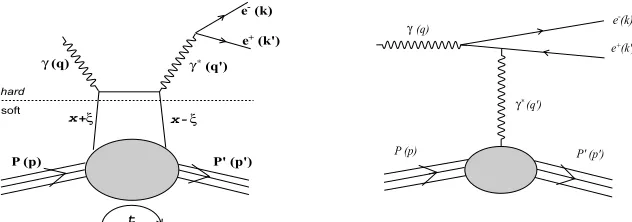
Timelike Compton Scattering (TCS) correspond to the scattering of a high energy photon offa quark. A timelike virtual photon is emitted and decays into a lepton pair (Fig. 1, left panel). We will focus on TCS offthe nucleon and on the case where the virtual photon decays into an electron-positron pair of invariant mass between 2 and 3 GeV. This condition ensures to avoid the region of vector mesons resonances. It also ensures a high enough virtuality (typicallyQ2 >2 GeV2) to allow for
factoriza-tion of TCS amplitude between a hard perturbative part, which is calculable, and a non perturbative
P' (p') P (p)
γ(q) γ∗ (q') (k') + e
(k) -e
hard
soft
x+ξ x-ξ
t
P' (p') P (p)
γ(q)
∗
γ(q')
(k') + e
(k)
-e
Figure 1.Left panel: diagram for TCS offthe nucleon, right panel: Bethe-Heitler process. Crossed diagrams are not represented.
part corresponding to low energy interactions in the nucleon. The later could be parameterized by Generalized Parton Distributions (GPDs) [1–5]. The GPDs are Fourier transform into momentum space of the QCD bilocal operators involved in the soft part of the amplitude. Without taking acount evolution effects (running in Q2), the GPDs depend on 3 independent variables, x, ξandt, which
represent respectively the longitudinal momentum fraction carried by the struck quark, the longitu-dinal momentum transfer to the quark (withξ 2sQ−Q22 for TCS on a fixed nucleon target) and the
4-momentum transfer squaredt =(p−p)2. GPDs contain the correlation between the longituninal
momentum fractionxof the struck quark and its transverse spatial distribution, implicitely contained in thet (momentum transfer squared) dependence. For instance, it can be shown in a model inde-pendent way [6] that the Fourier transform of GPD(x, ξ = 0,t) gives the probability to find a quark with momentum fraction xof the nucleon at a transverse distanceb⊥ of the center of the nucleon, whereb⊥is the conjugate variable oft. At leading twist, the amplitude for massless quarks involves 4 chiral-even GPDs (without quark helicity flip) that are associated to 4γmatrix structures: vector (GPDH), tensor (GPDE), axial (GPD ˜H) and pseudo-scalar (GPD ˜E).
TCS interfers with Bethe-Heitler (BH) process (Fig. 1, right panel), where the lepton pair comes from splitting of the initial photon and one lepton of the pair interacts with the nucleon. BH non perturbative part is parameterized by Form Factors.
TCS offthe proton was originally theoretically investigated in [7, 8]. The TCS and BH unpolar-ized, circularly and linearly beam polarized cross sections were derived. In our study, we calculated the BH and TCS amplitudes, where we waived some of thet/Q2andM2/Q2(where M is the proton
Figure 2.Left panel: scheme of the TCS reaction in theγPC.M.. The red arrows represent the 3 polarization states for the proton (along thex, yorzaxis, where thexzplane is the reaction plane) and 2 polarization states for a linearly polarized photon (along thex−andy−axis). The angle between the beam polarization vector and the reaction plane is notedΨ. Right panel: we boost the system and we define the 2 decay angles of the electron in thee+e−C.M., whereθandφare respectively the polar and azimuthal angles with respect to theγPplane and the direction of theγ∗axis.
2 Observables
2.1 Unpolarized cross section and formalism
The unpolarizedγP→e+e−P(wherePstands for a proton or a neutron) cross section depends on 5 independent kinematic observables. We decided to derive it at fixed beam energy or at fixedξ, where it can be expressed as a function of the kinematic variablesQ2 andtand as a function of the solid
angle of the electron in theγ∗rest frame,Ω =(θ, φ) (Fig. 2). At fixed beam energy the unpolarized cross section reads
d4σ
dQ2dtdΩ =
1
64 (2π)4 (2MEγ)2 |T
BH+TTCS|2, (1)
whereTBH andTTCS are respectivelly the BH and the TCS amplitudes. The|TBH+TTCS|2term is
averaged over the proton and photon polarization and summed over the outgoing proton helicities.
We use a frame were the average photon momenta ¯q = 1
2(q+q) and nucleon momentaP = 1
2(P+P) are collinear along thez−axis and in opposite directions. We define the lightlike vectors
along the positive and negativezdirections as:
˜
pμ=P+/√2(1,0,0,1),
nμ=1/P+·1/√2(1,0,0,−1), (2)
and we define the light-cone components a± by a± ≡ (a0 ±a3)/√2. The light cone momentum
fractionsxandξare defined respectively byk+ = xP+and byΔ+ = −2ξP+whereΔ = (p−p) = (q−q). In the asymptotic limit (neglecting terms int/Q2), the variableξcan be expressed as a
function ofQ2 ands, the squared center of mass energy, asξ = Q2
2s−Q2. The results that we present in this proceeding are calculated for the asymptotic limit. Within this formalism, the BH amplitude reads
TBH =−e
3
Δ2 u(p¯
)Γν
u(p) μ(q) ¯u(k)
γμ k− q
(k−q)2γν+γν
q− k
(q−k)2γμ
with the virtual photon-proton electromagnetic vertex matrix
Γν=γν F1(t)+
iσνρΔρ
2M F2(t). (4)
In this work, we used the Dirac and Pauli form factorsF1(t) andF2(t) parameterization of [11, 12].
The TCS amplitude reads (using Ji convention for the GPDs [5]):
TTCS =−e 3
q2 u¯(k)γ
νv
(k) μ(q)
(5)
1 2(−gμν)⊥
1
−1 dx
1 x−ξ−i +
1
x+ξ+i H
p(x, ξ,t)¯u(p) nu(p)+Ep(x, ξ,t)¯u(p)iσαβn
α Δβ 2Mu(p)
−i( νμ)⊥
1
−1 dx
1 x−ξ−i −
1
x+ξ+i H˜
p(x, ξ,t)¯u(p) nγ
5u(p)+E˜p(x, ξ,t)¯u(p)γ5Δ
.n
2Mu(p) .
We have used the metrics
(−gμν)⊥=−gμν+p˜μnν+p˜νnμ,
( νμ)⊥= νμαβ nαp˜β, (6)
and we used the VGG model for the GPDs parameterization [13, 14]. More details about the formal-ism may be found in [9].
2.2 Single spin asymmetries
Single spin asymmetries with a polarized target or a polarized photons beam are defined as
AU (ALU, AUi)=
σ+−σ−
σ++σ−, (7)
where the notationsAU,ALUandAUicorrespond respectivelly to the circularly polarized beam spin
asymmetry, the longitudinally polarized beam spin asymmetry and the target spin asymmetries with a nucleon polarized along thei−axis, wherei = x, yorz. Theσ±terms stand for the 4-differential polarized cross sections, with a polarization vector in the direction of the corresponding axis (+sign) or in the opposite direction (−sign). TheAUandAUiasymmetries are proportionnal to the imaginary
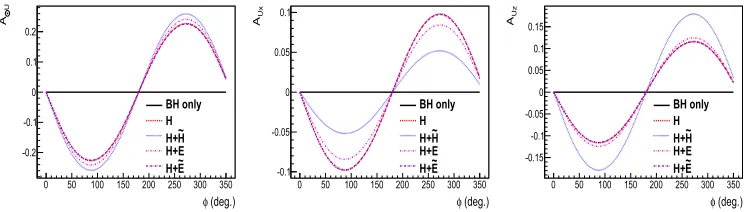
part of the amplitudes and are sensitive to the interference between BH and TCS. They would cancel if they were only BH in the reaction. This fact simplify the extraction of physics information about the imaginary part of TCS amplitude by fitting the asymmetries with a phenomenological model. We display on Fig. 3 theAU,AU x andAUz asymmetries as a function ofφ. The different curves
correspond to different scenarii of GPD parametrization. These results show that these observables are mostly sensitive to the GPDH, and present non negligible sensitivities to the GPDs ˜HandE.
(deg.) φ
0 50 100 150 200 250 300 350
U A -0.2 -0.1 0 0.1 0.2 BH only H H~ H+ H+E E~ H+ (deg.) φ
0 50 100 150 200 250 300 350
Ux A -0.1 -0.05 0 0.05 0.1 BH only H H~ H+ H+E E~ H+ (deg.) φ
0 50 100 150 200 250 300 350
Uz A -0.15 -0.1 -0.05 0 0.05 0.1 0.15 BH only H H~ H+ H+E E~ H+
Figure 3.Single spin asymmetries as a function ofφfor BH and for BH+TCS, with different scenarii of GPD
parametrization. Left panel:AU, central panel: AU x, left panel:AUz. Calculation have been done forξ =0.2
(Eγ11.2 GeV),t=−0.4 GeV2,Q2=7 GeV2andθintegrated over [45◦,135◦].
2.3 Proton and neutron comparison: circularly polarized beam spin asymmetry
Nucleon GPDs decompose into quark GPDs as
Hp= 4 9H
u+1
9H
d; Hn =4
9H
d+1
9H
u, (8)
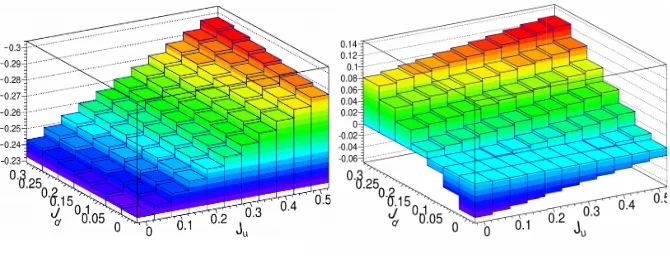
whereHp,n are proton or neutron GPDs and Hu,d are GPDs for quarks uor d. The knowledge of both proton and neutron GPDs leads to quark flavor decomposition. An other interest of studying both proton and neutron TCS comes from that some factors in the amplitudes may enhance some GPD dependencies for one of the nucleon more than for the other one. Indeed proton and neutron TCS observables may present different sensitivities to GPDs and different kinematic distributions. Fig. 4 presents the circularly polarized beam spin asymmetries and its quark angular momentaJuand
Jd dependencies, entering GPD E parametrization. We notice a∼ 3 times stronger sensitivity (for
this kinematic) to quarks angular momenta for the neutron, accompagnied by a sign change of the asymmetry. More details about comparison of TCS offthe proton and offthe neutron may be found in [10].
3 Experimental perspectives for TCS at JLab at 12 GeV
Several programs aiming at measuring TCS offthe proton at JLab at 12 GeV have been developped or are still in development. Two proposals [15, 16] have been already approved. Both of them aim at measuring the unpolarized BH+TCS cross section and the circularly polarized beam spin asymme-try. The proposal [15] plans to run for 100+20 days at a luminosity of 1035 cm−2s−1 with the JLab
Hall B large acceptance CLAS12 spectrometer. An analysis using the CLAS spectrometer and the 6 GeV electron beam has been performed [17]. It shows the experimental feasibility of such measure-ment in JLab Hall B. The proposal [16] plans to measure the same observables with the SoLID large acceptance spectrometer in Hall A, with a luminosity of 1037 cm−2s−1 for 50 days. The luminosity improvement of Hall A will provide a better precision for the study of theQ2andtevolution of the
Figure 4.Evolution of the circularly polarized beam spin asymmetries for TCS+BH offthe proton (left) or off
the neutron (right) as a function of the quark angular momentaJuandJd. Calculation have been done forξ=0.2
(Eγ11.2 GeV),t=−0.4 GeV2,Q2 =7 GeV2,φ=90◦andθintegrated over [45◦,135◦]. Four nucleon GPD
enter TCS parametrization.
GeV. They are complementary. Another program is in development for the JLab Hall C with the NPS spectrometer. It aims at measuring the single target spin asymmetries using a transversally polarized NH3target [18]. The main interests of these measurement are the sensitivity of the transverse target
spin asymmetries to the GPDs ˜Hand E and the fact that these observables have never been measured and will provide new independent constrains to CFF fits.
The measurement of observables related to TCS offthe neutron would be complementary to TCS offthe proton and present lot of interests (see previous section). However, it is experimentaly more challenging to measure TCS offthe neutron due to a lower cross section compared to proton and due to experimental issues such as neutron detection... No experimental programs have been developped yet for such measurement, but some studies may be done in a next future.
4 Conclusion
We presented a sample of our results for TCS and BH offthe proton and offthe neutron. We shown some of the single and double beam and/or target polarized spin asymmetries. We then discussed the interest of their experimental measurement in a purpose of extracting Compton Form Factors in order to parametrize the GPDs. We also presented some of the experimental perspectives for studying TCS at JLab at 12 GeV.
References
[1] K. Goeke, M. V. Polyakov and M. Vanderhaeghen, Prog. Part. Nucl. Phys.47, 401 (2001). [2] M. Diehl, Phys. Rept.388, 41 (2003).
[3] A.V. Belitsky, A.V. Radyushkin, Phys. Rept.418, 1 (2005).
[4] M. Guidal, H. Moutarde and M. Vanderhaeghen, Rept. Prog. Phys.76, 066202 (2013). [5] X. Ji, Phys.Rev.Lett.78, 610 (1997); Phys.Rev.D55, 7114 (1997).
[7] E. R. Berger, M. Diehl and B. Pire, Eur. Phys. J. C23, 675 (2002).
[8] A. T. Goritschnig, B. Pire and J. Wagner, Phys. Rev. D89(2014) 9, 094031 [9] M. Boër, M. Guidal and M. Vanderhaeghen, Eur. Phys. J. A51(2015) 8, 103. [10] M. Boër, M. Guidal and M. Vanderhaeghen, arXiv:1510.02880 [hep-ph].
[11] O. Gayouet al.[Jefferson Lab Hall A Collaboration], Phys. Rev. Lett.88(2002) 092301 [12] E. J. Brash, A. Kozlov, S. Li and G. M. Huber, Phys. Rev. C65(2002) 051001
[13] M. Vanderhaeghen, P.A.M. Guichon and M. Guidal, Phys. Rev. Lett.805064 (1998) [14] M. Vanderhaeghen, P. A. M. Guichon and M. Guidal, Phys. Rev. D60094017 (1999).
[15] M. Guidal, T. Horn, P. Nadel-Turonski, R. Paremuzyan, S. Stepanyanet al.and the CLAS Col-laboration,Jefferson Lab. PAC 39 proposal E12-12-001, (2012).
[16] M. Boër, P. Nadel-Turonski, J. Zhang, Z. Zhaoet al.and the SoLID coll.,Jefferson Lab. PAC 43 proposal E12-12-006A (2015).
[17] R. Paremuzyan, PhD thesis, Yerevan Institute,Time-like Compton Scattering, (2010).