Int. J. Electrochem. Sci., 8 (2013) 6343 - 6353
International Journal of
ELECTROCHEMICAL
SCIENCE
www.electrochemsci.org
Effect of Operating Parameters on Electrochemical Degradation
of Estriol (E3)
Te-San Chen, Kuo-Lin Huang*
Department of Environmental Science and Engineering, National Pingtung University of Science and Technology, Pingtung 91201, Taiwan (ROC)
*
E-mail: [email protected]
Received: 28 February 2013 / Accepted: 23 March 2013 / Published: 1 May 2013
This study investigates the effect of operating parameters on the electrochemical (anodic) degradation of estriol (E3) in aqueous solutions. We mainly focused on the use of a boron-doped diamond (BDD) electrode for the E3 degradation at various current densities, initial E3 concentrations, and temperatures. The performance of BDD for E3 degradation was compared with that of Ti/Pt and a dimensional stable anode (DSA). The oxidation of E3 on BDD was found to be electrochemically irreversible according to cyclic voltammetric analysis. In electrolysis, the degradation (anodic oxidation) of E3 was a pseudo-first-order (kinetic) reaction, which yielded an apparent rate constant of 8.9×10⁻³
s-1 on BDD at 20 mA/cm2 and 30°C in 0.1M Na2SO4 electrolyte. The degradation of E3 along with chemical oxygen demand (COD) removal was better on the BDD than on the Ti/Pt and DSA. Approximately 5 min was needed to achieve ~100% E3 (500 µg/L) degradation at 50–100 mA/cm2, whereas the required electrolysis time was double at 20 mA/cm2. The degradation efficiency of E3 noticeably decreased as initial E3 concentration increased, while the effect of temperature (30–70°C) was relatively slight on E3 degradation. The activation energy was 3.56 kJ/mol for the E3 degradation on BDD.
Keywords: Boron-doped diamond; Endocrine disrupting chemicals; Estriol; Degradation; Electrochemical
1. INTRODUCTION
ethynylestradiol (EE2) and 17β-estradiol (E2) two of most potent estrogenic compounds, followed by estrone (E1) and estriol (E3) [9]. These natural and synthetic estrogens are primarily of concern because they can adversely affect a number of aquatic species at very low concentration (ng/L level) [10, 11].
Sewage treatment plants (STPs) and livestock wastewaters are both of the major sources of estrogens released to the aquatic environment [12−14]. For instance, Sim et al. [14] measured estrogens in the wastewater samples collected from several municipal wastewater treatment plants (M-WWTPs), livestock wastewater treatment plants (L-(M-WWTPs), hospital WWTPs (H-(M-WWTPs), and pharmaceutical manufacture WWTPs (P-WWTPs) in Korea. They found that the concentrations of estrogens in the WWTP influents were 0.011 to 8.15 µg/L for E1, ND to 0.634 µg/L for βE2, ND to 0.766 µg/L for αE2, ND for EE2, and 0.046 to 2.28 µg/L for E3. In general, STPs can not completely or effectively remove trace levels of steroid estrogens in wastewater [15, 16]. Therefore, estrogens are often found in surface waters. According to a US national survey between 1999 and 2000 of 139 polluted streams and rivers, estrogens ranged from <5 to 112 ng/L for E1, <5 to 93 ng/L for E2, <5 to 51 ng/L for E3, and <5 to 831 ng/L for EE2; moreover, the detection frequencies were 7.1%, 10%, 21.4%, and 15.7%, for E1, E2, E3, and EE2, respectively [17]. With a higher water solubility of the estrogens, E3 is the metabolite and breakdown product of E1 and E2, and it is often detected at higher levels than E1, E2, and EE2 in M-WWTP influent [14, 18]. When considering the serious adverse impacts of E3 on our environment and health, it is quite urgent to develop approaches for removing E3 to minimize its contamination in the environment. However, little information is available on the destruction of E3 in aquatic environment.
Electro-oxidation can be regarded as a simple, rapid, and clean approach for the destruct of emerging environmental pollutants in water and wastewater [19]. Recently, many studies have been carried out to investigate the destruction of toxic organic contaminants on synthetic BDD thin film anodes [20−22]; in addition, the BDD electrode material exhibited several unique advantages and could achieve total mineralization of the toxic organic contaminants in wastewater. Nevertheless, to the best of our knowledge, the electro-degradation of E3 on BDD has not been addressed yet in literature. Thus, this study aims to investigate the electrochemical degradation of E3 at a BDD electrode in aqueous solutions under galvanostatic control. The effects of current density, initial concentration of E3, electrolyte temperature, and anode materials on E3 electro-degradation were evaluated.
2. MATERIALS AND METHODS
2.1. Chemicals and Materials
[image:3.596.194.410.273.381.2]
non-soluble substances. The exact concentration of this stock solution was measured through a high performance liquid chromatography (HPLC) technique which used the standard solutions of E3 (in CH3CN solvent) (see section 2.4 below). The working solution with required concentration was obtained by diluting the stock solution using 0.1 M Na2SO4. The BDD electrode was purchased from CONDIAS GmbH (Germany) (substrate: Niobium; BDD coating thickness: 2.0 mm), while the dimensional stable anode (DSA) (Ti/IrO2) and Ti/Pt (Pt coating thickness: 25 µm) electrode were supplied from SPEMET Co. Ltd. (Taiwan). The ion exchange separator (AMI-7001, Membranes International Inc.) is a type of strong base anion exchange membrane with quaternary ammonium functional groups [23]. Besides, Na2SO4 (SHOWA Co. Ltd. (Japan)) was employed to prepare the supporting electrolyte. HPLC analytical grade acetonitrile was purchased from ECHO Chemical Co. Ltd. (Taiwan).
Figure 1. Molecular structure of estriol (E3) [24].
2.2. Electrochemical Measurement
The electrochemical behaviors of E3 in the prepared solutions were investigated with cyclic voltammetry (CV). The potential scan range was 0↔1.2 V (starting/ending at 0 V and scan rate rate = 100 mV/s) for the CV measurements. A CHI 660B electrochemical work station connected with a personal computer was used to conduct the voltammetric measurements. The working electrode was a BDD disk electrode (WINDSOR SCIENTIFIC Co. Ltd. (UK)) with an area of 0.07 cm2 and the counter electrode was a platinum wire. An Ag/AgCl electrode (3 M KCl, 0.207 V vs SHE (standard hydrogen electrode) at 25°C) was used as the reference electrode.
2.3. E3 Electrolysis
DDW. All the electrolytic experiments were performed using a DC power supply (Good Will Instrument Co. Ltd. GPS-2303). The cell voltage and current were monitored with time based on the readings of DC power supply. Samples were taken at intervals during the electrolysis. The concentrations of residual E3 in samples were analyzed by a HPLC instrument (see below).
2.4. Analysis
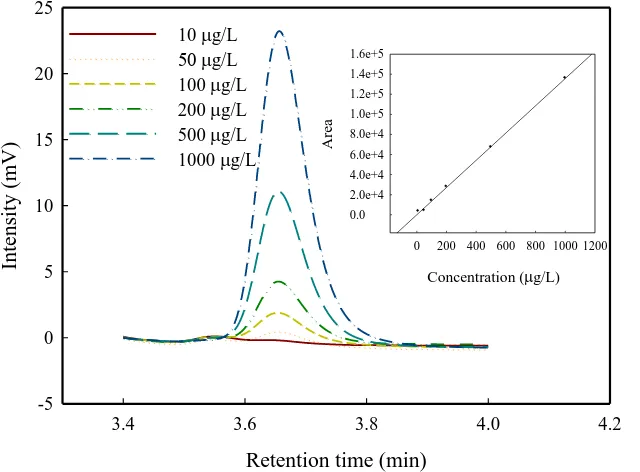
The concentrations of E3 were measured by HPLC (Hitachi chromaster 5420). The separations were performed on a RP-C18 column (250 mm×4.6 mm, particle size, 5µm). The mobile phase was acetonitrile/water (45:55, v/v), with a flow rate of 1mL/min. The injection volume was 20 µL and the working wavelength for quantitative analysis was 205 nm. A personal computer equipped with a Hitachi chromaster system manager for HPLC systems was used to acquire and process chromatographic data. The retention time of E3 was determined to be 3.65 min (Fig. 2). Triplicate measurements were conducted for a series of prepared E3 standard solutions to determine the measurement errors of the HPLC method. The relative standard deviations (RSDs) were 1.2−2.9% in a range of low E3 concentrations (10−1000 µg/L). The linear fitting of calibration curve yielded an R2 value of 0.999 (the inset in Fig. 2). Chemical oxygen demand (COD) measurements were performed to evaluate the abatement of organic compounds during the degradation of E3 and intermediates. For the determination of COD (consistent with the closed reflux colorimetric method), 2 mL of sample was introduced into a commercially available digestion tube and the mixture was then heated for 120 min at 150°C. The reduced amount of oxidizing agent was subsequently determined colorimetrically using a colorimeter (Hach DR/890) and expressed as the COD.
Retention time (min)
3.4 3.6 3.8 4.0 4.2
Int
en
sity
(
m
V
)
-5 0 5 10 15 20 25
10 g/L
g/L
100 g/L 200 g/L 500 g/L 1000 g/L
Concentration (g/L)
0 200 400 600 800 1000 1200
A
rea
0.0 2.0e+4 4.0e+4 6.0e+4 8.0e+4 1.0e+5 1.2e+5 1.4e+5 1.6e+5
[image:4.596.134.454.475.711.2]
3. RESULTS AND DISCUSSION
3.1. Cyclic voltammetry
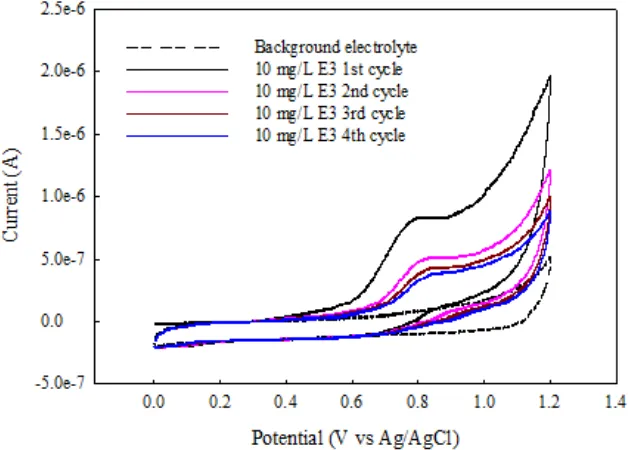
Cyclic voltammetric experiments were performed to examine the electrochemical behavior of E3 at BDD in sodium sulfate solution (supporting electrolyte, 0.1 M). Fig. 3 shows the cyclic voltammograms of 10 mg/L E3 in 0.1 M Na2SO4. As can be seen from Fig. 3, during the first anodic sweep from 0 to 1.2 V, a well-shaped oxidation peak is observed at about 0.78 V versus Ag/AgCl. In the reverse scan from 1.2 to 0 V, no corresponding reduction peak is observed, suggesting that the electrochemical oxidation of E3 at BDD is totally irreversible. Additionally, as the number of cycle increased, the anodic peak current decreased until a steady state is reached. This phenomenon has also been observed in the anodic oxidation of other phenolic compounds such as phenol [25], nitrophenols [26, 27], chlorophenols [28], polyhydroxybenzene [29], and 17β-estradiol (E2) [30] on BDD electrodes. This phenomenon can be attributed to the deposition of organic films on BDD surface that deactivate the electrode. According to some earlier investigations [25, 29, 30], this fouling layer can be removed by anodic polarization in the potential region of water decomposition (>2.3 V).
Figure 3. Cyclic voltammograms of E3 solution (10 mg/L) and background electrolyte (0.1 M Na2SO4) on BDD electrode at 25°C. Scan rate = 100 mV/s.
3.2. Effect of current density
[image:5.596.133.447.354.579.2]
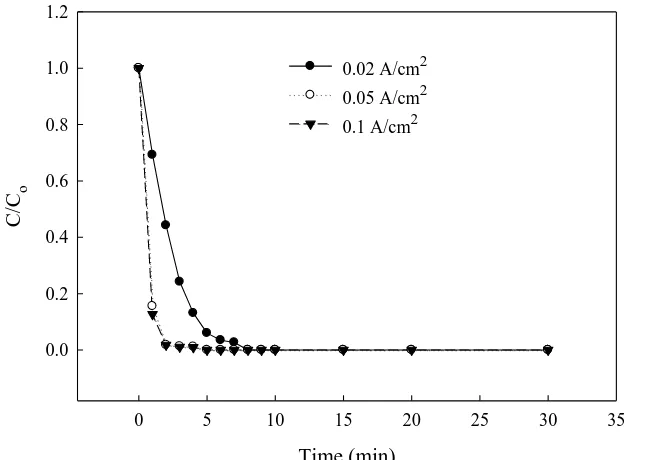
efficiencies of E3 were similar at 50 and 100 mA/cm2; nevertheless, most of E3 could be degraded in a very short time (<2 min) in the electrolysis. Near 100% E3 degradation could be accomplished within 10 min electrolysis at 20 mA/cm2, and only one half (5 min) was required at 50–100 mA/cm2. Because the E3 degradation reaction was too fast at high Iappl (50 and 100 mA/cm2), the low current density (20 mA/cm2) was used to carry out the subsequent tests in this study based on sampling consideration.
Time (min)
0 5 10 15 20 25 30 35
C
/C
o
0.0 0.2 0.4 0.6 0.8 1.0 1.2
0.02 A/cm2
0.05 A/cm2
0.1 A/cm2
Figure 4. Effect of current density on E3 degradation at BDD anode. (E3, 500 µg/L; electrolyte, 0.1M Na2SO4; T, 30°C; separator, AMI-7001).
3.3. Effect of initial E3 concentration
[image:6.596.137.462.179.409.2]
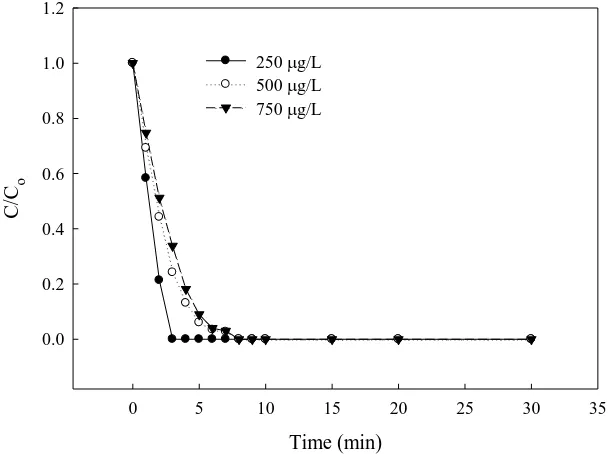
(especially major intermediates) with ·OH might lead to the side reactions and parallel consumption of ·OH [31]. Nevertheless, the difference in degradation efficiency due to various initial E3 concentrations was negligible after the electrolysis for 8 min because of the depletion of E3.
Time (min)
0 5 10 15 20 25 30 35
C
/C
o
0.0 0.2 0.4 0.6 0.8 1.0 1.2
250 g/L 500 g/L 750 g/L
Figure 5. Effect of different initial concentration on E3 degradation with BDD anode; inset: ln (C/Co) against time (current density, 20 mA/cm2; electrolyte, 0.1M Na2SO4; T, 30°C; separator, AMI-7001).
3.4. Effect of anode material
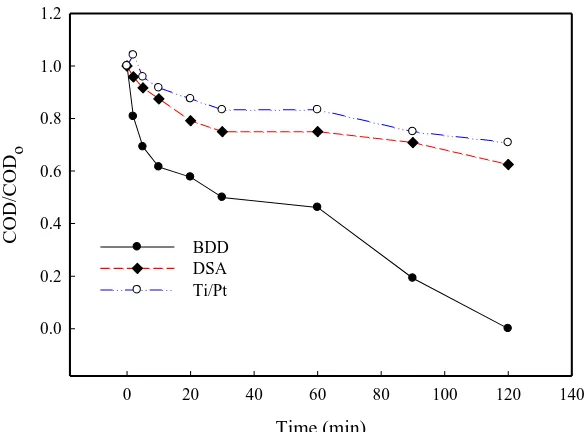
It is well known that the anodic oxidation of organics is strongly dependent on anode material. In this study, three anodes (BDD, Ti/Pt, and DSA) were compared for their performance of E3 oxidation at 20 mA/cm2 (E3 initial concentration = 500 µg/L). Fig. 6 shows that for E3 degradation, BDD anode was clearly superior to Ti/Pt and DSA, although the DSA was slightly better than the Ti/Pt. It was noted that after 8 min constant current electrolysis, no residual E3 was detected when BDD was used as the anode. At the same electrolysis time, however, the degradation efficiency of E3 was only about 19.3% and 27.1% on the Ti/Pt and DSA anodes, respectively. To achieve 100% E3 degradation, the Ti/Pt and DSA anodes needed more than 30 min, which was almost four-fold longer that BDD did. Likewise, the trend of COD removal was similar to that of E3 on the three anodes. For 120 min electrolysis of E3, BDD achieved an 100% COD removal (complete mineralization of E3) whereas the COD removal on DSA was less than 40% and that on Ti/Pt was even lower (Fig. 7).
[image:7.596.142.447.145.372.2]
metal)); in general, ·OH is more effective than O in MOx+1 for organic pollutant oxidation. A higher anodic potential may generate a greater electron trapping activity, favorable to the direct oxidation of organic pollutants on the anode surface [32] and the production of ·OH from water electrolysis for ·OH-mediated reactions [33]. The more free or adsorbed ·OH produced on the BDD than on the MOx+1 might cause electrophilic attack of E3 (with an aromatic ring) and its derivatives. As a result, the magnitude of E3 degradation efficiency or its mineralization rate was in order BDD > DSA > Ti/Pt. Some researchers also indicated that BDD electrodes were superior to Pt and GC anodes for the electro-oxidation of organic pollutants (e.g., bisphenol A) [34, 35].
Time (min)
0 10 20 30
C
/C
o
0.0 0.2 0.4 0.6 0.8 1.0 1.2
BDD Ti/Pt DSA
Figure 6. Comparative study of different electrodes on E3 degradation with equal surface area of 1 cm2. (E3, 500 µg/L; current density, 20 mA/cm2; electrolyte, 0.1M Na2SO4; T, 30°C; separator, AMI-7001).
Time (min)
0 20 40 60 80 100 120 140
C
OD
/C
OD
o
0.0 0.2 0.4 0.6 0.8 1.0 1.2
BDD DSA Ti/Pt
[image:8.596.153.431.226.432.2] [image:8.596.144.437.500.716.2]
3.5. Effect of temperature
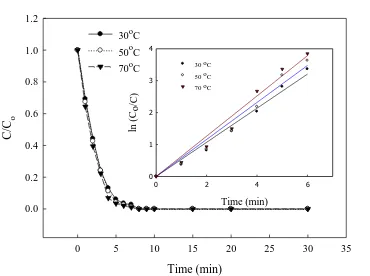
The increase of temperature (30–70°C) slightly increased the degradation of E3 at 20 mA/cm2 (Fig. 8). Similarly, Mahmoud and Ahmed [36] observed that phenol degradation was nearly complete as the solution temperature reached 25°C and further phenol removal was negligible at >25°C on Ni-Al2O3 composite-coating electrodes. Furthermore, the regressions of E3 degradation data were all linear (R2 = 0.97−0.98) for the three different concentrations (the inset in Fig. 8). Accordingly, the degradation of E3, is simplified to a bimolecular reaction between E3 and ·OH, and can be regarded as a pseudo-first-order reaction, if the concentration of ·OH does not change significantly.
] 3 [ ] ][ 3 [ ] 3 [ E k OH E k dt E d app (1)
where the k and kapp in Eq. 1 are the rate constant and apparent (pseudo-first-order) rate constant of reaction, respectively.
The obtained pseudo-first-order rate constants (kapp) are 8.9×10⁻³, 9.6×10⁻³, and 1.05×10⁻² s-1 at 30, 50, and 70°C, respectively. The activation energy Ea value calculated using Arrhenius’s law was 3.56 kJ/mol for the E3 degradation. For a diffusion-controlled homogeneous reaction, the Ea value is typically less than 40 kJ/mol [37]. It is inferred that the E3 oxidation was probably a diffusion-controlled reaction.
Time (min)
0 5 10 15 20 25 30 35
C /C o 0.0 0.2 0.4 0.6 0.8 1.0 1.2
30oC 50oC 70oC
Time (min)
0 2 4 6
ln (C o /C ) 0 1 2 3 4 30 oC 50 oC 70 oC
Figure 8. Effect of temperature on E3 degradation with BDD anode; inset: ln (Co/C) against time (E3, 500 µg/L; current density, 20 mA/cm2
[image:9.596.117.487.433.709.2]
4. CONCLUSIONS
In this study, well-defined irreversible cyclic voltammograms were obtained for the oxidation of E3, indicating that the E3 oxidation was irreversible on the BDD electrode. E3 can be completely degraded using the BDD anode in short-time electrolysis and the degradation of E3 was a pseudo-first-order reaction.
The degradation of E3 increased with increasing applied current density (20−100 mA/cm2) at 30°C. Although the degradation efficiencies of E3 were similar at 50 and 100 mA/cm2
, most of E3 could be electrochemically degraded in a very short time (<2 min). The performance of tested anodes for E3 degradation in terms of E3 degradation and COD removal efficiencies was in order BDD > DSA > Ti/Pt. When the BDD electrode was used, after 8-min constant current electrolysis, no residual E3 was detected; at the same electrolysis time, the degradation efficiencies of E3 were only approximately 19.3% and 27.1% on the Ti/Pt and DSA anodes, respectively. Additionally, the degradation efficiency of E3 decreased as the initial E3 concentration increased. The apparent rate constant of E3 degradation on the BDD anode slightly increased (8.9×10⁻³ to 1.05×10⁻² s-1) with the increase of temperature (30−70°C) at 20 mA/cm2
in 0.1M Na2SO4 electrolyte. Furthermore, the activation energy was 3.56 kJ/mol for E3, revealing that the E3 electro-oxidation is a diffusion-controlled. The use of the BDD electrode is very promising for the degradation of E3 in aqueous solutions at room temperature.
ACKNOWLEDGMENTS
The authors thank the National Science Council of Taiwan for financial support of this research under contract nos. NSC−100−2221−E−020−007−MY2, and NSC−101−2221−E−020−021.
References
1. M. Kuster, M.J. López de Alda, D. Barceló, Trends Analyt. Chem. 23 (2004) 790. 2. T. Colborn, F.S. vom Saal, A.M. Soto, Environ. Health Perspect. 101 (1993) 378.
3. S. Jobling, M. Nolan, C.R. Tyler, G. Brighty, J.P. Sumpter, Environ. Sci. Technol. 32 (1998) 2498. 4. C. Desbrow, E.J. Routledge, G.C. Brighty, J.P. Sumpter, M. Waldock, Environ. Sci. Technol. 32
(1998) 1549.
5. N. Hirai, A. Nanba, M. Koshio, T. Kondo, M. Morita, N. Tatarazako, Aquat. Toxicol. 77 (2006) 78. 6. S. Zuehlke, U. Duennbier, T. Heberer, B. Fritz, Ground Water Monit. R. 24 (2004) 78.
7. S.K. Khanal, B. Xie, M.L. Thompson, S. Sung, S.K. Ong, J.H. Van Leeuwen, Environ. Sci. Technol. 40 (2006) 6537.
8. W. Zheng, S.R. Yates, S.A. Bradford, Environ. Sci. Technol. 42 (2008) 530.
9. L.C. Folmar, M.J. Hemmer, N.D. Denslow, K. Kroll, J. Chen, A. Cheek, H. Richman, H. Meredith, E.G. Grau, Aquat. Toxicol. 60 (1-2) (2002) 101.
10. G.H. Panter, R.S. Thompson, J.P. Sumpter, Aquat. Toxicol. 42 (4) (1998) 243. 11. L.K. Irwin, S. Gray, E. Oberdorster, Aquat. Toxicol. 55 (1-2) (2001) 49.
12. T.A. Ternes, M. Stumpf, J. Mueller, K. Haberer, R.-D. Wilken, A. Servos, Sci. Total Environ. 225 (1999) 81.
14. W.-J. Sim, J.-W. Lee, S.-K. Shin, K.-B. Song, J.-E. Oh, Chemosphere 82 (2011) 1448. 15. A.C. Johnson, J.P. Sumpter, Environ. Sci. Technol. 35 (2001) 4697.
16. L. Racz, R.K. Goel, J. Environ. Monit. 12 (2010) 58.
17. D.W. Kolpin, E.T. Furlong, M.T. Meyer, E.M. Thurman, S.D. Zaugg, L.B. Barber, H.T. Buxton, Environ. Sci. Technol. 36 (2002) 1202.
18. V. Gabet-Giraud, C. Miège, J.M. Choubert, S. Martin Ruel, M. Coquery, Sci. Total Environ. 408 (2010) 4257.
19. G. Chen, Sep. Purif. Technol. 38 (2004) 11.
20. A.M. Polcaro, A.Vacca, M. Mascia, S. Palmas, Electrochim. Acta 50 (2005) 1841. 21. M. Panizza, G. Cerisola, Electrochim. Acta 49 (2004) 3221.
22. J.F. Zhi, H.B.Wang, T. Nakashima, T.N. Rao, A. Fujishima, J. Phys. Chem. B 107 (2003) 13389. 23. Membrane International Inc., http://membranesinternational.com/ (2013).
24. K.D. Santos, O.C. Braga, I.C. Vieira, A. Spinelli, Talanta 80 (2010) 1999.
25. J. Iniesta, P.A. Michaud, M. Panizza, G. Cerisola, A. Aldaz, C. Comninellis, Electrochim. Acta 46 (2001) 3573.
26. P. Cañizares, C. Saez, J. Lobato, M.A. Rodrigo, Electrochim. Acta 49 (2004) 4641. 27. P. Cañizares, C. Saez, J. Lobato, M.A. Rodrigo, Ind. Eng. Chem. Res. 43 (2004) 1944.
28. M.A. Rodrigo, P.A. Michaud, I. Duo, M. Panizza, G. Cerisola, C. Comninellis, J. Electrochem. Soc. 148 (2001) D60.
29. P. Cañizares, C. Saez, J. Lobato, M.A. Rodrigo, Ind. Eng. Chem. Res. 43 (2004) 6629.
30. M. Murugananthan, S. Yoshihara, T. Rakuma, N. Uehara, T. Shirakashi, Electrochim. Acta 52 (2007) 3242.
31. B. Boye, E. Brillas, B. Marselli, P.A. Michaud, C. Comninellis, G. Farnia, G. Sandona, Electrochim. Acta 51 (2006) 2872.
32. N.V. Smirnova, G.A. Tsirlina, S.N. Pron’kin, O.A. Petrii, Russ. J. Electrochem. 35 (1999) 113. 33. C. Terashima, T.N. Rao, B.V. Sarada, D.A. Tryk, A. Fujishima, Analyt. Chem. 74 (2002) 895. 34. M. Murugananthan, S. Yoshihara, T. Rakuma, T. Shirakashi, J. Hazard. Mater. 154 (2008) 213. 35. G.F. Pereira, R.C. Rocha-Filho, N, Bocchi, S.R. Biaggio, Chem. Eng. J. 198 (2012) 282.
36. S.S. Mahmoud, M.M. Ahmed, J. Alloys Comp. 477 (2009) 570. 37. N. Belhadj-Tahar, A. Savall, J. Electrochem. Soc. 145 (1998) 3427.
![Figure 1. Molecular structure of estriol (E3) [24].](https://thumb-us.123doks.com/thumbv2/123dok_us/1911481.149705/3.596.194.410.273.381/figure-molecular-structure-of-estriol-e.webp)