National Authorising Officer – Head of Delegation of the European
Commission, Kenya
Joint Annual Operational Review
of cooperation between
The Republic of Kenya
and
The European Community
in 2003
1 Executive summary
During 2003 the Government of Kenya strived to translate the political turning point marked by the 2002 elections into a concrete programme of economic and social renewal. This centred around the refinement of the PRSP and the publication of the preliminary Economic Recovery Strategy and associated Investment Programme. Towards the end of the year, Kenya reached an agreement with the IMF for a three-year PRGF programme of support, closely followed by the first Consultative Group meeting since 1997.
The EC stood ready throughout the year to provide support to this process. Highlights included the technical support to the Public Expenditure Review process, advanced budget support of €51 million designed to lay a platform for the IMF programme, progress in the Sultan Hamud – Mtito Andei section of the Mombasa-Nairobi highway, the launching of an emergency tourism marketing campaign for Kenya in Europe, and active participation in the preparations for the Consultative Group.
The signature of the CSP in October 2003 provides a solid framework for further progress in delivering a concrete programme of support to the Government’s ERS/PRSP priorities. The CSP emphasises the importance of macroeconomic support and the associated improvements in public financial management. Support to rural development meanwhile seeks to support improved service delivery and sustainable development through support to enhanced capacity and accountability of key local institutions. Support to the infrastructure sector focuses on improved trunk road network and rural roads in order to reduce the costs of doing business whilst promoting regional integration.
This Joint Operational Review (JOR) was thus undertaken against a background of an ongoing process of steadily improving cooperation between the Government of Kenya and the EC. The process of elaborating the report followed a period of intensive contact between the NAO, the EC Delegation and implementing ministries and agencies, with participation of non-state actors.
The result of the JOR process is a proposal to retain the CSP without amendment. Both the EC and the Government of Kenya firmly believe that the cooperation programmes foreseen under the CSP are strategically well placed to make a decisive contribution to achieving the goals of the ERS/PRSP. Some minor amendments to the National Indicative Programme are proposed. The main thrust of the JOR is to identify and agree on measures to accelerate implementation. The JOR has highlighted a number of important issues that should be taken into account to accelerate the implementation of the programme. These include the following:
• Improved efficiency in the approval of project proposals and the processing of payments to be addressed through joint GoK-EU mechanisms.
• Improved dialogue on macroeconomic and fiscal policy issues with concrete steps from the Government of Kenya to form a Budget Support Donor Technical Coordination Group for donors who may wish to provide this form of assistance.
• Closure of completed programmes and reallocation of resources to the 9th EDF pipeline.
• Increased awareness of important cross-cutting issues in the implementation of the programme including , in particular, HIV-AIDS and gender issues.
• A new openness towards meaningful involvement of Non State Actors.
2 The Policy Agenda of the partner country
The challenge of unwinding the structural impediments to growth and poverty reduction that have emerged over the past twenty years in Kenya is a medium to long-term process. As a first step in this direction, the new Government has elaborated its Economic Recovery Strategy for Wealth and Employment Creation 2003- 2007 (ERS). The ERS aims to build on the new Government’s commitments by translating the nation-wide consultative process that resulted in the PRSP into a coherent programme of action. In this context, the ERS aims to provide a concrete growth strategy that will deliver 500,000 jobs per annum over the next 5 years.
The PRSP/ERS acknowledges that this will require an accelerated programme of structural reforms. The aim is to provide an enabling environment for private sector growth with the focus on tax and tariff rationalisation; market deregulation, investment in infrastructure, privatisation, and the promotion of transparency and accountability in public service in order to reduce the costs of doing business in Kenya. In this respect, the Government’s demonstrable commitment in quickly passing the Anti-Corruption and Economic Crimes Act 2003 and the Public Officer Ethics Act 2003 sent an important signal to the international community and the private sector.
A further key policy initiative in this context is the recent elaboration of an Industrial Master Plan and National Investment Code which seeks to simplify and consolidate legislation relating to private investment. In addition, the Government has presented a Privatisation Bill to Parliament in order to elaborate a transparent institutional mechanism for privatisation. This foresees the creation of an independent Privatisation Commission to oversee and implement all privatisation transactions. The PRSP/ERS also devotes substantial attention to the need to provide a more stable framework for small enterprises as an important potential pole of employment growth.
The Government and donors are working out for the establishment of a Monitoring and Evaluation framework for the ERS/PRSP and to enhance harmonisation. It is hoped that this will provide the basis for a joint annual review process on progress in the ERS/PRSP implementation. The Government also intends to establish a Secretariat to enhance coordination and review mechanisms in relation to priority areas in the ERS/PRSP. This will serve as a basis for accelerating the move towards sector-wide approaches. Concrete proposals, building on the progress made at the Consultative Group Meeting, are currently underway.
3 Update of the political, economical and social situation
The political turning point after the elections in 2002 was accompanied by the launch of an ambitious reform agenda for economic and social renewal by the new Government. The Government affirmed its commitment on the policy of zero-tolerance to corruption with legal measures put in place at an early stage through the Anti-Corruption and Economic Crimes Act 2003 and the Public Officer Ethics Act 2003. This renewed commitment towards a reform programme also led to the signing of an agreement with the IMF in November 2003 for a three-year programme of support under the Poverty Reduction and Growth Facility. Nevertheless, IMF Board Members expressed concerns that the current coalition Government may not have the capacity to deliver the ambitious reform programme inherent in the PRGF. At the same time, the Government’s attention to the reform programme in 2003 was diverted by a number of unfortunate external factors including the death of the Vice President and the subsequent mourning period and the travel advisories following threats of international tourism, and its negative effects on the tourism industry. In addition, internal divisions on the Constitutional Review process, now expected to be completed by October 2004, have taken up substantial time of both the Government and Parliament.
economic management, resulting in increased structural rigidities and distortions in the economy. With GDP growth averaging only 2.2% over the past decade, and population growth averaging 2.7% per annum over the same period, GDP per capita has declined on average by 0.5% per annum. In addition to declining per capita incomes, Kenya suffers from high social inequality. The proportion of the population living in poverty is estimated to have increased from 11.3 million (48% of the population) in 1990 to 17.1 million (56%) in 2002.
The prospects for a rapid upturn in growth, and a corresponding decline in poverty, are limited by the structural legacy of the previous decades. Thus, the continued systemic governance problems, weakened institutions and the deterioration in infrastructure act as severe constraints to investment and private sector development. The costs of doing business in Kenya are pushed up by high user fees for essential services, inefficiencies in the regulatory environment, a justified lack of confidence in the judicial system, and by grand and petty corruption. Moreover, a general lack of security reduces livelihood options and access to essential services, and deters tourists, and foreign and local investors alike The Kenya Private Sector Alliance estimates that Kenyan firms spend 4% of their operating income on security measures, while recent terrorist activity has had a further negative impact on perceptions of Kenya as a safe place to visit and do business.
In addition, the burden of disease (particularly malaria and HIV/AIDS) and the continued high fertility rate result in a reduced labour force and relatively high dependency ratio. The effect of HIV/AIDS on the economy and society is complex, and further analysis is urgently needed. But the World Bank estimates that the recent increase in mortality, largely the result of the HIV/AIDS epidemic and the persistent burden of malaria, has reduced Kenya’s annual economic growth potential by 0.7%.
Finally, the over-extension of the public sector, rising domestic debt and the weakness of budgetary prioritisation have further damaged prospects for growth and poverty reduction. Approximately Ksh65 of every KSh100 collected from Kenyans in taxes is spent paying public servants and servicing Government debt. The wage bill (excluding the armed services) totals around 41% of Government expenditure, and debt servicing around 24%. Despite some piecemeal attempts at civil service rationalisation, the public sector wage bill is still increasing faster than GDP, and now stands at 8.5% of GDP. The ratio of public investment to GDP of about 3.5%, meanwhile, is one of the lowest in sub-Saharan Africa. At the same time, expenditure on operations and maintenance also remains low at about 4.5% of GDP.
In addition to the income-based measures of poverty, Kenya has also suffered from a general decline in human development indicators. Life expectancy has declined from 57 years in 1986, to 47 years in 2000. Infant mortality, meanwhile, has increased from 62 per thousand in 1990, to 78 per thousand in 2001. Against this background, recent estimates of growth potential indicate that, even under favourable assumptions, the Millennium Development Goal of cutting in half the proportion of the population living in poverty by 2015 (a reduction to 24.2%) is not likely to be attained. Kenya’s performance with respect to the MDGs actually declined during the 1990s with the proportion of the population living in poverty increased (see Table 1). The non-income dimensions of poverty also deteriorated in Kenya during the 1990s, although Kenya’s indicators of health and education remain better than many other Sub-Saharan African countries. Gender disparities have also persisted with women having on average, lower educational attainment, less access to health services, and a heavier workload than men
The dramatic decline in life expectancy (47 years in 2001 c.f. 57 in 1990) partly reflects the HIV/AIDS pandemic (the infection rate reached 13.5 percent of the adult population in 2000), but also has a gender dimension in that girls and young women are more likely to be infected than men. Infant and child mortality have worsened. Prevalence rates in pregnant women are currently around 10% nationally, and are roughly twice as high in Nyanza and Western provinces. Approximately 1.5 million Kenyans are living with HIV (of whom less than 10% know they have the virus), around 300 die from HIV/AIDS-related illness every day, and there are 1.2 million AIDS orphans. Recent data suggest that prevalence rates may now be stabilising or even falling, but most of those infected have not yet fallen sick, so the full impact of the epidemic has yet to be felt. . The health sector is being reformed with a view to ensuring access to basic drugs and quality service, although public expenditure on health remains extremely low at $5 per capita – well below the $20 normally considered the minimum required to deliver essential services – and only a small proportion of this is spent on preventive services in rural areas where it would have most impact. Against this background, the Government is considering the restructuring of the National Health Insurance Fund (NHIF). The Government has also increased awareness on HIV/AIDS and established a Cabinet sub-committee chaired by the President. A key challenge will be ensuring an effective and equitable distribution of anti-retroviral drugs (ARVs).
A recent report1 prepared for the Government of Kenya which measures Kenya’s progress towards the MDG goals, estimates the achievement by 2015 of six of ten indicators as “unlikely” without necessary improvements in the supporting environment, which is judged as “weak” in relation to four of these ten indicators (see Table 1). The ongoing MDG costing exercise, led by UNDP, has adopted Kenya as a pilot country and should provide further information on the resources required to bridge the gap between current trends and the MDG targets.
Kenya’s statistical systems for monitoring of the above 10 MDGs are of variable quality and comprehensiveness. For several critical indicators, including poverty rates, child nutrition and access to improved water, data is only available from infrequent survey sources (WMS, KDHS etc) so that annual monitoring is not currently feasible. The most important gap in current statistical capability arises from the continued reliance for several indicators on infrequent surveys. Consideration is being given to addressing this problem through the introduction of an annual survey by the Central Bureau of Statistics (CBS). The Delegation is also discussing possible support to CBS with the NAO, focusing on refining the CBS Strategic Plan, co-financing the implementation of the proposed Integrated Household Budget Survey, and providing more medium term institutional support to CBS and the development of the National Statistical System.
1
Table 1. Millennium Development Goal (MDG) IndicatorsTargets are in Italic
No
MDG Indicator
1994 1997 2000 2001 2002 2003 2004 2005 ERS
Target
1. Prevalence of Population under $1/day (local poverty line)
40.25 52.32 56.7 56
2. Prevalence of underweight children <5years
15.3 12.3 14.1 20
3. Under 5 Yrs Mortality Rate (per ‘000)
112 (1998) 119.8 122 120 114 114 112 100 by 2008 4. Net Enrolment Ratio (Primary) 73.5 (Poor)
79.8 (NonP)
73.7 n/a n/a 79.8 81.5 83.2 85 by 2007 5. Primary Completion Rate
Boys Girls 43.9 44.6 43.0 46.4 46.3 45.8 48.9 48.3 49.6
49.8 N/A 59.4 60.6 58.1 59.7 60.0 59.1 60 60 60 6. Girl/Boy ratios in:
Primary Secondary Tertiary 0.97 0.84 0.97 0.89 0.97 0.89 0.45 0.97 0.98 0.49 0.97 0.89 100
7. Proportion of births attended by skilled health personnel
35.4 (Poor) 52.3
(Non-P)
45 70.8 75.6
8. Proportion of 1 yr old children immunised against measles
80.7 75 76 76.7 80 85 90 Raise FIC to 85%
9. HIV Prevalence among 15-24 year old pregnant women
20.1 17.2 17.7 13.0 10.2 9.4 9.2 8.4 10. Proportion of population with
sustainable access to improved water source
43.3 49.0 90% by 2006 Notes:
1. Poverty Rate: 1994 and 1997 estimates based on local poverty line (not 1$) from Welfare Measurement Surveys; 2000 Estimate derived by KIPPRA from an econometric model; 2. Underweight Children: Sources: CHANIS (simple average of sub-age groups used for 1994 estimate)
3. Under 5 Mortality rate:
4. Net Enrolment Rate: Sources: 1997: WMS; later years from MOEST/TSC MIS 5. Primary Completion Rate: Source: MOEST
6. Girl/Boy ratios in education: Source: CBS Economic Survey cited in MOEST Report of the sector Review (Feb 2003) 7. Proportion of births attended by skilled personnel: Source: 1997: WMS
8. Measles Immunisation: Sources: KEPI Surveys and MOH HMIS 9. HIV Prevalence in 14-24 year old pregnant women: Source: NASCOP
4 Overview of past and ongoing cooperation
The EC is Kenya’s second largest development partner after the World Bank. On average, annual EC aid finances 10-15% of the Government’s development budget. The implementation of the EC programme in Kenya accelerated on 2003 compared to 2002, but achievements remained behind forecasts as the following figures show:
Table 1. Financial Performance 2003 (€ million)
2003 Forecast 2003 Actual
Global Commitments 50.4 52.2
Individual Commitments 140.4 10.8
Payments 36.4 25.0
The main reasons for the shortfall were the delays in finalising the Budget Support Programme and and the launch of the Mau Mahiu – Naivasha –Lanet Road works tender.
The targets for 2004 and 2005 are as follows:
Table 2. Financial Forecasts 23004-2005 (€ million)
2004 2005
Global Commitments 173.5 41.5
Individual Commitments 127.4 87.0
Payments 106.3 139.4
The significant increase between these targets and the amounts achieved in 2003 underlines the size of the task ahead of the Government and the Commission. Steps will also be taken during 2004 to close old and dormant projects. Some 13 old and dormant projects will be closed this year, which will release €9.8 million for utilisation elsewhere.
4.1 Focal sectors
4.1.1 Macroeconomic support
a) Results
At the same time, a key challenge facing the new Government is the need to reorient public finances in favour of pro-poor expenditures against a highly constrained fiscal background. The Government has therefore adopted a programme of medium-term fiscal consolidation in the context of the macroeconomic programme supported by the IMF PRGF facility. The PRGF programme covers the period 2003/04 to 2005/06 and seeks to restore fiscal sustainability by reducing borrowing and reversing the rise in the domestic debt burden. The programme also seeks to reorient public finances away from wages towards capital investment and the delivery of services for poverty reduction.
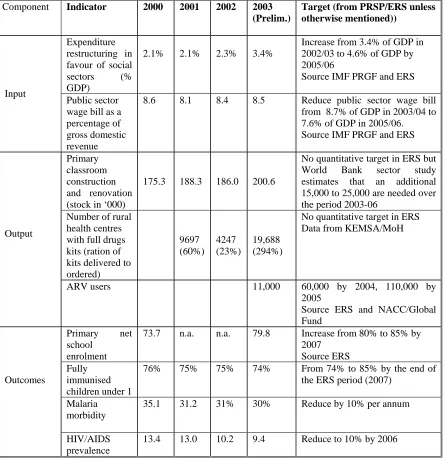
[image:8.595.52.498.329.788.2]Thus, capital expenditure is projected to rise from 3.6% of GDP in 2002/03 to 7.6% of GDP in 2005/06. Expenditure on essential poverty-focused services, meanwhile, is projected to rise from 3.4% of GDP in 2002/03 to 4.6% of GDP by the end of the programme. In order to create the fiscal space for these increased outlays, the programme includes expenditure reduction measures focusing on public sector pay and non-core goods and services. The programme therefore focuses on revising the public sector pay determination machinery and further civil service reform with a view to reducing the civil service wage bill from 8.7% of GDP in 2003/04 to 7.6% of GDP in 2005/06. (See Table 2 for further details).
Table 3: Macroeconomic Indicators
Component Indicator 2000 2001 2002 2003 (Prelim.)
Target (from PRSP/ERS unless otherwise mentioned))
Expenditure restructuring in favour of social sectors (% GDP)
2.1% 2.1% 2.3% 3.4%
Increase from 3.4% of GDP in 2002/03 to 4.6% of GDP by 2005/06
Source IMF PRGF and ERS Input
Public sector wage bill as a percentage of gross domestic revenue
8.6 8.1 8.4 8.5 Reduce public sector wage bill from 8.7% of GDP in 2003/04 to 7.6% of GDP in 2005/06. Source IMF PRGF and ERS Primary
classroom construction and renovation (stock in ‘000)
175.3 188.3 186.0 200.6
No quantitative target in ERS but World Bank sector study estimates that an additional 15,000 to 25,000 are needed over the period 2003-06
Number of rural health centres with full drugs kits (ration of kits delivered to ordered) 9697 (60%) 4247 (23%) 19,688 (294%)
No quantitative target in ERS Data from KEMSA/MoH Output
ARV users 11,000 60,000 by 2004, 110,000 by 2005
Source ERS and NACC/Global Fund
Primary net school
enrolment
73.7 n.a. n.a. 79.8 Increase from 80% to 85% by 2007
Source ERS Fully
immunised children under 1
76% 75% 75% 74% From 74% to 85% by the end of the ERS period (2007)
Malaria morbidity
35.1 31.2 31% 30% Reduce by 10% per annum Outcomes
HIV/AIDS prevalence
b) Progress in activities
The EC continues to support the Government in its efforts to develop a full PRSP through its encouragement of a results-based approach to budget support. Thus, during the formulation of the Poverty Reduction Budget Support Programme 2003-2006 (PRBS02) Financing Proposal, EC financed consultants worked closely with the Ministries of Health and Education in developing an annual series of indicators for health and education outcomes. This work is intended to feed into the Government’s ongoing efforts to refine the ERS/PRSP Implementation Matrix.
At the same time, the EC has also provided substantial assistance to the Public Expenditure Review (PER) process in an effort to support expenditure restructuring which is a key plank of the PRGF programme. This has also served to underpin progress in reflecting ERS/PRSP priorities in the budget, as outlined in the CSP. The 2004/05 Budget Circular goes some way towards setting out an integrated timetable whereby the PER is seen as the basic input into the budget allocation process. To reinforce communication and understanding between Ministry of Finance (Budget) and Ministry of Planning (PER) an Inter-Ministerial Coordination Committee has recently been established which meets on a weekly basis.
As recognised in the CSP, credible prospects for improved Public Financial Management (PFM) are the basis for implementing budget support. This requires an agreed Action Plan to be established with clear and monitorable indicators of progress in its implementation. In this context, the EC participated in the Public Expenditure Management Assessment and Action Plan (PEM-AAP) benchmarking of Kenya’s PFM systems in collaboration with the IMF, WB and DFID in April 2003. Following this, a draft PFM Action Plan was prepared and discussed at a workshop in June 2003 with the Minister and PS Ministry of Finance in attendance. This was based on the Country Financial Accountability Assessment (CFAA) update and the Public Expenditure Management Assessment and Action Plan (PEMAAP) exercise. Since then only limited progress has been made by the Government in both refining the Action Plan and implementing key recommendations of the PEMAAP. A PEMAAP update is scheduled for end March/early April 2004.
A draft Financing Proposal has been developed for a €120 million macroeconomic support programme over three years, plus a further €5 million for Institutional Support. The proposal focuses on supporting improvements in health and education sector outcomes in addition to improvements in public financial management. The FP is currently under consideration for approval by the EC. It should be highlighted, however, that disbursements are likely to be conditioned on the achievement of an additional two PEM-AAP benchmarks each year. The main macroeconomic developments and targets that PRBS02 will focus on are summarised in Table 2 above. It is anticipated that the accompanying Institutional Support will focus on support to the PER process and PFM improvements, in addition to enhancing the capacity of the Central Bureau of Statistics (CBS) in developing the Monitoring and Evaluation framework for the ERS/PRSP.
c) Integration of cross cutting themes
In view of the improved governance situation in Kenya since the 2002 elections, the new Government and the EC agreed to increase the emphasis on the macroeconomic support programme in the CSP, which at the same time placed greater emphasis on accompanying measures on governance and, in particular, improved public financial management.
of governance that are essential to achieving the objectives of the ERS/PRSP, including the efficient allocation of resources, the effective delivery of services, and attracting investment. Such measures include creating a Ministry of Justice, establishing the Kenya Anti-Corruption Commission in the Office of the President, replacing procurement officers and removing judges and magistrates, passing the Public Officer Ethics Act and the Anti-Corruption Act, and seeking adoption of legislation on public audit, the procurement and disposal of public assets, privatisation, and financial management. Both the Government and partners agreed that strong implementation of the legislation will be key to success in the fight against corruption.
Participants at the Consultative Group meeting recognized that more progress was needed in other key areas of reform, and in this regard welcomed the Government’s commitment to develop a more rational, transparent, and inclusive budget process; to institutionalise the PER in all Government ministries and to ensure that its results are reflected in the medium-term expenditure framework and in budgetary allocations; to strengthen capacity of local Governments to operate effectively within a decentralized framework; and to reform the civil services. In addition the Government informed partners that it is committed to completing the constitutional review process, and named a target date of June 2004. The challenge will be in implementing the reforms, so that budgetary allocations are truly pro-poor and public services are delivered effectively and efficiently. Development partners, civil society, and the Government agreed that all must work together to support of the reforms.
Since the CG, the Government has moved to bring the EC and other development partners into a closer relationship, building on the commitment to improved governance and improved donor harmonisation. The recent commitment by the Minister of Finance to hold Donor Coordination Group meetings every two months is a welcome step in this process. In addition, the Minister of Finance has proposed a review of the overall Government-donor coordination structure and mechanisms. More specifically, the Government has taken concrete steps in establishing a Budget Support Donor Technical Coordination Group for those multilateral and bilateral donors who wish to provide this form of assistance. The Government also proposes the formation of a small Joint Technical Working Group that will help to clarify the benchmarks for moving towards budget support, including the ERS objectives, and to provide a harmonised timetable for key decisions such as annual commitment levels, coordination of appraisal and tranche release procedures, among others. The Government also suggests a review, together with the existing Donor Technical Working Group, of necessary sectoral coordination procedures for priority areas in the ERS, as a basis for accelerating and strengthening the move towards Sector Wide Approaches.
In order to ensure all the above measures are put into place, the Government intends to establish a Secretariat to enhance coordination. The Secretariat will be facilitating preparation for and follow up on matters discussed in the Kenya Coordination Group and the Annual Consultative Group meetings as well as related issues such as facilitating the Public Expenditure Review (PER), and Public Expenditure Management Assessment and Action Plan (PEMAAP), Annual Progress Reports on the ERS, and monitoring progress on the donor harmonisation agenda.
The budget process is also becoming more open, with development partners, private sector and civil society explicitly included in the Sector Working Groups that are the focal point for budget preparation.
4.1.2 Rural Development and Agriculture
a) Results
capacity of line ministries to address accompanying measures for an enabling environment. In agriculture this fragmentation manifests itself in confusion regarding the organisation of marketing of export crops (esp. coffee) and the role of a number of non-productive parastatals. The fragmentation of the central government agriculture-related functions across a number of different ministries (Land, Livestock and Fisheries, Agriculture, Cooperatives and Marketing, Regional Development, Water etc.) also exacerbates the difficulties in developing a coherent strategic vision for the sector.
A positive development to address this is the new Government Strategy for the Revitalisation of Agriculture (SRA) to be released early 2004. Under this new framework, a review will take place of all the different laws affecting the agricultural sector (currently around 117) to bring into one common framework. It is also foreseen that the ERS implementation matrix will help improve a coherent approach and consistent measurement of sector performance, addressing the current scarcity of data.
There is a need for Government of Kenya to create an enabling environment for development of private sector initiatives. Stronger links between private sector initiatives in the agricultural sector and EC support for micro-enterprise development will be explored under the current CSP.
In the same way, continuing uncertainty around the overall approach to decentralisation creates difficulties in supporting programmes in the wider rural development sphere. The Government has nevertheless stated that, irrespective of the outcome of the Constitutional Review, it intends to strengthen the role and capacity of Local Authorities in service delivery. At the same time, however, the recent establishment of the Constituency Development Fund raises issues regarding the coordination of local planning and the respective roles of the different arms of Government.
b) Progress in activities
Ongoing projects have enjoyed mixed success against the uncertain policy background outlined above. The Smallholder Coffee Improvement Programme Phase II (STABEX) project in favour of small holder coffee farmers has been severely undermined by the chronic structural problems in the coffee sector. The recently completed coffee study should provide a way forward on this.
Studies have also been carried out in the areas of livestock and cotton (underway). Further financial support towards implementing recommendations coming out of these studies will be considered.
The KARI project (Agricultural Research Support Programme II has developed a participatory approach in the design of research programmes and appropriate technologies for farmers in the arid and semi-arid areas, and contributed to the dissemination of research results. It is drawing to a successful close, and the final evaluation and the preparation of a follow-up phase are in progress. The formulation of a further stage is dependent on a clarification of research consolidation and the expected role of KARI in extension vis a vis the Ministry of Agriculture. Some of these issues are to be addressed in the new Strategy for Revitalisation of Agriculture.
Table 4. Rural Development Indicators
The EC has been requested to support the elaboration of the Strategic Plan with work to be completed by June 2004 for the National Environment Management Authority (NEMA). It will also have to take into consideration the role of District Environment Committees. A financing proposal is also under preparation for a capacity building support programme.
In a similar way, the formulation of the Local Government support programme will have to take into account the recently established Constituency Development Fund. There is, however, confirmation from the government’s side that the Local Authority Transfer Fund (LATF) mechanism will remain a block grant to Local Authorities, conditioned on community participation through Local Authority Service Delivery Action Plans (LASDAPs).
Component Indicator 2000 2001 2002 2003 Target
Increased fiscal transfers to Local Authorities as percentage of income tax
2 5 5 5
No quantitative target in ERS: ‘proportion of budgetary resources controlled by local governments increased.’
Number of District
Environment Officers - - - 32
No quantitative target in ERS but NEMA target is to appoint one for each of the 72 districts
Input Rationalisation of agricultural research structures --establishments --staff numbers 8 7,158 9 6,934 9 6,626 7 6,055
No quantitative target in ERS but proposal to Cabinet under preparation
Local Authorities Gross Fixed Capital Formation (GFCF) as percentage of Total Government GFCF
8.4% 7.9% 4.6% 5.1%
No. of LA capital
projects 659 1291 1366 1584
No quantitative targets in ERS: ‘proportion of budgetary resources controlled by local governments increased.’ District Environmental
Action Plans prepared and approved
- - - -
10 pilot districts to finalise APs in 2004/05, thereafter roll-out to other districts (NEMA)
Output
% of HH in 11 ASAL districts aware of (adopted) improved technologies 15.4 (0.8) 19.9 (3.0) 22.6 (9.0)
SRA target: 25% annual increase (first 3 years) of access to and use of information by farmers and private sector
Reduced Rural Poverty
53%
No quantitative target in ERS but likely to be set once Integrated Household Budget Survey completed.
Real Agricultural sector GDP growth rate
-2.2 3.0 0.7 na
Growth rate accelerates to 3.1% annual average for 2004-07 (Strategy for Revitalising Agriculture)
Outcomes
Rate of decline of forest cover (hectares of gazetted forest land
excised) 0 67,724 0 0
c) Integration of cross cutting themes
Donors’ coordination and dialogue with ministries concerned are in progress on several cross cutting issues such as agricultural policy, extension and private sector development and food security.
Initiatives in this sector have also included training on gender-sensitive research, involvement of Non State Actors in community development initiatives under CDTF, a more prominent role of NEMA is also foreseen under the 9th EDF with the Community Development for Environmental Management Programme under preparation. The capacity building needs for line ministries need to be looked at in further detail (an institutional strengthening study is underway). KARI capacity building includes both degree courses and shorter courses in participatory approaches.
The limited nature of quantitative targets and indicators for agriculture and rural development in the ERS, and the evolving Strategy for the Revitalisation of Agriculture, suggests that substantial work is needed in this area. It is hoped that the proposed EC Institutional Support programme, as part of PRBS02, will help develop a more robust monitoring and evaluation framework in rural development.
4.1.3 Roads and transport
The main areas of EC activities are the financing of technical assistance in support of the reform of the road sub-sector, and provision of capital funding towards clearing the maintenance backlog of the road network. The sector is characterised by poor road network condition and an inefficient management. The situation is due to the absence of a harmonised institutional framework, lack of appropriate maintenance policy and absence of transparency in financial management and procurement. Presently, the absorption capacity for development projects is estimated at below 5%, with the sector objective to raise it to 85% under the ERS period (2003-2007). A more prominent role for the private sector is also envisaged.
a) Results
In total, the EC is contributing towards reducing the backlog maintenance burden for the Northern Corridor and rural roads to the extent of €191.5 million over the period 2002 – 2007 in ongoing and planned programmes.
The key challenges facing the sector are:
• to strengthen the Kenya Roads Board (KRB) by establishing autonomous road agencies with defined responsibilities and clear separation of roles between KRB as a funding body and the agencies as implementing bodies;
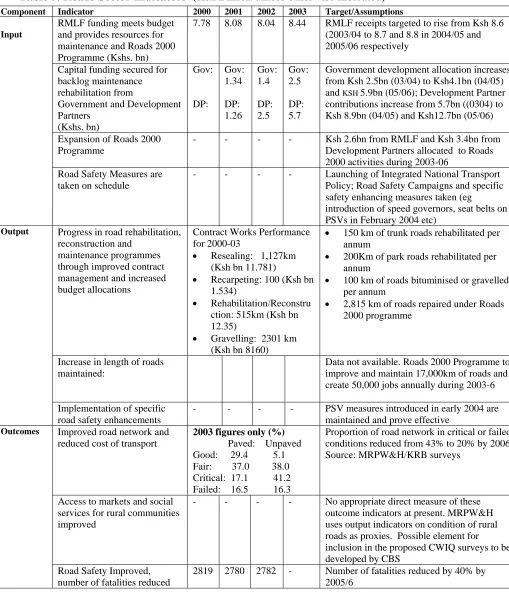
• to increase the level of revenue for maintenance from the current Kshs. 8.04 billion to 10 billion which is deemed sufficient for routine and periodic maintenance of the core network (see Table 4);
• to secure capital funding for backlog maintenance rehabilitation to the tune of Kshs. 75 billion over the next 5 years through a proactive approach to mobilise both donor and private sector finance;
• re-establishing effective routine maintenance through increased use of private sector contracting , expansion of the Roads 2000 Maintenance Strategy which emphasises labour-intensive methods, and introduction of performance-based contracts and maintenance concessions (see Table 4);
• to harmonise road safety programmes and ensure enforcement of road safety regulations
Table 5. Roads Sector Indicators (Ksh Billion unless otherwise indicated)
Component Indicator 2000 2001 2002 2003 Target/Assumptions
RMLF funding meets budget and provides resources for maintenance and Roads 2000 Programme (Kshs. bn)
7.78 8.08 8.04 8.44 RMLF receipts targeted to rise from Ksh 8.6 (2003/04 to 8.7 and 8.8 in 2004/05 and 2005/06 respectively
Capital funding secured for backlog maintenance rehabilitation from
Government and Development Partners (Kshs. bn) Gov: DP: Gov: 1.34 DP: 1.26 Gov: 1.4 DP: 2.5 Gov: 2.5 DP: 5.7
Government development allocation increases from Ksh 2.5bn (03/04) to Ksh4.1bn (04/05) and KSH 5.9bn (05/06); Development Partner contributions increase from 5.7bn ((0304) to Ksh 8.9bn (04/05) and Ksh12.7bn (05/06) Expansion of Roads 2000
Programme
- - - - Ksh 2.6bn from RMLF and Ksh 3.4bn from Development Partners allocated to Roads 2000 activities during 2003-06
Input
Road Safety Measures are taken on schedule
- - - - Launching of Integrated National Transport Policy; Road Safety Campaigns and specific safety enhancing measures taken (eg
introduction of speed governors, seat belts on PSVs in February 2004 etc)
Progress in road rehabilitation, reconstruction and
maintenance programmes through improved contract management and increased budget allocations
Contract Works Performance for 2000-03
• Resealing: 1,127km (Ksh bn 11.781)
• Recarpeting: 100 (Ksh bn 1.534)
• Rehabilitation/Reconstru ction: 515km (Ksh bn 12.35)
• Gravelling: 2301 km (Ksh bn 8160)
• 150 km of trunk roads rehabilitated per annum
• 200Km of park roads rehabilitated per annum
• 100 km of roads bituminised or gravelled per annum
• 2,815 km of roads repaired under Roads 2000 programme
Increase in length of roads maintained:
Data not available. Roads 2000 Programme to improve and maintain 17,000km of roads and create 50,000 jobs annually during 2003-6
Output
Implementation of specific road safety enhancements
- - - - PSV measures introduced in early 2004 are maintained and prove effective
Improved road network and reduced cost of transport
2003 figures only (%)
Paved: Unpaved Good: 29.4 5.1 Fair: 37.0 38.0 Critical: 17.1 41.2 Failed: 16.5 16.3
Proportion of road network in critical or failed conditions reduced from 43% to 20% by 2006 Source: MRPW&H/KRB surveys
Access to markets and social services for rural communities improved
- - - - No appropriate direct measure of these outcome indicators at present. MRPW&H uses output indicators on condition of rural roads as proxies. Possible element for inclusion in the proposed CWIQ surveys to be developed by CBS
Outcomes
Road Safety Improved, number of fatalities reduced
There is an overall lack of available data in the sector, and information from implementing agencies is not systematically collected. This has also called into question the level of ownership of roads projects by communities and road users. The monitoring function of CBOs and NSAs could be explored in this regard. However, stakeholders and NSAs should be better defined along with the mechanisms to involve them in this sector.
KRB has published disbursement information several times in the print media and will continue to do so and to refine the information. The Road Agencies that are Government departments (e.g. Roads Department, Department of Urban Development in MOLG) have difficulties in producing audited accounts due to established government procedures. Their accounts are normally audited by the Controller and Auditor General. These difficulties will be overcome once all Roads Agencies are transformed into corporate entities. However, these new corporate entities will require a lot of support in their inception/transition phase.
There is also need for the different road maintenance initiatives to be harmonised. Capacity to implement should also be better anticipated and addressed in the design phase to avoid implementation delays.
b) Progress in activities
The EC recently financed a study to develop a comprehensive and coherent roads sub-sector policy and strategy in accordance with the recommendations of the Road Sub-Sector Stakeholders’ Workshop held in May 2002. The study, undertaken under the auspices of Kenya Roads Board with broad stakeholder consultation was completed in February 2004 and it came up with recommendations for sector-wide institutional framework and policies for sustainable road maintenance. These Study Report is expected to be presented to the Minister for Roads, Public Works and Housing. Some of the key policy recommendations and strategies are;
• Creation of autonomous road agencies under KRB that are independent corporate entities with legal obligations for administration and management of main, rural and urban roads.
• Reclassification and gazetting of all public roads against the agencies charged with the statutory responsibilities for each
• Progressively increase funding for roads by raising the level of Road Maintenance Levy Fund and by incorporating road taxes, overloading and traffic fines, LATF component, cess, parking fees.
• Encourage private sector finance
• Establish a Road Safety Authority and strengthen road safety legislation
• Privatising axle load control
• Establishment of a Transport and Traffic Police Unit funded through vehicle licensing fees/fines
• KRB to finance road agencies on basis of realistic and achievable annual work programmes based on an agreed prioritisation criteria
• Implementation of schemes contained in the Nairobi Long-Term Transport Study including junction upgrading/signalisation
• Development of infrastructure for Non-Motorised Transport
Northern Corridor Rehabilitation Programme Phase II (96 km Mai Mahiu – Naivasha – Lanet Road) will be launched before mid 2004.
The Financing Agreement for the Kshs. 700 million EC/Stabex Roads 2000 Phase 1 Project in Eastern Province was extended to 31st December 2004 to facilitate completion of final lot of 6 labour-intensive roads improvement contracts.
In January 2004, the NAO commissioned an identification study by the Support Services Programme II (SSPII) Framework Consultant for the road sector activities under the 9th EDF NIP including the backlog periodic maintenance on the Northern Corridor, rural roads rehabilitation and feasibility studies/institutional support. A TA study on axle-load best option study is expected to be commissioned by Kenya Roads Board with EC funding.
d) Integration of cross cutting themes
Discussions are underway on a possible NGO grant contract for Aids/HIV awareness and prevention campaign on Sultan Hamud – Mtito Andei road rehabilitation project and Mai Mahiu – Naivasha – Lanet Road. Another aspect under discussion is the support to rural communities by eventually handing over to them boreholes which have been developed to supply water for the Sultan Hamud – Mtito Andei road contract.
4.2 Projects and programmes outside focal sectors
Under the 9th EDF support in the non-focal sectors is foreseen for Non State Actors and for the Micro-Enterprise sector. Ongoing activities funded from the 8th EDF (and STABEX) relate to support for democratic governance, institutional capacity development of the NAO’s office, to the decentralisation of health services, the tourism sector, to the preservation of cultural heritage and for institutional capacity related to the EPA-trade negotiations.
While diverse in nature, these programmes play a major role in supporting ongoing important reforms and processes in Kenya, e.g. the governance/legal sector reforms, the EPA trade-negotiations, and in the recovery of sectors, considered as key for economic recovery and growth, the Tourism and the Micro-enterprise sector.
4.2.1 Governance and institutional capacity
The overall Governance situation has clearly improved substantially since the elections in December 2002 and the new Government’s clear commitment to an anti-corruption agenda. In the context of the EC-supported programme, the improved dialogue on governance issues resulted in the immediate activation of the much-delayed Democratic Governance Support Programme. This has resulted in the delivery of important support to Parliament, the Constitutional Review process and the establishing of a flexible fund in support of non-state actors’ advocacy and governance support organisations.
implementation capacity of EC programmes across all ministries, also taking into account the Government’s request for a harmonised donor support approach.
a) Results
- Good governance and the fight against corruption are a priority of the Government of Kenya with the Ministry for Justice and Constitutional Affairs and the Office for Governance and Ethics under the Office of the President taking the lead. The EC has been playing a prominent role on Legal Sector Reforms in supporting, together with other donors, the Ministry of Justice in its preparation of a sector-wide Governance/Justice/Law and Order/Sector (= GJLOS) Strategy and a short-term (12 months) priorities programme (STPP). Funding contributions to the GJLOS-STPP are to be made from the EC’s Democratic Governance Support Programme (DGSP). Progress in implementing DGSP has picked up during 2003, with a PIU being operative since July 2003 and with the successful conclusion of a call for proposal under the DGSP-Flexible Fund.
- Whereas in the past the results of EC institutional capacity building support to the NAO and line ministries were mixed, this will be addressed in a comprehensive manner, once the currently ongoing review study is finalised and its findings and suggestions for a new EC support programme are discussed with the NAO, line ministries and stakeholders.
b) Progress in activities
- While in the area of governance support, good progress in the implementation of DGSP has been made during the second half of 2003, the loss of time through past delays could not be entirely compensated. In order of not to jeopardise the quality of projects through their hastened termination within the remaining seven months, the NAO is requesting a no-cost extension of the duration of the FA by 12 months beyond 31/12/2004.
- Concerning the strengthening of institutional capacity, EC support in Kenya includes related components in all programmes. The objective of one programme is specifically to make institutional capacity development sustainable: SSP II (Services Support programme) comprises studies, technical assistance, logistics and training to increase institutional capacity in EDF programme management at the NAO’s office and other government ministries. On request by the NAO, a comprehensive review of institutional structures, functions and capacity at the NAO and Line Ministries was contracted in January 2004, which is to help designing a consolidated, comprehensive capacity support programme (including SSP II Training Component).
4.2.2 Non State Actors Support
The Government takes a positive view on involving Non State Actors (NSAs) in its policy formulation. The PRSP/ERS was based upon an extensive consultative process, which involved a series of national workshops with civil society and stakeholders, including the poor, in which the Delegation also participated.
The space for NSA participation has dramatically increased since the change of government at the end of 2002. During 2003, a NAO representative attended and engaged with NSAs at a number of information meetings and workshops, organised by civil society and economic and social partners to prepare the ground for more structured collaboration on the Cotonou Agreement. The consolidation of platforms and networks will take some time, however, given that the space opened up to them to participate in policy formulation and programme implementation is still a recent phenomenon.
were encouraged to help identify and involve NSAs during sector consultations for the MTR and in their future work.
With the 9th EDF CSP including direct financial support for non-state actors, a study is to be finalised in the first half of 2004, including options for funding, which, after discussion with NAO and stakeholders, will result in a draft Financing Proposal to be presented to HQ.
4.2.3 Health and Education
a) Results
In 2003 the EC provided support (TA) for the successful completion of PERs both by the Ministry of Health and the Ministry of Education, not least with a view to future 9th EDF Budget Support, which will be linked to results indicators in the Social Sectors.
- Concerning the Health Sector, past EC interventions were specifically linked to reproductive health care and HIV/AIDS in Kenya. On both, EC funding in 2003 could contribute to some improvements through the delivery of 3.5 million injectable contraceptives, which prevented the complete stock-out for year 2003 and by funding the printing and distribution of ½ million of AIDS-awareness text-books for primary and secondary schools. However, due to scarce public resources sustainability remains uncertain with the end of this type of support for reproductive health.
The start-up of implementation of the decentralised District Health Services and Systems programme (8th EDF) suffered from serious problems with a 14 months’ delay in the completion of the PIU tender and award of contract (only at the end of January 2004) due to administrative difficulties experienced at the Ministry of Health.
- Concerning the Education Sector, past EC support has been limited to a small number of education projects, targeted at specific institutions, mostly for rehabilitation/ construction/ equipment of school classrooms under the Community Development Programme and for Technical Education under TESP.
b) Progress in activities
Actual implementation of the EC programme concerning the development of decentralized District Health Services and Systems is now about to begin.
In the education sector, progress in EC supported activities has been generally very slow, in particular in most components of TESP. Progress in EC supported TESP accelerated greatly in the last year and the two remaining programme components (Strathmore University and Eldoret Polytechnic) is advancing well and will be completed in 2004. Strathmore University already achieved the ISO 9000 certification under the Human Resource Development activity and is currently proceeding with the Infrastructure Development. The change in concept to a TA-assisted approach allowed the Eldoret Polytechnic to organise works (procurement, training, work tenders) and more ahead with the implementation of this programme component.
As part of the EC advanced budget support programme in 2003 the Government requested technical support in reviewing teacher staffing norms. This study should help establish greater efficiency in teacher deployment and help with progress in reducing geographic variations in Pupil Teacher Ratios. Terms of Reference have been developed and the study is currently out to tender.
4.2.4 Private Sector development, Tourism and Trade
The EC has been supporting the micro-enterprise sector since 1997 in order to help establish wholesale lending to micro-finance institutions, strengthen institutional capacity of the Ministry of Trade and Industry and of micro-finance institutions and to strengthen market access and product development of micro-entrepreneurs and cottage industries in Kenya
When EC programme support for this sector through the “Micro Enterprise Support Programme” (MESP) came to an end in 2002, MESP has been transformed into a GoK Trust Fund (‘MESPT’). Following the general elections and the inauguration of the new government, changes were made in the composition of the MESPT-Board of Trustees, and the Trust is about to start operating now.
Under the 9th EDF/NIP further support to the Microenterprise sector is envisaged. The sector is of high importance to the Government, which, during year 2003 prepared a Sessional paper on its MSE policy. Any EC-support was supposed to be linked to the new GoK SME-policy. The Sessional paper, having been finalised only in December 2003, is the entry-point for the consultancy, currently being contracted, which will result in a draft Financing Proposal for a MSE support programme, that will also take into consideration ongoing appraisals by WB and other donors.
EC support to the Tourism Sector has been taking the form of support for direct marketing of Kenya as a tourist destination, for product diversification (including eco-tourism/community-based tourism) and the formulation of a national tourism policy and an improved regulatory framework.
EC support for re-positioning Kenya’s Tourism Marketing essentially focussed on strengthening the Kenya Tourism Board (KTB) in its marketing efforts and in adapting the Kenyan tourism product to market demands. Project management shortcomings within KTB, exemplified by the dismissal of the Managing Director, could not be entirely resolved through technical assistance.
EC support under the “Tourism Diversification and Sustainable Development Programme” (TDSDP) aims to assist GoK in the articulation of its tourism policies, the provision of institutional support, and marketing and development of new products. The Tourism Trust Fund, whose operations started in 2002, manages EC support and provides assistance in policy formulation. However, severe management weaknesses within the TTF Management Unit resulted in December 2003 in a decision by the Board of Trustees to request a comprehensive performance assessment of the TTF-MU which, will be carried out during the first 5 months of 2004.
The terrorist attacks in Mombasa in November 2002 and the subsequent negative travel advisories led to a dramatic reduction in tourist arrivals and a major setback for the tourism industry. The EC positively responded to an urgent request of the Government by setting up a jointly funded Emergency Tourism Market Recovery Programme. Essentially a marketing campaign in Kenya’s major European source markets, the programme is reportedly successful (increased influx of tourists) and will come to a close in March 2004.
At the end of 2003 the Delegation responded to the Government request for a an appraisal of unexpected revenue losses and unforeseen budgetary expenditures arising from the security concerns in Kenyain 2003 (‘Mobilisation of Envelope B’),
A particular concern for Kenya is the dis-investment and the relocation of business to neighbouring countries experienced in 2002 and the trend away from imports of investment-related capital goods towards consumer goods. The dynamics of Kenya’s trade with and structure of exports to the EU has been another particular concern to the Government in view of the EU-ACP Trade negotiations. Both the Government and stakeholders have shown a keen interest in preparing thoroughly for these negotiations, but institutional capacity at the Ministry level has remained weak. The EC is providing support for Kenya’s trade negotiations through the Trade Negotiation Support Programme (KEPLOTRADE), with the specific objective to provide support for the smooth functioning of Kenya’s negotiation machinery, support a transparent mechanism of consultations with stakeholders and a back-up mechanism providing for demand-driven studies over the whole period of negotiations, and lastly, provide training and capacity strengthening as required.
b) Progress in activities
Concerning micro enterprise support the main activities in 2003 evolved around the orderly finalization of the MESP-programme, support for the start-up of the Kenyan Micro-Credit Trust Fund, participation in the GoK-donor consultations on the evolving MSE policy framework and preparation for the feasibility study with view to coming up with a MSE support programme (MESP II) under the 9th EDF.
Concerning the tourism sector, EC support activities mainly revolved around the design and implementation of the Emergency Tourism Market recovery programme, the drafting of a National Tourism Policy, and a regulatory and institutional framework and the funding of innovative Tourism Projects under TTF.
Following a request by Government in December 2003 to consider the mobilisation of the Envelope B related to unexpected revenue losses from Tourism and budgetary expenditures arising from the security concerns in Kenya in 2003, an appraisal mission was prepared, which is about to start in the first quarter of 2004 (see also Point 4.6.)
The design of and priorities for the EC programme support for Kenya’s trade negotiations on EPA has been the result of stakeholder consultations in 2002. During 2003, KEPLOTRADE was supported under STABEX through TA, an expert-pool was identified, workshops were held and 11 background studies carried out.
c) Integration of cross-cutting issues
Future micro enterprise support will continue to incorporate, as the past MESP programme, gender and environmental issues into project planning and promoting micro-enterprise development through sustainable environmental usage.
4.2.5 Culture and National Heritage
National Museums of Kenya Support Programme (EDF 8) aiming at the restructuring of the National Museums of Kenya (NMK) in order to put the organisation on a secure and sustainable economic basis. The project targets to reform management practices and boost visitor numbers and revenue through infrastructure improvements and development of NMK’s exhibitions and public programme.
a) Results
As prerequisite to the legal, institutional and management reforms and a pre-condition to the signing of the Financing Agreement, NMK Board approved the National Museums and Heritage Bill 2003. A further milestone was achieved when the Cabinet approved the Heritage Bill 2003 for publishing and submission to Parliament.
The “Rationalisation of NMK, Board Paper”, outlining the institutional and management reforms, was approved by the NMK Board in September 2002. NMK undertook substantial work regarding the institutional restructuring and in particular in drafting the new organisational structure of NMK. The new organisational structure was recently completed and awaits implementation, which could then be followed by the launch of the already prepared tender for Infrastructure Works and the approval and implementation of the Work Programme/Cost Estimate for the Public Programmes component.
b) Progress in activities
Based on the STABEX funded preparatory phase, the NMK Support Programme focusing on the implementation of legal re-drafting /harmonisation of NMK core legislation; staff rationalisation study; design and detailed planning of infrastructure rehabilitation programme and coordination/management support progressed throughout the year. Once GoK implement the remaining institutional restructuring components, strong input by the Project Manager and the T.A. supported PIU will continue to implement the staff rationalisation study and launch all other activities foreseen under the EDF 8 funded support programme.
4.3 Utilisation of resources for Non-State Actors
In addition to what has been detailed under section 4.2.2., NSAs are encouraged to engage with the different GoK sector conveners and implementers directly in order to fully participate in cooperation activities. This was initiated and encouraged at the launch of the MTR process with sectoral review meetings in 2004, and is expected to increase over time, through the support programme set aside for NSA information sharing and capacity building.
4.4 Utilisation of Envelope B
At present there are two proposals under consideration for the use of Envelope B resources: i) compensation for unforeseen losses related to security/terrorism threats, and ii) the establishment of a Disaster Preparedness Fund. In addition to these concrete proposals that are currently under appraisal, it might also be prudent to reserve some funds from envelope B for a follow-up to the Budget Support programme envisaged under the NIP.
4.4.1 Compensation for unforeseen losses
4.4.2 Disaster Preparedness
The need for a Disaster Preparedness programme is considered in the Kenya Country Strategy Paper. The CSP notes that insufficient attention to disaster preparedness in Kenya is one of the reasons why ECHO has had to intervene on frequent occasions, particularly for drought issues. Against this background the Delegation has engaged in discussions with the Government (OP-Arid Lands) and other donors on the possibility of establishing a Drought Contingency Fund. The possibility of using Envelope B for emergency assistance is foreseen in Cotonou, and since the relevant provisions in Cotonou on emergency assistance (Chapter 6) refer to the possibility of providing assistance to disaster preparedness mechanisms (Article 72.3.e), it has been suggested that this programme might be considered under Envelope B. Terms of Reference for a feasibility study are currently under preparation.
4.5 Other instruments
4.5.1 STABEX
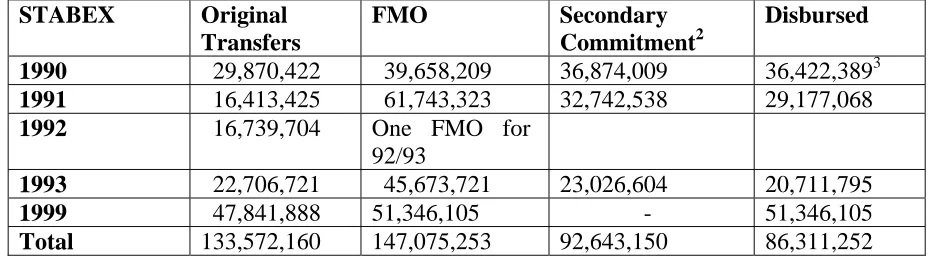
[image:22.595.90.558.366.494.2]Stabex resources (non-programmable aid) made available to Kenya by the 1990, 1991, 1992 and 1993 transfers were all programmed and consolidated into three main clusters which are governed by respective Framework of Mutual Obligations (FMO) and addenda. Funds are kept in various accounts in Brussels and in local banks. An overview of STABEX funds is presented hereunder:
Table 4. Overview of STABEX allocations in €uro (as at 31st December 2003)
STABEX Original Transfers
FMO Secondary Commitment2
Disbursed
1990 29,870,422 39,658,209 36,874,009 36,422,3893
1991 16,413,425 61,743,323 32,742,538 29,177,068
1992 16,739,704 One FMO for 92/93
1993 22,706,721 45,673,721 23,026,604 20,711,795
1999 47,841,888 51,346,105 - 51,346,105
Total 133,572,160 147,075,253 92,643,150 86,311,252 NB: Transfer and FMO figures cary due to interest accrued in local and foreign accounts, exchange fluctuations and funds lost in Meridien Bank collapse
4.5.2 Regional cooperation
The Regional Indicative Programme of which Kenya is a signatory in accordance with art 160 of the Convention with the long tern view of promoting long term collective self –sustaining and integrated social , cultural and economic development.
In November 2002 the 9th EDF Regional Support Programme for Eastern and Southern African and the Indian Ocean was signed in Kampala on the one hand and COMESE, EAC, IOC , and IGAD on the other for an amount of EUR 223 million.
Kenya has benefited under the 6th, 7th and 8th Regional Indicative Programmes in the following sectors:
i) Road transport sector through rehabilitation of the Northern corridor:
- Northern Corridor Rehabilitation Phase I Sultan Hamud-Mtito Andei Road - Northern Corridor Rehabilitation Phase II Mai Mahiu-Navaisha-Lanet Road
2
Contract(s), Work Programme(s) 3
- Isiolo-Moyale Road
ii) Agriculture and Livestock with a focus on
- Livestock disease control and eradication (PACE)
- Farming in tsetse infected areas (FITCA) and cross border migrant pest control. (Financing Agreement for FITCA extended up to Dec 2004.)
iii) Fish sector. Kenya is benefiting from 2 regional projects:
- Strengthening Fishery Product Health Conditions in ACP/OCT Countries (Budget Euros 56.6 million)
- Implementation of Lake Victoria Fisheries Management Plan (Tanzania, Uganda and Kenya). Total budget: Euros 30 million.
v) Other regional programmes:
- Meteorological Transition in Africa covering 52 African countries. - Collaborative MA Programme in Economics for Anglophone Africa.
4.5.3 Community Budget lines
The NGO Co-financing budget line provides financial assistance to Member State NGOs to support and build capacity of local NGOs to implement development projects at the grassroots level. Four co-financed projects underwent the Commission’s internal monitoring process during the 2003 exercise
At present there are 17 on-going projects covering the period 1999/2002 amounting to a Commission contribution of €7.8 million. In 2003, two new projects received funding amounting to a Commission contribution of €1.5 million (70% of overall project cost). The new projects support empowerment of children with disabilities and a food security programme, involving dairy goats and capacity building programme in Mwingi District.
The following programmes are on-going under funding from the Tropical Forests and Environment Budget Line:
• On-farm forestry and natural resource conservation in 3 locations north of the Arabuko-Sokoke Forest, Malindi District
• Sound Forest Management and Conservation in Kenya: the Kenya Forest Working Group
• Loita/Purko Naimina Endiyo forest integrated conservation and development project
Management of the budget lines is currently under the direct responsibility of Commission Headquarters but will be deconcentrated to EC Delegations in September 2004.
4.5.4 EIB
Indirect lending under Lomé IV was arranged mostly within the “Global Private Enterprise” (GPE) loans, of which the latest was signed at the end of 1999, and a small part under a finance agreement with Prefund, a venture capital provider. In this framework, the EIB in collaboration with the Central Bank of Kenya and a private management unit allocates funds to the intermediaries for long-term loans in foreign currency or in KShs, in amounts between € 10.000 and € 1.5 million, upon individual assessment of the projects submitted. The funds are accessible to private enterprises operating in commercial agriculture and horticulture, the industrial sectors, tourism and in related services sectors. Since 2002, health and education are also eligible. About 250 firms have been supported in this manner so far.
The EIB also contributed direct loans to the financing of large-scale projects, including under Lomé IV the construction of a steel sheet galvanising line by Mabati Rolling Mills Ltd. (finance of a total of € 9 million from both risk capital and own resources, signed in 1999) and the Olkaria II geothermal power project (a loan from own resources to the Government of Kenya of € 41 million, signed in 1999). Finally, funds were made available under Lomé IV to two European Development Finance Institutions in the magnitude of € 4.7 million from own resources and € 0.2 million from risk capital, for the construction of tea factories and to subscribe share capital of a financial institution respectively.
In 2003, the EIB’s activities in Kenya were focused on the preparation of a structured finance operation for Magadi Soda Company, in co-financing with the IFC and FMO, to help improving the international competitiveness of Kenya’s production and exports of natural soda ash. The Bank entered into a finance agreement of € 2 million with Co-operative Bank of Kenya, to support the financing of micro-sized private ventures. Already under the Cotonou Agreement, it approved an investment of € 8 million into a new regional venture capital fund, the Aureos East Africa Fund. Co-investors are the CDC group, Norfund and a number of other international finance institutions. From its operational headquarters in Nairobi, this fund targets Kenya, Uganda and Tanzania, acquiring stakes in private ventures. The implementation of the GPE IV finance contracts was continued, although on a lower pace reflecting investors’ risk awareness and the reduced attractiveness of fixed rate borrowing, as proposed under the GPE scheme, given the competitive level of floating interest rates on the international markets and, since the middle of the year, also on the Kenyan Shilling market. € 1.1 million was disbursed for loans to five private companies, of which 3 schools.
5 Programming perspectives for the following years
During 2004 it is expected that €171.5 million will be committed in programmes and projects designed to implement the CSP. This amounts to over 90% of programmable resources (Envelope A) under the CSP. At the same time, EDF disbursements of about €140 million per annum are forecast for the period 2004 to 2006. In order for these forecasts to be realised, however, it must be stressed that improved efficiency will be required on both sides of the partnership. On the Government side, this should focus on increased responsibility for approval of projects by the NAO and increased delegation of implementation tasks to line ministries and other implementing agencies. On the EC side, this will require more predictable and efficient processing of financing proposals for approval and more timely management of tenders, contracts and payments.
5.1 Integration of new EC/EU policy initiatives