by
Ken W. Sarkies
This thesis was submitted for the degree of Doctor of Philosophy in the Australian National University, 1972, under the supervision of
PREFACE
The work in the first two chapters of this thesis was begun under the supervision of Dr N.E. Frankel in the
Department of Theoretical Physics, Melbourne University, and was completed at the Austra l i a n National University. The work in the third and fourth chapters was done in
conjunction with Professor B.W. N i n h a m and Dr P. Richmond, along with help in d i scussion and proof reading from
several other workers in the field of critical phenomena,
and from unknown referees of papers submitted for publication. The work in chapters five to seven was completed by myself, along w ith Mr R.A. Sammut of the University of New South Wales, who helped in the initial mathematical w ork in chapter six, and w ith Dr J.W. P e r r a m who gave advice on the surface boundary conditions in chapter six. Most of the work in chapter eight was done by Dr P. Richmond,
with assistance from me in checking the mathematics and in discussing the physical significance of the results.
A C K NOWLEDGEMENTS
I would like to thank Professor B.W. Ni n h a m for much personal as well as academic assistance during the course of this work, and for checking the drafts of the thesis. I would also like to thank all members of the Department, especially Drs P. Richmond, J.W. P erram and V.A. Parsegian for discussions on all aspects of the work. I would like to thank the Austr a l i a n National University for financial support and for the use of their c o m p u t e r s , and the
PUBLISHED WORK
1. K.W. Sarkies and N.E. Frankel, "Nucleation Theory with a non-classical Free Energy", J. Chem. Phys.
54, 433 (1971) .
2. K.W. Sarkies and N.E. Frankel, "Non-classical Nucleation Theory", J. Chem. Phys. (in press).
3. K.W. Sarkies, B.W. Ninham and P. Richmond, "van der Waals Forces and Critical Phenomena",
J. Phys. C. 4, L245 (1971).
4. K.W. Sarkies, P. Richmond and B.W. Ninham, "Physical Theory of Fluid Interfaces near the Critical Point", Aust. J. Phys. 2_5 , 367 (1972).
5. K.W. Sarkies and J.W. Perram, "Electrostatic and van der Waals Forces in Fibrous Filters",
AIChE. Journal 1_8> no.6, 1225 (1972)
6. K.W. Sarkies and R.A. Sammut, "On the General Solution of the Poisson Boltzman Equation", Trans. Far. Soc.
(submitted).
7. K.W. Sarkies, "Interaction Theory of Fibrous Bed Filtration", (to be published).
8. K.W. Sarkies, "Critical Point Nucleation", J. Chem. Phys. (submitted).
9. P. Richmond and K.W. Sarkies, "Interaction of
Adsorbed Molecules", J. Phys. A. C, £, 401 (1973) 10. P. Richmond and K.W. Sarkies, "On the van der Waals
CONTENTS
Acknowledgements ii
List of Published Work iii
Abstract vii
1. Nucleation Theory near the Critical Point. Review of Relevant Theory.
1.1 Introduction 1
1.2 Physics and Application of Nucleation 2 1.3 Classical Theory of Nucleation 4 1.4 Theory of Surface Tension due to Cahn
and Hilliard 8
1.5 The Cahn - Hilliard Theory of Nucleation 11 1.6 Widom's Theory of the Free Energy of Fluids
near the Critical Point 13
2. Critical Point Nucleation Theory
2.1 Introduction 16
2.2 The Frenkel - Band Theory and Fisher's
Extension 16
2.3 The Sarkies - Frankel Theory of Nucleation 18
2.4 Comparison with Experiment 22
2.5 Discussion and Conclusions 24
3. Fluid Interfaces near the Critical Point Review of Relevant Theory
3.1 Introduction 26
3.2 Mean Field Theories of Hill and Metiu
-Ruckenstein 27
3.3 Developements of the Cahn - Hilliard Theory
by Lebowitz and Percus 29
3.4 Critique of Cahn and Hilliard's Theory 30 3.5 Reformulation of Cahn and Hilliard's Theory
by Widom 32
3.6 The Kuni - Rusanov Theory of Surface Layers 34 3.7 Zero Point Energy and van der Waals Forces 37
3.8 Dielectric Data 41
4. Physical Theory of Fluid Interfaces near the Critical Point.
4.1 Introduction 45
4.2 General Formulation 46
4.3 Numerical Calculations. Approximations 49 4.4 Numerical Calculations. Data and Results 52
4.5 Scaling Law Analysis 54
4.6 Discussion of Possible Extensions 59
5. Fibrous Bed Filtration of Emulsions. Review of Relevant Theory and Experiment
5.1 Introduction 63
5.2 Effects of Various Physical Properties.
Experimental 65
5.3 Fluid Dynamical Theory of Filtration 68 5.4 Nature of van der Waals Forces in Filters. 72
6. Fibrous Bed Filtration of Emulsions. Electrostatic Theory
6.1 Introduction 74
6.2 Formulation of the Poisson Boltzman Equation 75 6.3 Solution of the Poisson Boltzman Equation 76 6.4 Large Distance Approximations. Constant Potential
Repulsive Case 82
6.5 Constant Potential Attractive Case 85 6.6 Constant Charge Repulsive Case 86 6.7 Boundary Condition for the Droplet Surface 89 6.8 Boundary Condition for the Fibre Surface.
Ionization Equilibrium 94
6.9 Stern Theory of Adsorbed ions at Surfaces 96
7. Theory of Fibrous Bed Filtration
7.1 Introduction 102
7.7 Other Fibre Materials 115 7.8 Summary of General Conclusions 117
8. Interaction of Adsorbed. Molecules
8.1 Introduction 122
8.2 Role of I ntermol.ecular. Forces in Adsorption 124 8.3 Derivation of Interaction Energy for Two Dipoles
and a Plane 127
8.4 Discussion 134
Appendix 1. Non Retarded van der. Waals.:Forces .
Constant Gradient Interface .. 136
Appendix 2. Physical Significance of the van der
Waals Interaction in Inhomogeneous Media. 139 Appendix 3. Pressure due to the Electrostatic Double
Layer between Unlike Surfaces. 141
Appendix 4. Mathematical Properties of the Jacobi
Elliptic and Theta Functions. 143
Appendix 5. Evaluation of Integrals used in Chapter 8. 147
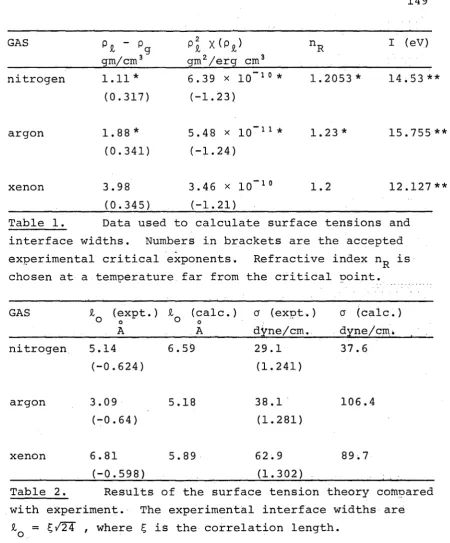
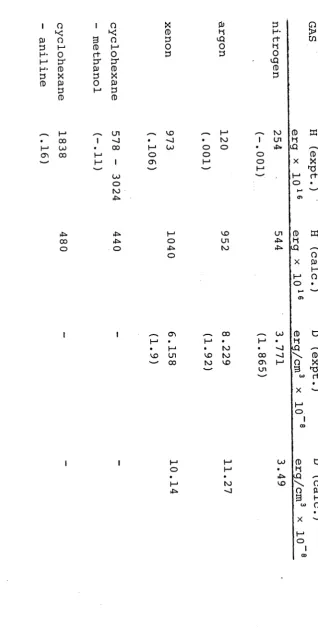
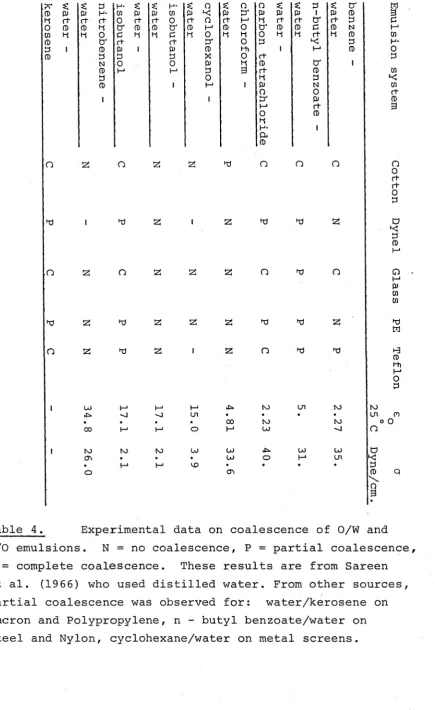
Tables 149
References 155
ABSTRACT
The content of this thesis is grouped into four separate contributions to the field of Surface Physics.
a) Critical Point Nucleation Theory. A theory of nucleation of metastable liquids or gases near the critical point is presented. The Cahn-Hilliard theory of inhomogeneous systems is combined with Widom's theory of the free energy of uniform fluids in the two phase region near the critical point, to find the free energy W of formation of a critical nucleus in this region. By introducing an experimental criterion on W for the condensation of a metastable gas, we are able to calculate the metastability limit as a function of
temperature, and to compare it with the experimental results of Dahl and Moldover, and a theory of Eggington.
b) Physical Theory of Surface Tension. We apply the
Lifshitz' theory of van der Waals forces to the inhomogeneity created by the diffuse region in a fluid interface. This enables us to discuss the reason for the stability of the diffuse interface, and to calculate surface tensions and
interface widths to within the correct order of magnitude, as a function of temperature near the critical point. As with other continuum theories of the diffuse interface, our
theory will not reduce to the low temperature "sharp inter face" limit. However it has a much sounder physical basis, and avoids the mean field approximation which is usually the starting point for alternative theories.
c) Interaction Theory of Fibrous Bed Filtration. A
fundamental theory of the coalescence of emulsion droplets in fibrous bed filters is presented by considering the interaction of droplets with fibres and with other free and attached droplets. It is possible to explain why some filters work and others do not, and to present some
predictions which can be tested by experiment. The
in general support our theory.
d) Interaction of Adsorbed Molecules. We apply Lifshitz' theory of van der Waals forces to the problem of the
interaction of two dipoles and a plane. This is used as a model for the interaction of molecules in a two dimensional gas adsorbed on the surface of a solid substrate. It is
shown that the critical temperature of this gas is different from that normally calculated by applying dimensional
REVIEW OF RELEVANT THEORY
(1.1) Introduction
Many recent developments both theoretically and
experimentally in the field of critical phenomena in fluids have given us a greater understanding of the problems involved than at any time in the past. Thermodynamic quantities such as specific heat, compressibility, density, surface tension have been found to diverge or disappear at the critical point, and appear to follow a power law behaviour with temperature AT = T -T. The critical exponents which
characterise this behaviour, if they exist, have been assumed to be the same for all systems regardless of the nature of the interparticle forces involved. These exponents have been
shown to obey rigorous thermodynamic inequalities
and physically based equalities called scaling laws (Fisher, 1964, Widom, 1965a, Kadanoff, 1966, 1967, Cooper, 1971, Wilson, 1971, Wilson and Fisher, 1971). Now the Frenkel-Band (1939) theory of imperfect gases is
based mainly upon the theory of nucleation of liquid droplets in vapours. This theory was extended to the critical point by Fisher (1967), but in general the nucleation theory has not been considered in this region of the fluid. It is the aim of this work to review the present state of the theory of nucleation as it has been developed in recent years, and to consider the possibility of extending the theory to the critical point. Since our first attempt (Sarkies and
Frankel, 1971) to do this, Eggington et al. (1971) published a paper on the Fisher theory, and Dahl and Moldover (1971)
3
carried out some experiments in liquid He . In chapter two we will present our own theory of nucleation and compare
it with the Eggington theory, and Dahl and Moldover's experimental results. We conclude that more experimental and theoretical work is needed in order to gain some better understanding of this area of critical phenomena.
In this chapter we shall review the kinetic theory of
★
nucleation which allows us to calculate the number of nucleii per unit volume per unit time formed in a metastable fluid. Then we shall consider several ways of calculating the free energy of nucleii of various sizes. Finally we review the theory of Widom (1965b) which describes the free energies of fluids near their critical points.
(1.2) Physics and Applications of the Nucleation Process
When a vapour is cooled below its condensation point it usually remains metastable for short periods of time before condensing to the liquid phase. This is a nonequilibrium process which cannot be handled by equilibrium statistical mechanics. The transformation from vapour to liquid begins with the formation of microscopic liquid droplets called
nucleii on surfaces, impurities such as dust particles, or spontaneously. The creation of nucleii on surfaces or impurities is called heterogenous nucleation and the
spontaneous creation of nucleii is homogeneous nucleation. We shall be considering only the latter process in these two chapters as it is the simplest case with which to begin our work. It occurs mainly in high speed wind tunnels and jet
streams where a sudden expansion of vapour causes adiabatic cooling below the condensation point. Heterogenous nucleation is negligible here because of the great rapidity of the
cooling process and the small number of nucleating centres (dust particles).
A metastable vapour is prevented from condensing by
the presence of an energy barrier to the formation of nucleii. This barrier arises from the fact that the pressure inside the nucleii is greater than the outside vapour pressure
(Thompson, 1871) and the nucleii evaporate (Gibbs, 1878). By increasing the vapour pressure or the radius of the nucleus, a point is reached where the two pressures are balanced and a critical nucleus is formed. Past this
condensation, but this probability is generally small. As the supersaturation or degree of metastability (usually
defined as the ratio of actual pressure to the vapour pressure at the same temperature) increases, the critical nucleus
becomes smaller and the probability of condensation increases. This is observed as an increase in the rate J of the
s
formation of nucleii. Eventually by increasing the super saturation, a point is reached where the rate appears to increase rapidly from almost zero to very large values. Thus the condensation point is very well defined and is experimentally reproducible.
The theory of nucleation is impörtant in many practical situations. Vapour nucleation occurs in supersonic wind tunnels and affects pressures and flow characteristics of the airstream, especially near sharp surfaces on the models being studied (Wegener and Mack, 1958). This hampers the experimental testing of aerodynamic theories. Condensation phenomena also occur in the formation of clouds and rain
(Latham, 1969), and are obviously of extreme importance in meteorology. Also some industrial distillation columns operate very near the critical point in order to save costs in refrigeration (Gerster, Slack and Harrison, 1966). This is done when the critical point of the liquids involved is close to or below room temperature. It may be possible to increase the efficiency of these columns by gaining a better understanding of the phase transformations involved.
Finally, by certain modifications to the theory (which we shall not consider here), we may extend our interest to the nucleation of immiscible liquids near the miscibility
point, nucleation of crystals from solution and nucleation of separating phases from solid solutions. These
phenomena have applications in steel manufacture (Bradley, 1951, Hollomon and Turnbull, 1953, La Mer, Pound and Reiss, 1952), formation of colloid suspensions and emulsions,
(1.3) Classical Theory of Nucleation
Any theory of nucleation falls naturally into two parts; kinetic theory and the theory of free energy of the nucleii. The kinetic theory; which yields a nucleation rate (defined as the number of visible macroscopic nucleii formed per second), in terms of the free energy and size of the critical nucleus. The kinetic theory was put forward in 1927 by Farkas who worked from a oroposition of Volmer and Weber (1925) that droplets would form by the association of molecules to form nucleii. The growth of the nucleus was then determined by the rates of evaporation and
impingement of the molecules upon the nucleus. Farkas showed that the growth of the droplets followed a random walk through different size classes in a field of force,
giving a nucleation rate
Jg = exp(-AG/kT) (1.1)
where AG is the free energy of formation of a critical nucleus. The theory was further developed by Becker and Doering (1935), Volmer (1939) and Zeldovich (1942) who proposed the full nucleation equation
3Ni
3t (C. l - i l - i N. + E ., N .. ) -l + i l + i (CiN i+EiN i ) (1.2)
This states that the rate of change of the concentration INF of nucleii having i molecules is equal to the difference between the rate of creation of nucleii and the rate of destruction of nucleii. C. and E. are the rates of
l l
condensation and evaporation respectively. The equilibrium distribution of nucleii of i molecules is given by the
Boltzman equation
n^ = n i exp(-AG^/kT) (1.3)
J s
ivi _ i
{i£ (C.n.) } (1.4)
where M is the m a x i m u m size of nucleus which is allowed to form, and n^ is given by eq. (1.3) . Note that N^ is a non e quilibrium concentration of nucleii, and does not equal n^. This only happens w h e n INF =0 . The nucleation rate in eq.(1.4) is given for e q u i librium situations only, the extension to non e q u i librium being immediate (Frish, 1957, Frish and earlier, 1971). Now AG^ has a m a x i m u m value due to the balancing of the vapour pressures inside and outside
*
the nucleus (sect. 1.2) and there is some i=i , the critical size, at w h i c h n. is a minimum. Because n. 1 falls away
1 * 1
very rapidly as i moves away from i , we may convert the sum in eq. (1.4) to an integral and use the steepest
descents approximation (Reiss, 1970) to get
V
2,2ikT l exp(-AG.*/kT) 8 2 AG
C i*n i 8i
1
(1.5) i=i
The difference between this eq. (1.5) and that of Farkas
eq. (1.1) is the Zeldovich non e q u i librium factor. This says that critical nucleii are still able to evaporate (Feder et a l . 1966). Cohen (1970) shows that this a p p r o x i m a t i o n eq. (1.5) to eq. (1.4) is accurate to 1% in all ohysical s i t u a t i o n s .
Now the free energy of formation AG^ of a nucleus is rather more difficult to calculate. There are several
different theories which yield a value for this. The first of these is the classical theory of Gibbs (1878) who writes the free energy simply as the sum of the free energy of a bulk liquid and the surface free energy
AGi = i n r 3 (f^-f ) + 4Trr2a (1.6)
where a is the surface tension of a flat interface, r is the radius of the nucleus and f ^ , f are the free energies of liquid and gas respectively. In general this a is
(Cahn and Hilliard, 1959) and its evaluation is a major problem of nucleation theory. Exact determination is
impossible apart from a full statistical determination of the free energy of the nucleii. Now the dependence of this classical free energy upon the supersaturation S may be found by equating the chemical ootentials of the liquid and vapour
f»-f = -pkTtn(p'/p) = -pkT£n(S) (1.7) t g
where S = p'/P^ p' is the saturation vapour pressure on the coexistence curve, and p is the actual supersaturated vapour pressure. The maximum in AG(r) exists for S>1 and occurs at
r = 2a/pkTf.n(S)
with
AG (r*) = — --- (1.8)
3 [pkTtn(S)]2
This gives a reasonably good agreement with experiment in many cases (Volmer and Flood, 1934, Katz and Ostermeier,
1967, Jaeger, Willson, Hill and Russel, 1969, Dawson,
Willson, Hill and Russel, 1969, Kasner and Schmidt, 1966).
Lothe and Pound (1961, 1966, 1968) then introduced several extra corrections to the classical free energy of the nucleii. These were the free energy required to compress the fluid in the nucleus from the saturated pressure p'
to the actual pressure p (Courtney, 1961, 1962, 1963);
the free energy required to seuarate a group of i molecules from a larger ensemble; and the translational and rotational energies of the nucleii. The net effect of these contributions was to increase the classical nucleation rate by a factor
17
of 10 , and consequently to predict a smaller critical
supersaturation or metastability limit at which condensation is observed. This agreed with some experimental results
Reiss and Katz (1967) proposed a self consistent statistical mechanical treatment by working directly from the partition function for an n-mer. From this they derived the classical free energy plus a small correction which
changed the classical nucleation rate very little (Reiss, Katz and Cohen, 1968).
Finally Abraham (1968) worked on the suggestion that the surface tension of the curved surfaces of the nucleii was not equal to that of a flat interface (as was usually supposed) and he proposed a phenomenological procedure for finding the correct value. He began with the Frenkel
(1939) and Band (1939) model of an imperfect gas which was assumed to be made up of a perfect gas mixture of tiny non-interacting droplets of liquid (see also Stillinger 1963). These droplets form in exactly the same way as
the nucleii considered in nucleation theory, and their free energy and distribution over the different size classes is calculated in a similar fashion. Abraham (1969) noted that the equation of state of a gas modeled in this way
was a known function of the surface tension of the droplets. By assuming it to be independent of the radius for very
small droplets, he calculated the surface tension in terms of the equation of state. Recent calculations by Binder and Stauffer (1972) show this to be a reasonably good
assumption for the lattice gas. The numerical calculations of nucleation rates by Abraham were in very good agreement with experiment provided the system was far from the
critical point.
(1.4) The Theory of Surface Tension due to Cahn and Hilliard (1958)
Consider a continuum fluid of density p which has a Helmholtz free energy density f (p). Suppose that an inhomogeneity occurs in the fluid so that the density is now p(r). Then we assume that the new free energy density f(p) may be expanded in a Taylor series in the density gradients, viz:
f(p,Vp,V2p,...) = fo (p) + K j V2 p + K 2 (Vp)2 + ... (1.9)
The term in Vp has been omitted on the basis of symmetry under reflection (see however Hirth, Tiller and Pound,
1970, who object to this procedure). If we neglect higher order terms, we may write the total free energy as
F = / fd3r = / {fo (p) + K ( V p ) 2}d3r (1.10)
where
K
and f (p) is the free energy density of a homogeneous fluid having uniform density p. Widom (1965a) however points out that because f (p) assumes values for a fluid in the unstable region, only the "self energy"
F = / f (p)d3r (1.11)
o V ° ~
has a physical meaning. The constant k is unfortunately
indeterminate and may in fact be a complicated function of density and/or temperature (Rice, 1960, Parlange, 1968). This is one of the major difficulties with the theory.
Now consider a liquid-vapour interface as shown in fig.l. The origin is taken to be just the Gibbs dividing surface defined by the conditions
8k
p£V t + PgVg
V„ + V
JL g
(1.1 2)
where N and V are both constant. Here the subscript l refers
to the liquid and g refers to the vapour. The surface
tension of this system is the difference per unit area
between the total Helmholtz free energy of the inhomogeneous
system, and that of a hypothetical system which is
homogeneous up to the Gibbs dividing surface. Thus
00 j 2 -I
a = {f0 (p(z)) + k (j£-) - |(f£+f ))dz (1.13)
where f^ and f are the Helmholtz free energy densities of
the liquid and vapour respectively. Minimizing a with
respect to small variations in the density profile p(z)
yields the Euler equation
1 = dz
(
3 (dp/dz)j
(1*14)where
I = Af(p)+K(|H.) and Af (p) = fQ (p) - j(f£+f )
Thus the density profile is given by
dp = , A f ( p K 1/2
dz ' k ' (1.15)
and the surface tension is
P„r 1 / 2
o = 2 f g {KAf (p) } dz (1.16)
pl
Provided we know k and f (p), we are able to deduce the
o
interface profile from eq.(1.15), and the surface tension
from e q . (1.16). This gives values of a which, when compared
with experiment, are at least as good as those of previous
theories (Tolman, 1949, Hill, 1952) based on continuum
theory is theoretically capable of much better results. The higher order terms in eq.(1.9) are negligible due to the small density gradients, and the long range correlation effects are implicitly accounted for in the known Helmholtz
free energy density f (Strickfaden and de Sobrino, 1970).
The basic difficulty with this theory is that the functional dependence of k on density and temperature is completely unknown except in models such as the van der Waals gas, where it is constant (Cahn and Hilliard, 1959). Most workers have assumed it to be independent of density in a real gas, while Parlange (1968) and Fisk and Widom
(1969) assume it to have a slight dependence upon T -T, so that k diverges weakly as T-*Tc . This aligns the Cahn- Hilliard theory with the accepted scaling laws. Lebowitz and Percus (1963) managed to derive a free energy expansion similar to that of eq. (1.9) for the free energy of an
inhomogeneous system using a functional Taylor series
expansion of local thermodynamical quantities. Unfortunately their coefficients are given in terms of the pair correlation
function and are impossible to calculate as a function of density and temperature at the present time. However they do show that k is generally not a constant. This aspect will be studied in more detail in sect. (3.3).
Another problem is the need for a sufficiently accurate free energy density near the critical point which may be analytically continued into the unstable two phase region of the fluid. The van der Waals equation of state is too crude a model to be of any use in this theory. At the present time it is possible to use an equation of state
(1.5) The Cahn-Hilliard Theory of Nucleation
Using the expression eq. (1.10) we may evaluate the free energy of any droplet in a homogeneous background
phase of vapour. Suppose the vapour is in a metastable state. Then droplets may grow to a macroscopic size by an infinite number of paths in the volume-radius plane. Physically they would be expected to follow only one path of minimum energy. This path will have an energy barrier dependent
upon the supersaturation ratio of the vapour, and the critical nucleus will have the maximum energy on this path. The
energy of this critical nucleus may be calculated directly using Cahn and Hilliard's (1958) theory of inhomogeneous fluids described above. Thus the artificial constraints that the droplets must have a sharp boundary between liquid and vapour phases, and a surface tension appropriate to a planar interface, are removed.
Consider a nucleus formed by a density fluctuation p(r) in a metastable vapour of density p. Because the total number of molecules is a constant, we may write
that is pQ decreases as the nucleii use up the vapour. Because the number of molecules is effectively infinite, we shall assume p to be constant. Now we define
o
Then by eqs.(l.lO), (1.17) and (1.18), the work of formation of nucleus is
I ( p - p ) d 3r = 0
JV o — (1.17)
3f Af'(p) = f (p) - f (p ) - (p-p )-^-|
o o Ko K K o 3 p 1 p o
(1.18)
(1.19)
The critical nucleus occurs when W has an extremal with
2 3 IC
2kV p + 1^- ( V p )
2 9 Af '
9p (1.20)
with
W = 4tr/ {Af' + k (— ■) } r 2dr
o dr (1.2 1)
From these equations, the following general properties of nucleii may be derived
a) At low supersaturations where P0 ~P S ' the critical
nucleus resembles that of Gibbs classical theory in that (i) The density at the centre of the nucleus approaches
that of the liquid
(ii) The surface tension approaches that of a flat interface
(iii) The radius of the nucleus approaches infinity.
b) Near the critical point, the work of formation W of the critical nucleus at a given scaled s u p e r saturation
defined by z = (P0 ” PS )/ (p£"Pg) approaches zero in a van der Waals gas.
2 2 •
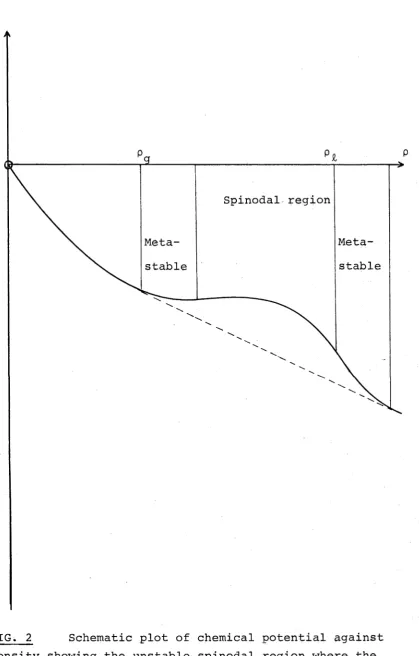
c) Near the spinodal curve 9 G/9V = 0 (see f i g . 2), the radius of the critical nucleus approaches infinity,
and the density at the centre of the nucleus approaches zero so that the w o r k of formation W approaches zero.
So far we have considered vapour condens a t i o n for simplicity. However it is possible by a simple change of notation to apply Cahn and Hilliard's (1958, 1959) theory to bubbles forming in liquids (cavitation) and to liquid and solid solutions. W h e n considering solid solutions, it is interesting to note that the very slow speed of
separation of phases allows us to consider a "supersaturation" well inside the u n stable region (see f i g . 2). This spinodal region is defined by 9 2G / 9 V 2 < 0, (see f i g . 2) w h e r e G is the Gibbs free energy of the fluids. Gibbs showed that the solution wou l d be unst a b l e to all infinitesimal
composition fluctuations spread over a large volume. These give rise to the p h e n o m e n o n of spinodal d e c o m p o s i t i o n
nature to nucleation, property (cj of critical nuclei! shows that nucleation theory goes naturally over to
spinodal decomposition as the spinodal is crossed. This is in contrast to classical theories where a barrier to nucleation exists in the spinodal region (Becker, 1938, Hobstetter, 1949).
Cahn and Hilliard (1959) did not consider the
calculation of nucleation rates in their treatment. Instead they supposed on the basis of experimental measurements
made in liquid-vapour systems far from T , that a gas would condense when the work of formation of a critical
nucleus fell below about 60kT. This is true if the
nucleation rate is given by eq.(l). However the Zeldovich non equilibrium factor (eq.5) has not been taken into
consideration. Cahn and Hilliard have made no provision for determinations of 3^AG /3i'|_*, and so their theory is lacking in this respect. We shall consider this aspect in more detail in chapter 2.
(1.6) Widom's Theory of the Free Energy of Fluids near the Critical Point
We have already mentioned briefly the equation of state near the critical point as postulated by Widom (1965b).
This has received much attention lately (Griffiths, 1967) and has been verified by Cooper (1968), and extended by him to regions further out from the critical region
(Cooper, 1971).
We may write the van der Waals equation of state in terms of the chemical potential y:
y (p,T)-p (pc ,T) = (P-Pc ) (T-t (p) ) 4> (1.22)
where $ is a constant and i(p) = Tc-a|p-pc | 7 is the temperature along the coexistence curve. In real fluids $ is a function of temperature and density. Widom
will be mathematically homogeneous in T-T and T -i(p), and of degree y-1. Thus
<Mx,y) = y' $ (x/y , 1)
= x Y 4>(l,y/x) , x < 0
= (-x)1 1$(-l,-y/x) , x < 0 (1.23)
If we define j (o)) = $(-1,-oj), then eq.(1.22) becomes T -T (p)
y(p)-y(p ) = (p-p ) (T-x (p) ) ( T - T)y j ( ^ _-,j— ) (1.24)
^ c
The function j(o)J must satisfy the following thermodynamic constraints.
(i) j (1) exists (coexistence curve o)=l). (ii) (l-o)) j' (o)) does not diverge as o)-*l. (iii) (l—cu) j (a)) is analytic in o)2^ at w=0 .
(iv) j (cü)/j (1) is positive for 0mjü<_1 .
(v) Thermodynamic quantities derived from eq.(1.24)
must obey experimental scaling laws.
Cooper (1971) extended the Widom theory to regions further away from the critical point by making j (u)) into a series of similar functions. However it is of no use for our purposes of finding a free energy near the critical point. Griffiths (1967) has considered very closely the different types of functions j(m) likely to satisfy the above
conditions in various systems. His considerations are mainly concerned with ferromagnetic systems, although they are
readily extended to liquids and gases. Fisk and Widom (1969) in their theory of surface tensions postulated a suitable form for j(m), viz:
(1-0)) j (03) / j (1) = J (1-0) Z ) (1.25)
all the conditions on 3 (00) given earlier. However y was
not analytic on the critical isotherm oj=0 . This problem was ignored as being of no concern to calculations
performed inside the metastable and unstable regions, as with Cahn and Hilliard's theory. However it shows u p a basic flaw with the choice of eq.il.25), as the exact
functional form of j (w) seems to be very critical. The agreement of Fisk and Widom's theory of surface tension with experiment was not very good. This could be due to
either the lack of knowledge about the parameter k in Cahn and Hilliard's theory, the fact that higher terms in Cooper's (1970) expansion of the equation of state are ignored, or the problem of choosing the correct j (to)
form. Fisk and Widom showed that by changing j (0 ) slightly,
CHAPTER 2 CRITICAL POINT NUCLEATION THEORY
(2.1) Introduction
In the first chapter we reviewed the relevant theories of nucleation and critical phenomena which will allow us to study nucleation near the critical point. In this chapter we will concentrate on the theory of nucleation in the critical region, as it was initiated by us (Sarkies and Frankel, 1971) and further developed by Eggington et a l .
(1971) using Fisher's (1967) modification of the Frenkel- Band theory of imperfect gases (Frenkel, 1939, Band 1939). We then point out the differences between the two theories and compare them with the experiments of Dahl and
3
Moldover (1971) for the nucleation of He vapours near the critical point. This leads to some very interesting conclusions.
(2.2) The Frenkel-Band Theory of Imperfect Gases, and Fisher's Theory
Frenkel (1939) and Band (1939) independently proposed a model based on nucleation theory for the equation of state of an imperfect gas. The gas is supposed to be made up of a perfect gas mixture of non interacting droplets which are created and destroyed by monomolecular
impingement and evaporation. The free energy of these droplets is taken to be just that of a bulk liquid plus
the surface free energy, as in e q . (1.6) . At any temperature and pressure, the droplets are scattered throughout different size classes according to eq.(1.3) and the gas is in a
dynamic equilibrium. Thus the total pressure and free energy of the gas is just the sum of partial pressures and free energies of the perfect gas mixture.
summation over the various droplet size classes). He
postulated that the free energy of a small droplet containing l molecules at temperature T could be represented by the
scaled form
AG. = i (y-y ) + i°kT£n(x) + ikT£n(i) (2.1)
The first term is just the bulk free energy of the
droplets. The second term is a surface free energy. This is assumed to have a different functional dependence on l
2
to that of a flat interface where o = -j . Here
l n(x)a(1-T/T ). The third term represents a translational and rotational free energy similar to the one introduced by Lothe and Pound (1962, 1968). The critical exponents o and t are to be calculated from scaling laws which relate the exponents to the known thermodynamic critical exponents through the sum over partial pressures. This model has been examined in detail by Kiang and Stauffer (1970) and modified by Reatto (1970) and Kadanoff (1970). The agreement with experiment and the accepted scaling
laws is good, but only at temperatures below T . Above T^ some unphysical discontinuities appear.
Subsequent to the publication of our own work (Sarkies and Frankel, 1971) on nucleation theory, Eggington, Kiang, Stauffer and Walker (1971) used Fisher's theory of critical phenomena to calculate nucleation rates near the critical point. It is important to examine their calculations in detail. Fisher's free energy eq.(2.1) was used with the nucleation rate eq.(1.4) and a monomolecular impingement rate
C, = l?-,ImkT) S. = A S i° (2.2)
1 P 1 P 2
y-u
k T[In (x)]
77Ö
y - y ,
(T -T)
C
V o
(2.3)
w h ich indicates how far the state is into the interior of the m e tastable region. On the coexistence curve y=pg and A = 0 . Now using the scaling laws (Fisher, 1967)
~ 1
2 + -rT
0 66 (2.4)
converting the sum in e q . (1.4) to an integral and using the steepest descents a p p r o ximation gives
J o c (AT) V + 1-a)/oA (T+i-3a/a,/oexD(_BA-o/(‘-a)) (2.5)
where B is a constant. Thus for constant A, and the typical values i=2.2, o=.635, we have
J V A T )
s (2.6)
Thus the n u cleation rate slows down as T->T , and the c
corresponding m e t a s tability limit occurs at a larger supersaturation. Eggington et a l . also showed that the critical exponent for the n u cleation rate increased to
6.8 if m u l timolecular clusters of a size the order of correlation length £a (AT) V were to impinge or evaporate from the nucleus. Note that this temperature dependence of J on AT comes from two sources; the Zeldovich non
s
e q u i librium factor (eq.1.5)
Ch *n^ ( V g
l 8i2
O 1/2
27TkT
j
(2.7)
and also the translatio n - r o t a t i o n contribution -xkTf.n(i) to the free energy eq.(2.1).
(2.3) The Sarkies-Frankel (1971) Scaling Theory of N u c l e a t i o n
In our contrib u t i o n to the theory of nucleation near the critical point, (Sarkies and Frankel, 1971) we
Widom's (1965b) equation of state to find the con d i t i o n for m e t a s t a b i l i t y in realistic liquid-gas systems.
We have already discussed Widom's (1965b) e q u a t i o n of state, eq. (1.22), but it is still necessary to choose an appropriate function to represent the behaviour in the unstable c o e x i s t e n c e region of the fluid. It is poss i b l e to genera l i z e the function (eq.1.25) chosen by Fisk and W i d o m (1969) to the form
(1-oj) j (w)/j (1) = i(l-üj^) (2.8)
where y is the critical exponent for the isothermal compressibility. This can be shown to have the same behaviour as e q . (1.25) only if 6 is an integer .* We take
6 to have the value 5 in real liquids (Gunton and Buckingham, 1968, Stell, 1968, McCoy and W u , 1968,
Frankel, 1969) and the value 3 in van der Waals liquids. Then y is related to 6 by the scaling law (Fisher, 1964)
Y = ( 6 - D ß (2.9)
If we define . a 3
2 = ( - ^ ( p - p c )
and
g(z) = y (z ‘/ 3 -1) j ( z ‘/ ß )/j (1) (2.1 0)
then
u - u
c
(AT) 13+7
zg (z)j (1) (2.1 1)
Here the scaling of the chemical potential is shown very clearly. Also the choice of j(m) in e q . (2.8) becomes
r \ <5- 1 i
g (z) = z - 1
(2.1 2)
At the coexistence curve z=l, and at the spinodal curve z=z we have
s
(2.13)
or equival e n t l y
^g(z) = Q
8z^so
z
= fiVl.»-«)
sThe curves of constant z are just curves in the coexistence region with a common axis through the critical point.
p“ pc = - J
<VT,e
a
This scaled supersa t u r a t i o n is effectively the same as that of Eggington et a l . (1971). Consider the curves z=constant. Then by e q . ( 2 . U ) we have
= (u-yG )-(Mg -yc )cc(AT)ß+Y (2.14)
Putting this into the expre s s i o n for A eq.(2.3) gives
A oc (AT) ß+Y"x/ö = (AT)ß_ß6+Y = constant (2.15)
by the scaling relations a = 1/36, y = (6-1)3. Thus A differs from z only by constant factors.
Now in the n u cleation equation of Cahn and Hilliard (1959) eq.(1.20), we m a y assume spherical symmetry and write
K = K (AT)“nV o
the Cahn-Hilliard theory of surface tension to agree with the accepted scaling laws (Widom, 1965a). Here v is the critical exponent for the correlation length and n is that for the correlation functions. E g . (1.20) now becomes
2k / 9 1 P , 2_ 9_p. r» 2 r Or
Or
y - y. (2.16)
where p = p (r) is the density at a radial distance r from the centre of the nucleus, and y = 9 A f / 9 p is the chemical potential. yQ is the chemical potential of the background phase of density p . Now using the definition of z in eq. (2.10) , and defining a scaled radial distance r' such that
r _ r . / 2k Y
V i d ) (AT)
Y//^
>
-0
v
O
J
\-1
(AT) _V
‘ V j (1)
where y = (2-g)\) , we may write e q . (2.16) as
92 z + 2 9z 9r '2 r ' 9 r'
= zg (z ) - zQg(zQ ) (2
, 6 6 . , . = (z -zo ) - (z-z0 )
with the boundary conditions 9z/9r'->0, z ^ z 0 as r_>0° and 9z/9r'->0 as r '->-0 . This is the equation which must be
solved to find the shape of the critical nucleus. The asymptotic solution for large distance r ' -*00 is obtained by expanding the right hand side of eq. (2.17) about z= z q
e x p ( r 'Voz ^ - 1)
z-z q ~ (const) ---
p
--- (2.18)W ( A T ) ^ VIc (zo ) (2.19)
where
I (z ) = f [ 2 [ Z zg(z)dz-(z-z ) (zg(z)-z g(z ))}r,2dr' (2.20)
c o 6 i o y o
o
If we accept the scaling law y=2v, we see that W is a
constant along lines of constant supersaturation z q near
the critical point. The van der Waals equation of state
gives y = ~ , v = j so that W a ( A T ) a l o n g these lines.
This shows a very different behaviour to a real system,
which is generally more stable to nucleation than the mean
field system of Cahn and Hilliard.
(2.4) Comparison with Experiment
Now the experimental criterion used by Cahn and
Hilliard (1959) for observable condensation is that the
work of formation W or AG of a critical nucleus must be less
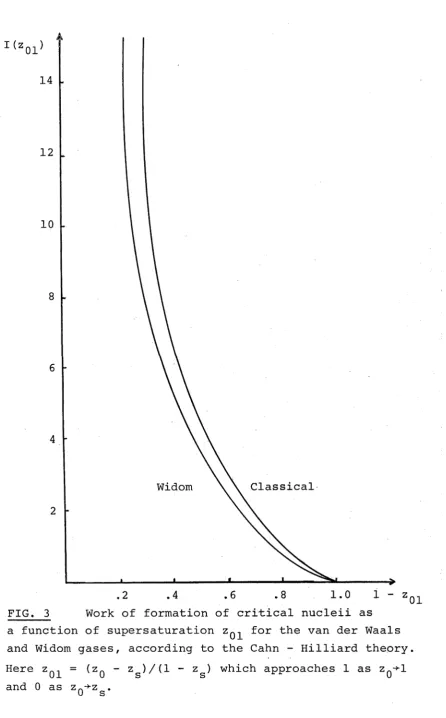
than about 60 kT at a given supersaturation. In fig.3
we have plotted the integral I (z ) in eq.(2.20) by
calculating the shape of the critical nucleus at each
supersaturation. This function is smoothly and monotonically
increasing from zero at the spinodal to infinity at
the coexistence curve. Fisk and Widom (1969) have given
data for argon whereby the constants in eq.(2.19)
may be evaluated. We have plotted the curve W = 60 kT
in the t, z q plane in fig.4 for the Widom gas (y = 2v,
curve B) for argon.
This criterion W = 60 kT for the metastability limit
unfortunately does not have a solid physical foundation.
A better criterion is to choose the nucleation rate
(eq.1.5) at which the human eye observes condensation to
occur. Because the rate changes over several orders of
magnitude with only small changes in supersaturation,
the point of condensation is very sharp and reproducible.
of temperature and other parameters of the experimental system. Now suppose that at temperatures far from the critical point, the condensation point is given by the condition W = 60 kT. As we move closer to the critical point, the Zeldovich non equilibrium factor (eq.2.7) may change in value, and so change the condition on W at which nucleation rates become invisible. In other words, if the nucleation rate along paths of constant
scaled supersaturation z near the critical ooint has a temperature dependence
J «t^ , t = AT/T (2.21)
s c
where j is the critical exponent given in eq.(2.16), then the condition on W for the metastability limit is
W/kT = 60 + jfnt (2.22)
which reduces to W = 60 kT when T = 0 or t = 1.
Consider the Zeldovich non equilibrium factor as given in eq.(1.5). If along paths of constant z , W
does not change with t, then the only temperature contributing factor is the size of the nucleus iar 3a:t Since the
2 / 3
impingement rate C^«i , we have the scaled form for the rate
J oc(AT)V s
This is a very minor temperature dependence compared to that predicted by Eggington et al. (1970). In fig.4 we have plotted the modified metastability limit according to eq. (2.22) with j = y, 4.1 and 6.8 (curves C,D and E
respectively). Within the experimentally accessible ranges of temperature shown, Eggington's theory predicts a very large dependence upon temperature for the metastability limit z (t).
Until recently very little experimental work on nucleation has been carried out near the critical point. The only known experiment is that of Dahl and Moldover
(1971) who presented preliminary results of metastable 3
states in He liquids near the critical point. This is a cavitation phenomenon ideally suited to Cahn and
Hilliard's (1959) theory, but not to that of Eggington et al. which is specifically designed for vapour nucleation. The
latter could not be observed in Dahl and Moldover's experiments 3
as the He wetted the walls of the container. Dahl and Moldover measured values of t,An/t , where t , i s the value of t at which the liquid had a lifetime of 100 seconds, and tcoex is the corresponding temperature at the coexistence curve. These measurements were made at constant density by cooling the liquid into the metastable region. They noted however that most nucleation occurred at the top of their apparatus where the density was smallest (due to gravity induced density gradients). They attempted to calculate this density and hence the corresponding value of t
using an approximate equation of state. Unfortunately they did not state the values of t which they calculated, nor did they attempt to estimate error bounds in their results. To plot their four points on our fig.4 we have tried to determine the values of t in the following way. When the mean density was 1.064 p , Dahl and Moldover state that t = 0. Consequently we have subtracted the value 1.064 rather than 1.000 from their stated values of
p /p in order to determine t = B J//^(p/p -1) . The value of B was taken to be 1.31 from the data of Wallace and Meyer (1970). We note that the parameter
— ß
^t100/^tcoex^ is just the scaled supersaturation z. These estimates are plotted in fig. 4 (curve A).
(2.5) Discussions and Conclusions
The experimental points are unfortunately too few and too inaccurate to say anything about the metastable states
3
constant zq as our theory predicts from scaling
hypotheses (Fisher, 1964, Widom, 1965a,b), then the various metastability limit curves for different values of the critical exponent j may be plotted on the same figure (fig. 4) as the
experimental results. The latter do not fall on any one of these curves, and consequently they cannot be used to predict a value for the critical exponent. Without any estimate of measurement error available, these results cannot be used to test the validity of nucleation theory. However, assuming that the theory is
correct, the results indicate that our prediction of 0.6 for the critical exponent j is probably too small. It is possible that some of the mechanisms of bubble growth by multimolecular Stages, as suggested by Eggington et al. (1971) are in fact
3
occurring in He liquids (Sarkies, 1973).
To conclude this section, we note that Cahn and
Hilliard's theory is capable of accurately calculating values of , the free energy of critical nucleii, near the
critical point. Unfortunately the theory says nothing about the actual growth of nucleii to critical size, nor about the translational and rotational energies of the nucleii. These are important considerations in determining the metastability limit in liquids and vapours. We are able to show from the scaling hypothesis of Widom (1965a) that
is constant along lines of constant scaled super
saturation zq , but the only experimental results available indicate a much larger variation of Jg with temperature than that predicated by us. The present need is for more
CHAPTER 3 PHYSICAL THEORY OF FLUID INTERFACES NEAR THE CRITICAL POINT. REVIEW OF RELEVANT THEORY (3.1) Introduction
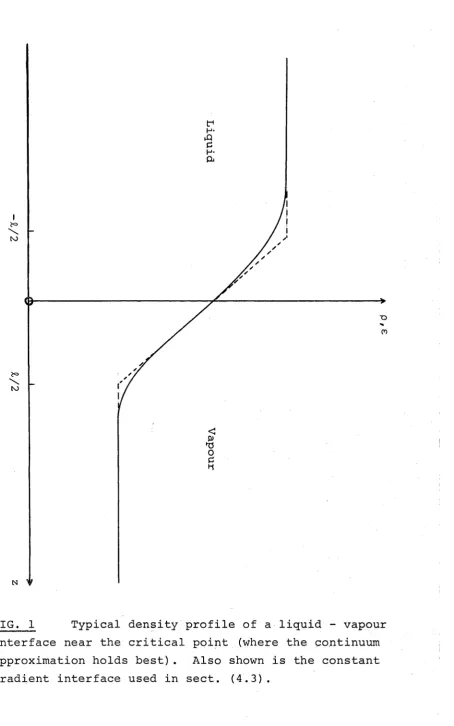
Light reflection experiments (Huang and Webb, 1969) near the critical point of a binary liquid system have shown that the physical interface is diffuse and spread over a distance of the order of a correlation length. A typical interface profile is shown in fig.l. This fact has been understood since the turn of the century (van der Waals, 1894), but attempts to put forward a fully consistent theory of surface tension have not been very successful. Lack of agreement with experimental critical exponents and the lack of solid physical basis have been some of the
problems which have plagued these theories. In this chapter we shall review the existing theories of surface tension valid near the critical point. Other theories which are applicable to temperatures and densities far from the critical point (Kirkwood and Buff, 1949, Fowkes, 1964,
Fowler, 1955, Croxton and Ferrier, 1971), either break down at the critical point, or are too complicated to be of any use for practical calculations.
In the remainder of this chapter we shall consider only liquid-gas systems unless otherwise stated. Most of the theory presented here can be readily extended to binary liquid mixtures by a simple change of notation.
(3.2) Mean Field Theories-of Hill* (1952) and Metiu - Ruckenstein (1971)
In most of the present theories of diffuse liquid interfaces, the free energy of inhomogeneity is split into two terms. These balance each other when the interface is in its equilibrium configuration. Cahn and Hilliard (1958)
(see sect. 1.4) chose to split the total free energy of the interface into a local "self energy" which was attractive, and balanced it against a gradient energy which was
constrained to be repulsive. However no physical or
mathematical justification of this repulsive behaviour has so far been advanced.
On the other hand, Hill (1952) chose to split the
interfacial free energy into a free energy of non interacting hard spheres (a repulsive entropy term) and the sum of the van der Waals interactions between each of the molecules in the fluid, calculated on a mean field basis. The improve ments introduced by other workers (Plesner and Platz, 1968, Strickfaden and de Sobrino, 1970) have been mainly in the area of the free energy of the hard sphere gas. The mean field approximation has not been improved.
Metiu and Ruckenstein (1971) improved the theory of Hill (1952) by splitting the free energy of the interface into a local self energy term as used by Cahn and Hilliard
(1958) and a mean field remainder term. The theory reduced to that of Hill (1952) when the first term was approximated by a van der Waals liquid free energy, and to that of Cahn and Hilliard (1958) when the second term was expanded in density gradients. The coefficient of the second term was
found to be a positive constant as derived by Cahn and
their theory in detail as it sheds some light on the theory of Cahn and Hilliard (1958) . Suppose the interface is
divided into cells over which a local mean field
approximation is assumed to apply. The free energy of the interface is the sum of the individual energies of each segment, plus the total interaction of each molecule in the cell with the excess number of molecules in the remaining fluid. If we let the cells become infinitely thin, the total free energy of interaction in cell i becomes
h “ v j ' V i T (
l
u <E12) [P(E1)P(E2)g(E1»r2)-pi2g ( r i2)] 1 ix dr dr
~ 1 ~ 2
(3.1)
where r — r -r , u(r ) is the intermolecular potential
L £ ^ 1 ~ 2 ~ 1 2 u
between molecules 1 and 2, and g ( r i2) is the radial distribution function for a homogeneous system of density in cell i.
Here g(r^,r^) is the radial distribution function for an inhomogeneous system. Metiu and Ruckenstein approximate this as g ( r j2) for simplicity. Although this introduces errors of unknown magnitude, it should preserve the
qualitative aspects of the problem. The condition for
equilibrium is the equality of chemical potential throughout the whole system, i.e.
y^ + = constant yQ (3.2)
This is exactly equivalent to the energy minimization condition of Cahn and Hilliard (1958) and is the actual criterion used by Hill (1952) . Now let \i^ be given by the equation of state of the real fluid, and assume that p(r) varies slowly in the z direction. We expand the integrand of eq.(3.1) in a Taylor series to get
, 2
d p
$ - < — 7 (3.3)
dz
4 / ( z - z ) g ( r )u(r )dr
2 2 l ^ v~ 1 2 ' ~ 1 2 7 ~ i
2TTea
(3.4)
w h ere e and a are the intermolecular potential strength and hard core radius respectively, viz:
g (r) u(r) -e (a/r) r>a
r <a
This k is identical to that derived by Cahn and Hilliard (1958) w h e n a m ean field approximation was used. We note
th
however that the in order term in the expansion of e q . (3.1) in density gradients have coefficients proportional to
TT2 p 2
— — ---- /°° u (r) g (r) r 2 1 ^ dr , m=0,l,2,... (3.5) 4n (n!) o
w h i c h is a div e r g e n t integral for m>l. This throws some doubt on the Taylor expansion method of obtaining the free energy of inhomogeneous systems (see also Hopper and
Uhlman (1972) who considered higher t e r m s ) .
(3.3) Deve l o p m e n t of the Cahn-Hilliard Theory by Lebowitz and Percus (1963)
Lebowitz and Percus (1963) have examined the Taylor series e x p a n s i o n m e thod of evaluating the thermodynamics of inhomogeneous fluids. They define a functional derivative 6f (p)/6p (r') by
6f(p) = / 6 p ( r ')d r '
and derive the general equation
f ( p ) = f(P0 ) +
± 1
...( Ap(r;)...ip(r')6n f(P)
6po (r;)...6p(r^) d r ' . . . d r '~ i ~n
Here f(p) is some thermodynamic or statistical quan t i t y such as free energy or a correlation function. It is possible to derive an expression for the chemical potential of the inhomogeneous fluid.
U = U„(P) - - i £ 2/ ( P % ) 2 [V. p ] 2 + ... (3.7)
CJ o U U q U U
where A and
t
are integrals over two and three bodycorrelation functions and X(p) is the compressibility. This expansion is identical to that of Cahn and Hilliard
(1958) with
1 _3 . A2 + l2P , _ 1 l2
6 3p 2 , 2 . 2 6 , 2 . 2
P X (p x) (p X)
(3.8)
U nfortunately it is not possible to determine the density
2 2 .
dependence of A or £ . We can only note that
£
isproportional to the Debye w a v e l e n g t h , (the second m oment of the intermolecular pair potentials, finite and non
zero at the critical point, Debye, 1959), and A ~ £ , the correlation length (Widom, 1972) as the critical point is approached. If we assume that A and x are e f f e ctively independent of p, the first term in eq. (3.8) has a
temperature dependence
< « ( A T ) Y " 2 v
near the critical point. This is in agreement with the suggestion of Parlange (1968), and is an indication that this theory of inhomogeneous fluids may hold some validity.
(3.4) Critique of Cahn and Hilliard's Theory
correct, the surface tension should be
a = Cß2 /k p2x(p£ ) (Ap)2 (3.9) where C is a dimensionless constant depending only upon
the form of the free energy function j(z). Using
compressibility and surface tension data for argon and nitrogen gases, Fisk and Widom then derived values of
the constant C from eq. (3.9) , which would be expected from a proper choice of j(z) defined in eqs. (1.22)-(1.24) .
However these values differed quite significantly, being 1.1 and 1.9 respectively, while a reasonable choice of j(z) (Fisk and Widom, 1969) gave values between 1 and 1.5 only. The density profile for the interface which they derived was slightly different from the classical tanh profile (Cahn and Hilliard, 1958), but it did fit the data of Huang and Webb (1969) much better than most other model profiles.
Several criticisms of Cahn and Hilliard's theory have arisen which we must consider. Firstly Widom (1965a)
(see next section) pointed out that the scaling laws for surface tension and interface width derived from the theory were not satisfied by experimental or Ising model critical
exponents. He also showed that the densities in the
A n o ther criticism (see Widom, 1972) is that critical fluctuations wou l d invalidate the expansion of Cahn and Hilliard. However Felderhof (1970) and Triezenberg and Zwanzig (1972) have put forward a justification of the surface tension equation of Fisk and W i d o m (1969) by
c o n s idering the fluctuations in the interface. Buff, Lovett and Stillinger (1965) also put forward an interesting
theory of surface tension based on the equilibrium fluctuation of the interface about its mean position.
Rather than the diffuse interface having a width dependent upon the bala n c e of a local self energy and an energy of inhomogeneity, a discontinuous interface with a diffuseness caused by the surface fluctuations in proposed. The
interface width so defined is dependent upon the area of the interface and the acceleration due to gravity. They indicate that the extension to naturally diffuse interfaces with an implicit energy of inhomogeneity can also be
m a d e .
(3.5) The R eformulation of Cahn and Hilliard's Theory by W i d o m (1965a)
In order to bring out clearly the physical assumptions of Cahn and Hilliard's (1958) theory of surface tension, W i d o m (1965a) suggested the following reformulation. Fluc t u a t i o n theory states that any small fluctuation An in the number density n of a fluid has a free energy
4>; = Bv (An) 2/n'x (3.10)
where B is a constant, x is the isothermal c o m p r essibility and v is the volume extent of the fluctuation. W i d o m
(1965a) postulated that this free energy eq.(3.10) would
apply to any inhomogeneity; in our case, that of the interface b e t ween two phases. Then if the interface has some
characteristic w i d t h l, the surface tension is
Minimizing this with respect to l gives an infinitely
sharp interface of zero width and zero surface tension. We conclude that there must be another term which balances this attractive fo-rce across the interface and stabilizes it at some finite width The hypothesis of the Cahn-Hilliard theory is that this second energy cf> , is
proportional to the square of the density gradients
<J>2 = xv(An
/Z)1
(3.12)where k is a proportionality constant independent of
Z.
This <j> is constrained to be repulsive at all temperatures. Thus we may write for the surface tension
a = B-l (An) 2/n‘‘x + <(An )2/l(3.13)
Minimizing this with respect to
Z
gives the optimum valuea = 2B£q (An ) 2/ n 2x (3.14)
where = (icnx/B) is the interface width. Now if we introduce critical exponents (Fisher, 1964) y, 3/ v and
y for X/ An, Z and a respectively, we have the scaling laws
y = 23-v+y , v = y/2 (3.15)
These assume that k is independent of temuerature AT.
(3.16)
and we have the scaling law for three dimensions
y = 2v (3.17)
W i d o m (1965a) claims that this new scaling law, along with the general relation y+v = 23+Y holds for all mod e l systems
(such as the Ising model) and agrees well with experiment. This is in contrast to the scaling laws eqs.(3.15) from Cahn and Hilliard's theory whi c h only agree with the m ean field models. In fact, the experiments are not sufficiently accurate to disti n g u i s h these two sets of scaling laws
(Sarkies, Richmond and Ninham, 1972).
(3.6) The K u ni-Rusanov (1968) Theory of Surface Layers
If we want to tackle the theory of fluid interfaces from a physical standpoint, we must introduce intermolecular forces. In this w a y Kuni and Rusanov (1968) and
Rusanov (1971) have presented an asymptotic theory of liquid interface structure using rigorous statistical
mechanical techniques. Consider a liquid-gas system having a diffuse interface situated at z=0 and an inhomogeneous density p(r ). In the presence of an external field u ^ , the BBGY e quation for the liquid is
whe r e <J> is the i n termolecular potential. The potential u^ which is just sufficient to force the liquid to be homogeneous with d e n s i t y is given by p(r^) = , i.e.
in Fluids
(3.18)
Now because G(r_,r2) ~ 1 / 1 r -r | as r - r ^ 00, then to leading order in 1/r 2 , we may ignore G(r ,r ). This appears to be the basic assumption of the Kuni-Rusanov theory. It assumes that the largest contribution from the integral comes from the region r2 far from r .
If we let
<f> = - A«/rc
t ~ i 2
where is the Hamaker constant for van der Waals
interactions between two molecules in the liquid, then eq.(3.19) becomes
u^ (r ( ~ - ttp^A^/6z3 (3.20)
Similarly if p is the gaseous density, and A is the
Hamaker constant for the van der Waals interactions between a molecule of the gas and a molecule of the liquid, we
have the "auxiliary" field
u(r^) ~ - ttp g Ag/6 z 3 (3.21)
Now Kuni (1965) has developed a functional expansion for an inhomogeneous fluid
P(r.) = exp(-ßAu(r. )) [p (ri : [u^])
/vg K .n (exp (-$Au(ri))-l)dri
+ --- ^ El--- ] (3.22)
where g ^ is the m*'*1 Mayer Ursell correlation function in the liquid in the presence of the auxiliary external field u^(r), and Au = u-u^ . Now if we use our expressions
p\ /v G (£i '£2 : [u£] ) (exp(-BAu(r2 ))-l) d r 2 (3.23)
This may be evaluated by expanding exp(-ßAu) in powers of Au and retaining the first term. Although
G (j£ i , r 2 : [Uq] ) ^ G(r 2) r the difference falls away as
3
0 (l/z ), and eq.(3.23) becomes
3tt
6
(Ag pg ~Al p
3
Z
+ O(-i-)
z(3.24)
where V is the volume of the fluid phase. The standard r e s u l t s :
) dr
~ 2
xl __ i_ ß " Pt
may be used in eq.(3.24). Now if we expand exp(-$Au)
in eq.(3.22) and include eq.(3.24) we finally obtain
PtCj) = P t it6 -a-ä 5---- A g ^g t 2 lA, l x
pl Xl+0(— :1
z z
(3.25)
This result is interesting because it is not based on any model equation of state, but uses only the long range van der Waals interactions between the molecules in the liquid and gas. It holds asymptotically as z->°°, and will yield an interface wid t h defined by
l
o
A p - A 0p 0
g g P ~Po
g t
1 / 3
Dlxl,
Unfortunately the result eq.(3.25) does not hold near the critical point. If y, 3 and v are the usual critical exponents (Fisher, 1964), and we note that the Hamaker constant is proportional to the density squared so that