City, University of London Institutional Repository
Citation: Nouri, M. (2016). Creativity-supporting environments: An emotion-based
framework for influencing designers’ creativity through using design environments. (Unpublished Doctoral thesis, City, University of London)This is the accepted version of the paper.
This version of the publication may differ from the final published
version.
Permanent repository link: http://openaccess.city.ac.uk/16161/
Link to published version:
Copyright and reuse: City Research Online aims to make research
outputs of City, University of London available to a wider audience.
Copyright and Moral Rights remain with the author(s) and/or copyright
holders. URLs from City Research Online may be freely distributed and
linked to.
Creativity-supporting environments
An emotion-based framework for influencing designers’ creativity through using design environments
Mobina Nouri
Supervised by
Professor Neil Maiden
Centre for Creativity in Professional Practice City University London
A thesis submitted for the Degree of Doctorate of philosophy
City, University of London Northampton Square London EC1V 0HB United Kingdom
T +44 (0)20 7040 5060
THE FOLLOWING PARTS OF THIS THESIS HAVE BEEN REDACTED
FOR COPYRIGHT REASONS:
p. 18:
Fig. 2.1.
The
4Ps model of creativity.
p. 33:
Fig. 2.8.
Plutchik’s wheel of emotion.
p. 41:
Fig. 2.16.
Geneva emotion wheel.
p. 48:
Fig. 2.19.
Model of dual pathway of tone and activation.
p. 54:
Fig. 2.21.
Image of environment colour changes.
p. 57:
Fig. 2.25.
Happiness, creativity and productivity in
different countries.
p. 62:
Fig. 2.29.
Creative space for design learning.
p. 76:
Fig. 3.5.
Design
process of Juicy Salif.
p. 138:
Fig. 4.17.
Plutchiks wheel of emotion.
p. 233:
Emotional self assessment questionnaire before and
Abstract
Declaration
The work described in this thesis is based on research carried out at the Centre for Creativity in Professional Practice, City University London, London, United Kingdom. No part of this thesis has been submitted elsewhere for any other degree or qualification. All work is my own, unless stated otherwise.
Mobina Nouri Date 26/07/2016
III
Acknowledgements
Table of Contents
1 Introduction ... 1
1.1 Problem description in the research domains ... 3
1.1.1 Environment ... 3
1.1.2 The effect of environment on creative design ... 4
1.2 Creative design in creative environments ... 5
1.3 Research Scope and Definition of Concepts ... 7
1.3.1 Emotion ... 7
1.3.2 Creativity and creative processes ... 7
1.3.3 Environment ... 9
1.3.4 The links between emotion, creativity and environment, and the research scope ... 10
1.4 Research challenges, questions and objectives ... 12
1.4.1 Research questions ... 12
1.4.2 Research objectives ... 12
1.5 The PhD outline structure ... 13
1.6 Contribution to the field ... 15
2 Literature review ... 17
2.1 Creativity ... 17
2.1.1 Creative Person ... 19
2.1.2 Creative Process ... 19
2.1.3 Creative Product ... 20
2.1.4 Creative Press ... 21
2.1.5 Measuring creativity ... 21
2.2 Design ... 23
2.2.1 Design thinking ... 23
2.2.2 Divergent versus convergent thinking ... 26
2.2.3 The relationship between creativity and design ... 28
2.2.4 Supporting designer’s creativity ... 30
2.3 Emotion ... 32
2.3.1 Emotion definition ... 32
2.3.2 Theories of emotion ... 32
2.3.3 Emotions and 3 dimensions of hedonic tone, activation and regulatory focus ... 34
V
2.3.5 Dimension of emotions that affect behaviour ... 35
2.3.6 Emotions and moods ... 36
2.3.7 What is flow state? ... 37
2.3.8 Different tools to measure emotions ... 40
2.3.9 The relationship between emotion and creativity ... 44
2.3.10 Meta-analysis of creativity-emotion links ... 45
2.3.11 Emotions and early versus late creativity production ... 49
2.4 Environment ... 50
2.4.1 Creative environment ... 51
2.4.2 Physical environment for creativity ... 52
2.4.3 Psychological environments for creativity (climate) ... 58
2.4.4 Using technology in environments to encourage creativity ... 60
2.5 Relationship between creativity, environment and emotion ... 65
2.5.1 The influences of 3 main domains in the previous research ... 66
2.5.2 Current thesis in the gap of research ... 69
3.1.4 The creative press (environment) ... 77
4.2.5 Results ... 139
5 Refined CSE Framework (Creativity Support Environment) ... 155
5.1 Findings of the first and second studies to develop the CSE framework ... 155
5.1.1 The spatial environment ... 157
5.1.2 The task environment ... 158
5.2 Refined CSE framework based on spatial and task environment ... 159
5.3 Spatial versus task environments in the high-activated and low-activated spaces ... 161
5.3.1 The ask environment supporting divergent and convergent task ... 161
5.3.2 Further design guidelines to support divergent creativity ... 161
6 Study III. A summative evaluation of the effect of environment change on divergent and convergent creative activities in design work ... 171
6.1 Hypotheses ... 172
6.2 Method ... 175
6.2.1 Participants ... 175
6.2.2 Design task ... 175
6.2.3 Procedure ... 176
6.2.4 Change in the creative environments ... 177
6.3 Material and measurement ... 179
6.3.1 Study conditions ... 179
6.3.2 Measuring participants’ emotions ... 180
6.4 Evaluation Results ... 182
7 Discussion ... 195
7.1 Introduction ... 195
7.2 Why the research matters ... 195
7.3 Empirical and theoretical findings ... 197
7.3.1 Research question 1 ... 197
7.3.2 Research question 2 ... 198
7.3.3 Research question 3 ... 199
7.4 Contributions to theoretical and practical knowledge ... 201
7.4.1 The theoretical CSE framework to investigate the relationship between environment, emotion and creativity ... 202
7.4.2 Design environment to enhance creativity ... 202
7.4.3 Design environment that influence emotion ... 203
7.4.4 Design environment that support creativity processes ... 204
7.5 Test of Validity ... 205
7.6 Suggestions for future work ... 206
7.6.1 Type of task ... 206
7.6.2 Type of environment: task or spatial environments ... 207
7.6.3 Type of stimuli based on 5 human senses ... 208
7.7 Conclusion ... 208
1
1 Introduction
Design fulfils an increasingly important role in modern society. Products, services and environments are all the result of complex design processes, an activity now worth at least £2.5 billion a year to the UK economy (DCMS, 2014). And yet, although design is a process of shaping creative ideas to become practical activities and objects in people’s lives (Design Council 2014), there has been relatively little research into the influences of creative thinking in design work. Although design activities have been studied empirically to reveal important cognitive phenomena such as idea fixation (Cross, 2004), little research has investigated factors that influence creative thinking in design processes. Therefore this research investigated one such factor – the environment for creative design. The physical and digital environment refers to all components that associated with visual and auditory senses in both physical and digital formats, and can conclude furniture, light, colours, plants, digital images, projector and computers.
Sternberg and Lubart (1999) define creativity as “the ability to produce work that is both novel (i.e. original, unexpected) and appropriate (i.e. useful, adaptive to task constraints)”. Novelty is defined in different contexts with respect to H-Creativity (historical creativity) that is new to person-kind (Boden, 1990), P-Creativity (psychological creativity) that is new to the person, but not to person-kind or others (Boden, 1990), or S-Creativity (Situated creativity) that defines a designer had an idea for a specific task with novelty in that particular situation or domain (Suwa et al., 2000). S-creativity defines creativity as a dynamic concept that is situated in a place or space. It is not only the result of psychological impulse of one individual, but rather it is the process that always happens in that context (Belussi and Sedita, 2011).
Accordingly creativity cannot be treated as a uniform phenomenon. Rather, most repeatable and effective creative process are divided into creative activities such as incubation then illumination of ideas (Wallace, 1926),
mess finding before idea generation (Osborn, 1953), or divergent idea generation before convergent solution building (Pslek, 1997). Each of these creative activities has different characteristics that could be supported more effectively by different environments. Of course, the new principles could be generated directly from existing creativity research. During creative divergence, for example, designers scope and explore different idea spaces (Boden, 1990), so a supportive environment might provide multiple stimuli to search and discover ideas in these spaces. Likewise, during creative divergence, designers select ideas and develop quick prototypes (Lockwood, 2010), so the environment might support designers to locate and experiment with ideas without hindrance, then construct simple prototypes.
3
designers to improve their creative potentials via their influence within the environment.
This chapter presents and explains the structure and the scope of this thesis. First it defines the research problem and the challenges in understanding the research problem. Then it outlines the research scope, and establishes a theoretical structure of this research, then presents the research questions and objectives. The chapter finishes with the proposed contribution to the field.
1.1 Problem description in the research domains
1.1.1 Environment
Characteristics of an environment can tell us about the “personality” of that space. These characteristics are not only physical such as colours, lighting and objects, but also the smell, sound and even haptic factors of the space that cause us to have different feeling about that space. For example, being in a restaurant is not just about food, but also experiences of being in the particular environment that is formed through the smells, music, lighting, and seating.
Each environment has the potential to cause specific emotions in people. In architecture, this is called the “genius loci” a Roman expression that refers to a location's distinctive atmosphere, or a “spirit of place” that is related to some particular emotions (Graves & Poraj, 2009). Furthermore, more widely, the form and function of a space can reflect the culture, behaviours and priorities of the people within it (Doorley & Witthoft, 2012).
environmental psychology research about how a room affects people’s behaviour, emotions and well being by reducing people’s stress and increasing their satisfaction. However, there is still a lack of applicable guidelines for designing specific spaces to provide different emotional changes. For example, several researches revealed that positive emotions have an impact to improve creativity (Baas et. al, 2011). So the environment can be designed to stimulate more positive emotions, such as happiness, by applying vivid colours in the space, and as a result facilitating creative thinking.
1.1.2 The effect of environment on creative design
Although human creativity could happen anywhere, there are some studies that indicate that, environment designs could notably affect creativity (Moultrie et al, 2007; Taher, 2008; Landry, 2012). Environments with certain qualities and elements e.g. access to the nature, natural material, warm colours and window views, have been shown to foster human creativity (Doorley & Witthoft, 2012), and innovation (Moultrie et al, 2007). However, although the Make Space tool (Doorley & Witthoft, 2012) guides how environments can be manipulated to ignite collaborative creativity, there are few principles to inform the construction of environments to support creative activities.
5
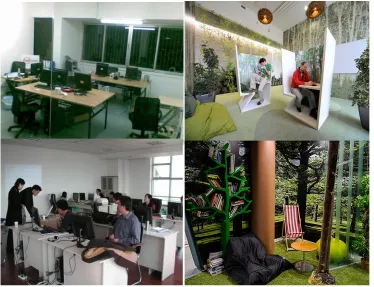
Figure 1.1. Different settings of creative and non-‐creative space: left column -‐ One limited location and one restricted way of engaging that cannot trigger positive emotions. It forces people to focus on the screens without any other possibility for change; right column -‐ positive emotions and creative space, variety of stimulus, visual, textural and spatial alternatives that provide interaction between people and the environment and represent freedom to choose the space and activity.
However, with all this evidence, there is still little research and knowledge about which features, how and in what extent; space can enhance creativity. Therefore, the main challenge for this research is to understand the features of the environment that enhance creativity by influencing people’s emotions.
1.2 Creative design in creative environments
[image:14.595.109.483.93.380.2]al., 1996).
According to a “Creativity in the workplace” report, creativity is now considered as a key factor of everyone’s job (Martin, 2010). In the report, creativity is strongly associated with motivation and satisfaction, and as a result can have a positive impact on productivity and robustness. Other research into work environments has revealed that 40% of office workers felt most productive at work on their own desk (Cooper, 2011). There is a need to investigate the workspace in terms of diverse needs of workers to enhance both their productivity and their creativity. A creative capacity could be affected by how people interact with their physical surrounding (Morel research, 2008).
Moreover, physical settings are very important in the workspaces in each organization (Moultrie et al., 2007). In designer’s jobs that involve a creative process, the role of workspace becomes even more crucial. Designers need the space that motivates and triggers creativity. However, poorly designed workspaces such as cubicles in limited spaces, desks in open areas, that cause interruptions and distractions, and poor lighting can all inhibit creativity. Such poor working conditions reduce productivity (Beach, 2015). However, good news is that technology companies reliant on effective design processes and problem solving in their projects now understand the vital role of workspace in worker’s wellbeing, productivity and creativity, and the importance of workspace has been demonstrated by better workspace designs in most successful organizations such as Google, Facebook, Apple and IDEO (Kahl, 2011).
7
1.3 Research Scope and Definition of Concepts
To provide a baseline for and to the scope of the doctoral research, this section defines the research components in three main domains: emotion, creativity and environment, for use throughout the thesis.
1.3.1 Emotion
Scherer (2000) defines emotions as a “ hypothetical construct denoting a process of an organism’s reaction to significant events” (Scherer, 2000). Events can be external such as behaviour of others, a change in the current situation or novel stimuli or internal such as thoughts, memories or sensations (Scherer, 2000). Each emotion episode lasts for a certain duration of time, with decreasing intensity, before it fades away (Scherer, 2000). Emotion can change moment by moment, and are short term in
duration. Evidence is that sights, smells, sounds and the external environment can trigger our emotions. The existing research demonstrates
the direct effect of emotion on creativity (Bass et al., 2011).
1.3.2 Creativity and creative processes
1.3.2.1 Creativity
Sternberg & Lubart (1999) define creativity as “the ability to produce work that is both novel (i.e. original, unexpected) and appropriate (i.e. useful, adaptive to task constraints)”. Boden (1990) categories creativity in three types: exploratory, combinational and transformational. Exploratory
creativity is a search space of partial and complete possibilities and rules exist to enable traversal of search space. Combinational creativity makes
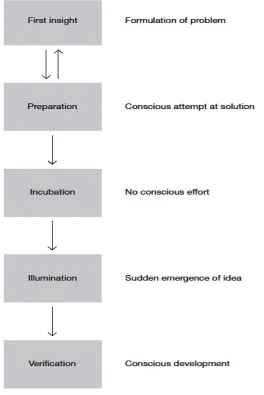
Creative processes can be characterized as inspirational, situational and structural creative processes. Wallas (1926) defined inspirational process as interplay between consciousness and unconsciousness, insight and breakthroughs in 4 known stages of preparation, incubation, illumination and verification. A situational creative process is applied for social aspects
of problem solving and interaction and collaboration in teams. Structural creative processes develop the creative ideas in a rational and systematic approach. It is an exhaustive, systematic and structured search for information and also structured and guided process to explore and solve problems (Osborn, 1953; Daupert, 2002). This research uses the last category, and seeks to support structural creative processes. Because this
research focuses on creative design processes that support structural creativity and needs to follow the method of problem solving in design field.
1.3.2.2 Divergent and convergent thinking
In a creative processes people search for alternative answers to one problem (divergence) then evaluate one possible answer from the alternatives (convergence) (Isaksen, 2008). “Convergent thinking can produce new ideas
scientifically, and divergent thinking can produce new ideas artistically. To produce meaningful art and creative science, artists and scientists combine convergent and divergent together for the best result of creativity” (Nilson, 2011). This research considers creativity as combination of divergent and convergent thinking.
1.3.2.3 Creativity in design
9
Design thinking is another term that refers to the process of design with the aim of solving a problem. Design thinking is a human-cantered innovation process that includes observation, collaboration, fast learning, and visualization of ideas, rapid prototyping and concurrent business analysis (Lockwood, 2010). Therefore the influence of creativity in design is needed to improve creative thinking in education and industry, and the innovative performance of the society grows gradually (Hollanders & Cruysen, 2009).
1.3.3 Environment
Environment is defined as “the context, including the place and situation in which creativity take place” (Isaksen et al., 2009). Spaces that people live and work can be understood through their five senses analysed by the brain and influenced by function of mind and cognition process. Many researches
have demonstrated that the physical environment influences creative output and thinking mode (McCoy, 2005; Deasy & Lasswell, 1990; Taher, 2008). The ways people feel in the space change their perception of the function of space and their activities shapes accordingly. For example, open-plan spaces reflect more flexibility, which enhances interactions and teamwork, while closed areas boost individuals’ concentration and development of ideas. For
1.3.4 The links between emotion, creativity and
environment, and the research scope
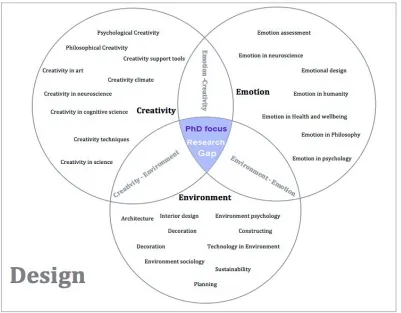
As will be reported in the literature review in chapter 2, there is research that has studied the associations between each two concepts: creativity-emotion, creativity-environment and environment-emotion that are showed in the intersections of each 2 circles (Figure 1.2). However, on connecting creativity, emotion and environment, there is still an absence of research to understand the links between emotion, environment and creativity in design work that is showed in the shared area of 3 circles (Figure 1.2).
[image:19.595.96.497.332.645.2]11
1.3.4.1 The proposed structure of the relationships between emotion, creativity and environment
This research seeks to create and investigate a new type of creativity space to influence the relationship between emotion and creativity, with the aim of helping designers to exploit their creative potential. These environments can support creativity in design by manipulating designers’ emotions.
This research introduces the concept of creativity support environments that aim to enhance designers’ creative performance. To do this, the research seeks to manipulate the environments in order to influence designers’ emotions at different stages of a creative process.
According to previous research, an environment with specific visual features such as colours, furniture and light could trigger particular emotions in designers and it can improve the creative performance. The structure in Figure 1.3 shows all connections between the main concepts (environment-emotion-creativity) in the creative design process, however the main research focus is on the affect arrows (illustrated with vertical arrows). How environment features affect emotions and then those emotions affect creative performance. To test the proposed structure the environment features will be implemented with different physical and digital stimuli.
[image:20.595.121.488.529.727.2]1.4 Research challenges, questions and objectives
1.4.1 Research questions
With respect to the main challenge, which is to explore how environment could stimulate or inhibit creativity during design processes, the research questions are:
1. How do environments affect on designers’ creativity by influencing their emotional states in a creative design work?
2. What kind of emotional states enhance creativity during the divergent and convergent stages of a creative design work?
3. How is an environment implemented during the divergent and convergent stages of creativity design work (divergent and convergent thinking) to manipulate designers’ emotions, with the aim to enhance designers’ creative thinking?
1.4.2 Research objectives
Answers to the three research questions will be sought in line with the following three objectives:
1. To investigate an original framework that can explain the relationship between creativity, emotion and environment to improve the creative performance in design process.
13
3. To evaluate the framework by undertaking empirical studies to test different environments to improve designers’ creative performance regarding to their emotions.
1.5 The PhD outline structure
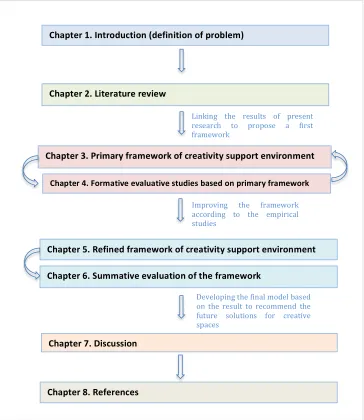
The structure of the thesis this is shown in Figure 1.4. Each chapter is outlined in more detail. The approach was to review the research context, explore an initial theoretical model, test and refine it, and then develop a final model with recommendations on how to use it to design environment to enhance creative work.
Chapter 1. Introduction (definition of problem)
Chapter 2. Literature review
Chapter 3. Primary framework of creativity support environment
Chapter 4. Formative evaluative studies based on primary framework evaluation
Chapter 5. Refined framework of creativity support environment Chapter 6. Summative evaluation of the framework
Chapter 7. Discussion
Chapter 8. References
Linking the results of present research to propose a first framework
Improving the framework according to the empirical studies
Developing the final model based on the result to recommend the future solutions for creative spaces
[image:22.595.125.489.320.740.2]The remainder of the thesis is organised as follows:
Chapter 2: Literature review
This chapter demonstrates an understanding of and critiques the knowledge in the three main fields of research:
1. The importance of creativity in the design process
2. Environment and the features of environment that affect creative performance
3. Emotions that are associated with creativity
To conclude, the chapter reviews the connection between these three areas within a framework of previous research, and identifies the lack of research of the intersections of these areas. The existing research was then analysed to identify gaps in current research.
Chapter 3: Primary framework of a creativity support environment
This chapter presents the primary framework of a creativity support environment. The framework has been developed to explore the new environment for a creative work that helps designers to improve their creative capabilities by changing their emotions. It describes and explains the framework to explore how the environment can be designed to stimulate designer’s emotions for enhancing creative thinking.
Chapter 4: Formative evaluative studies based on primary framework
15
and a controlled environment to allow comparison with the two other environments. The results investigated the effect of environment on each designer’s creativity and emotions, and led to an expanded version of the framework that was reported in chapter 5.
Chapter 5. Refined framework of creativity support environments
In this chapter, the revised framework of a creativity support environment posits from the results of the two studies from Chapter 4. This framework is elaborated details and specification of different elements of environment and emotions.
Chapter 6. Summative evaluation of the framework
This chapter reports an empirical summative validation of the framework. To investigate the effect of environment on creative performance, two different environments were designed, created and evaluated to stimulate the specific components of designers’ emotions. The empirical study involves 41 designer participants and explores how environment could change to support creative work that evolves through a sequence of divergent and convergent activities.
Chapter 7. Discussion
This chapter concludes the thesis by revising the objectives, answering the research questions and discussing future research. This research recommend the model of creativity support environment for future research, and make practical and theoretical contributions to the field.
1.6 Contribution to the field
creativity and design field. The new model could be investigated and experimented within theory, and then subsequently used to study designers’ behaviours within different settings of environments and emotions. The framework is particularly important because the influence of emotions in physical and digital design spaces can potentially enrich the creative process and enhance creativity. It aims to enhance the designer’s performance and creative thinking in the future design workspaces.
The future workspaces can provide an engaging interaction between designers and environment within the creativity design process, which includes both digital and physical features of the space. These features that lists in the design guidelines, practically could contribute in designing creativity-support-environments. This research investigates the environment that affect on emotions, the environment that affect on creativity and finally the environment that support creative process by considering the link between emotion and creativity. The framework is also intended to apply technology to enhance designer’s environments with the aim to help designers to gain most of their creative potentials.
17
2 Literature review
This chapter reports previous research undertaken in three disciplines: creativity, emotion and environment. It then presents the relationships between the results of research in these three disciplines that underpins on approach that sought to enhance human creativity with elements of environment that influence emotions to foster creativity. At the end of the chapter, it concludes the relationships between the disciplines to determine links between creativity, emotion and environment concepts, to target the gap of knowledge, and propose a model for this research.
2.1 Creativity
Runco (2009) claims that creativity is more important now than ever before in a review of 25 years of literature focusing on creativity in different domains. Creativity plays an important role in our everyday lives, and is more than just a concept for art, invention and innovation. It can benefit both individuals and society (Runco, 2009). Creativity is also an economic aspect of innovative organizations that has become more and more important. Creativity research is now significant part of competitive domains such as business, education, social development, health, design and technology (Norman, 2006).
There is also a difference between individual novelty (I-Novel) and group novelty (G-Novel) in a creative design process (Warr & O’Neil, 2007).
Edward de Bono (2010, p.38), the father of lateral thinking, statesthat “Creativity involves breaking out of established patterns in order to look at things in a different way.” Csiksentmihalyi believes that creativity is produced by seeing a new pattern in one domain by inclusion into the other domain (McIntyre, 2007). Guilford defines ‘modern’ creativity as applying four components of divergent thinking: fluency, flexibility, originality and elaboration. Creativity was also related to other features, such as newness and originality of insights (Csikszentmihalyi, 1999), motivation (Collins & Amabile 1999). In this research, the definition of divergent and convergent thinking in systematic creativity is used to explore the level of novelty, originality and usefulness of the ideas that create in different types of environment.
Rhodes (1990) suggested categorising the overlapping components of creativity to include person, process, product and press in a framework called 4P’s model of creativity (Figure 2.1).
Figure 2.1. The 4Ps model of creativity (Isaksen, 2011, p.7)
[image:27.595.129.465.448.614.2]19
2.1.1 Creative Person
The primary concept of a creative person suggests that ‘all people can be creative’ (Craft, 2003, 146). Other scholars have listed characteristics of a creative person such as originality, flexibility, fluency, risk taking, playfulness, elaboration, high energy, openness, complexity, imagination and curiosity (Treffinger et al, 2002). In other words, a creative person has the “capacity to produce new or original ideas, insights, inventions, or artistic products, which are accepted by experts as being scientific, aesthetic, social or has technical value” (Eysenk, 1995, p. 234).
Another characteristic of creative people is being sensitive to their environment. The nervous system of creative individuals is more sensitive to specific factors in the related domain. For example, a person that is sensitive to colours and light is more likely to be creative in painting and art, and similarly individuals that are interested in sound can easier innovate in music (Csikszentmihalyi, 1999). The higher sensitivity in creative individuals causes the experiences of joy (positive emotion) and pain (negative emotion) to be more extreme than in other people (Csikszentmihalyi, 1999). Therefore, understanding the emotions of a creative individual is key in fostering creativity. Later, this chapter explain how people’s emotion and creativity can be associated in order to foster creativity.
2.1.2 Creative Process
The creative process is the tools, techniques, and models that enable people to think creatively. Edward de Bono reports that “the creative process is an interruption in the smooth flow of routine in order to pay deliberate attention at some point”. People make their lives simple by setting up routines. Creative thinking is a tool that applies when they break the routine and changes their mind’s pattern (Lloyd, 2013).
idea by combining unrelated ‘matrix of thoughts’ (Dubitzky et al., 2012, p.16). One of the most known processes is Wallas’ model in 1926 that describes the stages of creativity as preparation, incubation, illumination and verification.
There are different approaches in different domains. For example IDEO, in the design field, describes this process as understanding, observing, visualizing, evaluating and implementing (Kelly & Littman, 2001). In education, the Cropley’s model (2001) is common and added stages to the Wallas’ stages in the process. Shneiderman (2000) also introduce a simple model: collect, relate, create and donate that could be used in many domains. None of these processes are linear. Each helps us to understand creativity better and use it as a skill to learn and teach.
2.1.3 Creative Product
“A creative outcome can be a physical outcome or a new solution depending on the domain of creativity in result of a creative process” (Cropley, 2011, p.11). A creative product is any product of mind, solution or idea that is novel and useful according to Sternberg and Lubert’s definition of a creativity outcome that should meet the user’s need. A creative product definition recognizes creativity as a product of the mind that is novel and useful: this is a helpful definition derived from interviewing 400 managers about their creative performances (Isaksen, 2009).
21
2.1.4 Creative Press
Press is considered to be the context of creativity that includes environment, place, situation, context or climate that creative activity takes place. Press is a broad container that explains the interaction between the person and situation that can promote or inhibit creativity (Isaksen, 2009). Rhodes (1987) stated that “press refers to the relationship of human and their environment.” The effect of press may be caused by general aspects of the environment such as culture, organization, or family, or more specific such as environmental settings (Runco, 2004). Hasirci (cited in Runco, 2004) states that certain environmental designs for schools encourage creativity. In organizational settings, Amabile (2004) suggests that environments needs to provide stimulation but not distraction, and resources should be available for people to improve creative thinking. Mooney also believes that press includes the conditions related to an individual or group that involve a creative process to develop the final outcome (Richards, 1997). People’s interaction with the environment makes a change in their creative thinking and behaviour.
2.1.5 Measuring creativity
There are two main approaches to measure creativity that are explaining in following sections.
1. Assessing the creative outcome of creativity
creative design’ based on comparing the new ideas with the existing ideas and studies the creative outcome as a product in the specific context. The 5 main elements of this model are imitation (the replication of previous work), variation (the modification of existing work), combination (the mixture of two or more works), transformation (the translation of a work in to another medium or mode) and original creation (the creation of something previously unrecognized) that can measure the novelty of a product in the form or content (Figure 2.2).
Figure2.2. Taxonomy of creative design, measuring the novelty of a product (Nilsson, 2011, p.4)
2. Assessing person’s creativity: the Guilford model
23
2.2 Design
Ralph and Wand (2009, p 108) defined design, as “a specification of an object, manifested by some agent, intended to accomplish goals, in a particular environment, using a set of primitive components, satisfying a set of requirements, subject to some constraints”. The Design Council (2011) reports that “Design shapes ideas to become practical and attractive propositions for users or customers.” Design may be described as creativity deployed to a specific end. Design is a bridge between creativity and innovation as a management process for development new products and services. It also defines as a creative and user-centered approach to problem solving (Design Council, 2011).
Designers should cope with various challenges and different types of creative thinking in a design process. For instance, they should prepare some ideas, and then using the limitations that a design problem presents, they should focus and improve an idea for the real use in the real world.
Nigel cross (2004) describes design as “more like building a ‘creative bridge’ between the problem space and the solution space” (p. 129). Anyone could be a designer if they understand the knowledge of design thinking.
2.2.1 Design thinking
Design thinking defines a systematic solution-focused method to find both creative and functional solutions for problems (Kimbell, 2009). It is a human-centred innovation process (Lockwood, 2010). As a complex cognitive skill, it requires: 1. concentrated, reflective interaction with images of problems and solutions, and; 2. easy and rapid shift between doing and thinking (Cross, 2008, pp.135–136). Therefore designers need to develop a deep understanding of a problem, and be able to make creative connections to shape an idea as a real solution in each new challenge.
implementation. Inspiration is the problem or opportunity that encourages the search for solutions. Ideation is the process of generating, developing ideas. Implementation is the path that leads from the project stage into people’s lives (IDEO, 2011). Design thinking is seen as a creative process that enables designers to provide creative outcomes.
25
Table 2.1. Approaches in design and design thinking (Kimble, 2009, p.17)
Kimbell/Beyond design thinking/6
[image:34.595.115.484.71.604.2]social is located. The aim of producing the table is not to synthesize existing work, but rather to highlight key themes and contradictions that appear across literatures.
Table 1 Research on design and design thinking
Characteristic Reference Goal of design To achieve fit between a form and its context Alexander 1971
Problem solving Simon 1969
The generation of new concepts and new knowledge; expandable rationality
Hatchuel and Weil 2009, Hatchuel 2001 The resolution of paradoxes between discourses
in a design situation Dorst 2006
Modes of reasoning and thinking in design
Abductive Cross 2006
Inductive, deductive and abductive Dunne and Martin 2006
Balancing divergent and convergent thinking Lawson 2006 Designing new possibilities rather than selecting
between alternatives Boland and Collopy 2004
The nature of design problems
Determinate; ill-structured problems can be solved similarly to well-structured problems
Simon 1969; Simon 1973
Indeterminate; design problems are wicked problems
Buchanan 1992
Paradoxes between discourses; design problems
are not knowable and evolve during the process Dorst 2006 A design attitude sees problems as opportunities
for the invention of new alternatives Boland and Collopy 2004 Design and creativity are special cases of problem
solving
Simon 1969 (Hatchuel 2001)
Problem solving is a subset of innovative design Hatchuel 2001
The nature of design processes and activity
Dynamic mapping between functions and design parameters
Braha and Reich 2003
Selecting and identifying constraints and applying
guidelines Lawson 2006
Exploratory and emergent Cross 2006
Functional decomposition Alexander 1971,
Hubka 1982 Reflection-in-action; making ‘moves’ to reframe
problems
Schön 1983
Design processes do not end Lawson 2006
Working at high levels of abstraction as well as detailed level
Co-evolution of problem and solution Dorst and Cross 2001
Solution fixated Cross 2006; Rowe
1987
Experimentalism Brown 2008
Designers’ approach to
knowledge production Comfortable with ambiguity and uncertainty Cross 2006, Michlewski 2008 Integrating across knowledge domains Hargadon and Sutton Consolidating multidimensional meanings Michlewski 2008 Empathy with users and stakeholders Brown 2008; Dunne
2.2.2 Divergent versus convergent thinking
Guilford (1999) was the first to distinguish between divergent and convergent thinking. Divergent thinking is the ability to offer different, unique or variant ideas to support one theme while convergent thinking is the ability to find the "correct" solution to the given problem. Design thinking encourages divergent thinking to ideate many solutions (possible or impossible), then uses convergent thinking to chose and realize the best resolution.
Guilford (cited in Cropely, 2001, p.35) states that divergent thinking is the fundamental core of creativity, and the source of novelty. In divergent thinking, fluency and originality are important to access the creative outcome because it is the “production of variability” (Cropely, 2001). In a design process, designers first diverge as they create a number of alternatives ideas for each, then converge as they evaluate the alternatives and select the most promising and most desirable alternative (Dubberly, 2005).
Designers often describe themselves as creating many options (diverging) and then narrowing down their options (converging). Designers have described analysis as a process of breaking a problem into pieces—of “decomposing” it. Synthesis follows as re-ordering of 1the pieces based on dependencies, solving each sub-piece, and finally knitting all the pieces back together— “recombining” the pieces (Figure 2.2).
[image:35.595.169.428.585.723.2]27
This decomposition-recombination process also diverges and then converges (Dubberly, 2005).
Figure 2.3. Totally convergent design process (Dubberly, 2005, p. 25)
Nigel Cross (2000) explains the overall aim of a design strategy is to converge on a final, evaluated and detailed design proposal, (Figure 2.3) but within the process of reaching that final design there will be times when it will be appropriate and necessary to diverge, to widen the search or to seek new ideas and starting points (Dubberly, 2005, p.25).
Figure 2.4. A simple model of design process (Dubberly, 2005, p.30, adopted from Nigel Cross, 2000)
2.2.3 The relationship between creativity and design
Creativity and design are inseparable concepts that are defined in different domains. Design can lead to the innovation. It is a path to shape creative ideas in reality. In simple words, creativity can exist without innovation, but innovation could not happen without creativity (Isaksen et al., 2009). So design is a bridge that makes it possible to travel the road from creativity to innovation (Design Council, 2011).
[image:37.595.213.385.72.297.2]29
Figure 2.5. The 'double diamond' design process model (Design council, 2007)
Figure 2.6. Creative process and design process model (Lawson, 2003, p. 42)
In addition, there are similarities between design methods and creativity techniques. A core idea element of both is production that reveals novelty and usefulness. Techniques from the design domain such as brainstorming, character profiles, customer journey mapping, fast visualization, focus group, physical prototyping, role-playing, scenarios, and user diaries all deliberately support creative thinking (Design Council, 2011).
2.2.4 Supporting designer’s creativity
[image:39.595.178.442.72.467.2]31
design from science, yet it is the crucial liberal arts that reflect the culture that designers use it as an insight to solve a wicked problem. Designers also
work with a cognitive-based design ideation that is called creative problem solving. This approach helps designers to think out of box and generate ideas laterally and creatively (Dorst & Cross, 2001).
There are many publications about creative-thinking techniques that have been shown to improve creative performance. Some techniques that are used by designers for creative problem solving include brainstorming (Rawlinson, 1981) and the Delphi method (Linstone & Turoff, 1975), which encourage group activities among designers to stimulate the derivation of solution concepts while other techniques such as lateral thinking (De Bono, 1977), mind mapping (Buzan 2005), creativity templates (Goldenberg & Mazursky, 2002), TRIZ (Altshuller, 1997; Mann 2002), Synectics (Gordon, 1961), and morphological analysis (Fargnoli et al., 2006) to provoke creativity. All of these techniques help designer’s thoughts to explore a solution in a creative way.
2.3 Emotion
2.3.1 Emotion definition
Emotions are “a psycho-physiological process or response, which is created every time a conscious or unconscious perception of important changes in
the environment or in the physical body appears” (Marsella & Gratch, 2014). Mower (1960) stated that emotion is a complex psycho-physiological experience of an individual's state of mind as interacting with biochemical
(internal) and environmental (external) influences see Figure 2.7. This research assess that emotions can be caused by environmental and the external stimuli.
Figure 2.7. Emotion with general internal and external features (derived from Mower, 1960)
2.3.2 Theories of emotion
There are different theories in emotionclassification. The simplest model is
pain and pleasure. it supposed that all types of emotion in humans originate from these two basic emotions (Mowrer, 1960). Ekman (1972) devised 6 basic emotion based on different facial expressions. Moreover, a recent classification justifies emotions as primary, secondary and tertiary emotions in a tree structure (Parrot, 2001) using Plutchik’s wheel of emotions (Figure
2.8). This model includes eight basic bipolar emotions: joy versus sadness; anger versus fear; trust versus disgust; and surprise versus anticipation. This model is depicted as a colour wheel, and the vertical dimension represents intensity, while the circle represents degrees of similarity among the emotions that provide a self-assessment tool in this research (Handel, 2012, p.195). The Plutchik’s model provides as a self-assessment test because it is a model that categorises emotions with colours accordingly, so people can
associate an emotion with words and colours to understand and choose Emotion Environment
(External stimuli) Physical body
33
quickly. The other positive points of Plutchik’s model is that it introduces semantically consistent set of distinct emotions and has an organizational structure with a standard set of names including levels of intensity in emotions.
Figure 2.8.Plutchik’s wheel of emotion (Handel, 2012)
More up-to-date theories that focus on research in the emotion field can be categorized into three main parts (Marsella & Gratch, 2014). First, discrete theories of emotion explain emotions as limited numbers that are determined naturally and biologically (such as sadness or anger). Second, appraisal theories focus on mental process that stimulates emotions, and a process of individual needs and external environments creates emotion. This appraisal theory is the fundamental dominant theory in psychology and computing in 20th century, however, there are some criticises of this theory because it treats emotions as a consequence while emotion is a reactive concept (Marsella & Gratch, 2014). Third, are dimensional theories that describe emotions as a continuous space in 2 or 3 dimensions. The ‘PAD’ model of emotion by Mehrabian & Russel (1974) is very common theory to use in numerous researches about environmental psychology. The three dimensions of PAD are pleasure (a measure of valence), arousal (the level
[image:42.595.177.448.155.398.2]PAD theory is very useful to assess human perceptions of their physical environment (Bakker et al., 2014). It has been used as an emotional assessment tool in previous studies. For instance, the PAD model has been used in organizational studies to collect the data of emotions towards specific factors such as motivation and productivity in the organisation
(Lance, et al. 2008), for marketing studies of products (Desmet, 2003), and studying the consumer behaviour in different stores (Ratneshwar and Glen 2003).
Therefore, in this research uses this dimensional theory, was selected for use to evaluate emotional state of people in different environment according to external stimuli.
2.3.3 Emotions and 3 dimensions of hedonic tone, activation
and regulatory focus
There are 3 dimensions of emotion - hedonic tone, activation and regulatory
focus- that have reported, developed and compared for their predictive validity in emotion studies (Baas et al., 2008). Figure 2.9 shows the resulting emotional states based on the related dimensions.
For example, relaxed is an emotion with positive tone that is deactivating and prevention focused, while angry is the emotion with negative tone that is activating and promotion focused. This classification of components of emotions enables scholars to study and assess emotions systematically.
35
2.3.4 Circumflex model of emotions in dimensional theory
Russell (1980) defined the Circumflex model of emotions as a two basic dimensions of emotion, and emotional states can be described in terms of two underlying dimensions: value and arousal. Value is a judgment of positive versus negative in emotional states. People tend to base these conscious judgments on whether something is pleasant or unpleasant.
Arousal shows the activation level of an emotion. Arousal in highest level represents anxiety and in the lowest level represents boredom (Figure 2.10). This research used these two dimensions to assess emotional states in the studies undertaken in this research. This tool can assess two important factors, pleasure and arousal that links to creativity. In addition, Circumflex model of emotions transfers the qualitative emotions into quantitative dimensions of emotion for further assessment that simplifies the model for participants to answer emotion questionnaires.
Figure 2.10.Circumflex model of emotion (Gorp, 2006, p.35, adapted from Desmet, 2002 and Russell, 1980)
2.3.5 Dimension of emotions that affect behaviour
Each dimension of emotion affects a different aspect of behaviour. Value
affects whether we approach (i.e. pleasure) or avoid (i.e. pain), while arousal levels influence how motivated we are to do things. Both pleasant and unpleasant events and experiences can increase arousal levels. For
Value
Ar
ou
sa
example, fear and excitement are both high arousal emotions. The level of arousal also affects how intensely we experience a given emotion, and the more intense the emotion, the more attention is demanded (Gorp, 2006). Arousal also affects the level of motivation. Low arousal or boredom results in low motivation, while higher arousal results in higher motivation (Figure
2.11). An optimum level of motivation, arousal and performance is called flow, which is an emotional state that is associated to creativity, and is reported in section 2.3.8.
Figure 2.11. Circumflex model of emotion and behaviour (adapted from Russell, 1980; van Gorp, 2012, p.44)
2.3.6 Emotions and moods
Emotion can change moment by moment, and are short term in duration. Emotions are intentional meanings that sights, smells, sounds and external
environment can trigger (Gorp, 2012, p 45-47). Moods describe the pattern of emotional responses over the short term, but are longer than emotions,
usually for hours or days and are non-intentional because they are not directed at anything particular (Gorp, 2012). Studying mood requires research monitor to people’s mood for days and weeks. Furthermore, moods are non-intentional to evaluate. Emotions that are acute and intentional can be evaluated more accurately. They change quickly by the external
environment, and the features that can trigger them are from human 5 senses
Behaviour
Mo
tiv
ati
on
Approach Avoid
High Motivation
[image:45.595.162.434.249.461.2]37
about a person’s environment. Therefore, the focus of this research is on emotion rather than mood.
2.3.7 What is flow state?
Flow is a state in which people become completely immersed in an activity that their level of skill matches the level of challenge (Csikszentmihalyi, 1990). It exists when people are completely motivated and absorbed in a task (Gorp & Adams, 2012) Other Scholars calls this type of experience ‘motivational activity’, which refers to a mental/emotional state where all of people’s attention (or energy) is totally focused on an activity that they experience in flow. It can be experienced while engaging in very diverse activities such as mountain climbing, meditation, playing chess, or creating art (Norman, 2004). Novak (1998) described the flow elements in three
different categories that are causes, characteristics and consequences of flow (Table 2.2).
Causes of Flow Characteristics of Flow Consequences of Flow
A clear goal Total concentration and focused
attention Distortions in the perception of time
Immediate feedback A sense of control over interactions Loss of consciousness of self
Balance between
challenge and skill Openness to new things Activity is perceived as intrinsically rewarding Increased exploratory behaviour
Positive feelings Increased learning
Table 2.2. Causes, characteristics and consequences of flow (Gorp, 2012, p73, adopted from Novak, 1998)
2.3.7.1 Flow and associated emotions
The basic model of flow describes how people that are in flow state experience different emotions according to the balance between challenge
Csíkszentmihályi (1997) published a chart that shows one further aspect of flow (Figure 2.13). It reveals that it can only occur when the activity at hand is a higher-than-average challenge and requires above-average skills. The centre of this chart represents one's average levels of challenge and skill. The further from the centre an experience is, the greater the intensity of that
state of being (whether it is flow or anxiety or boredom or relaxation). Being in control and higher arousal are the safest borders for being in the flow state (Figure 2.13).
Furthermore, the flow area can be matched in the circumplex model of
emotion, as shown in Figure 2.14. In the flow model, boredom creates the Figure 2.12. Flow, anxiety and boredom (Gorp, 2012, p.75, adopted from Csikszentmihalyi, 1990)
[image:47.595.185.408.460.664.2]39
lowest arousal and anxiety is the highest arousal, and the other emotions between them encompass both pleasant and unpleasant. This model reveals how it is possible to evaluate how people experienced flow state by measuring the valence and arousal level of their emotions as a tool that was used in this research.
2.3.7.2 Being in the flow can enhance creativity
Flow generally leads to more attention and creativity (Csíkszentmihályi, 1990). It is the state of mind that people’s emotions are pleasurable and joyful when doing some special activity. People remains in the flow state
enjoying the task if the level of challenge and skills are balanced. This research assumes the challenge and skills for designers can be changed during a creative process. They might tend towards anxiety or boredom, which leads to less attention and joy of what they do. So one intention of this research is support designers to remain in the flow emotional states that
foster creativity.
Figure 2.15. Flow emotional state in two dimensions of emotion (adopted from Gorp, 2012)
2.3.7.3 Dimensions of emotions in flow
Both pleasant and unpleasant objects and experiences can increase arousal levels. For instance, fear and excitement are both high arousal emotions. The level of arousal also affects how intensely people experience a given emotion, and the more intense the emotion, the more attention is demanded.
Arousal also affects our level of motivation. Low anxiety or boredom results in low motivation, while higher anxiety results in higher motivation. This continues to an optimum level (i.e. the balance of flow), after which motivation and performance decrease, while anxiety increases (Gorp, 2006).
Arousal as a component of emotion is largely unconscious, but it provides
an especially powerful channel to command attention and influence behaviour. For example, large images, bright-saturated colours and high contrast all increase arousal levels. When the level of arousal increases, the focus of attention narrows and goes to whatever is causing the stimulation. A good example of this is a stop sign, which uses a bright red to command
attention within the busy visual environment of the street.
2.3.8 Different tools to measure emotions
Measuring emotions is difficult. People are challenged to describe how they
41
2. technological tools that captures physiological changes and 3. coding systems based on expressive behaviour (Laurans, 2011). Each is reported in turn in the following sections.
2.3.8.1 Self-reports assessment
The most common technique in emotion research seeks to capture conscious feelings that users report about themselves. These self-report tools include verbal measurement tools and nonverbal measurement tools (Agarwal &
Meyer, 2009).
1. Verbal measurement tools
These tools are a self-report category that indicates the emotions by scales and with names of emotions (e.g. Geneva emotion wheel (GEW) questionnaire, see Figure 2.16) that categorises emotions based on their high/low control and high/low pleasure with different degrees of intensity of emotions.
Figure 2.16. Geneva emotion wheel, a verbal measurement tool (Scherer, 2005, p. 723)
However, the main problem with these tools is that they can only capture the conscious emotion of the participant. In addition, because emotions are
[image:50.595.127.474.403.624.2]Semantic Differential scale is another verbal tool (Agarwal & Meyer, 2009) that uses three-dimensional scales of pleasure, arousal and dominance. The pleasure-displeasure scale measures how pleasant an emotion might be. The arousal-no arousal scale measures the intensity of the emotion, and the dominance-submissiveness scale represents the controlling and dominant
nature of the emotion.
2. Nonverbal measurement tools
These tools represent emotions by using visual human cartoons instead of words (e.g. Self-Assessment Manikin (Bradley & Lang, 1994) see Figure 2.17) Participants choose the visual emotion that is closest to their feeling. These tools are good for low intensity and mixed emotions.
Figure 2.17. Self Assessment Manikin, SAM questionnaire (Bradley & Lang, 1994, p. 54)
Other nonverbal tools include PAM (Desmet et al., 2012), PreEmo (Desmet,
2003), Facial Action Coding System (Ekman & Friesen, 1978), and Emocards (Desmet, 2000). Some measurements are a combination of verbal and nonverbal, for example Emocard was used to evaluate the usability on interface by different used both verbal and characters (Desmet, 2000). The advantage of these tools is that they are independent from language and can
43
2.3.8.2 Physiological tools
Physiological changes in the body (e.g. while we are experiencing an emotion can be used to evaluate emotion with technological tools. Changes in inner organs to measure body arousal are a common topic in psychophysiological research. Some electrical signals in response system of body provide valuable information about emotion changes. The most frequent measure in research is electrical activity (EDA), which includes all
changes in skin and minor sweating deviations connected to the brain signals in experiencing special emotion. Although this device often generates ambiguous results and technical difficulties, it is common in both human-computer interaction and marketing research (Laurans, 2011).
2.3.8.3 Facial expressions
Facial movement captured in video recording is a suitable source of information that can be applied in coding system to recognize different
emotion. This approach reads points and edges of the face muscles that appear in a particular emotion. Most techniques are limited to a small number of 7 basic emotions (neutral, happy, surprised, sad, scared, disgusted, and puzzled). For example, the facial action system (FACS) is an anatomically based comprehensive system that presents affect and any visible change on the face. Max, Affex and Emface are some existing facial expression coding tools that have been applied in current research. Three are
Figure 2.18. Face-‐reader using to assess seven basic emotions (Lee, 2013)
Results from facial expression analysis are more valid when there is a stimuli like an commercial advertisement, movie or computer-game that make the participant looking directly to the camera and the program is able to find, recognise and classify emotions by representing some visual graphs at the same time (Terzis et al., 2010). These tools can measure between 6 and 8 basic emotions but not the mixed emotions and the accuracy of them is between only 60 and 80% (Desmet, 2012).
2.3.9 The relationship between emotion and creativity
Much research has sought to investigate the relationship between emotion and creativity from different perspectives. “Attractive things work better” is an idea that supports three levels of mind processing in which states as visceral, behavioural and reflective (Norman, 2004). It describes how people can be more creative when faced with an attractive design. For
example, someone who is relaxed, happy, and in a pleasant mood, is often a more creative, more able to overlook and cope with minor problem. In contrast when people are anxious, they are more focused (Norman, 2004).
Other studies have revealed that high levels of negative emotions lead to greater artistic creativity. One demonstrates how special biological
45
creativity are not the same, but go hand in hand. They have many similarities concerned with intellectual efforts and interpersonal contexts that require sharing and collaborating. It also involves competition, jealousy, secrecy, and other interpersonal issues (George et al., 2007).
2.3.10 Meta-analysis of creativity-emotion links
One of the most significant studies in this field is a meta-analysis. Bass harvested the collection of associated research in 25 years of emotion– creativity research. The result of this analysis contains three fundamental
classifications of hedonic tone, activation, and regulatory Focus (Baas et al., 2008). These three factors play a significant role in some of the reported studies. This meta-analysis synthesized 102 effect sizes reflecting the relationship between specific emotion and creativity. The basic results can
be summarised as:
• Positive emotions produce more creativity than emotion-neutral
controls;
• Creativity is enhanced most by positive emotions states that are
activating and associated with an approach motivation and promotion focus (e.g., happiness), rather than those that are deactivating and associated with an avoidance motivation and prevention focus (e.g., relaxed);
• Negative, deactivating emotion with an approach motivation and a promotion focus (e.g., sadness) were not associated with creativity, but negative, activating moods with an avoidance motivation and a prevention focus (fear, anxiety) were associated with lower creativity, especially when assessed as cognitive flexibility;
• With a few exceptions, these results generalized across experimental and correlational designs, populations (students vs. general adult
population), and facet of creativity (e.g., fluency, flexibility, originality, eureka/insight);
• The emotion–creativity link is better understood as a function of