MECHANICAL, THERMAL, DATA AND POWER TRANSFER TYPES
FOR ROBOTIC SPACE INTERFACES FOR ORBITAL AND PLANETARY MISSIONS - A
TECHNICAL REVIEW
Wiebke Wenzel1, Roberto Palazzetti2, Xiu T. Yan2, and Sebastian Bartsch1
1German Research Center for Artificial Intelligence - Robotics Innovation Center (DFKI RIC), Robert-Hooke-Str. 1,
28359 Bremen, Germany, Email: [email protected]
2University of Strathclyde, Engineering Faculty, DMEM department, James Weir Building, 75 Montrose Street, G1 1XJ
Glasgow, United Kingdom, Email: [email protected]
ABSTRACT
A wide variety of scientific aims have been formulated for future explorations of space and planets. In order to achieve these aims, a need for robotic systems and mission set-ups with increasing complexity arises. The H2020 EU-funded project SIROM (Standard Interface for Robotic Manipulation of Payloads in Future Space Missions), aims to realize an integrated interface for me-chanical, data, electrical and thermal connectivity that al-lows a reliable, robust and multi-functional coupling. The present paper reports an overview of classifications of power, data and mechanical interfaces and thermal trans-fer methods in current robotic and space applications. Eventually, the paper presents ideas for innovation and development of standard multi-functional interface with the most promising developments expected in the next few years.
Key words: Multifunctional Interface, Robotic Space In-terface, Transfer Classifications in Space, Modularity.
1. INTRODUCTION
Connectivity in space is one of the main issues, which engineers and space mission planner have to face nowa-days. With the increasing complexity of mission plans and tasks, a need for a standard, multifunctional, scalable and modular interface arise. The SIROM project aims to find a definitive solution for such needs: it aims to real-ize a set of integrated and inherently optimised interfaces for mechanical, data, electrical and thermal connectivity that allow reliable, robust and multi-functional coupling of payload to robot manipulators, payload to other pay-load or client to server, in both orbital and planetary en-vironments.
The present paper reports an overview of classifications of power, data and mechanical interfaces and thermal transfer methods in robotics and space applications.
All types are described in their functionalities and evalu-ated for orbital and planetary suitability. While in-orbit systems have to operate in harsh, but repeatable envi-ronment, planetary systems have to deal with potentially highly variable environment with, among others, chang-ing temperature and dust level. A comparison among ex-isting interfaces in robotics and space is also presented, with respect to pre-defined mission scenario and require-ments. The main focus is on the different transfer possi-bilities for space and planetary use in order to present a clear overview of the state of the art of the various types of functional connectivity.
Some existing interfaces will present in Section 2. An outline of each type of transfer is given in Section 3. Sec-tion 4 includes possibilities and ideas of innovaSec-tion and development of standard multi-functional interfaces with the most promising developments expected in the next few years. A conclusion and outlook is given in Sec-tion 5.
2. RELATED WORK
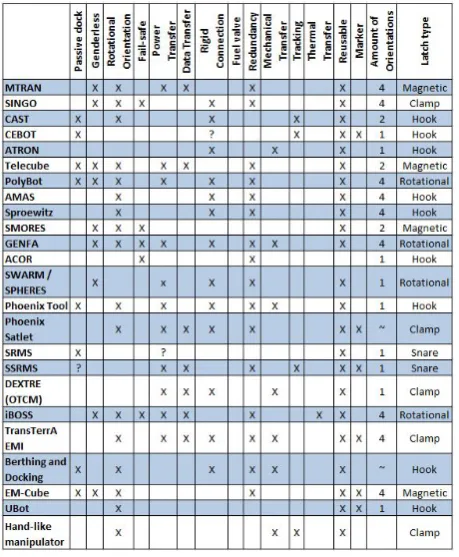
Terrestrial examples of robotic connection interfaces are commonly seen in modular robotics, where homoge-neous or heterogehomoge-neous modules interconnect to satisfy some functions, either mechanical, thermal, electrical or computational. Modular platforms make the creation and the operation of large structures easy, hence why they are being considered for large scale space operations [1]. A large range of space interface has been found in litera-ture [2] [3]. Figure 1 summarise the selected existing in-terfaces, based on the presence or absence of a number of given features.
(a) Hook (b) Roto-lock (c) Clamp (d) Carribena
Figure 2. Latching mechanism
Figure 1. Basic properties of existing interfaces
3. TYPE OF TRANSFER
3.1. Mechanical
Latches are used to lock or restrict movement after the initial interface contact; they can be activated automat-ically once the connectors have been firmly pushed to-gether or engaged. Sometimes latches are not necessary, but they are strongly recommended to ensure rigid con-nection. Latching can be achieved physically or mag-netically. Mechanical latching is any means of physical connection that maintains itself by interference of motion upon an object, developing a connection that mates two objects. Mechanical latches are often motor driven, but can also be initiated in other ways, such as Shape Mem-ory Alloy, even if they require high current to be acti-vated [4]. Among the various methods of physical
con-nection, in order to help identifying the core functional-ity of each one, these are classified in groups that share properties or traits. The literature review highlighted four latch classes: hook, rotational, clamp and carribena. Fig-ure 3 shows advantages and disasvantages of these four mechanical latch classes.
Hook The hook latch is perhaps the simplest of the mechanical latches, it involves one side of the connec-tor rotating hook-like appendages into position around the other face of the connector, interfering in any trans-lational movement perpendicular to the face, as well as rotational movement around that axis if possible. Fig-ure 2(a) shows an example of a hook latch. Locking is possible in passive manner (with e.g. springs) or in active manner with actuators.
Roto-lock A rotational locking mechanism is a motor-powered type of lock, that requires a male/female inter-face to operate. It usually works by first having the male side of the connection coupled with the female side; then the roto-lock engages, rotating around the centre of inter-face, tightening the female side, or latching into groves on the male side. This concept is almost exclusively used with the Peg-in-hole system, expanded further in Fig-ure 2(b). The main benefit of a roto-lock system is that it only involves one moving part, which is highly beneficial for space applications.
Figure 3. Advantages and disadvantages of mechanical latch classes
Carribena This latch involves having a mechanical in-terference piece in a passive locked state on the female side, and on the male side one crossbar piece. The male part pushes into the female part to disengage the interfer-ence piece using low amounts of force. Once the male piece is past a certain threshold, the female piece returns to its default position either through active (actuator, elec-tromagnet) or passive (spring, static magnet) means. The lock can only be disengaged using an active unlock se-quence, but the translational motion required opens up many options for automatic alignment. Figure 2(d) shows the Carribena mechanism.
3.2. Electrical
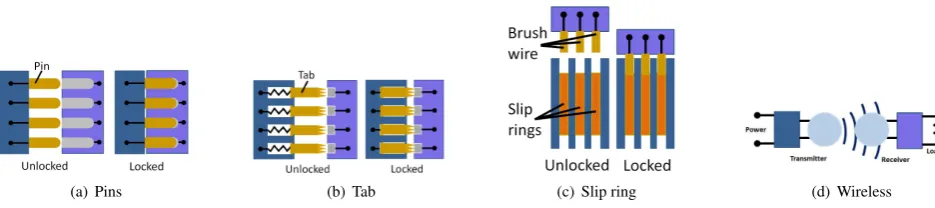
The functionality of transferring electrical load in a spacecraft is similar to terrestrial applications, but the cold vacuum of space adds some challenges to the pro-cess; in particular the high temperature range makes on-purpose space-designed cables necessary. The power transfer is a common function for modern an dated inter-faces, and few designs have been devloped for the pur-pose: each one of them have pros and cons that need to be considered an are here highlighted. Four types for power transfer interfaces have been indentified and here described: pin, tabs, slip rings and wireless power trans-mission. Advantages and disadvantages of these four types are shown in Figure 5.
Pins Pin connections are a versatile way of interlock-ing and maintaininterlock-ing electrical contact between two inter-faces. It involves the use of, commonly long and cylin-drical, male/female inserts (see Figure 4(a)). This type of connection prevents lateral movement but axial move-ment is still allowed without a latching mechanism. The arrangement of pins determines redundancy, rotational symmetry and gender of the interface. Pins are affected adversely by particles, and depending on their thickness, may be easy to break.
Tab Tab contacts (see Figure 4(b)) are spring loaded metal component that acts as a simple touch interface for power. They are not designed with any form of latching, but the spring load gives the interface excellent angular and axial tolerance, enabling the connection even before the latch has fully closed. Tabs need to be sized care-fully to compensate for high power loads and other space environment effects.
Slip rings Slip rings are electrical contacts in ring form, allowing for theoretically infinite number of rotational al-lowances (see Figure 4(c)). They demand much more space than other methods of power conduits, but provide a more flexible solution for abstract rotation connections.
Wireless power transmission Wireless power trans-mission is a very high specific power electric propulsion enabled by disassociating the power generation from the transfer vehicle. First, power is acquired on the power-beamers through the use of solar arrays. This DC power is then converted to RF power so that it may be transmit-ted to the rectenna (rectifying antenna) on the transfer ve-hicle. A rectenna captures incident RF power and trans-forms it to DC power by a diode based converter. This system increases, by one order of magnitude, the actual specific power transferred to spacecrafts.
3.3. Data
On-board bus requirements are currently driven by the need to move from fully centralized processing towards distributed processing. A modern spacecraft bus will need to be able to acquire synchronous data frames from sensors with controlled latency, transmit synchronous to actuators with controlled latency, transfer asynchronous and isochronous data packets between nodes, and pro-vide a symmetric medium access control service to nodes (i.e. each node can access the bus on demand), accu-rate distribution of time data and time reference pulse, and a safe implementation for a cross-strapping mech-anism. Many industry-standard serial data communica-tions methods are in use in space. The limiting factor is often the availability of space-qualified supporting hard-ware for a given hardhard-ware bus, though softhard-ware protocols may remain the same. Although I2C, SPI, PCI, and even USB have been long tested and used as board-level data buses in space, with appropriate redundancy and soft-ware support, a Modular Data Interface is expected to use a communications bus suitable for reliable long-range wired links. Eight main data buses have been highlighted from literature review and are here briefly presented.
(a) Pins (b) Tab (c) Slip ring (d) Wireless
Figure 4. Electrical transfer types
robust, and been used in many space applications be-ing self-clockbe-ing and capable of detectbe-ing many types of communications error. However, the use of Manchester encoding introduces frequency related issues at high data rates, and it may not be suitable for operations that re-quires high data rate.
CANbus The Controller Area Network is a very pop-ular and common message-based half-duplex bus in robotics and automotive applications, and has been used in several space applications. ECSS-E-ST-50-15C de-scribes the use of CAN bus in space hardware, with CANOpen chosen as standard protocol layer for ESA missions. The current development towards low power rad-hard ISO 11898-2 CAN transceiver hardware and CAN can be implemented over twisted pairs also. The main limitation of CAN is the bit rate, with a maximum of 3.7Mbit/s in the CAN FD standard.
SpaceWire One of the newest and most space-centered buses is SpaceWire, which focuses on connecting pro-cessing nodes via reliable full-duplex switched serial packet links. The SpaceWire communications standard ECSS-E-ST-50-12C from 2003, has been supplemented by protocol identification in ECSS-E-ST-50-51C, remote memory access in ECSS-E-ST-50-52C, and packet trans-fer in ECSS-E-ST-50-53C, and adopted by ESA, NASA, JAXA, and RosCosmos. As a decentralized network, it is well suited to redundancy and multi-node robotic systems and is much simpler and more reliable than traditional spacecraft backplanes. SpaceWire is typically limited by hardware design to 50Mbit/s, but the underlying LVDS standard can perform much faster with up to 3Gbit/s pos-sible in concept on terrestrial hardware.
Standardized Serial Interface The RS-422/423 ANSI standards were created as industrial serial bus standards, and have proved vastly superior performance that the pre-vious RS-232 due to the use of lower voltages and differ-ential signalling for higher bit rates. The RS-485 also defines an enhanced RS-422 standard that enables very flexible multiple-point networking options in both half-and full-duplex configurations on a differential bus.
Time-Triggered Bus Four time-triggered common bus architectures are the SAFEbus, TTA (Time-Triggered Architecture), SPIDER (Scalable Processor-Independent Design for Electromagnetic Resilience) and FlexRay. SAFEbus interfaces (Bus Interface Units, BIUs) are du-plicated, and the interconnect bus is quad-redundant. Its data rate is limited to 60MB/s. TTA is unique in being used for aircraft, where a mature tradition of design and certification for flight-critical electron-ics provides strong scrutiny of arguments for safety. SPIDER is a research platform dedicated to explore recovery strategies for radiation-induced high-intensity radiated fields/electromagnetic interference (HIRFEMI) faults, and the interconnect is composed of active ele-ments called Redundancy Management Units (RMUs). SPIDER uses a different topology and a different class of algorithms from the other three types of busses. FlexRay operation is divided between time-triggered and event-triggered activities. Its mixture of time- and event-triggered operation is potentially important.
Firewire Among the major contender for data busses, there are the Firewire (IEEE1394) and the Time-Triggered (TT) Ethernet. Bus IEEE1394 has been firstly introduced in 1995 for real-time high-speed data trans-mission, and has recently been updated to a real-time standard satisfying space and military avionics intercon-nect needs. It is a high versatile system, because of its variable channel sizes, bandwidth on demand, hierarchi-cal addressing, and the 1600 Mbps data rate with a 64-bit wide data path.
Figure 5. Advantages and disadvantages of electrical connections
3.4. Thermal
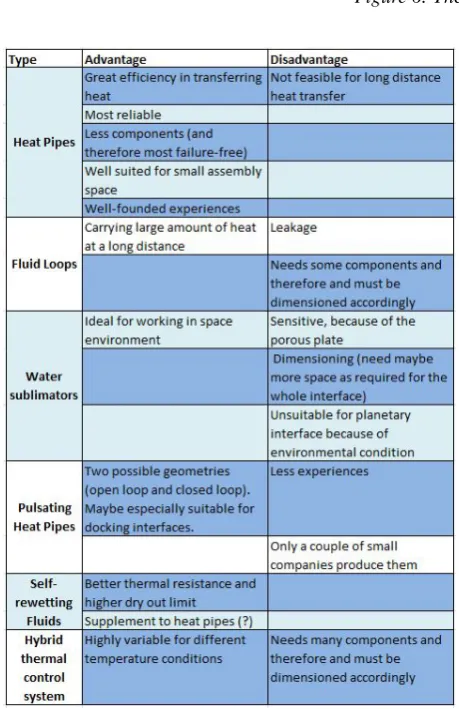
The following section aims to present a review of the state-of-the-art of the thermal interfaces used in space-craft. The table in Figure 7 shows advantages and disad-vantages of six different possibilities of thermal transfer methods.
Heat Pipes Loop heat pipes (LHPs) are among the most common thermal transfer methods used in space-craft. They transfer heat by two-phase heat transfer de-vices that utilize the evaporation and condensation of a working fluid, which circulates due to the capillary force developed in a fine porous wick. The advantages of LHPs are best manifested at large capacities and heat-transfer distances. Furthermore LHPs are particularly suitable when it is necessary to ensure efficient transfer at any orientation of the gravity field. The LHP principle allows creating ramified heat-transfer devices including different numbers of evaporators and condensers situated at dif-ferent orientations, making themselves particularly suit-able for thermoregulation systems of spacecraft, reducing
mass and increasing compactness.
Fluid Loops Mechanical Pumped Fluid Loop (MPFLs), in conjunction with a deployable radiator, is one of the technologies that has enormous potential to meet the demands of future spacecraft thermal control. It is used to transmit a large amount of heat between two regions separated by large distances. The working fluid does not undergo any phase change as it flows through various components.
Water Sublimators Those spacecraft working in warm environments can use water sublimators, which offer sim-plicity, reliability, small volume, high efficiency and ex-cellent work performance in zero gravity. In sublimation mode water freezes in the pores of the plate and heat is removed from the system by sublimation to the vacuum of space. Ice will generate some heat as it freezes from liquid to solid form due to the heat of fusion. Water has an unusually high latent heat of evaporation/sublimation which is enough compensate the heat generated upon fu-sion (freezing), as well as any heat that might be gener-ated by friction as the water moves through the plate. The availability of space vacuum allows for water to go from the solid to vapour state on the surface of a porous plate, which is sensitive to trace contaminants that can pede the sublimation process. If a plate is adversely im-pacted by trace contaminants, it cannot maintain the re-quired heat rejection properties. The intermediate porous plate approach has a good chance of resulting in a sealed porous plate, but the risk is a reduction in cooling capac-ity.
Pulsating Heat Pipes Pulsating heat pipes (PHPs), or oscillating heat pipes (OHPs) are one of the latest type of highly efficient heat transfer systems. The state-of-the-art of experimental investigations on PHPs are mainly focused on the applications of nanofluids and other func-tional fluids, aiming at enhancing the heat transfer perfor-mance of the PHPs.
Self-rewetting Fluids Some studies have been con-ducted on thermal management devices, such as wick-less heat pipes, using the so-called “self-rewetting fluids” (dilute aqueous solutions of high carbon alcohols) as a working fluid. Most of the liquids show a decrease in the surface tension with increasing temperature, while self-rewetting fluids exhibit the opposite behaviour.
[image:5.595.56.285.61.423.2](a) Heat pipe (b) Mechanical Pumped Fluid Loop
[image:6.595.388.536.81.140.2](c) Pulsating heat pipe
Figure 6. Thermal transfer types
Figure 7. Advantages and disadvantages of thermal transfer types
pump is applied in hot environments, where a compres-sor is needed to raise the fluid temperature above that of the heat sink.
4. KEY INNOVATIONS
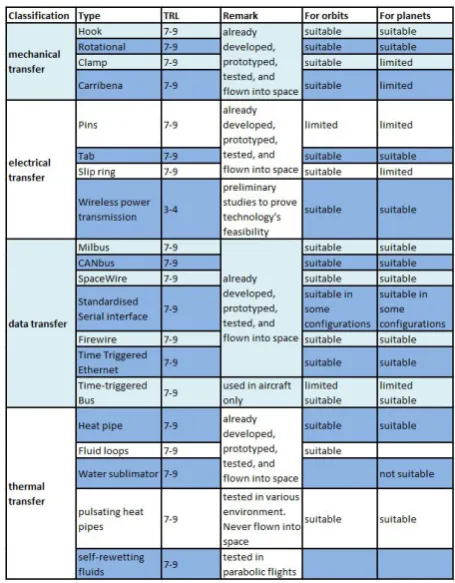
This section will cover proposed standards to use for power and data, as well as methods for thermal trans-fer and mechanical latching, suitable for space and plan-etary applications, in particular to the mentioned SIROM project. The table in Figure 8 shows the technology
readi-ness level (TRL) of the transfer types described in Sec-tion 3.
The suitability of each transfer types is noted in the columns ”for orbits” and ”for planets” of the table in Fig-ure 8. For this evaluation, influences of space and plan-etary environments have been considered. There are in-fluences as a wide range of temperature differences, ef-fects on materials, atomic oxygen erosion, radiation, sin-gle event effects (SEEs), gravity and magnetism, atmo-sphere, high vacuum and contamination (dust particles and space debris).
4.1. Proposed latching methods
Meaningful archetype of connection interface design, which would work best within the context of the project SIROM, are either the rotational lock or clamp type latches. Both methods do not require physical translated force against the target interface to latch and offer the ability of androgynous design. In addition, both methods are inherently fail-safe and offer significant misalignment correction. The clamp latch can offer component redun-dancy, but rotational locking can offer simplicity.
Useful examples of these interfaces are the androgy-nous, self-correcting clamp geometry from SINGO [5] and iBoss [6] a simple rotational locking mechanism.
4.2. Proposed power transfer methods
[image:6.595.55.285.183.538.2]4.3. Proposed data standards
Main requirements for the data interface are compactness and robustness, low mass, mutliple usage, compliance with space environment conditions and the highest pos-sible data rate desirably should be 100 Mbit/s.
In terms of the physical interface, recommended features to fulfill these requirements are open-drain signalling, ro-bust for short distances/low data rates, to achieve high data rates differential-driven signalling will be needed (e.g. LVDS). Synchronous and clocked (or self-clocking) operation to prevent timing variations. Using of redun-dant pairs (at least two) in a given data link in case of a bad contact. Full-duplex operation (potentially using re-dundant pairs) is desirable. Connectors must ensure cor-rect polarity and positive contact locking against vibra-tion. Connectors must be made of materials that will not corrode or accumulate nonconductive layers in planetary or vacuum environments. Voltage must be high enough to overcome radiation and static buildup effects but not high enough to be hazardous in the space environment. External contacts and wiring must be electrically isolated at the transceiver by means of optical or pulse transformer coupling to ensure protection against static discharge.
Considering the specified requirements and recom-mended features as well as the review presented in Sec-tion 3.3, it may be advisable to make use of the LVDS SpaceWire interface standard [8], but without the require-ment that only SpaceWire protocol be transmitted over it, and with the addition of robust isolation.
4.4. Proposed transfer methods
Thermal transfer between modules is not a well traversed knowledge area, thus further detailed research is rec-ommended to build confidence. While consideration of low weight, compactness, robustness, multiple usage and low complexity, heat pipes [9], fluid loop [10] and self-rewetting fluid technology [11] are meaningful. Heat pipes represent the most reliable thermal interface, al-ready applied in several spacecrafts, fluid loop technol-ogy is capable of carrying on the largest amount of heat at the longest distance and the self-rewetting fluid tech-nology appears to be the most promising one in future perspective.
5. CONCLUSION AND OUTLOOK
This review aimed to present the state-of-the-art and the future perspective of robotic space interfaces, with focus on thermal, data, electrical and mechanical functionali-ties. The main conclusions are here summarized:
[image:7.595.310.538.62.354.2]1. Many existing interface designs target small modu-lar robots, but the design principle can be up scaled
Figure 8. Basic properties of existing interfaces
• The iBoss is the closest existing prototype that integrates all the 4 main functionalities de-scribed here
• Rotational symmetry, internal redundancy and hermaphroditic connection are common and basic requirements.
• Additional design effectiveness is achieved with particle mitigation, 6-DoF misalignment tolerance and fail-safe docking and undocking
2. Latching methods consist of four archetypes; hook, clamp, carribena and rotational lock
• Clamping/rotational locking methods are rec-ommended for low force/torque
3. Electrical power transfer methods included tabs, slip rings, pin arrangements and even wireless
• Scoop proof and spring loaded tab contacts are recommended physical means of power trans-fer
• 100V bus minimum requirements are recom-mended as a benchmark
• Slip rings can also be taken if a pseudo-infinite orientation design is pursued
4. Data transfer protocols ranged fro CANbus to SpaceWire and Firewire
5. Thermal exchange methods are rarely applied in such a way, but usually took the form of heat pipes or fluid loops
• Heat pipes represent the simplest method, but fluid loops/rewetting fluids have the most po-tential
• Only one design with integrated thermal inter-face has been found, and it still needs further development
In conclusion, the path toward a development of a stan-dard space interface with integrated multiple functional-ities, has still a long way to go, but the current devel-opments are moving in the right direction. The current SIROM H2020 project aims to develop the current state of the art and to integrate the most promising technology and develop a product with the ambition of becoming the standard for the next 10-year space missions.
ACKNOWLEDGMENTS
The authors would like to thank all Partners (SENER, AIRBUS DS LTD, AIRBUS DS GMBH, TAS ITALIA SPA, Leonardo SPA, Strathclyde University, DFKI GMBH, TELETEL, SPACEAPPS, MAG SOAR S.L.) and supporting staff of the SIROM Project. The project results presented in this publication are derived from the conceptual phase.
SIROM is part of the project “PERASPERA”, which is funded, as part of the Horizon 2020 Space Work Pro-gramme 2014, a ProPro-gramme Support Activity (PSA) for the implementation of a Strategic Research Cluster (SRC) on Space Robotics Technologies. The project leading to this publication has received funding from the Euro-pean Union’s Horizon 2020 research and innovation pro-gramme under grant agreement No 730035.
REFERENCES
[1] Thomas M Roehr, Florian Cordes, and Frank Kirch-ner. Reconfigurable integrated multirobot explo-ration system (rimres): heterogeneous modular re-configurable robots for space exploration. Journal of Field Robotics, 31(1):3–34, 2014.
[2] Carl Glen Henshaw. The darpa phoenix spacecraft servicing program: Overview and plans for risk re-duction. In International Symposium on Artificial Intelligence, Robotics and Automation in Space (i-SAIRAS), 2014.
[3] M. Oda, M. Nishida, and S. Nishida. Development of an eva end-effector, grapple fixtures and tools for the satellite mounted robot system. In Intelli-gent Robots and Systems ’96, IROS 96, Proceedings of the 1996 IEEE/RSJ International Conference on, volume 3, pages 1536–1543 vol.3, Nov 1996.
[4] B. Khoshnevis, P. Will, and Wei-Min Shen. Highly compliant and self-tightening docking modules for precise and fast connection of self-reconfigurable robots. In 2003 IEEE International Conference on Robotics and Automation (Cat. No.03CH37422), volume 2, pages 2311–2316 vol.2, Sept 2003.
[5] W. M. Shen, R. Kovac, and M. Rubenstein. Singo: A single-end-operative and genderless connector for reconfiguration, assembly and self-healing. In2009 IEEE International Conference on Robotics and Automation, pages 4253–4258, May 2009.
[6] M. Goeller, J. Oberlaender, K.Uhl, A. Roennau, and R. Dillmann. Modular robots for on-orbit satellite servicing modular robots for on-orbit satellite ser-vicing. In Proceedings of the 13th Symposium on Advanced Space Technologies in Robotics and Au-tomation - ASTRA, June 2016.
[7] A. Dettmann, Z. Wang, W. Wenzel, F. Cordes, and F. Kirchner. Heterogeneous modules with a ho-mogeneous electromechanical interface in multi-module systems for space exploration. In 2011 IEEE International Conference on Robotics and Au-tomation, pages 1964–1969, May 2011.
[8] Steve Parkes, Albert Ferrer, Stuart Mills, and Alex Mason. Spacewire-d: Deterministic data delivery with spacewire. In International SpaceWire Con-ference, St Petersburg, Russia, 2010.
[9] Yu.F. Maydanik. Loop heat pipes.Applied Thermal Engineering, 25(5–6):635 – 657, 2005.
[10] Prashant Kumar Rai, Simhachala Rao Chikkala, Abhijit A Adoni, and Dinesh Kumar. Space radiator optimization for single-phase mechanical pumped fluid loop. Journal of Thermal Science and Engi-neering Applications, 7(4):041021, 2015.
[11] Yoshiyuki Abe, Akira Iwaski, and Kotaro Tanaka. Thermal management with self-rewetting fluids.