City, University of London Institutional Repository
Citation
:
Ozkaya, M. and Kloukinas, C. (2013). Towards a design-by-contract based
approach for realizable connector-centric software architectures. Paper presented at the
ICSOFT 2013 - Proceedings of the 8th International Joint Conference on Software
Technologies, 29 - 31 Jul 2013, Rejkyavik, Iceland.
This is the unspecified version of the paper.
This version of the publication may differ from the final published
version.
Permanent repository link: http://openaccess.city.ac.uk/2881/
Link to published version
:
Copyright and reuse:
City Research Online aims to make research
outputs of City, University of London available to a wider audience.
Copyright and Moral Rights remain with the author(s) and/or copyright
holders. URLs from City Research Online may be freely distributed and
linked to.
City Research Online: http://openaccess.city.ac.uk/ [email protected]
Towards a Design-by-Contract Based Approach for Realizable
Connector-Centric Software Architectures
Mert Ozkaya and Christos Kloukinas
Department of Computer Science, City University London, London, EC1V 0HB, UK
{mert.ozkaya.1, C.Kloukinas}@city.ac.uk
Keywords: Architecture Description Language, Design by Contract, Complex Interaction Protocols, Realizable Designs
Abstract: Despite being a widely-used language for specifying software systems, UML remains less than ideal for soft-ware architectures. Architecture description languages (ADLs) were developed to provide more comprehen-sive support. However, so far the application of ADLs in practice has been impeded by at least one of the following problems: (i) advanced formal notations, (ii) lack of support for complex connectors, and (iii) po-tentially unrealizable designs. In this paper we propose a new ADL that is based on Design-by-Contract (DbC) for specifying software architectures. While DbC promotes a formal and precise way of specifying system be-haviours, it is more familiar to practising developers, thus allowing for a more comfortable way of specifying architectures than using process algebras. Furthermore, by granting connectors a first-class status, our ADL allows designers to specify not only simple interaction mechanisms as connectors but also complex interaction protocols. Finally, in order to ensure that architectural designs are always realizable we eliminate potentially unrealizable constructs in connector specifications (the connector “glue”).
1
Introduction
Since the early work on software architectures [Perry and Wolf, 1992, Garlan and Shaw, 1993], spe-cialized architecture description languages (ADLs) [Medvidovic and Taylor, 2000] have been proposed for specifying software architectures. But UML has become a de facto design language for specifying and designing software systems – more practitioners use it than all other languages (e.g., AADL, ArchiMate, etc.) combined [Malavolta et al., 2013], even though it is less than ideal [Dashofy et al., 2002]. This is de-spite some ADLs having formally defined semantics, enabling not only formally precise models that help avoid confusion about what is meant by the specifi-cation but also early formal analysis of software ar-chitectures. Other ADLs offer automatic code gener-ation, etc. Nevertheless, UML is still the first choice of practitioners for specifying software architectures, with most ADLs seemingly remaining of interest to the research community alone. In our view, there are three main problems that ADLs suffer from: (i) for-mal notations for behaviour specifications that require a steep learning curve, (ii) lack of support for com-plex connectors (i.e., interaction protocols), and (iii) potential for producing unrealizable designs. Indeed, to the best of our knowledge, there is no ADL that is
easy to learn, treats connectors as first-class elements and ensures that architecture specifications are realiz-able. While (i) has been identified by practitioners as being a serious impediment to their adoption of cur-rent ADLs, (ii) is not an issue that they consider as crucial1but we believe that it can substantially help
in developing concise designs, as it promotes reuse-by-call instead of reuse-by-copy. Condition (iii) is in fact something that has not been identified so far at all to the best of our knowledge2but we believe that it is crucial to identify and resolve, if a connector-centric ADL is to succeed.
Formal notations Many ADLs (e.g., Wright [Allen and Garlan, 1997], LEDA [Canal et al., 1999], SOFA [Plasil and Visnovsky, 2002], CONNECT [Issarny et al., 2011], etc.) adopt formal notations, e.g., pro-cess algebras [Bergstra et al., 2001], for specifying the behaviours of architectural elements. They do so in order to enable the architectural analysis of sys-tems, which is extremely important in uncovering se-rious system design errors early on in the lifetime of
1Along with a number of researchers, as many ADLs do
not support connectors.
2Perhaps due to the non-adoption of ADLs supporting
a project. Indeed, if such an analysis is not possible, then there is no point in using a specialized language for software architectures – even simple drawings suf-fice. However, the aforementioned ADLs employ no-tations that practitioners view (with reason) as having a steep learning curve [Malavolta et al., 2013]. Thus, practitioners end up avoiding them and use instead simpler languages, even if that means that they lose the ability to properly describe and analyze their sys-tems – better an informal description of a system that everybody understands than a formal description of a system that people struggle understanding.
Limited support for complex connectors Another problem with many ADLs (e.g., Darwin [Magee and Kramer, 1996], Rapide [Luckham, 1996], LEDA [Canal et al., 1999], and AADL [Feiler et al., 2006]), as well as with UML, is that they provide limited or no support for complex connectors, treating them in-stead as simple connections. Other ADLs, such as UniCon [Shaw et al., 1995], provide only partial sup-port through a limited number of basic connectors but do not allow designers to freely specify their own (complex) types. This is unfortunate because connec-tors represent the interaction patterns between com-ponents, i.e., the interaction protocols that are em-ployed to achieve the system goals using the sys-tem components, such as reliability. By instead of-fering support only for components, architects end up with two alternatives. One is to ignore protocols, which inhibits the analysis of crucial system proper-ties, such as deadlock-freedom, and also leads to ar-chitectural mismatch [Garlan et al., 1995], i.e., the in-ability to compose seemingly compatible components due to wrong assumptions these make about their in-teraction. The other is to incorporate the protocol behaviour inside the components themselves, which leads to complicated component behaviour that is nei-ther easy to understand nor to analyze and makes it difficult to reuse components with different pro-tocols, as well as to find errors in specific protocol instances. Incorporating protocol behaviour inside components is essentially following a reuse-by-copy approach, whereby each component has its own copy of the protocol constraints. On the other hand, support for protocols through first-class connectors promotes a reuse-by-call approach, whereby there is only one instance of the protocol constraints and these are sim-ply called wherever they are needed.
[image:3.595.308.536.98.178.2]Potentially unrealizable designs The third prob-lem of existing ADLs is that when they do support user-defined, complex connectors, they do so in a way that can lead to unrealizable designs. This is because,
Figure 1: A nuclear power plant’s unrealizable MSCs [Alur et al., 2003]
connectorPlant Connector=
roleIncrementor = ur→na→Incrementor
roleDoubler = ur→na→Doubler
roleNA = increment→NAudouble→NA
roleUR = increment→URudouble→UR
glue=Incrementor.ur→UR.increment→Incrementor.na→ NA.increment→Doubler.ur→UR.double→ Doubler.na→NA.double→glue
[image:3.595.353.476.387.470.2]Doubler.ur→UR.double→Doubler.na→NA.double→ Incrementor.ur→UR.increment→Incrementor.na→ NA.increment→glue
Figure 2: Wright’s(unrealizable)connector for Alur’s nu-clear power plant
Figure 3: An implied bad scenario in Alur’s plant [Alur et al., 2003] (hiddenby Wright’s glue specification)
algo-rithm that can be implemented to warn architects that the glue they are specifying is not realizable by the existing roles. The only easy solution to realize a pro-tocol then is to introduce yet another component that will assume the role of the glue, thus transforming all protocols into centralized ones.
An example of such an unrealizable protocol from a simplified nuclear power plant is described in [Alur et al., 2003] and reproduced in Figure 1. The in-teraction therein involves an Incrementor (P1) and a
Doubler (P2) client roles updating the amounts of the
Uranium fuel (UR) and Nitric Acid (NA) server pro-cesses in a nuclear reactor. After the update opera-tions, the amounts of UR and NA must be equal to avoid nuclear accidents, for which reason we wish to allow only the sequences shown in Figure 1. The in-teraction of the two clients with the NA and UR vari-ables, can easily be specified in Wright as in Figure 2. Note that this glue specification does two things. First it establishes bindings between clients and servers (e.g.,Incrementor.ur→U R.increment). Then it con-straints interactions by requiring that we only
al-lowU R.increment→NA.incrementorU R.double→
NA.double. This specification is however
unrealiz-able as [Alur et al., 2003] have shown because it is impossible to implement it in a decentralized manner in a way that avoids behaviours excluded by the glue, e.g., the one depicted in Figure 3. The only way to achieve the desired behaviour is to introduce another role, for a centralized controllerG. Roles Incrementor and Doubler then need to informGwhen they wish to interact with UR and NA and haveGperform the in-teractions withU RandNAin their place.
2
Our Approach
The ADL we are developing tries to overcome the problems identified in the previous section and offer:
• first-class support for user-defined complex con-nectors;
• realizable software architectures by construction; and
• a simple to understand, yet formal, language for specifying behaviour, based on design-by-contract (DbC).
2.1
Support for Complex Connectors
Our ADL grants connectors in software architectures first-class status, allowing designers to specify both simple interaction mechanisms and complex proto-cols. These can then be instantiated as many times
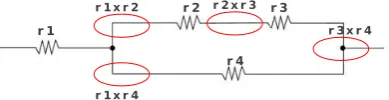
r 1 x r 2
r 3 x r 4 r 2 x r 3
r 1
r 2 r 3 r 4
[image:4.595.326.521.105.155.2]r 1 x r 4
Figure 4: Simple connectors in circuits
→(r1,||(→(r2,r3),r4))
Figure 5: Complex connectors in circuits
as needed, allowing architects to simplify the specifi-cations of their components and easily reuse the spec-ification of complex protocols.
To illustrate how important this is for both archi-tectural understandability and also analysis, we will use a simple example from electrical engineering. Let us consider kconcrete electrical resistors,r1,· · ·,rk,
i.e., our system components. When using a sequen-tial connector (→), the overall resistance is computed as R→(N,{Ri}Ni=1) =∑
N
i=1Ri, where N,Ri are
vari-ables (Ri correspond to connector roles), to be
as-signed eventually some concrete values k,rj. If
us-ing a parallel connector (k) instead, it is computed as Rk(N,{Ri}Ni=1) =1/∑Ni=11/Ri. So the interaction
protocol (connector) used is the one that gives us the formula we need to use to analyze it – if it does not do so, then we are probably using the wrong connec-tor abstraction. The components (rj) are simply
pro-viding some numerical values to use in the formula, while the system configuration tells us which specific value (k,rj) we should assign to each variable (N,Ri)
of the connector-derived formula. By simply enumer-ating the wires/connections between resistors/compo-nents, we miss the forest for the trees. This leads to ar-chitectural designs at a very low level that is not easy to communicate and develop – as [Delanote et al., 2008] found the case to be with AADL.
eas-ier to understand the system and to analyze its overall resistance by taking advantage of the connector prop-erties as:
r→(r1,||(→(r2,r3),r4)) = r1+r||(→(r2,r3),r4)
= r1+
1
1
→(r2,r3)+
1
r4
= r1+
1
1
r2+r3+
1
r4
2.2
Realizable Software Architectures
Connectors in our ADL are not specified with glue-like elements. Instead, we consider connectors as a simple composition of roles, which represent the in-teraction behaviour of participating components, and channels that allow actions of one role to reach an-other. Coordination is now the responsibility of roles alone. If a particular property is desired then it must be shown that the roles satisfy it. But this is a prob-lem that is decidable for finite state systems – model-checking. Thus an architect can easily specify a pro-tocol and be sure that it has the required properties. Designers can also feel reassured that the architectural protocols are indeed realizable in principle.
So in the case of Figure 1, the architect should quickly realize that the desired property is not sat-isfied by the roles and opt for a centralized protocol instead, by adding a centralized controller. Thus, sur-prises are avoided – it becomes clear early on whether something can be made to work in a decentralized manner or not, as it is tested by the more experienced architect. The less experienced designers do not have to waste their time trying to achieve the impossible or take the easy way out and turn a decentralized pro-tocol into a centralized one. We essentially turn the glue from constraints to be imposed, to a property that needs to be verified, thus turning an undecidable prob-lem that the impprob-lementers have to deal with, into a de-cidable one for them (and pushing the responsibility to resolve the issue to the more experienced architect).
2.3
DbC-based Specifications
Java Modelling Language (JML) [Chalin et al., 2006] seems to be gaining popularity among developers, as they use it for “test-driven development” and even for static analysis in some instances. Our new ADL at-tempts to follow this trend so as to maximize adop-tion by practiadop-tioners. Thus, it departs from the ADLs that adopt process algebras, and instead follows a Design by Contract (DbC) [Meyer, 1992] approach like JML, specifying behavioural aspects of systems through simplepairs of method pre-/post-conditions,
in a syntax reminiscent of JML. DbC allows for a for-mal specification of systems, as it is based on Hoare’s logic [Hoare, 1969] and VDM’s [Bjørner and Jones, 1978] rely-guarantee specification approach. DbC has so far been mainly considered for programming languages (e.g., Java through JML), which is why contracts have been restricted to provided services (i.e., class methods).
There are very few ADLs that employ DbC. The work of Schreiner et al. [Schreiner and G¨oschka, 2007] along with the TrustME ADL [Schmidt et al., 2001] are some of the very few examples applying DbC at the level of software architecture. Schreiner et al.’s work however does not support component interfaces emitting or receiving events. Moreover, they view connectors as simple interconnection mech-anisms, providing no support for the contractual spec-ification of complex interaction protocols. Likewise, TrustME supports only required and provided inter-faces for components, again neglecting asynchronous events. Our approach attempts to apply DbC in a more comprehensive manner, covering both methods and events. As we view connectors as first-class el-ements, we use DbC to specify their behaviour as well. Our ADL further extends DbC by structuring contracts into functional and interaction parts.
2.3.1 Component Contracts
Components are used to specify at a high-level the
functionalunits in software systems. Our ADL allows
designers to describe freely as components whatever they deem appropriate in their system, not impos-ing, nor introducimpos-ing, low-level notions (e.g., threads, processes) as AADL does. Component types are es-sentially specified in terms of (i) ports representing the points of interaction with their environment, and (ii) data representing the component state. Simi-larly to CORBA interfaces [OMG, 2006], component ports can be either eventconsumer/emitterones, cor-responding to CORBA sink and source events respec-tively, orprovided/requiredmethod ones, correspond-ing to CORBA facets and receptacles.
re-sults, while the latter specify (i) the particular manner in which components want to behave (i.e., the order of actions), and (ii) the cases in which they do not know how to behave, thus leading tochaotic behaviour.
2.3.2 Connector Contracts
As aforementioned, connectors in our ADL are in-troduced to represent high-levelcomplex interaction
protocols, which the components interacting through
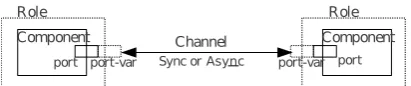
connectors adhere to. Connector types are specified in terms of roles and channels. Each role can be viewed as a component wrapper as depicted in Fig-ure 6, which further constrains the interaction be-haviour of the component assuming it. A role is described withdata andport-variables, mirroring a component – a role is essentially acomponent vari-able, with extra state. The port-variables of a role are bound to ports of the components assuming the role. Channels of a connector represent the commu-nication links between interacting roles and can be synchronous or asynchronous. A channel is described with a pair of communicating role port-variables and its communication type.
The behaviour of connectors is specified with
in-teractioncontracts attached to the port-variable
ac-tions. These interaction contracts constrain port-variable actions so that the respective component ports behave in a particular manner (i.e., enforcing a certain action order), according to the desired in-teraction protocols. In doing so, components avoid undesired interactions with other components associ-ated with the same connector. The end result is then a set of components interacting with their environments successfully to compose the whole system. All con-straints imposed are local ones, ensuring realizability.
3
Case Study: Shared-Data Access
Listing 1 below illustrates our ADL’s DbC-based behavioural specification on shared-data access. An important thing to note is the overall syntax; it resem-bles JML, with expressions that shouldn’t feel alien to practitioners – a far step from process algebraic notations. Two component types are specified,user
between lines 1–21 andmemory between lines 22– 44. User comprises arequired port, puser r (lines 4–12), through which its instances call method get
from thememoryand anemitterport,puser e(lines 13–20), through which eventsetis emitted. Memory comprises a provided port, pmem p (lines 25–34), through which its instances accept calls for method
get from users and aconsumer port, pmem c(lines
Component Component
Role Role
Channel Sync or Async
[image:6.595.312.518.96.139.2]port port-var port-var port
Figure 6: Connectors with roles wrapping components
35–43) through which eventsetis received.
Ports are specified in terms of method/event signatures and contracts (i.e., @f unctional and
@interaction). @interactionconstraints on port
ac-tions (e.g., method call and event emission) have precedence over @functional, i.e, the evaluation of the latter depends on the satisfaction of the former.
User Component Type User’s required port
puser r is used to call method get. These calls
are delayed until the promised condition specified in
@interaction is met. Since it istrue in line 6, get
can be called immediately. Next, the @f unctionalin lines 7–10 is evaluated; sincegethas no parameters, there is no promised actual parameters (promises con-dition in line 8 istrue). Upon receiving the response after callingget, the received result isensured to be stored in variabledata.
The user components emit event set through its
emitter port puser e. Note that events are specified
without return types – they can only have an identi-fier and parameters. The emission of eventset is de-layed until the promised condition of @interactionin lines 14–15 is met. Since it is specified astrue, emis-sion can be made at any instance, using the promised actual parameters specified in @f unctional(line 17). This thenensuresthatinitialised uis set totrue. Also note that events are emitted/received asynchronously.
Memory Component Type Memory’s provided
port pmem preceives calls for method get. These
calls are accepted when the accepts condition in
@interactionis met,initialised mevaluating totrue
(line 27). Otherwise, the call is re jected when
initialised mis f alse(line 29) leading to chaotic be-haviour. If the call is accepted, then @f unctional in lines 30–32 is evaluated. There, it isensuredthat the result value to be emitted is equal to thesh data.
The memory components receive event set via
the consumer port pmem c. The reception of event
set is delayed until the promised condition is met
in @interaction. Since it is specified as true in
line 37, the set event can be received at any in-stance. Upon reception of the eventset, @f unctional
in lines 38–41 is evaluated. As the functional pre-condition (requires) is true, the event’s post-condition initialised mis ensured andsh datais set todata arg.
1component user {
3 int data ;
4 required port p u s e r _ r { 5 @interaction{
6 promises: true ; } 7 @functional{
8 promises: true ; 9 requires: true ;
10 ensures: data = \ re sult ; } 11 int get ();
12 };
13 emitter:port p u s e r _ e { 14 @interaction{
15 promises: true ; } 16 @functional{
17 promises: d a t a _ a r g = 7;
18 ensures: i n t i a l i s e d _ u = true ; } 19 set ( int d a t a _ a r g );
20 }; // port ends 21}; // c o m p o n e n t ends 22component memo ry {
23 bool i n i t i a l i s e d _ m = false ; 24 int s h _ d a t a = 0;
25 provided port pmem _p { 26 @interaction{
27 accepts: i n i t i a l i s e d _ m ;
28 also:
29 rejects: ! i n i t i a l i s e d _ m ; } 30 @functional{
31 requires: true ;
32 ensures: \ res ult = s h _ d a t a ;} 33 int get ();
34 }; // port ends 35 consumer port pmem _c { 36 @interaction{ 37 accepts: true ; } 38 @functional{ 39 requires: true ;
40 ensures: i n t i a l i s e d _ m = true 41 && s h _ d a t a = d a t a _ a r g ; } 42 set ( int d a t a _ a r g );
43 }; // port ends 44}; // c o m p o n e n t ends 45connector s h a r e d D a t a (
46 u s e r R o l e { p v _ u s e r } , m e m o r y R o l e { pv _mem }) { 47 role u s e r R o l e {
48 bool i n i t i a l i s e d _ u = true ; 49 required port variable p v _ u s e r _ r { 50 @interaction{
51 promises: when ( i n t i a l i s e d _ u ); } 52 int get ();
53 };
54 emitter port variable p v _ u s e r _ e { 55 @interaction{
56 promises: true ;
57 ensures: i n i t i a l i s e d _ u = true ; } 58 set ( int d a t a _ a r g );
59 }; // port - v a r i a b l e ends 60 }; // role ends
61 role m e m o r y R o l e {
62 bool i n i t i a l i s e d _ m = true ; 63 provided port variable p v _ m e m _ p { 64 @interaction{
65 accepts: when ( i n t i a l i s e d _ m );} 66 int get ();
67 }; // port - v a r i a b l e ends 68 consumer port variable p v _ m e m _ c { 69 @interaction{
70 accepts: true ;
71 ensures: i n i t i a l i s e d _ m = true ; } 72 set ( int d a t a _ a r g );
73 }; // port - v a r i a b l e ends 74 }; // role ends
75 channel async u s e r 2 m e m o r y _ m ( pv_user_r , 76 p v _ m e m _ p ); 77 channel async u s e r 2 m e m o r y _ e ( pv_user_e , 78 p v _ m e m _ c ); 79}; // c o n n e c t o r ends
Listing 1: Shared-data Access in our ADL
Shared-Data Connector Type The connector
typesharedData, specified in lines 45–79, serves as a
mediator between users and memory. It essentially avoids memory from behaving chaotically. In the
sharedData, two roles are specified,userRolein lines
47–60 andmemoryRolein lines 61–74, where the for-mer is assumed by theusercomponent instances and the latter by thememoryinstances.
The interaction behaviour of the event ports is constrained via the respective port-variables (i.e.,
pv user e of the userRole and pv mem c of the
memoryRole) so that emission/receipt of eventset
en-sures that the respective role data initialised u/mis set totrue. Furthermore, the pv mem pin lines 63– 67 and pv user rin lines 49–53 constrain the mem-ory provided port, so that it delays calls for method
get until the shareddatais initialized, and the user required port so that it does not make calls forget un-til thedatais initialized. Therefore, the correspond-ing ports of the user and memory components playcorrespond-ing the roles interact in a way that an eventset is always executed before methodgetis called. This avoids at-tempts to access uninitialized data and the resulting chaotic behaviour, as well as deadlocks.
In lines 75–78, there are two channels specified to indicate which role port-variable communicates with which other role port-variable.
Finally, the matching between connector roles and components is performed via the connector parame-ters, as specified in line 46. At configuration time,
whensharedDatais instantiated, the user and
mem-ory component instances and their ports are passed as its parameters.
4
Discussion
familiar to practitioners. This should help facilitate its adoption as it does not require a steep learning curve – one should be able to use it with minimal train-ing. At the same time, it introduces connector con-structs that are essentially (decentralized) algorithms (as protocols are). So practitioners who have expe-rienced the distinction between say C++ classes and C++ generic algorithms should feel comfortable with the distinction between components and connectors as made here. Apart fromπcalculus’ ability to send
channels as messages, which we do not support, our ADL should allow architects to express what they can express now with ADLs based on process algebras.
All constraints in our ADL are local, expressed on local component/role data and parameters. This ensures realizability and makes reasoning about the effects of actions easier. Data are encapsulated, so there are no aliasing problems, and concurrency is controlled through the ports – each port is a concur-rent unit, thus ensuring that actions of a port are mu-tually exclusive. As event emission/consumption and method servicing (at provided ports) are atomic, ar-chitects need only guarantee (and verify) that method calling (at required ports) will not lead to data race conditions.
The type of constraints an architect uses depends on the tool support they have. If for example they ex-press something like 0≤x+y+z≤25 then their tool would probably need to use an SMT solver or theo-rem prover and be helped by the architect whenever it cannot prove or disprove a claim. However, we be-lieve that in practice one can constrain the type of ex-pressions used, so as to enable automated verification through a model-checker, without losing much. The aforementioned constraint can easily be expressed as
x∈[0,25]∧y∈[0,25−x]∧z∈[0,25−x−y], which makes it easy for a model-checker to establish, as it introduces an order for selecting values for variables. By constraining the form of expressions we enable better tool support for practitioners and make it pos-sible for these tools to be fully automated3.
5
Conclusions
This paper presents a new ADL that aims at re-solving three main problems in current ADLs: (i) advanced formal notations used for specifying be-haviours, (ii) lack of support for complex connectors, and (iii) potentially unrealizable designs.
In response to these problems, our ADL follows a Design-by-Contract approach for specifying
be-3Less is more.
haviour, using a JML-like syntax as much as pos-sible. Thus, practitioners should be able to use it with minimal training and find it not much differ-ent to other languages that they might have used, such as JML. Furthermore, architectural connectors in our ADL can be used to specify either simple inter-connection mechanisms or complex interaction pro-tocols. So, large and complex systems can be spec-ified at a high level as components interacting via complex interaction protocols, like someone may use C++ classes and C++ generic algorithms to structure a system so as to avoid re-coding generic algorithm fragments inside the classes. Finally, connectors are specified as a set of decentralized, independent roles assumed by the participating components. There is no glue-like centralized element in connector speci-fications or elsewhere – all constraints are expressed on local state. This leads to architectural designs that are realizable by construction and whose verification is decidable (when restricted to a finite number of el-ements) through model-checking.
Acknowledgements
This work has been partially supported by the EU project FP7-257367 IoT@Work – “Internet of Things at Work”.
REFERENCES
Allen, R. and Garlan, D. (1997). A formal basis for architec-tural connection. ACM Trans. Softw. Eng. Methodol., 6(3):213–249.
Alur, R., Etessami, K., and Yannakakis, M. (2003). Infer-ence of message sequInfer-ence charts. IEEE Trans. Soft-ware Eng., 29(7):623–633.
Alur, R., Etessami, K., and Yannakakis, M. (2005). Realiz-ability and verification of msc graphs.Theor. Comput. Sci., 331(1):97–114.
Bergstra, J. A., Ponse, A., and Smolka, S. A., editors (2001).Handbook of Process Algebra. Elsevier. Bjørner, D. and Jones, C. B., editors (1978).The Vienna
De-velopment Method: The Meta-Language, volume 61 ofLecture Notes in Computer Science. Springer. Canal, C., Pimentel, E., and Troya, J. M. (1999).
Specifica-tion and refinement of dynamic software architectures. In Donohoe, P., editor, WICSA, volume 140 ofIFIP Conference Proceedings, pages 107–126. Kluwer. Chalin, P., Kiniry, J. R., Leavens, G. T., and Poll, E. (2006).
Beyond assertions: Advanced specification and ver-ification with JML and ESC/Java2. In FMCO’05 – Formal Methods for Comp. and Obj., volume 4111 of
Dashofy, E. M., van der Hoek, A., and Taylor, R. N. (2002). An infrastructure for the rapid development of xml-based architecture description languages. In Tracz, W., Young, M., and Magee, J., editors,ICSE, pages 266–276. ACM.
Delanote, D., Baelen, S. V., Joosen, W., and Berbers, Y. (2008). Using aadl to model a protocol stack. In
ICECCS, pages 277–281. IEEE Computer Society. Feiler, P. H., Gluch, D. P., and Hudak, J. J. (2006). The
Ar-chitecture Analysis & Design Language (AADL): An Introduction. Technical report, Software Engineering Institute.
Garlan, D., Allen, R., and Ockerbloom, J. (1995). Architec-tural mismatch or why it’s hard to build systems out of existing parts. InICSE, pages 179–185.
Garlan, D. and Shaw, M. (1993). An introduction to soft-ware architecture. In Ambriola, V. and Tortora, G., ed-itors,Advances in Software Engineering and Knowl-edge Engineering, pages 1–39, Singapore. World Sci-entific Publishing Company. Also appears as SCS and SEI technical reports: CMU-CS-94-166, CMU/SEI-94-TR-21, ESC-TR-94-021.
Hoare, C. A. R. (1969). An axiomatic basis for computer programming.Commun. ACM, 12(10):576–580. Issarny, V., Bennaceur, A., and Bromberg, Y.-D. (2011).
Middleware-layer connector synthesis: Beyond state of the art in middleware interoperability. In Bernardo, M. and Issarny, V., editors, SFM, volume 6659 of
Lecture Notes in Computer Science, pages 217–255. Springer.
Luckham, D. C. (1996). Rapide: A language and toolset for simulation of distributed systems by partial order-ings of events. Technical report, Stanford University, Stanford, CA, USA.
Magee, J. and Kramer, J. (1996). Dynamic structure in soft-ware architectures. InSIGSOFT FSE, pages 3–14. Malavolta, I., Lago, P., Muccini, H., Pelliccione, P., and
Tang, A. (2013). What industry needs from archi-tectural languages: A survey. IEEE Transactions on Software Engineering, 99(PrePrints):1–25. DOI:
10.1109/TSE.2012.74 . Medvidovic, N. and Taylor, R. N. (2000). A classification and comparison framework for software architecture description languages. IEEE Trans. Software Eng., 26(1):70–93.
Meyer, B. (1992). Applying “Design by Contract”. IEEE Computer, 25(10):40–51.
OMG (2006). Corba component model 4.0 specification. Specification Version 4.0, Object Management Group. Perry, D. E. and Wolf, A. L. (1992). Foundations for the study of software architecture. SIGSOFT Softw. Eng. Notes, 17(4):40–52.
Plasil, F. and Visnovsky, S. (2002). Behavior protocols for software components.IEEE Trans. Software Eng., 28(11):1056–1076.
Schmidt, H., Poernomo, I., and Reussner, R. (2001). Trust-by-contract: Modelling, analysing and predicting be-haviour of software architectures. J. Integr. Des. Pro-cess Sci., 5(3):25–51.
Schreiner, D. and G¨oschka, K. M. (2007). Explicit con-nectors in component based software engineering for distributed embedded systems. InProceedings of the 33rd conference on Current Trends in Theory and Practice of Computer Science, SOFSEM ’07, pages 923–934, Berlin, Heidelberg. Springer-Verlag. Shaw, M., DeLine, R., Klein, D. V., Ross, T. L., Young,
D. M., and Zelesnik, G. (1995). Abstractions for soft-ware architecture and tools to support them. IEEE Trans. Software Eng., 21(4):314–335.
Tripakis, S. (2001). Undecidable problems of decentral-ized observation and control. In Proc. of the 40th IEEE Conf. on Decision and Control, volume 5, pages 4104–4109, Orlando, FL, USA. IEEE.
![Figure 1: A nuclear power plant’s unrealizable MSCs [Aluret al., 2003]](https://thumb-us.123doks.com/thumbv2/123dok_us/1553059.107863/3.595.308.536.98.178/figure-nuclear-power-plant-unrealizable-mscs-aluret-al.webp)