The SPAIR method: Isolating incident and re
fl
ected directional wave
spectra in multidirectional wave basins
S. Draycott
a,⁎
, T. Davey
a, D.M. Ingram
b, A. Day
c, L. Johanning
d aFloWave Ocean Energy Research Facility, Max Born Crescent, King's Buildings, Edinburgh EH9 3BF, UK
bInstitute for Energy Systems, School of Engineering, The University of Edinburgh, Edinburgh EH9 3JL, UK c
Naval Architecture and Marine Engineering, The University of Strathclyde, Glasgow G4 0LZ, UK
d
Renewable Energy Research Group, University of Exeter, TR10 9E, UK
a b s t r a c t
a r t i c l e i n f o
Article history:
Received 3 June 2015
Received in revised form 6 April 2016 Accepted 9 April 2016
Available online xxxx
Wave tank tests aiming to reproduce realistic or site specific conditions will commonly involve using directionally spread, short-crested sea states. The measurement of these directional characteristics is required for the purposes of calibrating and validating the modelled sea state. Commonly used methods of directional spectrum reconstruction, based on directional spreading functions, have an inherent level of uncertainty associated with them. In this paper we aim to reduce the uncertainty in directional spectrum validation by introducing the SPAIR (Single-summation PTPD Approach with In-line Reflections) method, in combination with a directional wave gauge array. A variety of wave conditions were generated in the FloWave Ocean Energy Research Facility, Edinburgh, UK, to obtain a range of sea state and reflection scenarios. The presented approach is found to provide improved estimates of directional spectra over standard methods, reducing the mean apparent directional deviation down to below 6% over the range of sea states. Additionally, the method isolates incident and reflected spectra in both the frequency and time domain, and can separate these wave systems over 360°. The accuracy of the method is shown to be only slightly sensitive to the level of in-line reflection present, but at present cannot deal with oblique reflections. The SPAIR method, as presented or with slight modification, will allow complex directional sea states to be validated more effectively, enabling multidirectional wave basins to simulate realistic wave scenarios with increased confidence.
© 2016 The Authors. Published by Elsevier B.V. This is an open access article under the CC BY license (http://creativecommons.org/licenses/by/4.0/). Keywords:
SPAIR Tank testing
Directional spectrum measurement FloWave
Phase-Time-Path-Difference Wave reflection
Single-summation method
1. Introduction
Wave tank tests facilitate the understanding of how complex sea
conditions influence the dynamics of man-made structures. A key
requirement for any test programme is the ability to create these conditions in a highly controlled and repeatable manner. To have such control, it is vital to be able to measure and validate the desired test conditions. Whilst this is a relatively simple task when generating uni-directional waves, the extension to the measurement and validation of directional spectra can be challenging.
The experimental measurements presented here were made at the FloWave Ocean Energy Research Facility, located at the University of
Ed-inburgh (Fig. 1). The facility consists of a circular 25 m diameter, 2 m
depth combined wave and current test basin which is encircled by 168 active-absorbing force-feedback wavemakers. This geometry and de-sign are intended to remove any inherent limitation on wave direction and therefore allow the recreation of highly spread and highly complex
directional spectra. As such, it presents an ideal environment to explore and demonstrate directional measurement methodologies.
To validate a directional spectrum, a method of reconstruction is re-quired. Most of these methods aim to resolve the frequency-dependent Directional Spreading Function (DSF), thus describing the distribution of wave energy with direction. These methods use the measured cross-spectra between wave gauges, along with the known gauge
posi-tions, tofit a directional distribution. There are a number of approaches
in doing this, with some commonly used approaches being the Bayesian
Directional Method (BDM) (Hashimoto and Konbune, 1988), the
Maximum Likelihood Method (MLM) (Benoit et al., 1997; Krogstad,
1988), and the Extended Maximum Entropy Principal (EMEP)
(Hashimoto et al., 1994).
The nature of DSF-based reconstruction methods means that there is some uncertainty associated with the estimate. In this work we use a combined wave generation-measurement approach that enables the directional spectra to be estimated with increased certainty, whilst
additionally enabling the isolation of incident and reflected components
under certain conditions. This method has been named SPAIR, or the
Single-summation PTPD Approach with In-line Reflections, and enables
directional sea states to be validated with greater confidence.
Coastal Engineering xxx (2016) xxx–xxx
⁎ Corresponding author.
E-mail address:[email protected](S. Draycott).
http://dx.doi.org/10.1016/j.coastaleng.2016.04.012
0378-3839/© 2016 The Authors. Published by Elsevier B.V. This is an open access article under the CC BY license (http://creativecommons.org/licenses/by/4.0/).
Contents lists available atScienceDirect
Coastal Engineering
To generate the waves a single-summation method is used (Miles and Funke, 1989) ensuring that each discrete frequency component only has one propagation direction. This enables meaningful frequency dependent wave directions to be inferred from a wave gauge array,
using a Phase-Time-Path-Difference (PTPD) approach (Esteva, 1976),
providing an estimate of the directional spectrum. This approach is
demonstrated byDraycott et al. (2015), and has been shown to be
significantly more effective than both the EMEP and BDM methods at
estimating directional spectra when combined with single-summation wave generation. In this paper the method is demonstrated over a larger test matrix, designed to explore the reconstruction effectiveness over a range of peak frequencies, directional spreading and peak steepness.
Additional complex spectra are explored, which highlight the benefit
of using this approach when analysing highly spread or multi-modal spectra.
The SPAIR method, as employed in FloWave, uses the PTPD
ap-proach and calculated directions to perform in-line reflection
analy-sis using a least squares method, similar toZelt and Skjelbreia
(1992). Under the assumption that reflections mirror the incident,
this enables the reflected directional spectrum to be isolated, with
phase information, enabling both incident and reflected time-series
to be reconstructed.
Limits of the method assumptions are explored, particularly relating
how the magnitude and angle of reflections affect both the incident
angle calculation, and on the separation of incident and reflected
components. In addition, alternative uses of these single-summation based tools are discussed for different purposes, and for when the SPAIR method assumptions are inappropriate.
2. Methodology
2.1. Sea state input and generation
2.1.1. Input sea states
To examine the SPAIR method performance under a range of repre-sentative conditions, 27 parametric sea states were created and tested
at the facility. These tests cover a range of peak frequencies,fp, directional
spreading,s, and peak wave steepness',sp(defined asHm0/Lp, whereHm0
is the significant wave height, andLpis the peak wavelength). All of the
sea states were created using JONSWAP spectra with a constant gamma value of 3.3. In addition to this, a range of mean directions were then
considered, examining the influence of the wave gauge orientation on
the method performance. Finally three complex sea states were created, using combinations of parametric seas to provide unconventional wave conditions; both multi-modal and highly spread. The wave parameters
for these sea states are shown inTables 1, 2 and 3.
The complex sea states inTable 3have been designed to prove that
the method can reconstruct such spectra, whilst additionally isolating
the incident and reflected components over 360°. Thefirst spectrum is
a multi-modal sea state consisting of two identical wave systems with the mean direction 120° apart, whilst the second spectrum is a single wave system with a very large directional spread, spanning 360°. Two completely opposing wave systems have been used for spectrum three, with a slight difference in peak frequency. These spectra are
illustrated inFig. 17. It is often difficult to isolate the different incident
modes of such spectra using conventional methods, and the isolation of
the incident and reflected spectra is not usually possible at all without a
defined incident range. These tests therefore serve as a useful
demon-stration of the capability of the SPAIR approach used here.
2.1.2. Wave generation
Deterministic waves are generated at FloWave using force-feedback
wavemakers, providing a very high degree of repeatability (Ingram et al.,
2014). This enables device alterations to be assessed independently
of sea state variations, and allows wave-by-wave comparisons to be made of the device in the time domain.
Throughout this work the generation of directional wave spectra is achieved using the single-summation method, avoiding phase-locking (Miles and Funke, 1989). Phase-locking occurs when waves at the same frequency but different directions interact, causing spatial
patterns across the tank, thus creating a non-ergodic wavefield. To
avoid this, the initial frequency increments,ΔF, can be split up further
to create sub-frequency incrementsδf =ΔF/Nθ, as shown inPascal
(2012). These new frequency increments, still within the original frequency bins, now have a unique wave propagation direction associ-ated with each of them. In addition to avoiding phase-locking, this method of wave generation is key to the application of the SPAIR
method. This generation approach is demonstrated inFig. 2.
Using the re-defined directional spectrum, the surface elevation can
be calculated via an Inverse Fast Fourier Transform (IFFT), or summation.
The surface elevation at point [x,y], and timetcan now be described by:
ηðx;y;tÞ ¼ X
NfNθ−1
i¼0
Aicosð−ωitþki½xcosαiþysinαi þΦiÞ ð1Þ
where:
Ai wave amplitude of frequency componenti
ωi angular frequency of componenti, rad/s
ki ¼2Lπi, wavenumber of componenti
[image:2.595.318.539.76.130.2]Fig. 1.The FloWave Ocean Energy Research Facility.
Table 1
Main 3×3×3 test matrix (27 tests in total).
Wave parameter Range of values
Peak frequency,fp[Hz] 0.45 0.6 0.75
cos-2 s spreading value,s 5 10 25
Peak steepness [%] 1 2 4
Table 2
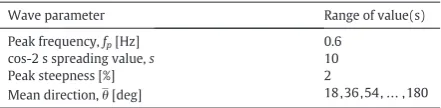
Directional sensitivity tests (10 tests in total).
Wave parameter Range of value(s)
Peak frequency,fp[Hz] 0.6
cos-2 s spreading value,s 10
Peak steepness [%] 2
Mean direction,θ[deg] 18 , 36 , 54 ,…, 180
Table 3
Complex spectra tests.
Wave parameter Spec 1 Spec 2 Spec 3
Peak frequency,fp[Hz] 0.5, 0.5 0.45 0.45, 0.55
αi wave direction of componenti
Φi phase of componentiatx=y=t= 0.
The sea states presented here have a repeat time, T, of 1024 s. This
defines the frequency increments,δf, to be 1
1024Hz, providing 2048
frequency components within the tank's nominal generation range,
0–2 Hz. For the simulation of directional spectra this was achieved
using 64 frequency bins, and 32 directional bins (Nf= 64 ,Nθ= 32).
Re-defining the directional spectrum for use in the single-summation
method gives the required frequency increments of:
δf¼ΔNF
θ¼ fmax NfNθ
¼1T¼10241 ½ Hz ð2Þ
2.2. Experimental configuration
Wave surface elevations are measured within the facility using multiplexed two-wire resistance type wave gauges, each providing a point measurement with a sample frequency of 32 Hz. The wave gener-ation and data acquisition (DAQ) are synchronised using a common clock, and are controlled using a single interface provided by Edinburgh Designs. Such synchronisation of DAQ and wavemaker system is expected to be needed for the application of the new method.
In order to estimate wave directionality these gauges must be deployed in an array. The wave directions will be inferred from the known array spacings, and as such it is important that these vector separations cover as many directions and magnitudes as possible rela-tive to the wavelengths present in the tank. For DSF-based reconstruc-tion methods this enables the direcreconstruc-tional distribureconstruc-tions to be inferred at a range of frequencies with greater angular resolution. The PTPD
method detailed inSection 2.3.1only requires a minimum of 3 gauges,
however a larger number of vector separations enables effective error
reduction (seeFig. 8). In addition to this, the reflection analysis
proce-dure shown inSection 2.3.2benefits from having a range of projected
in-line array separations for each calculated direction.
Inter-array gauge separations can be represented by their co-array,
describing the vector separations between all points (Haubrich, 1968).
Effective directional wave gauge arrays therefore have a uniform co-array, spanning the appropriate range of magnitudes. With this criteria in mind, an 8 gauge array layout was designed for installation
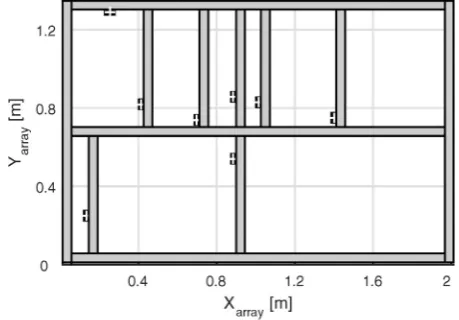
on a re-configurable rig, shown inFig. 3, with the co-array and projected
in-line separations shown inFigs. 4 and 5respectively.
It is observed that the co-array of the array design is largely uniform with no duplicate vector separations, and that there is a good range of projected in-line separations for every angle of incidence. The size of
the array was chosen to ensure that there is a sufficient number of useful
separations for the frequency range of interest, taken here to be 0.2−
1.2 Hz. Analogous to the criteria proposed byGoda and Suzuki (1976)
for reflection analysis, separations are considered useful for frequency
componentiif they are between 0.05λiand 0.45λi. Asλf = 1.2 Hzis
1.08 m, andλf = 0.2 Hzis roughly 21 m, the array has been designed
so that there are a sufficient number of separations smaller than
0.49 m and larger than 1.05 m.
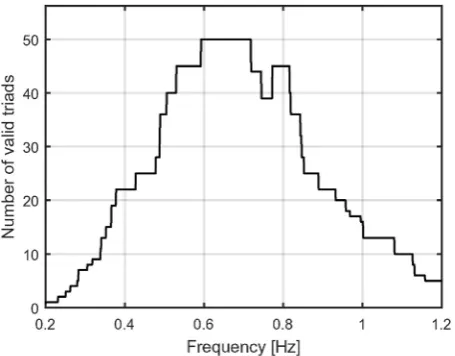
Gauges are used in groups of three to estimate wave angles, and so for a given frequency component the estimate is only assumed valid if all separations adhere to the separation criteria. The resulting number
of valid gauge triads as a function of frequency is shown inFig. 6, and
it can be seen that for the frequency components of interest there are normally multiple useful gauge triads, and hence multiple valid angle estimates.
2.3. The SPAIR method applied to the FloWave Ocean Energy Research Facility
The SPAIR method as detailed in this section uses single-summation wave generation before estimating the frequency dependent incident angles. These angles provide projected in-line separations, which are
used to perform a 2D reflection analysis for each frequency component.
[image:3.595.49.289.53.226.2]Under the assumption that this frequency dependent 2D approach is Fig. 2.The single (right) and double (left) summation methods of wave generation. This
[image:3.595.320.550.54.214.2]demonstrates how wave partitions made in the frequency domain are attributed unique directions (Draycott et al., 2015).
Fig. 3.Wave gauge array layout with bar positions for re-configurable rig.
[image:3.595.348.520.557.727.2]valid, this enables isolation of the incident and reflected directional spectra, and time-series.
The complete method works very well for sea state validation at the FloWave Ocean Energy Research Facility. However, the combined use of all the single-summation based tools present in the SPAIR method may not always be appropriate. For example, if it is known that the wave tank produces incident waves at the correct angle then the initial
PTPD angle calculation is not required. Also if reflections are large, and
not a mirror of the incident, the reflection analysis procedure will give
unreliable results. The method limitations and sensitivity are detailed in
Section 4.1, and alternative uses of the tools are discussed inSection 4.2.
2.3.1. Input angle calculation using PTPD approach
The current methods of calculating directional spectra in tanks, such as the EMEP and BDM approaches, have been developed for ocean mea-surement and subsequently utilised for wave tank analysis. Similarly, the PTPD approach was also initially developed for use in ocean
measure-ment (Esteva, 1976; Fernandes et al., 2000). This technique has not
however made the transition to the tank environment for the routine reconstruction of directional spectra. This is likely because of the method's inability to effectively resolve directional spectra in the ocean.
The PTPD approach uses the phase difference between triads of gauges to infer the wave direction. In the ocean, and when using the double-summation method in tanks, the phase differences at a given frequency will encompass a range of wave components travelling in different directions. In practice the result is that the PTPD outputs es-sentially give a representative angle for that frequency band and cannot be used to create a full directional spectrum. When using the single-summation method of wave generation, however, there are many discrete frequency components, each of which propagates in a single direction. This should enable the method to calculate the actual directions at each sub-frequency, thereby allowing effective reconstruction of a directional spectrum when re-considering the desired, original frequency bins.
The present work uses 8 wave gauges to improve the propagation
direction estimate, as previously described byDraycott et al. (2015).
The method is implemented as follows:
1. Obtain Fourier coefficientsai,nusing an FFT for each gaugen.
Calculate amplitudesAi,nand absolute phasesΦi,n.
2. Find all 3 gauge combinations for N gauges, i.e. 8C
3= 56.
For every triad and all frequency components:
3. Ensure relative separationsL1 , 2,L1 , 3andL2 , 3are allN0.05λi(f) and
b0.45λi(f). If so:
4. Calculate relative phasesΦ1,2andΦ1,3.
5. Calculate perceived angle,α, by the method ofEsteva (1976). The
final equations of which are shown below:
α¼ tan−1ðx1−x2ÞΦ1;3−ðx1−x3ÞΦ1;2=sgn Pð Þ
y1−y3
ð ÞΦ1;2−ðy1−y2ÞΦ1;3
=sgn Pð Þ ð3Þ
P¼½ðx1−x2Þðy1−y3Þ−ðx1−x3Þðy1−y2Þ: ð4Þ
6. Take the peak of a circular kernel density estimate over all valid triad combinations as the propagation direction for that frequency. 7. Comparisons can now be made between the desired and measured
angles, as per the single summation method. Additionally the data can be re-binned and compared with the desired directional spectrum.
The PTPD approach relies on the fact that the phase difference between gauges is a function of the frequency-dependent wave-length and their relative positions. The phase difference between
gaugenand gaugem, for a given Fourier coefficient,i, can therefore
be represented as:
Φi;nm¼ki½ðxn−xmÞcosαiþðyn−ymÞsinαi
¼ki x0i;n−x0i;m
: ð5Þ
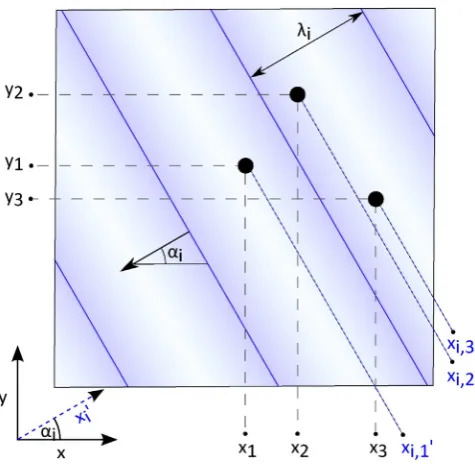
Fig. 7shows the projected in-line x-positions for frequencyi,xi,n′, as
a function of the measured wave direction,αi. Although only 3 gauges
are required to get an estimate of the wave directions it is advantageous to have multiple estimates for the propagation direction at each fre-quency. This is because measurement noise, position error and the
pres-ence, or build-up of reflections, may result in errors in individual
directional estimates.
In this work a maximum of 56 estimates are used to give a represen-tative direction for each frequency, disregarding estimates derived from triads with inappropriate separation magnitudes. A circular mean, or cir-cular median value may be used from these to estimate the true incident
direction at this frequency, however, to limit the influence from rogue
[image:4.595.44.274.53.233.2] [image:4.595.46.274.539.717.2]estimates a circular kernel density estimate has been used for this work. The peak of this kernel density estimate should generally represent the Fig. 5.Projected in-line wave gauge separations for a range of angles of incidence.
Fig. 6.Number of valid gauge triads (all separationsN0.05λiandb0.45λi) as a function of
incident wave direction, with estimates lying either side of the peak being
affected more strongly by reflections or position error etc.
There are 2048 kernel density estimates for each sea state, corre-sponding to the discrete frequency increments used in these tests.
Fig. 8shows some example outputs of these estimates, highlighting the requirement to have multiple estimates in some scenarios, but not
others.Fig. 8a and d highlights the advantage of using the peak of the
kernel density estimates, rather than the mean, with Fig. 8a
demonstrating this particularly well. It is clear here that using the
circu-lar mean value would have lead to a significant‘over-estimate’of the
wave direction, amounting to around 10°.
2.3.2. Calculating in-line reflections using projected gauge positions The PTPD approach used here takes advantage of the fact that the phase differences at a given frequency should be solely a function of the gauge positions and the wave propagation direction. This trait allows for the calculation of frequency dependent, in-line separations:
x0i;n−x0i;m¼ðxn−xmÞcosαiþðyn−ymÞsinαi: ð6Þ
The complex amplitude spectra measured at each gauge,ai,n, along
with these assumed separations then allow a reflection analysis
proce-dure to take place. The process in doing this essentially treats each frequency component as a uni-direction problem.
Typical uni-directional reflection analysis can be achieved with a
small number of gauges, as demonstrated byGoda and Suzuki (1976)
for 2 gauges, andMansard and Funke (1980), using a least-squares
approach with 3 gauges. These methods require the gauge separations to be within a small range to give useful estimates. In this multi-directional work the effective in-line separations are highly variable, and as such require more gauges to ensure useful spacings are available.
Zelt and Skjelbreia (1992)present an extension to the Mansard & Funke method, formulating a weighted least-square approach to
estimating incident and reflected wavefields for any number of gauges.
This approach is used in this work with some slight modification. The
three modifications made are as follows:
1. x-Values are now frequency dependent in-line x-positions, based on
the calculatedαvalues.
2. Absolute phases are used rather than phase difference to gauge 1.
This eventually allows reconstruction of total, incident, and reflected
time-series, and also direct use of the isolated Fourier coefficients.
3. As a weighting function the goodness function presented inZelt and
Skjelbreia (1992)is used in conjunction with the coherence spectra between gauges (dot product). This should enable spacing consider-ations (goodness function) to be considered in conjunction with a measure of the consistency of the phase differences between gauges. In the results presented here this has made little improvement
(b2%). If, however there are particularly noisy signals, or if complex
reflections build up throughout a test this may prove more useful.
The coherence spectra were calculated using the in-built mscohere MATLAB function.
Thefinal modified equations used to calculate the complex incident
and reflected Fourier coefficients,aincandarefare shown below:
ainc;i¼
XN
n¼1
Ci;nai;n ð7Þ
aref;i¼
XN
n¼1
Ci;nai;n ð8Þ
whereai,nis themeasuredFourier coefficients with absolute phase
(rather than with phases relative to gauge 1), and
Ci;n¼
2iWi;n
D XN
m¼1
Wi;msinΔΦi;nmeiΦi;m ð9Þ
D¼4X N
n¼1
X
mbn
Wi;nWi;msinΔΦi;nm 2
[image:5.595.49.287.50.282.2]ð10Þ
[image:5.595.45.552.395.744.2]Fig. 7.Example projected x values for a single frequency component and its associated propagation direction.
[image:5.595.46.308.440.719.2]where:
ΔΦi;nm¼ki½ðxn−xmÞcosαiþðyn−ymÞsinαi ¼ki x0i;n−x0i;m
ð11Þ
Φi;m¼kix0i;m: ð12Þ
Wi,nis the weighting function for gauge n and frequency i. SeeZelt
and Skjelbreia (1992)for the goodness function, andMandel and Wolf (1976)for information on coherence spectra.
These equations allow the incident and reflected amplitude spectra
to be resolved for single-summation generated directional spectrum.
The incident and reflected wave energy density spectra can now be
calculated as:
Sinc;i¼ ainc;i
2
2δf ð13Þ
Sref;i¼ aref;i
2
2δf : ð14Þ
The frequency-dependent reflection coefficient,Kr,i, can also be
readily calculated as:
Kr;i¼ aref;i
ainc;i : ð
15Þ
2.3.3. Calculating the updated incident, and the reflected directional spectrum
Knowledge of the incident and reflected wave frequency spectrum
does not allow for an update to be made to the incident directional
spectrum directly. The reflections present in the tank cause gauge
dependent amplitude and phase deviations. The nature of the PTPD approach means that these can manifest themselves as a directional distribution error, rather than being isolated. This requires the incident propagation directions to be recalculated, using the already isolated
incident Fourier coefficients.
In order tofix the measured incident directional spectrum the isolated
incident Fourier coefficients can be re-processed using the PTPD
approach. This requires the phases for the base Fourier coefficients,
ainc,i, at [0,0], to be shifted to the in-line apparent gauge positions.
This is done noting that:
ai;n¼ainc;ie−iΦi;nþaref;ieiΦi;n: ð16Þ
This defines the incident, position shifted Fourier coefficients as:
ainc;i;n¼ainc;ie−iΦi;n¼ainc;ie−i kix
0
i;n
[image:6.595.84.508.53.429.2]
: ð17Þ
These Fourier coefficients can now be used directly with the PTPD approach, enabling an estimate of the incident directional spectrum to
be made with an attempt to remove the artificial amplitude and phase
deviations. The reflected directional spectrum can be calculated similarly,
or more easily through knowledge of the reflection coefficients. In
addition to this, the incident and reflected time series at the gauge
posi-tions can be estimated through an IFFT.
The nature of this combined approach means that incident and
reflected spectra can be separated over all directions without requiring
[image:7.595.112.487.55.605.2]prior knowledge of the input angular range. Neither the BDM or EMEP Fig. 10.Example SPAIR reconstructed directional spectra outputs. Energy density [m2
Fig. 11.Example time series outputs for the example spectra shown inFigs. 9 and 10. Theoretical time series as well as measured are shown, in addition to the isolated incident and reflected components for a range of gauges. Sea state 1, gauge 1; sea state 2, gauge 2 etc.
[image:8.595.70.517.555.727.2]approaches are capable of achieving this, and even with a defined input range are shown to exhibit much larger uncertainties.
3. Results
3.1. Frequency spectra
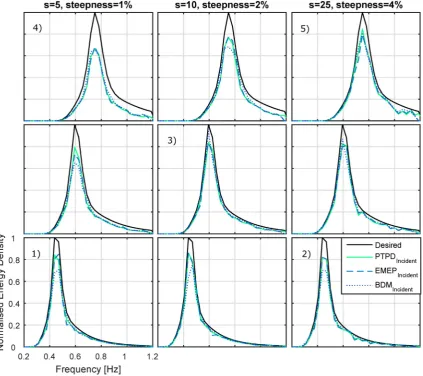
Example incident frequency spectra are shown inFig. 9. These
provide results for a range of sea states covering both the highest and
lowest reflection conditions, as shown inFig. 12. There is an apparent
tendency to under-produce waves, particularly at the spectral peak, and whilst being more pronounced for sea states with higher peak
frequency, and inherently higher reflections, it is prevalent throughout.
In general the deviation is much lower for sea states with lower peak frequency, suggesting that, as expected, the tank's generating and absorbing effectiveness reduces above a certain frequency threshold. To demonstrate that this deviation isn't a function of the method, and
to allow comparisons to be made inSection 3.5.1, the frequency spectra
outputs for the BDM and EMEP approaches are also been shown. This deviation, despite being consistent, is also easy to rectify. Linear frequency dependent correction factors can be applied as a function of the deviation between the target amplitude spectrum and the isolated incident spectrum. These have proved to be effective in previous tests,
bringing down the relative deviation to 1−2%. As the current tests are
focussed on directional distribution and reflection calculation it was
not deemed necessary to apply them for this purpose.
3.2. Incident and reflected directional spectra
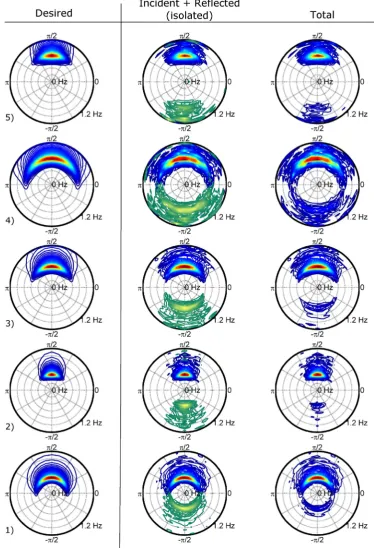
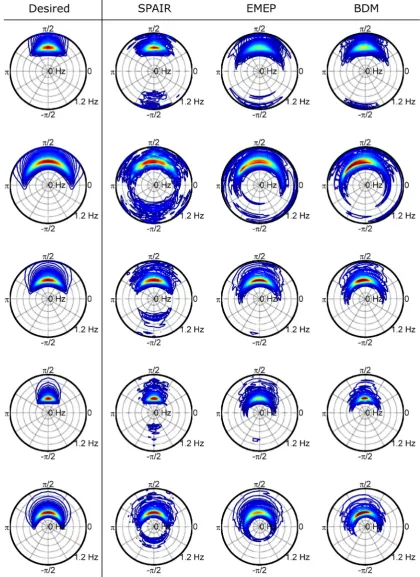
Directional spectra relating to the numbered frequency spectra in
Fig. 9are shown inFig 10, ensuring the extremes of the test programme are still included. The majority of sea states shows good agreement between the input and measured spectra. The difference between the measured incident spectrum from the desired input is generally low, with the exception of sea state 4. Viewing the colour-scale-separated
spectra (middle column ofFig. 10) it is apparent that the reflected
spectrum has been effectively isolated, generally mirroring the form of the incident distribution.
It is apparent that example sea state 4 demonstrates much larger
deviations than the others.Fig. 9highlights that this is largely due to
significant under-generation, whilst inFig. 12it is observed that the
reflection coefficient is also very high. This re-iterates thefindings that
high frequency, low amplitude waves are generated, and absorbed less effectively, especially when combined with high directional spreading.
3.3. Time series
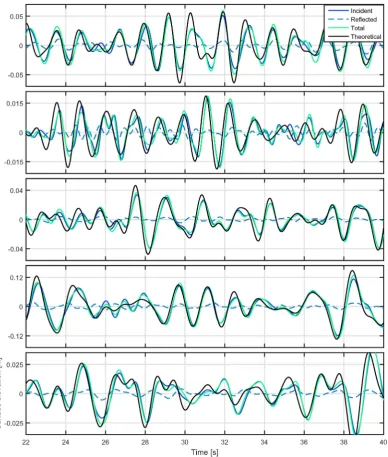
Fig. 11shows the example time series outputs for the spectra in
[image:9.595.86.521.51.223.2]Fig. 10. An IFFT of the complex input amplitude spectra enables the Fig. 13.Mean frequency dependent reflection coefficients for each peak frequency averaged over directional spreading, separated by steepness. Normalised wave spectra overlaid to aid explanation of overall reflection coefficients (Fig. 12).
theoretical time series to be computed using linear wave theory, before
being compared to the actual measurements. As shown inSection 2.3.3,
the presented method also allows for the separation of incident and
reflected time series in the tank domain, and as such these have been
computed at the gauge locations for comparison.
The measured time series outputs show reasonably good agreement with the theoretical time series calculated using linear wave theory. The
removal of the reflected components generally provides a closer match,
however, this is not always the case. The isolation of what is unaccounted
[image:10.595.81.502.55.633.2]reflections from non-linear behaviour appears difficult. As expected from
Fig. 15.Comparison of example directional spectrum outputs from SPAIR, EMEP and BDM approaches. Energy density [m2
the spectral analysis, example sea state 4 shows the largest deviations,
and also the largest relative reflected components.
3.4. Reflection analysis
The output of the directional reflection analysis for the 3 × 3 ×3 test
matrix is shown inFig. 12. Reflections in the FloWave facility are
primarily related to the absorption characteristics of the force-feedback wavemakers, and as such are both frequency and amplitude dependent.
This is demonstrated inFig. 12where it can be clearly observed
that increasing peak frequency, or decreasing wave steepness,
causes an increase in the overall wave reflection coefficient. This
frequency dependency can be attributed to the paddle characteristics,
as well as absorption control scheme, as explored inGyongy et al.
(2014). The reduced sensitivity of the force-feedback mechanism to low wave forces appears to drive the decreased absorption effectiveness for small, low steepness waves.
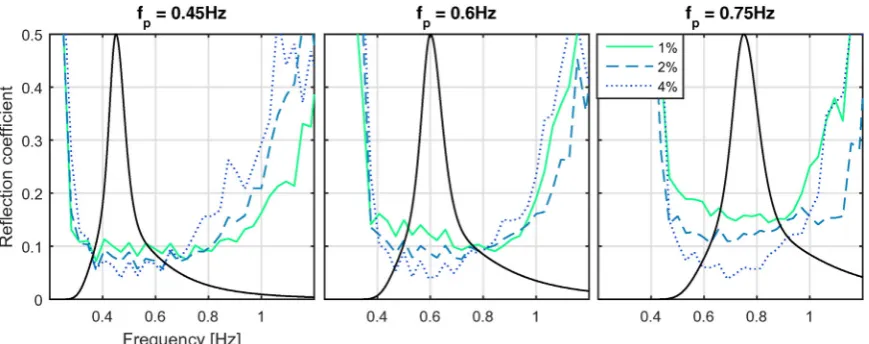
Fig. 13shows the mean frequency dependent reflection coefficients for each peak frequency used, averaged over directional spreading. This enables a more detailed frequency dependent exploration of the
reflection coefficients, and offers further explanation to the results
shown inFig. 12.
3.5. Method performance
3.5.1. Comparison to other methods
In order to assess combined sea state and method performance, the Normalised Total Difference (NTD) between target and measured
spectra can be assessed, defined as:
For directional spectra:
NTDE¼
XNf p¼1
XNθ
q¼1Ei;pq−Em;pq
XNf p¼1
XNθ q¼1Ei;pq
: ð18Þ
For frequency spectra:
NTDS¼
XNf
p¼1Si;p−Sm;p
XNf p¼1Si;p
: ð19Þ
NTDEprovides assessment of the total deviation from target spectra,
which includes:
• frequency spectrum error,NTDS
• directional distribution error,NTDD
• method reconstruction error,NTDM
• miscellaneous (other) error,NTDOe.g. noise, position error.
Ideally the method reconstruction error,NTDM, would be assessed to
gauge method performance. It is not possible, however, to isolate this as
the true directional distribution error is not known.Fig. 9shows that the
deviation from target frequency spectra,NTDS, is mostly tank dependent
and not a function of the methodology. For these reasons to assess
meth-od performance,NTDE–NTDShas been used, noting that it incorporates
the method reconstruction error, along with the directional distribution error. As the true distribution error is constant this should allow effec-tive comparisons to be made between methods.
Fig. 14shows this comparison for the calculated incident spectra
[image:11.595.94.513.53.390.2](using afixed input range of 0–180° for BDM and EMEP methods)
Fig. 16.Complex directional spectra outputs (total) for SPAIR, BDM and EMEP approaches. Energy density [m2
over the initial 3 × 3 × 3 test plan. The SPAIR approach consistently per-forms better, with a mean NTD of 5.93%, compared with 16.1 and 21.7% for the EMEP and BDM approaches respectively.
Example directional spectrum outputs from these methods are
shown inFig. 15, for the same sea states as shown inFig. 10. It can be
seen that neither the EMEP or BDM approaches consistentlyfit a DSF
that incorporates reflected components. The EMEP approach appears to
incorporate some reflected energy content, but the distribution seems
incorrect, likely constrained by the inherent frequency-dependent
‘curve-fitting’process.
Visually all of the methods perform reasonably well in terms of
characterising the incident wavefield, with the SPAIR approach
demon-strating the best performance, as shown inFig. 14. This is also apparent
through visual observation, as the high energy components of the incident distribution match up very well with that of the desired. At low energy levels, however, the distribution does appear to be
ill-defined, a function of the discretised nature of the solution, and the
low energy densities present at these frequencies.
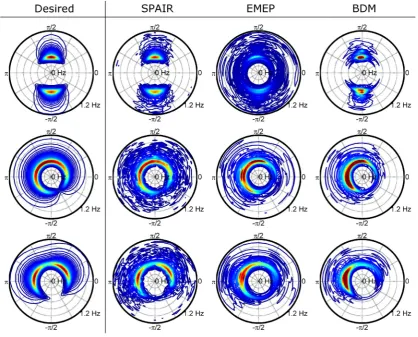
3.5.2. Performance with complex spectra
The complex spectra defined inTable 3have no defined incident and
reflected range and as such the EMEP and BDM approaches cannot
resolve the reflected components.Fig. 16shows the total reconstructed
wavefield using the three methodologies. It is clear that the EMEP and
BDM approaches generally fail to capture the multi-modal and highly spread nature of the input sea states, other than perhaps the BDM approach reconstruction of sea state 3.
The SPAIR approach enables a much more effective characterisation
of the input conditions, as demonstrated inFig. 16andTable 4. The
reflected spectrum and coefficients can also be calculated as no input
angular range is required, with the result that the incident and reflected
[image:12.595.33.284.77.120.2]spectra can apparently overlap. The reflected spectra are shown in
Fig. 17, and the total reflection calculated coefficients were found to be 8.36, 8.61 and 8.13% respectively.
Each of the unusual spectra have peak frequencies of between
0.45 Hz and 0.5 Hz, around 2–3% steepness, and large spreading. Despite
having vastly different spectral forms they have near identical reflection
coefficients, consistent with the results shown inFig. 12. This supports
previousfindings that peak frequency and steepness are the main
parameters to which absorption effectiveness is sensitive to, along with some sensitivity to directional spreading.
4. Discussion
4.1. Method limitations and sensitivity
4.1.1. Effect of in-line reflection level
The presence of in-line reflections alter the phases and phase
differences measured at the gauges, and hence causes an apparent
angle estimation error through Eq.(3). The effect of this can be
under-stood by looking at the resulting Fourier coefficients in the presence of
such reflections.
Table 4
Directional distribution error,NTDE–NTDS, for complex spectra.
NTDE–NTDS Sea state 1 Sea state 2 Sea state 3
SPAIR 0.153 0.127 0.054
EMEP 0.340 0.227 0.454
[image:12.595.121.468.385.719.2]BDM 0.414 0.344 0.322
Fig. 17.Incident and reflected directional spectrum outputs for complex spectra defined inTable 3. Energy density [m2
Surface elevations in the presence of in-line reflections, at [x,y], can be modelled as:
ηðx;y;tÞ ¼X
N
n¼1
Ainc;icoski xcosαinc;iþysinαinc;i
þΦinc;iþωit
þKr;iAinc;icos−kixcosαinc;iþysinαinc;i
þΦinc;iþΦref;iþωitÞ:
ð20Þ
Definingki,xy=ki(xncosαinc,i+ynsinαinc,i), andkr,i=Kr,ieiΦref,i, the
resulting Fourier coefficients at gauge n can be expressed as:
ai;n¼ainc;ieiki;xyþainc;ikr;ie−iki;xy
¼ainc;icoski;xyþisinki;xyþainc;ikr;icoski;xy−isinki;xy
¼ainc;i 1−kr;i
isinki;xy
þainc;i 1þkr;i
cos ki;xy
:
ð21Þ
The expected phase at gauge n is therefore:
Φn;i¼atan
tanki;xy1−kr;i
1þkr;i
" #
: ð22Þ
Apparent angle for each gauge triad is calculated using:
αapparent;i¼tan−1 x1−x2
ð ÞΦi;13−ðx1−x3ÞΦi;12
=sgn Pð Þ
y1−y3
ð ÞΦi;12−ðy1−y2ÞΦi;13
=sgn Pð Þ ð23Þ
where:
Φi;mn¼Φm;i−Φn;i: ð24Þ
From Eq.(22)it can be seen that phases and phase differences at the
gauge locations are heavily influenced by the magnitude of the reflection
coefficient,Kr,i. However the extent with which this alters the resulting
angle estimation depends on the relative change inΦi,13toΦi,12, which
[image:13.595.86.522.52.250.2]is a function of the angle relative to the triad orientation, along with the magnitude of the separations relative to the wavelength.
[image:13.595.109.537.533.721.2]Fig. 18.Effect of in-line reflection coefficient, wave angle and relative separation magnitude on apparent angle calculation.
Fig. 19.Uni-directional spectrum for numerical sensitivity analysis.Hm0= 0.2. For the
simulations, an incident angle ofθ=22.5°has been used.
[image:13.595.321.550.538.716.2]Fig. 18shows the expected angular error for a single equilateral
gauge triad as a function of the reflection coefficient, incident angle
and relative separation magnitude.Krvalues between 0 to 10 have
been used to assess whether the PTPD method presented identifies
the‘reflected’component as the incident direction if KrN1. From
Fig. 18it is apparent that the method doesfind the correct‘dominant’
angle whenKrN1.
It is clear that if gauge separations are small then the angle calculation
is relatively unaffected by the level of reflection. Practically, however, if
gauge separations aretoosmall relative to all frequency components,
position error and noise will alter the measured phases more greatly and hence cause increased errors in the apparent angle estimates.
As expected, when reflection levels are low the angular estimates
are also largely unaffected. When reflections are large, however, the
incident angle relative to the gauge triad orientation becomes
impor-tant, highly influencing the values of individual angle estimates. Overall
the effect of these poor individual estimates can be minimised by designing a wave gauge array so that for each frequency (wavelength) there is a uniform co-array distribution of valid separations. If this is the case, using all of the estimates, the kernel density estimate approach
discussed inSection 2.3.1should be able to provide the correct incident
angle.
To assess how the kernel density approach with the array layout
shown inFig. 3deals with different levels of reflection, a numerical
simulation has been carried out, using a uni-directional broad-banded
spectrum with frequency independent in-line reflections. This spectrum
has been used as it covers the operational frequency range of the tank
(0.2→1.2 Hz), whilst enabling easy analysis and viewing of results.
This spectrum is shown inFig. 19and is also used for the sensitivity
[image:14.595.77.514.52.298.2]analysis shown inSection 4.1.2.
Fig. 20shows the angular error resulting from the simulation. It is clear that the combination of the array and method used performs
very well for frequencies up to 0.95 Hz, regardless of the level of refl
ec-tion. The error shown is purely a function of the number of bins used for
the kernel density estimate (250). When reflection is relatively low
(Krb0.5) there is also no perceived error in the angle estimate, at any
frequency. This shows that the array-method combination performs
very well in general, especially for the level of reflection present in the
(empty) FloWave basin. Once this initial angle is effectively identified
the subsequent in-line reflection analysis will then be correct, which
can be seen inFig. 23when the oblique reflection angle is 0°.
Errors arise from 0.95 Hz onwards when the reflection coefficient is
over 0.5, due to the smaller number of valid gauge triads (seeFig. 6).
This means that poor individual estimates have a greater effect on the
final angle calculation, a result of the combined effect of larger reflections,
triad orientation and large relative separations. Individual estimates for
1 Hz with a range of reflection scenarios are illustrated inFig. 21,
demon-strating how individual estimates are affected by reflection levels and
how the kernel density estimate mitigates the effect of these on the
final angle values.
Where large reflections and high wave frequencies are present it
may be necessary to use an array with additional gauges placed closer together. This would ensure that there are enough gauge triads with
Fig. 22.Effect of reflection level and angle on the mean apparent angle (over all frequencies).
[image:14.595.303.550.519.717.2]separations less than 0.45λi, thus improving the high frequency
esti-mates. For the levels of reflection present in the empty tank the current
array layout should be suitable for identifying the correct incident angle regardless of frequency. That is, under the assumption that position
error and noise are negligible, and more importantly, that reflections
can be assumed to be in-line. This will be discussed inSection 4.1.2.
4.1.2. Effect of reflection angle and curvature
4.1.2.1. Oblique reflections.InSection 4.1.1it was found that the level of
in-line reflection does not greatly affect the correct identification of
the incident angle when using the current implementation of the meth-od in combination with the wave gauge array. This additionally enables
a correct in-line reflection analysis to take place. If, however, the refl
ec-tions are not in-line then this is no longer the case.
Introducing a change in reflected angle,Δαref,i, the surface elevations
become:
ηðx;y;tÞ ¼XN
n¼1
Ainc;icoskixcosαinc;iþysinαinc;iþΦinc;iþwit
þKr;iAinc;icos−kixcosαinc;iþΔαref;i
þysinαinc;iþΔαref;i
Þ þΦinc;iþΦref;iþwitÞ:
ð25Þ
Definingki,α,xy=ki(xcos (αinc,i+Δαref,i) +ysin (αinc,i+Δαref,i), the
resulting phases can be shown to be:
Φn;i¼atan
ainc;isinki;xy
−kr;iainc;isinki;α;xy
ainc;icos ki;xy
þkr;iainc;icoski;α;xy
" #
[image:15.595.99.510.238.723.2]: ð26Þ
It can be seen from Eq.(26)that the phase differences will be altered
by the magnitude ofΔαref,iin addition to the level of reflection and array
layout. The difference here compared with the in-line reflection analysis,
Eq.(22), is that when the angles are calculated using Eq.(3), the
‘direction’of the angular error is now no longer solely a function of
the triad layout, and as such does not‘average’out over multiple
esti-mates. All angle estimates now contain a consistent error as a function ofΔαref,i.
Using the spectrum shown inFig. 19, and simulating the oblique
reflections over the array we can observe this consistent shift in angle
estimate, shown inFig. 22. This shows that if there are sizeable refl
ec-tions with even a small reflection angle then the PTPD approach cannot
be used to effectively identify the incident angle.
As discussed inSection 4.2.2it is not always necessary to estimate
the incident angle. To further assess how oblique reflections affect the
isolation of incident and reflected spectra the incident angles are
assumed to be known.Fig. 23shows how the level, and angle of refl
ec-tion, affect the isolation of incident and reflected spectra. As expected,
this shows that it is not appropriate to use in-line reflection analysis
when the reflections are oblique relative to the incident. This is because
the phase differences are no longer a function of the‘in-line’gauge
separations assumed in the analysis. It may however be suggested
that results are still somewhat useful if the reflection angle is low,
perhaps less than 20°.
4.1.2.2. Curved reflections.When reflections are curved or directionally spread, there will be larger variation in the individual angle estimates generated using the gauge triad combinations. If the mean direction of the curved waves is not opposite the incident, then similar behaviour is to be expected to the oblique wave analysis, but with additional scatter. If, however the mean direction of the curved waves opposes
the incident, then the correct incident angle can be identified with an
appropriate array, and a meaningful representative in-line reflection
analysis procedure can take place. This is the case at FloWave. The circular wave basin at FloWave ensures that the mean direction
of reflected components opposes the incident direction. The circular
shape also means that the reflected components are curved, as a
func-tion of the wave basin geometry and the angular dependency of the tank transfer function.
Reflected wave curvature has been analysed through the spatial
variation of measured wave heights. As it is known that the incident waves are long crested and uniform, the variation in wave height is
solely a function of the curved reflected components interacting with
the incident waves. An example‘spatial map’is shown inFig. 24for
0.45 Hz regular waves, noting that from further tests the curvature of
these reflections appears to be independent of wave frequency. Over
the small array area (1 m2) the assumption that curvature is negligible
[image:16.595.37.282.51.217.2]for the purpose of reflection analysis seems appropriate.
[image:16.595.324.512.52.214.2]Fig. 24.Spatial map of wave height variation for 0.45 Hz regular waves (2% steepness). Shows reflected wave curvature over the tank operational area (roughly equal tofloor area).
Fig. 25.Effect of mean direction on perceived sea state performance. Maximum and minimum values of the test programme shown in dashed lines.
Fig. 26.Effect of mean direction on perceived reflection coefficient. Maximum and minimum values of the test programme shown in dashed lines.
[image:16.595.225.530.542.721.2]The results presented here clearly shows that for the level of refl ec-tion and curvature present, the incident angle can be effectively
identi-fied using PTPD approach with the wave gauge array shown inFig. 3.
Once these are identified the co-array uniformity and least squares
approach of the reflection analysis should ensure that the
representa-tive in-line reflection coefficients are valid despite these small levels of
curvature. This should give a very good estimate of the incident and
reflected spectra, and time-series, over the array area. This approach
means that sea states can be effectively characterised in a particular location (generally in the tank centre), prior to use in a test programme with a model installed.
FromFig. 24, it is apparent that the effective reflection coefficient is not constant, and in fact varies in the in-line direction due to circular
focussing effects. As a result of this, and the reflected wave curvature,
it is clear that the reflected directional spectrum is spatially variable.
This means that although the isolation of incident and reflected spectra,
and time-series over the array area gives reliable results, using this 2D approach to extrapolate far from the measurement area will not be accurate. However, through knowledge of the wave curvature and
in-line dependency of the reflection coefficient, it should be possible
to alter the energy density and angles in the reflected spectrum, and
amplitudes and phases in the time-series reconstructions to provide reasonable estimates over the tank area, if desired.
4.1.3. Influence of mean direction
The wave generating capability at FloWave is designed to be directionally independent, meaning that any change in mean wave
propagation direction should not influence the sea state performance.
Any perceived changes should therefore be attributed to the array layout, and the method itself.
Figs. 25 and 26show the perceived reflection coefficient and direc-tional NTD variation incurred by varying mean direction for a single
sea state. The sea state used is detailed inTable 2. It can be seen in
Fig. 26that when altering the mean direction, the perceived reflections
also vary. This is coupled with variation in the perceived directional distribution error.
Without the presence of reflections, noise, or position error, there
would be no error in the measured propagation directions, and hence no discrepancy in the directional distribution. Of these factors, the
presence of reflections is probably the largest contributor in most
circumstances. It is observed to have a consistent effect on both the relative phases, and the amplitudes at the gauge locations.
As the mean direction changes, the array layout plays an important
role, as the relative reflection and error-influenced phase differences
are dependent on the projected in-line separations. These deviations cause differences in the perceived angles and hence incur a varied and largely unpredictable directional distribution error. A portion of the perceived directional deviation for any sea state is therefore a complex
function of the induced phase errors (mostly reflection based), and
the array layout.
4.1.4. Influence of primary sea state parameters on performance
Analysing the variation in NTD, it is difficult to assess what
propor-tion of this difference is the result of actual sea state deviapropor-tion, and what can be attributed to the array-methodology effectiveness under
various conditions. This was one of the reasons for usingNTDE–NTDS
Fig. 29.Influence the number of gauges has on the directional distribution error, along with the standard deviation of this error.
Table 5
Number of gauge combinations available.
Number of gauges Number of combinations
3 56
4 70
5 56
6 28
7 8
[image:17.595.80.524.52.220.2]8 1
inSection 3.5.1, removing the frequency spectrum deviation, and focus-sing on the directional distribution reconstruction.
The total deviation,NTDE, and the frequency spectrum deviation,
NTDS, essentially show the same dependencies as the reflection coeffi
-cient, shown inFig. 12. It appears that higher peak frequency sea states
with low steepness incur both greater reflections, and larger deviations
in the incident spectrum simultaneously. The correlation between NTD
and reflection coefficient can be seen inFig. 27.
The directional deviation metric,NTDE–NTDS, appears not to have
a predictable correlation to reflection coefficient, as discussed in
Section 4.1.3.Fig. 28shows the relationship between the directional distribution component, and the primary sea state parameters. The only apparent relationship appears to be a reduced NTD when
spreading is lower (sis higher). This is potentially expected as the
only two parameters affecting directionality are spreading and mean
direction, of which, mean direction has been fixed for the main
3 × 3 × 3 test matrix.
4.1.5. Influence of number of gauges
As discussed inSection 4.1.3increasing the number of gauges, if
po-sitioned correctly, should reduce the sensitivity to wave directionality. In general, additional gauges should give rise to improved estimates
and reduced directional discrepancy between target and measured spectra. To explore the effect of the number of gauges all gauge combi-nations with 3 or more gauges have been assessed under an individual
sea state (Table 2,θ¼36). The number of combinations for a desired
number of gauges is shown inTable 5, whilst the mean directional
devi-ation and the standard devidevi-ation of this between array layouts is shown inFig. 29. As expected, the mean directional deviation reduces with the use of more gauges. The standard deviation of the directional deviation is also shown, describing the expected variation in performance when using different sets of gauges.
Increasing the number of gauges will further reduce both the direc-tional deviation and the variation between hypothetical gauge subsets. As the gauge combination choice is analogous to an effective change in wave direction, this will further reduce the sensitivity of an array to direction, thus improving the reliability of the estimates under a variety of wave conditions.
4.2. Alternative applications
4.2.1. No reflection analysis: PTPD approach only
As demonstrated inDraycott et al. (2015), using the PTPD approach
to reconstruct directional spectra at FloWave works effectively without
the addition of reflection analysis. This works particularly well at the
FloWave facility (or other circular wave basins with active absorption)
as the reflections are low, and can be approximated as in-line. It should
also be effective for tanks with different geometry, providing reflections
are relatively low, and the reflection angle isn't very large (seeFig. 22). If
this is the case then the incident directions should be effectively
identi-fied, and a more accurate representation of the incident directional
spectrum should be attained than when using the EMEP or BDM approaches.
4.2.2. No angle calculation: assumed incident angles
Sections 4.1.1 and 4.1.2show that under certain conditions the
pres-ence of reflections can introduce errors in the incident angle calculation.
This, consequently, means that the projected in-line reflection analysis
is done at a slightly incorrect angle thus meaning that the reflection
coefficients themselves will be incorrectly calculated, along with the
incident and reflected spectra. If it can be assumed that the incident
wave propagation angles are known, and precisely produced, then
reflection coefficients can be calculated more accurately, whilst giving
[image:18.595.45.272.49.241.2] [image:18.595.76.513.558.726.2]a better representation of the reflected wavefield.
Fig. 30shows the relative time lag between gauges mounted perpendicular to the expected wave propagation direction, for a variety of regular waves with different frequencies. Sampled at 128 Hz, it can be seen that the phase lags are all less than 1 time step. This shows that the
Fig. 31.Influence assuming the incident direction has on the reflection coefficient calculation.
desired angle is precisely produced with negligible curvature, at least from ±8 m from the tank centre. This analysis was done on only the
first few regular waves (to avoid reflections), however it is probably a
good assumption that the generation capability is not greatly affected by either simultaneous absorption or the generation of multi-directional sea states. Therefore the incident angles can be assumed correct at FloWave.
The resulting overall reflection coefficients when the assumed input
angles are used are shown inFig. 31. It is apparent that when the refl
ec-tions are larger, the greater the error in the computed reflection coeffi
-cient, highlighting this‘feedback loop’problem. In general however, the
reflection coefficients agree very well and it is clear that the computations
where angle isn't assumed will provide adequate practical reflection
estimations in the majority of cases.
4.3. Further work
Further work aims to include an extension to handle oblique refl
ec-tions, potentially using a procedure similar toWang et al. (2008). This
ex-tension, along with an understanding of the geometry in question would
enable directional reflections to be calculated accurately for other objects
such as rectangular tanks, or indeed other structures and devices. The idea
of enabling of reflections to be resolved using double summation
ap-proaches, or as curved components will also be explored, enabling the
reflected components to have a spread at each frequency.
5. Conclusions
The directional characteristics of sea states are often relevant to ocean and coastal engineering problems. The capability of wave basins to produce more complex multidirectional sea states has expanded in recent years, with many facilities now having wavemakers along multi-ple boundaries, or in the case of circular tanks, around the entire circum-ference. The ability to generate more complex spectra, including those with extreme spreading and multi-modality, brings about challenges in validating and calibrating these sea states and highlights the limita-tions in the established measurement techniques. To this end the SPAIR method has been developed. A single-summation method of wave generation has been used to generate a range of directional sea state conditions in a circular wave tank, FloWave. A phase-time-path difference approach has then been used to calculate wave propagation
angles, before frequency-dependent in-line reflection analysis is
performed.
This method, SPAIR, has proved to be highly effective in the measurement of multidirectional sea states within a circular wave
tank, providing both incident and reflected directional spectra, and
reconstructed time-series. The method has been demonstrated with both standard parametric and more complex multi-modal and extremely spread seas. When this single-summation method of wave generation is used, the PTPD-based reconstruction method has shown to be more effective at validating directional sea states
than either the EMEP or BDM approaches, reducing the mean apparent directional deviation from 16.1% (EMEP), and 21.7% (BDM), down to 5.93%.
Sensitivity analysis shows that method itself, in combination with the
wave gauge array, has very low sensitivity the level of in-line reflection,
particularly for the range expected at the FloWave facility. However,
high sensitivity is displayed to the presence of oblique reflections,
something which future work aims to deal with.
Acknowledgements
The authors would like to thank the Energy Technology Institute and the Research Council UK Energy Programme for funding this research as part of the IDCORE programme (EP/J500847/1). In addition we would like to thank the UK Engineering and Physical Science Research Council for funding towards the creation of the FloWave Ocean Energy Research Facility (EP/I02932X/1).
References
Benoit, M.P., Frigaard, P., Schaffer, H.A., 1997.Analysing multidirectional wave spectra: a tentative classification of available methods. Assoc. Hydraulic Res. Seminar: Multidirec-tional Waves.
Draycott, S., Davey, T., Ingram, D.M., Lawrence, J., Day, A., Johanning, L., 2015.Using a Phase-Time-Path-Difference Approach to measure directional wave spectra in FloWave. EWTEC Conference Proceedings.
Esteva, D., 1976.Wave direction computations with three gage arrays. Coastal Engineering Proceedings.
Fernandes, A.A., Sarma, Y.V.B., Menon, H.B., 2000.Directional spectrum of ocean waves from array measurements using phase/time/path difference methods. Ocean Eng. 27 (4), 345–363.
Goda, Y., Suzuki, T., 1976.Estimation of incident and reflected waves in random wave experiments. Coastal Engineering Proceedings, pp. 828–845.
Gyongy, I., Bruce, T., Bryden, I., 2014.Numerical analysis of force-feedback control in a circular tank. Appl. Ocean Res. 47, 329–343 (August).
Hashimoto, N., Konbune, K., 1988.Directional spectrum estimation from a Bayesian approach. Coastal Engineering Proceedings, pp. 62–76.
Hashimoto, N., Nagai, T., Asai, T., 1994.Extension of the maximum entropy principle method for directional wave spectrum estimation. Coastal Engineering Proceedings, pp. 232–246.
Haubrich, R.A., 1968.Array Des. 58 (3), 977–991.
Ingram, D., Wallace, R., Robinson, A., Bryden, I., 2014.The design and commissioning of thefirst, circular, combined current and wave test basin. Flow3d.com.
Krogstad, H.E., 1988.Maximum likelihood estimation of ocean wave spectra from general arrays of wave gauges. Modeling, Identification and Control.
Mandel, L., Wolf, E., 1976.Spectral coherence and the concept of cross-spectral purity. J. Opt. Soc. Am. 66 (6), 529.
Mansard, E.P.D., Funke, E.R., 1980.The measurement of incident and reflected spectra using a least squares method. Coastal Engineering Proceedings, pp. 154–172.
Miles, M.D., Funke, E.R., 1989.A Comparison of Methods for Synthesis of Directional Seas.
Pascal, R.C.R., 2012.Quantification of the Influence of Directional Sea State Parameters Over the Performances of Wave Energy Converters.
Wang, S.K., Hsu, T.W., Weng, W.K., Ou, S.H., 2008.A three-point method for estimating wave reflection of obliquely incident waves over a sloping bottom. Coast. Eng. 55 (2), 125–138 (February).