RESEARCH NOTE
Effect of a text message intervention
on alcohol-related harms and behaviours:
secondary outcomes of a randomised
controlled trial
Sarah Sharpe
1*, Bridget Kool
1, Robyn Whittaker
2, Arier C. Lee
1, Papaarangi Reid
3, Ian Civil
4and Shanthi Ameratunga
1Abstract
Objective: Mobile Health approaches show promise as a delivery mode for alcohol screening and brief intervention. The ‘YourCall’ trial evaluated the effect of a low-intensity mobile phone text message brief intervention compared with usual care on hazardous drinking and alcohol-related harms among injured adults. This paper extends our previously published primary outcome analysis which revealed a significant reduction in hazardous drinking associ-ated with the intervention at 3 months, with the effect maintained across 12 months follow-up. The objective of the current study was to evaluate the effect of the intervention on alcohol-related harms and troubles and help-seeking behaviours (secondary outcomes) at 12-months follow-up.
Results: A parallel two-group, single-blind, randomised controlled trial was conducted in 598 injured inpatients aged 16–69 years identified as having medium-risk hazardous drinking. Logistic regression models applied to 12-month follow-up data showed no significant differences between intervention and control groups in self-reported alcohol-related harms and troubles and help-seeking behaviours. Although this text message intervention led to a significant reduction in hazardous alcohol consumption (previously published primary outcome), changes in self-reported alcohol-related harms and troubles and help seeking behaviours at 12-months follow up (secondary outcomes) were small and non-significant.
Trial registration: ACTRN12612001220853. Retrospectively registered 19 November 2012.
Keywords: Alcohol drinking, Injuries, Cell phones, Text messaging, mHealth intervention, brief intervention for harm (BI)
© The Author(s) 2019. This article is distributed under the terms of the Creative Commons Attribution 4.0 International License (http://creat iveco mmons .org/licen ses/by/4.0/), which permits unrestricted use, distribution, and reproduction in any medium, provided you give appropriate credit to the original author(s) and the source, provide a link to the Creative Commons license, and indicate if changes were made. The Creative Commons Public Domain Dedication waiver (http://creat iveco mmons .org/ publi cdoma in/zero/1.0/) applies to the data made available in this article, unless otherwise stated.
Introduction
Alcohol-related harms are a significant global issue, caus-ing large health, social and economic burdens to people, communities, and society [1–3]. An individual’s haz-ardous drinking can cause a wide range of harms (e.g. physical, mental, relationship, employment, financial and legal) to themselves as well as others [4, 5].
Alcohol Screening and Brief Interventions (SBI) can reduce alcohol consumption and alcohol-related harms [6–8], and digital (including mobile health–mHealth) approaches could enhance the scalability of such inter-ventions [9]. As described elsewhere [10], our study group developed a low-intensity, automated, culturally-appropriate, brief text message intervention (called ‘YourCall’), drawing on SBI principles [11] and Stages of Change behaviour change theory [12], and designed to reduce hazardous drinking and alcohol-related harm among adults admitted to hospital following an injury. A randomised controlled trial (RCT) evaluating the
Open Access
*Correspondence: [email protected]
1 Section of Epidemiology and Biostatistics, School of Population Health,
Faculty of Medical & Health Sciences, University of Auckland, Private Bag 92019, Auckland 1142, New Zealand
intervention found a significant effect in the primary outcome, i.e., a reduction in hazardous drinking in the intervention group compared with control (usual care) group [13]. The effect was maintained across follow-up points (three, six and 12 months) and was similar among Māori (New Zealand’s indigenous population) and non-Māori, and among younger (16–29 years) and older (30– 69 years) participants.
This paper extends our previously published RCT find-ings, by evaluating secondary outcomes from the RCT’s 12-month follow-up survey, which investigated the effects of the ‘YourCall’ text message intervention on a range of self-reported alcohol-related harms and troubles and participants’ alcohol-related help-seeking behav-iours. The hypothesis of this study was that, in com-parison to hazardous drinkers discharged from hospital following an injury admission who received usual care, those receiving the intervention would have experienced less alcohol-related harms at the 12-month follow-up point.
Main text
Methods
Study design and participants
The RCT design, patient population and eligibility cri-teria are described in the published study protocol [14] and the paper reporting the primary outcome [13]. A two-group, parallel, RCT conducted in Auckland, New Zealand, in 598 trauma inpatients with medium-risk hazardous drinking patterns, compared the effects of the ‘YourCall’ text message intervention with ‘usual care’ on hazardous drinking and alcohol-related harms. The trial only included patients with medium-risk drink-ing patterns as BIs are treatments designed specifically for medium-risk drinkers rather than drinkers at higher risk of harm and dependent on alcohol, for whom the appropriate management involves counselling, special-ist evaluation and treatment [11]. The trial was approved by the New Zealand Health and Disability Ethics Com-mittee (12/NTB/28), registered with the Australian New Zealand Clinical Trials Registry (anzctr.org.au; Identifier: ACTRN12612001220853), and followed the Consoli-dated Standards of Reporting Trials (CONSORT) guide-lines [15]. Written informed consent was obtained from all participants.
Procedures
The group randomised to the intervention received 16 text messages over four weeks, commencing 7–10 days after hospital discharge. Control group participants received one text message acknowledging their partici-pation and indicating they would be contacted in three months’ time.
Participants’ baseline assessments included demo-graphic data and responses to the Alcohol Use Disor-ders Identification Test (AUDIT). Participants were invited to complete the AUDIT-C via text message at 3- and 6-months follow-up and complete a web-based survey at 12 months which included the AUDIT and other alcohol-related questions (described in more detail next). Participants who did not respond to the web survey were contacted by research assistants to complete assessments via telephone.
Secondary outcome measures assessed at 12‑months follow‑up
Alcohol-related harms and troubles were assessed using the ‘Alcohol Harms’ and ‘Alcohol Troubles’ seven-item checklists, drawn from the Gender, Alcohol, and Cul-ture International Study (http://www.genacis.org./11) [16, 17]. All questions had a possible value 0–2, and the total score for each checklist ranged between 0 and 14.
Help-seeking behaviour was assessed by asking par-ticipants if they did any of the following: (a) rang the Alcohol Drug Helpline (offers free confidential profes-sional advice); (b) visited the Alcohol Drug Helpline website; (c) visited other websites for information or help relating to alcohol use; (d) talked with a doc-tor or other health professional about their drinking; (e) talked with anyone else, such as friends or fam-ily, about their or others’ drinking. ‘Behaviours a–d’ (reflecting professional sources of help) were assessed as a composite outcome called ‘Help-seeking behav-iours 1’. ‘Behaviour e’ was assessed separately as infor-mal sources, referred to as ‘Help-seeking behaviour 2’ in this analysis.
Statistical analysis
Data were analysed following a pre-specified analysis plan. Baseline demographic variables (age, sex, and eth-nic group), employment, and AUDIT-C mean scores, and 12-month survey question responses were summarised for the intervention and control groups.
The differences between the intervention and control groups in secondary outcome measures were analysed using logistic regression models adjusted for the ran-domisation variables of age, sex, hospital centre, ethnic-ity, and baseline AUDIT-C score.
Results
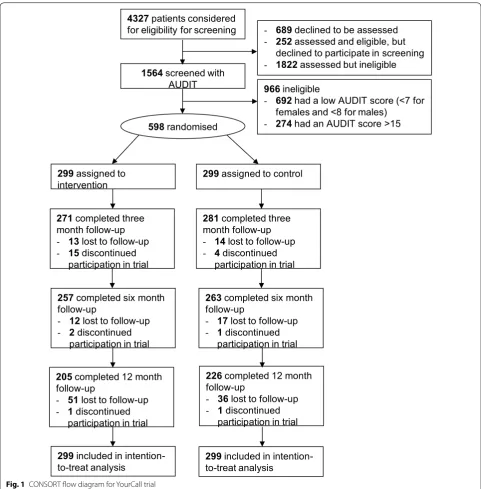
As previously described [13], 598 of the 1564 poten-tially eligible participants who were screened met the trial inclusion criteria (Fig. 1). The characteristics of the two groups were similar at baseline, including mean AUDIT-C scores (control group: 6.82 [95% CI 6.62–7.03]; intervention group: 6.87 [95% CI 6.68– 7.06]). Twelve-month follow-up data were provided by 226 (76%) of the 299 control group participants and 205 (69%) of the 299 intervention group participants.
The percentages of females and Māori respondents at 12 months were similar to those at baseline, however there were fewer participants in the 16–29-year-old group at 12 months compared to baseline (Table 1).
The group specific responses relating to alcohol harms, alcohol troubles, and help seeking are presented next, followed by the results of multivariable regression models which indicate that the intervention did not have a significant effect on these secondary outcomes.
4327patients considered for eligibility for screening
1564screened with AUDIT
- 689declined to be assessed - 252assessed and eligible, but
declined to participate in screening - 1822assessed but ineligible
598randomised
299assigned to
intervention 299assigned to control
299included in intention-to-treat analysis
226completed 12 month follow-up
- 36lost to follow-up - 1discontinued
participation in trial 205completed 12 month
follow-up
- 51lost to follow-up - 1discontinued
participation in trial
299included in intention-to-treat analysis
966ineligible
- 692had a low AUDIT score (<7 for females and <8 for males)
- 274had an AUDIT score >15
257completed six month follow-up
- 12lost to follow-up - 2discontinued
participation in trial 271completed three month follow-up - 13lost to follow-up - 15discontinued
participation in trial
263completed six month follow-up
- 17lost to follow-up - 1discontinued
participation in trial 281completed three month follow-up - 14lost to follow-up - 4discontinued
participation in trial
[image:3.595.57.539.230.720.2]Among participants responding to the ‘alcohol harms’ questions in the 12-month survey (Table 2), over half (124 [55%] of the control group and 106 [53%] of the interven-tion group) reported alcohol-related harmful effects in one or more of the following domains: work, studies, or employment; housework or chores around the house; marriage/intimate relationships; relationships with other family members including children; friendships or social life; finances; physical health. Of those responding to the ‘alcohol troubles’ questions, one-third of both control and intervention groups (76 [34%] and 65 [33%], respec-tively) reported alcohol-related troubles in one or more of the following domains: the law; illness connected with drinking; losing or nearly losing a job; feeling annoyed by other people’s criticisms of their drinking; having a spouse or someone close leave or threaten to leave; loss of a friendship; getting into a fight.
A small number of respondents (24 [11%] of the con-trol group and 31 [16%] of intervention group) had sought help in relation to their drinking through con-tacting a health professional, via the Alcohol Drug Hel-pline, or through seeking information or help from online sources (‘help-seeking behaviours 1’ in Table 2). In con-trast, 90 (41%) control group respondents and 85 (43%)
intervention group respondents reported talking with others, such as friends or family, about their drinking (‘help-seeking behaviour 2’ in Table 2).
The logistic regression models adjusted for age, sex, hospital, ethnicity, and baseline AUDIT-C score found that there were only small and non-significant differ-ences between intervention and control groups in rela-tion to self-reported alcohol-related harms (OR 0.88, 95% CI 0.60–1.30, p = 0.53) and alcohol-related troubles (OR 0.89, 95% CI 0.59–1.35, p = 0.58). The evidence of an intervention effect on increased help seeking in rela-tion to their alcohol use from professional and infor-mal sources was also weak (‘help-seeking behaviours 1’: OR 1.67, 95% CI 0.93–3.01, p = 0.09; and ‘help-seeking behaviours 2’: OR 1.16, 95% CI 0.78–1.72, 0.48).
Discussion
This study reports the analysis of secondary outcome data collected at 12-months follow-up in an RCT evalu-ating the effect of a low-intensity mobile phone text message intervention compared with usual care on hazardous drinking and alcohol-related harms among injured adults. While the primary outcome analysis found a significant reduction in hazardous drinking in
Table 1 Characteristics of participants at baseline and 12-months
Characteristics Baseline 12-month follow-up point
Control group n = 299
n (%) Intervention group n n (%) = 299 Control group n n (%) = 226 Intervention group n = 205 n (%)
Female 86 (28.8) 85 (28.4) 67 (29.6) 63 (30.7)
Age (mean, SD) 34 (13) 34 (13) 36 (13) 35 (13)
Age group 16–29 yrs 144 (48.2) 145 (48.5) 90 (39.8) 94 (45.9)
Māori ethnicity 64 (21.4) 62 (20.7) 43 (19.0) 36 (17.6)
Table 2 Summary of responses to 12-month survey
a Alcohol Harms score of 1 or more (i.e. score of 0 indicates no harm, and a score of 1 or more indicates one or more harms) b Alcohol Troubles score of 1 or more (i.e. score of 0 indicates no troubles, and a score of 1 or more indicates one or more troubles)
12-month survey domains and questions Control group n = 226
n (%) Intervention group n = 205 n (%)
Alcohol harms
Reports a harmful effect during the past 12 months from drinking alcohola n 124 (55.1)=225 n 106 (53.3)=199
Alcohol troubles
Reports experiencing trouble during the past 12 months from drinking alcoholb n 76 (34.1)=223 n 65 (32.5)=200
Help-seeking behaviours 1
Reports any of the following behaviours in the last 12 months: a) ringing Alcohol Helpline, b) looking at Alcohol Helpline website, c) looking at other website for information or help about alcohol, d) talking with a doctor or other health professional about respondent’s drinking
n =219
24 (11.0) n 31 (16.0)=194
Help-seeking behaviour 2
Reports having talked in the last 12 months with someone else, such as friends or family about the respondent or someone else’s drinking
n =222
[image:4.595.58.540.100.206.2] [image:4.595.61.537.552.706.2]the intervention group compared with control (usual care) group, we did not detect any important differences between treatment groups in the measures of alcohol-related harms and troubles and help-seeking behaviours at 12-months follow-up.
The strengths of this trial include the trial’s size, broad age range, generalisability to adult inpatient trauma care patients, focus on medium-risk drinkers, and recruit-ment practices that ensured a high participation of Māori patients. The study was not limited to patients wanting to change their drinking or wanting help. Many SBI trials only measure alcohol consumption outcomes. This trial included alcohol-related harms and troubles and help-seeking behaviours as secondary outcomes.
The findings described in this paper are similar to other trials evaluating the effect of alcohol SBI on alcohol-related negative consequences which have reported no differences between treatment groups [18, 19], yet con-trast with other studies which have reported significant differences [6, 20]. In SBI trials that report on alcohol-related harms, the measures and outcomes are wide-ranging and difficult to compare across studies [7, 9]. Few SBI trials have evaluated alcohol-related help-seeking behaviours and the findings have been inconsistent [18,
21]. Neumann et al. [21] reported more frequent use of community alcohol treatment services by ‘at-risk drink-ing’ injured patients who received computer-generated BI in the ED compared with control group participants who received screening only, during a one year follow-up period. In contrast, D’Onofrio et al. [18] found that the rate of health service utilisation did not differ by treat-ment group in their study of staff-administered BI com-pared to scripted discharge instructions.
There are several possible explanations for the null findings of this study. The content of the text messages focussed mainly on reducing alcohol consumption. This may explain the stronger effects of this intervention on hazardous alcohol use (primary outcome [13]) and the weak effects on alcohol-related harm and help seeking. Furthermore, as the study was powered for the primary outcome and not the outcomes examined in the pre-sent analysis, Type II error could account for the weak treatment effects observed. The baseline assessment, screening, and repeated administration of the AUDIT-C at follow-up could have also acted as a form of treat-ment for the control group, creating a beneficial effect and decreasing differences in secondary outcome meas-ures between the intervention and control groups [19,
22]. Factors outside the scope of the intervention such as inequities in access to information and treatment services, and perceptions of social norms and stigmati-sation, could also influence the likelihood of help seek-ing—although we have no reason to assume these were
differentially distributed in the intervention and control groups in our trial.
In conclusion, although mHealth BIs are promis-ing strategies for helppromis-ing people to reduce their alcohol consumption and change their drinking patterns, our findings raise questions about the role of mHealth BI in reducing alcohol-related harms. Further research is required to investigate if enhanced programme content on harms and sources of support for self-management and treatment could strengthen the effectiveness of mHealth interventions. Regardless of the potential ben-efits that could accrue, BIs should be viewed as a health sector strategy that is one component of a multi-pronged public health approach. Alcohol-related harms are ineq-uitably distributed at a societal level and mediated by complex and multi-factorial pathways including perva-sive commercial determinants of health [3, 23, 24]. Con-sequently, addressing the price, availability, advertising and marketing of alcohol should remain cornerstones of equity-focused harm reduction strategies [23, 25].
Limitations
As secondary outcome measures were only assessed at 12 months due to concerns regarding the length of the baseline assessment and potential treatment effects in the control group [22, 26], we cannot assess if there were differential changes in these measures from baseline to 12 months. As evident in our primary outcome analy-sis [13] focusing on differences in hazardous drinking in the intervention and control groups (measured using the AUDIT-C), mean AUDIT-C scores were similar in both groups at baseline. Although not assessed directly, both groups are also likely to have had similar baseline scores in measures of alcohol-related harms and troubles given the randomisation procedure. The notable finding from our primary outcome analysis was evidence of an impor-tant (statistically significant) intervention effect, over and above observed declines in mean AUDIT-C scores over the follow-up period in both the intervention and con-trol groups. While this trial was not designed to investi-gate changes in alcohol-related harms and troubles over time, the statistically non-significant differences between the two groups with respect to these measures in the 12-month survey suggest that evidence of any interven-tion effect on these secondary outcomes was weak. How-ever, a Type II error could have a stronger influence in these analyses as the study was only powered for the pri-mary outcome.
inaccuracies such as under-reporting, this is unlikely to differ between the randomised treatment groups.
Abbreviations
AUDIT: alcohol use disorders identification test; AUDIT-C: alcohol use disorders identification test—consumption; BI: brief intervention; CI: confidence interval; CONSORT: consolidated standards of reporting trials; ED: emergency depart-ment; mHealth: mobile health; OR: odds ratio; RCT : randomised controlled trial; SBI: screening and brief intervention.
Acknowledgements
We thank the participants, research assistants, and study staff who were involved in this research.
Authors’ contributions
All authors had input in to the study concept and design, and SS served as the principal research fellow. Study co-ordination was led by BK and SS, and SA was the principal investigator overseeing the conduct of the study. Statistical analysis was conducted by AL and SS and findings were reviewed by SA, BK, and RW. SS drafted the manuscript and BK, RW, AL, PR, IC, and SA have read, provided comment, and approved the final manuscript. SA and SS had full access to all the data in the study and take responsibility for the integrity of the data and the accuracy of the data analysis. SS and SA are the guarantors for this research.
Funding
The Health Research Council of New Zealand funded this research. The funder was not involved in the study design; collection, analysis, and interpretation of the study data; the writing of the manuscript; or the decision to submit the manuscript for publication.
Availability of data and materials
Due to the conditions of the informed consent obtained from participants, the institutional and Ministry of Health ethical requirements do not permit us to share participant data from this study.
Ethics approval and consent to participate
The trial was approved by the New Zealand Health and Disability Ethics Committee (12/NTB/28) and was carried out in accordance with the ethical guidelines of the National Ethics Advisory Committee (New Zealand). Written informed consent was obtained from all participants.
Consent for publication Not applicable.
Competing interests
The authors declare that they have no competing interests.
Author details
1 Section of Epidemiology and Biostatistics, School of Population Health,
Faculty of Medical & Health Sciences, University of Auckland, Private Bag 92019, Auckland 1142, New Zealand. 2 National Institute for Health Innovation,
University of Auckland, and Waitemata District Health Board, Auckland, New Zealand. 3 Te Kupenga Hauora Māori, Faculty of Medical & Health Sciences,
University of Auckland, Auckland, New Zealand. 4 Trauma Service, Auckland
City Hospital, Auckland, New Zealand.
Received: 1 March 2019 Accepted: 8 May 2019
References
1. Rehm J, Mathers C, Popova S, Thavorncharoensap M, Teerawat-tananon Y, Patra J. Global burden of disease and injury and economic cost attributable to alcohol use and alcohol-use disorders. Lancet. 2009;373(9682):2223–33.
2. G.B.D. 2016 Alcohol Collaborators. Alcohol use and burden for 195 countries and territories, 1990–2016: a systematic analysis for the Global Burden of Disease Study 2016. Lancet. 2018.
3. World Health Organization. Global status report on alcohol and health. Geneva: WHO; 2018.
4. Meiklejohn J, Connor J, Kypri K. One in three New Zealand drinkers reports being harmed by their own drinking in the past year. N Z Med J. 2012;125(1360):28–36.
5. Connor J, Casswell S. Alcohol-related harm to others in New Zea-land: evidence of the burden and gaps in knowledge. N Z Med J. 2012;125(1360):11–27.
6. Nilsen P, Baird J, Mello MJ, Nirenberg T, Woolard R, Bendtsen P, et al. A systematic review of emergency care brief alcohol interventions for injury patients. J Subst Abuse Treat. 2008;35(2):184–201.
7. Schmidt CS, Schulte B, Seo HN, Kuhn S, O’Donnell A, Kriston L, et al. Meta-analysis on the effectiveness of alcohol screening with brief interventions for patients in emergency care settings. Addiction. 2016;111(5):783–94. 8. O’Donnell A, Anderson P, Newbury-Birch D, Schulte B, Schmidt C, Reimer
J, et al. The impact of brief alcohol interventions in primary healthcare: a systematic review of reviews. Alcohol Alcohol. 2014;49(1):66–78. 9. Kaner EF, Beyer FR, Garnett C, Crane D, Brown J, Muirhead C, et al.
Person-alised digital interventions for reducing hazardous and harmful alcohol consumption in community-dwelling populations. Cochrane Database Syst Rev. 2017;9:CD011479.
10. Sharpe S, Shepherd M, Kool B, Whittaker R, Nosa V, Dorey E, et al. Develop-ment of a text message intervention aimed at reducing alcohol-related harm in patients admitted to hospital as a result of injury. BMC Public Health. 2015;15:815.
11. Babor TF, Higgins-Biddle JC. Brief Intervention for Hazardous and Harmful Drinking. A Manual for Use in Primary Care. Geneva: World Health Organi-zation., 2001.
12. Prochaska JO, DiClemente CC. Stages of change in the modification of problem behaviors. Prog Behav Modif. 1992;28:183–218.
13. Sharpe S, Kool B, Whittaker R, Lee AC, Reid P, Civil I, et al. Effect of a text message intervention to reduce hazardous drinking among injured patients discharged from a trauma ward: a randomized controlled trial. npj Digital Medicine. 2018;1(13).
14. Ameratunga S, Kool B, Sharpe S, Reid P, Lee A, Civil I, et al. Effectiveness of the YourCall text message intervention to reduce harmful drinking in patients discharged from trauma wards: protocol for a randomised controlled trial. BMC Public Health. 2017;17(1):48.
15. Schulz KF, Altman DG, Moher D, Group C. CONSORT 2010 statement: updated guidelines for reporting parallel group randomised trials. BMJ. 2010;340:c332.
16. GENACIS partners. GENACIS: Gender, Alcohol, and Culture: an Interna-tional Study. Expanded Core Questionnaire 2017 [19th February 2018]. Available from: http://www.genac is.org/11.
17. Connor JL, Kypri K, Bell ML, Cousins K. Alcohol outlet density, levels of drinking and alcohol-related harm in New Zealand: a national study. J Epidemiol Community Health. 2011;65(10):841–6.
18. D’Onofrio G, Pantalon MV, Degutis LC, Fiellin DA, Busch SH, Chawarski MC, et al. Brief intervention for hazardous and harmful drinkers in the emergency department. Ann Emerg Med. 2008;51(6):742-50 e2. 19. Mello MJ, Baird J, Nirenberg TD, Lee C, Woolard R, Longabaugh R. DIAL:
a randomised trial of a telephone brief intervention for alcohol. Injury Prevention: J Int Soc Child Adolesc Injury Preven. 2013;19(1):44–8. 20. Bock BC, Barnett NP, Thind H, Rosen R, Walaska K, Traficante R, et al. A text
message intervention for alcohol risk reduction among community col-lege students: TMAP. Addict Behav. 2016;63:107–13.
21. Neumann T, Neuner B, Weiss-Gerlach E, Tonnesen H, Gentilello LM, Wernecke KD, et al. The effect of computerized tailored brief advice on at-risk drinking in subcritically injured trauma patients. J Trauma. 2006;61(4):805–14.
22. Kypri K, Langley JD, Saunders JB, Cashell-Smith ML. Assessment may conceal therapeutic benefit: findings from a randomized controlled trial for hazardous drinking. Addiction. 2007;102(1):62–70.
23. Anderson P, Chisholm D, Fuhr DC. Effectiveness and cost-effectiveness of policies and programmes to reduce the harm caused by alcohol. Lancet. 2009;373(9682):2234–46.
•fast, convenient online submission •
thorough peer review by experienced researchers in your field • rapid publication on acceptance
• support for research data, including large and complex data types •
gold Open Access which fosters wider collaboration and increased citations maximum visibility for your research: over 100M website views per year •
At BMC, research is always in progress.
Learn more biomedcentral.com/submissions
Ready to submit your research? Choose BMC and benefit from:
25. Roche A, Kostadinov V, Fischer J, Nicholas R, O’Rourke K, Pidd K, et al. Addressing inequities in alcohol consumption and related harms. Health promotion international. 2015;30 Suppl 2:ii20–35.
26. McCambridge J, Kypri K. Can simply answering research questions change behaviour? Systematic review and meta analyses of brief alcohol intervention trials. PLoS ONE. 2011;6(10):e23748.
27. Kypri K. Methodological issues in alcohol screening and brief intervention research. Substance abuse. 2007;28(3):31–42.
Publisher’s Note