S H O R T R E P O R T
Open Access
Medication prescribing errors in a pediatric
inpatient tertiary care setting in Saudi Arabia
Majed I Al-Jeraisy
1, Menyfah Q Alanazi
2and Mostafa A Abolfotouh
1*Abstract
Background:Medication errors (MEs) are among the most common types of medical errors and one of the most common and preventable causes of iatrogenic injuries. The aims of the present study were; (i) to determine the incidence and types of medication prescribing errors (MPEs), and (ii) to identify some potential risk factors in a pediatric inpatient tertiary care setting in Saudi Arabia.
Findings:A five-week retrospective cohort study identified medication errors in the general pediatric ward and pediatric intensive care unit (PICU) at King Abdulaziz Medical City (KAMC) through the physical inspection of physician medication orders and reviews of patients’files. Out of the 2,380 orders examined, the overall error rate was 56 per 100 medication orders (95% CI: 54.2%, 57.8%). Dose errors were the most prevalent (22.1%). These were followed by route errors (12.0%), errors in clarity (11.4%) and frequency errors (5.4%). Other types of errors were incompatibility (1.9%), incorrect drug selection (1.7%) and duplicate therapy (1%). The majority of orders (81.8%) had one or more abbreviations. Error rates were highest in prescriptions for electrolytes (17.17%), antibiotics (13.72%) and bronchodilators (12.97%). Medication prescription errors occurred more frequently in males (64.5%), infants (44.5%) and for medications with an intravenous route of administration (50.2%). Approximately one third of the errors occurred in the PICU (33.9%).
Conclusions:The incidence of MPEs was significantly high. Large-scale prospective studies are recommended to determine the extent and outcome of medication errors in pediatric hospitals in Saudi Arabia.
Keywords:medication errors, prescriptions, pediatric, in-patient, Saudi Arabia
Introduction
Medication errors (MEs) are one of the most common types of medical errors and one of the most common and preventable causes of iatrogenic injuries [1]. MEs contribute to the morbidity and mortality of hospitalized patients. In the USA, MEs have been found to be responsible for 7,000 patient injuries per year, with a similar incidence and consequences in the UK [2,3]. Approximately one third of adverse drug events (ADEs) are associated with medication errors and are thus pre-ventable [4]. MEs occur in 6.5 of 100 adult hospital admissions and 5 of 100 adult medication orders [5].
When medication errors occur, pediatric patients have a much higher risk of death than adults [6]. There are many factors that put children at a greater risk for
medication errors, such as their variations in age and weight, high intra-patient variability, rapid changes in the pharmacokinetic properties of drugs in children, and the frequent use of “off-label” indications in children [1,7-9]. Reports of MEs in children are becoming more common, yet the findings of many of the reports are conflicting [10]. In a systematic review, Miller et al. [11] found that 5 to 27% of inpatient orders contained errors. Creating a prescription is an early step in medication use; therefore, reviewing orders and prescriptions by pharmacists and nurses is critical for detecting errors and preventing adverse impacts on patients [12]. In pediatrics, the prescribing and ordering phases, followed by the administration phase, are associated with the most errors (usually dosing errors) [1,3,11]. Prescription errors occur at a rate of 3 to 20% of all prescriptions in hospitalized pediatric patients and 10.1% of children seen in emergency departments [8,13]. In the Gulf region, few studies have explored the significance of
* Correspondence: [email protected]
1
King Abdullah International Medical Research Center, King Saud Bin-Abdulaziz University for Health Sciences, Riyadh, Saudi Arabia Full list of author information is available at the end of the article
medication errors in pediatric patients [14,15], and none of these studies has targeted pediatric inpatients. The electronic prescription system implemented by govern-ment health care facilities in Dubai has helped reduce medication errors by 50% [15]. The aims of the present study were to identify, in a pediatric inpatient tertiary care setting in Saudi Arabia, (i) the incidence and types of medication prescribing errors (MPEs) and (ii) some potential risk factors for MPEs.
Materials and methods
Study Setting
This study was conducted in the general pediatric wards and the pediatric intensive care unit (PICU) of King Abdulaziz Medical City (KAMC), which is a tertiary care hospital in Riyadh, the capital of Saudi Arabia. The pediatric/neonatal care units at KAMC are composed of general pediatric wards; medical, surgical and cardiac intensive care units; and oncology and pediatric emer-gency units. The total capacity of these wards is approximately 280 beds, which represents approximately 30% of the overall hospital capacity.
Study design
This was a retrospective cohort study of physician medi-cation orders over a period of five weeks in King Abdu-laziz Medical City, Riyadh, Saudi Arabia.
Study population
This study included all of the medication orders that were prescribed in the general pediatric wards -for chil-dren up to 14 years of age - and the pediatric intensive care unit (PICU) during the designated study period. The following orders were not included in the study: orders from the pediatric cardiac wards, the pediatric oncology wards, or the neonatal intensive care unit (NICU); orders corrected by the pharmacist prior to the review; errors in medication reorders; doses of antipyre-tics that were no more than 30% above the maximum dose; and verbal orders.
Measurement
The medication orders were written by the pediatric medical staff of residents, fellows and consultants. They used either standard blank physician order sheets, a number of special order sheets (e.g., an antibiotics order sheet or an immunoglobulin order sheet), or pre-printed order-dependent protocols and clinical pathways. Copies of these original orders were sent to the pharmacy via fax or carried by the nurses or pharmacy aides. All of the medication orders were reviewed by staff pharma-cists and entered into a computerized pharmacy data system prior to dispensation. The information on each medication order, including the date of birth, the
diagnosis upon admission, any reported medication allergies, body weight, and a complete medication profile for the present hospitalization, was reviewed by the pharmacist. Two clinical pharmacists covered all of the orders for the pediatric patients.
Data were collected daily, and the following were examined: (1) the types of errors in terms of the drug selection, dose, frequency, route, order clarity, incompat-ibility, and therapy duplication; (2) the drug route of administration; (3) the hospital location; (4) the patient’s age; and (5) the patient’s gender. The use of unapproved abbreviations was recorded. All of the medication pre-scribing errors were then classified into two main cate-gories: (i) potentially harmful errors (including all potential ADEs) and (ii) non-harmful errors (e.g., miss-ing information, missmiss-ing weight, illegibility, abbreviation errors, and trailing zeros) [8]. The pediatric staff was not informed of the study during the data collection period to assure the validity of the results.
Operational definitions
A prescription error was defined as an incorrect or inap-propriate drug selection (based on indications, contrain-dications and other factors), dose, route, rate of administration, or frequency. A prescription error also included illegible handwriting, an incomplete order (missing the dose, route, or frequency), incompatibility, incorrect instructions for using the drug product, and the use of non-standard nomenclature or abbreviations that requires further interpretation [4,11,12,16,17]. Because the definition of a medication error is non-uni-form across different studies, the literature was thor-oughly reviewed, and the categories were allocated accordingly.
Ethical issues
This study was approved by the research committee at King Abdullah International Medical Research Center, King Saud Bin-Abdulaziz University for Health Sciences, Riyadh, Saudi Arabia.
Results
Types and incidence of medication errors
interactions, and an incorrect duration of therapy or monitoring.
Dose errors constituted more than one third of the errors (39.4%), with overdose as the main type of dose error (47.3%). A missed route was the main type of route error (94.8%), while a missed frequency was the main type of frequency error (73.6%). Medication pre-scription errors occurred the most frequently in males (64.5%), infants (44.5%) and intravenous routes of administration (50.2%). Approximately one third of the errors occurred in the PICU (33.9%) (table 2).
Errors and medication category
Figure 1 shows that the largest number of errors were associated with prescribing electrolytes (17.2%), followed by antibiotics (13.7%), bronchodilators (12.9%), narcotic analgesics (11.6%), gastrointestinal medications (6.9%), non-narcotic analgesics (5.7%), cardiac medications (5.3%), sedatives and hypnotics (5%), steroids (4.8%), topical medications (4.5%) and vitamins (1.7%).
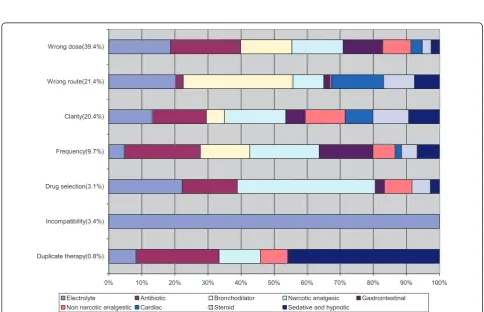
Figure 2 shows that the majority of incompatibility errors (97%) occurred in prescribing electrolytes, while drug selec-tion errors were committed mainly in prescribing narcotic analgesics (37%). Dose errors were committed in prescrib-ing antibiotics (18%), electrolytes (16%), bronchodilators and narcotic analgesics (13% each). Route errors were represented in the prescription of bronchodilators (30%), electrolytes (18%), cardiac medications (14%) and steroids (8%). Frequency errors were committed in prescribing anti-biotics (18%), narcotic analgesics (16%), gastrointestinal medications (12.6%), and bronchodilators (12%). Duplicate therapy errors were committed mainly in prescribing seda-tives and hypnotics (42%) and antibiotics (23%).
Using the list of dangerous abbreviations of the Joint Commission, the study found that these abbreviations were highly prevalent (81.8%). They were in the form of QD (11.4%), a trailing zero after decimal point (e.g., 1.0 mg; 4.9%), a naked decimal point (e.g.,.5 mg; 2.6%), U (2.5%), and IU (1.9%). Incorrect drug abbreviations were observed in 17.1% of all of the prescriptions.
Discussion
[image:3.595.307.538.122.416.2]Medication errors, which are common when prescribing medication [18], are a serious and potentially harmful
Table 1 Frequency (%) and incidence of medication prescription errors according to type of error at King Abdulaziz Medical City, Riyadh, Saudi Arabia
Types of error No. of
errors
% Incidence (95% CI)
(A). Potentially harmful errors:
22.1 (9.0, 25.2)
Dose
Overdose 249 47.3
Missed dose 186 35.4
Underdose 79 15.0
Undecided dose 12 2.3
Subtotal * 526 39.4
Route 12.0 (8.5, 15.5)
Missed route 271 94.8
Undecided route 11 3.8
Inappropriate route 4 1.4
Subtotal * 286 21.4
Frequency 5.4 (1.6, 9.2)
Missed frequency 95 73.6
High frequency 17 13.2
Low frequency 11 8.5
Undecided frequency 6 4.7
Subtotal * 129 9.7
Incompatibility 45 3.4 1.9 (-2.1, 5.9)
Wrong drug selection 41 3.1 1.7 (-2.2, 5.6)
Duplicate therapy 24 1.8 1.00 (-3.1, 4.1)
(B) Non-harmful errors:
Clarity 272 20.4 11.4 (7.8, 15.0)
Miscellaneous 10 0.8 0.4 (-5.8, 6.6)
TOTAL 1333 100.0 56.0 (54.2,57.8)
[image:3.595.55.291.125.466.2]•Percentages were calculated from the total number of errors (N = 1,333).
Table 2 Frequency (%) of medication prescription errors according to potential risk factors at King Abdulaziz Medical City, Riyadh, Saudi Arabia
Characteristics No. of errors %
Gender
Male 860 64.5
Female 473 35.5
Total 1333 100
Age group
Less than 1 year 593 44.5
1-3 years 249 18.7
4-6 years 167 12.5
7-9 years 43 3.2
10-12 years 281 21.1
Total 1333 100
Administration route
Intravenous 669 50.2
Oral 342 25.7
Inhalation 222 16.6
Topical 60 4.5
Subcutaneous 24 1.8
Intramuscular 16 1.2
Total 1333 100
Location
PICU 452 33.9
Pediatric wards 881 66.1
Total 1333 100
0 2 4 6 8 10 12 14 16 18 20 Electrolytes
Antibiotics Bronchodilator Narcotic analgesics Gastrointestinal Non narcotic analgesics Cardiac medication Sedative and hypnotics Steroid Topical medication
Vitamins Antiviral Antidote Anticonvulsant General anesthetics Anticoagulant Immunosupressant Antihistamine Antihemophilic Antifungal
[image:4.595.58.540.89.374.2]Percent
Figure 1Incidence (%) of medication errors in the different medication categories.
0% 10% 20% 30% 40% 50% 60% 70% 80% 90% 100%
Duplicate therapy(0.8%) Incompatibility(3.4%) Drug selection(3.1%) Frequency(9.7%) Clarity(20.4%) Wrong route(21.4%) Wrong dose(39.4%)
Electrolyte Antibiotic Bronchodilator Narcotic analgesic Gastrointestinal
Non narcotic analgestic Cardiac Steroid Sedative and hypnotic
[image:4.595.55.540.400.712.2]problem. Of the 2,380 medication orders that were ana-lyzed in the present study, 1,333 errors (56%) were iden-tified. The majority of these errors were classified as potentially harmful (1,051, 78.8%). This figure is much higher than the figures of 4.9 and 4.5 errors per 1,000 medication orders reported by Foli [19] for two large pediatric hospitals in the US and the figures of 5.9 per 1,000 reported by Lesar [20], 5.7% reported by Kaushal et al. [4], and 5.7% reported by Fortescue et al. [18]. Two more recent studies of medication errors in pedia-tric intensive care units by Potts [8] and Cimino [21] found that 3.4 and 11.1% of orders had at least one pre-scription error. However, the definition of medication error was non-uniform across these studies [10]. Both Potts [8] and Fortescue et al. [10] appeared to use a broader definition of medication error, as errors in both studies included all types of omissions, such as omis-sions in the patient’s weight or prescriber’s name [11]. These definitions differ from the definition of an omis-sion in the present study, which only included a missing dose, route or frequency.
In general, dosing errors are the most common type of medication error in children, with overdoses generally outnumbering under-doses [4,10,20]. In this study, dos-ing errors were the most common type of error, fol-lowed by incorrect route, order clarity, and frequency.
Medication errors are more common in sicker patients with urgent and complex medical conditions [3,22]. In a previous study, although the total error rate per 100 orders was similar across different settings, serious errors were much more common in intensive care environments [23]. In the present study, approximately one third of the errors occurred in the PICU. This fig-ure was higher than the figfig-ure reported by Cimino (11.1%) [21], and comparable to the figure (33.1%) reported by Potts [8]. When such a patient needs urgent care, there is often insufficient time to verify the correct dosage [24].
According to Foli [19], pediatric patients (2 years old or less) and pediatric ICU patients received the greatest pro-portion of errant orders. In the present study, 44.5% of all errors were in infants less than one year old. Children (< 5 years old) were at the highest risk of errors, and the risk for infants (< 1 year old) was more than double that of the next risk-prone group (aged 65 to 70)[19].
The use of abbreviations in prescribing medication has recently received much attention and has become an international concern as one of the major causes of medication errors [16,25,26]. In the present study, abbreviations were used in 82% of all orders. Abbrevia-tions were in the form of QD (11.4%), a trailing zero after the decimal point (.9%), and a naked decimal point (2.6%). Incorrect abbreviations were found in 17% of all
prescriptions. These figures were compared to those of Potts [8], who also found drug abbreviation errors (6.04%) and the use of a trailing zero after the decimal point (0.81%).
The administration route ranked second as a medica-tion error in the present study, representing 21.4% of all errors. This finding was similar to that of a previous study [4] in which the administration route represented 18% of all errors. The intravenous route was most com-monly associated with medication errors. This finding might explain the highest prevalence of errors in pre-scribing electrolytes and the finding that PICU errors were more common.
Limitations
The present study has some limitations. First, the study was only conducted in one setting that does not repre-sent other health care settings in Saudi Arabia. Thus, the findings cannot be generalized. Second, the study period was short (5 weeks), and most of the orders were collected during the day shift. It was difficult to collect the orders during the evening and night shifts, during which more serious mistakes may occur. Third, there was no follow-up studying the consequences of these errors (i.e., deaths and/or adverse events). Fourth, the incidence of errors was estimated based on the number of errors and not the number of orders with one or more errors, which might overestimate the incidence of errors in this study, making the comparison with other studies difficult.
Aside from these limitations, we can conclude the following:
1. The incidence of medication prescription errors in this tertiary care setting was significantly high. Dosing errors were the most common type of error, followed by the wrong route, order clarity, and the wrong frequency. Approximately one third of the errors occurred in the PICU, and one half occurred in infants less than one year old.
2. Pediatricians should help hospitals develop effective programs to safely provide medications, report medica-tion errors, eliminate barriers to reporting medicamedica-tion errors, encourage a non-punitive reporting culture and create an environment of medication safety for all hospi-talized pediatric patients.
3. The development, implementation, and assessment of a computerized physician order entry system, clinical decision-support systems, ward-based clinical pharma-cists, and improved communication among physicians, nurses, and pharmacists are recommended.
Acknowledgements
The authors would like to acknowledge the pharmaceutical care department, pediatric department, and nursing department for their contributions to this project and support. This study was approved by the research committee of King Abdullah International Medical Research Center (KAIMRC), King Saud Bin-Abdulaziz University for Health Sciences, Riyadh, Saudi Arabia. Special thanks are to the editing office at KAIMRC for the English language editing of the manuscript via a specialist English language copy editor (American Journal Experts). The authors would like to thank Ms. Aisha Mahfouz, the research coordinator in KAIMRC, for constructing the GIF figures of the manuscript.
Author details
1King Abdullah International Medical Research Center, King Saud
Bin-Abdulaziz University for Health Sciences, Riyadh, Saudi Arabia.2Drug Policy &
Economic Center, King Abdulaziz Medical City, Riyadh, Saudi Arabia.
Authors’contributions
All of the authors contributed to the design and execution of the study and the analyses. MAA and MQA were actively involved in writing the manuscript. MIA commented on the drafts. All of the authors read and approved the final manuscript.
Competing interests
The authors declare that they have no competing interests.
Received: 21 February 2011 Accepted: 14 August 2011 Published: 14 August 2011
References
1. Kozer E, Berkovitch M, Koten G:Medication errors in children.Pediatr Clin N Am2006,53:1155-1168.
2. Ghaleb MA, Barber N, Franklin BD, Wong ICK:what constitutes a prescribing error in pediatrics?Qual saf health care2005,14:352-357. 3. Ghaleb MA, Barber N, Franklin BD, Yeung VW, Khaki ZF, Wong IC:
Systematic review of medication errors in pediatric patients.The annals of pharmacotherapy2006,40:1766-1776.
4. Kaushal R, Bates DW, Landrigan C, McKenna KJ, Clapp MD, Federico F, Goldmann DA:Medication errors and adverse drug events in pediatric inpatients.JAMA2001,285:2114-2120.
5. Bates DW, Cullen DJ, Laird N, Peterson LA, Small SD, Servi D, Laffel G, Sweitzer BJ, Shea BF, Hallisey R, Vliet MV, Nemeskal R, Leape LL:Incidence of adverse events and potential adverse events. Implications for prevention. ADE prevention study group.JAMA1995, 274-34. 6. Phillips J, Beam S, Brinker A, Holquist C, Honig P, Lee LY, Pamer C:
Retrospective analysis of mortalities associated with medication errors. Am J Health Syst Pharm2001,58(19):1835-41.
7. Lesar TS:Ten-fold medication prescribing errors.Ann Pharmacother2002, 36:1833-9.
8. Potts AL, Barr FE, Gregory DF, Wrigght L, Patel NR:Computerized physician order entry and medication errors in pediatric critical care unit.Pediatrics 2004,113:59-63.
9. Peth HA:Medication errors in the emergency department a system approach to minimizing risk.Emerge Med Clin N Am2003,21:141-158. 10. Fortescue EB, Kaushal R, Landrigan CP, McKenna KJ, Clapp MD, Federico F,
Goldmann DA, Bates DW:Prioritizing strategies for preventing medication errors and adverse drug events in pediatric inpatient. Pediatrics2003,111(4 pt1):722-9.
11. Miller MR, Rbinson KA, Lubomski LH, Rinke ML, Pronovst PJ:Medication errors in pediatric care: a systematic review of epidemiology and evaluation of evidence supporting reduction strategy recommendations. Qual Saf Health Care2007,16:116-126.
12. Lesar TS, Mitchell A, Sommo P:Medication Safety in Critically III Children. Clinical pediatric emergency medicine2006,7:215-225.
13. King WJ, Paice N, Rangrej J, Forestell GJ, Swartz R:The effect of
computerized physician order entry on medication errors and adverse in pediatric inpatients.Pediatric2003,112:506-509.
14. Al Khaja KJ, Al Ansari TM, Damanhori AHH, Sequeira RP:Evaluation of drug utilization and prescribing errors in infants: A primary care prescription-based study.Health Policy2007,81:350-357.
15. MENAFN.Com:Dubai’s e-prescriptions reduce medication errors by 50%. [http://www.menafn.com/qn_news_story_s.asp?StoryId=1093239285/]. 16. Abushaiqa ME, Zaran FK, Bach DS, Smolarek RT, Farber MS:Educational
Interventions to Reduce Use of Unsafe Abbreviations.American Journal of Health-System Pharmacy2007,64(11):1170-1173.
17. Kohn LT, Corrigan JM, Donaldson MS, eds:To Err Is Human: Building a safer health system.Institute of Medicine, Washington, DC; National Academy press; 2000.
18. Lehmann CU, Kim GR:Computerized provider order entry and patient safety.Pediatr Clin N Am2006,53:1169-1184.
19. Folli HL, Poole RL, Benitz WE, Russo JC:Medication error prevention by clinical pharmacists in two children’s hospitals.Pediatrics1987,97:718-22. 20. Lesar TS:tenfold medication dose prescribing errors.The annals of
pharmacotherapy2002,36:1833-1839.
21. Cimino MA, Kirschbaum MS, Shaha SH:Assessing medication prescribing errors in pediatric intensive care units.Pediatr Crit Care Med2004, 5(2):124-32.
22. Dale Needham M, David Thompson A, Christine holzmueller G:A system factors analysis of airway events from the Intensive care unit safety reporting system (ICUSRS).Crit Care Med2004,32(11):2227-2233. 23. Landrigan CP:The safety of inpatient pediatrics: preventing medial errors
and injuries among hospitalized children.Pediatr Clin N Am2005, 52:979-993.
24. Kozer E, Seto W, Verjee Z, Parshuram C, Khattak S, Koren G, Jarvis DA: Prospective observational study on the incidence of medication errors during simulated resuscitation in a paediatric emergency department. BMJ2004,329(7478):1321.
25. Lassetter JH, Warnick ML:Medical errors, drug-related problems, and medication errors: a literature review on quality of care and cost issues. J Nurs Care Qual2003,18(3):175-81.
26. Barker KN, Flynn EA, Pepper GA, Bates DW, Mikeal RL:Medication errors observed in 36 health care facilities.Arch Intern Med2002,
162(16):1897-903.
doi:10.1186/1756-0500-4-294
Cite this article as:Al-Jeraisyet al.:Medication prescribing errors in a pediatric inpatient tertiary care setting in Saudi Arabia.BMC Research Notes20114:294.
Submit your next manuscript to BioMed Central and take full advantage of:
• Convenient online submission
• Thorough peer review
• No space constraints or color figure charges
• Immediate publication on acceptance
• Inclusion in PubMed, CAS, Scopus and Google Scholar
• Research which is freely available for redistribution