METHODS FOR CANONICITY
MSc Thesis
(Afstudeerscriptie)
written by
Samuel Jacob van Gool
(born November 1st, 1987 in Amsterdam, The Netherlands)
under the supervision of Dr Alessandra Palmigiano, and submitted to the Board of Examiners in partial fulfillment of the requirements for the degree of
MSc in Logic
at theUniversiteit van Amsterdam.
Date of the public defense: Members of the Thesis Committee:
November 30, 2009 Prof Dr Mai Gehrke
Prof Dr Dick de Jongh
Dr Alessandra Palmigiano
Abstract
In the first part of this thesis, we focus on the canonical extension of partially ordered sets, which
was defined by algebraic means by Dunn, Gehrke and Palmigiano [9]. We show that it can be
obtained alternatively via a generalization of Urquhart and Hartung’s maximal filter-ideal pair
construction ([43], [27]). We further give a first-order dual characterization of perfect lattice
hemi-and homomorphisms, in the spirit of, but different from Gehrke [16], hemi-and make category-theoretic
observations regarding the canonical extension.
The second part of the thesis concerns the algebraic canonicity proof of the Sahlqvist fragment
for distributive modal logic by Gehrke, Nagahashi and Venema [22]. We pay particular attention
to the additional operation n, which is crucial to that proof, and show that the proof can not be straightforwardly translated to an algebraic canonicity proof of the inductive fragment for
distributive modal logic [7]. We extract requirements on a new version of the operationn, which would yield a proof of the canonicity of the inductive fragment, and finish by starting to explore
two new perspectives on the magical nature of the operationn.
Contact information
Sam van Gool
Contents
Introduction 5
1 The canonical extension via duality . . . 5
2 Canonical extensions and completeness . . . 7
3 Beyond classical logic . . . 8
4 Outline of the thesis . . . 10
1 Canonical extensions of partially ordered sets 11 1 Algebraic construction . . . 12
1.1 Filter definitions . . . 12
1.2 Definition of the canonical extension . . . 13
1.3 Existence and uniqueness . . . 14
1.4 A categorical perspective . . . 16
2 Discrete duality: Objects . . . 18
2.1 Perfect Lattices and Polarities . . . 19
2.2 RS Polarities . . . 21
3 Canonical extension via discrete duality . . . 23
3.1 Definition and fundamental theorem of maximal pairs . . . 24
3.2 The canonical extension via maximal pairs . . . 25
4 Discrete duality: Morphisms . . . 27
4.1 Adjoint pairs . . . 28
4.2 Composition . . . 30
4.3 Equivalence ofPLatad andRSPolad . . . 31
4.4 Hemimorphisms . . . 33
4.5 Complete homomorphisms . . . 34
2 Canonicity of inequalities 37 1 Terms and trees . . . 38
1.1 Terms . . . 38
1.2 Trees . . . 39
1.3 The Sahlqvist fragment . . . 41
2 Collapsing terms . . . 43
2.1 The binary operationn . . . 43
3 After the collapse . . . 49
3.1 Minimal collapses are proper Sahlqvist . . . 49
3.2 Positive terms on the right . . . 50
4 Canonicity of the Sahlqvist fragment . . . 50
4.1 Stability and contraction of certain terms . . . 50
4.2 Canonicity of general Sahlqvist terms . . . 51
5 The inductive fragment . . . 52
5.1 Definitions and comparison with Sahlqvist fragment . . . 52
5.2 Connections with Ackermann’s Lemma . . . 53
Conclusion 55 1 Reconstructing the lost duality . . . 55
2 Category-theoretic perspective on canonical extensions . . . 58
3 Canonicity and correspondence . . . 58
Acknowledgements
An earlier version of this document was submitted as my Master of Logic thesis at the University
of Amsterdam, and successfully defended on 30 November, 2009. The main part of it was written
between June and November 2009. Some parts, most notably section 1.4 of Chapter 1, needed to
be revised following up questions and discussions at the occasion of and after my Thesis defense,
and this was done somewhat later and sporadically in the first months of 2010 at the Radboud
Universiteit Nijmegen and LIAFA, Universit´e Paris-Diderot, France.
I would like to take this opportunity to thank my thesis committee, consisting of Mai Gehrke,
Yde Venema, Dick de Jongh and Alessandra Palmigiano for their critical questions, from which I
benefited a lot, and so did the thesis (hopefully).
Alessandra Palmigiano, as the supervisor of this thesis, deserves special mention: she inspired me
to take up this project; I fondly remember many afternoons of working on the project together,
which was sometimes hard, and even stressful work, but without exception a lot of fun.
Writing this thesis would also not have been possible without moral support and necessary
dis-tractions from many people. Thanks to: Jacobien Carstens, Chris van Dorp, Evelien, Floor and
Sophie Frenkel, Lisa Fulford, Christian Geist, my parents Pim and Carolien, my sisters Sophie,
Rosa and Joanne, Jan Loerakker, Niels van Maanen, Gover Meit, Joe Mier, Joep Pijpers, Hanna
Schreuders, Jonathan Shaheen, Bouwien Smid.
Thanks also to all those whom I did not mention here; I do explicitly express my sincere hope
that they are somewhat consoled by being mentioned implicitly in the current sentence.
Introduction
1
The canonical extension via duality
Representation theorems are statements of the form: every element of the class of structures X
is isomorphic to some element of the proper subclass Y of X. Representation theorems can be found in various fields of mathematics: among one of the first and most famous examples is
Cayley’s theoremthat every group is isomorphic to a subgroup of a symmetric group, stated and
partly proved by Cayley in 1854 [6]. In functional analysis, Riesz’s theorems, to the effect that
certain linear functionals on a space can be represented as measures, are important instances of
representation theorems, dating from the first decade of the twentieth century [39], [40]. Taking a
leap of roughly fifty years, in 1954 or ‘55, Nobuo Yoneda met Saunders MacLane in a caf´e at the
Gare du Nord in Paris, and told him about the category-theoretic fact, which was later baptized
the Yoneda Lemma ([33], [32]). This fact greatly generalised and unified many of the previous
representation theorems. For instance, when applied to a group regarded as a category, the Yoneda
Lemma yields Cayley’s theorem (Cf. [8], Example 2.7.5).
The conceptual importance of a representation theorem is proportional to the size and complexity
of the proper subclass Y of the general class of structures X: if this subclass is much more transparent and easy to work with than the general class, then the representation theorem makes
it easier both to conceive and to prove isomorphism-invariant properties of all structures in the
(apparently) larger classX.
Representation theorems are of particular importance in logic because they pave the way to
com-pleteness results, to be made precise below in Section 2. In the field of mathematical logic, the
following theorem, proved by Marshall H. Stone in 1936, is probably the best known representation
theorem.
Stone’s representation theorem (1936) [41]. Every Boolean algebraAcan be embedded in the complete and atomic Boolean algebraAσ, defined as the power set algebra of the set of ultrafilters
of A.
This statement already looks very significant. For instance, it tells us a lot about the behaviour of
the operations in a Boolean algebra and gives us a very powerful grasp on theirmeaning. However,
it is fair to say that the abbreviated form in which the theorem is stated here discloses only a tiny
fraction of the true significance and potential of this result, which is mostly concentrated in the
special properties of theembeddingofAintoAσ.
These special properties are abstractly encoded in the definition of the central concept of this
and ‘ultrafilter’ functors, each of which is part of adual equivalenceordualityof categories. Loosely
speaking, a duality is a one-to-one correspondence, or ‘back-and-forth translation’, between two
categories that preserves and reflects the logical information stored in the two categories. It works
in part as a dictionary and in part as a comparative grammar: a duality does not only translate
words (e.g., homomorphism), but it also translates properties (e.g., injective) and constructions
(e.g., product) from the one category into thedual properties (e.g., surjective) and constructions
(e.g., disjoint sum) of the other category.
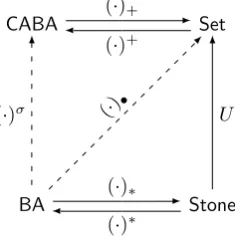
The following diagram is meant to express how Stone’s representation theorem relies on the
exis-tence of two dualities of categories.
CABA
(·)+
(·)+ Set
BA (·)σ
6
(·)∗
(·)∗ (·)•
-Stone
[image:8.595.244.362.265.384.2]U 6
Figure 1: Duality and Stone’s representation theorem
Let us take some time to examine this diagram in detail, since its shape is a ‘blueprint’ for some
more such diagrams that we will consider in this thesis. We first describe the categories and
(object components of the) functors involved.
The category BA is that of Boolean algebras with homomorphisms, CABA is the category of
complete atomic Boolean algebras with complete homomorphisms,Stoneis the category of Stone
spaces (i.e., compact, Hausdorff, totally disconnected topological spaces) with continuous maps,
andSetthe category of sets with functions.
The functor pair (·)+, (·)+ constitutes a dual equivalence between the categoriesCABA andSet,
which we will refer to as thediscrete duality. For a setS, S+ is defined as the power set algebra
ofS, and for a complete atomic Boolean algebraA,A+ is the set of atoms ofA.
The functors (·)∗, (·)∗ constitute atopological dualitybetweenBAandStone, respectively. To any
Boolean algebraA, the functor (·)∗associates theultrafilter spaceA∗, and for any Stone spaceX, X∗is defined to be the Boolean algebra of clopen sets of that space.
Finally, the canonical extension functor(·)σ is defined as (·)σ := (·)+◦U ◦(·)
∗, and the functor
(·)• is defined to be the compositionU◦(·)∗.
It is now easy to see that by combining the topological and discrete duality, we actually get two
important results:
(i) Any Boolean algebraAcan beembeddedin the algebraAσ, and,
(ii) Any Boolean algebra homomorphism f : A → B can be extended to a complete Boolean algebra homomorphismfσ:
Putting the first item in a slightly different wording, we see that any Boolean algebra is (up to
isomorphism) a subalgebra of a power set algebra: Stone’s representation theorem.
The second item can be generalised: we can actually apply the functor (·)σ not only to Boolean algebra homomorphisms, but to any (order-preserving) function. This construction will be studied
in a more general context in Chapter 1 of this thesis, and is one of the important ingredients which
enables us to use canonical extensions to studymodallogic.
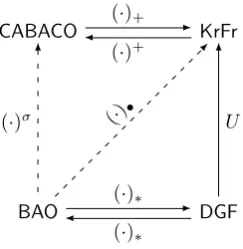
Using this construction, it is possible to devise a diagram, similar to that in Figure 1, in which
Boolean algebraswith operators(BAO’s) occupy the lower left corner.
CABACO (·)+
(·)+
KrFr
BAO (·)σ
6
(·)∗
(·)∗
(·)•
-DGF
[image:9.595.241.363.247.372.2]U 6
Figure 2: Duality and the J´onsson-Tarski representation theorem
A Boolean algebra with an operator (BAO) is a pair hA,3i where A is a Boolean algebra and 3 : A → A is a function which preserves all finite joins. A unary operator is called complete if it preserves all joins, so a ‘CABACO’ is a complete atomic Boolean algebra with a complete
operator. KrFrdenotes the category of Kripke frames (sets with a relation on the set) and DGF
the category of descriptive general frames, which can also be seen as Stone spaces, equipped with
a relation which is point-closed.1
The following theorem is now the classical starting point for the use of canonical extensions in the
study of modal logic.
J´onsson-Tarski representation theorem (1952) [31]. Any BAO A can be embedded in its canonical extension Aσ.
In the next section, we will discuss the relevance of canonical extensions for logic in general and
modal logic in particular.
2
Canonical extensions and completeness
From a logical point of view, representation theorems and canonical extensions are relevant because
they yield frame completeness results. Probably the simplest example of this phenomenon is that
Stone’s representation theorem can be used to prove the completeness of classical propositional
calculus with respect to subset semantics.
We focus on a little bit more involved example frommodal logic. Using the J´onsson-Tarski theorem
outlined in the previous section, we can easily prove the completeness of the modal logic K. Say thatK`φiff the equationφ=>is valid in all Boolean algebras with operators.
The definition of Kripke semantics immediately gives us the following lemma.
Lemma 2.1. For any Kripke frame hS, Riand any modal formula φ, hS, Ri |=φ if and only if
hS, Ri+|=φ=>.
Using the J´onsson-Tarski representation theorem, we then easily prove the completeness ofKwith respect to the class of Kripke frames.
Theorem 2.2. Let φ be a modal formula. Then K ` φ if and only if φ is valid on all Kripke frames.
Proof. If K ` φ, then in particular φ = > holds on all BAO’s of the form hS, Ri+, so, by the
Lemma,hS, Ri |=φfor all Kripke frameshS, Ri.
Conversely, suppose K 6` φ, and letA be a BAO which falsifies the equation φ=>. Then, by the J´onsson-Tarski representation theorem, the algebraAσ also falsifies the equationφ=>, since validity of equations is preserved under taking subalgebras. Hence, by the Lemma, A• ∼= (Aσ)+
is a frame falsifyingφ.
We hope that this simple example already convinces the reader of the power and relevance to
logic of representation theorems like Stone’s and J´onsson and Tarski’s. However, this example
can be enhanced in several ways. We can ask, for example, if we can give a similiar proof of
the completeness of the logicK4(that is, the logic of the class of BAO’s in which the inequality 33p ≤ 3p holds) with respect to the transitive frames. An easy inspection of the proof of Theorem 2.2 shows that the proof carries over, provided that we can make an inference of the
form
IfA|=α≤β, thenAσ|=α≤β.
Inequalitiesα≤β with this property are calledcanonical. The second part of this thesis, Chap-ter 2, will be devoted, broadly speaking, to finding canonical formulas, in a more general context
than that of BAO’s. Another generalisation of this example, obtained by moving away from
classical logic, will be introduced in the next section.
3
Beyond classical logic
In recent years, there has been an increasing amount of interest in logics for which the algebras
are not Boolean algebras, but rather more general. For example, [19], [24], [21], [22], and [7]
treat the topics of canonical extension and canonicity in a context where Boolean algebras are
replaced by distributive lattices, building on Priestley’s duality theory [38]. Later, this approach
was generalised tobounded latticeswhich are no longer required to be distributive ([17], [10]), for
which Urquhart [43] and Hartung [27], among others, (cf. Chapter 1 and the Conclusion for more
details) had developed a duality theory. Finally, in [9] and [16], a theory of duality and canonical
extension is developed for partially ordered sets, and reported on and applied to the study of
Importantly, just in the same way in which classical modal logic was treated algebraically as
an expansion of the Boolean signature, a vast number of lattice- or poset-based logics can be
accounted for in a completely analogous way in the lattice or poset setting. As a result, the
algebraic study of canonicity of formulas that was revived by J´onsson for classical modal logic
[30] could be generalised to the context of distributive lattices, as was first done by Ghilardi and
Meloni [24] in a constructive setting for intermediate and intuitionistic modal logics. The work
that we will focus on in Chapter 2 of this thesis is that of Gehrke, Nagahashi and Venema [22],
who prove the canonicity of a Sahlqvist fragment for distributive modal logic (i.e., a modal logic
which is based on distributive lattices). One of the main common points of the works mentioned
in this paragraph is that canonicity is studied independently of correspondence. In Chapter 2,
we will investigate the possibility of extending this approach of ‘proving canonicity independently
of correspondence’ from the Sahlqvist fragment to the inductive fragment for distributive modal
logic, which was introduced and proved to be canonical via correspondence by Palmigiano and
Conradie [7]. We will come back to the links between canonicity and correspondence in Section 3
of the Conclusion of this thesis.
Studying canonical extensions and duality in more general contexts than that of Boolean algebras
is interesting and important, for at least three reasons. The first reason is that we thus obtain
a uniform approach to the theory of duality and canonical extensions. Rather than having to
develop a whole new theory whenever confronted with a unknown logic which is associated with
a certain class of algebras, one can rely on the existing general theory. An example of such an
application of the general theory of canonical extensions is [13], where the canonical extension for
so-calledbi-implicative algebrasis defined as a direct application the theory of canonical extensions
for posets from [9].
Related to this, moving beyond Boolean algebras is interesting because it enables us to get a
modular picture of the theory of canonical extensions. We then regard Boolean algebras, for
example, as partially ordered sets with a number of additional operations (i.e.,∧,∨,¬,>) which are required to satisfy certain equations. In this view, it becomes apparent that the majority of
the algebraic structures mentioned so far (Boolean algebras, BAO’s, distributive lattices, bounded
lattices) can all be seen as ‘poset expansions’ of a certain type. This leads one to conclude that
theorderon an algebra is actually all that is required to define the canonical extension. Adding
‘privileged’ operations like ∧, ∨ and ¬ then slightly simplifies the appearance of the canonical extension, however at the expense of partially blurring our view of what the canonical extension
actually is: a certain completion of a partially ordered set. This perspective has recently been
investigated in [23] and [18].
The two reasons mentioned so far were of a more theoretical and methodological nature, but
there is also an application-driven motivation behind the project of studying canonical extensions
and duality in non-classical logic: the project can provide powerful tools to obtain relational
semantics for non-classical logics, such as, among others, distributive modal logic, logics based on
semilattice expansions, and substructural logics. For instance, as mentioned above, Chapter 2 of
this thesis will be devoted to applying the canonical extension of distributive lattices to the study
4
Outline of the thesis
In Chapter 1, we study the construction of the canonical extension of a partially ordered set. In
particular, we will try to ‘complete the square diagram’, using a generalisation of the ultrafilter
construction for Boolean algebras, inspired by Urquhart’s maximal filter-ideal pairs construction
for bounded lattices. We will show that the canonical extension can be realized as the complex
algebra of a polarity that naturally arises from the maximal filter-ideal pairs. More specifically,
we will identify the ‘atoms and coatoms’ of the polarity associated with the canonical extension
as the optimalfilters and ideals of the original poset, thus generalising the result that the atoms
of the canonical extension Aσ of a Boolean algebraA may be realized as the ultrafilters of the
original Boolean algebra.
After studying the object part for the discrete duality that we need in in this construction, we
will focus on the morphism part of the discrete duality in Section 4 of Chapter 1. Morphisms are
of particular importance from a logical perspective when we want to add operationsto the logics
we study.
An example of such an added operation is the operation called n, which will play an important role in Chapter 2, where we will extensively discuss the canonicity proof of the Sahlqvist fragment
for distributive modal logic by Gehrke, Nagahashi and Venema [22]. We will study and explain
in detail some of the mechanisms underlying that canonicity proof, which is special because it
is mainly algebraicin nature, and does not directly rely on a correspondence result. In the last
section of that chapter, we explain why the proof method does not directly transfer to other
syntactic fragments, such as the inductive fragment for distributive modal logic, introduced by
Conradie and Palmigiano [7]. This led us to consider the operationnin more detail, from which some interesting similarities between n and the Ackermann Lemma emerged, on which we will report at the end of Chapter 2.
In the Conclusion, we will reflect on the thesis, and collect the open problems and possible
Chapter 1
Canonical extensions of partially
ordered sets
Existence and uniqueness of the canonical extension of partially ordered sets were proved by
alge-braic methods in [9]. There, the algebras which are canonical extensions of partially ordered sets
were characterized as perfect lattices. Gehrke [16] developed a ‘discrete duality’ between perfect
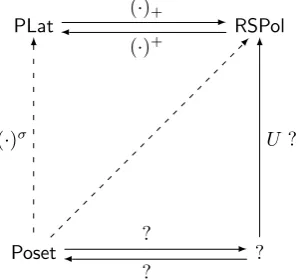
lattices and two-sorted structures called RS polarities. However, an analogue of the topological
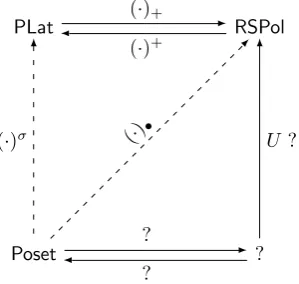
duality for Boolean algebras, or even of the ‘ultrafilter frame’ functor, is missing. Thus, the current
situation can be expressed by the following diagram.
PLat
(·)+
(·)+ RSPol
Poset (·)σ
6
?
?
-?
U ?
[image:13.595.228.379.448.588.2]6
Figure 1.1: Partial duality square for posets
In this chapter, we start by reviewing the algebraic construction of the canonical extension
(Sec-tion 1) and the discrete duality (Sec(Sec-tion 2). After that, we move on to ‘expand’ this diagram in
the following two ways:
First, in Section 3, we will develop an analogue of the ultrafilter frame functor (the diagonal arrow
in the diagram), generalizing work done by Urquhart [43] and Hartonas and Dunn [26] for lattices,
also drawing inspiration from the MSc Logic thesis by Haim [25].
Secondly, in section 4, we will re-examine the categories and the duality in the upper half of the
categories PLat and RSPol? In order to give a well-balanced answer to this question, we start
developing acorrespondence theoryfor perfect lattices and RS polarities, which can be seen as a
relatively new attempt to uniformly generalize correspondence theory for modal logic to a much
wider setting.
1
Algebraic construction
In this section, we briefly review the algebraic construction of the canonical extension of a poset as
given in [9]. While doing so, we will also encounter the definition of the canonical extension, which
we parametrize by a choice of filters and ideals, since different definitions of ‘filter’ are possible in
a poset.
1.1
Filter definitions
Because there are many reasonable choices for the definition of ‘filter’ in a poset, each having
different advantages and disadvantages, we here list the properties such a definition must have in
order for us to be able to define a canonical extension, and show that two standard definitions of
‘filter’ in a poset satisfy these properties.
Definition 1.1.1. Given a posetP= (P,≤P), we say a collectionF(P)⊆ P(P) is afilter system
inP if it has the following four properties:
(i) ∅ 6∈ F(P),
(ii) everyF ∈ F(P) is upward closed, (iii) for everyp∈P,p↑ ∈ F(P),
(iv) F(P) is closed under unions of chains, i.e.
If{Fα}α∈A is a⊆-chain of elements inF(P) then
[
α∈A
Fα∈ F(P).
An assignmentF which sends every posetPto a filter systemF(P) is called afilter definition. Given a filter definitionF, we let the ideal definition I associated with F for every posetP beI(P) :={F ∈ P(P) :F ∈ F(P∂)}.
After fixing a filter definition F, elements of F(P) are called filters of P and elements of the associated ideal definitionI(P) are called ideals ofP.
Let us look at two filter definitions in particular.
Examples 1.1.2. (i) For a poset P, let F(P) be the collection of non-empty down-directed up-sets ofP. We show thatF is a filter definition, that is, everyF(P) is a filter system. Requirements (1) and (2) are met by definition of F(P).
To see that F(P) is closed under unions of chains, suppose{Fα}α∈A is a⊆-chain of down-directed up-sets, and letF :=S
α∈AFα.
Suppose p∈F and p≤q, then p ∈Fα for some α∈ A, soq ∈ Fα ⊆ F. Hence, F is an up-set.
Ifp1, p2∈F, then, because theFαform a chain, there is some α∈Asuch thatpi∈Fα for both i= 1,2. SinceFα is down-directed, there isp∈Fα⊆F such that p≤p1 andp≤p2. Hence,F is down-directed. We conclude thatF ∈ F(P), as required.
(ii) For P a poset, let F(P) be the collection of non-empty up-sets F which are closed under existing binary meets, i.e., if a, b ∈ F and {a, b} has a greatest lower boundc in P, then
c∈F. We show again thatF is a filter definition. Again, (1) and (2) are met by definition.
Letp∈P. Then p↑ is clearly a non-empty up-set. Suppose thatq1, q2∈p↑ and their meet
exists. Then q1∧q2≥psince both qi ≥p, soq1∧q2 ∈p↑. Therefore,p↑ ∈ F(P), which is requirement (3).
To see for requirement (4) that F(P) is closed under unions of chains, suppose{Fα}α∈A is a ⊆-chain of down-directed up-sets, and letF :=S
α∈AFα. By the same argument as in part (1),F is an up-set.
Let p1, p2 ∈F such that their meet exists inP. Then, because the Fα form a chain, there is someα∈Asuch thatpi∈Fα for bothi= 1,2. SinceFα is closed under existing binary meets, we have p1∧p2∈Fα ⊆F. Hence,F is closed under existing meets, so we see that
F ∈ F(P), as required.
From now on, we will always use the letter F to refer to an arbitrary, fixed, filter definition and the letterI to refer to its associated ideal definition.
1.2
Definition of the canonical extension
We will now follow the same route as in [34] and [13], and define the notion of an extension in
the poset setting, parametrized by a filter definition F. This generalizes the notion of canonical extension of a poset from [9], where the particular filter definition from Example 1.1.2(i) is used.
LetP= (P,≤P) be a partially ordered set. Recall that a posetQ= (Q,≤Q) is called anextension
ofPviaη if there is an order embeddingη:P→Q. Furthermore, ifQis a complete lattice, then an extensionQofP is also called acompletion ofP.
With the following definition, we put two (in general different) topologies on such an extensionQ.
Definition 1.2.1. LetQbe an extension of a posetPviaη.
An elementkin the extensionQisF(P)-closedif there is a filterF∈ F(P) such thatk=Vη[F].
The set of closed elements of Qis denoted by KF(P)(Q), or simply K(Q), or even K, when the
other parameters are clear from the context.
Dually, an elementj in Qis calledI(P)-openif there is an idealI∈ I(P) such that j=Wη[I],
We are now ready to state the two properties which will distinguish the canonical extension among
other poset completions.
Definition 1.2.2. LetPbe a poset and letQbe an extension ofP viaη.
(i) The extensionQofPisdenseif, for everyu∈Q:
_
{k∈ K(Q) :k≤u}=u=^{j∈ O(Q) :j≥u}.
(ii) The extension Qof P is compactif, for any F ∈ F(P) and I ∈ I(P), ifVη[F]≤Wη[I],
thenF∩I6=∅.
(iii) Acanonical extensionofPis a compact and dense completion of P.
Note that these definitions very much depend on the chosen filter definition F: different filter definitions give rise to different canonical extensions. For sake of readability, we suppress explicit
reference to the filter definition, but we would like to note here that the concepts defined in
Definition 1.2.2 should be properly named ‘(F,I)-dense’, ‘(F,I)-compact’ and ‘(F,I)-canonical extension’.
In the next subsection, we will review the algebraic proof that, for any filter definition F, the canonical extension exists uniquely.
1.3
Existence and uniqueness
We will merely sketch the algebraic existence and uniqueness proofs from [9] and [34], because
one of the points of this chapter is that an alternative proof can be given by combining discrete
duality and the optimal filter-construction. We start by sketching the existence proof.
First note that, by clause (iii) of the definition of a filter system (Definition 1.1.1), the assignment
p7→p↑defines an order embedding ofPinto the posetF(P) = (F(P),⊇). SoFis an extension of P. Dually,I(P) = (I(P),⊆) is an extension ofP via the embeddingp7→p↓.
The algebraic recipe for obtaining the canonical extension now runs as follows: first amalgamate
the posetsFandIinto a compact and dense extension ofP, and then take the Dedekind-MacNeille
(DM) completion of this amalgamation in order to obtain a compact and dense completion. It
then remains to show that taking the DM-completion preserves the properties of compactness and
denseness, which the amalgamation held.
As we will show in Section 1.4, the amalgamation could be simply defined as a pushout in the
categoryPoset, of posets with monotone maps, and the DM completion as a left adjoint to a
par-ticular forgetful functor. Still, we think it is useful to outline the concrete, algebraic construction
here.
LetF(P) +I(P) be the disjoint union of the setsF(P) andI(P). We define a preliminary relation
RonF(P) +I(P) as the union
R:=≤F(P)∪ ≤I(P)∪ {(F, I) :F∩I6=∅} ∪ {(I, F) :∀p∈I,∀p0∈F:p≤Pp
Proof. Ris clearly reflexive. The proof thatRis transitive is elementary, and uses that every filter is upward closed, and every ideal is downward closed, which holds by clause (ii) of Definition 1.1.1.
Let ∼ be the equivalence relation on F(P) +I(P) defined by x ∼ y iff xRy and yRx, and let
F(P)⊕ I(P) := (F(P) +I(P))/∼be the set of equivalence classes. We order this set by [x]≤⊕[y]
iff there arex0∈[x] andy0 ∈[y] such thatx0Ry0. This is an instance of the general construction to turn a preorder into a partial order. In the current case, we actually have a nice characterization
of this equivalence relation.
Lemma 1.3.2. x∼y if and only if x=y or {x, y}={p↑, p↓}for somep∈P.
Define the projected embeddings jF : F(P) → F(P)⊕ I(P) and jI : I(P) → F(P)⊕ I(P) by
f 7→[f] andi 7→[i]. The following lemma actually contains nothing more than the general fact that this quotient of a preorder is a partial order.
Lemma 1.3.3. The relation ≤⊕ defines a partial order onF(P)⊕ I(P)such that jF andjI are
order preserving maps.
The amalgamated posetF(P)⊕I(P) :=hF(P)⊕I(P),≤⊕iis close to being the canonical extension,
except that it fails to be complete in general.
Proposition 1.3.4. F(P)⊕I(P) is a compact and dense extension ofP.
Proof. The proof rests on the fact that the closed elements of the extensionF(P)⊕I(P) ofP are precisely the classes of the form [F], forF ∈ F(P), and the open elements are precisely the classes of the form [I], forI∈ I(P).
For denseness, it is then a matter of calculation, using only that filters are upward closed and
that principal upsets are filters, to show that, any element ofF(P)⊕I(P) is the join of the closed elements below it, and, dually, the meet of open elements above it. Compactness then follows
almost directly from the definition of the order≤⊕.
A detailed proof is given in Theorem 2.22 of [34].
So, in order to obtain a canonical extension ofP, we need to make F(P)⊕ I(P) into a complete lattice. The easiest (and most economic) way to do this is by taking the Dedekind-MacNeille
completionF(P)⊕I(P) ofF(P)⊕I(P). We then make use of the following fact.
Lemma 1.3.5. IfQis a compact and dense extension of P, then so isQ.
The proof of this fact rests on the fact that the Dedekind-MacNeille completion preserves all joins
and meets which already exist inQ.
Finally, combining Proposition 1.3.4 and Lemma 1.3.5, we get to the end of our algebraic
con-struction.
Theorem 1.3.6. For any posetP,F(P)⊕I(P)is a canonical extension ofP.
After successfully performing the algebraic construction to prove existence, the uniqueness proof
consists of showing that any canonical extension of Pwill be isomorphic to the complete lattice
Theorem 1.3.7. The canonical extension ofP is unique up to an isomorphism fixingP.
We now also define the extension ofmonotone mapsbetween posets, which we will be relevant for
Chapter 2. This is precisely Definition 3.2 from [9].
Definition 1.3.8. LetPandQbe posets, andf :P→Qany function. Definefσ andfπ: Pσ → Qσ, called thesigma and pi extension of f, by
fσ(u) :=_{^{f(p) :x≤p, p∈P}:x≤u, x∈ K(Pσ)},
fπ(u) :=^{_{f(p) :y≥p, p∈P}:y≥u, y∈ O(Pσ)}.
1.4
A categorical perspective
1 As mentioned above, both steps in the construction of Section 1.3, i.e., the amalgamation and
the DM-completion, can be viewed from the perspective of category theory.
Regarding the amalgamation, although one might hope that it is a pushout in the category of
posets with monotone maps, the following example shows that this is not the case in general.
Example 1.4.1. Consider the posetPwhose underlying set is N× {0,1}, with the order defined by (n,0)≤(m,0) iff n≤m, (n,1)≤(m,1) iff m≤n, and (n,0)≤(m,1) for all n, m. We think ofPas the partial order Nwith a mirrored copy above it.
Then the non-principal ideals of P are ∅ and {(n,0) : n ∈N}, which we denote by∞, and the non-principal filters ofPare∅ and{(n,1) :n∈N}, which we denote by∞∗.
One can calculate that the amalgamation F(P)⊕ I(P) has as underlying set that of P, with two additional points ∞ and ∞∗, and the order is that from
P, with the additional relations (n,0)≤ ∞ ≤ ∞∗≤(n,1) for alln.
However, we can consider the poset Qwhich has the same underlying set and order, except that
∞and∞∗are not comparable in
Q, the ‘legs’F(P)→QandI(P)→Qare the obvious inclusion functions, which preserve the orders ofF(P) andI(P).
Now there is clearly no order-preserving map fromF(P)⊕ I(P)→Qcommuting with the legs of Q, soF(P)⊕ I(Q) is not the pushout.
It is not hard to see that the posetQwe defined aboveisthe pushout inPoset. This is an instance
of a general way to construct the pushout inPoset, that we do not discuss any further here.
However, the amalgamation does have another, rather delicate, universal property.
Proposition 1.4.2. Let Pbe a poset,F(P) =hF(P),⊇i andI(P) =hI(P),⊆i the filter and ideal
posets of P, and F(P)⊕I(P)the amalgamated poset constructed in Section 1.3. Suppose we have a diagram
P
ιF
- F(P)
I(P)
ιI
? g
- Q f
?
1This section was heavily revised after the defense of this thesis, and benefited greatly from several discussions
where Q is a poset such that f preserves directed meets and g preserves directed joins (more
precisely, for a down-directed set D in F(P), the directed meet of f[D] exists and is equal to
f(dD), and similarly for g).
Then there exists a unique order-preserving function h:F(P)⊕ I(P)→Q such thath◦jF =f
andh◦jI =g.
In the category Poset, the Dedekind-MacNeille completion of a poset P can be characterized
categorically as theinjective hullof the objectP(Cf. [2] and 9.17 of [1] for details). More related
to our work in Section 4 of this chapter, there is also a universal mapping characterization of the
DM completion, provided by Bishop [4], which we will briefly review here2.
Fix a poset P. For u ⊆ P, let uP and lP, defined by uP(u) := {p0 ∈ P : ∀p ∈ u(p≤ p0)} and
lP(u) :={p∈P :∀p0∈u(p≤p0)}, be theupper and lower maps onP(P). These maps form a residuated pair, and their composition cP :=lPuP is a closure operator onP. We can use this closure operator to realize the DM completion ofP.
Theorem 1.4.3. The complete lattice P, consisting of the subsets of P which are closed under
cP, is the Dedekind-MacNeille completion of P (up to an isomorphism fixing P) with the order
embedding ηP:P→Pwhich sendsptop↓. Moreover, ηP preserves any joins or meets which exist
inP.
One may expect at first sight that ηP is a universal arrow in the category Poset, but this is not the case; we only have the following result.
Proposition 1.4.4. For any monotone mapf :P→Q, where P is a poset and Qis a complete
lattice, there exists a monotone mapf¯:P→Qsuch thatf¯◦ηP=f. In general,f¯is not unique.
If we want to get an actual universal arrow, we need to consider a subcategory of Poset by
restricting the functions which we admit as morphisms in our category. The following definition
is the key point in Bishop [4].
Definition 1.4.5. We say a mapf :P→Qisclosediff−1:P(Q)→ P(P) sendscQ-closed sets
tocP-closed sets.
More explicitly, f is closed if, for every subset u ⊆ Q such that cQ(u) = u, we have that
cP(f−1(u)) =f−1(u).
It is not hard to see that residuated maps are closed, and that closed maps preserves arbitrary
joins which exist in the domain. Then, Bishop has the following result.
Theorem 1.4.6 (Theorem 3, [4]). For any closed mapf :P→Qbetween posets, there exists a unique closed mapf¯:P→Qsuch that the diagram
P
f - Q
P
ηP ? f¯
- Q ηQ ?
2Although Bishop only considers completions of lattices, it is straightforward to see that the same results hold
commutes.
We observe the following immediate consequence of this theorem.
Corollary 1.4.7. Let PosetC be the category of posets with closed maps, andCLat∨ the category
of complete lattices with completely join-preserving functions. We have functors
L:PosetC→CLat∨ U :CLat∨→PosetC
P7→P C7→C (f :P→Q)7→( ¯f :P→Q) f 7→f.
These functorsL:PosetC CLat∨:U form a reflection, i.e., an adjunction whose counit is an
isomorphism.
Proof. The unit of the adjunction ηP is the embedding of P into P, which is a closed map. The co-unit is the isomorphism between the complete latticesUCandC, which is given by sending a
cUC-closed setuto
W
Cu.
With this Corollary, we have represented the Dedekind-MacNeille completion categorically as the
reflector of the the subcategory CLat∨ of PosetC. Ern´e [11] later showed that the categoryCLat
of complete lattices with complete lattice homomorphisms is also reflective in a category whose
objects are pre-ordered sets, and whose morphisms are so-called cut-stablemaps. It is clear that
the results from Gehrke [16] and our own results in Section 4 of this chapter are closely related
to Ern´e’s and Bishop’s work, and we think that making these connections explicit would make an
interesting and necessary further research project.
Furthermore, we would like to reconsider Proposition 1.4.2 in this context. It is not clear at this
point in what categoryF(P)⊕ I(P) could be a pushout, if in any category at all.
We conclude that, in order to simultaneously capture the two parts of the canonical extension
construction (amalgamation and completion) in a categorical framework, and hence give a
co-herent category-theoretic perspective on the canonical extension, we would need a subcategory
ofPoset for which both the Dedekind-MacNeille completion is a reflector, and the diagram from
Proposition 1.4.2 is a pushout. As far as we know, such a subcategory is not presently known.
2
Discrete duality: Objects
Whereas the construction outlined in the previous section took place on the algebraic (left) side
of the square diagram 1.1, our first aim in this chapter is to ‘reconstruct’ the anti-clockwise route
through the diagram, which was how the canonical extension was first defined in the context of
Boolean algebras and BAO’s (cf. Introduction).
As mentioned at the beginning of this chapter, thediscrete dualityin the upper half of the diagram
was proposed in this context in [16], based on earlier work by Hartung [27] and Ern´e [11]. We
review the object part of this duality in this section, and then show how to obtain the canonical
2.1
Perfect Lattices and Polarities
In order to reconstruct the dual object of the canonical extensionPσ of a posetP, it is a necessary
first step to investigate the algebraic properties of the complete lattice Pσ in some more detail.
Let us first try to motivate this investigation and the ensuing choice of a dual object for Pσ by
considering the more specialized cases wherePis a Boolean algebra, and wherePis a distributive
lattice.
Recall that the canonical extensionAσof a Boolean algebraAis alwayscompleteandatomic. This
observation then leads one to take theatom setof Aσ as the dual object of the algebra, because
the entire structure of any complete and atomic Boolean algebra is already determined by its set
of atoms.
A similar process can be seen at work for the canonical extension Dσ of a distributive lattice
D: here, one first observes thatDσ is alwayscomplete, and also join-generated by its completely join-prime elements and meet-generated by its completely meet-prime elements. Then the sets
of completely join-prime and completely meet-prime elements turn out to be isomorphic because
of the distributivity ofD, and it suffices to take theposet3 of completely join-primesas the dual
object of Dσ. Note that, in Boolean algebras, the completely join-prime elements are precisely
the same as the atoms, and the order of the Boolean algebra restricted to the atoms is always
discrete. So, we can regard the canonical extension of a Boolean algebra as a special case of the
construction for distributive lattices.
Moving back to the general context of the canonical extensionPσ of a partially ordered set P, we find that the symmetry between the sets of completely join- and meet-irreducibles that was present
in distributive lattices is lost, so that we will have to keep track of both sets on the dual side. The
dual object of Pσ will thus become a two-sorted object. To encode the order ofPσ on the dual
side, it suffices to remember only the order between the completely join- and meet-irreducibles,
from which the rest of the order inPσcan be reconstructed. Now, a remark analogous to the one
at the end of the previous paragraph can be made: in a distributive lattice, the completely
join-/meet-irreducible elements are precisely the same as the completely join-/meet-prime elements,
so that the canonical extension of a distributive lattice can be regarded as a special case of the
canonical extension of a poset.
We now formalise the ideas sketched here, closely following [16].
Definition 2.1.1. An elementxin a complete lattice Lis calledcompletely join-irreducible if, for any A ⊆ L, x = WA implies x
∈ A. The dual property is called completely meet-irreducible. The sets of completely join- and meet-irreducible elements of L are denoted by
J∞(L) andM∞(L), respectively.
A complete lattice L is called perfect if it is join-generated by its completely join-irreducibles, and meet-generated by its completely meet-irreducibles. That is,Lis perfect if for anyu∈L, we have
_
{x∈J∞(L) :x≤u}=u=
^
{a∈M∞(L) :a≥u}.
Lemma 2.1.2. IfP is a poset, thenPσ is a perfect lattice.
3It is interesting and relevant to duality theory that we get anorderedset as the dual of a distributive lattice,
Proof. By denseness of the closed elements inPσ, it suffices to show that any closed element of
Pσ is equal to the join of the completely join-irreducible elements below it (and that the dual statement holds for the open elements). The proof of this fact uses the denseness of the open
elements inPσ and Zorn’s Lemma. See the proof of Theorem 2.8(3) in [9] for the details.
We are now ready to set up our objects on the dual side. By our reasoning above, these objects
should consist of two sets with a relation between them.
Definition 2.1.3. Apolarityis a tripleF=hX, A, Ri, whereX andAare sets, andR⊆X×A
is a relation fromX toA.4
Remark 2.1.4. The polarity object has been studied in full generality from several different perspectives, of which we want to mention a few here.
Firstly, polarities form the central object of study in Formal Concept Analysis, where a polarity
is called a ‘context’. The field of Formal Concept Analysis focuses on applications, of which there
are many, ranging from linguistics to economics [15].
A polarity can also be regarded as a special case of a Chu space [37]: in that field, a polarity is
called a {0,1}-Chu space. We will refer to the latter observation when discussing morphisms in Section 4 of this chapter.
Since the structure of a perfect lattice is determined by its completely join- and meet-irreducibles,
there is a natural way to encode a perfect lattice as a polarity:
Definition 2.1.5. LetLbe a perfect lattice. Thepolarity associated with L, denotedL+, is
defined to be the triplehJ∞(L), M∞(L),≤L∩J∞(L)×M∞(L)i.
A natural question to ask, now that we have defined a ‘dual object’ for a perfect lattice, is the
following: how can we retrieve a perfect latticeLfrom its associated polarityL+? To answer this
question, we need to recall how a polarity gives rise to a closure operator in a natural way.
Definition 2.1.6. If F = hX, A, Ri is a polarity, define functions uR (upper) and lR (lower) between the posetshP(X),⊇i andhP(Y),⊆i, as follows:
foru∈ P(X), letuR(u) :={a:∀x∈u:xRa}
forv∈ P(A), letlR(v) :={x:∀a∈v:xRa}.5
Then (uR,lR) is a residuated pair, socR:=lRuR is a closure operator on the setX, and we call
a subset u⊆X cR-closed6 ifcR(u) =u. We write F+ for the complete lattice of subsets of X which are closed under the closure operatorcR. Recall that the lattice operations onF+are given
byV
U =T
U andW
U =cR(S
U), for any setU ofcR-closed subsets.
4For notational convenience, especially in Section 4, we will denote variables which vary over the setX byx, x0,
and variables varying over the setAbya, a0, and then sometimes abbreviate expressions such as “∀x∈X∃a∈A” as simply “∀x∃a”.
5For sake of readability, ifx∈X anda∈A, we will often writeu
R(x) instead ofuR({x}) andlR(a) instead of
lR({a}).
6Note that, unfortunately, we need two completely different uses of the word ‘closed’: on the one hand ‘closed’
is the property of an element of the canonical extension that can be written as the meet of a filter, and on the other hand it is the word for a subset that is invariant under the closure operatorcR. To avoid confusion, we will always
Remark 2.1.7. Of course, the definitions of the upper and lower maps and the associated closure operator cP that we considered in Section 1.4 are the particular case of this definition where
X =P =AandR=≤P.
Lemma 2.1.8. IfL is a perfect lattice, thenL∼= (L+)+.
Proof. SinceLis perfect,Lis the DM completion of the posetJ∞(
L)∪M∞(L). It is not hard to see that (L+)+ isalsothe DM completion of the posetJ∞(L)∪M∞(L). The result then follows from the uniqueness part of Theorem 1.4.3 above. Cf. Proposition 4.7(1) in [9].
2.2
RS Polarities
Lemma 2.1.8 gives us half of the object correspondence between perfect lattices and polarities. We
are now left with the question: which polarities arise as the dual objects of perfect lattices? Such
polarities must have certain special properties, expressing the fact that (·)+turns these polarities
into perfect lattices. In this subsection, we will express these properties without any reference to
the perfect lattices.
For any polarityF=hX, A, Ri, we letiX :X →F+ be the mapx7→cR(x) andiA:A→F+ the map a7→ lR(a). ForF to be of the formL+ for some perfect lattice L, one first requirement is that both mapsiX andiA are injective, so that we can regard both X andAas subsets ofF+.
Lemma 2.2.1. LetF=hX, A, Ribe a polarity.
(i) The following are equivalent:
(a) iX is injective,
(b) ∀x1, x2∈X (x16=x2→uR(x1)6=uR(x2)). (SX)
(ii) The following are equivalent:
(a) iA is injective,
(b) ∀a1, a2∈A(a16=a2→lR(a1)6=lR(a2)). (SA)
Proof. (i) SupposeiXis injective. Letx1, x2∈X,x1=6 x2. If we would haveuR(x1) =uR(x2),
then clearly iX(x1) = cR(x1) =lRuR(x1) = lRuR(x2) =cR(x2) =iX(x2), contrary to the assumption. SouR(x1)6=uR(x2).
Conversely, suppose (SX) holds. Letx1, x2∈X, x1 6=x2. By (SX) we get thatuR(x1)6= uR(x2). Now cR(x1) = cR(x2) would imply uR(x1) = uRcR(x1) = uRcR(x2) = uR(x2), which is a contradiction. SocR(x1)6=cR(x2).
(ii) is the definition of injectivity.
Definition 2.2.2. We say a polarity is separating, or an S polarity, if it satisfies conditions (SX) and (SA) of Lemma 2.2.1. In this case, we may thus regardX andAas subsets ofF+, and we then write≤for the partial order on the setX∪Ainherited fromF+.
An important, well-known fact about polarities is thatF+ is determined by the way in whichX
Proposition 2.2.3. Let F=hX, A, Ribe an S polarity. ThenX join-generatesF+ andA
meet-generatesF+.
Proof. In fact, forany subsetuofX, we have the equality
cR(u) =cR[{cR(x) :x∈u}, (1.1)
which we will prove first.
Sinceu⊆ {cR(x) :x∈u} andcRis monotone, the direction⊆is clear.
For the direction⊇, it suffices to show uR(u)⊆uR(S{cR(x) :x∈u}), sincelRis antitone. Leta∈ uR(u) be arbitrary. Take any x0 ∈S
{cR(x) :x∈u}. Pick x∈usuch that x0 ∈cR(x). Then xRa since a ∈ uR(u). In particular, we then have a ∈ uR(x), so x0Ra, since x0 ∈ cR(x). Sincex0 was arbitrary, this shows thata∈uR(S
{cR(x) :x∈u}), as required. Now, by definition of the operations inF+ and the embedding i
X ofX in F+, for any cR-closed subsetuofX, (1.1) specializes tou=cR(u) =W
{iX(x) :x≤u}. The proof thatAmeet-generates F+ is similar.
We now formulate a second property of polarities, which isolates those polarities among the S
polarities in whichX really fulfills the role of ‘set of completely join-irreducibles’, andA the role of ‘set of completely meet-irreducibles’.
Lemma 2.2.4. LetF=hX, A, Ribe an S polarity. (i) The following are equivalent.
(a) The elements ofX are completely join-irreducible inF+,
(b) ∀x∈X∃a∈A(xa∧ ∀x0∈X(x0< x→x0≤a)). (RX)
(ii) The following are equivalent.
(a) The elements ofAare completely meet-irreducible in F+,
(b) ∀a∈A∃x∈X(ax∧ ∀a0∈A(a0> a→a0≥x)). (RA)
Proof. We only prove the equivalence in (i), the proof of (ii) being analogous.
Suppose that the elements of X are completely join-irreducible in F+. Let x∈X be arbitrary.
Consider the elementu:=W
{x0:x0< x}ofF+, which is clearly less than or equal tox. If we had that u=x, then the join-irreducibility of xwould imply thatx∈ {x0 :x0 < x}, which is clearly absurd. So we must haveu < x. SinceAmeet-generates F+ (Proposition 2.2.3), pick an element
a∈A such that x6≤aand u≤a. Ifx0 < x, thenx0 ≤u≤a. Soa is the element required to exist by (RX).
Conversely, suppose that (RX) holds. Let x∈ X be arbitrary. Suppose thatx=WU for some collection U of elements ofF+. Assume, to obtain a contradiction, that x6∈U, so thatu < xfor
allu∈U. By (RX), picka∈Asuch thatxaand, for allx0< x, x0 ≤a. Letu∈U be arbitrary. Thenu=W{x0∈X :x0 ≤u}, since X join-generates
F+. Now, for any
x0 withx0 ≤u, we havex0< x, sox0≤aby the choice ofa. Since this holds for arbitrary x0, we
getu≤a. However, this holds for arbitraryu∈U, so we conclude x=W
Definition 2.2.5. An S polarity is called reduced, or an RS polarity, if it satisfies both conditions (RX) and (RA) of the Lemma.
The work we have done in this section is meant to motivate the following result.
Fact 2.2.6. The assignments L 7→ L+ and F 7→ F+ define a bijective correspondence between
perfect lattices and RS polarities.
Strictly speaking, because we do not yet have a proper notion of ‘isomorphism’ between RS
polarities, we can not prove a statement of the form ‘IfFis an RS polarity, thenF∼= (F+)+.’ We
do hope to have convinced the reader, however, that such a statement, when made precise, is now
within reach.
We have thus defined the objects of a category that will be dual to PLat and take up the place
in the upper right corner of Diagram 1.1. In the next section, we will show how the obtain the
canonical extension object via RS polarities. We will then return to the question of what are the
morphisms in the categoryRSPolin Section 4.
3
Canonical extension via discrete duality
As indicated in the Introduction, Stone [41], Priestley [38], Urquhart [43] and Hartung [27] are
con-cerned with developing topological dualities for increasingly general algebraic structures. Stone’s
duality establishes a correspondence between the categories of Boolean algebras and of Stone
spaces. Priestley duality extends the correspondence to the categories of distributive lattices and
of Priestley spaces, and Urquhart and Hartung again generalize this to the categories of bounded
lattices and ofL-spaces (Urquhart), or topological contexts (Hartung). In the last step of
gener-alization, however, both Urquhart and Hartung needed to consider the subcategory of bounded
lattices with surjective homomorphisms. More recent attempts by Hartonas and Dunn [26] and
Jipsen and Moshier [28], [29] follow a different route to obtain a duality between bounded lattices
with all homomorphisms and an appropriate subcategory of the category of topological spaces.
However, this duality is not a generalisation of Stone duality. Our motivation here stems from
logic rather than algebra, so that we want to remain consistent with Stone duality.
The algebraic objects needed for the mentioned dualities are of increasing complexity: Stone
duality uses ultrafilters, Priestley duality needs prime filters, and Urquhart’s bounded lattice
duality rests onmaximal filter-ideal pairs. A natural next step would be to extend this duality to
the category of partially ordered sets. In this section, as a first part of this larger project, we show
how to construct the functor (·)•, which will be a straightforward generalization of the optimal
filter-ideal functor for bounded lattices, in such a way that composing it with the discrete duality
functor (·)+ introduced in the previous section yields the canonical extension.
More concretely, we will show that Urquhart and Hartung’s optimal filter-ideal construction still
works for partially ordered sets, no matter what filter definition we choose, and that it yields the
canonical extension. We thus obtain a second construction of the canonical extension, uniformly
3.1
Definition and fundamental theorem of maximal pairs
Definition 3.1.1. LetF be a filter andI an ideal in a posetP. We sayF isI-maximalif it is a ⊆-maximal element of the set{F0 ∈ F(P) :F0∩I=∅}. Dually, we say I is F-maximalif it is a⊆-maximal element of the set{I0 ∈ I(P) :F ∩I0=∅}. The pairhF, Iiis called a maximal
pairifF isI-maximal andI isF-maximal.
Anoptimal filter7 is a filter F for which there exists an ideal I such that hF, Iiis a maximal pair. The set of optimal filters is denoted byF∗(P). Dually, we define anoptimal idealto be an idealI for which there exists a filter F such thathF, Iiis a maximal pair, and denote the set of optimal ideals byI∗(P).
We now generalize some of the theory from bounded lattices to the context of posets.
Theorem 3.1.2. For any filter F and ideal I in a poset P such thatF∩I=∅, there is a filter
F∗⊇F such thatF∗isI-maximal, and, dually, there is an idealI∗⊇Isuch thatI∗ isF-maximal. Moreover,hF∗, I∗iis a maximal pair.
Proof. LetF be a filter andI an ideal such thatF∩I=∅. Consider the collection
X :={F0∈ F(P) :F ⊆F0 andF0∩I=∅}.
Since the union of a chain of filters is still a filter, by property (iv) of filter systems, we have that
every chain of elements ofX has an upper bound, namely, the union of the chain. Therefore, by Zorn’s Lemma, there is a⊆-maximal elementF∗ in X.
Now, if we would haveF∗(F0 for someF0 ∈ F(P) such thatF0∩I=∅, then alsoF ⊆F∗⊆F0, soF0∈ X, contradicting that F∗ is⊆-maximal inX. Hence, F∗ isI-maximal.
By a dual argument, we obtain an idealI∗⊇I which isF∗-maximal.
It remains to show thathF∗, I∗iis a maximal pair. We will only show thatF∗ isI∗-maximal, the
other property being dual.
SupposeF∗(F0for someF0∈ F(P) andF0∩I∗=∅. Then we also haveF0∩I⊆F0∩I∗=∅, and F ⊆F∗(F0, soF0∈ X, contradicting thatF∗is⊆-maximal inX. Hence,F∗isI∗-maximal.
In particular, this theorem shows thatevery disjoint filter-ideal pair can be extended to a maximal
pair, which can be viewed as a generalization of the well-known fact in Boolean algebras thatevery
filter can be extended to an ultrafilter.
An important corollary, that we use more often than the theorem itself, is the following:
Corollary 3.1.3. Let F be a filter and p6∈F. There is a maximal pair hF∗, I∗isuch thatF ⊆F∗
andp∈I∗.
Dually, for an idealI andq6∈I, there is a maximal pair hF∗, I∗isuch that I⊆I∗ andq∈F∗.
Proof. LetF be a filter and p6∈F. Thenp↓ is an ideal. Also, F∩p↓=∅: if there was p0 ∈P
such thatp0∈F andp0≤p, then we would havep∈F, becauseF is an up-set, contradicting the assumption thatp6∈F.
By the Theorem, there is a maximal pairhF∗, I∗isuch thatF ⊆F∗ andp↓ ⊆I∗. In particular, p∈I∗.
The proof of the second part is dual.
3.2
The canonical extension via maximal pairs
There is an obvious way to put optimal filters and ideals together in a polarity.
Definition 3.2.1. LetPbe a poset. Recall thatF∗(P) andI∗(P) denote the sets of optimal filters and ideals ofP. We define theincidence relation⊥ ⊆ F∗(P)× I∗(P) by
F ⊥I ⇐⇒ F∩I6=∅,
and we callP•:=hF∗(P),I∗(P),⊥itheoptimal polarityofP.
We now aim to show that applying the discrete duality functor (·)+ to the optimal polarity of
P yields the canonical extension. In brief: we want to show thatPσ∼= (P•)+.
We first show that (P•)+ is always a completion of P in a natural way. Recall that (P•)+, by
definition, consists of sets of optimal filters which are closed under the closure operatorc⊥ (this
is Definition 2.1.6, applied toR:=⊥).
Proposition 3.2.2. The assignmentp7→η(p) :={F ∈ F∗(P) :p∈F}defines an order embedding
η:P→(P•)+.
Proof. To see that η is well-defined, we need to show that η(p) is a c⊥-closed set, i.e., that
η(p) =c⊥(η(p)).
First note thatη(p)⊆c⊥(η(p)) always holds, sincec⊥ is a closure operator.
For the other inclusion, suppose that F ∈ F∗(P) is such that F 6∈ η(p), i.e., p6∈ F. By Corol-lary 3.1.3, there is a maximal pairhF∗, I∗isuch thatF ⊆F∗ andp∈I∗. Note thatI∗∈u⊥(η(p)):
for anyF0 ∈η(p), we havep∈F0, so, sincep∈I
∗, we getF0⊥I∗. However,F∩I∗⊆F∗∩I∗=∅,
soF 6⊥I∗, so F 6∈c⊥(η(p)).
Soηis well-defined, and it remains to show that it is an order embedding. Clearly, ifp1≤p2, then η(p1)⊆η(p2), because any filter containingp1 will then also containp2, since filters are upward closed.
For the other direction, supposep16≤p2. ThenF :=p1↑is a filter and p26∈F by assumption, so by Corollary 3.1.3, there is a maximal pairhF∗, I∗isuch thatp1↑ ⊆F∗ andp2∈I∗. In particular, p1 ∈F∗ and p2 6∈F∗, so that F∗ is in the setη(p1) but not in η(p2). Therefore,η(p1) 6⊆η(p2),
which is what we wanted to show.
We are now ready to prove the main result of this section.
Theorem 3.2.3. The complete lattice(P•)+ is the canonical extension ofP.
Proof. We need to show thatη:P→(P•)+is a compact and dense extension.
• Compactness.
LetF ∈ F(P) andI∈ I(P) and suppose that F∩I=∅. We show thatVη[F]
6≤Wη[I].
By Theorem 3.1.2, there is a maximal pair hF∗, I∗i such thatF ⊆F∗ andI ⊆I∗. We will
show that F∗ ∈V
η[F] and F∗ 6∈ W
η[I]. This will conclude the proof of the compactness property, sinceF∗is then an element ofF∗(P) witnessing thatVη[F]6≤Wη[I].
Since F ⊆ F∗, we have f ∈ F∗ for all f ∈ F, i.e., F∗ ∈ η(f) for all f ∈ F. Hence, F∗∈Tf∈Fη(f) =
Note that I∗ is an element of the set u⊥(Sη[I]): for any F0 ∈ Sη[I], there is i ∈I such
that F0 ∈η(i), i.e.,i∈F0. But then we also havei∈I∗, sinceI ⊆I∗, soF0∩I∗ 6=∅, i.e, F0⊥I, as claimed.
So, sinceF∗∩I∗=∅, we conclude thatF∗6∈l⊥u⊥(Sη[I]) =Wη[I].
• Denseness.
Letu∈(P•)+be ac⊥-closed set of optimal filters.
– LetKu:={k∈ K((P•)+) :k≤u}. We want to show thatu=WKu.
It is clear that u is an upper bound for Ku, so we need to show that it is a (the) least upper bound. Supposeu0 is an upper bound in (P•)+ forKu. It suffices to show that u⊥(u0)⊆u⊥(u): from this it follows by the residuation property of (u⊥,l⊥) that u⊆l⊥u⊥(u0) =u0, which is what we need to show.
Suppose I 6∈ u⊥(u). Pick F ∈ usuch that F∩I = ∅. Since u is c⊥-closed, the set k:={F0∈ F∗(P) :F ⊆F0} must be a subset ofu. Note also thatk=Vη[F], andF is a filter inP, sokis a closed element in (P•)+ that is belowu, i.e.,k∈Ku. Sinceu0 is an upper bound for Ku, we havek⊆u0. In particular, F ∈u0, so since F∩I=∅, we have I6∈u⊥(u0).
– LetOu:={j∈ O((P•)+) :u≤j}. We want to show thatu=VOu=TOu. It is clear that uis contained inT
Ou. For the converse inclusion, suppose that F 6∈ufor some
F ∈ F∗(P). We need to show that there is an open element aboveusuch thatF 6∈u. Since uisc⊥-closed, we also have F 6∈l⊥u⊥(u). Pick I∈u⊥(u) such that F∩I=∅.
Letj be the open elementWη[I]. The following calculation shows thatj=l
⊥({I}): j=c⊥
[
η[I]
=c⊥({F :∃i∈I:F ∈η(i)})
=c⊥({F :F∩I6=∅})
=c⊥l⊥({I}) =l⊥({I}).
Now, since {I} ⊆ u⊥(u) by assumption, we get u ⊆ l⊥({I}) = j by the residuation
property of (u⊥,l⊥). Furthermore, since F∩I =∅, we haveF 6∈j, so we have found
4
Discrete duality: Morphisms
In this section8, we show how the object correspondence between RS polarities and perfect lattices
from Section 2 can be extended to a duality. As indicated in the beginning of Section 3, finding
appropriate duals for morphisms was already a problem in the category of bounded lattices, as
can be seen in the development of duality by Urquhart [43] and Hartung [27]. There, it was only
possible to findfunctional duals when the category of bounded lattices was restricted to contain
onlysurjectivemorphisms.
In [9] and [16], the idea arose that allowing morphisms between polarities to berelationsinstead of
requiring them to be functions largely widens the scope of possibilities. We pursue this approach
and will consider categories, whose objects are RS polarities, in which the morphisms are relations,
and even pairs of relations, satisfying certain properties.
Our approach can be distinguished from previous work in a few ways. First of all, an aspect which
may be regarded as merely a cosmetic difference, but we believe is still worth mentioning, is that
in [9] and [16], a morphism between RS polaritieshX, A, RiandhY, B, Siwas always ‘cross-wise’: fromX toB, and fromY to A. We have chosen to take our relations ‘horizontally’, i.e., fromX
toY and from B toA.
Furthermore, we will show that our definition of morphisms between RS polarities can be seen
to generalize the definition of Chu transform from the theory of Chu spaces, thus providing an
independent reason why our definitions may be considered natural.
Finally, we try to be as impartial as possible about the question which arethe morphisms in the
category of perfect lattices, but rather treat several reasonable choices in a modular manner. We
thus get a picture of increasingly more restricting choices of morphisms between perfect lattices,
corresponding to increasingly more restricting conditions on the morphisms between RS polarities.
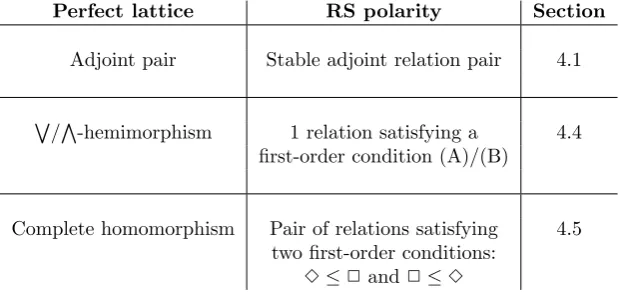
For the reader’s convenience, our results are informally summarized and indexed in the table below.
Perfect lattice RS polarity Section
Adjoint pair Stable adjoint relation pair 4.1
W/V-hemimorphism 1 relation satisfying a 4.4
first-order condition (A)/(B)
Complete homomorphism Pair of relations satisfying 4.5 two first-order conditions:
[image:29.595.147.457.486.633.2]3≤2and2≤3
Figure 1.2: Table of correspondence results
Furthermore, in Sections 4.2 and 4.3, we will define a composition on the morphisms between RS
polarities, and indicate how, with this composition, the functors (·)+and (·)+constitute a duality. 8I would like to acknowledge explicitly the impact on this section of several discussions with Mai Gehrke and