Revealing Scars:
A study through printmaking of visual art as a
language expressing subliminal experience.
UTAS
Submitted in fulfilment of the requirements for the Degree of
Master of Fine Art
from
University of Tasmania (June, 2009)
By
Linden Langdon
Bachelor of Arts (2003)
Certification
I, Linden Jane Langdon, declare that this exegesis, submitted in partial
fulfilment of the requirements for the award of Master of Fine Arts, in the
Faculty of Fine Arts, University of Tasmania, is wholly my own work
unless otherwise referenced or acknowledged. The document has not
been submitted for qualifications at any other academic institution.
Linde ane Langdon
Abstract
Revealing scars:
A study through printmaking of visual art
as a language expressing subliminal experience
This research project investigates the possibilities of visual art as an effective means of expressing the lived experience of trauma and subliminal memory without direct reference to any specific event. The projects theoretical and practical research explores the delineation between the intentional expression of repressed emotions and the
unintentional presence of suggestive elements within visual works of art. The practical work considers that we construct our understanding of the world through memories and visual (or visualised) cues attached to language.
The motivation for this project stems from the diaries my father wrote during his incarceration as a POW in WWII. Although they form a tangible link to the experiences of being a soldier and prisoner during WWII, it is the emotional aftermath which creates the catalyst for this research. His work as a potter and sculptor inspires the questions that form the boundaries of the research.
Artists who have been inspirational for the studio research during this project include contemporary artists Doris Salcedo and William Kentridge as well as historic artist Otto Dix. The aim of the studio research has been to work through the medium of printmaking to examine the visual
expression of the subliminal emotive responses that traumatic events can render in a person's psyche. Mechanisms of plate sequence, site specific arrangement and tonal variation contribute to the development of prints on paper and clay. In the exhibition work, which comprises of over 80 prints of primarily etchings and lithographs, the literal and sense
memories are carried through time and place informing and affecting the interpretation and emotional engagement with each encountered
Acknowledgements
Thanks to the many people who contributed time, opinions and assistance to see the completion of my printmaking excursion.
First and foremost thanks to my long suffering family who have set aside many of their needs to be a support in the home and as critical eyes and ears.
Also to my supervisors, Milan Milojevic who assisted directly to harness my wandering mind toward a conclusion with patience and
understanding, as well as Leigh Hobba who contributed through
commentary and support for the crucial final stages of the research and project development. Thanks also to Michael Schlitz and Karen Lunn who contributed through commentary at various stages of my research.
To my fellow colleagues who have provided endless snippets of
suggestion, and moments of relaxation, when it all seemed too much. Plus a big thanks to Jude Maisch for her seemingly endless patience when teaching me ceramics over the period of my masters' research.
Table of Contents
Preface
5
Chapter 1:
Revealing Scars
9
1.1 The project in context
9
1.2 Research
11
1.3 Art and therapy
20
1.4 Summary
22
Chapter 2:
Trauma and Art: Artists Projects 23
2.1 Doris Salcedo
23
2.2 Dennis Del Favero
26
2.3 William Kentridge
28
2.4 Antony Gormley
31
2.5 Art and War
32
2.6 Summary
34
Chapter 3:
Revealing Scars: Navigating the Subliminal 35
3.1 Physical Expression
35
3.2
Precipice
38
3.3
Beneath the Skin
46
3.4 Summary
49
Chapter 4:
Conclusion
50
Appendix A:
Entries from John Langdon's WWII diaries
52
Appendix B:
Examples of pottery experiments
56
Appendix
C: Further reading relating to physiology
57
Appendix
D:
Further reading
59
Appendix,E:
Images of the working process in stone lithography
61
Appendix F:
Further work
63
Appendix G:
Images of primary work
67
Appendix H:
A glossary of printmaking terms
69
Bibliography
72
Figure 1: Last Touch, drypoint, 25 x
25cm, 2005
Figure 2: Hand size sculptures, John Langdon
Preface
Trauma:-
Psychological-a startling experience which has a lasting effect on
mental life; a shock'.
Early in 2005 I was sitting next to my father's hospital bed trying to come
to terms with what would be the last
conversations I would have with my Dad.
His milky eyes welled with tears and love
and pain as he struggled to say the things
that would carry me through the rest of
my life without him. He reached out and
grasped my hand tightly, awkwardly, and
with a rare moment of revelation told me
he had not had time to work out which of
his carefully guarded sculptures would go
to each of us. He was inconsolably stressed
that he had not been able to do this and no words from me could really
answer the cry.
My father was a POW for a
period of three years in
both Italian and German
camps. This experience
was never discussed in the
family home; however the
residual effects lived on
through his interaction
with his personal world. I
came to believe that there
was an aspect of his life,
closely guarded and
intimate, that was his means of expressing the deeply emotional memories
he denied existence of. My father formed, carved and kneaded a
combination of clay and grog (crushed brick) into sculptures. He then
fired them in his wood fired kiln. The tunnelled, minimised and strangely
elusive forms gathered in the garden, secreted under trees and placed
carefully on rocks or logs. The forms don't talk directly about traumatic memory, but they evoke a litany of questions and their tactile surfaces provoke the possibility of sense memory'. It is only now that I read his
diaries from WWII that I find a possible link between the ceramic forms and the trench (bivvy) he carved in the Libyan Desert to guard him from the onslaught of bullets and protect his few possessions. His work, words and process of creating pottery and sculpture form a means
for
me to develop my theory of transference of traumatic memory through art process and practice. Reference to my father's work and writing will be intertwined within the paper.The practical work for my study sets out to determine that:-
. Art can behave as a therapy for a person who has suffered severe emotional distress without acknowledging the act as therapeutic or the specifics of the trauma.
• The art can be a work developed by a third party through research or engagement with accounts of trauma.
• The art may elicit an emotive response from a viewer that defies logic as the image contains intrinsic qualities rather than overt direct comment.
Figure 3: Sculpture, John Langdon, approx 35cm wide
2 Sense Memory is an expression I first came across in Jill Bennett's
Dennis Del Favero Fan tasmi, (University of New South Wales Press, 2004). The term refers to the ambiguous
My interest in the long term and subliminal effects of trauma stems from my own experiences of life and the people who have been entwined within it. Researching the emotional implications of extreme stress or trauma through environmental experience or social interaction began with my 2004 honours paper titled, "Incarceration: the relationship between the physical environment of a prison and suicide explored through
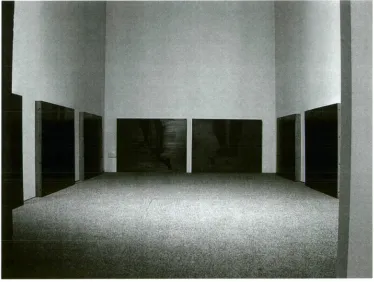
printmaking." This project focused on the solitary nature of the moment leading to suicide within the prison environment by exploring the connection between physical confinement and isolation through incarceration, with resulting psychological and emotional withdrawal. The outcome of this project was a set of 8 steel plates that were etched, inked and sealed to form a dull mirrored surface. Each plate had an image of legs in the motion of pacing. The plates lined the walls of the gallery space at floor level to form a small prison cell like space. Pacing utilised
[image:8.558.108.482.376.658.2]the sparse walls, confined space and minimal imagery to create a sense of atmosphere that a person experiences in the isolation of a prison cell.
Figure 4: Pacing, size variable, steel etched plates, 70 x 90cm, x 8, 2004
individual's expression of the moment, yet they come together to offer a sense of cohesion within a singular space.
Figure 5: Pacing (detail), steel etched plate, 70 x 90cm, 2004
[image:9.556.127.469.453.685.2]Chapter 1
Revealing Scars
My MFA project explores the visual representation of subliminal
suppressed emotive experiences in life that become so entwined with the psyche that artwork which bears no relation to events still carry the messages or signifiers of emotional upheaval. The intention of my project is to work in the medium of printmaking to produce images that avoid a literal depiction of any specific traumatic event, yet imbue a sense of subliminal emotive expression that is exposed through transactive engagement with the work. This intention is realised by redefining the literal understanding of memory as a source of ordered narrative that suggests a complete and reliable recollection of a traumatic event. This introduces the presence of sense memory, repression and the inability to process traumatic events in an ordered narrative manner to produce work that reflects an internal disorder.
In my process of printmaking, I have followed several paths of
questioning; the literal, the psychological and the physical. The following three questions enabled me to direct my visual investigation.
1) Through the process of plate sequence and tonal direction in printmaking, can creative expression expose subliminal
emotionally disturbing experiences of life without direct or literal acknowledgment?
2) Can you create a space that stimulates a response which draws on a sense memory to empathise with unsolicited emotionally
disturbing encounters without reference to any specific event? 3) Can the emotionally disturbing experiences of life expressed
through the physical body in a subliminal way be exposed through visual art as effectively as the physical scars which record an event?
1.1 The project in context
quality within the work with deliberation. While these works evoke empathy and understanding for events or situations that have borne the heavy weight of trauma to people involved, my interest lies slightly askew to their primary intent.
Jill Bennett 3 introduces terminology and perspectives upon work which may not have been immediately recognised as works relating to emotional upheaval such as the deliberate representative or evocative works
previously mentioned. This idea of work which contains within it an expression of the residual influences and effects of trauma is exhilarating as it releases work from the realm of the representative state to a more engaged relationship between the artist, the work and the viewer.
In context, traumatic experience is an expected part of being of flesh and blood and living in a community. Modern day society, with added complexities of communication beyond the confines of a localised community, may add more distressing events into individual lives through a range of media. More social pressure, political pressure and upheaval, wealth inequity and cultural intolerance are all beamed into the lounge rooms of the world than at any other point in history.
The intent of my project, to determine whether visual media is an effective means of expressing the lived experience of trauma and subliminal
memory without direct reference to any specific event, is examined through contemporary and historic research of art as an effective visual descriptor. I also introduce the research questions I have used to develop the visual investigation and discuss the significance of the visual
expression of subliminal negative experience.
As my aim is to reveal subliminal repressed emotive responses and residual descriptions of traumatic events that remain unexposed, the process of analysing and consciously working to create art that does
reveal the disguised is in direct contradiction to the premise. My approach to overcome the deliberate nature of working is to divide my artwork into three distinct projects that respond to three separate questions. These are explained in detail in Chapter 3.
Figure 7: John I,angdon, WWII dairies I started by reading my
father's diaries. They are a collection of small notebooks and pages he had managed to keep together through his journey as a soldier and then POW in WWII. His beautiful cursive handwriting is
cramped as much as possible to conserve the pages that are used on both sides. Dates and
days merge into a repetitive pattern of discipline, reward and monotony. The flashes of youthful enthusiasm and courage, as my father was a young volunteer among older conscripts (turning 21 on the ship that carried them to Egypt) is rapidly squandered and crushed by boredom and daily functions. But the horror of the battle keeps him content to seek and destroy lice, sew repairs in socks and shirts and invent ways to reuse the tins that arrive in the red cross parcels to keep a mere coating of flesh on his bones in the relative safety of the prison camps in Italy and
Germany 4.
I .2 1:c-,ed rch
Although working with three distinct questions allowed me to divide my work process, the division is more ambiguous and artificial in the
research. However, it is useful to separate the questions for the sake of ease of working with the research. The first question, "Through the
process of plate sequence and tonal direction in printmaking, can creative expression expose subliminal emotionally disturbing experiences of life without direct or literal acknowledgment", relates directly to the
repressed emotions in a spontaneous way without dissecting them in a more considered way.
The initial research centred on philosophy and psychology which introduced concepts of perception and an understanding of the
physiology of the human body and sensory capabilities. Following the
trail led to recent published research work and then on to biographical
and autobiographical work.
Hume (1711 - 76) was a Scottish philosopher who built strong arguments
about human nature. He presented the human mind as being
'unbounded' with vast imagination that had no confinement, and then
proceeded to contradict such a claim with sound rationale. He wrote:
But though our thought seems to possess this unbounded liberty,
we shall find, upon nearer examination, that it is really confined
within very narrow limits, and that all this creative power of the
mind amounts to no more than the faculty of compounding,
transposing, augmenting, or diminishing the materials afforded us
by the senses and experience.
5
If it can be accepted then, through the wisdom of generations of
philosophers that perception is a manifestation of sensory and physical
experiences, then perception' must be a corner stone of an individual's
experience of trauma.
Works of art are in many ways an act of storytelling. They can expose not
only the conscious construction of the narrative within the images, but
also the more subtle intonation of words through image. This can appear
in choices such as colour and tone, and through the development of the
work as the artist adds more and more detail to the flow of the story.
Alternatively the development of the work may also disguise the content
through degradation of the image and therefore the detail of the ordered
narrative.
In the case of work created following a negative emotional experience, the
work can reveal a sense narrative
7
as opposed to the more literal
narrative. This differentiation is essential to understand the subliminal
appearance of elements within artwork created by a person who has
5 David Hume, 1777 Enquiries - Section II: Of The Origin Of Ideas 'Enquiries Concerning Human Understanding', in Phil Dowe. Highlights in Modern Philosophy, (Hobart: Pyrrho
Press,1998), p156.
6 See Appendix D for further discussion of perception
suffered emotional turmoil. Narrative constructs our view of the world we
see around us. Each time we absorb an environment and the experience of
it we are using words to create a familiar and understandable scene that
can be recalled, overwritten and altered by adding or losing information.
These are the normal processes of our perception, however in the case of
severe stress this system can fail, leaving a person unable to communicate
what they have seen. This is where sense narrative becomes the primary
means of absorbing information. For example a person may be able to
recall a sound, smell or sensation but be unable to find words to describe
such sensory experiences.
The function of memory is a crucial factor in the repression of clear
recollection of an event, but it has many debatable complexities. For the
purpose of this study memory may be considered in three ways, the literal
or common memory that is created through a narrative construction, the
sense memory that encompasses the sensory information and the more
ambiguous inherent memory. Jill Bennett talks about sense memory in
Empathic Vision:
By co-opting the designation "victim" into a narrative of good and
evil, we foreclose on the possibility of elaborating a description of
traumatic experience that addresses either the moral ambiguities of
lived experience or the inherent tension between the experience of
sense memory and that of common
-
memory. It is this tension that
fundamentally characterises the struggle to represent or register
traumatic experience. Thus, the art of sense memory is less an art of
pure personal or subjective expression than an enactment of the
uneasy relationship between common memory and that which
threatens its coherence: a manifestation of the lived experience of
an inside and an outside.
8
This notion of ambiguities, tension and coherence that arise from the
human experience of negotiating an event and forming an understandable
and knowable memory juxtaposes the physiological responses and forms
the unwritten narrative that lives within the sensory system. It is this
complexity that goes part of the way to explain the subliminal nature of
the sense memory and its emergence as unintentional elements within an artist's work.
Jill Bennett indicates that sense memory, and the art that
expresses it, is "a manifestation of the lived experience of an inside and an outside." 9 The reference to
2. ;A.. .'0-...,
.1.1
,44, .__,,„i ...ii47.4-.--;-„, . 2.4_:.e: ... if- -c,...77,..i. mt,e2--.......-.... •—m...c- ,E ..., 1.; 4...fr :..e..,- ..,Z.Ge ....
;(...e- ,,i..4,:e Ar. ,....,:at /..,..,,_,..tt . 0 ,....r...4.4 0.... Ige ....e; .4...c_
a. fr"....ba, if 1..., 4_4., ... ..t..." ...* 44-.
d P-
.
.0 ... A.- Pir1 ,...P.-. "...44.. e..- I. '''''''`I t ''''''' ., .a.t. tr" ...,..-,,....L.--...,.. ...,.... . tt.‘......7:_cii...c .i.,:....-t- ,-..; ,
-i...., . ..-.. zit ... q. .* ... a--J.:4. 1. .
4_
....97.441....-
9 .4...4 ...1..--41+ Att.cc'di...,... _ca. l...C- ...00 ... ,G4
.c...f , 4. ...-..t , -91.., A.L. ?.,...- ...-.,....a...teg...t./..-.
the inner self and the outer self Figure 8: John Langdon, detail of diary writing
recurs throughout the research I
have done for this project, from the 'innerman' and 'outermang° my father writes about in his final journal entry from WWII to the memoirs,
biographies and the autobiographies of people who have experienced traumatic events or who have a relationship with their environment that encompasses a disconnectedness.
The readings are inspirational for the process of the practical work which has been developed with as little conscious consideration as possible with the intention of expressing the internal landscape rather than the known external one. The shift through skin, nerves and cells of the bodily held impressions to be exposed by the mark of the hand is a subtle one that evades description beyond terminology such as 'intuitive expression' as its reference point. The shift is unrecognisable in narrative.
This project endeavours to express the internal landscape as external through the tension between environments encountered through a time span in life carrying the subliminal embodiment of past events that
influence the interpretation of the visual information in any situation. The prints engage notions of sanctuary and security, the known and unknown.
In her 1997 article Jean Fisher explores the transactive nature of Everlyn Nicodemus' work as the creation of work releasing the body of pain through the act of making and "...whereby interior sensation is displaced metonymically to the exterior. Thus, the body is projected into a sign that
9 Bennett, Empathic Vision, Affect, Trauma and Contemporary Art, p.27.
Figure 9: Everlyn Nicodemus, installation view, 2006
can be transformed into further signs..."" Again the exposure of the internal landscape is expressed as the subliminal element within the artwork.
Elaine Scarry discusses the pain of a person experiencing torture and the merging of the external act with the internal responses. This conversion of the visual and physical setting of the torture scene "is internal as well as
external since it acts as an image of the impact of pain on human consciousness." Scarry continues,
"This dissolution of the boundary between inside and outside gives rise to a fourth aspect of the felt experience of physical pain, an almost obscene conflation of private and public." This draws attention to the
comprehension aspects of memory and the merging of sense memory with common or narrative memory. Scarry highlights the conflict of experience with the artistic expression and that the "objectifications of pain often concentrate on this combination of isolation and exposure." 12 Perhaps a defining sentence for the continued presence of trauma is from Carol Altmann's "After Port Arthur" when Brigid Cook talks about the daily experience of living with physical injuries received during the Port Arthur massacre of 1996 and firmly entrenched yet illusive recollections. She writes, "It is not a nightmare, but a series of uncomfortable images." 3
Memory works hand in hand with stimuli. We have all experienced the sudden recollection of events, conversations or simple interaction with an area when we have been exposed to specific stimuli that allow the mind to revisit the memories long lost on unused pathways. Creating a space that may stimulate buried thoughts was the aim for the second question: "Can you create a space that stimulates a response which draws on a sense
11 Jean Fisher, Everlyn Nicodemus, Between Silence and Laughter, Third Text edition 40
(Autumn, 1997), p.45.
12Elaine Scarry, The Body in Pain, The Making and Unmaking of the World, (New York:
Oxford University Press, 1985), p.39.
memory to empathise with unsolicited emotionally disturbing encounters without reference to any specific event?"
Again there is no suggestion that there is a specific event that is captured within the space, but the sense of the space may enable a disconnection from the lived reality and the viewer may access subliminal experience.
The expression of creativity manifests in many ways. Stephen Spender writes in his essay The Making of a Poem:
The difference between two types of genius is that one type (the Mozartian) is able to plunge the greatest depths of his own experience by the tremendous effort of a moment, the other (the Beethovenian) must dig deeper and deeper into his consciousness, layer by layer. What counts in either case is the vision which sees and pursues and attains the end; the logic of the artistic purpose. 14
The need to create logical, rational and understandable responses to a sense of place is a strong theme for artistic purpose. Many artists seek out specific places to stimulate senses. Drawing on the external stimuli the artist is seduced to follow, tapping into internal responses, memories and whispers with the resulting creativity as a discovery rather than a planned and calculated construction.
Figure 10: Kim Mahood, Faultline, relief print and acrylic on canvas, 49cm x 179cm, 2002
Kim Mahood writes about her connection with place in her memoir and the relationship between time, memory and inherent sensory qualities that are imbedded into the psyche through engagement with place. She writes:
There is something unnerving about finding the lake still here. For
a long time it has existed only in my imagination. Now its familiar contours hold the traces of a remembered time far more intensely
14 Steven Spender, The Making of a Poem in Creativity in the Arts, ed. V. Tomas, (New
than I have ever imagined. And yet its realness simultaneously displaces memory, insists on the passage of time which has separated me from place and memory. ... It is one thing to keep a place alive in the mind, another to go back to that place and hold past and present together. 15
Her response to being in the place that she has been distanced from for a considerable time is to work creatively and she writes:
Using a wash of dark pigment I fill the rectangle, crawling about on hands and knees, spreading the black stain across the canvas. The thoughtless, repetitious action is a relief, respite from thinking. My shadow intercedes between me and the work. A shadow moves too on the lake surface, though when I turn to see what casts it, there is nothing. Only the echo of presence I have glimpsed before, moving through the pages of my journal. 16
Mahood echoes several key points in these paragraphs. The clarity of common memory, overwritten and distorted by time and the lived experience which emerges to confuse comprehension become apparent through example. The subtle seeping of the restrained, repressed inner being bypasses the thought process that creates a comprehensible
narrative that the mind seeks to make sense of what we see and feel and hear.
The bodily experience of a traumatic event can register physical scars, but it could also be argued that the body holds scars within its cells that don't appear directly on the surface of the skin. This line of enquiry gave rise to the third question "Can the emotionally disturbing experiences of life expressed through the physical body in a subliminal way be exposed through visual art as effectively as the physical scars which record an event?"
The bodily connection with the earth and inherent carriage of lived experience is accepted as normal in Aboriginal culture, but has been a negotiation for western culture. Jennifer Louride Biddle has extensive knowledge and understanding of the women's art of the Walpiri people
15 Kim Mahood, craft for a Dry Lake, (Milsons Point: Transworld Publishers, 2000), pp.62 —
63.
Lreasis, Loclies, canvas
OM.! Alit 11141C.
Figure 11: Jennifer Louride Biddle, book cover, 2007
from Central Australia. In her book' 7 she carries the reader through an extensive process of integrating the art of the women to the language of the land and ancestral knowledge. The art, a
written language which details storytelling and direct response to landscape and cultural history, is traditionally marked upon the upper body. While the skin of the body becomes the site for displaying the artwork the relationship is much deeper than surface. Biddle writes "The body is here a living text that is felt as it is worn; it is a text that transforms with age and the patina of time, like the marks, spaces, contours of country
itself, worn and weathered by seasons, storms and now, of course, mining machinery, roads, houses."8
The subtle shift of thinking about the skin as being a surface that separates the body from the landscape, that holds the interior of the body in and forms a barrier between the inner and the outer breaks down with the comprehension that the surface of the land and the surface of the skin are as one. To further clarify the point Biddle writes:
Desert women's bodies embrace, open out to, and equally take in Ancestral habits, sentiments, sensibilities. The surface of the body, somatically rendered the same as the surface of the country, allows for this bodily exchange between human and Ancestor, by making the two almost identical. What lies between the two 'skin' — is not so much a border as a certain bridging potentiality. Fat to skin,
painting to canvas, hand to mark: an intimacy of conjoining is engendered. A mark — an epiphany of touch — results.' 9
Biddle awakens us to the intricacy of the art that reveals the emotive and responsive connections between the cultural and personal history, written on the body and on the canvas which is the same for the artists, and the awareness alerts me to a sense of carrying my ancestors' sensory
experience within my skin, my body, my mind.
'7 Jennifer L. Biddle, breasts, bodies, canvas, Central desert Art as Experience, (Sydney:
University of New South Wales Press, 2007), p.60.
18 Biddle, breasts, bodies, canvas, Central desert Art as Experience p.60.
Gilles Deleuze interprets the presence and experience of sensation within
the works of Francis Bacon "...at one and the same time I
becomein the
sensation and something
happensthrough the sensation, one through the
other, one in the other" thus creating a transactive engagement between
the viewer and the artwork. He continues:
And at the limit, it is the same body which, being both subject and
object, gives and receives the sensation. As a spectator, I experience
the sensation only by entering the painting, by reaching the unity
of the sensing and the sensed. ...sensation is not in the 'free' or
disembodied play of light and color (impressions); on the contrary,
it is in the body, even the body of an apple. Color is in the body,
sensation is in the body, and not in the air. Sensation is what is
painted. What is painted on the canvas is the body, not insofar as it
is represented as an object, but insofar as it is experienced as
sustaining
thissensation.. 20
From the day we are conceived, the influences of our physiology begin to
affect who we are and the perception of our environment. Sensory
coding, the gathering of information about environmental energy, informs
the nervous system. The skin responds to sensations of touch through
warmth, cold, itchiness, vibration and pain stimulating a range of variable
responses. Our bodies learn how to move and the extent of movement we
can elicit from our muscles and joints. Taste and smell carry with them
responses that range between pleasure and alarm as we negotiate the
experiences of living.
Behavioural training in early childhood stimulates the brain and assists
emotional development, and secretion of chemicals to produce feelings of
pleasure are all important aspects of developing with a balance between
the cognitive and physical engagement with our environment. Perception
is derived from our life experiences and our individual physiology and
"most contemporary psychologists believe that perception depends upon
both innate perceptual mechanisms and learning."
21
20Giles Deleuze, Francis Bacon: the logic of sensation (London: Editions de la Difference, Continuum, English translation 2003, 1981), p.35.
In the case of creating artwork that reveals and expresses a sense of sensory experience, the artist is working to render into a visible form an invisible element which is perhaps a conflict of senses. For example the artist may express an auditory experience as a visual one. The experiences of the viewer then, are relevant to the experience of viewing. Artwork that depicts an act that instigates horror disguises the sensation. Deleuze
writes:
If we could express this as a dilemma, it would be: either I paint the horror and I do not paint the scream, because I make a figuration of the horrible; or else I paint the scream, and I do not paint the
horror, I will paint the visible horror less and less, since the scream captures or detects as invisible force.22
Trauma strikes without warning, or is the result of circumstances
experienced but perhaps underestimated. War, for example, with soldiers trained to kill and witness death; to cope with the endless fire of weapons. Yet returned soldiers are one of the most prominent groups of
traumatised individuals we have.
1.3 Art and therapy
My initial focus of the project was my father's diaries which he kept for the entire three year period of his imprisonment as a POW. Returned soldiers are one of the groups of people who are readily acknowledged as being traumatised by their experiences. This was not the case in history, when soldiers were told to forget what they had been through and get on with life. This was considered the best way to get over seeing your best friend killed by the enemy or by suicide, starving for long periods, living in conditions which were never safe from attack and so on. It is hardly surprising that returned soldiers, left completely without support, would find assimilating into society with all its expected norms difficult, if not impossible, to do.
Art as a means of expressing atrocity has been questioned extensively on a psychological and philosophical basis. Theodor Adorno's famous quote
'to write poetry after Auschwitz is barbaric' 23 in response to the
horrendous acts of human degradation suggests that to express through a medium which is largely associated with beauty and rhythm would fail to have the capacity to adequately portray the scene and emotional content. While the quote itself has become a platform of debate, the essence of the words distils in the mind as an artwork in itself. It is suggested that
-
expressing a traumatic experience through the written word or visual form, can help to relieve the pressure of the experience24.
At times of political violence the expectations of daily living with specific boundaries and responses are frequently lost as the conflict disrupts the social organisation of family and community life. Art therapy must
therefore be placed within the context of a bigger picture that includes the social order that has become disrupted. If it can be accepted that memory is the means by which a person negotiates the surrounding environment, then memory holds the key to accessing trauma that affects the daily choices an individual makes. Using creative expression a person may be able to externalise the events in a visual form when they are unable to vocalise it. Accessing such a memory, externalising it through creative expression and recalling details that have been diminished by fear is thought to enable a person to begin the healing process and gain courage from the fact that they have survived.
Kalmanowitz, D. & Loyd, B. 25 present accounts of cases where art has been introduced to victims of political violence. Post Traumatic Stress Disorder by current definition involves the witnessing or involvement in an event which has a threat to the safety of the person or another person and results in responses of fear, helplessness or horror. This is the measure that identifies individuals as in need of therapy. However, it could be argued that subliminal effects of traumatic experiences become intrinsic to the personality of a person who experiences the horrors, whether they display the necessary indentifying behaviours or not.
A loss of identity through the demands of war and the acts of war which can lead to a sense of losing meaning in life can be healed, in part, through
23 Kalmanawitz, D. & Lloyd, B., Art Therapy and Political Violence, (East Sussex: Routledge, 2005), prologue.
the process of making art. This is essentially because creativity connects a person between the material world and the internal one. The
physiological urge to survive that can drive the means of coping in the extreme circumstance of war can leave a person in a state of emotional numbness which has a role in survival, but in a stable society becomes a wall of defence. Art can be a means of extending through the emotional barriers constructed for survival and connecting with the present day. "From an art therapeutic perspective 'emotional numbness' could be regarded as 'frozen' creativity. Activities like painting and modelling first 'unfreeze' and then stimulate the survivor's creativity." 26
1.4 Summary
In conclusion, our perception of our environment becomes crucial in our understanding of our engagement with it, and in the case of a traumatised person the logical and educated reasoning can become clouded with fear responses or subliminal reactions. Revealing Scars draws on the extensive
information debated, discussed and studied for generations to solve the riddles of the traumatised mind. The practical work has followed several paths of questioning; the literal, the psychological and the physical.
This chapter has given a brief summary of some of the keystone points that inform the practical work of Revealing Scars. Reference to persons and studies in a
historical and current context has ensured a strong depth of
understanding for the project. In the next chapter I discuss the various approaches that have been taken in a visual context in dealing with the issue of trauma and in relation to the
[image:23.556.291.490.441.639.2]development of Revealing Scars.
Figure 12: Precipice (detail), 59 x 59cm, 2007
Figure 13: Shibboleth, Doris Salcedo, 2007
Chapter 2
Trauma and Art: Artists Projects
Artists working with matters of psychological complexity, the physical body and literal representations of traumatic situations have approached the subjects in a wide and varied range of mediums. A thread that weaves between the works is formed by the emotive drive to create the work and therefore to expose to the public eye moments or issues that may
otherwise have remained unheard.
I
1Durk L;01ceclo
Doris Salcedo engages directly with situations that result in traumatised individuals and politically alienated people. Focusing primarily on her home country of Columbia, she
researches deeply into an event, interviewing the people directly affected, then works to produce an installation or sculpture that draws out the hidden
perspectives that fall between the cracks of public knowledge.
In a recent work, Shibboleth27
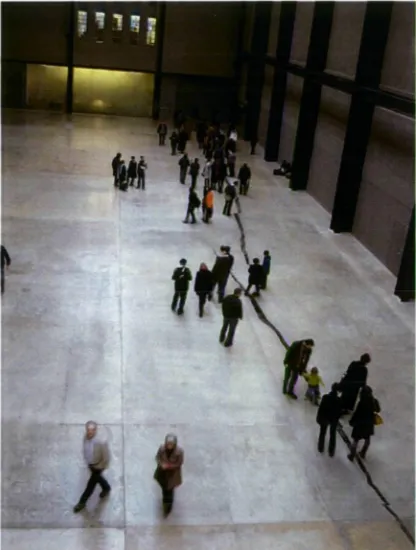
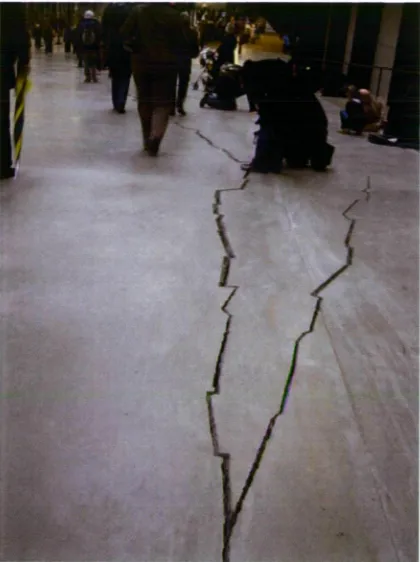
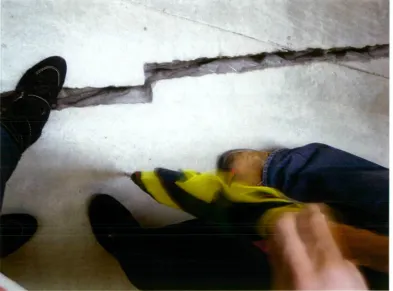
Salcedo has created a concrete floor in the Turbine Hall of the
Tate Modern in London. The area covered is huge and features a crack that has a small starting point and increases in size as it runs across the floor. The floor's surface is also ruptured by a steel mesh fence. The permanency of the floor is significant as it will remain under the floor of the Turbine Hall, a presence that will always be there as a vague memory of the installation and its message.
27 Definition: a word, especially seen as a test, to distinguish someone as belonging to a
Figure 14: Shibboleth, Doris Salcedo, 2007 The work draws a circle from
the roots of colonialism in Britain to the mesh fences that divide the borders between the countries in turmoil in South America. The unwelcome presence of immigration that is addressed with barriers and racial hatred are highlighted by the barriers that the visitor meets when they cross the surface of Shibboleth. The visitor
needs to observe their step, to be careful and conscious of their movement as the floor slopes downwards from the entry point and the crack creates a
visual obstacle, "...we all look down and maybe try to encounter the experience of these people.. •"28 Salcedo works to create art that is from "the perspective of the defeated people not from the perspective of the triumph" thus engaging the visitor with the sensory experience of being in the moment. Describing herself as a secondary witness, Salcedo endeavours to reveal the hidden scars of the human condition in the aftermath of traumatic events and Shibboleth is "about people who have
been exposed to extreme experience of racial hatred and subjected to inhuman conditions in the first world."
Salcedo approaches her work with a determination to draw attention to the affliction of suffering upon people following an event. Bennett writes, "there is a fundamental difference between the knife that induces bodily memory of physical pain and an object like the Orphan's Tunic that
conveys the psychic trauma of grieving or loss." 30 The Orphan's Tunic
consists of a table with a layer of silk over its surface which has been sewed onto the wood with human hair and is in response to interviews with a young girl who had witnessed the death of her parents. Unable to
communicate her loss, the dress the girl wore each day as she met with the artist (made by her mother) became the focus of the resulting piece. A powerful and poignant work of art, Orphan's Tunic engages the viewer
directly with the emotion of the child's loss. The revelation of the work is not instantaneous for a viewer, it is slowly revealed through disclosure and comprehension.
By avoiding a narrative account, Salcedo is able to:
...present an image that is loaded with experience yet silent, without anecdote, where the viewer, in an act of silent
[image:26.558.95.488.321.612.2]contemplation, may bring his own memory of pain into contact with that of the victim, and it is from this juxtaposition that the meaning of the work arises.31
Figure 15: Shibboleth, Doris Salcedo, 2007
Silence is an important element in her work. Salcedo recognises the
difference between the violence and volume of the event as opposed to the "silent history revealed by individual memory." ... "Sculpture for me is the giving of a material gift to the being who makes his presence felt in my
3' Marguerite Feitlowitz, Cultural Supplement, Interview with Doris Salcedo,
work."
32
This presence can be seen as an expression of the emotional,
internal sensory response to trauma. This subliminal tapping is essential
in the case of working with people who have suffered such pain. The acts
of violence and stress are difficult if not impossible to recall for the
sufferer "because disaster literally annihilates people and things, but also
because when attempts are made to recall it, there is often a failing of
memory, since trauma has the effect of obliterating its own recollection."
33
Whether Salcedo is working in a large scale that addresses political issues
affecting many people or an intimate small scale work that addresses the
trauma of one person, she renders the invisible, visible, and in doing so
ensures the undeniable presence of the individual suffering as a condition
of humanity. Her work draws on the sense memory to create a transactive
engagement between the viewer and the artwork. This is emphasised by
the space that the work is situated in and the use of sound, which for
Salcedo is silence, to gradually reveal the essence of the work. The work
may not relate to any specific event, but is in response to the aftermath of
one or more events. Doris Salcedo says, "I believe every work of art is
political because every work of art is breaking new ground and it's in a
way against the status quo so every work of art and the nature of art is
political."
34
2.2 Dennis Del Favero
Dennis Del Favero invites the viewer to experience the emotional fallout
from traumatic events, primarily through video installation. Events that
are reported by the mass media are thrust into the loungerooms across the
world, but only for very brief time, and always with a framework of
reporting to the guidelines of the media control. The people who are the
focus of the event become a medium through which the reporter can grab
the angle of the story that is desired. The people, their flesh and blood,
their emotions, may become irrelevant. Del Favero revisits the people and
investigates the psychological impact and loss as a result of traumatic
events. The temptation is to retell the event, however "Del Favero does
32 Doris Salcedo, http://www.iniva.org/dare/themes/space/salcedo.html.
33 Madeleine Grynsztejn, in Voice of the Invisible Tate ETC issue 11, Autumn, 2007,
http://www.tate.org.uk/tateetc/issue11/invisible.htm.
34 Doris Salcedo, TateShots, http://www.tate.org.uk/tateshots/episode.jsp?item=12198,
RTF format release date: 18th October 2007.
not relate their stories so much as provide a sense of what it is like to inhabit a world made strange by trauma from which there is no release." 35 Memory is a key factor in dealing with trauma, and the perceptual
[image:28.556.105.489.266.526.2]influences which create a unique memory experience for each person. It is also a fractured memory, maybe pieced together with actual experience, visual and verbal queues from other people and media. Del Favero highlights the continuous process of dealing with trauma as he portrays the effects of trauma as "...inscribed onto a landscape that itself bears the scars of loss, violence and devastation. Inhabitants must traverse this landscape of memory and find ways of existing upon it." 36
Figure 16: Deep Sleep, (1,1— , Del Favet _
Memory is a driving factor in both Parting Embrace (1998) and Deep Sleep (2004). Del Favero introduces the concepts of sense memory and narrative memory. Narrative is the means by which memory is constructed on a normative basis, however the impact of a trauma that is not within the known narrative of the assaulted is initially rendered in the cognitive through sensory recording. Deep Sleep, a video installation, encapsulates the perhaps naive attempts to resolve the issues of traumatised patients through deep sleep therapy, revealed as a barbaric and risky process
35 Jill Bennett, Dennis Del Favero Fantasmi, (Sydney: University of New South Wales Press,
2004), p.67.
through the murmurings and confusion of the subjects. If narrative is the primary means of expression, then its failure is highlighted in Parting Embrace which takes on the weighty. subject of sexual awakening and abuse. Memory is depicted as fragmented and perhaps disguised by overwriting of the traumatic memory. The sense memory prevails.
2.3 William Kentridge
If Del Favero's work is aimed at awareness through sensory expression, then perhaps it could be argued that William Kentridge creates narrative based works with an intention of raising awareness of issues that may be forgotten. Using drawing as his main means of creating images,
Kentridge has produced a number of short films which follow the development of a drawing, frame by frame. In his artist statement Kentridge says:
I have never tried to make illustrations of apartheid, but the drawings and films are certainly spawned by and feed off the brutalized society left in its wake. I am interested in a political art, that is to say an art of ambiguity, contradiction, uncompleted gestures, and certain endings; an art (and a politics) in which optimism is kept in check and nihilism at bay. 37
Essentially Kentridge deals with human interaction and engagement with the environment which in this case is the South African landscape and urban scene. For an outsider to South Africa, the scenes are foreign, challenging and complex, but for Kentridge they are the reality of his daily life. His stories keep the experiences that have shaped the political history of the country fresh in the eyes of the world, and at the same time increase the awareness of the very human history. His 1989 etching Casspirs Full of Love seems a contradiction when the visual is that of a number of heads lying in a coffin shaped, divided box. The violence of the work refers to the Casspir, "...an armoured vehicle used by security forces to quell riots and demonstrations..." but the text Casspirs full of love written along the length of the image, "...emerges from an utterly mundane context: state radio messages sent by families to their offspring in uniform, in one of which a parent closes her message with a cheery,
'from mum, with Casspirs full of love'."
38
The horror becomes the daily
reality of political unrest.
In a recent Sunday Arts interview Virginia Trioli asked William Kentridge
about a box of photographs that he had discovered as a child growing up
in South Africa:
Well this was in 19...early-1960s, just after the Sharpeville massacre.
So I would have been seven...six or seven years old. And my father
was one of the lawyers involved with the inquest into the
Sharpeville massacre. I went into his office one day, into his study,
and saw what looked to me like a shiny yellow box, which I
assumed would be Black Magic chocolates, or a dairy tray, and
opened them. And instead of being this box of chocolates, it was
these 8 by 10 glossy photos of all these people who'd been shot.
And I'm sure that was.. .1 mean, there are various moments when
one understands the world kind of turns on its side, where
everything you'd assumed you'd understood about how the world
and the world of adults operates, changes. I.. .1 obviously was
shocked at the time, but didn't think about it for the next 20 or 30
years. When I was making one of my films, Felix In Exile, I
suddenly realised that all the drawings I was doing had an echo,
and it took me a while to actually place it, that it was back in that
box of photographs.39
Kentridge clearly outlines the somewhat subversive effects of an
experience that leaves remnants of emotive responses and visual
imprinting which can appear without direct acknowledgment of the
source at the moment of its emergence in current artwork. Like a sleeping
jolt of awareness the connections between current thought and those
deeply buried in the complexity of the mind, which works to maintain self
preservation, ignited for a moment and he knew where his work had a
seed of imagery germinating in the brew of life.
Figure 17: Herbaceous Border, ‘Villiarn Kentridge, charcoal and pastel, 121 .8 x 159.6cm, 1995
In
Herbaceous Border(1995) Kentridge invites the viewer to move into a
position where the land dominates on a macro scale. Working from late
nineteenth century illustrations:
Kentridge reinterprets an illustration of a white hunter and his
African guide pressing through towering reeds to hunt
spur-winged geese. Although he uses the same compositional layering
of vegetation, water and a high, distant river bank, Kentridge's
landscape is unpopulated, and he lowers the viewpoint so as to
position the viewer within the swampy plants. Drawn with an
energetic application of charcoal and dense black pastel, the
uninviting, even sinister, landscape is made more menacing by the
surveillance and communication towers visible against the
oppressive sky. A tracing of red lines that punctuates the image
refers to surveyors marks, recalling the damage inflicted upon the
land by explorers, settlers and the mining industry, and upon its
people by colonisation and its aftermath.
4
°
Kentridge works with spaces (landscapes) "which are not natural or neutral"41 to produce works that remind the viewer of historical events, or events that may or may not have happened in that site. Talking about his drawing process Kentridge says, "elements of a landscape throw
themselves up as appropriate and become the structure of the drawing. Pieces of a drawing lose their hold and must be removed."42This concept of working intuitively with the drawing, allowing the elements to disclose themselves as significant and erasing those that become insignificant reveals as much about the hand of the artist as it does about his subject.
Erasure is an important and distinguishing feature of Kentridge's work, the erasure of figures, of landscape, of culture, a reflection of the politics of his country. Information is absorbed into the overwriting of the work, and memory acts in the same way, overwriting, erasing, losing distinction and becoming indistinguishable. The marks are developed with a sense of their history.
2.4 Antony Gormley
Antony Gormley has used his own body as a source of inspiration and means of producing work for 25 years. His 2007 exhibition
in
London united Event Horizon and Blind light as a collective of works on a hugescale. Event Horizon comprised of about 30 figures placed on walkways
and rooftops around the Southbank Centre area. Each of the figures was placed in a way to suggest directing the gaze or the flow of people
towards the Hayward Gallery where Blind Light and a collection of other
work was on show. In contrast to many of Gormley's installations where the figures are looking out, or filling a space, Event Horizon has
"established the inverse of this outward looking presence, substituting a multiplicity of guardians overlooking and verifying the contents of the gallery."43
Blind Light uses the effect of light on moisture to create a space filled by
opacity. Vidler writes:
41 Cameron,Wi/liam Kentridge, p.111.
42 Cameron, William Ken tridge, p.111.
43 Anthony Vidler et al., Antony Gormley Blind Light, (Southbank Centre: Hayward
Gormley's installation plays with psychological themes without instrumental programme; rather the sensation of losing spatial coordination (within the mist of the installation) is experienced as a positive and enriching state — one that liberates the body from its normal conditions of responding vertically, horizontally and clear boundaries.44
This disorientation of the viewer within the installation draws on sense memory as the viewer responds according to their own life experience which surfaces as an immediate interaction. In Australia Gormley worked with the indigenous people of the community around Menzies in Western Australia to create casts of their scanned bodies. Each person's form was scaled down to create a lifelike sculpture that retained a presence of the individual yet avoids a literal representation. The sculptures are installed across Lake Ballard, a salt lake that suffers the onslaught of extreme temperatures and harsh abrasion of mineral assault. Spread across 10 kilometres the 50 figures of cast black steel appear to be actual people in the landscape despite the harshness of the salt lake conditions. "We stand not so much on the brink of the void but at the point of absorption, where consciousness merges into material, a word that has mater (mother) as its
root." 45
The Inside Australia installation draws on the natural landscape and
human engagement with it to unite yet question our interaction with it. Viewing the work requires a considered approach as the conditions are harsh enough to risk life at certain times of the day and season. It is a challenge to traverse the salt lake to the furthest figure that is seven kilometres from the lake edge. This forces the viewer to consider their step, interaction and position within the installation.
2.5 Art and War
Literal depiction of the human loss during war can be displayed visually in powerful scenes from the events or as an overview through
comprehension of the catastrophic results in figures. Charles Joseph
44 Vidler, Antony Gormley Blind Light, p.85.
45 Anthony Bond, in Gormley, A., Antony Gormley Inside Australia, (London: Thames &
Hudson 2005), p.172.
Citric .11,7urative L.0 a_ 1( Wok, 41/2 -
... ...a...a.,
a. ea.&
. Cr% ,
TvaLii• CE.Iptotatt: Itspie. r. lat.rmravrr
.11.1.■•••■■•• Figure18: Figurative Map, Charles Minard, 1869
Minard chose a statistical graph 46 to plot the march of Napoleons army across Russia from the Polish border to Moscow. The thick brown band that begins the march dwindles rapidly as the conflicts and conditions claim the lives of the soldiers. The return line marked in black reveals the woeful number of men who made it to the safety of the Polish border. Beginning in June 1812 with 422,000 men, the returning army had dwindled to just 10,000.47
Interest in the visual depiction of traumatic events has carried through the documentation of human history forming a crucial understanding of the conflicts of human development. Otto Dix fought and worked during WWI. His interest in experiencing life to its heights and depths saw a keen Dix volunteer to fight for his home country of Germany in the trenches of France, Russia and Belgium. The intensely intimate etchings he produced following the end of the war were possible as he had utilised the scenarios of war to express a lived experience he documented as drawings he
produced amongst the carnage, boredom and misery. Surviving serious injury on several occasions, Dix committed his post war art to producing a portfolio of 50 prints in five parts (plus one depicting the rape of a nun that was suppressed originally) titled Der Kreig (War)1924.
Otto Dix offers the view of a soldier who fought and worked his art amongst the bodies of his fallen comrades, yet his depictions were not created to expose the horrors, but more to reflect on the experience that he
46Char1es Minard, (http://www.edwardtufte.com/tufte/posters, 1869), 24/4/2009.
had wanted to have, and indeed what he had enlisted for. Trauma does not operate to any particular formulae, or to our expectations.
The 51 prints from the portfolio depict the decimation of human life and the landscape with an 'unflinching realism' that operates on an intimate level which "...is about recapturing the nightmare-like quality of its psychological impact." 48 The interest he had in the impact of war extended to the civilian population and powerful images of traumatised and abused women sit beside the images of soldiers in the trenches. These literal works allow the viewer to
Figure 19: Collapsed Trenches, Otto Dix, etching, empathise with the events and aquatint, drypoint, 1924
human suffering of war and
develop a response to the specifics of the imagery. This is a logical and culturally cultivated expectation. The graphic detail of Dix's prints form a counterbalance to the research for the project which explores the
subliminal effects beyond an event such as the ones depicted by Dix. The project endeavours to visually present the power of the suggestion rather than the power of the imagery in a narrative sense.
2.6 Summary
Each artist discussed in chapter 2 has influenced the project development through their approach to the issue of trauma or traumatic events. From the representational to the ambiguous in a range of art forms, researching their work assisted the understanding of the scale and mediums needed to address the angle that the premise of this project outlines.
[image:35.556.295.494.118.361.2]Figure 20: Body 1, lithograph, 76 x 56cm, 21/L)
Chapter 3
Revealing Scars: Navigating the Subliminal
My initial inspiration for the project, reaching into my father's history in an attempt to resolve the known and unknown aspect of my father's life and personality, became a divided quest. This resulted in several
questions becoming the primary means of travelling through
the
venture. These questions assisted the negotiation of the physical, conceptual and emotional understanding of the environment determined bythe
framework of my research. They also helped to maintain a
focus
for each direction of study. My project was essentially of a personalnature
that worked on developing a dialogue between my inner self andthe
outward experience of creating the work. This was progressed through observation of the natural world and encountered conversations within the timeframe of developing the work, rendering the private into the public.3.1 1 ) 11vicd11-1\rression
To begin, the self portrait was the most logical course of action. My interest in depicting the self was to develop an intimate connection between the outer skin and inner being of my body.
The development of the prints centred on the figure from the perspective of the self rather than a reflected or distanced image. Working in lithograph, and primarily with stone lithography, the images are essentially life drawings which offer a distorted view of the self in response to the attempt to contain the psychological
[image:36.556.302.490.407.676.2]The physical action of working with the lithograph stones became an intrinsic part of developing the work as the process of grinding the stones, applying the layers of marks and etches mimics the erasure, writing, rewriting and carving of emotive responses into the psyche.
The print development took the direction of exploring the concept of a symbiotic relationship between my father's work, specifically his
[image:37.554.96.495.253.547.2]sculptures, and my body. What emerged from my self portrait studies was the revealing of the subliminal repressed emotions becoming the relevant focus for developing images relating to the body.
Figure 21: Body 2, lithograph, 56 x 76cm, 2008
Question 3 led to the development of a body of work that centred on the depiction, placement and exploration of the physical body in print. Most of the prints were created using stone lithography either as partial body sections that were printed together to create a whole body image or as lower body images on their own.
images were worked in a way that denied a literal reading. The body
images were usually worked on separate stones and connected on the
paper, resulting in distorted and unrealistic body shapes. This process
allowed the image to be distorted in a way that reflected a suggested outer
appearance rather than a literal one.
The lithograph prints moved through the distorted body to images
working with the lower half of the body only. This was in response to the
desire to share only a portion of 'story', the rest remaining unknown,
hidden. The poses were contained within the dimensions of the paper and
placed in a way to suggest a preceding narrative, and a continuing
narrative.
To this point, the prints existed in a suggestive space of the domestic.
Without any indicators of the natural environment, the bodies seemed
contained by the edges and surface of the paper. Some natural elements
began to appear in the prints hinting towards a symbiotic relationship
between the environment and the physical engagement with it. As the
body exists by natural elements that render it into existence, the natural
world is intrinsic to the physical being. The body images were developed
as an expression of mutualism, adhered to the natural world.
Symbiosis was also the central element for the prints that depicted the
body blended with my father's sculptures°. There were three prints
developed to a final state with this distortion. The prints combine the
natural environment, the body and portions of three of the ceramic
sculptures that slowly spread through the gardens of my childhood.
The human form is recognisable by specifics of an organic nature, yet the
individual characteristics encompass a history of the lived experience of
existence. Stone lithography
50
was the primary technique used in the
development of these prints. This process involves some heavy physical
labour, but with a gentle meditative quality rather than the more
aggressive approach in some of the etchings. The stone is prepared by
grinding the surface to a smooth finish, removing the previous image that
had been etched into it. The body images in the work were created by
49 See Appendix F
sketching and rubbing ink onto the stone which then goes through a series
of etching and rolling up with ink to strengthen the image before printing.
The aim of the work was to allow the gentle process of drawing to access
the subliminal layers of emotions without preconceived ideas about the
mark making. The form of the image and its positioning within the frame
of the paper is controlled by conscious thought and relates to specific
responses in circumstance of distress and fear.
3.2
Precipice
Spatial reality can, for ease of discussion, be divided into external and
internal realms or landscapes. The external reality is constructed with an
understanding through language and sensory queues. We are trained
from the moment we are born to respond to the world around us with
specific information and 'knowledge' guiding our response and
understanding of what are expected norms within societal structure.
Does the interior landscape have the same boundary of definition? We
could view our internal realm as a storehouse where information, sensory
triggers, memories, genetic code (and so the list goes on) is tucked away
within the body cells to form the basis for emotive response and
interpretation.
Precipiceendeavours to answer my working question 1.
Precipice