Extending ILM with an operator for Σ
1
-ness
1 byEvan Goris
Abstract
In this paper we formulate a logic ΣILM. This logic extends ILM and contains a new unary modal operator Σ1. The formulas of this logic can be evaluated on Veltman frames. We show that ΣILM is modally sound and complete with respect to a certain class of Veltman frames. An arithmetical interpretation of the modal formulas can be obtained by reading the Σ1 operator as formalized Σ1-ness in PA and¤as formalized Π1-conservativity between finite extensions of PA. We show that under this arithmetically interpretation ΣILM is sound and complete.
The main motivation for formulating ΣILM at all is that one coun-terexample for interpolation in ILM seems to emerge because of the lack of ILM to express Σ1-ness. We show that ΣILM does not have interpo-lation either. Our counterexample seems to emerge because of the in-ability of ΣILM to express Σ-interpolation[7]. (A formula φ→ψ has a Σ1-interpolant if there exist some σ ∈ Σ1 such that PA ` φ → σ and PA`σ→ψ.)
1The text of this paper formed the master’s thesis of the author at the ILLC, June 2003,
Contents
1 Introduction 2
1.1 Preliminaries: Interpretability logics . . . 2
1.2 Motivation . . . 4
1.3 Notations . . . 5
2 The logicΣL 6 2.1 Definitions . . . 6
2.2 Modal soundness . . . 8
2.3 Modal completeness . . . 8
2.3.1 Introduction and definitions . . . 8
2.3.2 Tools . . . 12
2.3.3 Extension theorem . . . 14
2.4 Failure of interpolation . . . 15
2.5 Arithmetical interpretation . . . 21
3 The logicΣILM 21 3.1 ILM . . . 21
3.2 The logic ΣILM . . . 23
3.3 Modal semantics . . . 23
3.3.1 A complication . . . 23
3.3.2 ΣILM semantics . . . 25
3.4 Modal soundness . . . 26
3.5 Modal completeness . . . 27
3.5.1 Introduction and definitions . . . 27
3.5.2 Tools . . . 31
3.5.3 Extension theorem . . . 33
3.6 Failure of interpolation . . . 39
4 Arithmetical interpretation 41 4.1 Arithmetical completeness of ΣILM . . . 43
4.2 ΣL . . . 54
5 Fragments and variations 55 5.1 The propositional Σ1-logic of PA . . . 55
5.1.1 An arithmetical consequence relation |=Σ1 . . . 55
5.1.2 The syntactical consequence relation `Σ1 . . . 56
5.1.3 The semantical consequence relation°Σ1 . . . 56
6 Conclusion and further research 57
7 Acknowledgements 59
Symbols 60
In this paper the logic ΣILM is introduced and some of its properties inves-tigated. ΣILM is basically the union of the known logic ILM and the in this paper introduced logic ΣL. In section 1 the main preliminaries are explained. In section 2 and 3 the logics ΣL and ΣILM are treated. We show that both logics are sound and complete w.r.t. a modal and an arithmetical interpretation. We also show that both logics lack the interpolation property.
1
Introduction
In section 1.1 the modal logic ILM and its relation to arithmetic is introduced. We define a class of structures called Veltman frames. These serve as a basis for a modal semantics for all the logics we will see in this paper. More on ILM will be introduced in later sections when needed. In section 1.2 we motivate our study.
1.1
Preliminaries: Interpretability logics
In this paper we will be concerned with what are known as interpretability logics. These are nonstandard extensions of the normal modal logic GL and their language contains, besides the2, a binary modal operator¤.
Definition 1.1 (PROP). P ROP is a (fixed) countable infinite set of propo-sitional variables.
Definition 1.2 (IL-formulas). IL-formulas are built up using PROP, the propositional connectives, a unary modal operator2and a binary modal
oper-ator¤.
With regard to priorities¤behaves similarly as→, although¤binds stronger
than→. SoA∧B¤Cmeans (A∧B)¤CandA→B¤CmeansA→(B¤C).
As is well-known one can give arithmetical meaning to modal formulas by substituting for the proposition variables (arbitrary) arithmetical sentences and interpreting the2 as a formalization of ‘provable in PA’. See for example [2].
We can extend this to formulas which contain ¤ as follows. IfA and B are
modal formulas andA∗andB∗arithmetical ones, the ‘arithmetical meaning’ of AandB respectively, then the arithmetical meaning ofA¤Bis a formalization
of:
PA +A∗interprets PA +B∗.
In general: a theory T interprets a theory S if there exists a translation of formulas ofS into formulas ofT such thatT proves all the (translations of the) theorems ofS (for a precise formulation see [10][19], I will not bother with this here since we will switch to another interpretation of¤anyway).
Why is interpreting (S into T) interesting? Interpreting a theory into an-other is useful for e.g. showing relative consistency or, as we shall see, showing partial conservation results. Moreover, if we replace PA by some other theoryT
extensions ofT) then¤gives us a means to distinguish between different
theo-riesT far better than was possible with only the2. For example IΣ1 and PA
are indistinguishable using2 only butA¤B →2(A¤B) is a valid principle
(what this means will be made precise below) in IΣ1 but not in PA. So, in general, replacing PA by another theory will change the discussion. However there is a basic system with nice properties that is present in all (reasonable) choices. This logic is called IL. It should be noted that this is not the largest logic present in all reasonable choices. What is, is still open. For conjectures (and for a definition of reasonable) see [13].
Definition 1.3 (IL). With IL we will refer to the following set of axiom schemata:
1. 2(A→B)→2A→2B,
2. 2(2A→A)→2A,
3. 2(A→B)→(A¤B),
4. (A¤B)∧(B¤C)→(A¤C),
5. (A¤C)∧(B¤C)→(A∨B¤C),
6. (A¤B)→(3A→3B),
7. 3A¤A.
We will obtain the logic IL by taking all instances of the above schemata, classical propositional logic in the enriched language2, and close off under ne-cessitation and modus ponens. We writeIL`AforA∈the logicIL. Without danger of confusion we speak ofILwhen we meanthe logicIL.
The class of valid interpretability principles for certain theories can be ax-iomatized by adjoining to IL appropriate axiom schemata. PA is a theory for which such a schema has been obtained. The schema called (M).
Definition 1.4 (ILM ,(M)). With (M) we denote the schema:
A¤B→A∧2C¤B∧2C.
ILM is the set of schemata{(M)}+ IL and we obtainthe logic ILM by taking the universal closure of (the schemata)ILM and close off under necessitation and modus ponens. Again we writeILM when we meanthe logicILM.
We can evaluate IL-formulas on Veltman frames and in Veltman models.
Definition 1.5 (Veltman Frame). AVeltman frame, or justframe, is a triple
F=hW, R, Siwhere
1. W is a set, the domain ofF,
2. Ris a binary relation onW,
3. S is a ternary relation on W such that for all w, a, b: (w, a, b) ∈ S ⇒
(w, a),(w, b)∈R.
We will write aSwb for (w, a, b) ∈ S, and Sw designates the binary relation
{(a, b)|(w, a, b)∈S}.
Definition 1.6 (Veltman model). A Veltman model, or simply model, is a quadruple M = hW, R, S, Vi where hW, R, Si is a Veltman frame and V is a function PROP −→ P(W). With a valuation appropriate for a frame F we mean such a function PROP−→ P(W).
Veltman frames and Veltman models will serve as a basis for a semantics for all logics to be seen in this paper. How exactly will be postponed until later sections.
1.2
Motivation
Although modally and arithmetically complete (for PA) there still is a problem with ILM. It does not have the interpolation property. This problem is easier addressed when we switch to another arithmetical interpretation of¤.
Definition 1.7 (Bounded quantifier, Π1!, Σ1!, Π1 and Σ1-formulas).
∀x≤z φ(x) abbreviates ∀x(x≤z →φ(x)) and ∃x≤z φ(x) abbreviates∃x(x≤z∧
φ(x)). ∀x≤z and∃x≤z are called bounded quantifiers.
A Π1!-formulais a formula of the form∀xφ(x). Where inφ(x) all quantifiers occur bounded. A Σ1!-formula is a formula of the form∃xφ(x). Where inφ(x) all quantifiers occur bounded. A Π1-formula is a formula equivalent to a Π1!
formula. A Σ1-formula is the negation of a Π1 formula.
Definition 1.8 (Π1-Conservativity). LetT andS be theories. We say that
S is Π1-Conservative overT if for any Π1! sentenceπ
S`π⇒T `π.
Besides being the logic of interpretability, ILM happens to be the logic of Π1-Conservativity of PA as well (in fact in PA these notions coincide, see e.g. [10])3. Now let us see why the (M) schema is, in some sense, true when we read¤
as Π1-Conservativity between PA finite extensions of PA and 2 as provability
in PA. We show that for all arithmetical first-order formulasφ,ψ,η:
φ¤ψ⇒φ∧2η¤ψ∧2η. (1)
Suppose φ¤ψ and π is some Π1 sentence provable in PA +ψ∧2η. Then
PA +ψproves the Π1 sentence (Π1 since2η is a Σ1 statement)2η→π, and
thus PA +φproves2η→πas well, conclusion: PA +φ∧2η provesπ.
3It should be noted however that ILM is the logic of Π1-Conservativity for IΣ1 as well.
Now let us consider a well-known counterexample, due to Ignatiev, for in-terpolation in ILM [19]4:
2(p↔2q)→(r¤s→r∧p¤s∧p). (2)
Suppose we could express Σ1-ness by a ILM-formula with one proposition vari-able, say Σ1(p). The above proof that the (M) schema is true actually shows that the following schema is true:
Σ1(C)→(A¤B →A∧C¤B∧C).
Moreover that argument can be carried out in PA and that means, by definition, that (1) is arithmetically valid. Since 2(A↔ 2C)→Σ1(A) is arithmetically
valid as well, and ILM is known to prove all arithmetically valid formulas, we would have an interpolant for (2) (namely Σ1(p)).
The main subject of this paper is to investigate the possibility of adjoining an operator to ILM which should express Σ1-ness and see what it gives us. As a starting point we reduce the logic HGL [8], which contains, among other things, for eachn≥1 a predicate expressing Σn-ness, to a logic, which we will call ΣL,
with only the Σ1 predicate. We give a simple proof of modal and arithmetical completeness for this logic. It turns out, however, that ΣL has no interpolation. These results are extended to show that it is insufficient to extend ILM with a Σ1 predicate in order to obtain a logic with interpolation.
1.3
Notations
In this section we agree on some notations and conventions.
Upper case characters A, B, C, . . . range over modal formulas (of all kinds to be seen in this paper). The lower case charactersa, b, c, . . . , p, q, r, . . . range over elements of PROP and over nodes in frames and models.
For modelsM we will use the notationM for both the model and its domain. Similarly for frames. IfF =hW, R, Sithen we write WF forW,RF forR,SF
forS:
hWF, RF, SFi=defF.
We define all the set-theoretic operations and tests on frames by performing them on their components. So for instance:
F0∩F1=defhWF0∩WF1, RF0∩RF1, SF0∩SF1i.
Similar definitions hold for F0∪F1 and F0 ⊆ F1. For two models M0 and
M1 similar conventions hold but of course this only makes sense when x ∈
M0∩M1⇒ ∀p∈PROP :x∈VM0(p)⇔x∈VM1(p).
For binary relationsRwe write R∗ for the reflexive transitive closure of R.
IfAis a modal formula then
¡A=def2A∧A.
If Γ is a finite set of formulas (first order or modal), say Γ = {γ0, . . . , γn−1}
then ^
Γ =defγ0∧ · · · ∧γn−1
and _
Γ =defγ0∨ · · · ∨γn−1. If Γ is a set of modal formulas then
2Γ =def{2γ|γ∈Γ}
and
¡Γ =def{¡γ|γ∈Γ}.
2
The logic
Σ
L
A a modal logic called ΣL is defined. We show how the formulas of this logic can be evaluated on Veltman frames. A specific class of Veltman frames is defined. These are essentially the frames Japaridze used for his HGL [8] reduced to the Σ1-case. In Section 2.2 and 2.3 ΣL is shown, by a relatively simple proof, to be sound and complete w.r.t. this class of frames. In Section 2.4 we show that ΣL does not have interpolation. In Section 2.5 we make a note on an arithmetical interpretation of ΣL but a treatment is postponed until Section 4.2.
2.1
Definitions
Definition 2.1 (ΣL-formulas). With a ΣL-formula we will mean a formula over PROP constructed using boolean connectives and two unary modal oper-ators: 2and Σ1.
Σ1binds like the2. So e.g. Σ1A→Bmeans (Σ1A)→B. We will be evaluating
ΣL-formulas on Veltman frames.
Definition 2.2 (ΣL forcing relation). For a model M = hW, R, S, Vi we let|=M be the unique relation between elements w from W and ΣL-formulas
satisfying
1. w|=M pifw∈V(p),
2. w|=M 2Aif for eachv s.t. wRv: v|=M A,
3. w|=M Σ1A if for eachu, v s.t. uSwv: u|=M A⇒v|=M A,
In what follows we write M, v |= A for v |=M A or, when M is clear from
context,v|=A.
For a justification for this forcing relation one can think about the following. In our setting Σ1 sentences are those sentences that are preserved along the
Sw relations. By the L¨os-Tarski theorem (see [6]) and Matjasevich’s theorem
(see [16]) a sentence is Σ1in PA precisely if it is preserved along embeddings of models of PA. For a full discussion on this see the appendix in [19].
Definition 2.3 (Frame validity). We say that a formulaAisvalid on a frame
F =hW, R, Si, and write F |=A, whenever for any valuation V : PROP −→ P(W) and anyw∈W,w|=hW,R,S,ViA.
Definition 2.4 (ΣL). With ΣLwe denote the set of schemata:
1. 2(A→B)→(2A→2B),
2. 2(2A→A)→2A,
3. Σ1A∧Σ1B→Σ1(A∧B),
4. Σ1A∧Σ1B→Σ1(A∨B),
5. Σ1A∧2(A↔B)→Σ1B,
6. Σ1A→2Σ1A,
7. Σ1⊥,
8. Σ12A,
9. Σ1Σ1A,
10. Σ1A→2(A→2A).
The logicΣLis obtained by taking the universal closure of the above schemata, classical propositional logic and closing off under necessitation and modus po-nens. We write ΣL`A, or`A, forA∈the logicΣL.
Definition 2.5 (ΣL-frame). F =hW, R, Siis a ΣL-frame ifF is a frame and 1. Ris transitive and conversely well-founded,
2. for alla, b, c, w, t:
(a) aSwbRc⇒aRc,
(b) wRaRb⇒aSwb,
(c) wRvandaSvb ⇒aSwb,
(d) wStv andaSvb ⇒aSwb.
It is possible to take theSw’s to be transitive and reflexive. In later sections
we will do so but for now we keep it like this.
Definition 2.6 (ΣL-model). A model M = hW, R, S, Vi is a ΣL-model if
2.2
Modal soundness
In this section we will show that the logic ΣL is sound with respect to ΣL-frames.
Theorem 2.7. IfΣL `A thenAis valid on each ΣL-frame.
Proof. It is well-known that frame validity is preserved under modus ponens (if
AandA→Bare valid onF then so isB) and necessitation (ifAis valid onF
then so is2A). See for example [5]. Propositional tautologies are clearly valid
on any frame. What is left is to show that any formula which is of one of the forms 1-10 from Definition 2.4 is valid on any ΣL-frame.
The (relevant parts of the) proof of modal soundness for GL (see [2]) with respect to transitive conversely well-founded Kripke frames can be copied here to show Items 1 and 2.
So we show the Cases 3-10. In each of the cases below letF be a ΣL-frame,
w∈F and letV be a valuation forF (a function PROP−→ P(WF)).
3. Supposew |= Σ1A∧Σ1B. Let x, y be such thatwRx, y and xSwy and
x |= A∧B. Then x |= A, so y |= A, and x |= B, so y |= B, and therefore
y|=A∧B.
4. Supposew |= Σ1A∧Σ1B. Let x, y be such thatwRx, y and xSwy and
x|= A∨B. Ifx |= A then y |= A, and if x |=B then y |= B. Either way
y|=A∨B.
5. Supposew|= Σ1A∧2(A↔B). Letx, ybe such thatwRx, y,xSwy and
x|=B. Thenx|=A, soy|=A, and thusy|=B.
6. Supposew |= Σ1A. Suppose wRv, we will show v |= Σ1A. Choosex, y
such thatvRx, y and xSvy andx|=A. By Property 2c of ΣL-frames we have
xSwy and thereforey|=A.
7. Clear, since the situationx|=⊥cannot occur.
8. Choose x, y such that wRxSwy, x|=2A. We want to show: y |=2A.
Choosezsuch thatyRz. By Property 2a of ΣL-frames (Definition 2.5) we have
xRzand thusz|=A.
9. Choose x, y such that wRx, y and xSwy and x |= Σ1A. We want to
showy |= Σ1A. Choose z0, z1 such thatyRz0, z1 andz0Syz1 and z0 |=A. By Property 2d of ΣL-frames we havez0Sxz1 and thusz1|=A.
10. Suppose w |= Σ1A. Choosev such that wRv. We want to show v |=
A→2A. So suppose that v|=A. Ifuis such that vRuthen by Property 2b
of ΣL-frames we havevSwuand thusu|=A. a
2.3
Modal completeness
2.3.1 Introduction and definitions
In this section we prove completeness of the logic ΣL with respect to ΣL-frames.
Theorem 2.8 (Completeness). Let A be a ΣL-formula such that ΣL 6` A. Then there exist aΣL-modelM =hW, R, S, Viandw∈W such thatM, w6|=A.
Definition 2.9 (Inconsistent/Consistent). A set of formulas Γ is called
inconsistent if for some finite subset Γ0 ⊆Γ we have ΣL`VΓ0→ ⊥. A set of
formulas isconsistent if it is notinconsistent.
Definition 2.10 (MCS). A maximal consistent set is a set of formulas which is consistent and of which any proper superset is inconsistent.
It is easy to prove, using the appropriate variation on Lindenbaum’s lemma, see for example [3], that any formula consistent with ΣL is contained in some maximal consistent set. Also, for any model we can associate to each world an MCS, namely the set of formulas true in that world. The road followed in most modal completeness proofs is: Fix a nonprovable formulaAand some MCS ∆A
containing¬A and find a model which contains a worldwsuch that the set of formulas true atwis ∆A.
In general MCS’s are infinite. If there are infinitely many formulas of the form3B in an MCS then we might need infinitely many successors.
So in cases in which one wants a finite model, and this is such a case, one needs to refine a bit.5
One solution is to take maximal sets which are maximal as a subset of some (fixed) finite set.
Another is to take (full) MCS’s but only to require the model to contain a world wsuch that a finite number of formulas in ∆A are true at w. We take
the latter option. What finite subset of ∆A to take depends on the particular
nonprovable formula. So we make the following definition:
Definition 2.11 (Relevant Set).IfAis a formula then defineRA,the relevant
set ofA, to be the smallest set such that 1. ¬A∈ RA,
2. RAis closed under subformulas and single negation.
Next let us have some definitions to talk about MCS’s in combination with frames.
Definition 2.12 (Labeled frames). A quadruple hW, R, S, νi is a labeled frame if
• hW, R, Siis a frame and
• ν is a functionW −→ {x|xan MCS}.
Definition 2.13 (≺, ⊆Σ1). Let ∆0, ∆1 and Γ be MCS’s. Define the binary
relations≺and⊆Σ1,Γ as follows:
• ∆0≺∆1⇔ {D,2D|2D∈∆0} ⊆∆1,
• ∆0⊆Σ1,Γ∆1⇔ {D∈∆0|Σ1D∈Γ} ⊆∆1.
5In any case, GL is not compact (see [2]) so the use of infinite MCS’s in this way is bound
How will we be using labeled frames? We fix a nonprovable formula A, an MCS ∆A which contains¬A and construct a labeled frameF with a worldw
such that νF(w) = ∆
A. We can define a modelM from a labeled frameF by
puttingVM(p) ={w|p∈νF(w)}.
As mentioned above we want a finite set of the formulas in ∆A(= νF(w))
(namely the set RA∩∆A) to be formulas forced at w ∈ M, in fact we will
constructF in such a way that for each v in F the formulas RA∩νF(v) are
true atv. Let us say that ‘a truth lemma holds’ if the frame at hand possesses this property. This is somewhat imprecise since we do not specify the formula
Abut it will be clear what is meant. Now labeled frames could possess certain ‘problems’ which prevent such a truth lemma to hold:
Definition 2.14 (X-problems). SupposeX is a set of formulas,F a labeled frame. AnX-probleminF is a nodew∈F and a formulaA∈X∩νF(w) such
that one of the following two cases applies:
1. A=¬Σ1B and for nouSF
wv: B ∈νF(u) and¬B∈νF(v),
2. A=¬2B and for nowRFv: ¬B∈νF(v).
How are we to determine an F without any such problems? We take the limit of a series of better and better approximations: F will be the union of a chain F0 ⊆ F1 ⊆ · · · of labeled frames where each frame Fi+1 has fewer ‘problems’ than its predecessor Fi. In view of this goal the usefulness of the
following lemma is evident.
Lemma 2.15. If F and G are two labeled frames such that F ⊆G. Then if
w∈F and(w, A)is an X-problem in Gthen (w, A) is an X-problem in F as well.
Proof. Trivial a
Besides having no problems we need (for a truth lemma to hold) that F is reasonable:
Definition 2.16 (Reasonable). We say that a labeled frameF isreasonable
if:
• vRFw⇒νF(v)≺νF(w),
• vSF
uw⇒νF(v)⊆Σ1,νF(u)ν F(w).
Definition 2.17 (ΣL-closure). IfF =hW, R, Siis a finite frame such thatR
is conversely well-founded. Then we define the ΣL-closure ofF to be the inter-section of all the ΣL-frames with domainW (the same domain asF) and which extendsF. IfFis a labeled frame then the ΣL-closure ofFishWG, RG, SG, νFi
whereGis the ΣL closure ofhWF, RF, SFi.
Lemma 2.18. Suppose F = hW, R, S, νi is a finite labeled frame such that
R is conversely well founded. If F is reasonable then the ΣL-closure of F is reasonable as well.
Proof. It is easy to see that, since the ΣL-closure of a frame F is a ΣL-frame. And is the smallest ΣL-frame extending F. The ΣL closure of a frame F is equal to the union of a chainF0⊆F1⊆ · · · which satisfies6:
1. F0=F and
2. ifi≥0 andFi=hW, R, S, νione of the following applies:
(a) aRbRcbut notaRcandFi+1=hW, R+{(a, c)}, S, νi, (b) aSwbRcbut notaRcandFi+1=hW, R+{(a, c)}, S, νi,
(c) wRaRbbut notaSwbandFi+1=hW, R, S+{(w, a, b)}, νi, (d) wRvandaSvb but notaSwbandFi+1=hW, R, S+{(w, a, b)}, νi,
(e) wStv andaSvb but notaSwb andFi+1=hW, R, S+{(w, a, b)}, νi, (f) Fiis a ΣL-frame andFi+1=Fi.
We show with induction oni that each Fi is reasonable. The casei= 0 is
trivial. So assume thati≥0 and Fi is reasonable. Assume we are in Case 2e.
ThenRFi=RFi+1. Moreover for alli: WFi =W andνFi=ν. So
Fi=hW, R, SFi, νi,
Fi+1=hW, R, SFi+1, νi. We thus have to show:
for alla, b: aRb⇒ν(a)≺ν(b), (3) for alla, b, w: aSFi+1
w b⇒ν(a)⊆Σ1,ν(w)ν(b). (4)
By (IH) (3) holds directly. So what is left is to show (4). Picka, b, wand assume
aSFi+1
w b, D ∈ ν(a) and Σ1(D)∈ ν(w). If aSwFib then we are done since Fi is
reasonable so we can assume that for someu, t: wSFi
t uandaSuFib. By (IH):
ν(w)⊆Σ1,ν(t)ν(v), (5)
ν(a)⊆Σ1,ν(v)ν(b). (6)
Since Σ1Σ1D∈ν(t) we have by (5): Σ1D∈ν(v). And thus by (6): D ∈ν(b). Which shows (4). The other cases are even easier.
a
6SinceF is finite any such chain will do. If we allowF to be infinite we should be more
2.3.2 Tools
Lemmas 2.20 and 2.21 are the main engine behind the definition of the chain of approximations. Before we can prove them we need some well-known facts about GL. For proofs see for example [2][15].
Lemma 2.19. SupposeX is a finite set of formulas. Then 1. ΣL`V¡X →(2A→A)⇒ΣL`V¡X→A.
2. If X+{A} is ΣL-consistent. Then ¡X +{A,2¬A} is ΣL-consistent as
well.
a
Lemma 2.20. Let w be an MCS. Suppose ¬Σ1A∈ w. Then there exist u, v
s.t. w ≺u, v, A∈u, ¬A∈v andu⊆Σ1,ν(w)v. Moreover we can ensure that
Σ1A∈u, v. Proof. Let
¡(x) = {D,2D|2D∈x},
Σ(x) = {D|Σ1D∈x},
Σcon = {Y ⊆Σ(w)| {¬A}+¡(w) +Y is consistent and maximally such}.
Although we do not strictly need to show it separately, let us first prove that Σcon is not empty. The argument is a simplification of the complete proof of
Lemma 2.20.
For Σcon to be not empty it is sufficient that {¬A}+¡(w) is consistent.
Suppose, for a contradiction, that this is not the case. Then for some finite
w0⊆w:
`^¡(w0)→A,
thus
`2(^¡(w0))→2A,
but trivially`2A→Σ1Aso
Σ1A∈w.
A contradiction.
If we write`V¡(w)→Aabove as`V¡(w)∧ ¬A→ ⊥, then the argument below is an extension of the argument above replacing ⊥by a more complex Σ1-sentence.
Claim. For some Y ∈Σconthe set
{A,Σ1A}+¡(w) +{¬σ|σ∈Σ(w)−Y}
Proof of Claim. Suppose the claim is false. Then we can choose for each Y ∈
Σcon a finite setFY ⊆Σ(w)−Y such that
{A,Σ1A}+¡(w) +{¬σ|σ∈FY} (7)
is inconsistent. Next we will show that:
{¬A}+¡(w) +{ _
σ∈FY
σ|Y ∈Σcon} is inconsistent. (8)
For suppose (8) is not the case. Then for some S ∈Σcon (note that Σ(w) is
closed under disjunctions):
{ _
σ∈FY
σ|Y ∈Σcon} ⊆S.
In particular we have _
σ∈FS
σ∈S.
But for allσ∈FS we have
σ6∈S,
in contradiction with the maximality of S. Thus we have shown (8). So we can select some finiteY0⊆Σ
conand a finitew0⊆wsuch that
` ¬A∧^¡(w0)→ ¬ ^
Y∈Y0 _
σ∈FY
σ (9)
By the inconsistency of the sets (7) for each Y ∈ Σcon there exists a finite
wY ⊆wsuch that
`A∧Σ1A∧^¡(wY)→ ¬
^
σ∈FY
¬σ.
So we certainly have
`A∧Σ1A∧^¡( [
Y∈Y0
wY)→ ¬
_
Y∈Y0 ^
σ∈FY
¬σ. (10)
Combining (9) with (10) we get
`2^¡(w0∪ [
Y∈Y0
wY)∧2Σ1A→2(A↔
^
Y∈Y0 _
σ∈FY
σ).
Thus
`2^¡(w0∪ [ Y∈Y0
wY)→(2Σ1A→Σ1A).
And by Lemma 2.19
`^w0∪ [
Y∈Y0
wY →Σ1A.
So, to summarize, we have for someY ∈Σconthat both the sets
{A,Σ1A}+¡(w) +{¬σ|σ∈Σ(w)−Y} (11)
{¬A}+¡(w) +Y (12) are consistent. Since Σ1Athen must be in Y the lemma follows by takingu, v
extending (11) and (12) respectively. a
Lemma 2.21. Supposew is anMCS. Suppose¬2D∈w. Then there exists v
such thatw≺v and¬D∈v. Moreover we can choosev such that ¬2D6∈v. Proof. The usual proof already gives avs.t. 2D∈v. See for example [2][10]. a
Now we put the previous two lemmas to work in showing that once we have a reasonable frame Fi we can extend it to a reasonable frameFi+1 with fewer problems. Before we state and prove this theorem we need to measure the number ofX-problems in a node v∈Fi. We will do this for finiteX only and
we will not count them exactly but bound them from above only.
Definition 2.22 (|v|X). IfF =hW, R, S, νi is a labeled frame,v ∈W andX
a finite set of formulas then define:
|v|X= #{¬Σ1A∈ν(v)∩X}+ #{¬2A∈ν(v)∩X}.
2.3.3 Extension theorem
Theorem 2.23 (Extension theorem). Let F be a labeled frame. If F is reasonable and (w, A) an X-problem in F then, there exists a labeled frame
G such that: F ⊆G, G is reasonable and (w, A) is not an X-problem in G. Moreover ifX is finite then:
v∈G−F ⇒ |v|X<|w|X.
And ifF is finite then so isG.
Proof. We treat the case A =¬Σ1B. The case A =¬2B goes similarly. Let
u, v be two nodes not in F. ∆0, ∆1 be two MCS’s such that ν(w)≺∆0,∆1, ∆0 ⊆Σ1,νF(w) ∆1, Σ1B, B ∈ ∆0 and Σ1B,¬B ∈ ∆1. These ∆0, ∆1 exist by
Lemma 2.20. Now put
G=hWF+{u, v}, RF+{(w, u),(w, v)}, SF+{(w, u, v)}, νF+{(u,∆0),(v,∆1)}i.
ClearlyGis reasonable and (w, A) is not anX-problem inG. Now supposeX
is finite. Since for eachC: ΣL`2C→22C, ΣL`Σ1C →2Σ1C and ν(w)≺
∆0,∆1we have|u|X≤ |w|X and|v|X ≤ |w|X. So since Σ1B∈ν(u)−ν(w) and
Σ1B∈ν(v)−ν(w), we conclude: |u|X<|w|X and|v|X<|w|X. a
Proof of Theorem 2.8. Let A be some formula not provable in ΣL, let ∆A be
some MCS containing ¬A and let RA be the relevant set of A. We define a
• F0=h{w0},∅,∅,{(w0,∆A)}i,
• IfFi is defined then
– IfFi is not a ΣL-frame then letFi+1 be the ΣL-closure ofFi, – Else ifFi contains noRA-problems letFi+1=Fi,
– Else let (x, B) be someRA-problem and apply the Extension theorem
(withRA forX and (x, B) for (w, A)) to findFi+1.
It is evident that eachFi is reasonable and finite. We show thatF =Si≥0Fi
is a finite ΣL-frame without anyRA-problems.
If we combine Lemma 2.15 (once we have solved a problem it will not reoccur) with the fact that RA is finite (for each node v there are only finitely many
problems involving v) we see that F is finitely branching: for each w ∈ F,
{v|wRFv}is finite. In addition we havewRFv⇒ |w|
RA >|v|RA≥0.
Conclusion: F is finite and thus for somejwe havej0 ≥j ⇒F
j0 =Fj. This latter fact implies thatF is a ΣL-frame and does not have any RA-problems.
If we define M = hWF, RF, SF, Vi by putting V(p) = {w ∈ WF | p ∈
νF(w)} then one proves by induction on B that for each w ∈ M and B ∈
νF(w)∩ R
A: w|=B. So in particularw0|=¬A. a
2.4
Failure of interpolation
Definition 2.24 (Interpolant). Suppose ΣL`A→B. We say thatI is an
interpolant forA→B if all the proposition variables inI occur in bothAand
B and ΣL`A→Iand ΣL`I→B.
Alternatively one can say that if {A, B} is inconsistent thenI is an inter-polant for {A, B} if all proposition variables in I occur in bothA and B and ΣL`A→Iand ΣL`B→ ¬I.
Theorem 2.25. If M = hW, R, S, Vi is a ΣL-model and M = hW, R, S, Vi, whereS is the unique ternary relation onW such that for each w∈W: Sw is
the transitive closure ofSw. Then
1. M is aΣL-model and
2. for each formula I and each x∈W: M , x|=I⇔M, x|=I. Proof. 1 An easy verification of the properties 2.5.
2 Induction on the complexity of I. Boolean connectives and 2 cases are
trivial, so suppose I= ΣI0. (⇐) Take x0, x1 s.t. xRx0, x1 and for some
xRw x0Swx1 x0 |=I0. Take any sequencex0=z0Swz1Sw· · ·Swzk =x1.
z1|=I0 and thusz2|=I0 and thus. . .and thuszk=x1|=I. Which was to be proved. (⇒) Trivial.
Definition 2.26 (ΣL-Bisimulation). Let M0 and M1 be ΣL-models and
P a set of proposition variables. A binary relation Z ⊆ M0×M1 is a ΣL
-Bisimulation w.r.t. P if the following conditions are met. 1. Ifa0Za1then for each p∈P: a0∈V0(p)⇔a1∈V1(p).
2. Ifa0Za1anda0Rb0 then there existsb1such thatb0Zb1 anda1Rb1. 3. Same as 2 withM0 andM1 interchanged.
4. Ifa0Za1then for allb0, c0∈M0. If
a0Rb0, c0andb0Sa0c0,
then there existb1, c1∈M1 such thatb0Zb1 andc0Zc1
a1Rb1, c1andb1Sa1c1.
5. Same as 4 withM0 andM1 interchanged.
Notationally this notion of bisimulation is somewhat complex. However, in essence, it is in fact simpler than the notion of bisimulation for ILM (Definition 2.30 below). If you look at satisfaction as a game, then falsifying a formula ΣA
in a pointxrequires Falsifier to simultaneously pickxRy, z withySxz whereas
in ILM the falsification of a formulaA¤B requires two moves. First Falsifier
picks xRy |=A and then Verifier should (not be able to) pick some xRz|=B
withySxz.
Theorem 2.27. If M0 and M1 are ΣL-models and Z is a ΣL-bisimulation
w.r.t. P between them, then for any formulaI whose proposition variables all occur inP,m0∈M0,m1∈M1 andm0Zm1 then
M0, m0|=I⇔M1, m1|=I
Proof. Induction onI. Letm0∈M0 andm1∈M1be such thatm0Zm1. The atomic and boolean connective cases are trivial.
CaseI=2I0. (⇐) Assume M0, m06|=2I0. Then there existsn0 such that
m0Rn0andM0, n06|=I0. Then by 2 of Definition 2.26 there existsn1 such that
m1Rn1 andn0Zn1. But then by (IH),M1, n16|=I0. (⇒) Analogously.
CaseI = Σ1I0. (⇐) AssumeM0, m0 6|= Σ1I0. Then there existn0, l0 such thatm0Rn0, l0, n0Sm0l0 and M0, n0|=I0 andM0, l06|=I0. By 4 of Definition
2.26 there existn1, l1such thatm1Rn1, l1n1Sm1l1andn0Zn1andl0Zl1. Then
(IH)M1, n1|=I1andM1, l16|=I1. (⇒) analogous a Immediately the question arrises whether Theorem 2.27 can be reversed. In Corollary 2.29 below this is answered negatively.
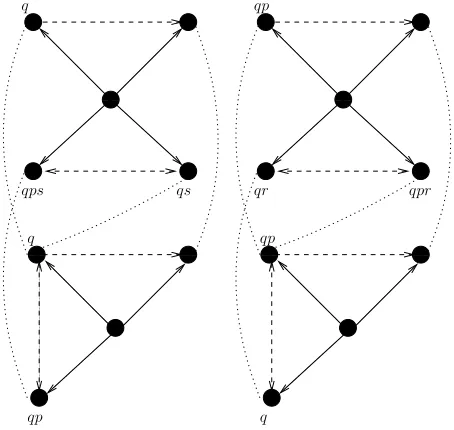
! !" " # #$ $ % %& & ' '( ( ) )* * ++ ++, , --. . / /0 0 11 112 2 3333 3333 3333 3333 3333 3333 3333 3333 4444 4444 4444 4444 4444 4444 4444 4444 5555 5555 5555 5555 5555 5555 5555 5555 6666 6666 6666 6666 6666 6666 6666 6666 7777 7777 7777 7777 7777 7777 7777 8888 8888 8888 8888 8888 8888 8888 9999 9999 9999 9999 9999 9999 9999 :::: :::: :::: :::: :::: :::: :::: ; ; ; ; ; ; ; ; ; ; ; ; ; ; < < < < < < < < < < < < < < ==== ==== ==== ==== ==== ==== ==== >>>> >>>> >>>> >>>> >>>> >>>> >>>> ???? ???? ???? ???? ???? ???? ???? ???? @@@@ @@@@ @@@@ @@@@ @@@@ @@@@ @@@@ @@@@ AAAAA AAAAA AAAAA AAAAA AAAAA AAAAA AAAAA AAAAA BBBB BBBB BBBB BBBB BBBB BBBB BBBB BBBB qp qr qpr qp q q qps qs q qp
Figure 1: Two bisimularions.
CDC CDCE E F FG G H HI I J JK K LDLDLDL LDLDLDL LDLDLDL LDLDLDL LDLDLDL LDLDLDL LDLDLDL MDMDMDM MDMDMDM MDMDMDM MDMDMDM MDMDMDM MDMDMDM MDMDMDM NDNDNDN NDNDNDN NDNDNDN NDNDNDN NDNDNDN NDNDNDN NDNDNDN NDNDNDN ODODODO ODODODO ODODODO ODODODO ODODODO ODODODO ODODODO ODODODO PDPDPDP PDPDPDP PDPDPDP PDPDPDP PDPDPDP PDPDPDP PDPDPDP QDQDQDQ QDQDQDQ QDQDQDQ QDQDQDQ QDQDQDQ QDQDQDQ QDQDQDQ RDR RDRS S T TU U V VW W X XY Y ZDZDZDZ ZDZDZDZ ZDZDZDZ ZDZDZDZ ZDZDZDZ ZDZDZDZ ZDZDZDZ ZDZDZDZ [D[D[D[ [D[D[D[ [D[D[D[ [D[D[D[ [D[D[D[ [D[D[D[ [D[D[D[ [D[D[D[ \D\D\D\ \D\D\D\ \D\D\D\ \D\D\D\ \D\D\D\ \D\D\D\ \D\D\D\ \D\D\D\ ]D]D]D] ]D]D]D] ]D]D]D] ]D]D]D] ]D]D]D] ]D]D]D] ]D]D]D] ]D]D]D] ^D^D^D^ ^D^D^D^ ^D^D^D^ ^D^D^D^ ^D^D^D^ ^D^D^D^ ^D^D^D^ _D_D_D_ _D_D_D_ _D_D_D_ _D_D_D_ _D_D_D_ _D_D_D_ _D_D_D_ qp q qp q
Theorem 2.28. The logic ΣL does not have interpolation. Proof. Consider the following two formulas
A(p, q, s) =def ¬Σ1q∧Σ1s∧2(s→q)∧2(p∧q→s),
B(p, q, r) =def ¬Σ1q∧Σ1r∧2(r→q)∧2(¬p∧q→r).
WriteAs =A(p, q, s) and Br =B(p, q, r). Then {As, Br} is inconsistent but
for no formula I = I(p, q) with all proposition variables among p, q we have ΣL`As→I and ΣL`Br→ ¬I. First their inconsistency. We have
`As∧Br→2(q↔r∨s),
as well as
`As∧Br→Σ1(r∨s).
Thus
`As∧Br→Σ1q.
So indeed{As, Br} is inconsistent.
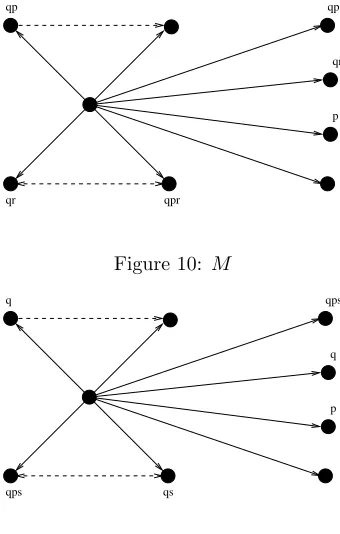
Now, to show that no interpolant exists, consider Figure 1. The upper left model forces As in its center point and the upper right model forces Br
in its center point. The upper left model is bisimilar w.r.t. {p, q} with the lower left as indicated by the dotted lines. Similarly for the two models on the right. Moreover if we replace in the lower two models theSwrelations by their
transitive closures, the two models become the same. This is clarified by Figure 2, where the lower two models of Figure 1 are drawn again but the left one is layed out a bit differently. Applying Theorem 2.25 and Theorem 2.27 we see that the upper two models force the same{p, q}-formulas in their center point. So clearly an interpolant forAs→ ¬Brcannot exist. a
From the above proof we can immediately extract the following corollary.
Corollary 2.29. There exist two models M and M0 and two worlds m ∈ M
andm0 ∈M0 such thatm and m0 force the same formula. But there does not
exist a bisimulation betweenM andM0 that connectsm andm0.
Proof. As was shown, the two center-points of (the restrictions to the proposi-tion variables{p.q}of) the two upper models of Figure 1 force the same formulas. One easily verifies directly that there does not exists a ({p, q}-)bisimulation that
connects those two points7. a
Two questions arise.
1. What additions to the language would make an interpolant ofAs→ ¬Br
exist and
7Below one can find an indirect argument for this fact, namely that no two bisimilar model
2. Can we simplify the proof by using two bisimilar models (the models in Figure 2 are not bisimilar).
To answer the first question we use the idea of an arithmetical semantics for a modal logic. The reader should first read Section 2.5 if (s)he is unfamiliar with this. A sufficient addition for an interpolant is Σ1-interpolability[7]:
IΣ1(φ, ψ) =∃σ(Σ1(σ)∧2(φ→σ)∧2(σ→ψ).
For any mapping∗: PROP−→‘arithmetical sentences’8clearly:
PA`A(p∗, q∗, s∗)→IΣ1(p
∗∧q∗, q∗) (13)
and
PA`B(p∗, q∗, r∗)→I
Σ1(¬p
∗∧q∗, q∗).
Moreover
PA`Σ1q∗↔IΣ1(q
∗, q∗).
Lemma. For allφ0,φ1 andψ. PA`IΣ1(φ0, ψ)∧IΣ1(φ1, ψ)→IΣ1(φ0∨φ1, ψ).
Proof. Reason in PA. Assume that for some σ0: Σ1(σ0), PA ` φ0 → σ0 and PA ` σ0 → ψ. And assume that for some σ1: Σ1(σ1), PA ` φ1 → σ1 and PA` σ1 →ψ. Then PA ` σ0∨σ1 → ψ and PA` φ0∨φ1 → σ0∨σ1. Since
Σ1(σ0∨σ1), this concludes the proof. a
So, by the above lemma:
PA`IΣ1(¬p
∗∧q∗, q∗)∧I
Σ1(p
∗∧q∗, q∗)→I
Σ1(q
∗, q∗).
So
PA` ¬Σ1q∗∧IΣ1(¬p
∗∧q∗, q∗)→ ¬I
Σ1(p
∗∧q∗, q∗).
And thus
PA`B(p∗, q∗, r∗)→ ¬I
Σ1(p
∗∧q∗, q∗). (14)
So, combining (13) and (14), if we could express Σ1-interpolability, by a (modal) formulaIΣ1(p, q) say, then the formulaIΣ1(p∧q, q) is an interpolant forAs→
¬Br.
In [7] a modal theory, which language contains, besides the 2, an operator
for Σ1-interpolability, is developed. And indeed this logic has the interpolation property. This logic is also evaluated on Veltman frames and the same notion of bisimulation that we used is appropriate for this extended9 logic. But this answers the second question: We will not be able to give two bisimilar models that differentiate between As and Br. (Since in this enriched language of
Σ1-interpolabilty we do have an interpolant.) The harmless looking Theorem 2.25 is thus an essential part of our present argument that shows Theorem 2.28.
8Actually∗should map to G¨odel numbers of arithmetical sentences but we are only sketch-ing an idea.
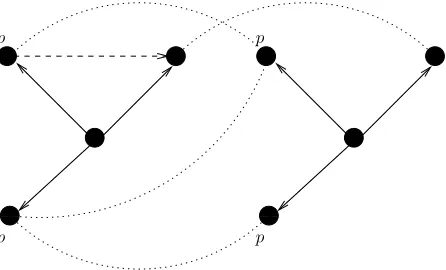
p p p p
Figure 3: ¤-bisimilar but not σ-bisimilar.
With one of the goals of our investigation in mind: extending ILM in such a way that we get interpolation, it is reasonable to think about an extension of the present result to a combination of ILM with ΣL. Let us therefore state and investigate a notion of bisimulation for IL-formulas.
Definition 2.30 (IL-bisimulation). LetM andM0 be two models and P a
set of proposition letters. A relationZ ⊆M ×M0 is anIL-bisimulation w.r.t. P if
1. wZw0 ⇒ for eachp∈P: w∈V(p)⇔w0∈W(p),
2. If wZw0 and wRv then there exists somevZv0 such that w0Rv0 and for
eachv0S
w0u0 there exists someuZu0 withvSwu, 3. Same as 2 withM andM0 interchanged.
Of course we have a theorem asserting that two IL-bisimilar (w.r.t. P) models force the same IL-formulas (with proposition letters inP) in bisimilar points [18].
One difficulty arises. The two notions of bisimulation are incomparable. We say that two models are IL(ΣL)-bisimilar if a IL(ΣL)-bisimulation w.r.t. PROP exists.
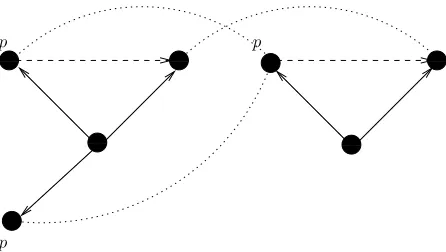
Fact 2.31. There are two models which areΣL-bisimilar but notIL-bisimilar. And there are two models which areIL-bisimilar but not ΣL-bisimilar.
Proof. The proof is contained in Figures 3 and 4. Namely the claimed bisimu-lations are indicated and the models in 4 are distinguished byp¤¬pand those
in Figure 3 by Σ1p. a
p p p
Figure 4: σ-bisimilar but not¤-bisimilar.
2.5
Arithmetical interpretation
It is possible to give an arithmetical meaning to ΣL-formulas. We will however first extend the logic ΣL to a logic ΣILM, give arithmetical meaning to the ΣILM-formulas and project this on ΣL. The reader is referred to Section 4.2 for details.
3
The logic
Σ
ILM
In Section 3.1 we elaborate some more on ILM. In Sections 3.2 and 3.3 the logic ΣILM and a modal semantics is introduced. This semantics are not the most obvious one. In Section 3.3.1 we explain why we deviate from the more obvious choice. In Section 3.4 and 3.5 we show that ΣILM is sound and complete w.r.t. the proposed semantics. In Section 3.6 we extend the results in Section 2.4 to show that ΣILM lacks interpolation. In Section 4 we give arithmetical meaning to ΣILM and in Section 4.2 we reflect this on ΣL.
3.1
ILM
The interpretability logic of PA known as ILM has been introduced in Section 1.1. To investigate this logic we can evaluate IL-formulas on the same frames we have used for ΣL. But first let us prove a lemma.
Lemma 3.1. The following is provable inIL. 1. 2¬A↔A¤⊥,
2. A∨3A¤A.
3. A∧2¬A¤B →A¤B,
Proof. (1.) By IL Axiom 6: IL`A¤⊥ →(¬3⊥ → ¬3A). Trivially IL` ¬3⊥,
3. (2.) By Axiom 3: IL`A¤A. 2 follows if we combine this via Axiom 5 with
Axiom 7. (3.) We use the following fact about GL (see [10]):
GL`A→(A∧2¬A)∨3(A∧2¬A).
Using necessitation and Axiom 3: IL`A¤(A∧2¬A)∨3(A∧2¬A) and then using part 2 of this lemma and Axiom 4:
IL`A¤A∧2¬A.
So, again using Axiom 4, we conclude IL`A∧2¬A¤B→A¤B. a
Note that the first item allows us to only consider ¤ and define 2A as
(¬A)¤⊥.
Definition 3.2 (IL forcing relation).IfM =hW, R, S, Visuch thathW, R, Si
is a Veltman frame andV is a valuation onWthen let|=M bethe unique relation
between worldsw∈M andIL-formulaswhich satisfies: 1. w|=M p⇔w∈VM(p),
2. w|=M A¤B ⇔for eachwRusuch thatu|=M Athere existsuSwvsuch
thatv|=M B,
3. The usual clauses for propositional connectives.
The proper Veltman frames differ slightly from those for ΣL.
Definition 3.3 (IL-frame). A tripleF =hW, R, Siis called anIL-frame ifF
is a frame and
1. Ris transitive and conversely well-founded,
2. for alla, b, c, w, t
(a) wRaRb⇒aSwb,
(b) aSwbSwc⇒aSwc,
(c) wRa⇒aSwa.
Definition 3.4 (ILM-frame). A triple F =hW, R, Siis an ILM-frame if it is an IL-frame and satisfies the additional requirement (M):
aSwbRc⇒aRc.
As usual we can talk about the validity of an IL-formula on a frame and it turns out that we have the following theorem (see [10][4]).
3.2
The logic
ΣILM
In this section we begin the development of an arithmetically complete logic which can talk about both Π1-Conservativity and Σ1-ness. The Π1-Conservativity part is taken to be ILM except for the (M) axiom, which we can replace by Σ1C∧(A¤B)→A∧C¤B∧C. The Σ1 part of the logic is simply ΣL from
Section 2. The resulting logic will we denote by ΣILM.
Definition 3.6 (ΣILM-formulas). ΣILM-formulas are built up from vari-ables in PROP, propositional connectives, unary operators2 and Σ1 and the
binary operator¤.
Definition 3.7 (ΣILM). ΣILM is the set of schemata IL + ΣL together with the schemaM(Σ):
Σ1C∧(A¤B)→A∧C¤B∧C.
The logicΣILM is the smallest set of ΣILM-formulas which contains the uni-versal closure of all the ΣILM schemata and is closed under modus ponens and necessitation. We write ΣILM`A, or`A, forA∈the logicΣILM.
Ideally we would like to prove this logic to be complete with respect to the class of frames which both satisfy the ΣL- and ILM-frame conditions. And this can indeed be done except for the fact that we must then allow for infinite models.
This, however, makes the situation somewhat problematic if we want to show the logic to be arithmetically complete. As in [1] we could introduce the notion of a primitive recursive model. These are models which, among other things, have as their domain a primitive recursive set of numbers so that (for instance) PA can easily talk about them, almost as easily as with finite models (which are a particular case of primitive recursive models). But since our construction works with maximal consistent sets of formulas and selecting (or constructing) a specific maximal consistent set requires decidability, the arithmetic theory (PA in our case) needs to know that ΣILM is decidable, which we, at this point, did not even show for ourselves.
Therefore we will show ΣILM to be modally complete with respect to a slightly modified semantics in which we have translated some of the frame prop-erties into the forcing relation.
3.3
Modal semantics
3.3.1 A complication
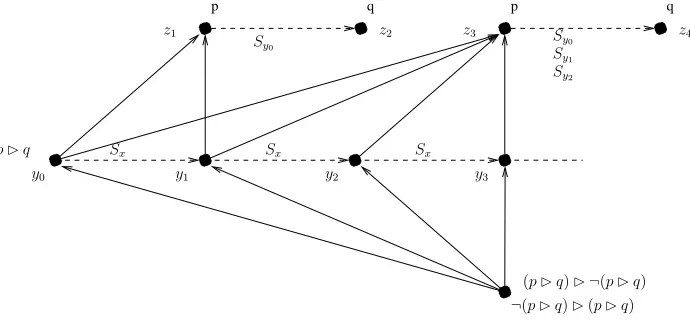
As mentioned, simply taking the intersection of all the ΣL- and ILM-frames will not give the finite model property. Let us show this assertion.
Proof. LetAbe the formula
3(p¤q)∧((p¤q)¤¬(p¤q))∧(¬(p¤q)¤(p¤q)).
LetM =hW, R, S, Viwhere
1. W ={x}+{y0, y1, y2, y3. . .}+{z1, z2, z3, . . .}, 2. i≥0⇒xRyi,i≥1⇒xRzi,
3. Ifiis even andi < j thenyiRzj,
4. Ifiis odd then yiRzi and ifi+ 1< j thenyiRzj,
5. i≤j⇒yiSxyj,
6. Ifiis odd and j < i,ziSyjzi+1,
7. V(p) ={z1, z3, z5, . . .}andV(q) ={z2, z4, z6, . . .},
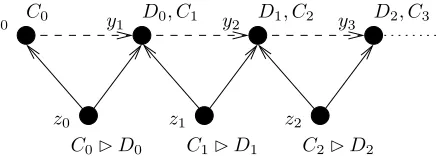
ThenM satisfies all the requirements and forcesA inx. A part of M is shown in Figure 5. For clarity some arrows which should be there sinceRand theSw’s
are transitive,wRa⇒aSwaand aSwb⇒wRa, b are not drawn. It remains to
q p q
p
Sy0 Sy0
Sy1 Sy2
Sx
Sx Sx
y2 y3
y1
y0
z1 z3
¬(p¤q)¤(p¤q) p¤q
(p¤q)¤¬(p¤q) z4
[image:25.612.136.481.325.487.2]z2
Figure 5: Initial part ofM.
show thatAdoes not have a finite model with the required property. So letN
be any model satisfying
aStb∧cSbd⇒cSad. (15)
Letn∈N be such thatn|=A. Letu=u0, u1, u2, . . .be a sequence of worlds ofN such that
a. For alli≥0,uiSnui+1,
c. For alli≥0u2i+1|=¬(p¤q).
Such a sequence exists since n |= A, it might however be cycling. We claim that this is not so: the set{ui |i≥0} is infinite. For suppose it is not. Then
there existsi < j such thatui =uj. Assume iis even (the case iis odd goes
similarly). We have uiSnui+1Snuj = ui. Moreover, since i+ 1 is odd by 3,
we can choose someui+1Rv such thatv |=pand for novSui+1w: w|=q. By
property (M) of ILM-framesuiRvand thus there exists somevSuiwsuch that
w|=q. ButvSuiwandui+1Snui implyvSui+1wby (15), a contradiction. a
3.3.2 ΣILM semantics
As we have seen above (Theorem 2.25) taking theSwrelations to be transitive
does not harm the ΣL completeness result. It is even easier to see that taking theSw’s reflexive is harmless as well. Modifying the modal completeness proof
for ILM as to incorporateaSvb∧wRv⇒aSwb(and keeping the model finite) is
no problem either but the remaining property: aSvb∧wStv⇒aSwbis somewhat
of a problem as we have shown above. The solution is to transfer this frame property into the forcing relation.
Definition 3.9 (ΣILM-frame). A ΣILM-frame is a Veltman framehW, R, Si
such that
1. Ris transitive and conversely well-founded,
2. for alla, b, c, w:
(a) aSwb⇒wRa, b,
(b) aSwbRc⇒aRc,
(c) wRaRb⇒aSwb,
(d) aSwbSwc⇒aSwc,
(e) aRb⇒bSab.
Definition 3.10 (ΣILM-model). hW, R, S, Viis a ΣILM-model ifhW, R, Si
is a ΣILM-frame andV is a mapping PROP−→ P(w).
Definition 3.11 (ΣILM forcing relation). For a modelM, let |=M be the
unique relation betweenWM andΣILM-formulas satisfying:
1. w|=M p⇔w∈VM(p),
2. w|=M A¤B ⇔ for allwRv such thatv |=M Athere exists some vSwu
such thatu|=M B,
3. w|=M Σ1A⇔for all vSw0usuch thatw(R∪S
u∈MSu)
∗w0: v |=
M A⇒
u|=M A (see Figure 6),
Sv A
v
R∪Sw∈MSw
R∪Sw∈MSw
¬A
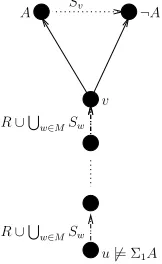
[image:27.612.262.343.77.209.2]u6|= Σ1A
Figure 6: Σ1Ais not forced inu.
As usual we writeM, w|=A forw|=M A or even, when there is no danger of
confusion,w|=A.
Using this forcing relation we define frame validity as usual: Ais valid on a frameF ifw|=M Afor any model M =hWF, RF, SF, Viandw∈M.
3.4
Modal soundness
Theorem 3.12 (Modal Soundness). If ΣILM ` A then F |= A for any
ΣILM-frameF.
Proof. Frame validity is preserved under modus ponens and necessitation. Clearly all propositional tautologies are valid on all frames so it is sufficient to show that all the ΣILM schemata are valid on each frame.
The ΣL part is just like in the modal soundness for ΣL (Theorem 2.7). Where the change in the forcing relation compensates for the change in frame properties.
So it is sufficient to show that the schema M(Σ) and all IL schemata involving the operator¤are valid. Below letM be a ΣILM-model andw, u, v, v0∈M.
Supposew|=2(A→B). SupposewRuandu|=A. Thenu|=B and thus
sinceuSwu: w|=A¤B.
Suppose w |= A¤B and w |= B¤C. Suppose wRu and u |= A. Then for some v0: uS
wv0 and v0 |=B and thus for some v: v0Swv and v |=C. By
transitivity ofSw: uSwv.
Supposew|=A¤C andw|=B¤C. SupposewRuandu|=A∨B. Then
u|= A or u |= B and in either case there exists some v such that uSwv and
v|=C.
Supposew|=A¤B andw|=3A. Then for someu: wRuandu|=A. Thus
for somev: uSwv andv|=B. SinceSw⊆ {(a, b)|wRa, b}: w|=3B.
SupposewRuand u|=3A. Then there existsv such that uRv andv |=A
Supposew|= Σ1C,w|=A¤B. SupposewRuand u|=A∧C. Then there
existsv such thatuSwv andv|=B. Sincew|= Σ1C alsov|=C. a
3.5
Modal completeness
3.5.1 Introduction and definitions
In this section we are to prove the modal completeness theorem for the logic ΣILM.
Theorem 3.13 (Modal completeness). Suppose ΣILM 6` A. Then there exist aΣILM-model M and some m∈M such that m6|=A. Moreover we can take form a root ofM (that is: ∀m0∈M(m06=m→mRm0)).
The method used will be the same as for ΣL above, that is we will be using labeled frames, identify ‘problems’ in these frames and prove an extension theorem which solves these problems. This method was first applied in [12] to give a modal completeness proof for ILM. Consequently we will be using the same concepts, notations and definitions as before but then translated to the case at hand (e.g. maximal consistent sets are ΣILM-consistent in stead of ΣL-consistent, etc). Also we again use the notion of a relevant set (Definition 2.11).
Applying that method will not go as smoothly as in the case of ΣL. If we simply take the truth definition of¤and deny this to create the definition
of a problem we will not be able to prove an analogue of Lemma 2.15 (once problems are solved they do not reoccur). The solution is to broaden the notion of a problem in such a way that, although we do a bit too much, we do have that once a problem is solved, it will not return. To this end let us first extend the notion of a (labeled) frame.
Definition 3.14 (Labeled frames). Alabeled frameis a quintuplehW, R, S, Re, νi
such that
1. hW, R, Siis a frame,
2. ν is a functionW −→MCS and
3. Re ⊆ {A | Aa ΣILM-formula} ×W ×W such that for each B: RBe =
{(u, v)|(B, u, v)∈Re} ⊆R.
Having this extended notion of a frame we define problems as follows:
Definition 3.15 (X-problems). LetXbe a set of formulas. AnX-problemin a labeled framehW, R, S, Re, νiis a worldw∈W and a formulaA∈ν(w)∩X
such that one of the following two cases applies:
1. A=¬(C¤D) and there does not existwRDev withC∈ν(v).
Notice that this definition differs from problems in labeled frames in the more natural sense:
¬(B¤C)∈νF(w) but for allv for whichwRvandB∈νF(v)
we have ausuch thatvSwuandC∈νF(u). (16)
The ¤ parts in Definition 3.15 and (16) are incomparable. A labeled frame
without any problems in the sense of Definition 3.15 might still posses problems in the sense of (16). (And the other way around.) A lot of work will be put in ensuring that Definition 3.15 will be good enough on the frames we will be considering.
Moreover the Σ1 part in problems as defined above is stronger than we ac-tually need for Theorem 3.13. This stronger version is useful in the arithmetical completeness theorem below so we give it a name.
Definition 3.16 (StrongΣ1 ΣILM-models). A ΣILM-model isstrongΣ1 if wheneverM, w|=¬Σ1A then there existuand v withuSwv such that u|=A
andv6|=A.
Theorem 3.17 (Extended modal completeness). SupposeΣILM6`Athen there exist a strongΣ1 ΣILM-modelM andw∈M such that wis a root ofM
andM, w6|=A.
Before we move on let us note that we now do have an analogue of Lemma 2.15.
Lemma 3.18. Suppose F ⊆G are labeled frames, u∈ F, A a formula such that (u, A) is not anX-problem in F. Then (x, A) is not an X-problem in G
either.
Proof. Trivial. a
How are we to ensure that our notion of a problem is appropriate? Let us fix a worldv. The intention of the relationReis to provide for an example for
v|=¬(B¤C) whenever¬(B¤C)∈ν(v).
Let us say that a worldw avoids a formulaC if for anyufor which wSvu
we haveC 6∈ν(u). Then we organize things so that, (1) for any D, vRD
ew⇒
‘wavoidsD’ and (2) if¬(B¤C)∈ν(v) then there existswsuch thatvRC ew.
We would like to recognize whether a world is avoiding by only considering the world itself. An attempt to this is the notion of critical successor [4].
Definition 3.19 (Critical successor). Let ∆ and Γ be MCS’s. We say that ∆ is aB-critical successor of Γ and write Γ≺B∆ if Γ≺∆ and for eachAfor
whichA¤B∈Γ: ¬A,2¬A∈∆.
Lemma 3.20. Let ∆, Γ andΓ0 be MCS’s and B a formula. If ∆≺
B Γ≺Γ0
then∆≺B Γ0.
Proof. ∆ ≺Γ0 is clear. SupposeA¤B ∈∆. Then 2¬A∈ Γ and thus, since
Part of Definition 3.19 is clear. If A ∈ ν(v) and A¤B ∈ ν(w) then by
the truth definition of ¤(and by anticipating on a truth lemma) there must
exist somevSwusuch that B ∈ν(u), precisely what we are trying to avoid. If
¬2¬A ∈ν(v) then for some vRu: A ∈ ν(u). By transitivity of R: wRu and
thus there exists someu0 withuS
wu0andB∈ν(u0). ButwRvRuimpliesvSwu
and so by transitivity ofSw: vSwu0, again not what we want.
So
v avoidsB⇒ν(w)≺B ν(v).
Can we strengthen this to get a sufficient condition forvto avoid a formulaB? Yes:
v avoidsB ⇔ ∀u(vSwu⇒ν(w)≺Bν(u)).
Since ILM`B¤B the sufficiency is clear. Necessity is easily shown by using
transitivity ofSwandR.
Let us identify the worlds we have to check whether indeed these RB e
suc-cessors avoid what they should in such a situation.
Definition 3.21 (Critical cones CB
x). IfhW, R, S, Re, νiis a labeled frame,
B a ΣILM-formula andx∈W. Then theB-critical cone ofx, denoted byCB x,
is defined to be the smallest set such that:
1. xRB
ey⇒y∈CxB,
2. y∈CB
x ∧ySxz⇒z∈CxB,
3. y∈CB
x ∧yRz⇒z∈CxB.
Our main concern will be to ensure that theCB
x-Critical cones (indeed) lie
B-critically abovex.
As in the ΣL case there is more than just solving problems (but see the remarks before Definition 3.23). There is the issue of reasonability. In this notion we have incooperated the above considerations on the critical cones. And an additional technical requirement.
Definition 3.22 (Reasonable). A labeled frameF is calledreasonable if 1. For eachB, x∈F andy∈CB
x: ν(y) liesB-critically aboveν(x),
2. For eachxandB6=B0: CB x ∩CB
0
x =∅,
3. xRy⇒νF(x)≺νF(y),
4. xSzy⇒νF(x)⊆Σ1,νF(z)ν F(y).
If we compare the notions introduced in this section to the corresponding notions in the ΣL case we see a difference.
Suppose we want to show that a labeled, reasonable, ΣL-frame F without problems satisfies a (ΣL) truth lemma: ‘v |=A ⇔A ∈νF(v)’. If we proceed
by induction onAthen the nonexistence of problems handles the¬2and¬Σ1
of such a treatment lies in the quantifier complexity of the¬2and ¬Σ1 truth
definitions (∃) and the quantifier complexity of the 2and Σ1 truth definitions
(∀).
The formulation of truth of an IL-formula has, however, quantifier complex-ity ∀∃ and its negation, thus,∃∀. Via the introduction of the relation Re we
will manage to handle the¬(A¤B) truth definition as if it has quantifier
com-plexity∃. Luckily a property of a labeling functionνwith quantifier complexity
∀∃behaves quite well under frame extensions (Lemma 3.25 and Lemma 3.24). So problems in frames involving a formula B¤C, called defects, are handled
‘directly’.
Definition 3.23 (X-defects). AnX-defect in a labeled framehW, R, S, Re, νi
is a worldw∈W together with a formulaC¤D∈ν(w)∩X such that for some
wRvwithC∈ν(v) there does not exists avSwuwithD∈ν(u). In this case we
say that (w, A) is anX-defect (or simply defect when X is understood) w.r.t.
v.
Lemma 3.24. If F ⊆G are labeled frames, B a formula and x, y ∈ F such that(x, B)is a defect w.r.t. y inGthen(x, B)is a defect w.r.t. y inF.
Proof. Trivial. a
Lemma 3.25. LetF0⊆F1⊆F2⊆ · · · be a chain of labeled frames. If for each
i≥0 Fi is reasonable then so is F =Si≥0Fi.
Proof. Trivial. a
And, of course, besides ensuring a truth lemma we need to make sure that our model satisfies the ΣILM-frame properties:
Definition 3.26 (ΣILM-closure). IfF =hW, R, Siis a finite frame such that
R is conversely well-founded. Then the ΣILM-closure of F is defined as the intersection of all ΣILM-frames with domainW (the domain ofF) which extend
F.
Lemma 3.27. Let F =hW, R, Si be a finite frame such that R is conversely well founded. IfGis theΣILM closure ofF then:
1. Gis aΣILM-frame,
2. If(x, y)∈RG or, for somet,(x, y)∈SG
t . Then there exists azsuch that
(z, y)∈RF and(x, z)∈(RF∪S
x∈FSxF)∗,
3. Gis reasonable if F is.
Proof. Since the intersection of any set of ΣILM-frames is a ΣILM-frame and there exists at least one frame extendingF which satisfies all the ΣILM-frame properties the first assertion is trivial. Knowing this it is easy to see that the ΣILM closure is equal to the union of a chainF0⊆F1⊆ · · · which satisfies10:
10SinceF is finite any such chain will do. If we allowF to be infinite we need to be more
1. F0=F, 2. Fori≥1:
(a) xRFiyRFiz but notxRFiz andF
i+1=hW, RFi+{(x, z)}, SFiior (b) xSFi
t yRzbut notxRFiz andFi+1=hW, RFi+{(x, z)}, SFiior (c) xSFi
t ySFtiz but notxStFizandFi+1=hW, RFi, SFi+{(x, t, z)}i or (d) xRFiy but notySFi
x y andFi+1=hW, RFi, SFi+{(x, y, y)}i. (e) xRFiyRFiz but notySFi
x zandFi+1=hW, RFi, SFi+{(y, x, z)}ior (f) Fiis a ΣILM-frame andFi+1=Fi.
Now one easily shows that 2 holds for eachFi in such a chain and therefore
forGas well.
To show 3 only that the ΣILM-closure satisfies 3.22-1 needs a proof. We show that 3 holds for eachFi with induction oni. The critical cones inF0and
F1 are equal to those in F so assume i ≥ 1. Suppose we are in situation 2e. Since successors of critical successors are themselves critical successors (Lemma 3.20)Fi+1 satisfies 3.22-1 ifFi does. The other cases are handled similarly. a
3.5.2 Tools
As in the ΣL case we need some mathematical facts on maximal consistent sets. In one of the proofs below we will be using a well-known equivalent (equivalent in ZF set theory) of the axiom of choice known as ‘Zorn’s lemma’, which reads as follows: If (X,≤) is a partial order such that any chain has an upper bound then (X,≤) has a maximal element, that is: there exists somex∈X such that for ally∈X: x≤y⇒x=y. See for example [14].
Lemma 3.28. Suppose∆ is anMCSand¬Σ1A∈∆. Then there exist MCS’s
Γ0 andΓ1 such that Γ0⊆Σ1,∆Γ1,A∈Γ0,A6∈Γ1 andΣ1A∈Γ0∩Γ1.
Proof. This lemma has been proven in the context of ΣL above (Lemma 2.20).
Exactly the same proof works here. a
Lemma 3.29. If∆is anMCSand¬(B¤C)∈∆then there exists an MCS Γ
such that∆≺C Γ,B∈Γ and2¬B∈Γ.
Proof. Let ∆, B,C be as in the condition of the lemma. Then the set
{D,2D|2D∈∆}+{2¬A,¬A|A¤C∈∆}+{B,2¬B} (17)
is consistent. For suppose it is not. Then there exist D0, . . . , Dk, A0, . . . , Al
such that:
` ^
0≤i≤k
(Di∧2Di)∧
^
0≤i≤l