Words with Attitude
Jaap Kamps and Maarten Marx
Institute for Logic, Language and Computation University of Amsterdam
Nieuwe Achtergracht 166 1018WV Amsterdam
the Netherlands
kamps,marx @illc.uva.nl
Abstract
The traditional notion of word meaning used in natural language processing is literal or lexical meaning as used in dic-tionaries and lexicons. This relatively objective notion of lexical meaning is different from more subjective notions of emotive or affective meaning. Our aim is to come to grips with subjective aspects of meaning expressed in writ-ten texts, such as the attitudes or value expressed in them. This paper explores how the structure of the WordNet lexi-cal database might be used to assess af-fective or emotive meaning. In particu-lar, we construct measures based on Os-good’s semantic differential technique.
1 Introduction
The traditional notion of word meaning used in natural language processing is literal or lexical meaning. This is the way the meaning of words is explained in dictionaries and lexicons. And, as may come as no surprise, the majority of re-search in natural language processing deempha-sizes other aspects of meaning. Yet at the same time, we find a myriad of notions of meaning in
This research was supported by the Netherlands Orga-nization for Scientific Research (NWO, grants # 400-20-036 and # 612-62-001). Thanks to Patrick Blackburn, Michael Masuch and Ivar Vermeulen for their comments, and to Rob Mokken for suggesting Osgood’s semantic differential tech-nique. All data is derived from Princeton WordNet 1.7, using Perl and Dan Brian’s excellentLingua::Wordnetmodule.
the writings of philosophers, linguists, psycholo-gists, and sociologists. This is not the place to have an extensive discussion on the meaning of meaning, but our aim will be to bring other no-tions of meaning into natural language process-ing. In particular, we will be interested difference between the relatively objective notions of lexical meaning, and more subjective notions of emotive or affective meaning.
Suppose we can evaluate the subjective mean-ing expressed in a text. This would allow us to classify documents on subjective criteria, rather than on their factual content. This can be as radi-cal a change as categorizing the screws in a repair shop’s inventory by their beauty, instead of their size and material. This may not be very practi-cal for a repair shop, but document classification does not require a physical rearrangement of ob-jects. As a result, it would simply provide an ad-ditional classification criterion. It is not difficult to envision cases in which precisely a subjective categorization is desirable and useful.
automatically.
Our working hypothesis is that subjective as-pects of meaning can be derived from the partic-ular choice of words in a text. That is, there are indeed words with attitude or values. Prominent candidates for this are modifiers, such as descrip-tive adjecdescrip-tives like ‘beautiful’ or ‘good’ (and their antonyms ‘ugly’ and ‘bad’). This paper explores how to assess more subjective aspects of mean-ing by usmean-ing the structure of the WordNet lexical database (Miller, 1990; Fellbaum, 1998). At first glance, this may appear not a very good choice because the words in WordNet are structured by their lexical meaning. In particular, the synonymy or SYNSET relation in WordNet represents the coincidence of lexical meaning. However, the or-ganization of WordNet is not a conventional al-phabetical list, but a large interconnected network of words (resembling the organization of human lexical memory). It is precisely this larger Word-Net structure that we want to exploit.
This paper is structured as follows. In 2, we will discuss a classical theory for measuring af-fective or emotive meaning. From this we take the major factors that differentiate between val-ues or attitudes. Then, in 3 we explore how we can translate the structure of WordNet into a mea-sure for these factors. Next, in 4 we discuss how such measures can be implemented, and we end in 5 with conclusions and some discussion.
2 Affective Aspects of Meaning
Our aim is to measure the subjective meaning ex-pressed in a text. For such an enterprise to be suc-cessful, there must be sufficient generality in the semantic dimensions used by individuals. This immediately prompts a number of questions: do such generic semantic dimensions exist at all? And if so, can we characterize these specific se-mantic dimensions?
The classic work on measuring emotive or af-fective meaning in texts is Charles Osgood’s The-ory of Semantic Differentiation (Osgood et al., 1957). Osgood and his collaborators identify the aspect of meaning in which they are interested as
a strictly psychological one: those cognitive states of human language users which are neces-sary antecedent conditions for selective encod-ing of lexical signs and necessary subsequent
conditions in selective decoding of signs in mes-sages. (Osgood et al., 1957, p.318)
Their semantic differential technique is using sev-eral pairs of bipolar adjectives to scale the re-sponses of subjects to words, short phrases, or texts. That is, subjects are asked to rate their meaning on scales like active–passive; good– bad; optimistic–pessimistic; positive–negative; strong–weak; serious–humorous; and ugly– beautifully.
Each pair of bipolar adjectives is a factor in the semantic differential technique. As a result, the differential technique can cope with quite a large number of aspects of affective meaning. A natural question to ask is whether each of these factors is equally important. Osgood et al. (1957) use fac-torial analysis of extensive empirical tests to in-vestigate this question. The surprising answer is that most of the variance in judgment could be ex-plained by only three major factors. These three factors of the affective or emotive meaning are the evaluative factor (e.g., good–bad); the potency factor (e.g., strong–weak); and the activity tor (e.g., active–passive). Among these three fac-tors, the evaluative factor has the strongest rela-tive weight. In the next section, we will focus on this most important factor of affective meaning.
3 Affective Meaning and WordNet
We will now investigate measures for the eval-uative factor of meaning based on the WordNet lexical database (Fellbaum, 1998). The WordNet database has entries on the level of words (just as traditional dictionaries and lexicons). The unit of evaluation we are interested in is not individual words, but larger units of text, such as phrases, paragraphs, and larger units. We will proceed as follows: we will first investigate WordNet-based measures for individual words, and then consider ways of aggregating the scores of indi-vidual words to larger textual units. For example, an obvious way is to view a textual unit as a bag of words, and evaluate the text by combining the scores for the individual words in the text.
eval-uative adjectives in WordNet we find that they are each other’s antonym. Our plan is to evaluate in-dividual words by determining their relation to the words ‘good’ and ‘bad’ in the WordNet database. For this, we can use the synonymy relation (or a generalization of it) to establish the relatedness of two words. That is, WordNet’s SYNSET rela-tion may provide a handle to determine Osgood’s evaluative factor.
We will define the notion of -relatedness based on the SYNSET relation.
Definition 1 Two words and are -related
if there exists an
-long sequence of words
such that for each
from to
the two words and are in the same
SYNSET.
For example, the adjectives ‘good’ and ‘proper’ are -related since there exists a! -long sequence
#"%$&$(' )+*
"-,/. 0)
$
0%1)2. Two words may of course be related by many different sequences, or by none at all. We will mainly be interested in the shortest sequences relating words. The minimal path-length (MPL) of two words and43 is if there is an
56 -long sequence relating and 43 and there is no sequence with length 78 . If there is no sequence relating the two words, then the minimal path-length is undefined.
Definition 2 Let 9;:< be a partial function such
that 9;:=<
> 43/@?A if is the smallest number
such that and43 are -related.
The minimal path-length enjoys some of the geometrical properties we might expect from a distance measure.
Observation 1 The minimal path-length is a
metric, that is, it gives a non-negative number
9;:<
> 43/ such that
i) BCED/FHGJILK+GNMPONQR if and only ifGJI&QGNM ,
ii) BCEDFHG I K+G M ONQSBCEDFHG M K+G IO, and
iii) BCEDFHG I K+G M O&TBCEDUFHG M K+GWVXOZY[B\C(D/FHG I K+GWVPO. The minimal path-length is a straightforward generalization of the synonymy relation. The synonymy relation connects words with similar meaning, so the minimal distance between words says something on the similarity of their meaning. For example, using WordNet we now find that
]
9;:=< #"%$&$('
0)
$
0%1) ^?A ,
]
9;:=< #"%$&$('
_U1`
.
@?! , and
]
9;:< _ 1 ^?6d .
This suggest that we can use the 9;:=< dis-tance measure for determining Osgood’s evalu-ative dimension, for example by scoring words that are closely related to the words ‘good’ and ‘bad’ respectively. That is, we might consider using the distance to the word ‘good’ as a mea-sure of ‘goodness.’ This makes sense considering the SYNSET relation in WordNet is representing similarity of meaning, and our 9;:< is a straight-forward generalization of the SYNSET relation.
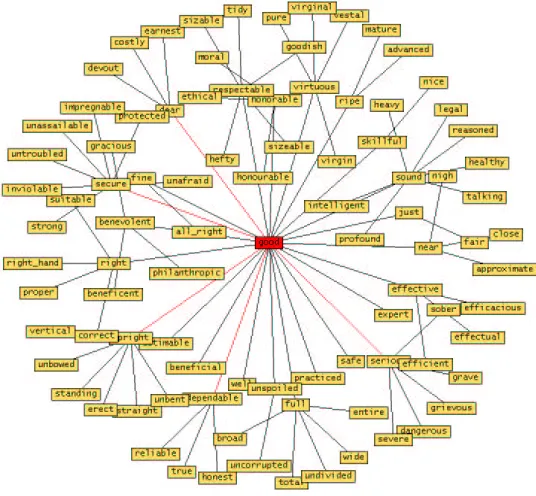
Figure 1 shows the minimal-path lengths of a selection of adjectives to the adjective ‘good’ based on the WordNet database.1 Inspection of such a cloud of words gives us some confidence in the use of 9;:=< as a measure for similarity of meaning. Note that we do not claim that the val-ues obtained in this way are a precise scale for measuring degrees of goodness. Rather, we only expect a weak relation between the words used to express an positive opinion and their distance to words like ‘good.’
However, further experimentation quickly re-veal that this relation is very weak indeed. It turns out that the similarity of meaning waters down re-markably quick. A striking example of this is that we also find that ‘good’ and ‘bad’ themselves are closely related in WordNet.
Observation 2 There exists a 5-long sequence
#"%$($&' fe
$Eg
_
'
,
1`h/i-a
*
"
a
`
'
. So, we have that 9;:=<
#"%$&$('
a
`
'
@?6d .
Even though the adjectives ‘good’ and ‘bad’ have opposite meaning—they are antonyms—they are still closely related by the synonymy relation.2 As a result of this, we must seriously question whether the relatedness to the word ‘good’ is a measure of ‘goodness,’ since any word related to ‘good’ is at most slightly less close-related to ‘bad.’
Observation 3 For any , if9;:=<
#"%$($('
j4?6
thenkSdl7m9;:=< na
`
'
75od .
1
To be more precise: these are all adjectives G with B\C(D/FHpPqqrsKLGtOZuv and word familiarity or polysemy count Yv .
2
Figure 1: Part of the WordNet database from the vista point of adjective ‘good.’ The edges are SYNSET relations, nodes are only connected by a shortest path.
Figure 2: The MPL’s to adjectives ‘good’ and ‘bad’. Nodes are connected by edges of length corre-sponding to the 9;:=< .
Good Bad
1 0.5 0 −1 1
1
1 −1 −1 −1 −1 −1
0 0 0
0.25 −0.25 0.75 −0.75
0.5
−0.5 −0.5 0.25 −0.25 0.25 −0.25
−0.5
−0.75 0.5
0.75
1 1
[image:4.612.186.413.556.643.2]We seem to be at a dead-end: the WordNet database gives us similarity of meaning by its SYNSET relation, but its straightforward gener-alization 9;:< fails to provide a general measure of coincidence of meaning.
At this point several strategies present them-selves. We might argue that, despite of obser-vation 3, we may still expect some correlation between the opinion expressed in a text, and (a refined version of) a distance measure like 9;:=< . Here, we will pursue an alternative strategy based on the fact that any word that is related to the ad-jective ‘good’ is also related to the adad-jective ‘bad’ (and vice versa). That is, we will use observa-tion 3 to our advantage.
For each word, we can consider not only the shortest distance to ‘good’ but also the shortest distance to the antonym ‘bad.’ Figure 2 shows the minimal-path lengths of words to both the adjectives ‘good’ and ‘bad.’3 Inspection reveals that words neatly cluster in groups depending on the minimal path-lengths to ‘good’ and ‘bad’. In short, this sort of graphs seems to resonate closely with an underlying evaluative factor (at least, much better than graphs based on a single distance measure such as figure 1).
We try to materialize this impression by defin-ing a three argument function that measures the relative distance of a word to two reference words.
Definition 3 We define a partial function of
>, 3 , and (with 3 ?6 ) as
> 43 %@? 9;:=< > s= 9;:=< > 43U 9;:< 43/
If any of 9;:<
43U , 9;:<
>
s, or
9;:<
3 is undefined, then
3 s
is undefined.
We calculate the function based on two ref-erence words ( 3 and in definition 3). The maximal difference in minimal-path length to the two reference words depends on the 9;:< of the two reference words (by observation 3). There-fore, we divide the difference by the 9;:=< of the two reference words, yielding a value in the in-terval
. In particular, we will be interested
3
To be more precise: these are all adjectives G with BCEDFHpXqqrK+G=O4u or B\C(D/F r/K+G=O4u , and with word
familiarity or polysemy countYv .
in the partial function instantiated for the ref-erence words ‘good’ and ‘bad’. Recall that these two words correspond to Osgood’s evaluative fac-tor.
Definition 4 We define a partial function of
as j^? "%$&$(' a ` ' .
We now have that every word, provided it is re-lated to the adjectives ‘good’ and ‘bad,’ will be assigned a value ranging from (for words on the ‘bad’ side of the lexicon) to (for words on the ‘good’ side of the lexicon). Figure 3 shows how the function assigns values based on the minimal-path lengths from adjectives ‘good’ and ‘bad.’
For example, using WordNet we now find the following measures: ] 0) $ 0%1) ^? 0) $ 0%1)n "%$($&' a ` ' 4? !#"$%&'$(!)*+,- !#"$%.#!()
/.#!(0%&#'1(-)
?32 *54
6
?8 ,
] _U1` . ^?87 * 7 6 ? , ] _ $Eacb 1 @?:9 * 6 6
?A ; ,
] #"%$($&' ^? 6 * 6
? , and
] na ` ' @? * 6 6 ?8 .
Note that we do not claim that the function assigns a precise measure of the ‘goodness’ or ‘badness’ of individual words (if such a thing is possible at all). Rather, we can only expect that it allows us to differentiate between words that are predominantly used for expressing positive opin-ions (values close to 1), or for expressing negative opinions (values close to -1), or for neutral words (values around 0).
Recall that is a partial function that is un-defined for words that are unrelated to the adjec-tives ‘good’ and ‘bad.’ The unrelatedness of such words is a sign that they are indifferent for assess-ing the evaluative factor. That is, unrelated words can be regarded as neutral for the function. We will complete the partial function in pre-cisely this way, and define a complete function
< that returns a value for any arbitrary word. 4
4
To be more precise, following WordNet we use the SYNSET relation only for words with the same part-of-speech (nouns, adjectives, verbs, adverbs), and only consider adjectives for=0>@? and=0>@?5A . That is, the =0>@?5A of a verb
Definition 5 The function < is defined as
fol-lows:
<
^?
if defined if undefined Recall that we are mainly interested in evalu-ating larger textual units. A straightforward ag-gregation procedure is to view a text as a bag of words, evaluate each a these individual words, and simply add up their scores. Slightly abusing our notation, we will generalize the < func-tion to apply to arbitrary sequences of words.
Definition 6 Let
E be a bag of words.
We define the function < as follows:
<
f
> ^?
<
We now have a function
< that gives us a value for any arbitrary text. The precise interpre-tation of this value is not immediately clear, be-cause it depends on how well our operationaliza-tion captures the concept of meaning we set out to measure (which was not very precisely defined to start with). Although
< function yields a spe-cific value, we will be happy to use it as a coarse-grained ordinal scale. For example, by classifying text as positive, neutral, or negative, depending on the value of the function.
4 Implementation and Evaluation
In the previous section, we have defined a func-tion < that gives a measure for the evalua-tive factor of meaning expressed in a text. To ap-ply this measure in practice would require us to calculate a large number of minimal path-lengths between words (recall the definition of < in terms of and 9;:=< ). Calculating a large num-ber of minimal path-lengths is far from trivial in a large network like the WordNet database. Es-pecially since many words will not be related to the adjectives ‘good’ and ‘bad,’ which is the hard-est case to hard-establish. To make this problem feasi-ble, we compile lists of words related to ‘good’ and ‘bad,’ either up to a particular MPL, or all re-lated words. Words not occurring on this list have
< value zero, and can be safely ignored. For this purpose, we have implemented a set of scripts that can efficiently generate related words
by their 9;:=< . The script starts with a particular word (such as ‘good’) and recursively generates all synonyms while filtering away words it has encountered earlier. That is, we start with a par-ticular word (i.e., having minimal path-length zero to itself), then generate all words with
9;:=<
>2? , then with 9;:<
? ,
etcetera, until the search exhausts, or until we reach a given maximal value of 9;:=< . The script has an additional argument that allows us to ig-nore words with a low polysemy count. By run-ning this script on two related words (such as ‘good’ and ‘bad’), we will have determined the minimal path-lengths needed for calculating the weight of all related words. The resulting list of rated words can be stored in a file for future use.
In particular, we can run these scripts exhaus-tively on the adjectives ‘good’ and ‘bad.’ As it turns out, this generates a list of ;Ud adjectives with weights corresponding to the evaluative fac-tor of meaning. Each word in the list gets as-signed a value in the interval , with positive values for words on the ‘good’ side and negative values for words on the ‘bad’ side. The adjective cluster in which ‘good’ and ‘bad’ reside, contains
; of the adjectives in the WordNet database. 5
Note that this list will completely determine the
< function: all words not on this list will have < value zero. This allows us to efficiently cal-culate the < function of a text.
The exhaustive list of adjectives related to ‘good’ and ‘bad’ is also useful in its own right. We can use such lists for further evaluation of the constructed measures. In particular, one may sus-pect there to be a bias towards one of the bipo-lar adjectives, simply by the number of words in the WordNet database. This is not unlikely con-sidering that the WordNet database gives!; syn-onyms of the adjective ‘good,’ and only 0; syn-onyms of ‘bad.’ Using the exhaustive list of all
;Ud adjectives related to ‘good’ and ‘bad,’ we can simply add up each word’s assigned value. Recall that these values range from to , so if the amounts of positive and negative words are
5
Our version of WordNet, 1.7, hasv adjectives (i.e.,
when counting unique strings), so the cluster surrounding ‘good’ and ‘bad’ isv v of the total collection of
completely balanced, the grand total will be zero, making the mean value assigned to a word zero as well. It turns out that the total score over
;Ud words is >d ; , yielding a mean value of * 64
9
9
6
? \ s .
6 This is only a marginal
deviation, so we may conclude that the list of words is well-balanced between the two opposite words. In light of the resemblance of the WordNet database structure to human lexical memory, this finding increases our confidence that the ,< measure is corresponding to an evaluative aspect of meaning. This relates to one of the problems left unsolved in Osgood et al. (1957, p.327).
One of the most difficult methodological prob-lems we have faced—unsuccessful so far—is to demonstrate that the polar terms we now use are true psychological opposites, i.e., fall at equal distances from the origin of the semantic space and in opposite directions along a straight line passing through the origin.
Almost half a century later, our measure based on the WordNet database provides some indirect evi-dence for this.7 In this sense, our work can also be viewed as a partial evaluation of Osgood’s origi-nal semantic differential technique.
The same set of scripts also allows us to com-pile lists for the other factors of meaning. For Osgood’s potency factor, the prototypical opera-tionalization is using the adjectives ‘strong’ and ‘weak.’ As it turns out, ‘strong’ and ‘weak’ and antonyms in WordNet, but also related by the syn-onymy relation.
Observation 4 9;:=<
e
.
)
$
_
"
^1` ^?
We can define a function :< as follows:
Definition 7 The function : ,< of a word is
defined as follows:
:
<
?
fe
.
)
$
_
"
^1` if defined
otherwise
6Perhaps we can make this more clear by estimating the
number of words with the ‘wrong’ sign. Since negative words range from toR , the average weight of a negative
word is WR . So we may estimate the excess of negative
words to be
Q words, which is ! of the
total number of words in the list. This amounts to flipping the sign of"# words in the list.
7
At least, this seems to be the case for the English lan-guage, it is unclear whether there are significant differences in other languages or cultures. This could be investigated using the multi-lingual versions of EuroWordNet (Vossen, 1998).
Let be a bag of words. We define
the function : < of a tuple
j as:
: < f
^?
: <
>2
The third major factor of meaning, Osgood’s ac-tivity factor, is usually operationalized using the two adjectives ‘active’ and ‘passive.’ Again, ad-jectives ‘active’ and ‘passive’ are antonyms in WordNet, but also related by the synonymy re-lation
Observation 5 9;:=<
`%$
.
*h1s0U`/efe *hU1 @?8 We define a function '& < just like < and : < but now with the reference words ‘ac-tive’ and ‘passive.’ Specifically, we will use the
`($
.
*hU1s0`efe *hU1 function yielding a value for'& <
`($
.
*hU1 , and for'& <
0`efe *hU1 . Similar to the evaluative factor, our set of scripts generates lists of all related adjectives for the potency and activity factors. Investigating these three lists, we immediately discover the fol-lowing, remarkable finding.
Observation 6 All three lists corresponding to
< , : < , and'& < functions single-out the
same cluster of ;Ud related adjectives in
Word-Net.
This cluster of words appears to have a special status: it contains all the important modifiers used to express emotive or affective meaning—to use our slogan, these are “words with attitude.” Al-though the three measures use the same set of words, the distribution of weights is radically dif-ferent. These weights for each of the three mea-sures is calculated from different words, giving rise to different minimal path-lengths, and thus different values. For example, we find that
]
<
0)
$
0%1) @?8 s ;
]
: <
0)
$
0%1) @?A ; ; and
]
)& <
0)
$
0%1) @?A
.
5 Conclusions and Discussion
of words in a text. That is, there are indeed words with attitude or values. This is not undis-puted, some philosophers have been skeptical whether different people’s words can mean the same (Quine, 1960).8 Our focus on texts, rather than other modes of communication, gives some confidence that certain aspects of the expressed meaning can be derived from the particular word choice. One of the types of texts we consider interesting are texts on Internet discussion sites: here there is a strong incentive for the writer to make sure that a reader can grasp the intended meaning from the textual content. Even the mere existence of such discussion sites can be viewed as evidence that this is the case.
Mainstream research in natural language pro-cessing deemphasizes more subjective aspects of meaning (Manning and Sch¨utze, 1999; Jurafsky and Martin, 2000). Our work can be viewed as an attempt to rectify this. A consequence of go-ing beyond the established notion of lexical mean-ing, is that there is no consensus on notions of affective or emotive meaning. So it is not imme-diate clear what notions to use. We decided to go back to one of the seminal works on measur-ing affective meanmeasur-ing, Osgood et al. (1957)’s se-mantic differential technique. From this, we took some of the most important factors of affective meaning, the evaluative, potency, and activity fac-tors. The second crucial ingredient is our use of the WordNet lexical database (Miller, 1990; Fell-baum, 1998). The basic notion of meaning used in WordNet is lexical meaning, and WordNet’s main SYNSET relation is denoting coincidence of lex-ical meaning. However, it is important to stress that WordNet is partly inspired by psycholinguis-tic theories of human lexical memory. That is, the meaning of words is also determined by its place in the larger structure of the database. Also note that this larger structure shows some resemblance with our own lexical memory. In this paper, we
8This reminds of (Carroll, 1871, Chapter 6):
“When I use a word,” Humpty Dumpty said in rather a scornful tone, “it means just what I choose it to mean—neither more nor less.”
“The question is,” said Alice, “whether you
can make words mean so many different things.”
“The question is,” said Humpty Dumpty, “which is to be master—that’s all.”
have translated this structure back into concrete measures for the Osgood factors of meaning. This resulting three measures all single-out the same cluster of ;Ud adjectives, which is ; of the adjectives in WordNet. This cluster appears to have a special status: it contains all the impor-tant modifiers used to express affective or emotive meaning—these are words with attitude.
As it turned out, the measures we constructed are based on a distance metric. This relates our work to the ubiquity of measures of distance, sim-ilarity, or relatedness in natural language process-ing. To name a few, the use of path-length as a measure of similarity can be traced to (Quillian, 1968). The use of path-length as similarity met-ric also discussed in (Rada et al., 1989). A recent evaluation of five distance measure can be found in (Budanitsky and Hirst, 2001). Most measures of relatedness use more than just the synonymy relation. For our purposes, this is not useful be-cause it destroys the bipolarity of the concepts we are interested in. For example, all our pairs of ad-jectives are directly related by the antonymy rela-tion, and one may suspect a close common hyper-nym. Although there is similarity with the tradi-tional distance measures use in NLP, it is impor-tant to stress that we use these measures for dif-ferent purposes. Already Quillian (1968, p.228) has it that
One issue facing the investigator of semantic memory is: exactly what is it about word mean-ings that is to be considered? First, the memory model here is designed to deal with exactly com-plementary kinds of meaning to that involved in Osgood’s “semantic differential” (Osgood et al., 1957). While the semantic differential is con-cerned with people’s feelings in regard to words, or the words possible emotive impact on others, this model is explicitly designed to represent the nonemotive, relatively “objective” part of mean-ing.
We have shown in this paper how a measure for the affective meaning studied by Osgood can be derived from a representation of the relatively “objective” meaning as represented in the Word-Net database.
texts. So far we have been unable to locate such a corpus, and are investigating ways to construct one ourselves. We have also done initial tests on texts found on Internet discussion sites. The first initial observation on this small test set is that there is correspondence between the mea-sures and the meaning expressed. On the one hand, the measures are not flawless when con-sidering individual texts. This is hardly surpriz-ing since sometimes none or very few of the spe-cial adjectives occur in these short texts. On the other hand, however, over larger sets of texts the measure gives a much better impression (i.e., the false positives and false negatives seem to can-cel out each-other). We need extensive empirical tests in order to qualify what the particular value means (i.e., can we distinguish degrees of good-ness instead of more coarse-grained distinctions). Since scores increase with the length of a text, it is clear that some normalization for the length of a text is needed for considering the value to indicate the degree of goodness. Another initial observation is that, although the set of words is well-balanced between the opposing sides, there appears to be a bias towards the good-side of the evaluative factor. That is, there seems to be a ten-dency to expound negative judgments more con-cisely than positive judgments. The existence of an asymmetry between positive and negative de-viations is also known from judgments under un-certainty, think of prospect theory (Tversky and Kahneman, 1974). If a similar bias in positive word-choice exists, we can easily compensate for it by the relative weight we assign to words.
References
Alexander Budanitsky and Graeme Hirst. 2001. Semantic distance in wordnet: An experimental, application-oriented evaluation of five measures. In Workshop on WordNet and Other Lexical
Re-sources. Second meeting of the North American
Chapter of the Association for Computational Lin-guistics, Pittsburgh.
Lewis Carroll. 1871. Through the looking-glass, and
what Alice found there. Macmillan, London.
Christiane Fellbaum, editor. 1998. WordNet: An
Elec-tronic Lexical Database, Language, Speech, and
Communication Series. The MIT Press, Cambridge MA.
Daniel Jurafsky and James H. Martin. 2000. Speech
and Language Processing: An Introduction to Nat-ural Language Processing, Computational Linguis-tics and Speech Recognition. Prentice Hall, Upper
Saddle River NJ.
Christopher D. Manning and Hinrich Sch¨utze. 1999.
Foundations of Statistical Natural Language Pro-cessing. The MIT Press, Cambridge MA.
Stanley Milgram. 1967. The small world problem.
Psychology Today, 2:61–67.
George A. Miller. 1990. WordNet: An on-line lexical database. International Journal of Lexicography, 3(4):235–312. Special Issue.
Charles E. Osgood, George J. Succi, and Percy H. Tan-nenbaum. 1957. The Measurement of Meaning. University of Illinois Press, Urbana IL.
M. Ross Quillian. 1968. Semantic memory. In Marvin Minsky, editor, Semantic Information
Pro-cessing, chapter 4, pages 227–270. The MIT Press,
Cambridge MA.
Willard Van Orman Quine. 1960. Word and Object. The MIT Press, Cambridge MA.
Roy Rada, Hafedh Mili, Ellen Bicknell, and Maria Blettner. 1989. Development and application of a metric on semantic nets. IEEE Transactions on
Systems, Man, and Cybernetics, 19:17–30.
Amos Tversky and Daniel Kahneman. 1974. Judg-ment under uncertainty: Heuristics and biases.
Sci-ence, 185:1124–1131.
Piek Vossen. 1998. Special issue on EuroWordNet.