This is a repository copy of A Tangential Microslip Model for Circularly and Elliptically
Loaded Structures.
White Rose Research Online URL for this paper:
http://eprints.whiterose.ac.uk/97156/
Version: Accepted Version
Article:
Lord, C.E. orcid.org/0000-0002-2470-098X and Rongong, J.A.
orcid.org/0000-0002-6252-6230 (2016) A Tangential Microslip Model for Circularly and
Elliptically Loaded Structures. Proceedings of the Institution of Mechanical Engineers, Part
C: Journal of Mechanical Engineering Science , 230 (6). pp. 900-909. ISSN 0954-4062
https://doi.org/10.1177/0954406215608409
Reuse
Unless indicated otherwise, fulltext items are protected by copyright with all rights reserved. The copyright exception in section 29 of the Copyright, Designs and Patents Act 1988 allows the making of a single copy solely for the purpose of non-commercial research or private study within the limits of fair dealing. The publisher or other rights-holder may allow further reproduction and re-use of this version - refer to the White Rose Research Online record for this item. Where records identify the publisher as the copyright holder, users can verify any specific terms of use on the publisher’s website.
Takedown
Original Article
A tangential microslip model for circularly and elliptically
loaded structures
Charles E Lord and Jem A Rongong
Department of Mechanical Engineering, Dynamics Research Group,
University of Sheffield, Sheffield, S1 3JD, United Kingdom
Email: [email protected]
Abstract
It is well known that the noise and vibration control of structures is a continuing challenge. With many
structures this is commonly achieved through passive vibration damping; often using viscoelastic
materials. It is sometimes however that the use of such materials is not permitted as their properties
change over time, or when they are subjected to low and high temperature environments. For these
structures and structural elements, it is often that clamping or applied boundary conditions are critical
for providing the energy dissipation through microslip. This makes it necessary to understand the level of
damping that arises from the clamping zones. In general, the estimation of damping is complicated in that
most structures are not uni-directionally loaded and can have a planar path of motion (e.g. gas turbine
blades, circular motion valves). Although it is typical during experiments and simulations to reduce a
structure into a single axis of excitation, this can often be an over simplification which does not describe
the dynamics of the system; but should be included. This paper presents a biaxial planar motion
tangential microslip model that accounts for the vibratory loads arising from circular and elliptical
motion. This model vectorially decouples and reduces the planar vibratory circular and elliptical motion
into two separate independent tangential microslip models. The models account for tip loading and for
centroid loading within the microslip region of the clamping zone. Each analytical microslip model is
presented and is compared to numerical simulations using finite elements. The analytical models are then
Original Article
within the structure. The coupled models are then compared to numerical simulations using finite
elements through ANSYS.
Keywords
Friction model, microslip, damping, hysteresis
1 Introduction
Typically, clamped joints express two different types of motion during vibrations: microslip and
macroslip. When a tangential force is applied to a clamped joint small zones at the clamp initially break
free and allow slipping to occur in localised areas; this is referred to as microslip. If the force is large
enough, the microslip will propagate throughout the entire clamped joint and will result in gross slip; this
is known as macroslip. In this paper, macroslip is not considered but rather focus is confined to purely
microslip and therefore various friction models and stick-slip behaviour are not discussed.
Vibrational damping in most structures, without purpose-driven damping elements, is relatively
small. This is especially true with metallic structures. The joints within these structures serve as a method
that can be instigated for increasing the level of damping. For example, work done by Hartwigsen et al [1]
has demonstrated experimentally the nonlinear effects from a beam with a shear lap joint. They showed
that damping ratios could be greater than 0.03 depending on the exciting amplitude.
Although the use of joints as a method of promoting damping is not a new approach, there is still
inadequate knowledge of how to model the behaviour of these structures accurately and, all importantly,
how to design efficient structures utilising them. It is however well-recognised that the dynamic response
of clamped joints is strongly affected by microslip. For these reasons further understanding is a necessity.
Original Article
parallel-series model. They showed that with the correctly chosen parameters, their model predicted
energy dissipation and matched experimentally obtained responses for a range of excitation frequencies
and amplitudes. Following this work, Cigeroglu et al [4] proposed a similar model, differences being that
this model included the inertia from the bar and that the normal force was non-uniform. They
demonstrated that as the excitation frequency approached the natural frequency that the system began to
soften. Using the Fourier coefficients, they then developed a point friction model. Xiao et al [5] studied
the energy dissipation of a mechanical lap joint using the one-dimensional friction model developed by
Menq et al [2]. They were interested in the contact interface tangential stiffness and pressure distribution
laws on the energy dissipation at bolted joints. They demonstrated that as the pressure law coefficient
increased, the stiffness decreased and as the elastic stiffness of the shear layer decreased that the
hysteresis loops began to resemble a viscoelastic response. Sanliturk and Ewins [6] modelled the
two-dimensional behaviour of a point friction contact using the harmonic balance method. Their proposed
efforts were an extension of work from Menq et al [7]. One of the main differences from others is that in
their model they were not limited to Coulomb friction while the friction force at the joint was
accommodating to either experimental or theoretical data.
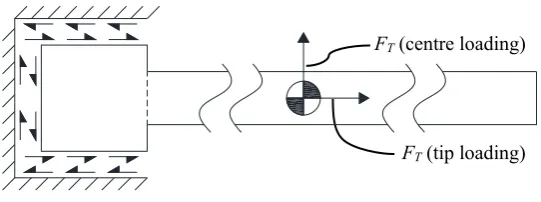
In this paper a two-dimensional clamped joint is considered that is exposed to circular and
elliptical loading. Clamping with preload is applied on three sides around the perimeter of the clamp
(detailed in Figure 2). A sinusoidal forcing function is applied for each direction (orthogonal) at the same
frequency with a zero phase shift. This forcing function originates from the portion of the cantilever
structure that extends beyond the clamped zone creating the tangential loading. The harmonic loading is
considered to be small compared to the clamping preload force and therefore the coupling of the
Original Article
2 Mathematical model
The planar tangential model presented in this paper is coupled by two different and distinctive
one-dimensional tangential models: tip loading and centre loading. The tip and centre loading are defined as
axial loadings applied to the biased extreme boundary and applied to the centroid of a 2-D bar,
respectively. Each of the tip loaded and centre loaded models are based on a backward finite difference
approach to find the force-displacement response. The loads at the clamping zone originate from the
inertial loads external to the clamping zone. The circular and elliptical motion is created depending on
T tip
T centre
F R
F
, (1)
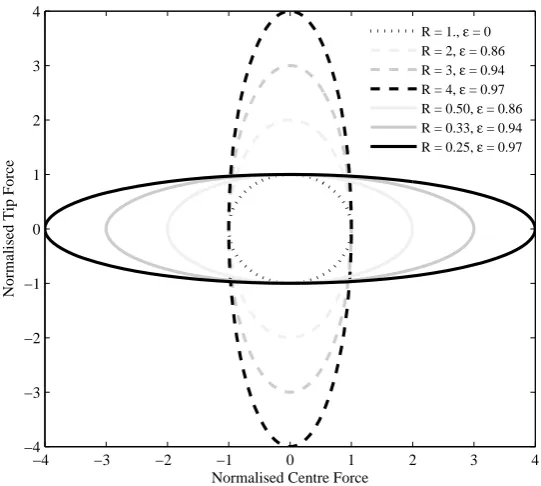
where FT is the force being applied to the contact zone. The two-dimensional trajectories being
considered are listed in Figure 1.
−4 −3 −2 −1 0 1 2 3 4
−4 −3 −2 −1 0 1 2 3 4
Normalised Centre Force
Normalised Tip Force
[image:5.595.158.429.412.655.2]R = 1., ε = 0 R = 2, ε = 0.86 R = 3, ε = 0.94 R = 4, ε = 0.97 R = 0.50, ε = 0.86 R = 0.33, ε = 0.94 R = 0.25, ε = 0.97
Original Article
Both the tip and centre loaded models ignore the clamped zone mass making the assumption that the
[image:6.595.162.433.224.325.2]external mass (or equivalent mass) is significantly larger. An example of this type of loading is shown in
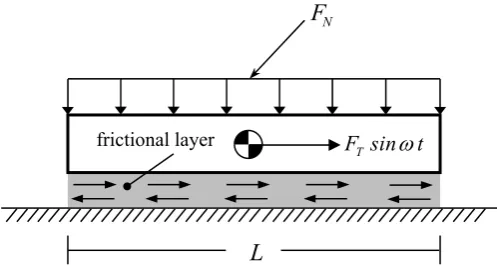
Figure 2.
Figure 2: Two-dimensional tip and centre loading on clamping zone
The mass external to the clamped zone is assumed to act as a translational moving rigid body in both the
tip and centre loading directions ignoring any bending. Shear deformations for the mass inside the
clamped zone are ignored as they are relatively minute in amplitude.
For each simulation the preload (normal force) and coefficient of friction are considered to be
constant. Furthermore, the static and dynamic friction coefficients are equal and any transition is
neglected.
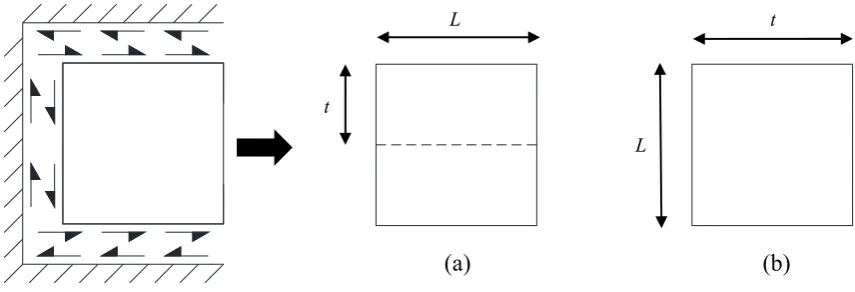
Since the loading for each of the models is perpendicular to the other, the notation of the geometric
variables for the length, L, and thickness, t, requires a slight alteration. This is depicted in Figure 3.
Considering the clamped zone from Figure 2, when applying the tip loading, the clamped zone has a line
of symmetry. Therefore the two symmetric halves act in parallel and only one half needs to be considered
(each half accepts half of the tip force). Converse to this, the centre loading does not contain a line of
symmetry so the entire clamped zone needs to be evaluated.
FT (centre loading)
Original Article
Figure 3: Clamped zone orientation for length, L, and thickness, t, for (a) tip loading and (b) centre loading
Since a symmetric loading is being used, both models will only include the first loading cycle and the
completion of the force-displacement hysteresis loop will be achieved using Masing’s Rule [8] in this
paper.
2.1 Tip loading
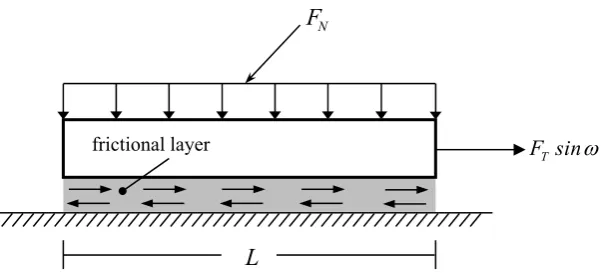
The motion caused from the tip loading for the mass in the clamped zone is such that the microslip begins
at the edge that is closest to the external mass. The tip loaded microslip model is such that a uniformly
distributed clamping load, FN, is placed on the non-stationary part. The microslip model assumes that the
interface always being in full contact over the entire surface and that no overlap is permitted. Unlike
microslip from bending, under axial tip loading, the microslip begins at the inception of the applied tip
force meaning that no fully sticking contact condition exists. For the first phase, the microslip model is
initiated by applying the load from the external mass, FT, incrementally. The chosen increment size of FT
is important for defining the shape of the hysteresis loop as it relies on a back-looking approach of the
displacement of the previous increment of FT. A graphical representation of the model is shown in Figure
(a)
(b)
L t
t
Original Article
Figure 4: One-dimensional tip loaded axial microslip model
Since FT is applied perpendicular to FN, and FN is distributed over the length of the layer, FN can then be
expressed as a distributed loading along the length such that,
N
F q
L
, (2)
where L is the length of the clamp zone in Figure 3 and is the friction coefficient. Equation 1 implies
that for any increment of FT applied, some amount of slip will immediately be returned. The slip zone for
the first iteration is then described by
1
1
T i i
F u
q
. (3)
When applying FN, slipping begins at the edges of the contact area and progresses toward the centre as FN
increases. This slipping is however ignored and is considered to be negligible. Substituting Equation 2
into Equation 3, the slip zone length for the subsequent iterations is expressed as
L
N
F
T
F sin
tOriginal Article
1
T i x i
i N F L u F
, (4)
where x is the axial displacement that is used to update L and the subscript i denotes the increment of FT .
It becomes apparent that macroslipping is initiated once
T N
F
F
. (5)Poisson’s ratio effects have been included for both the tip and centre microslip models since a no sticking
condition is achieved and that the compressive loads could be rather high resulting in high FT under
displacement controlled excitation. Although the volumetric change from Poisson’s ratio occurs evenly
for each direction, one key assumption that is made is that in the thickness direction, the thickness
changes are accumulated only in a single direction. Meaning that any increase and/or decrease in
thickness occurs at the top surface of the sample only so that contact is maintained at all times. The depth
and thickness are respectively expressed as
1 1
1 1 i T i
i i i i w F w w Ew t
, (6)
and
1 1
1 1 i T i
i i i i t F t t Ew t
Original Article
where is Poisson’s ratio and E is the modulus of elasticity. Once slipping occurs, the friction is fully
overcome and the interface behaves as though it is frictionless where slipping is present for the amplitude
of force that is being applied that exceeds the friction force. Knowing that the axial stiffness of a uniform
cross-section is defined as
AE k
L
, (8)
where A is the cross-sectional area, substituting Equations 4, 6 and 7 into Equation 8, the axial stiffness of
the portion of the bar that is slipping becomes
2
i i i
i
w t E
k u
. (9)
The stiffness in this case is doubled as not only does the slipping have to be overcome but also a load that
is necessary to allow for displacement of the slipped zone. Although the microslip resembles a
nonlinearity, each displacement is linear. Therefore, the displacement is expressed by
T i
x i i
F k
. (10)
2.2 Centre loading
Converse to that from the tip loading, the motion created by the centre loading, for the mass located
within the clamped zone, is such that the microslip originates at the centre. The non-stationary sample of
Original Article
preload. The microslip model is predicated on the interface always being in full contact over the entire
surface and that no overlap exists between the sample and the constrained support. Unlike microslip from
bending, and similar to axial tip loading, the microslip begins at the inception of the applied centre force
resulting in a non-fully sticking contact condition. For the first phase, the microslip model is initiated by
applying the load from the external mass, FT, incrementally. The resolution and accuracy for the shape of
the hysteresis loop is defined by the chosen increment size of FT as it relies on a back-looking approach of
[image:11.595.181.430.336.469.2]the displacement of the previous increment of FT. A graphical representation of the model is shown in
Figure 5.
Figure 5: One-dimensional centre loaded axial microslip model
Like the tip loaded microslip model, the same assumptions apply and too when FN is placed on the
non-stationary sample, the microslip caused from it is considered to be negligible and is therefore omitted.
Microslip begins when FT > 0, however this now originates at the centre of the sample. Unlike that of the
tip loaded microslip model, where the tension and compression occur separately, the compression and
tension for the centre loaded microslip model occurs simultaneously for each phase. Consequently, to
determine the hysteresis loop, the sample is split at the centre of mass along the length separating the
tension and compression domains. Knowing that the slip zone develops from Equation 3 and that FT is
L
N
F
T
F sin
tOriginal Article
equally shared between the tension and compression domains, the slip zone of interest for each domain
for the first phase is defined as
1 1
4
T i x ic ,it ic ,it
N
F L
u
F
, (11)
where the subscripts ic and it define the increment for the compression and tension domains, respectively.
For the first increment, x(ic−1,it−1) = 0 and the slip zones are equal to one another. Since both tension and
compression occur simultaneously, a reduction and an increase in cross-sectional areas occur at once but
at different rates. Hence, the Poisson’s ratio effects need to be computed for each domain separately. The
depth and thickness changes for the compression domain are increasing in cross-sectional area and are
expressed as
1
1
x ic ic
ic
w
w w
u
, (12)
and
1
1
x ic ic
ic
t
t t
u
. (13)
On the other hand, the tension domain is reducing in cross-sectional area so the depth and thickness
Original Article
1
1 x it it it w w w u
, (14)
and
1
1 x it it it t t t u
. (15)
Now that the Poisson’s ratio effects have been included, the stiffness shift for each domain is expressed as
2
ic ,it ic ,it ic ,it
ic ,it
w t E
k
u
. (16)
Following the same format as Equation 10, the displacement for the compression and tension domains are
expressed as
T ic,it
x ic,it
ic,it
F k
. (17)
Up to now, the peak displacements that have been computed are related to the restriction of no
participation from the other domain. The total peak centre displacement of the system is now expressed as
a combination of the peak displacements for each of the domains and is given as
ic x ic it x it
x i ic it k k k k
Original Article
3 Model coupling
To find the overall damping from the two models, for the planar motion in the clamping zone, a coupling
between the models is required. In the approach that is listed in this paper, the hysteresis loops for each of
the different loadings (tip and centre) are required which are defined from above in the previous sections.
The coupling is achieved by vectorially combining the two independent motions to create a resultant
hysteresis loop as shown in Figure 6. For clarity, the solid lines indicate the data located in the
[image:14.595.105.520.326.526.2]positive-positive-positive quadrant while the dashed lines are for data in all other quadrants.
Figure 6: Euclidean space representation for resultant hysteresis loop. For clarity, solid lines indicate the positive-positive-positive octant data and dashed lines represent the remaining octants data.
Once the hysteresis loop for each model is established, the resultant hysteresis displacement can be
defined by
tip centre
FT
Resultant hysteresis loop
Original Article
2 2 x it
x ir x it x ic
x it
, (19)
where the subscript ir denotes the resultant iteration. In a similar approach, the resultant hysteresis force
can also be described by
2 2 T it
T ir T it T ic
T it
F
F F F
F
. (20)
Once the resultant displacement and force are both found, the resultant hysteresis can then be formed.
Using the resultant hysteresis loop, the total absorbed energy, Wd, and peak strain energy, U, can be
estimated and is accomplished by
Wd
FT ir x ir , (21)and 0
x ir T ir
x ir T ir ,F
T ir x ir ,F
U F
, (22)where is the peak amplitude. By knowing Eqs. 20 and 21, the damping loss factor is then conventionally
Original Article
2
d
W U
. (23)
4 Finite element model
ANSYS commercial finite element (FE) code is used as the FE solver. The FE model employs 3-D solid
higher-order hexahedron (SOLID186) and 2-D contact elements with approximately 10500 degrees of
freedom. Only two different parts are needed for the FE model: a base and a sample. The sample
represents the mass that is inside the clamping zone while the base represents the rigid clamp. Contact
pairs consisting of contact (CONTA174) and target (TARGE170) elements are used to provide interaction
between the mass and clamped zone through the implementation of Coulomb friction. The interpretation
of Coulomb friction for ANSYS is that the product of the force normal to the sliding direction and the
friction coefficient is a limiting force. If the tangential force is less than the limiting force the state of the
contact is sticking. However, if the tangential force is equal or greater than the limiting force then the
contact is sliding producing relative motion. An augmented Lagrange contact formulation is used to help
with convergence. This method is an iterative series whereby the pressure and frictional stresses are
augmented during the equilibrium iterations resulting in the final contact penetration being decreased and
lower than the user-defined allowable penetration. This generally leads to better conditioning of the
stiffness matrix as compared to other penalty methods. A contact stiffness factor of 1, which is updated
for each equilibrium iteration, is used to minimise the amount of penetration between the sample and
base. Although the sample is not subjected to large deflections, nonlinear geometry is accounted for to
accommodate the sliding of the contact elements. The FE model configuration is shown in Figure 7.
FN
Original Article
Figure 7: Example FE model for the mass and clamp zone
A single loadstep was used for each simulation comprised of a sinusoidal load applied over a
duration equal to 125% of the frequency period (1Hz was used in this paper). The first 25% of the period
moves the sample from rest into the hysteresis loop path while the remaining 100% of the period
completes a loop. To help with convergence further, and to gain meaningful and comparable results with
the tip and centre loaded models, the tip and centre loads were discretised into 50 linearly-spaced
substeps. The size of the substeps is dependent on several factors (e.g. mesh, deformation). However,
possibly the most important of them being the contact element mesh density. The mesh density needs to
be sufficient to capture the stick-slip of the contact region. Each substep was then split into a maximum of
26 equilibrium iterations while outputting the Newton-Raphson residuals for convergence checking.
As also noted in the tip model, when the tip force is initiated, the contact zone of the tip breaks
free firstly while propagating to the root end of the sample. In a similar way, when the centre load is
firstly applied to the centre model, the centre contact zone of the sample commences slipping and extends
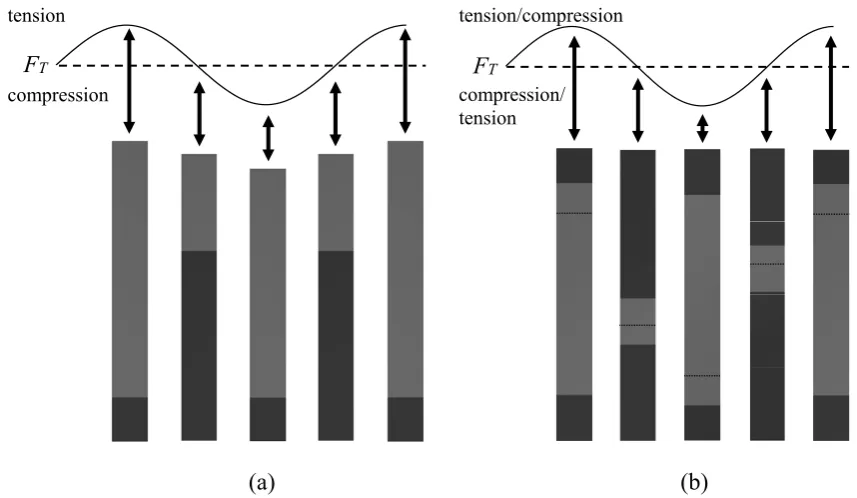
toward the edges as the load increases. The slip growth for the various loading and unloading phases is
illustrated in Figure 8.
F
T tensioncompression
F
Ttension/compression
Original Article
Figure 8: Typical contact status and exaggerated deformations from FE simulation for various loading and unloading phases for (a) tip loading and (b) centre loading
Figure 8 shows the sticking (dark grey) and slipping (light grey) regions at the end of each 90° for the
sequential tip and centre harmonic loading. For the tip loading, the bottom-most portion is constrained
while the top-most portion is where FT is applied. It is clear that when tension loading the portion of the
layer that is slipping is elongated and that as the slip zone decreases, the stiffness is increased and that the
elongation is reduced. For the centre loading, the black lines indicate the displaced position of L/2. It is
clear that unlike the tip loading, the overall length of the layer remains constant since the loading is
confined to the microslip region and is in the centre.
5 Results and discussion
A total of seven unique loading eccentricities were used as depicted in Figure 1. To validate the accuracy
and propriety of the mathematical models, numerical models using FEs are used as a comparison. For the
ease and interest of reducing computational time, for the nonlinear simulations, the comparisons are made
using a simplified geometry. The geometry, material properties and parameters used for the simulations
Original Article
L
(mm)
w
(mm)
t
(mm)
E
(MPa)
mF
N(N)
F
T(N)
[image:19.595.97.500.143.189.2]254
25.4
3.18
68947
0.3
0.8
445
267
Table 1: Simplified geometry, properties and parameters
Although this geometry has been simplified, it still contains all of the important aspects of the actual
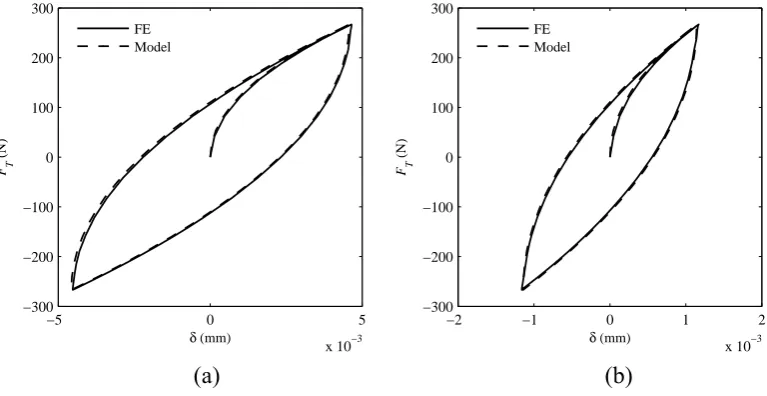
clamped joint. The comparison between the mathematical model and numerical model, for the tip loading
and centre loading, are given in Figure 9a-b, respectively. To balance the accuracy of the FE model and
the computational time, the contact mesh adequacy was defined in these simulations as a difference in
contact sliding distance as less than 0.5%.
−5 0 5
x 10−3 −300
−200 −100 0 100 200 300
δ (mm)
FT
(N)
FE Model
−2 −1 0 1 2
x 10−3 −300
−200 −100 0 100 200 300
δ (mm)
FT
(N)
FE Model
Figure 9: FE and mathematical model comparison for (a) tip loading and (b) centre loading
For the example joint that is used in this paper, for the comparison of various eccentricities for the
mathematical models, the joint geometry along with the properties and parameters are identified in Table
2. The amplitude of FT that is applied to the tip model is 2000N, 4000N, 6000N and 8000N and for the
[image:19.595.115.499.359.557.2]Original Article
centre model 4000N, 8000N, 12000N and 16000N. The FT for the tip model is half that of the centre
model since symmetry is being used.
model
L
(mm)
w
(mm)
t
(mm)
E
(MPa)
mF
N(N)
tip
50
10
25
10000
0.3
0.8
20000
centre
50
10
50
10000
0.3
0.8
20000
Table 2: Respective joint geometries, properties and parameters
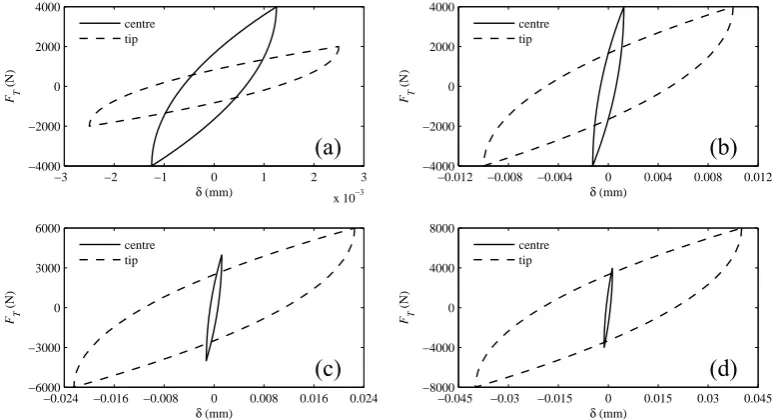
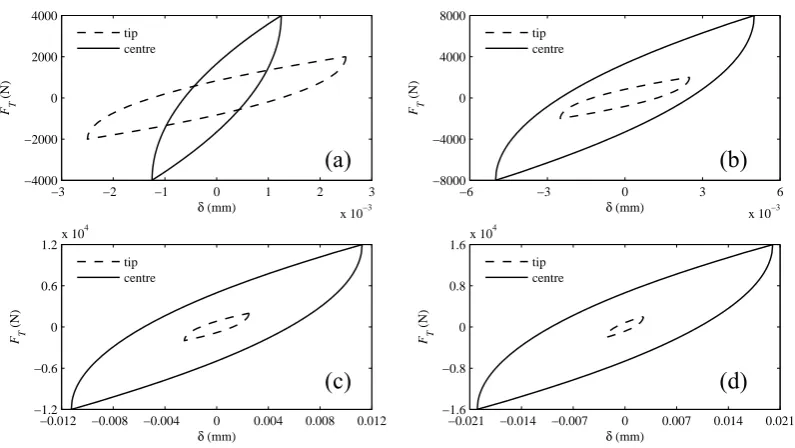
The results for each of the circular and elliptical force ratios and eccentricities, defined from Figure 1, are
shown in Figures 10 (R=1, 2, 3 and 4) and 11 (R=1, 0.50, 0.33, 0.25). It is noticed that as FT is increased
for each of the models, the stiffness decreases having a softening effect. It is also obvious from Figure 8a
that the stiffness of the centre model is greater than that of the tip model.
−3 −2 −1 0 1 2 3
x 10−3 −4000
−2000 0 2000 4000
δ (mm)
FT
(N)
−0.012 −0.008 −0.004 0 0.004 0.008 0.012 −4000
−2000 0 2000 4000
δ (mm)
FT
(N)
−0.024 −0.016 −0.008 0 0.008 0.016 0.024 −6000
−3000 0 3000 6000
δ (mm)
FT
(N)
−0.045 −0.03 −0.015 0 0.015 0.03 0.045 −8000
−4000 0 4000 8000
δ (mm)
[image:20.595.103.494.429.639.2]FT (N) centre tip centre tip centre tip centre tip
Figure 10: Tip and centre loading force-displacement hysteresis loops for (a) R=1, =0, (b) R=2, =0.86, (c) R=3, =0.94 and (d) R=4, =0.97
(a) (b)
Original Article
−3 −2 −1 0 1 2 3
x 10−3 −4000
−2000 0 2000 4000
δ (mm)
FT
(N)
−6 −3 0 3 6
x 10−3 −8000
−4000 0 4000 8000
δ (mm)
FT
(N)
−0.012 −0.008 −0.004 0 0.004 0.008 0.012 −1.2
−0.6 0 0.6 1.2x 10
4
δ (mm)
FT
(N)
−0.021 −0.014 −0.007 0 0.007 0.014 0.021 −1.6
−0.8 0 0.8 1.6x 10
4
δ (mm)
[image:21.595.98.496.140.364.2]FT (N) tip centre tip centre tip centre tip centre
Figure 11: Tip and centre loading force-displacement hysteresis loops for (a) R=1, =0, (b) R=0.5, =0.86, (c) R=0.33, =0.94 and (d) R=0.25, =0.97
The normalised vibration damping loss factor for the different forcing ratios (eccentricities) is shown in
Figure 12. Interestingly the highest damping loss factors are at the extreme elliptical motion. This is
directly associated with the combination of the ellipticity and the increase in FT. This information follows
the findings by Hartwigsen et al [1].
(a) (b)
Original Article
F
T (centre)
F
T (tip)
1 1.5 2 2.5 3 3.5 4
1 1.5 2 2.5 3 3.5 4
normalised damping loss factor,
η
[image:22.595.105.483.157.472.2]0.55 0.6 0.65 0.7 0.75 0.8 0.85 0.9 0.95 1
Figure 12: Normalised damping loss factor for various R
It is noticed from Figure 12 that when R=1, the loss factor is the lowest. Conversely, when R is minimum
and maximum (R=0.25 and R=4), the loss factor is the largest. Additionally, the gradient of the slope
between for the damping loss factor changes as R increases and decreases pivoting around R=1.
6 Conclusions
Two different tangential microslip models (tip and centre loaded) have been presented. Each model is
capable of producing force-displacement responses. Both models are compared to FE models and have
Original Article
two microslip models are combined to demonstrate the overall response for the normalised damping loss
factor for various two-dimensional trajectories
Acknowledgements
This research received no specific grant from any funding agency in the public, commercial, or
not-for-profit sectors.
References
[1] Hartwigsen, C.J.; Song, Y.; McFarland, D.M.; Bergman, L.A.; Vakakis, A.F.. Experimental study of
non-linear effects in a typical shear lap joint configuration, Journal of Sound and Vibration, 2004,
277, 327-351.
[2] Menq, C.H.; Bielak, J.; Griffin, J.H. The influence of microslip on vibratory response, part I: A new
microslip model, Journal of Sound and Vibration, 1986, 107(2), 279-293.
[3] Menq, C.H.; Griffin, J.H.; Bielak, J. The influence of microslip on vibratory response, part II: A
comparison with experimental results, Journal of Sound and Vibration, 1986, 107(2), 295-307.
[4] Cigeroglu, E.; Lu, W.; Menq, C.H. One-dimensional dynamic microslip friction model, Journal of
Sound and Vibration, 2006, 292, 881-898.
[5] Xiao, H.; Shao, Y.; Xu, J. Investigation into the energy dissipation of a lap joint using the
one-dimensional microslip friction model, European Journal of Mechanics A/Solids, 2014, 43, 1-8.
[6] Sanliturk, K.Y.; Ewins; D.J. Modelling two-dimensional friction contact and its application using
harmonic balance method, Journal of Sound and Vibration, 1996, 193(2), 511-523.
[7] Menq, C.H.; Chidamparam, P.; Griffin, J.H. Friction damping of two-dimensional motion and its
Original Article
[8] G. Masing. Eigenspannungen un verfestigung beim messing. Second International Congress for