This is a repository copy of Selection of robust features for the Cover Source Mismatch
problem in 3D steganalysis.
White Rose Research Online URL for this paper:
http://eprints.whiterose.ac.uk/127771/
Version: Accepted Version
Proceedings Paper:
Li, Zhenyu and Bors, Adrian Gheorghe orcid.org/0000-0001-7838-0021 (2016) Selection of
robust features for the Cover Source Mismatch problem in 3D steganalysis. In: Proc. of
International Conference on Pattern Recognition (ICPR). IEEE , pp. 4251-4256.
[email protected] https://eprints.whiterose.ac.uk/
Reuse
Items deposited in White Rose Research Online are protected by copyright, with all rights reserved unless indicated otherwise. They may be downloaded and/or printed for private study, or other acts as permitted by national copyright laws. The publisher or other rights holders may allow further reproduction and re-use of the full text version. This is indicated by the licence information on the White Rose Research Online record for the item.
Takedown
If you consider content in White Rose Research Online to be in breach of UK law, please notify us by
Selection of Robust Features for the Cover Source
Mismatch Problem in 3D Steganalysis
Zhenyu Li and Adrian G. Bors
Department of Computer Science, University of York, York, UK YO10 5GH Email: {zl991, adrian.bors}@york.ac.uk
Abstract—This paper introduces a method extracting features
from 3D objects characterising a robust steganalyzer such that would mitigate the cover source mismatch (CSM) paradigm. A steganalyzer is considered as a classifier aiming to identify separately cover and stego objects, representing 3D objects before and after embedding information through steganography. A steganalyzer behaves as a classifier considering a set of features extracted from stego-cover pairs of 3D objects as inputs during the training stage. However, during the testing stage, the stegan-alyzer would have to identify whether information was hidden in a set of 3D objects which is different from that used in the training. Addressing the CSM paradigm corresponds to testing the generalization ability of the steganalyzer when introducing distortions in the cover objects before hiding information through steganography. The proposed steganalysis robustness approach is tested when considering mesh simplification and additive noise to the 3D objects, bringing significant distortions to their shapes, in the context when using a high capacity steganography method.
I. INTRODUCTION
Steganography and information hiding in 3D graphics has known a rapid expansion during the last years. Steganalysis can be seen as a classification problem in which we aim to identify whether information was hidden or not into a specific media through steganography or digital watermarking. Steganalysis in audio or image data was studied in [9], [13], [21]. 3D steganalysis algorithms extract certain features from a large number of cover-stego pairs, representing 3D objects before and after hiding information [17], [26]. The parameters characterizing the statistics of these features are then used as inputs for machine learning algorithms aiming to discriminate the stego-objects from cover-objects. In this study we assess the robustness of 3D steganalyzers in the context of the cover source mismatch (CSM) problem, which assumes that in the testing stage we have a much larger variability in the shapes of the objects than those used during the training.
The CSM problem is represented by the realistic scenario that the objects used for a steganalyzer may be originated in a cover source that is different from the one that the steganographer used for hiding information during the training stage [13]. A known example of CSM in the context of image steganalysis, was addressed during the “Break Our Steganographic System” (BOSS) contest [1]. The mismatch of the training set and testing set caused many difficulties to the participants in this contest [1], [8], [10]. The CSM problem was addressed in the image domain by considering the following aspects: the training sets, the feature set and the machine learning methods used for steganalysis.
In the case of digital images, the cover source mismatch problem is analyzed by testing the steganalyzers on images that are taken by cameras with different characteristics than those used during the training. Differences considered in those studies include different ISO levels of noise, characterizing various cameras, as well as different JPEG quality factors [16], [23]. Gul and Kurugollu [10] proposed a feature se-lection algorithm, in the BOSS context, which calculates the correlation between a feature and the embedding rate as the criterion for its selection. Pasquet et al. [19] proposed to use the Ensemble Classifier with Feature Selection [4] for the CSM problem. The feature selection is considered by evaluating the importance of each feature in the learning process [4]. A feature condensing method, called Calibrated Least Squares (CLS) is proposed in [20] in order to make the high dimensional feature sets compatible with the anomaly detector is employed for steganalysis. A method to mitigate the CSM due to changes in the cover feature is presented in [14]. This approach shifts all the centers of the cover features from different steganographers towards the origin by subtracting the centroid of each steganographer’s cover feature distribution. Other research studies addressing the CSM problem in images aim to find a classifier that would be robust to the variation between training and testing data. In [18] it was shown that simple classifiers, such as the Fisher Linear Discriminant (FLD) ensemble and the Ensemble Average Perceptron have better performances than other, more complex classifiers, when faced with the cover source mismatch problem. In order to mitigate the mismatch due to various changes in stego features, Ker and Pevn`y [14] used an ensemble of classifiers which gives more weight to those classifiers that are robust to changes in the stego features. A similar weighting strategy for improving the FLD ensemble’s performance in CSM context is presented in [23].
transfor-mations, such as mesh simplification or additive noise. We hide information into these distorted 3D shapes which and then used for testingthe steganalyzer. The proposed methodology is tested on the Princeton Mesh Segmentation project database [5], when considering the 3D steganography algorithm pro-posed in [3]. 3D steganalysis is briefly described in Section II, while the proposed method addressing the CSM problem in the context of 3D steganalysis is explained in Section III. The experimental results are provided in Section IV and the conclusions of this study in Section V.
II. 3D STEGANALYSIS
3D steganalysis consists of training and testing stages as in a supervized pattern recognition approach. While during the first stage, the steganalyzer learns a set of parameters characterizing the differences between sets of 3D stego and cover objects, during the second stage these parameters are used for distinguishing a different set of stego and cover-objects. The set of features extracted from the 3D objects is modelled statistically in both the training and testing stages. The first four statistical moments of their features are con-sidered as inputs to a machine learning algorithm. The 3D steganalysis approach proposed in [26] uses the feature set YANG208, which includes the norms in the Cartesian and Laplacian coordinate system [25], the dihedral angles of faces and the face normals, among other features. These features are then used as inputs for a quadratic classifier. Yang et al. [27] proposed a new steganalysis algorithm, specifically designed for the mean-based watermarking algorithm proposed in [6]. Li and Bors propose the feature set LFS52 in [17], which includes the local curvature and vertex normals as steganography features, while dropping some of the other features used in [26], which are not found as being that important in 3D steganalysis. The quadratic discriminant [25] and the FLD ensemble [17], use such features as inputs in order to discriminate the stego-objects from cover-objects.
The cover source mismatch (CSM) problem in 3D steganal-ysis addresses the robustness of steganalyzers to be trained using a set of cover and stego 3D objects characterized by certain properties and then being tested on a set of stego and cover objects with different surface properties. The ability of the steganalyzer to perform well in different data during the testing stage is consistent to the ability of computational intelligence algorithms to generalize. This corresponds to the application of steganalyzers in practice, because in a general case the 3D objects are characterized by various resolutions and have a wide variation of surface smoothness among other changing factors. In this study we consider mesh simplification and noise addition as transformation factors of the cover objects for addressing the CSM problem. Such transformations would change significantly the geometrical and statistical characteristics of cover sources. Under these conditions, in order to deal properly with the CSM problem, 3D features should be consistent with characterizing stego and cover objects when considering such transformations. Moreover, the machine learning algorithms should be robust to the changes
caused by such transformations in the statistical distributions of 3D object features.
III. ROBUSTNESS ANDRELEVANCE BASEDFEATURE
SELECTION ALGORITHM
In the following we consider that we have a set of 3D objectsO, used as the cover source for training a steganalyzer. A set of features is extracted from these objects and the parameters characterizing their statistics are then used as inputs in a machine learning classifier in order to distinguish between stego and cover objects. Several 3D features have been found as useful for 3D steganalysis by various studies. The relevance of 3D features used in this study is performed by using the Pearson correlation coefficient between each feature and their object’ corresponding class. Nevertheless, not all of these features contribute equally to the performance of the steganalyzer and not all of them are robust enough to variations in the cover source during the testing stage. In this section we describe a selection mechanism for deciding which features would be robust enough to be used when addressing the CSM problem. The proposed algorithm, called Robustness and Relevance based Feature Selection (RRFS), defines a criterion for choosing those features which will guarantee the steganalysis performance. The key idea of the proposed algorithm is to find those features that are more robust to the variation of the cover source, while preserving a relatively strong relevance to the class label as well. Two criteria are considered during the selection: the relevance of the features to the class label, and the robustness of the selected feature set to the variation of the cover source.
The feature selection algorithm proposed in this study belongs to the filter methods [2], shown to be efficient when used for selecting input features in various machine learning algorithms and its pseudocode is provided on the next page. The filter methods are suitable to be applied in the cover source mismatch situations, because they can avoid the overfitting of the training data whilst being characterised by a better generalization during the testing stage [11]. In the proposed algorithm, the relevance of the features to the class label is estimated by using the Pearson correlation coefficient, calculated between the distribution of each feature and the steganalyzer’s classes:
ρ(Xi,Y) =
cov(Xi,Y) σXiσY
, (1)
where Xi is the i-th feature of a given feature set, X =
{Xi|i= 1,2, . . . , N}, where N is the dimensionality of the
input feature,Y is the class label indicating whether the class corresponds to a cover or a stego object, cov represents the covariance andσXi is the standard deviation ofXi. The Pear-son correlation coefficient can capture the linear dependencies between features and the label, and it is widely used in science as a measure of the degree of linear dependence between two variables, with |ρ(Xi,Y)| = 1 indicating a high degree of
linearity whileρ(Xi,Y) = 0indicates a scattered dependency.
label [12]. All features are ranked according to their relevance to the class label, calculated using equation (1), in descending order as:
|ρ(XI1,Y)|>|ρ(XI2,Y)|> . . . >|ρ(XIN,Y)|, (2)
whereI ={I1, I2, ...IN} is the feature index.
Algorithm 1:RRFS algorithm
Input:
Features extracted from the cover objects used for trainingX0={X0,i|i= 1,2, ..., N}
features extracted from other cover sources
Xj={Xj,i|i= 1,2, ..., N, j= 1,2, ..., M}
class labelY
dimension of the selected featureN′
Output: Index of the selected feature subsetF′
1 Compute the relevance of the features to the class label, ρ(Xi,Y) = cov(σXXi,Y)
iσY ;
2 Compute the features’ robustness to the variation of the cover source,ρi(Xi,Xj,i) =cov(σXXi,Xj,i)
iσXj,i
;
3 Normalize the|ρi(Xi,Xj,i)|to [0,1];
4 Compute the robustness of the features to the variation of the cover source,ri= M1
!M
j=1|ρi(Xi,Xj,i)|; 5 Sort the features by relevance|ρ(Xi,Y)|in the
descending order and get the indexI={I1, I2, ...IN}; 6 Initializep←90 and
θp←percentile({ri|i= 1,2, ...N}, p),;
7 while|F′|< N′ do
8 fork←I1 toIN do
9 if(k /∈F′)∧(rk>θp)then
10 Add k toF′;
11 end
12 p←p−10;
θp=percentile({ri|i= 1,2, ...N}, p);
13 end
14 end 15 returnF′;
Features’ robustness to the variation of the cover source is related to solving the CSM problem. If objects’ features do not change much after applying transformations to the cover objects, they would be expected to provide similar steganalysis results to those achieved with the original cover and stego objects. Such features would have a strong robustness in the context of steganalyzers. In the following we consider two different feature sets for a given set of 3D objects: the first one is extracted from the original objects used as the cover sources for training the steganalyzers while the other is extracted after applying certain transformations to the same objects. Then the Pearson correlation coefficient of two feature sets is calculated as:
ρi(Xi,Xj,i) =
cov(Xi,Xj,i)
σXiσXj,i
, (3)
where Xi and Xj,i represent the vector of the feature i extracted from the original set of cover objects O, used for training the steganalyzer, and from the objects obtained by applying specific transformations to the same cover source,
j = 1,2, . . . , M, where M represents the number of
trans-formations applied to the original set of cover objects O. This formula indicates how well correlated are the initial 3D features with those that are extracted after certain transforma-tions. We normalize|ρi(Xi,Xj,i)|to the interval[0,1]. Ideally, robust features should model the statistical characterstics that distinguish cover and stego objects even after certain distor-tions are considered on the cover objects. The robustness is indicated by the average of the absolute values of the Person correlation coefficients, calculated for a specific featurei, for allM transformations:
ri=
1 M
M
"
j=1
|ρi(Xi,Xj,i)|, (4) wherei= 1,2, . . . , N.
(a) Cover object.
(b)
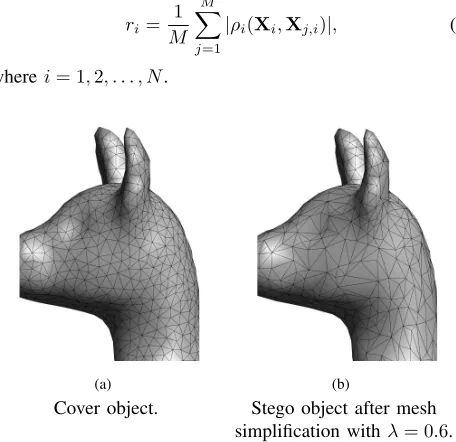
Stego object after mesh simplification withλ= 0.6. Fig. 1. Applying surface simplication on the cover object in order to test cover-source mismatch paradigm in 3D steganalyzers.
The Robustness and Relevance based Feature Selection (RRFS) algorithm starts with a preset number ofNfeatures as input. The algorithm aims to find the mostN′relevant features which have relatively strong robustness to be used for a steganalyzer that addresses the CSM problem. TheN′features are selected by multiple passes through the features ranked according to their relevance, calculated using equation (1). During each pass, a subset of features is selected successively such that:
ri>θp (5)
[image:4.595.308.536.242.463.2]the classification capability of the algorithm. The threshold is reduced, considering lower percentiles p, until the total number of selected features becomes equal toN′. Eventually,
we would haveN′ selected features that are robust enough to
the variation of cover source whilst having a high relevance to the class label, according to (1), at the same time.
IV. EXPERIMENTALRESULTS
In the following we firstly apply the RRFS algorithm to select a feature subset from a given larger feature set. Then we test the performance of the selected feature subset by using it in a cover source mismatch scenario. For the exper-imental framework we consider 354 3D objects represented as meshes which are part of the Princeton Mesh Segmen-tation project [5] database. In order to test the robustness of the steganalyzer we distort the original objects of the database by considering two different transformations: mesh simplification and corruption by noise. These transformations significantly degrade the properties of 3D objects. While the former changes the actual topology of the mesh, the latter alters its geometry. The simplification algorithm from [22] reduces the number of the faces while preserving the overall shape of the 3D object, according to a simplification factor
λ = {0.98,0.95,0.9,0.8,0.6}. When considering corruption by noise, its amplitude of the noise is modulated by the parameter βD, with β ∈ {10−5,10−4,10−3}, and D is the maximum distance between the projections of any two vertices on the first principal axis, obtained by applying the Principal Component Analysis (PCA) on the original 3D object.
False positive rate
0 0.2 0.4 0.6 0.8 1
T
ru
e
p
o
si
ti
ve
ra
te
0 0.2 0.4 0.6 0.8 1
[image:5.595.311.533.66.260.2]YANG208 LFS52
Fig. 2. ROC curves for the results of the steganalyzers based on LFS52 and YANG208 [24] for the Quadratic Learning classifier.
The stego objects are generated by applying the 3D steganography algorithm proposed in [3] to the given set of cover sources. The number of steganographic embedding layers is considered as 10 and the number of intervals is chosen as 10000 in the algorithm proposed in [3]. The relative payload ratio is nearly 1, except for three vertices used for
False positive rate
0 0.2 0.4 0.6 0.8 1
T
ru
e
p
o
si
ti
ve
ra
te
0 0.2 0.4 0.6 0.8 1
[image:5.595.61.281.408.600.2]YANG208 LFS52
Fig. 3. ROC curves for the results of the steganalyzers based on LFS52 and YANG208 [24] for the FLD ensemble classifier.
extracting the code, which are not modified at all. Similarly to the approach from [17] we consider FLD ensembles [7], [15] as the machine learning based steganalyzer. The parameters for the FLD ensembles, such as the number of the base learner and the subspace dimensionality, are chosen as in [15]. The close-up detail of one of the original 3D objects used in the experiments is shown in Figure 1a, while its corresponding stego object obtained by embedding information after mesh simplification with the factorλ= 0.6, is shown in Figure 1b. In the following we test the efficiency of using various feature sets for 3D steganalysis. In Figures 2 and 3 we show the Receiver Operating Curves (ROC) results when consider-ing the LFS52, proposed in [17], and YANG208 feature sets proposed in [26], for training the Quadratic Learning classifier and the FLD ensemble classifier, respectively, in the context when detecting the changes produces by the steganographic algorithm from [3], considering ten layers of embedding. According to the ROC curves from both plots we can observe that the feature set LFS52 provides the best results in the case of both classifiers.
on the 354 cover-stego pairs obtained from the original cover source. Meanwhile, we compute the robustness of the feature set {ri|i= 1,2, . . .252} based on the experiments using the cover-stego pairs from the simplified cover sources, assuming
M = 5 different simplification factors as specified above.
The N′-dimensional feature subset is selected as explained
in Section III. The selection of the feature subset for the CSM due to noise addition is similar to that when assuming mesh simplification in the CSM paradigm. During the experiments
we select various features, assumingN′≤N. IfN′= 252it
would mean that no feature selection process is conducted at all. In order to test the performance of the selected features in the cover source mismatch (CSM) scenario, we randomly select 260 cover objects from the original cover source and the corresponding stego-objects for training the steganalyzer. Then we test the steganalyzer on 94 pairs of cover and stego-objects originated from different cover sources from the database, after they had been simplified or distorted by additive noise. We repeat the steganalysis experiments, using FLD ensembles for 30 times and consider the final test results as the median of the resulting errors.
N'
0 20 40 60 80 100 120 140 160 180 200 220 240 260
Erro
r
(%
)
25 30 35 40 45 50
!=0.6 !=0.8 !=0.9 !=0.95 !=0.98
Fig. 4. Test results, under the CSM paradigm, when selecting features for steganalysis where the distortion to the original cover objects is due to mesh simplification.
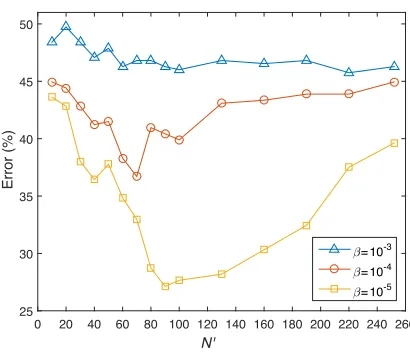
Figures 4 and 5 show the test results when using features selected by the proposed RRFS method from the initial feature set LAY252 for steganalysis under the CSM assumption, by considering the distortions caused by mesh simplification and by additive noise, respectively. As it can be observed from these two plots, as the dimensionality of the selected features increases, the error rates first decline and then rises up. There are several local fluctuations in the plots, but generally these plots display clear minima, except for the case when the noise
level of the testing set corresponds to β = 10−3
, when the
level of the error does not change much for N > 60. When
testing the CSM problem for mesh simplification, the results from Figure 4 show that the steganalyzer achieves the best
detection accuracy for N = 40, while when considering the
N'
0 20 40 60 80 100 120 140 160 180 200 220 240 260
Erro
r
(%
)
25 30 35 40 45 50
!= 101/ !0 &!1#
!0 &!1.
Fig. 5. Test results, under the CSM paradigm, when selecting features for steganalysis where the distortion to the original cover objects is due to noise addition to the mesh surface.
CSM problem for additive noise, the results from Figure 5,
indicate that the best results are obtained for N = 90. The
bar plots from Figure 6 show clearly that the steganalyzers trained with a lower dimensional data set, when considering the features selected by the proposed RRFS method, achieve better performance when compared to the results produced by training the steganalysed with the entire dataset LAY252, under the CSM paradigm.
!
0.6 0.8 0.9 0.95 0.98
Erro
r
(%
)
0 10 20 30 40 50
N'=252 (All) N' =40
(a) Simplification
!
10-3
10-4
10-5
Erro
r
(%
)
0 10 20 30 40 50
N' =252 (All) N'#+,
(b) Noise addition
Fig. 6. Test results when using the entire feature set compared to the results provided by a selected set of robust features for training the steganalyzers under the CSM paradigm. The blue bars represent the test results of using all the 252-dimensional features in LAY252, while the yellow bars represent the test results of using the features selected by the proposed RRFS algorithm.
V. CONCLUSION
[image:6.595.318.523.65.242.2] [image:6.595.66.271.321.494.2]the transformed objects. A robust feature selection algorithm, called the Robustness and Relevance based Feature Selection, is proposed in this paper. This algorithm employs the Pearson correlation coefficient to define the relevance and robustness for each feature leading to the selection of a relevant feature subset . The proposed methodology is shown to choose a better feature set, than those considered by other studies, when addressing the CSM problem. A limitation of this study is that for selecting the robust features we consider a limited set of transformations for addressing the CSM problem. A more general study should compare the set of cover objects with a set of transformed objects originated from completely different cover sources than those initially used in the training stage.
REFERENCES
[1] P. Bas, T. Filler, and T. Pevn`y. Break our steganographic system: The ins and outs of orgaizing BOSS. InProc. of Information Hiding Conf., LNCS, vol. 6958, pages 59–70, 2011.
[2] G. Chandrashekar and F. Sahin. A survey on feature selection methods.
Computers & Electrical Engineering, 40(1):16–28, 2014.
[3] M.-W. Chao, C.-h. Lin, C.-W. Yu, and T.-Y. Lee. A high capacity 3D steganography algorithm. IEEE Transactions on Visualization and Computer Graphics, 15(2):274–284, 2009.
[4] M. Chaumont and S. Kouider. Steganalysis by ensemble classifiers with boosting by regression, and post-selection of features. InProc. of IEEE Int. Conf. on Image Processing, pages 1133–1136. IEEE, 2012. [5] X. Chen, A. Golovinskiy, and T. Funkhouser. A benchmark for 3D
mesh segmentation. In ACM Transactions on Graphics, volume 28, pages 73:1–73:12, 2009.
[6] J.-W. Cho, R. Prost, and H.-Y. Jung. An oblivious watermarking for 3-D polygonal meshes using distribution of vertex norms.IEEE Transactions on Signal Processing, 55(1):142–155, 2007.
[7] R. Cogranne and J. Fridrich. Modeling and extending the ensemble classifier for steganalysis of digital images using hypothesis testing theory. IEEE Transactions on Information Forensics and Security, 10(12):2627–2642, 2015.
[8] J. Fridrich, J. Kodovsk`y, V. Holub, and M. Goljan. Breaking hugo–the process discovery. InProc. of Information Hiding Conf., LNCS, vol. 6958, pages 85–101, 2011.
[9] G. Gul and F. Kurugollu. SVD-based universal spatial domain image steganalysis.IEEE Transactions on Information Forensics and Security, 5(2):349–353, 2010.
[10] G. Gul and F. Kurugollu. A new methodology in steganalysis: breaking highly undetectable steganograpy (hugo). InProc.of Information Hiding Conf., LNCS, vol. 6958, pages 71–84, 2011.
[11] I. Guyon and A. Elisseeff. An introduction to variable and feature selection. The Journal of Machine Learning Research, 3:1157–1182, 2003.
[12] M. A. Hall.Correlation-based Feature Selection for Machine Learning. PhD thesis, The University of Waikato, 1999.
[13] A. D. Ker, P. Bas, R. B¨ohme, R. Cogranne, S. Craver, T. Filler, J. Fridrich, and T. Pevn`y. Moving steganography and steganalysis from the laboratory into the real world. InProc. of ACM Workshop on Information Hiding and Multimedia Security, pages 45–58, 2013. [14] A. D. Ker and T. Pevny. A mishmash of methods for mitigating the
model mismatch mess. InProc. of IS&T/SPIE Electronic Imaging, pages 90280I–90280I–15, 2014.
[15] J. Kodovsk`y, J. Fridrich, and V. Holub. Ensemble classifiers for ste-ganalysis of digital media.IEEE Transactions on Information Forensics and Security, 7(2):432–444, 2012.
[16] J. Kodovsky, V. Sedighi, and J. Fridrich. Study of cover source mismatch in steganalysis and ways to mitigate its impact. InProc. of IS&T/SPIE Electronic Imaging, pages 90280J–90280J–12, 2014.
[17] Z. Li and A. G. Bors. 3D mesh steganalysis using local shape features. InProc. of IEEE Int. Conf. on Acoustics, Speech and Signal Processing (ICASSP), pages 2144–2148, 2016.
[18] I. Lubenko and A. D. Ker. Steganalysis with mismatched covers: Do simple classifiers help? InProc. of ACM Workshop on Multimedia and Security, pages 11–18, 2012.
[19] J. Pasquet, S. Bringay, and M. Chaumont. Steganalysis with cover-source mismatch and a small learning database. InProc. of the European Signal Processing Conference, pages 2425–2429, 2014.
[20] T. Pevn`y and A. D. Ker. The challenges of rich features in universal steganalysis. InProc. of IS&T/SPIE Electronic Imaging, pages 86650M– 86650M–15, 2013.
[21] Y. Ren, T. Cai, M. Tang, and L. Wang. Amr steganalysis based on the probability of same pulse position. IEEE Transactions on Information Forensics and Security, PP(99):1–11, 2015.
[22] W. J. Schroeder, J. A. Zarge, and W. E. Lorensen. Decimation of triangle meshes. InACM SIGGRAPH, Computer Graphics, volume 26, pages 65–70, 1992.
[23] X. Xu, J. Dong, W. Wang, and T. Tan. Robust steganalysis based on training set construction and ensemble classifiers weighting. InProc. of IEEE Int. Conf. on Image Processing, pages 1498–1502, 2015. [24] D. Yan, R. Wang, X. Yu, and J. Zhu. Steganalysis for MP3Stego using
differential statistics of quantization step. Digital Signal Processing, 23(4):1181–1185, 2013.
[25] Y. Yang and I. Ivrissimtzis. Polygonal mesh watermarking using laplacian coordinates. InComputer Graphics Forum, volume 29, pages 1585–1593, 2010.
[26] Y. Yang and I. Ivrissimtzis. Mesh discriminative features for 3D steganalysis. ACM Transactions on Multimedia Computing, Commu-nications, and Applications, 10(3):27:1–27:13, 2014.
![Fig. 3. ROC curves for the results of the steganalyzers based on LFS52 andYANG208 [24] for the FLD ensemble classifier.](https://thumb-us.123doks.com/thumbv2/123dok_us/7860407.179891/5.595.61.281.408.600/fig-curves-results-steganalyzers-based-andyang-ensemble-classier.webp)