This is a repository copy of
Energy Efficient Network Function Virtualization in 5G
Networks
.
White Rose Research Online URL for this paper:
http://eprints.whiterose.ac.uk/88417/
Version: Accepted Version
Proceedings Paper:
Al-Quzweeni, AN, El-Gorashi, TEH, Nonde, L et al. (1 more author) (2015) Energy Efficient
Network Function Virtualization in 5G Networks. In: 17th International Conference on
Transparent Optical Networks (ICTON), 2015. International Conference on Transparent
Optical Network (ICTON), 05-09 Jul 2015, Budapest. IEEE , pp. 1-4.
https://doi.org/10.1109/ICTON.2015.7193559
[email protected] https://eprints.whiterose.ac.uk/ Reuse
Unless indicated otherwise, fulltext items are protected by copyright with all rights reserved. The copyright exception in section 29 of the Copyright, Designs and Patents Act 1988 allows the making of a single copy solely for the purpose of non-commercial research or private study within the limits of fair dealing. The publisher or other rights-holder may allow further reproduction and re-use of this version - refer to the White Rose Research Online record for this item. Where records identify the publisher as the copyright holder, users can verify any specific terms of use on the publisher’s website.
Takedown
If you consider content in White Rose Research Online to be in breach of UK law, please notify us by
Energy Efficient Network Function Virtualization in 5G Networks
A. Al-Quzweeni, Taisir E.H. El-Gorashi, L. Nonde, and Jaafar M.H. Elmirghani Senior Member, IEEE
School of Electronic & Electrical Engineering, University of Leeds, LS2 9JT, United Kingdom
ABSTRACT
A Number of merits could be brought by network function virtualization (NFV) such as scalability, on demand allocation of resources, and the efficient utilization of network resources. In this paper, we introduce a framework for designing an energy efficient architecture for 5G mobile network function virtualization. In the proposed architecture, the main functionalities of the mobile core network which include the packet gateway (P-GW), serving gateway (S-(P-GW), mobility management entity (MME), policy control and charging role function, and the home subscriber server (HSS) functions are virtualized and provisioned on demand. We also virtualize the functions of the base band unit (BBU) of the evolved node B (eNB) and offload them from the mobile radio side. We leverage the capabilities of gigabit passive optical networks (GPON) as the radio access technology to connect the remote radio head (RRH) to new virtualized BBUs. We consider the IP/WDM backbone network and the GPON based access network as the hosts of virtual machines (VMs) where network functions will be implemented. Two cases were investigated; in the first case, we considered virtualization in the IP/WDM network only (since the core network is typically the location that supports virtualization) and in the second case we considered virtualization in both the IP/WDM and GPON access network. Our results indicate that we can achieve energy savings of 22% on average with virtualization in both the IP/WDM network and GPON access network compared to the case where virtualization is only done in the IP/WDM network.
1. INTRODUCTION
The current mobile system has evolved from circuit-switched based analogue voice network to a formidable system supporting hundreds of thousands of various applications and a very huge number of users. We are just at the dawn of the conversion to ubiquitous high data rate network that connects anything to anything anytime and anywhere. Therefore, the next generation mobile network will not only connect people, but anything that needs the use of its resources. Various devices will join this network such as medical devices, meteorological equipment, traffic and security cameras, household appliances, etc. As a result, the next generation mobile network will affect many spheres of human life and the growth in traffic will continue during the 5G era beyond 2020 [1, 2]. Mobile operators and service providers will have to deal with a 1000 fold increase in traffic compared to the levels in 2010 [3] and they have to properly address a number of challenges due to this huge amount of traffic such as bandwidth requirements and power consumption. In order to address the power consumption challenges, in [4] we have proposed an energy efficient virtual network embedding (EEVNE) approach for cloud computing networks. In [5] we have introduced a framework for energy efficient cloud computing over IP/WDM networks. We have examined energy efficient future HDTV in [6] and investigated the role of physical topology optimization on energy efficiency in IP/WDM networks in [7]. We also evaluated the use of renewable energy sources in the design of IP/WDM core networks in [8] in order to reduce the carbon footprint contribution of ICT networks.
The authors in [9] have introduced the concept of network function virtualization (NFV) and its benefits in 5G networks. They focused on its deployment in radio access networks (RAN) because network operators and service providers showed interest in virtualization in the RAN since the RAN accounts for around 70% to 80% of the total energy requirements [3]. Although the term virtualization has been used widely in mobile networks especially in the cloud radio access network (C-RAN), it only refers to the case where multiple base stations share resources or cooperate with each other [10-12] in what is called ÒBBU poolingÓ. Here, we go further by deploying a new architecture that exploits the benefits NFV in both the mobile core network and the RAN with the goal of minimizing power consumption. The rest of the paper is organized as follows: In Section 2 we discuss virtualization in mobile networks and present the proposed architecture. In Section 3 we present the results obtained from the MILP model and conclude the paper in Section 4.
2. VIRTUALIZATION IN MOBILE NETWORK
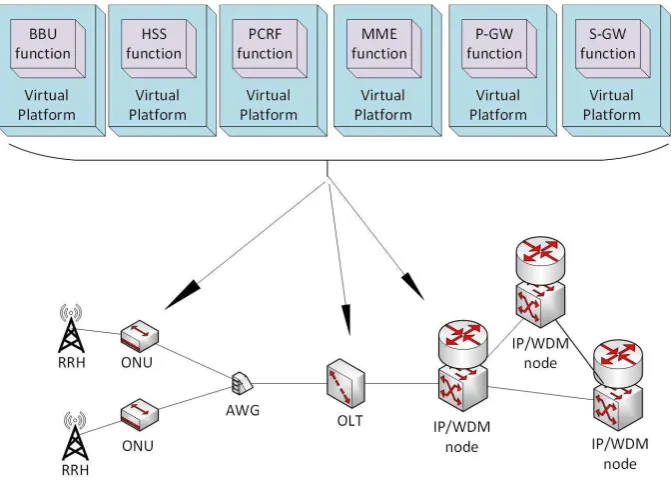
functions we also virtualize the functions of the BBU of the eNB. The BBU entity is separated from the RRH and virtualized; in this case the RRH will be connected directly to the core network through optical links as shown in Figure 1. For virtual machine hosting and data processing close to the RAN, we have used GPON in the optical front-haul. In addition to the deployment of GPON as a front-haul, we have attached the mobile home office (mobile core) to the IP/WDM core network. With the deployment of GPON, the location range of the virtual machines is extended to include the optical front-haul. Hence the candidate nodes, which might host the virtual machines, are increased and distributed along the path from the mobile home office to the radio access network over the IP/WDM and GPON networks. With such a scenario a virtual machine of any type (mobile core network or BBU) can be placed, replicated, or migrated in ONU, OLT, or in the IP/WDM node as well.
Figure 1. Proposed architecture for virtualization in 5G
[image:3.595.130.466.184.428.2]We have developed a MILP model for energy efficient virtualization in 5G networks. The model minimizes the power consumption associated with the RRH requests and optimizes the location of the virtual machines. We have assumed two different virtual machine types: mobile core network functions virtual machines (CNVMs) and BBU functions virtual machines (BBUVMs). To capture a range of processing scenarios and account for factors such as variation in the BBU processor type or number of cycles per instruction, we have examined five scenarios with different ranges of normalized workload (NWL) of BBUVMs and CNVMs as shown in Table 1. The power consumption of a virtual machine is modelled as a function of the normalized workload. In modelling the power consumption of the network we consider three power-consuming parts: IP/WDM network, GPON, and the RRH.
Table 1: Virtual machines workload (%) of different scenarios
Scenario
Workload %
Scenario 1 Scenario 2 Scenario 3 Scenario 4 Scenario 5
Core VM 1 Ð 10% 2 Ð 20% 3 Ð 30% 4 Ð 40% 5 Ð 50% BBU VM 0.25 Ð 0.5% 0.5 Ð 5 % 0.75 Ð 7.5% 1 Ð 10% 1.25 Ð 12.5%
3. RESULTS
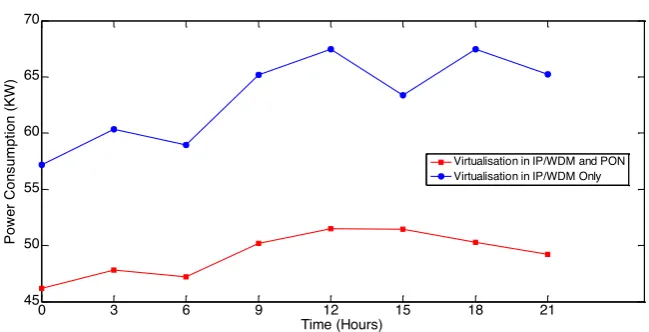
over the BBUVMs. Five scenarios, shown in Table 1, have been used with different ranges of workloads for both BBU VMs and CNVMs and the results are shown in Figure 3. It is clearly seen from Figure 3 that the power consumption increases due to the increase in the virtual machine workloads. This increase in the power consumption however, is not very crucial because the number of virtual machines is the same in all the scenarios. The power consumption of both virtualization with and without the use of network elements in the GPON is shown in Figure 4.
[image:4.595.145.456.334.486.2]Figure 2. Network topology used in the MILPoptimization
Figure 3. Power Consumption under different VM workloads
Figure 4. Power Consumption of Virtualization in IP/WDM only and in IP/WDM and PON
Virtualization in both the IP/WDM and GPON networks shows an average saving in power consumption of 22% compared to the case where virtualization occurs only in the IP/WDM network. Virtualization in the GPON network adds a high level of flexibility due to virtual machine behaviour. The virtual machines can be migrated, replicated, or distributed according to the demand and the satisfaction of our goal, which is the minimization of
0 3 6 9 12 15 18 21
45 46 47 48 49 50 51 52 Time (Hours) P o w e r C o n su m p ti o n ( K W )
CN VM NWL 1~10 BBU VM NWL 0.25~2.5
CN VM NWL 2~20 BBU VM NWL 0.5~5
CN VM NWL 3~30 BBU VM NWL 0.75~7.5
CN VM NWL 4~40 BBU VM NWL 1~10
CN VM NWL 5~50 BBU VM NWL 1.25~12.5
0 3 6 9 12 15 18 21
45 50 55 60 65 70 Time (Hours) Po w e r C o n s u m p ti o n (KW )
[image:4.595.130.455.520.686.2]total power consumption. For a particular RRH, the demand does not need to travel along the network to be served or processed if the virtual machine is placed close to it in ONU or in OLT. As a result the power consumption will decrease due to the shorter route taken by the demand. In addition, if the BBU VM and its serving CNVM are placed in the same node, the power consumption due to the internal traffic between them will be zero because they are processed in the same node.
4. CONCLUSIONS
In this paper we have introduced a new architecture for future 5G networks employing network function virtualization and using GPON as the preferred radio access network backhaul technology. We have investigated the energy efficiency brought about by virtualizing both the BBU and mobile core functions by allowing virtual machine instances to be created in both the GPON nodes (ONUs and OLTs) and IP/WDM nodes (since the core network is typically the location of infrastructure that supports virtualization). Virtualization in both IP/WDM and GPON nodes shows energy savings of 22% on average compared to the case where virtualization is done only in the IP/WDM core network nodes. In future, we will consider internal traffic between core network virtual machines, processing delay, and caching. These considerations will add trade off challenges to the work and they will affect virtual machine behaviour and location.
5. ACKNOWLEDGEMENTS
The authors would like to acknowledge funding from the Engineering and Physical Sciences Research Council (EPSRC), INTERNET (EP/H040536/1) and STAR (EP/K016873/1), and would like to thank A. Lawey for many useful discussions. Also Mr. Ahmed Al-Quzweeni would like to thank the Higher Committee for Education Development (HCED) for funding his scholarship.
REFERENCES