http://eprints.whiterose.ac.uk/103168/
Version: Accepted Version
Proceedings Paper:
Aitken, J., Boorman, L., Cameron, D. et al. (6 more authors) (2016) ROBO-GUIDE -
Lessons from an Interdisciplinary Project. In: Proceedings of the 6th International
Symposium of Engineering Education. 6th International Symposium of Engineering
Education, 14 - 15 July 2016, University of Sheffield. , University of Sheffield .
[email protected] https://eprints.whiterose.ac.uk/ Reuse
Unless indicated otherwise, fulltext items are protected by copyright with all rights reserved. The copyright exception in section 29 of the Copyright, Designs and Patents Act 1988 allows the making of a single copy solely for the purpose of non-commercial research or private study within the limits of fair dealing. The publisher or other rights-holder may allow further reproduction and re-use of this version - refer to the White Rose Research Online record for this item. Where records identify the publisher as the copyright holder, users can verify any specific terms of use on the publisher’s website.
Takedown
If you consider content in White Rose Research Online to be in breach of UK law, please notify us by
ROBO-GUIDE - Lessons from an
Interdisciplinary Project
Jonathan M. Aitken, Luke Boorman, David Cameron, Emily C. Collins,
Adriel Chua, Samuel Fernando, Uriel Martinez-Hernandez, Owen McAree,
James Law
aa
Sheffield Robotics, University of Sheffield
ABSTRACT
ROBO-GUIDE is an open, voluntary, and bottom-up group project to build an au-tonomous robot to guide visitors through the Mappin and Pam Liversidge Buildings at the University of Sheffield. It is an interdisciplinary, cross-departmental project within Sheffield Robotics, giving undergraduates, PhD students, and early career researchers the opportunity to work together on a practical robotics research project. The project began in January 2015 as a joint initiative between researchers and undergraduates with a desire to obtain practical robotics experience and collaborate on projects outside of their own field. The project has included 12 team members from backgrounds across computer science, control engineering, psychology, and neuroscience. In a year, the project has produced eleven research publications in local, national, and international conferences, spawned a successful EPSRC-funded research proposal, and an EU H2020 submission. The project has given robotics research experience for undergraduates, an opportunity for PhD students to work outside their discipline, and experience of managing people and projects for early career researches.
This paper discusses learning points of the project over to date and future implications. These include the interdisciplinary aspects that helped formulate the project, the at-traction of undergraduates to working on a real research project, how well-directed and enthusiastic students can play a significant role in active research, and how providing space, time, and equipment to motivated students and early career researchers can lead to the development of sustainable new research programs. We highlight areas of difficulty encountered in the hope to motivate easier solutions in the future, including the need to source and secure funding to support equipment purchases and travel.
Keywords: robotics, engineering education, project management, engagement, society.
1. INTRODUCTION
1.1 ROBO-Guide Project Outline
The ROBO-GUIDE (ROBOtic GUidance and Interaction DEvelopment) project aims to develop a guide robot that can lead visitors from the entrance to the Mappin Building, at the University of Sheffield, to the Sheffield Robotics Laboratory in the adjoining Pam Liversidge Building (approximately a 3-5 minute walk of about 500m). This is a complex task as the robot must safely navigate corridors populated with building users (many of whom will be unfamiliar with robots in the environment), pass through closed doors and use a lift to navigate between different floors of the Pam Liversidge Building. The project aims to address how an assistive robot can be designed and built with a comprehensive view to its requirements, to elicit help in a friendly manner from passers-by to achieve its goals, to successfully navigate around the building, and to co-exist safely in its environment.
1.2 ROBO-GUIDE Project Outputs and Successes
The project has successfully produced eight research publications, including this one, and three abstracts, these span local,1,3,8,10national,2,4,6,9 European11 and
International5conferences. Each of these papers details various aspects of the project
but can be broadly grouped into three separate areas:
• General project overviews.3,8,9 • Human-Robot Interaction.2–6,10
• Safety and navigation around the building.1,11
Interactions between project members have also led to the development of a new line of research focussing on trust in Human-Robot Interaction (HRI). Collaboration and early work on ROBO-GUIDE led to a successful funding application to investigate trust in robot co-working for manufacturing. The Assessing Graphical Robot Aids for
Interactive Co-Working7secured 19,998 funding from the EPSRC Centre for Innovative
Manufacturing in Intelligent Automation to conduct a six month Feasibility Study into the impact of signage on people working closely with manufacturing robots.
ROBO-GUIDE, and its reputation within Sheffield Robotics, also led team members being approached to contribute to the Horizon 2020 proposal for the CO-SAPIENt (COllaborative and Smart robotic platform to Assist and help medical staff and Patients to Improve transportation and accommodation in hospital Environments) project. Various other spin-out projects are also under discussion, around assistive robotics, robotics for manufacturing, and trust in HRI.
1.3 Team Profile
The ROBO-GUIDE project is an interdisciplinary project bringing together engineers and scientists working in computational neuroscience, control systems, formal
• Post-doctoral and early career researchers (7)
• PhD Researchers (1)
• Undergraduates (4)
2. COMMENCING AND GROWING ROBO-GUIDE
2.1 The conditions enabling ROBO-GUIDE
Sheffield Robotics is an interdisciplinary research institute with dedicated laboratory and office space in the University of Sheffield. It provides space to researchers from departments across the university to undertake robotics-related work, and these shared workspaces enable researchers to connect around their common interest in robotics. Whilst many researchers were committed full-time to specific projects, discussions turned to ways of working together and participating in creative sided projects that required minimal time commitments.
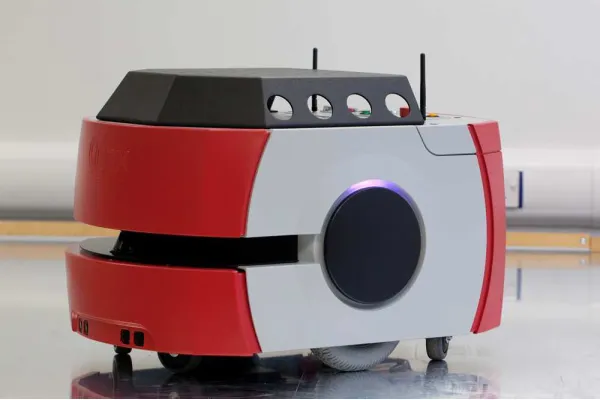
A common interest amongst the group was to undertake practical work using real robots in real environments. As part of an EPSRC capital grant, Sheffield Robotics acquired a Pioneer LX was from Adept MobileRobots∗ (see Figure1). This is an
extendible, wheeled platform with a 13 hour run time, laser scanner for indoor mapping and navigation, proximity and impact sensors, speech synthesis software, and
autonomous charging capacity. This robot was purchased to fill a gap in the portfolio for an mobile platform able to operate autonomously for long durations, but was not being used for active research at the genesis of ROBO-GUIDE. The robot provided a free platform for new research, and was sufficiently supported that it was accessible to most researchers.
The final element in the creation of the ROBO-GUIDE project was a student volunteer, with an interest in getting experience working in a robotics lab. This provided someone with the time and motivation to work on the robot platform, and help with implementation and experimentation.
2.2 Project Motivation
The motivation behind the project was to create a small and flexible working group, which would develop features and perform experiments with the Pioneer LX, working in a distributed manner. This work would be primarily researcher-led and
interdisciplinary in nature, that is to say new ideas would quickly be evaluated and available personnel used as flexibly as possible. Priority was generally given to ideas concerned with interdisciplinary themes, typically technical innovations that enable novel psychological studies to take place.
Figure 1. Pioneer LX from Adept MobileRobotics.
2.3 Project Methodology
2.3.1 Team Management
Typically team meetings were conducted on a bi-weekly cycle, due to individuals time commitments. High level decisions about project direction were agreed in a democratic fashion, with sub-groups formed between meetings to work on the areas discussed. Typically post-docs and PhD students would supervise the work of undergraduate students, and contribute heavily to the production of papers.
2.3.2 Project Management
One of the opportunities provided by the ROBO-GUIDE project was for team members to develop new skills in research and project management, not afforded to them by their routine activities.
For undergraduates, these opportunities have included: gaining experience of working in a research environment; working with state-of-the-art robotic hardware; pursuing practical goal-focused research with distinct, achievable aims; presenting at conferences and workshops; and contributing to research publications. In addition, students have been able to draw on the experience and support of enthusiastic researchers, leading to quick resolution of problems, rather than struggling with unfamiliar hardware.
For PhD students and postdoctoral researchers the project has provided the
opportunity to: undertake research independently of their supervisors; work within a team with researchers from other disciplines; produce additional publications to bolster their research profile; and supervise undergraduate students.
A key motivator in project progression has been the generation of research papers. Throughout the project, team members have actively contributed to identifying opportunities to publish, and the writing of papers. Each publication provided a deadline for the next phase of work, and helped focus activity. An individual (or group) would take responsibility for leading on each paper, but with the support of the team and their joint commitment to the project, papers were produced as a group effort relieving the pressure on the principal author(s).
2.4 Challenges as development opportunities
Throughout the project the team faced challenges, just as any research project might. Although these presented obstacles to the work being undertaken, they also provided opportunities for learning and development.
2.4.1 Funding
ROBO-GUIDE is an unfunded project. Whilst time was given voluntarily, an the team had access to a robotic platform and laboratory space, there was no budget to support additional equipment, travel, conference fees, accommodation, publishing fees, or anything else that might usually be costed to a research project. This presents several difficulties, especially in practical implementations.
Due to the lack of funding, the research plan was always directed so as to minimise any costs associated with the project. Additional components and hardware were limited whenever possible, and publications were aimed at conferences where attendance costs would be low, or where the presenter was already funded from another project. In an early conference, presenters volunteered to help at trade stands to help cover
attendance costs. At another, a PhD student volunteered to present to take advantage of reduced student fees. Nevertheless, this frugal approach did restrict research, and made it difficult to publish work in more visible locations.
Restrictions on the equipment available is not a typical problem encountered within robotics projects, especially student projects where funds, even at a low level, are available to purchase essential equipment. ROBO-GUIDE became a source of innovation and adaptation as equipment could not be sourced to complete the task. This had three direct benefits:
• More challenge for team members to be innovative around problems, especially
potential hardware bottlenecks.
• Often a quicker lead time for solving problems; the group did not have to wait for
components to be ordered, signed-off, delivered, and then integrated.
• By using common components integration times were substantially reduced as
there was a higher level of familiarity with hardware.
For example,,11 a pressure sensor is added to ROBO-GUIDE, to sense time in the lift.
As the project progressed, and the lack of funding became a greater barrier to progress and publication, team members began to search out and apply for any relevant small pots of money to cover travel costs. As a consequence, team members unintentionally began to develop skills in applying for funding, that they would not have otherwise. After the project had been running for 6 months, and had shown its value in terms of supporting student and researcher development, Sheffield Robotics set up a 2k fund to support bottom-up projects initiated by students and postdocs. This funding
recognised the potential for projects like ROBO-GUIDE to help create new research avenues, and support student and staff development. It is intended that this annual fund be available for internal projects to apply for, as they would any grant, but with the aim of fostering bottom-up development in the institute.
By the end of its first year, ROBO-GUIDE had lead to an externally-funded feasibility study to investigate human-robot interaction (25k). By the end of its 14th month, a 350k proposal on robot navigation in busy indoor environments had been submitted as part of a larger H2020 consortium.
2.4.2 Time Pressures
As with all projects of this nature, where participants are donating their time, ROBO-GUIDE often encountered situations where there were clashing deadlines with participants normal work. Generally the project was managed such that busy periods were expected and could be avoided, as the project had a large pool of members that could provide cover. Typically for any project output, members were assigned a section of a paper as their responsibility, which was adjusted given their current constraints. A common bottleneck was with the team members that commonly worked with the robot itself. The learning curve for operating the Pioneer-LX is relatively gradual; but depending on team members preferences for work areas there were relatively few participants who were readily acquainted with running ROBO-GUIDE. This built a dependence on practical team members, typically PhD students and undergraduates attached to the project.
The time pressures and commitment of producing an output for ROBO-GUIDE has provided ample practice in time management, whether for the undergraduates balancing lectures and assignments with programming tasks, PhD students writing theses or researchers with project deadlines. However, the shared responsibility felt by team members, and attempts to balance workload, meant that work was well
distributed.
An unexpected outcome is that members of the group have been exposed to wider subject areas than their own backgrounds. Often whilst compiling papers, such as Cameron et al., 2015b, literature reviews have been required. These have been
distributed around the group to available members allowing insights into different fields.
2.4.3 Maintaining Motivation
ROBO-GUIDE maintained a strong sense of team spirit during its development phase. This was through a shared sense of community fostered by Sheffield Robotics strong laboratory environment which acted as an area to mix, bringing team members together in the same space. This helped produce a togetherness during development as team members shared the same laboratory environment. This produced a strong sense of peer-group support, as members were in the same space so able to provide support, skills and problem solving abilities quickly as part of daily life.
Throughout the project team members had several key objective areas; namely practical development and publications. This meant that members of the group would react very positively to potential suggestions for research areas that would lead to practical development and potential output. This lead to a supportive environment for ideas from any member of the team which could be taken and acted on quickly through the strong team environment.
Because of the group commitment paper production and publication became an effective and non-time-consuming task. As the team was commited to producing outputs, small sections could be delegated. Due to the shared commitment to publications each member knew they could rely on group members to bring together their small components into an output. As the team comprised of a large group of members this meant responsibility for production was shared amongst the group. This lead to an easy route to paper production and success in publication. The positive response formed part of a positive feedback loop, success in producing papers acted to motivate members to suggest and work on further output.
3. CASE STUDIES
This section draws on the specific experience of members of the project at each career stage to reflect on how they have benefited from being part of ROBO-GUIDE.
3.1 Early Career Researchers
The early career researchers role within the project focuses around project management, this typically revolves around:
• Overall project direction
• Guidance for postgraduate and undergraduate students on technical work
• Identification of publication output locations Sourcing funding for components
and conference travel
Working on the ROBO-GUIDE project has provided numerous opportunities to develop project management skills, which became increasingly important as the limited availability of people became apparent. This would often involve balancing the
3.2 Postgraduate Students
The postgraduate students role within the project focuses on technical and theoretical outputs, typically composed of:
• Practical implementations of work on the robot • Theoretical developments of human-robot interaction
The ROBO-GUIDE project has afforded PhD students the opportunity to develop examples of effective research independence and contribute to publications that are not co-authored by their PhD supervisors. Work on the project supports a broader
understanding of the field and efforts spent on the project can complement work undertaken for PhD research. Contribution to the project can support early career development through both supporting PhD completion and demonstration of research independence.
4. UNDERGRADUATE STUDENTS
The undergraduate students role within the project focuses on technical outputs, typically composed of:
• Practical implementations of work on the robot • Conducting experiments to establish validity of theory
The ROBO-GUIDE project exposed the undergraduate students to the entire process of research, including the inception of a research idea to the process of journal and conference submissions. This has provided a better understanding of academic life. Furthermore, the interdisciplinary nature of the project allowed the introduction to a variety of experts in different fields, allowing an insight into several different fields of science. This was especially useful as an undergraduate to better select an area of research to further studies. Attaining knowledge and insight into different fields was also an interesting experience.
During time in the lab, there was an exposure to several important skills to research such as the use of LaTeX, a program commonly used to produce research papers and not usually taught during undergraduate studies. This project also allows students with different levels of software experience to get involved, access the project/robot using different software packages, from those routinely taught (e.g. Matlab at undergraduate level) to more advanced languages, outside of typical undergraduate experience, especially in Psychology, (e.g. c++). Ultimately the project has allowed students to use robotic platforms such as YARP and ROSARIA, which lie well outside typical undergraduate studies, which aids preparation for postgraduate courses in robotics or industrial development.
5. CONCLUSIONS
The ROBO-GUIDE project has provided a model for teaching and learning across multiple disciplines, from the practical development of hardware and software to the communication of research findings. It has also impacted at multiple levels, providing development opportunities from the undergraduate student to the early career researcher. The model has encouraged interaction, both across the different levels of research experience, and across academic disciplines found within a university environment. It is now also providing formal learning opportunities in the form of student projects and international internships.
In addition to the development opportunities for students and researchers, this activity has also resulted in recognised benefits including new interdisciplinary collaborations and research areas, and successful grant proposals. New research opportunities and external collaborations are continuing to result from ROBO-GUIDE. This has not required large financial or time commitment, but instead has relied upon voluntary input and enthusiasm found in junior researchers and students.
We recognise the importance of several key factors in enabling this project to happen, and that have contributed to its success:
• Physically co-located researchers from different disciplines, and a shared
laboratory space provided the environment needed for the gestation of this project
• Shared equipment made freely available for “hobby” projects
• The availability of small sources of funding to support: student recruitment,
equipment, and conference travel
• Opportunities for postdocs to supervise undergraduates in research labs on
projects independent of their supervisors
As the desire for more interdisciplinary ways of working continues to grow, we believe the ROBO-GUIDE model provides excellent learning and development opportunities, with the added potential for generating new research. The model can easily be adapted and employed in other areas of academic teaching, without additional burden to teaching staff.
REFERENCES
[1] Aitken, J.M., McAree, O., Boorman, L., Cameron, D., Chua, A., Collins, E.C., Fernando, S., Law, J., Martinez-Hernandez, U.: Safety and verification for a mobile guide robot. In: 2nd University of Sheffield Engineering Symposium (2015) [2] Cameron, D., Aitken, J., Boorman, L., Chua, A., Collins, E.C., Fernando, S.,
Martinez-Hernandez, U., McAree, O., Law, J.: ROBO-GUIDE: Autonomous navigation of dynamic spatial and social environments. In: iCog 3 Cognitive Science Conference (2016)
[4] Cameron, D., Loh, E.J., Chua, A., Collins, E.C., Aitken, J., Law, J.: Robot-stated limitations but not intentions promote user assistance. In: Interdisciplinary Learning and Teaching: Frameworks and Practice (2016)
[5] Cameron, D., Aitken, J.M., Collins, E.C., Boorman, L., Chua, A., Fernando, S., McAree, O., Martinez-Hernandez, U., Law, J.: Framing factors: The importance of context and the individual in understanding trust in human-robot interaction. In: IEEE/RSJ International Conference on Intelligent Robots and Systems (IROS), Workshop on Designing and Evaluating Social Robots for Public Settings (2015) [6] Cameron, D., Collins, E.C., Chua, A., Fernando, S., McAree, O.,
Martinez-Hernandez, U., Aitken, J.M., Boorman, L., Law, J.: Help! I cant reach the buttons: Facilitating helping behaviors towards robots. In: Biomimetic and Biohybrid Systems, Living Machines 2015, Lecture Notes in Computer Science, vol. 9222, pp. 354–358 (2015)
[7] Eimontaite, I., Gwilt, I., Cameron, D., Aitken, J.M., Rolph, J., Mokaram, S., Law, J.: Assessing graphical robot aids for interactive co-working. In: 7th International Conference on Applied Human Factors and Ergonomics (2016)
[8] Law, J., Aitken, J.M., Boorman, L., Cameron, D., Chua, A., Collins, E.C., Fernando, S., Martinez-Hernandez, U., McAree, O.: “Please Press Floor B”, Engendering Trust in a Guide Robot. In: 2nd University of Sheffield Engineering Symposium (2015)
[9] Law, J., Aitken, J.M., Boorman, L., Cameron, D., Chua, A., Collins, E.C., Fernando, S., Martinez-Hernandez, U., McAree, O.: Robo-guide: Towards safe, reliable, trustworthy, and natural behaviours in robotic assistants. In: Towards Autonomous Robotic Systems (TAROS) 2015, Lecture Notes in Computer Science, vol. 9287, pp. 149–154 (2015)
[10] Loh, E.J., Cameron, D.: Developing robot personalities for improved human-robot interaction. In: 5th British Conference of Undergraduate Research (BCUR2016) (2016)