BORANG PENGESAHAN STATUS TESIS*
JUDUL: SECURE SMS
SESI PENGAJIAN: SESI 200812009
Saya ROHAIZA BINTI ABU SEMAN
(HURUF BESAR)
Mengaku membenarkan tesis (PSMI- ini disirnpan di Perpustakaan Fakulti Teknologi Maklumat dan Komunikasi dengan syarat-syarat kegunaan seperti berikut:
1. Tesis dan projek adalah hakrnilik Universiti Teknikal Malaysia Melaka.
2. Perpustakaan Fakulti Teknologi Maklumat clan Komunikasi dibenarkan membuat salinan untuk tujuan pengajian sahaja.
3. Perpustakaan Fakulti Teknologi Maklurnat dan Komunikasi dibenarkan membuat salinan tesis ini sebagai bahan pertukaran antara institusi pengajian tinggi.
4.
** Sila tandakan (0
SULIT (Mengandungi maklumat yang berdarjah keselamatan atau Kepentingan Malaysia seperti yang termaktup di dalam AKTA RAHSIA RASMI 1972)
TERHAD (Mengandungi maklurnat TERHAD yang telah ditentukan oleh organisasil badan di mana penyelidikan dijalankan)
/
TIDAK TERHAD(TANDATANGAN PENYELIA) Alamattetap:~o~% ~ f . CPI ~ b O A c l , \RD4 B(M-I G = s z ~ q . N
4 q o 0 0 e4. ~ Y L O H ,gecAlV?oR Nama penyelia
Tarikh: 0 JUW O C \ Tarikh: \ 3 JULM a 4
CATATAN: * Tesis dimaksudkan sebagai Laporan Akhir Projek Sarjana Muda (PSM)
SECURE SMS
ROHAIZA BINTI ABU SEMAN
This report is submitted in partial hlfillment of the requirements for the Bachelor of computer Science (Computer Networking)
FACULTY OF INFORMATION AND COMMUNICATION TECHNOLOGY UNIVERSITI TEKNIKAL MALAYSIA MELAKA
DECLARATION
I hereby declare that this project report entitled SECURE SMS
is written by me and is my own effort and that no part has been plagiarized without citations.
STUDENT : DATE: ( 3 J ~ 1 ~ 4 - f 0 4
(ROHAIZA BINTI ABU SEMAN)
SUPERVISOR: DATE: I3 JUL" 0 4
DEDICATION
Specially dedicated to my beloved father, mother and family,
For my supervisor, Cik Irda Binti Roslan (UTeM)
ACKNOWLEDGEMENTS
I would like expand my gratitude and heartfelt thanks to Universiti Teknikal Malaysia Melaka (UTeM) and Faculty of Information and Communication Technology (FTMK) for providing such a good environment for students in gaining knowledge and skills.
First of all, I am particularly grateful to my supervisor, Cik Irda Roslan for her advising and encouragement from the earliest beginning. Thank you for her teaching, guidance and help during this project. Thanks for the support, cooperative in leading way throughout the whole progress of the project.
Special thanks my parent, siblings and friend for their support, thoughts and advices. Nothing is possible without their support and they inspired me to move even further and ever.
ABSTRACT
ABSTRAK
TABLE OF CONTENTS
CHAPTER SUBJECT
DECLARATION DEDICATION
ACKNOWLEDGEMENT ABSTRACT
ABSTRAK
TABLE OF CONTENTS LIST OF TABLE
LIST OF FIGURE
CHAPTER I INTRODUCTION
1.1 Project Background
1.2 Problem Statement
1.3 Objective
1.4 Scope
1.5 Project significance
1.6 Expected Output
1.7 Conclusion
CHAPTER I1 LITERATURE
REVIEW
AND PROJECT METHODOLOGY2.1 Introduction
2.2 Literature Review 2.2.1 Domain 2.2.2 Keyword
2.2.2.1 Short Messaging Service
(SMS) 2.2.2.2 Cipher 2.2.2.3 Encryption 2.2.2.4 Decryption
2.2.2.5 Symmetric Algorithm 2.2.2.6 RC4 Encryption Algorithm 2.2.2.7 Mobile Phone
2.2.3 Previous Research
2.2.3.1 CryptoGraf Messaging v2.5
2.2.3.2 CryptoSMS 2.2.3.3 k i p t o s ~ s T M 2.3 Proposed Solution
2.3.1 Project Methodology 2.4 Project Schedule and Milestone 2.5 Conclusion
CHAPTER
~n
ANALYSIS3.1 Introduction 3.2 Problem Analysis
3.2.1 Research for the Existing Application
3.3 Requirement Analysis 3.3.1 Data Requirement 3.3 -2 Functional Requirement
3.3.2.3 Read message 3.3 -2.4 Encrypt message 3.3.2.5 Decrypt message 3.3.3 Non-functional Requirement 3.3.4 Others Requirement
3.3 -4.1 Software Requirement 3.3.4.2 Hardware Requirement 3.4 Conclusion
CHAPTER IV DESIGN
4.1 Introduction 4.2 High-Level Design
4.2.1 System Architecture 4.2.2 User Interface Design
4.2.2.1 Navigation Design 4.2.2.2 Input Design 4.2.2.3 Output Design 4.2.3 Database Design
4.2.3.1 Conceptual and Logical Database Design 4.3 Details Design
4.3.1 Software Design 4.3.1.1 Use Case
4.3.2 Physical Database Design 4.4 Conclusion
CHAPTER V IMPLEMENTATION
5.1 Introduction
5.2 S o h a r e Development Environment Setup 5.3 Software Configuration Management
5.3.1.1 Configure mobile profile 5.3.1.1 Configure port
5.3.2 Version Control 5.4 Implementation Status 5.5 Conclusion
CHAPTER VI TESTING
6.1 Introduction 6.2 Test Plan
6.2.1 Test Organization 6.2.2 Test Environment 6.2.3 Test Schedule 6.3 Test Strategy
6.3.1 Classes of tests 6.4 Test Design
6.4.1 Test Description 6.4.2 Test Data
6.5 Test Result and Analysis 6.6 Conclusion
CHAPTER VII PROJECT CONCLUSION
7.1 Observation on Weakness and Strengths 7.2 Propositions for Improvement
7.3 Contribution 7.4 Conclusion
REFERENCES BIBLIOGRAPHY APPENDIX
LIST OF TABLES
TABLE TITLE PAGE
Symmetric algorithm versus Asymmetric algorithm Comparison between symmetric encryption algorithms
Comparison between existing applications Details of input design
Details of output design Data Dictionary
Database design
Version Control Procedures Test Data
LIST OF FIGURES
DIAGRAM TITLE PAGE
Preview design for the Secure SMS Application Symmetric algorithm
CryptoGraf Messaging v2.5 CryptoSMS
KriptoSMS 1.1
Waterfall methodology Man in the middle attack Data Model
Data Flow Diagram Secure SMS architecture
Main interfaces for the application Interfaces New text message Interface Inbox
Interface Outbox
Interface Encryption Secret Key Interface Encrypted message Interface Decryption Secret Key Interface New SMS
xii
Use Case
CHAPTER I
INTRODUCTION
1.1 Project Background
Short Message Service (SMS) is a communications protocol allowing the interchange of short text messages between mobile telephone devices. It is a store and forward way of transmitting messages to and from mobiles. The message (text only) from the sending mobile is stored in a central short message center which then forwards it to the destination mobile. This means if happen that the recipient is not available, the short message is stored and can be sent later.
Lately, SMS has replaced the traditional way of human communication. The change is caused by the changing lifestyle, flexibility of network and advance technology in mobile device. SMS is one of the communication protocols that used to exchange information in text message between mobile handsets. SMS is transformed into data packet when travel in GSMAJMTS network and this technology operates approximately in real time mode.
device communication. Some of the software systems are programmed to send alert to mobile device and receive control command from particular handset in SMS. For example, vehicle tracking service uses the SMS to notify car stolen cases and uses the mobile SMS to remotely control home appliances.
SMS are sometimes used for the interchange of confidential data such as social security number, bank account number, password etc. A typing error in selecting a number when sending such a message can have severe consequences if the message is readable to any receiver. Most mobile operators encrypt all mobile communication data, including SMS messages but sometimes this is not the case, and even when encrypted, the data is readable for the operator.
So solution for this problem is to encrypt the message sender want to send. And receiver will decrypt back the message to read it. This system has both functions that can encrypt the plaintext to cipher text and decrypt back the cipher text to the plaintext. With this function the message cannot be read by the third party like the operator.
1.2 Problem Statement
1 3 Objective
Provide sent and receive message between mobile users.
To secure the message fiom sender to receiver been read by the third party.
To create a new idea of secure message in system telecommunication.
1.4 Scope
The scope of this system is the user of mobile phone. This system using java program that supported for most of mobile device.
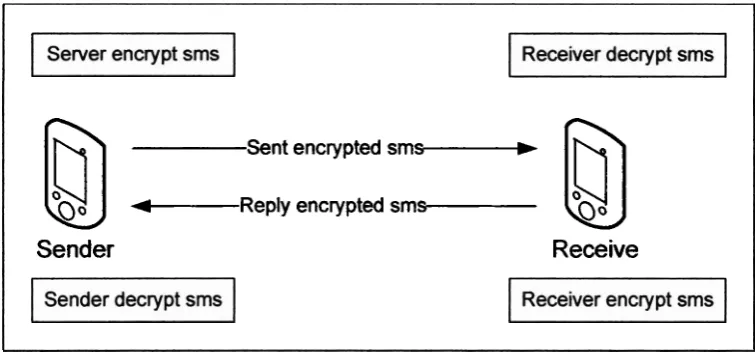
Sent encrypted sm
-8
yRepl. encrypted srn [image:17.534.120.498.311.487.2]-Sender Receive
Figure 1.1 Preview design for the Secure SMS system
1.5 Project Significance
SMS today is important way to communicate between people. SMS increases the amount of voice calling by providing a mechanism for voice mail notification to the handset. SMS provides a convenient, low-cost mechanism for non-voice communication. SMS provides a mechanism for enabling various other systems such as prepaid. User also sometimes used SMS to exchange private or confidential information with others.
Most of the technology today encrypt message been send but it still readable by the operator. In any case one user send his/ her bank account number to the receiver it can be read by anyone if the sender mistakenly sends the SMS. With this project the SMS message will be encrypt by the sender and send the cipher text through the network. Event the third party stole the message it still cannot be read because of the cipher text. The message will be decrypt back to the plain text when receiver receives the SMS.
1.6 Expected Output
The expected output can be concluding from this project is the SMS message been send through network securely. Using Netbeans 6.5 Java 2 Micro Edition as IDE to build the system with the appropriate security algorithm to create a system that can be used for the above proposes. To reduce the possibility wrong sending private information and been read by other people.
1.7 Conclusion
Most mobile operators encrypt all mobile communication data, including SMS messages but sometimes this is not the case, and even when encrypted, the data is readable for the operator. Among others these needs give rise for the need to develop additional encryption for SMS messages, so that only accredited parties are able to engage communication. An approach to this problem is to develop an system that can be used in mobile devices to encrypt messages that are about to be sent. Naturally decryption for encrypted messages is also provided.
This system act as fuewall before the message been seen and receive. Before the message had been sent it will be encrypt to the cipher text and the receiver will decrypt back to the plain text to read it. If the users send private information it will be secure from others event the operator.
CHAPTER I1
LITERATURE REVIEW AND PROJECT METHODOLOGY
2.1 Introduction
This chapter is to discuss .and study about Secure SMS issue and development process includes programming tools and system features. To develop a project, it need more research and information about the project as a guideline to make sure that the project will be execute successfully. The research that needs to make is about the scope of the project, the main objective, understands about the system requirement and a comparison with the existing system.
2.2 Literature Review
2.2.1 Domain
Information and Communication Technology (ICT) in Defense introduce to provide security in ICT. Now days most of our work can be done online such as paid bills, register account, send email including using mobile to communicate. With this user personal details vulnerable to danger.
In this project the system will provide security for the message. In the term of defense this system avoid private message been stolen and read by the third party. In some case user needs to send personal message to receiver and to keep the message private between sender and receiver this system can be used.
2.2.2 Keyword
2.2.2.1 Short Messaging Service (SMS)
SMS is a globally accepted wireless service that enables the transmission of alphanumeric messages between mobile subscribers and external systems such as electronic mail, paging, and voice-mail systems. SMS provides a mechanism for transmitting short messages to and fiom wireless devices.
SMS supports several input mechanisms that allow interconnection with different message sources and destinations. SMS also guarantees delivery of the short message by the network. Temporary failures due to unavailable receiving stations are identified, and the short message is stored in the SMSC until the destination device becomes available.
The benefits of SMS to subscribers center on convenience, flexibility, and seamless integration of messaging services and data access. From this perspective, the primary benefit is the ability to use the handset as an extension of the computer. SMS also delivery of notifications and alerts, guaranteed message delivery, reliable and low- cost communication mechanism for concise information.
2.2.2.2 Cipher
Cipher is a complicated computer software algorithm that is used to perform digital encryption and decryption (Bauchle, et al. 2006). The plain text (message) is transformed by the cipher throughout a repetition of processing steps into cipher text. The reverse process converts the cipher text back to the original message.
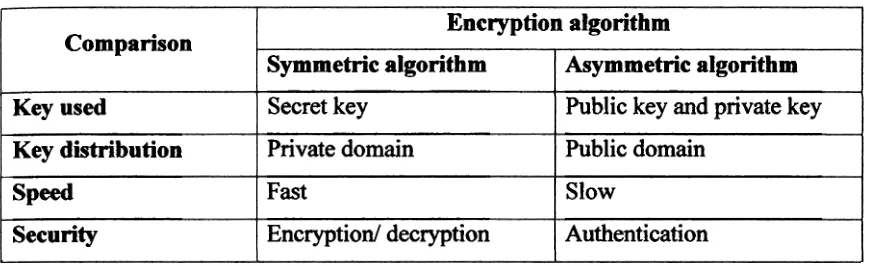
There are three types of cipher which are symmetric, asymmetric, and hybrid (Knudsen, 1998:89). The symmetric cipher uses one secret key, known as private key and used to perform encryption and decryption. Pairing keys are needed for asymmetric cipher. Public key is for encryption purpose while private key is required for decryption. Hybrid cipher is the effort of combination of symmetric and asymmetric ciphers.
Table 2.1 Symmetric algorithm versus Asymmetric algorithm Comparison Key used Key distribution speed Security
2.2.23 Encryption
The safest way to ensure all confidential data, file and message are unreachable by adversary or unauthorized person is encryption. Encryption is the conversion of plain text into unreadable cipher text. This conversion is done after undergoing a series of complex mathematical transformational steps. Therefore, it can prevent eavesdrop activity.
Encryption algorithm
The security of encryption depends on the decided key length and algorithm used. According to National Security Agency (NSA), the key length falls between 192 to 256 bits is considered as TOP SECRET level (Fact Sheet NSA Suite B Cryptography, 2008). If the encryption algorithm is more complex, the produced cipher text may be harder to be broken. However, the implementation cost will be more expensive and decrease the speed of the performance.
Symmetric algorithm Secret key Private domain Fast Encryption/ decryption 2.2.2.4 Decryption Asymmetric algorithm Public key and private key Public domain
Slow
Authentication
[image:23.534.65.502.56.189.2]algorithm that applies for encryption must be used for decryption. Asymmetric encryptioddecryption also execute in the same manner.
2.2.2.5 Symmetric Algorithm
There is a lot of symmetric algorithm available for cryptography purpose. As mentioned before, the security of algorithm depends on the chosen algorithm and decided key length. Generally, the algorithm uses a secret key to change the normal text into unreadable cipher text (encryption) and then use back the same key and algorithm to get back to the original text.
Figure 2.1 below shows the encryption and decryption operation of symmetric algorithm. Symmetric encryption is simple, fast, and easy to apply on digital message. This is the main reason why it is so popular in electronic commerce (E-commerce). The execution speed on performing encryption and decryption is within 10 milliseconds with minimal computer power.