Copyright © 2000, American Society for Microbiology. All Rights Reserved.
Reovirus Protein
NS Binds in Multiple Copies to Single-Stranded
RNA and Shares Properties with Single-Stranded DNA
Binding Proteins
ANNE LYNN GILLIAN,1STEPHEN C. SCHMECHEL,2JONATHAN LIVNY,1LESLIE A. SCHIFF,2
ANDMAX L. NIBERT1*
Department of Biochemistry and Institute for Molecular Virology, The College of Agricultural and Life Sciences, and
The Graduate School, University of Wisconsin-Madison, Madison, Wisconsin 53706,1and Department of
Microbiology, University of Minnesota Medical School, Minneapolis, Minnesota 554552
Received 14 December 1999/Accepted 5 April 2000
Reovirus nonstructural proteinNS interacts with reovirus plus-strand RNAs in infected cells, but little is known about the nature of those interactions or their roles in viral replication. In this study, a recombinant form ofNS was analyzed for in vitro binding to nucleic acids using gel mobility shift assays. Multiple units of NS bound to single-stranded RNA molecules with positive cooperativity and with each unit covering about 25 nucleotides at saturation. TheNS protein did not bind preferentially to reovirus RNA over nonreovirus RNA in competition experiments but did bind preferentially to single-stranded over double-stranded nucleic acids and with a slight preference for RNA over DNA. In addition,NS bound to single-stranded RNA to which a 19-base DNA oligonucleotide was hybridized at either end or near the middle. When present in saturative amounts, NS displaced this oligonucleotide from the partial duplex. The strand displacement activity did not require ATP hydrolysis and was inhibited by MgCl2, distinguishing it from a classical ATP-dependent helicase. These
properties ofNS are similar to those of single-stranded DNA binding proteins that are known to participate in genomic DNA replication, suggesting a related role forNS in replication of the reovirus RNA genome.
Mammalian orthoreoviruses (reoviruses) encode three non-structural proteins, NS, NS, and 1s, whose roles during viral infection remain poorly understood. This report concerns
NS, which is known to be essential for reovirus replication based on the phenotype of a conditionally lethal (temperature-sensitive) mutant with its lesion in theNS-encoding S3 gene segment (9, 27). TheNS protein comprises 366 amino acids and has a molecular mass of 41 kDa. Interaction ofNS with the viral plus-strand RNAs in infected cells is well documented (3, 14). Moreover, whenNS from infected cells is used to bind those RNAs in vitro, it protects 20- to 40-nucleotide fragments of the RNAs from RNase T1 digestion (34). Since the pro-tected fragments include the 3⬘ ends of at least some of the plus-strand RNAs, it was proposed thatNS binds specifically to those regions (34). In addition,NS and two other reovirus proteins,NS and 3, are found to associate with the viral plus-strand RNAs shortly after they are transcribed in infected cells and before minus-strand synthesis converts them into the double-stranded RNA (dsRNA) genome segments (3). These findings have led to a hypothesis that NS plays a role in selecting or condensing the viral plus-strand RNAs for pack-aging during early stages of particle morphogenesis (3, 14, 28, 34). A role forNS in translation of proteins from the reovirus plus-strand RNAs has also been suggested (10, 14).
Evidence for a direct role ofNS in minus-strand synthesis is limited. The temperature-sensitive mutant whose lesion maps to the S3 gene segment (27) produces little or no dsRNA at restrictive temperatures (9, 15), but this indicates only that
NS provides a required function at or before minus-strand synthesis in the replication cycle. Other previous work
demon-strated thatNS-containing ribonucleoprotein complexes iso-lated from reovirus-infected cells display a poly(C)-dependent poly(G) polymerase activity (12, 13). However, recombinant
NS expressed inEscherichia colior insect cells does not dis-play this activity (10, 28), whereas recombinant reovirus pro-tein3 obtained from mammalian or insect cells does (35; D. L. Farsetta and M. L. Nibert, unpublished data). These findings suggest that theNS-containing complexes character-ized by Gomatos et al. (12, 13) also contained3, which is a known component of the reovirus RNA polymerase (22, 35). Thus, despite not having polymerase activity itself,NS might play a role in minus-strand synthesis within these3-containing complexes.
In the present study, we performed additional characteriza-tions of the RNA-binding properties of NS to learn more about its roles in reovirus replication. In initial experiments, we analyzed purified, baculovirus-expressedNS (10) for its ca-pacity to bind single-stranded RNA (ssRNA) molecules in gel mobility shift assays. The results indicated that multiple units ofNS bind to single molecules of ssRNA with positive coop-erativity and in numbers dependent on RNA length such that each unit of NS covered approximately 25 nucleotides at saturation. Competition experiments with various nucleic acids addressed the specificity of NS binding. These studies re-vealed a preference forNS to bind single-stranded over dou-ble-stranded nucleic acids, with a slight preference for RNA over DNA, but they showed no preference forNS to bind reovirus over nonreovirus RNA. We also characterized the capacity ofNS to bind ssRNA to which short DNA nucleotides were hybridized. Displacement of these oligo-nucleotides from the partial duplexes was observed, and further characterizations demonstrated that this strand dis-placement activity ofNS is distinct from that of a classical helicase. The observed activities ofNS are similar to those of several well-characterized single-stranded DNA (ssDNA)
* Corresponding author. Mailing address: Institute for Molecular Virology, University of Wisconsin-Madison, 1525 Linden Dr., Madi-son, WI 53706. Phone: (608) 262-1536. Fax: (608) 262-7414. E-mail: [email protected].
5939
on November 9, 2019 by guest
http://jvi.asm.org/
binding proteins, which are known to be involved in genomic double-stranded DNA (dsDNA) replication, suggesting that
NS may play a related role in replication of the reovirus dsRNA genome.
MATERIALS AND METHODS
Overexpression and purification ofNS. NS was overexpressed in insect cells infected with a recombinant baculovirus containing theNS-encoding reo-virus type 1 Lang S3 gene and purified as described previously (10). Although RNase A was used in the purification procedure, no nuclease activity was de-tected in the final purified preparations ofNS. As noted in the previous study (10), theNS protein obtained by this protocol wasⱖ95% pure according to results with Coomassie-stained sodium dodecyl sulfate-polyacrylamide gels and appeared to be relatively homogeneous in that it migrated between 7- and 9S in 5 to 20% sucrose gradients in the absence of RNA. Nonetheless, whether these complexes represent one discrete type ofNS oligomer (e.g., tetramer or hex-amer) or a mixture and whether or not they can self-associate under some conditions to form higher-order multimers remain to be determined.
Construction of the plasmids pGEM-DS4 and pGEM-3ⴕDS4.The reovirus type 3 Dearing S4 gene was amplified from a linearized plasmid (19) by PCR (29) with Vent DNA polymerase (New England Biolabs, Beverly, Mass.) and primers (Integrated DNA Technologies, Coralville, Iowa) representing the 5⬘and 3⬘ends of S4 plusEcoRI andPstI sites, respectively. The purified PCR product was digested withEcoRI andPstI, again purified, and ligated into those sites in the pGEM-4 plasmid (Promega, Madison, Wis.). A PCR with other primers was used to amplify nucleotides 738 to 1196 of the S4 gene from the new plasmid as well as the majority of pGEM-4 sequences between thePstI andEcoRI sites. Another PCR was used to amplify nucleotides 1 to 536 of the S4 gene. A final PCR was used to join and amplify the purified products from the first two reac-tions (8). The purified product from the final reaction was digested withSpeI and
XhoI and ligated to the purifiedSpeI-XhoI fragment of the cloned S4 gene to generate new plasmid pGEM-DS4, with the entire S4 gene positioned immedi-ately 3⬘to the SP6 RNA polymerase promoter such that the first nucleotide of the SP6 transcript was S4 nucleotide 1 (23).
For subcloning the 3⬘end of S4 from pGEM-DS4, we performed PCR with two primers (Integrated DNA Technologies) and Deep Vent DNA polymerase (New England Biolabs). One primer represented the plus strand of pGEM-DS4 from S4 nucleotides 1061 to 1096, except for two nucleotide substitutions that generated a new EcoRI site at S4 nucleotides 1082 to 1087, and the second primer represented the minus strand of pGEM-DS4 in vector sequences 3⬘to the S4 gene and an interveningHindIII site. The amplified product was digested with
EcoRI andHindIII and ligated into those sites in the pGEM-4Z vector to generate new plasmid pGEM-3⬘DS4. The first 6 nucleotides of the SP6 transcript from this plasmid were from pGEM-4Z, the next 6 were theEcoRI site, and the next 109 were from the S4 3⬘end, beginning with S4 nucleotide 1088 and ending with the final S4 nucleotide, 1196.
Generation of RNA probes and competitors by in vitro runoff transcription.
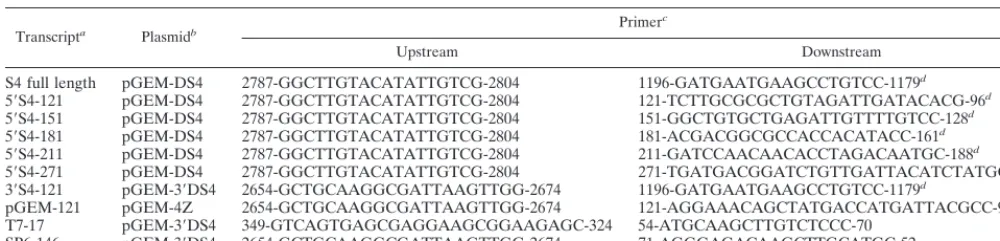
To synthesize linear DNA templates with the desired termini for in vitro runoff transcription, we performed PCR with different primer pairs (Integrated DNA Technologies) (Table 1) and Deep Vent DNA polymerase (New England Bio-labs). For making either full-length or partial (5⬘S4-121, 5⬘S4-151, 5⬘S4-181, 5⬘S4-211, 5⬘S4-271, and 3⬘S4-121) S4 plus-strand transcripts, one primer repre-sented the plus strand of pGEM-DS4 or pGEM-3⬘DS4 in vector sequences 5⬘to
the SP6 promoter and the second primer represented the minus strand of pGEM-DS4 or pGEM-3⬘DS4 in S4 sequences beginning either at the 3⬘end (relative to the plus strand) or the indicated (Table 1) internal position of S4. For making the 121-nucleotide vector transcript (pGEM-121), one primer repre-sented the plus strand of pGEM-4Z in sequences 5⬘to the SP6 promoter and the second primer represented the minus strand of pGEM-4Z in the appropriate downstream sequences. The fragments were isolated from 1% agarose gels and purified using the Qiaex II kit (Qiagen, Valencia, Calif.).
To generate RNA transcripts from each amplified DNA fragment, 1 to 2g of the purified fragment was combined with transcription buffer (50 mM HEPES [pH 7.5], 16 mM MgCl2, 2 mM spermidine, 40 mM dithiothreitol); 3 mM ATP,
CTP, and UTP; 1 mM GTP (Pharmacia Biotech, Piscataway, N.J.); 200 U of SP6 RNA polymerase (Epicentre, Madison, Wis.); 20 U of RNasin (Promega); and 0.1 U of inorganic pyrophosphatase (Sigma, St. Louis, Mo.). To radiolabel the RNA transcripts, 0.13 nmol of [␣-32P]GTP (specific activity, 3,000 Ci/mmol)
(NEN, Boston, Mass.) was also added. The reaction mixtures were incubated at 37°C for 90 min prior to the addition of another 130 U of SP6 RNA polymerase, 13 U of RNasin, and 0.067 U of inorganic pyrophosphatase. The reaction mix-tures were then incubated for another 90 min, after which they were extracted with phenol-chloroform, and the RNA was precipitated with 1 volume of 7.5 M ammonium acetate and 2 volumes of 100% ethanol. The RNAs were gel isolated from a 5% polyacrylamide Tris-glycine native gel (25 mM Tris, 192 mM glycine) and eluted overnight at room temperature in elution buffer (0.1% sodium do-decyl sulfate, 0.5 M ammonium acetate, 10 mM magnesium acetate, 1 mM EDTA; filter sterilized). The eluted RNA was then extracted with phenol-chlo-roform and precipitated with 0.3 M sodium acetate and 2 volumes of 100% ethanol. The RNA concentration was determined by scintillation counting (11).
Gel mobility shift assays.Various amounts of purifiedNS in phosphate-buffered saline (137 mM NaCl, 3 mM KCl, 8.4 mM Na2HPO4, 1.6 mM KH2PO4)
were incubated with various amounts of32P-labeled RNA in gel shift buffer (12
mM Tris-HCl [pH 7.5], 0.1 mg of bovine serum albumin/ml, 10 mM -mercap-toethanol, 0.2% Tween 20, 10 U of RNasin) (32) for 15 min at room temperature in a total volume of 10l. The samples were mixed with gel loading buffer (25 mM Tris, 192 mM glycine, 0.25% bromophenol blue, 0.25% xylene cyanole FF, 30% glycerol) and subjected to electrophoresis through either a 1% agarose-Tris-acetate-EDTA gel (40 mM Tris-acetate, 1 mM EDTA) at 90 V or a 5% polyacrylamide Tris-glycine native gel (described above) at 10 mA. The times of electrophoresis varied depending on the size of the RNA probe used in the assay. The gels were dried onto filter paper under vacuum, and the samples were vi-sualized by phosphorimaging (Molecular Dynamics, Sunnyvale, Calif.). The amount of radioactivity in the samples was quantitated using ImageQuant soft-ware (Molecular Dynamics). Concentrations of NaCl from 0 to 300 mM had little effect on the binding ofNS to RNA. The standard binding reaction mixture used throughout this study contained less than 30 mM NaCl.
Immunoblots.Proteins in the 5% Tris-glycine polyacrylamide gels were blot-ted onto a nylon membrane (Bio-Rad, Hercules, Calif.) at 30 V overnight at 4°C in transfer buffer (25 mM Tris, 192 mM glycine). The membrane was probed with the anti-NS antibody (10) at a dilution of 1/500 using the protocol supplied with the Bio-Rad color development reagent kit. The secondary antibody was visual-ized with color development reagents 5-bromo-4-chloro-3-indoylphosphate p -toluidine salt andp-nitroblue tetrazolium chloride (Bio-Rad).
[image:2.612.53.553.84.204.2]Hill plots.A Hill plot was generated for the 121-, 151-, and 181-nucleotide RNAs in Fig. 3 as well as for three other assays done with a 121-nucleotide RNA andNS amounts from 0.24 to 6.0 pmol (1g⬇24 pmol) (26). The amount of boundNS was calculated as follows. First the amount of radiolabeled RNA in
TABLE 1. DNA primers used for PCR to generate linear DNA templates for in vitro transcription
Transcripta Plasmidb Primer
c
Upstream Downstream
S4 full length pGEM-DS4 2787-GGCTTGTACATATTGTCG-2804 1196-GATGAATGAAGCCTGTCC-1179d 5⬘S4-121 pGEM-DS4 2787-GGCTTGTACATATTGTCG-2804 121-TCTTGCGCGCTGTAGATTGATACACG-96d 5⬘S4-151 pGEM-DS4 2787-GGCTTGTACATATTGTCG-2804 151-GGCTGTGCTGAGATTGTTTTGTCC-128d 5⬘S4-181 pGEM-DS4 2787-GGCTTGTACATATTGTCG-2804 181-ACGACGGCGCCACCACATACC-161d 5⬘S4-211 pGEM-DS4 2787-GGCTTGTACATATTGTCG-2804 211-GATCCAACAACACCTAGACAATGC-188d 5⬘S4-271 pGEM-DS4 2787-GGCTTGTACATATTGTCG-2804 271-TGATGACGGATCTGTTGATTACATCTATGG-242d 3⬘S4-121 pGEM-3⬘DS4 2654-GCTGCAAGGCGATTAAGTTGG-2674 1196-GATGAATGAAGCCTGTCC-1179d
pGEM-121 pGEM-4Z 2654-GCTGCAAGGCGATTAAGTTGG-2674 121-AGGAAACAGCTATGACCATGATTACGCC-94 T7-17 pGEM-3⬘DS4 349-GTCAGTGAGCGAGGAAGCGGAAGAGC-324 54-ATGCAAGCTTGTCTCCC-70
SP6-146 pGEM-3⬘DS4 2654-GCTGCAAGGCGATTAAGTTGG-2674 71-AGGGAGACAAGCTTGCATGC-52
aRNA transcripts generated by in vitro runoff transcription from PCR-amplified DNA fragments. Each was generated using SP6 RNA polymerase except for T7-17,
which was generated using T7 RNA polymerase.
bPlasmid DNA used as the template for PCR.
cSequence numbers are those designated for pGEM-4Z in the Promega Life Science catalog unless otherwise indicated (see footnoted). All sequences are written
in 5⬘-to-3⬘orientation. Sequence numbers that decrease from left to right represent minus strands between those numbers (SP6 transcripts are defined as plus strands). Upstream and downstream are defined relative to the promoter (SP6 or T7) used in generating each transcript.
dSequence numbers are those for the type 3 Dearing S4 plus strand.
on November 9, 2019 by guest
http://jvi.asm.org/
each shifted band was quantitated and expressed as a percentage of total RNA in the reaction mixture. Next the percentage was multiplied by the number of NS units in each band (e.g., oneNS unit in the fastest-migrating band and four in the slowest). Finally, the amounts ofNS in all four bands were summed and the sum was divided by the total amount of protein added to each sample. The amount of unboundNS⫽1⫺the amount of boundNS. The log10(bound
NS/unboundNS) versus the log10(NS concentration) was plotted, and the
best-fit line to the linear portion of the graph was calculated using Excel (Mi-crosoft, Redmond, Wash.). The slope of the line is the Hill coefficient (40) and was calculated for all six assays and averaged.
Competition assays.A radiolabeled RNA probe (0.24 pmol each) was mixed with the unlabeled competitors in various relative amounts, after which 4.8 pmol ofNS was added, and the samples were incubated for 15 min at room temper-ature. For one set of samples,NS was combined with radiolabeled RNA probe and incubated for 15 min as described above. The competitor was then added, and the samples were incubated for an additional 15 min or 2 h. Equivalent weights of RNA (concentration determined byA260[30]) were used. The
radio-labeled RNA probe used for both competition experiments was the 121-nucle-otide fragment from the 5⬘end of S4 in the pGEM-DS4 plasmid. The nucleic acid competitors used for competition between ss- and dsRNA and ss- and dsDNA were the following: ssRNA, full-length in vitro-transcribed S4 gene; dsRNA, reovirus type 3 Dearing genomic RNAs; ssDNA, circular M13 plasmid containing rhinovirus sequences; dsDNA, SmaI-linearized pGEM-4Z vector containing the reovirus type 1 Lang S3 gene (10). The unlabeled RNA compet-itors used for competitions were the following: the 5⬘121 nucleotides of S4 (same RNA used as the labeled probe), the 3⬘121 nucleotides of S4, and 121 nucleo-tides from the multiple-cloning region of the pGEM-4Z vector (Promega) that did not contain reovirus sequences. The amount of radiolabeled RNA bound was determined as the amount of RNA in the upper four shifted bands versus the total amount of RNA. All results are expressed relative to the sample containing no competitor.
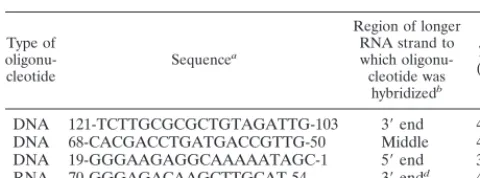
RNA-DNA and RNA-RNA partial duplexes.Nineteen-nucleotide DNA oligo-nucleotides (Integrated DNA Technologies) were designed to be complementary to the 3⬘end, the middle, or the 5⬘end of the 5⬘S4-121 RNA (Table 2). The oligonucleotides were 5⬘-end-labeled with polynucleotide kinase (New England Biolabs) and [␥-32P]ATP, extracted with phenol-chloroform, and precipitated
with ethanol. The oligonucleotides were then hybridized to the 5⬘S4-121 RNA in hybridization buffer (100 mM NaCl, 50 mM Tris-HCl, 2 mM EDTA) at 90°C for 5 min and cooled to room temperature.
To synthesize linear DNA templates for transcribing the 17-nucleotide RNA oligonucleotide (T7-17) (Table 2) and the 146-nucleotide RNA (SP6-146) to which T7-17 was later hybridized, we performed PCR with different primer pairs (Integrated DNA Technologies) (Table 1) and Deep Vent DNA polymerase (New England Biolabs). For making T7-17, one primer represented the minus strand of pGEM-3⬘DS4 in vector sequences 5⬘to the T7 promoter and the second primer represented the plus strand of pGEM-3⬘DS4 in the appropriate downstream vector sequences. For making SP6-146, one primer represented the plus strand of pGEM-3⬘DS4 in vector sequences 5⬘to the SP6 promoter and the second primer represented the minus strand of pGEM-3⬘DS4 in the appropriate downstream vector sequences. Both RNA transcripts were generated by runoff
transcription in vitro as described above except that T7 RNA polymerase (Epi-centre) and 12 mM MgCl2were used in making T7-17. [␣-32P]GTP was included
in the reaction mixture to provide radiolabeling of T7-17, SP6-146, or both in different experiments. T7-17 was hybridized to the 3⬘end of SP6-146 as described above for the RNA-DNA hybrids.
ATPase and displacement assays.In theNS samples for the ATPase assay, 75 pmol of purifiedNS was incubated with 3Ci of [␣-32P]ATP (NEN) in gel
shift buffer with or without EDTA (12.5 mM). In the core samples for the ATPase assay, 6⫻109reovirus cores were incubated with 3Ci of [␣-32P]ATP
(NEN) in nucleoside triphosphatase buffer (50 mM Tris-morpholinoethanesul-fonic acid [MES] [pH 8.5], 5 mM MgCl2) (25) with or without EDTA (12.5 mM).
The RNA-DNA hybrid (0.11 pmol) was added to all samples, which were incu-bated at room temperature or 35°C (cores) for 30 min in a total volume of 5l each. One microliter of each sample was then spotted onto a polyester-backed polyethyleneimine-cellulose thin-layer chromatography plate (Sigma) and devel-oped with ascending solvent (1 M formic acid, 0.5 M LiCl). The reaction prod-ucts were visualized by phosphorimaging (Molecular Dynamics). To assay for DNA oligonucleotide displacement activity in parallel with ATPase assays, sam-ples were prepared in the same manner except that no [␣-32P]ATP was added.
The entire volume of each sample was then analyzed on a 5% polyacrylamide Tris-glycine native gel as described above. For other experiments in which DNA or RNA oligonucleotide displacement activity was measured, various amounts of purifiedNS and 0.24 to 0.26 pmol of RNA-DNA or RNA-RNA were added to gel shift buffer in a total volume of 10l and then the mixtures were incubated at room temperature for 15 min before running the entire sample on a 5% polyacrylamide Tris-glycine native gel.
RESULTS
Gel mobility shift assays forNS binding to 1,196- or 151-nucleotide ssRNAs.The RNA-binding activity of purifiedNS was examined using an agarose gel mobility shift assay. In initial experiments, increasing amounts ofNS were incubated with runoff transcripts representing full-length ssRNA plus strands of the reovirus type 3 Dearing S4 gene (data not shown). More than one band was seen in the mobility shift assay with this long RNA (1,196 nucleotides); however, most of the intermediate-size complexes migrated as a smear, making it difficult to distinguish the number of different complexes.
To improve resolution of the intermediate-size complexes, we decreased the length of the ssRNA and assayed for NS binding using a polyacrylamide gel mobility shift assay (Fig. 1A). For initial experiments with smaller ssRNA molecules, we used runoff transcripts representing the 5⬘151 nucleotides of the S4 plus strand (5⬘S4-151). As the amount of NS was increased, the mobility of the 5⬘S4-151 RNA was progressively retarded and clearly distinguishable, intermediate-size com-plexes were observed. At the larger amounts of NS (⬎12 pmol), a lowest-mobility complex was formed, accumulated, and was not further retarded with the addition of more protein. Based on the detection of more than one shifted RNA band over the range ofNS amounts added, we concluded that more than one unit ofNS can bind per molecule of 5⬘S4-151 plus-strand RNA. In addition, we concluded that the lowest-mobil-ity complex represents RNA molecules that have each been saturatively bound by the same maximum number of NS units. Each binding unit ofNS is hypothesized to be a small oligomer of that protein based on the sedimentation properties of the purified protein (10).
[image:3.612.53.293.91.180.2]To confirm that the shifted bands containNS, a gel from a mobility shift assay with unlabeled 5⬘S4-151 RNA was subject-ed to immunoblotting using a polyclonal antiserum forNS (10). The antiserum detected protein migrating in distinct bands (Fig. 1B,⫹RNA) with the same mobilities as the radiolabeled, protein-shifted RNA bands in Fig. 1A. TheNS protein did not show this pattern of banding in the absence of ssRNA (Fig. 1B,⫺RNA), althoughNS did appear to concentrate in sev-eral distinct bands when excess amounts of the protein were present. Bands of similar mobility were visible in the presence of RNA as well (Fig. 1B,⫹RNA). The nature of these pro-tein-specific bands is not known, but they may reflect a capacity
TABLE 2. Oligonucleotides used in forming partial duplexes, RNA-DNA or RNA-RNA
Type of
oligonu-cleotide Sequence
a
Region of longer RNA strand to which oligonu-cleotide was
hybridizedb Tmc
(°C)
DNA 121-TCTTGCGCGCTGTAGATTG-103 3⬘end 43.1 DNA 68-CACGACCTGATGACCGTTG-50 Middle 44.1 DNA 19-GGGAAGAGGCAAAAATAGC-1 5⬘end 35.5 RNA 70-GGGAGACAAGCTTGCAT-54 3⬘endd 48.8 aFor DNA oligonucleotides, sequence numbers are those for the type 3
Dearing S4 plus strand. For the RNA oligonucleotide, sequence numbers are those for pGEM-4Z as designated in the Promega Life Science catalog. All sequences are written in 5⬘-to-3⬘orientation. Sequence numbers decrease from left to right since the sequences represent minus strands (SP6 transcripts are defined as plus strands).
bDNA oligonucleotides were individually hybridized to RNA 5⬘S4-121. The
RNA oligonucleotide was hybridized to RNA SP6-146.
cMelting temperatures calculated for RNA-DNA or RNA-RNA duplexes of
the indicated sequences at 25 nM duplex and 25 mM salt using the algorithms of Sugimoto et al. (36) for RNA-DNA and Xia et al. (41) for RNA-RNA as implemented at http://bioweb.pasteur.fr/seqanal/interfaces/melting.html at the Pasteur Institute.
dThe 5⬘end of the RNA oligonucleotide was hybridized to the penultimate 3⬘
nucleotide of the longer RNA.
on November 9, 2019 by guest
http://jvi.asm.org/
ofNS to self-associate into higher-order multimers in the ab-sence of RNA under these conditions. Their appearance only with excess amounts ofNS suggests that they hold limited significance for the RNA-binding results. The findings confirm thatNS was present in the shifted RNA-protein complexes.
Gel mobility shift assay forNS binding to ssRNAs of other lengths.The 5⬘S4-151 RNA appeared to be shifted into six distinct bands over the range of amounts ofNS (Fig. 1A). The presence of six shifted bands suggested that if the larger amounts ofNS were fully saturating the RNA, then a maxi-mum of six units ofNS were binding to each RNA molecule. Moreover, since the RNA was 151 nucleotides long, each unit ofNS must be covering about 25 nucleotides if theNS units are evenly distributed. To test this hypothesis, three additional plus-strand RNAs, differing in length by 30 nucleotides (5⬘ S4-121, 5⬘S4-181, and 5⬘S4-211), were generated as runoff tran-scripts from the same S4 clone used to generate the 5⬘S4-151 RNA. The new RNAs were incubated with increasing amounts ofNS and were analyzed in the polyacrylamide gel mobility shift assay. As predicted from initial findings with 5⬘S4-151 (Fig. 1A), 5⬘S4-121 was shifted into five distinguishable com-plexes, 5⬘S4-151 was shifted into six distinguishable complexes, 5⬘S4-181 was shifted into seven distinguishable complexes, and 5⬘S4-211 was shifted into eight distinguishable complexes with increasing amounts ofNS (Fig. 2A). To compare the mobil-ities of the different complexes formed with each RNA, all four RNAs were incubated with the same amount ofNS (18 pmol) and subjected to electrophoresis in adjacent lanes of the same gel (Fig. 2B). This analysis demonstrated that with each 30-nucleotide increase in RNA length over this range, one new lower-mobility complex was seen. In later experiments, 5⬘ S4-271 RNA was also tested and found to be shifted into 11 distinguishable complexes with increasing amounts of NS (data not shown). Considering the size of each RNA and the number of distinguishable complexes formed with each, we concluded that the binding unit ofNS covers a 24- to 27-nucleotide region of RNA and that the total number ofNS units that bound per RNA molecule is determined by the overall length of the RNA.
Binding cooperativity.Since multiple units ofNS bound to a single RNA molecule, the binding could have exhibited pos-itive, negative, or no cooperativity. To address these
possibil-FIG. 1. Gel mobility shift assay with a 151-nucleotide fragment of reovirus S4 plus strand and immunoblot analysis of a similar assay with anti-NS serum. (A) Increasing amounts of purifiedNS were incubated with 0.21 pmol of radiola-beled ssRNA comprising the 5⬘151 nucleotides of the reovirus S4 plus strand (5⬘S4-151). The samples were then subjected to electrophoresis in a 5% Tris-glycine polyacrylamide native gel until the free RNA was near the bottom of the gel. The radiolabeled RNA in the dried gel was visualized by phosphorimaging. NS-RNA complexes with six distinct mobilities are indicated at left. (B) In-creasing amounts ofNS were incubated with and without unlabeled 5⬘S4-151 RNA (0.8 pmol) and subjected to electrophoresis as described above. An immunoblot assay was performed to detect the protein. The amounts of RNA and protein in these samples were increased so that the ratios were similar to those in panel A but the protein was more easily detected. Arrows, comparable bands in panels A and B.
FIG. 2. Gel mobility shift assays with S4 plus-strand RNA fragments ranging in size from 121 to 211 nucleotides in 30-base increments. Radiolabeled ssRNA fragments comprising the following 5⬘portions of the S4 plus strand were synthesized: 121 nucleotides, 5⬘S4-121; 151 nucleotides, 5⬘S4-151; 181 nucleotides, 5⬘S4-181; and 211 nucleotides, 5⬘S4-211. (A) Increasing amounts of purifiedNS were separately incubated with 0.21 to 0.22 pmol of each RNA, and the samples were analyzed as described for Fig. 1A.NS-RNA complexes with five to eight distinct mobilities are indicated to the left of each gel. (B) PurifiedNS (18 pmol) was incubated with each of the four RNAs as described for panel A (RNA sizes are indicated above the lanes) and subjected to electrophoresis as described for Fig. 1A. To provide better separation of the shifted complexes, the gel was run longer in this experiment such that the free RNA was run off the bottom.
on November 9, 2019 by guest
http://jvi.asm.org/
ities, the ratio of bound to total NS in each sample was calculated for the 121-, 151-, and 181-nucleotide RNAs from Fig. 2A. In addition, three other experiments using the 121-nucleotide RNA and smaller protein amounts were performed. Hill plots were generated for all six data sets (40). A represen-tative plot for the 121-nucleotide RNA is shown (Fig. 3). The linear region of this curve has a slope⬎1 indicating thatNS binds ssRNA with positive cooperativity. When the data from all six experiments were averaged andNS was assumed to bind ssRNA as a monomer, the Hill coefficient was calculated at 1.43⫾0.10. Since the RNA-binding unit ofNS is thought to be a small oligomer (10), the calculations were also done for
NS binding as a dimer, trimer, and tetramer. The Hill coef-ficient increased by 0.02 to 0.03 unit with each step in oligomer order (data not shown), indicating thatNS binding to ssRNA exhibited positive cooperativity regardless of the oligomeric nature of the binding unit.
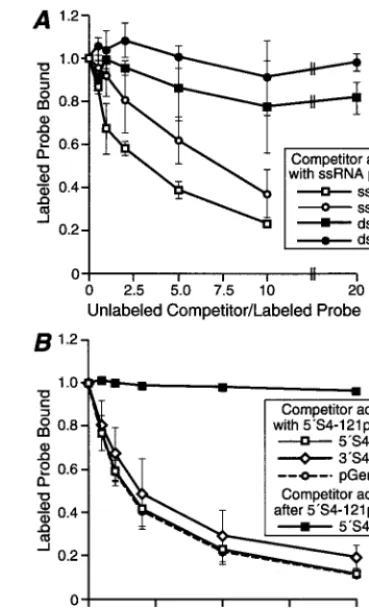
Competition assays with single- and double-stranded nu-cleic acids. Previous work demonstrated that NS does not bind detectably to dsRNA or dsDNA in filter-binding or sed-imentation assays (14, 28) but does bind to ssDNA in the filter-binding assay (28). To compare the affinities ofNS for ssRNA and other nucleic acids in a more quantitative fashion, we performed competition assays. Radiolabeled 5⬘S4-121 RNA was combined with unlabeled competitor nucleic acids (reovirus ssRNA, reovirus dsRNA, ssDNA, or dsDNA) before the addition ofNS. The RNA-protein complexes were then analyzed using the polyacrylamide gel mobility shift assay (Fig. 4A). Both ssRNA and ssDNA competed efficiently with the labeled ssRNA probe forNS binding, whereas dsRNA and dsDNA competed much less efficiently (Fig. 4A). For example, when 10-fold more ssRNA or ssDNA competitor was added only 23%⫾2% or 37%⫾ 11%, respectively, of the radiola-beled 5⬘S4-121 RNA was bound. In contrast, when 20-fold more dsRNA or dsDNA competitor was added, 82%⫾7% or 98%⫾ 4%, respectively, of the radiolabeled 5⬘S4-121 RNA was bound. In addition, with either single- or double-stranded competitors, RNA competed with only a slightly greater effi-ciency for binding toNS than did DNA (Fig. 4A). In sum-mary,NS bound efficiently to single-stranded, but not double-stranded, nucleic acids and exhibited a slight preference for RNA over DNA.
Competition assays with reovirus and nonreovirus ssRNAs.
Previous work demonstratedNS binding to reovirus RNA in infected cells (3, 14) and to nonreovirus RNA in vitro (14, 28). However, no experiments addressed whetherNS exhibits a preference for reovirus RNA (14, 28). Sequences at the 5⬘and 3⬘ termini of all 10 reovirus RNAs are conserved (2) and therefore may be involved in distinguishing reovirus from non-reovirus RNA for binding by proteins such asNS during steps in reovirus replication. To test this hypothesis, we used a com-petition assay to compare the affinities ofNS for RNAs rep-resenting the 5⬘end of the reovirus S4 plus strand, the 3⬘end of the reovirus S4 plus strand, and nonreovirus sequences derived from pGEM-4Z. Radiolabeled 5⬘S4-121 RNA was in-cubated with unlabeled competitor RNAs (5⬘S4-121, 3⬘S4-121, or pGEM-121) before addition of NS. The RNA-protein complexes were then analyzed using the polyacrylamide gel mobility shift assay (Fig. 4B). In this assay, all three competitor RNAs competed to approximately the same level with radio-labeled 5⬘S4-121 RNA for binding toNS. For example, when fivefold more 5⬘S4-121 competitor RNA was added, only 13%
FIG. 3. Hill plot ofNS binding to ssRNA to determine cooperativity. A gel shift assay with 0.24 pmol of radiolabeled 5⬘S4-121 RNA was performed as described for Fig. 2A except that the concentrations of purifiedNS ranged from 0.24 to 6 pmol. The amount ofNS bound at each concentration was calculated as described in Materials and Methods. Log10(boundNS/1⫺boundNS) was plotted relative to log10(NS concentration), and a best-fit line was calculated for the linear portion of the graph (the equation and coefficient of determination for the line are shown in the box).
FIG. 4. Competition assays forNS binding to ssRNA using ssRNA, dsRNA, ssDNA, or dsDNA as the competitor. Each data point represents the mean from three experiments, and the error bars represent the standard deviation of the mean. (A) Increasing concentrations of unlabeled competitor ssRNA, dsRNA, dsDNA, or ssDNA (see Materials and Methods) were combined with 0.24 pmol of radiolabeled 5⬘S4-121 ssRNA. PurifiedNS (4.8 pmol) was added to each sample, and the sample was incubated. The samples were subjected to electro-phoresis and visualized as described for Fig. 1A. The upper four shifted RNA bands were included in the quantitation of bound RNA. The ratios of competitor to probe RNA were calculated from weights rather than molar amounts of nucleic acid to reflect numbers of potentialNS binding sites rather than num-bers of nucleic acid molecules. (B) The assay was performed as described for panel A except that the unlabeled competitor ssRNAs were 121 nucleotides from the 5⬘end of the S4 plus strand (5⬘S4-121), the 3⬘end of the S4 plus strand (3⬘S4-121), or the vector sequence (pGEM-121). For one set of samples,NS was added to the labeled RNA prior to addition of the 5⬘S4-121 competitor.
on November 9, 2019 by guest
http://jvi.asm.org/
[image:5.612.338.523.72.376.2]⫾3% of the radiolabeled 5⬘S4-121 RNA was bound byNS. When fivefold more 3⬘S4-121 competitor RNA was added, only 22% ⫾ 12% of the radiolabeled 5⬘S4-121 RNA was bound. Last, when fivefold more pGEM-121 competitor RNA was added, only 13%⫾9% of the radiolabeled 5⬘S4-121 RNA was bound. Although these data suggested thatNS does not preferentially bind reovirus sequences, it was possible that both ends of the RNA together might be required to confer speci-ficity. However, the amount of 5⬘S4-121 RNA bound toNS in the presence of the full-length ssRNA competitor in Fig. 4A was similar to the amount bound in the presence of each of the competitor RNAs in Fig. 4B. Thus, all ssRNAs appeared to compete to about the same level with radiolabeled 5⬘S4-121 RNA for binding to NS. This suggests that NS does not distinguish between RNA sequences corresponding to the 5⬘
and 3⬘ends of the S4 gene and does not exhibit preference for binding to reovirus sequences.
To investigate the stability of preformed RNA-protein com-plexes, radiolabeled 5⬘S4-121 RNA was incubated with NS prior to addition of competitor (Fig. 4B). Unlabeled 5⬘S4-121 RNA did not displace radiolabeled 5⬘S4-121 RNA that was already bound toNS, even when the competitor was added in 10-fold excess. The complex of 5⬘S4-121 RNA andNS was stable for at least 2 h after addition of this competitor (data not shown). These results suggest that, onceNS bound to RNA, it formed a stable complex that could not be easily disrupted by subsequent addition of other RNA.
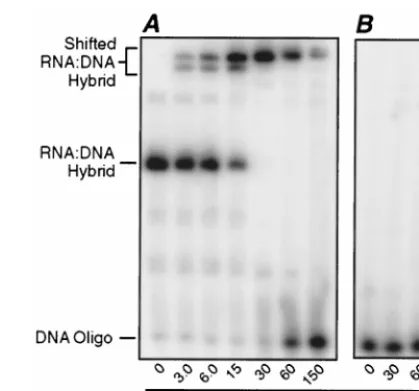
Gel mobility shift assays forNS binding to partially du-plex RNA-DNA hybrids and evidence for a strand displace-ment activity.We hypothesized thatNS may require a single-stranded 5⬘or 3⬘end of RNA to initiate binding. To test this hypothesis, an end-radiolabeled DNA oligonucleotide comple-mentary to 19 nucleotides at the 3⬘end of the 5⬘S4-121 RNA (Table 2) was hybridized to that RNA. The RNA-DNA hybrid was then incubated with increasing amounts ofNS and ana-lyzed using the polyacrylamide gel mobility shift assay (Fig. 5). The mobility of this RNA-DNA hybrid with a duplex region at the RNA 3⬘end was retarded by the smaller amounts ofNS (Fig. 5A). Moreover, the amount ofNS that shifted the ma-jority of this RNA-DNA hybrid (30 pmol ofNS to shift 0.26 pmol of hybrid in Fig. 5A) was comparable to the amount that shifted the majority of the 121-nucleotide RNA (24 pmol of
NS to shift 0.22 pmol of RNA in Fig. 2A). Similar results were observed when other end-radiolabeled DNA oligonucleotides (Table 2) were hybridized to either the middle or the 5⬘end of the 5⬘S4-121 RNA (data not shown). We therefore concluded thatNS does not require a large single-stranded region at either the 5⬘or the 3⬘end of RNA to initiate binding.
Interestingly, when larger amounts ofNS were incubated with the RNA-DNA hybrid having a duplex region at the 3⬘
end, the shifted hybrids disappeared and increasing amounts of free oligonucleotide were observed (Fig. 5A). This suggests that, as the final unit ofNS was binding to each molecule of the hybrid, it destabilized the duplex region and caused the DNA oligonucleotide to be released. The DNA oligonucleo-tides bound to the middle or the 5⬘end of the RNA were also released when saturating amounts ofNS were incubated with the respective hybrids (data not shown), suggesting that the displacement activity was not direction dependent.
Evidence thatNS is not an ATP-dependent helicase.Since
NS displaced DNA oligonucleotides from RNA-DNA hy-brids, we recognized that the protein might possess helicase activity. If so, thenNS like other RNA or DNA helicases, should require hydrolysis of ATP as a source of energy for the displacement activity (reviewed in reference 16). Although ATP was not added to the displacement assay mixtures
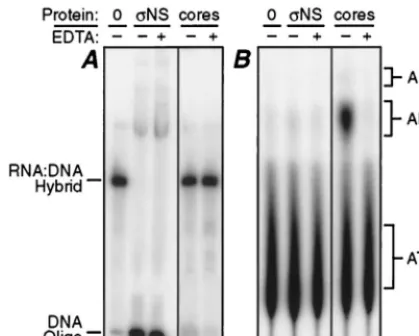
de-scribed in the previous section, it is possible that there was contaminating ATP from the reaction mixture used to radio-label the DNA oligonucleotides (see Materials and Methods). To investigate whether ATP hydrolysis was required forNS to displace the DNA oligonucleotides, the displacement assay was repeated in the absence or presence of EDTA, a known inhibitor of ATPase and RNA helicase functions through its chelation of divalent cations (16, 25). In addition, [␣-32P]ATP was added to parallel samples, which were then analyzed by thin-layer chromatography to determine if ATP had been hy-drolyzed. The NS protein displaced DNA from the RNA-DNA hybrid in the absence or presence of EDTA (Fig. 6A) but did not detectably hydrolyze ATP in either case (Fig. 6B). Reovirus cores, which were analyzed as a positive control for EDTA-sensitive ATPase activity (25), hydrolyzed ATP in the absence, but not in the presence, of EDTA (Fig. 6B). These data suggest that NS does not require hydrolysis of ATP during displacement of the DNA oligonucleotide from the RNA-DNA hybrid.
To assess the effect of MgCl2on theNS-associated strand displacement activity, the displacement assay was performed in the presence of increasing concentrations of MgCl2. The ac-tivity was progressively decreased with increasing MgCl2(data not shown). At 10 mM MgCl2, for example, only 30% of the DNA oligonucleotide was displaced relative to the amount displaced in the absence of MgCl2(data not shown), suggesting that Mg2⫹inhibited rather than stimulated the displacement activity. This response to MgCl2provided additional evidence that the strand displacement activity ofNS is distinguishable from that of a classical helicase (16).
Test for strand displacement activity ofNS using a par-tially duplex RNA molecule.Regions of RNA-RNA duplex are generated during the normal course of reovirus replication, certainly in the genomic dsRNA segments and probably also in regions of secondary structure within the free plus-strand
tran-FIG. 5. Gel shift assay with ssRNA having an RNA-DNA duplex region at its 3⬘end. A 19-nucleotide DNA oligonucleotide that was exactly complementary to the 3⬘end of the RNA was32P-labeled at its 5⬘end. (A) The oligonucleotide was
hybridized to unlabeled ssRNA (5⬘S4-121) and purified. Differing amounts of purifiedNS were then mixed with 0.26 pmol of hybrid and assayed as described for Fig. 1A. (B) An unhybridized32P-labeled oligonucleotide was incubated in
the presence of increasing amounts ofNS and also assayed as described for Fig. 1A. For both panels, the amounts ofNS added to samples are indicated beneath the lanes, and the positions of the RNA-DNA hybrid and the DNA oligonucleotide are also indicated.
on November 9, 2019 by guest
http://jvi.asm.org/
[image:6.612.325.535.70.266.2]scripts. The strand displacement activity that we demonstrated for NS using RNA-DNA hybrids may therefore reflect an essential activity of this protein at disrupting regions of RNA-RNA duplex during one or more steps in reovirus replication. The poor capacity ofNS to bind to fully duplex RNA mole-cules (Fig. 4A) suggested that partial duplexes were more appropriate for further testing. In experiments with one such partially duplex RNA, we found thatNS could not displace a fully complementary 17-nucleotide RNA oligonucleotide (Table 2) from the 3⬘end of a longer RNA to which it was hybridized (data not shown). Notably, however, this RNA-RNA duplex had a higher calculated melting temperature than the RNA-DNA duplexes used in the preceding experiments (Table 2), which may have limited the capacity ofNS to act on it. Further experiments are warranted before concluding thatNS can or cannot disrupt dsRNA regions in partially duplex molecules.
DISCUSSION
NS binds in multiple copies to single ssRNA molecules, but there are unresolved questions about the nature of these complexes.Results from the gel mobility shift assays indicate that multiple units ofNS can bind to a single ssRNA mole-cule. Such molecules, bound by multiple units of NS, may represent the large nucleoprotein complexes obtained from both reovirus-infected mammalian cells (14) and insect cells infected with a recombinant baculovirus expressingNS (10). By binding in multiple units to the viral plus-strand RNAs (minus-strand RNAs are not released from template plus strands during reovirus replication [1, 31]),NS may provide multiple sites for interactions with other viral or cellular pro-teins that may play roles in translation, packaging, or minus-strand synthesis. Questions remaining to be answered include whether the multiple units ofNS that bind to an RNA
mol-ecule stretch out like beads on a necklace or self-associate to form a more compact structure.
The positive cooperativity demonstrated forNS binding to ssRNA may arise either from changes in RNA conformation uponNS binding that promote subsequentNS units to bind more readily or fromNS-NS interactions, similar to the case for poliovirus RNA polymerase (4, 26). Certain observations are consistent with each possibility. Data indicating thatNS destabilizes short regions of a nucleic acid duplex and thereby alters the RNA conformation are consistent with an RNA-based explanation for cooperativity. On the other hand, evi-dence thatNS oligomers might self-associate to form higher-order multimers under certain conditions (Fig. 1B) suggests that positive cooperativity may arise from suchNS-NS in-teractions. Additional analyses of NS-RNA and NS-NS interactions are needed to establish the basis of the observed cooperativity.
One curious feature of the results is that saturative binding occurred at between 12 and 24 pmol ofNS for each RNA, despite their different sizes (Fig. 2A). Assuming thatNS was present in limiting amounts but not limiting concentrations in these experiments, we would expect saturation of the 211-nucleotide RNA to have required approximately twice the amount of NS as saturation of the 121-nucleotide RNA. However, since the interval between amounts of addedNS in the saturation range was large (twofold), the experimental findings are reasonable. For example, if the 121-nucleotide RNA was saturatively bound by five units of NS when 15 pmol ofNS was added in this assay, then the 211-nucleotide RNA should have been saturatively bound by eight units of
NS when 24 pmol ofNS was added. This is consistent with the data in Fig. 2A.
Another interesting feature of the results is that a faint ladder of higher-mobility complexes was seen even when satu-rative amounts of NS were added (Fig. 1A and 2). These complexes showed mobilities distinct from the major ones seen with smaller amounts ofNS (Fig. 1A and 2A). Moreover, the higher-mobility complexes seen with saturative amounts of
NS showed the same mobilities regardless of the size of added RNA and also comigrated with the saturated complexes of each smaller added RNA over the range at which those were analyzed (Fig. 2B). There are several possible explanations for these observations, but by far the most likely would seem to be that these higher-mobility complexes represent small amounts of partially degraded RNA molecules that were present in each sample and to whichNS was also saturatively bound. Enu-meration of these complexes in Fig. 2B lends support to the conclusion that eachNS binding unit covers about 25 nucle-otides of RNA.
What are the unit of NS that binds to ssRNA and the number of nucleotides of RNA that each unit contacts?The purifiedNS protein migrates as 7- to 9S complexes in 5 to 20% sucrose gradients (10), consistent with oligomers contain-ing three to six 41-kDa monomers ofNS. As stated earlier, whether these complexes represent one discrete type ofNS oligomer or a mixture and whether they can self-associate to form higher-order multimers in the absence of RNA remain unknown. We nonetheless hypothesize that one of these oli-gomers or multimers represents the unit ofNS that binds to ssRNA in a number of copies dependent on RNA length. The molar ratio of NS to RNA at saturation in this study may indicate the number ofNS subunits in the binding unit, that is, if the concentrations ofNS are not limiting and if most or all of the addedNS is competent for RNA binding. In this case, we can calculate that saturative binding was achieved with
[image:7.612.68.278.74.242.2]NS in 60- to 120-fold molar excess to each RNA in Fig. 2A
FIG. 6. Analysis of ATP hydrolysis during strand displacement byNS. Ei-ther 12.5 mM EDTA (⫹) or H2O (⫺) was added to 75 pmol of purifiedNS
(NS) or 6⫻109reovirus core particles (cores) in each sample. Cores were
included as a positive control for ATP hydrolysis. All samples were analyzed in duplicate. (A) The RNA-DNA hybrid described for Fig. 5 (0.11 pmol) was added to each sample in one set. These samples were then analyzed as described for Fig. 1A. The positions of the RNA-DNA hybrid and the DNA oligonucleotide are indicated. (B) Three microcuries of [␣-32P]ATP and 0.11 pmol of the
RNA-DNA hybrid were added to each sample in the other set. Products of the reaction with ATP were resolved by thin-layer chromatography and analyzed by phos-phorimaging. The positions of unlabeled ATP, ADP, and AMP markers, as determined by UV absorption, are indicated.
on November 9, 2019 by guest
http://jvi.asm.org/
(12 to 24 pmol ofNS for about 0.2 pmol of RNA). Consid-ering that only five to eight units ofNS were bound to each RNA in the 121- to 211-nucleotide range at saturation, we can further calculate that each binding unit contained 8 to 24 subunits ofNS. If the RNA-free, 7- to 9SNS oligomer is a tetramer, for example, this suggests that a multimer comprising two to six tetramers constitutes each binding unit. Given that some of the purifiedNS in our preparations might not have been competent for RNA binding, we recognize that these numbers indicate an upper limit for the size of the binding unit. It remains possible that each binding unit comprises one copy of a discrete type ofNS oligomer that sediments in the 7- to 9S range in the absence of RNA (10).
The finding that each binding unit ofNS covers about 25 nucleotides of RNA is consistent with previous work demon-strating that NS protects 20 to 40 nucleotides of reovirus ssRNAs from RNase T1 degradation (34). However, it is im-portant to distinguish this 25-nucleotide region of ssRNA cov-ered byNS from the number of nucleotides that constitutes the minimum or preferred size of binding site for each unit of
NS. No experiments in this report directly address the latter, but further analyses of NS binding to different-size RNAs might be used to establish this number. For example, if a 140-nucleotide RNA binds fiveNS units covering 25 nucleo-tides each, are the 15 “extra” nucleonucleo-tides enough to bind a sixthNS unit?
No evidence for sequence specificity in NS binding to ssRNA.Since reovirus replication is cytoplasmic (reviewed in reference 24), there is no selective advantage forNS to have a strong preference for binding ssRNA over ssDNA. Accord-ingly, we found that NS binds to ssRNA with only slightly greater efficiency than to ssDNA. Our evidence that neither dsRNA nor dsDNA is an efficient competitor forNS binding to ssRNA is consistent with previous findings (28), but our further evidence for strand displacement from short duplex regions is novel (see below).
Although previous work suggested thatNS can bind nonreo-virus RNA (14, 28), this study provides the first evidence that nonreovirus RNA efficiently competes with reovirus RNA se-quences for binding. Previous authors suggested that NS binds specifically to the 3⬘ end of the reovirus plus-strand RNAs (34). Our findings suggest that the reason reovirus 3⬘
RNA ends were protected from nuclease degradation in the previous study is thatNS protects many regions along the length of the RNAs, including the 3⬘ ends. We have in fact demonstrated thatNS binding to ssRNA partially protects it from in vitro digestion with RNase A (data not shown). Since our data indicate thatNS does not bind specifically to the short conserved sequences at the 5⬘and 3⬘ends of all reovirus plus-strand RNAs (2), we hypothesize thatNS is not involved in recognizing these sequences during packaging or minus-strand synthesis. Thus, these sequences are likely to be recog-nized by other viral or cellular proteins.
NS displaces DNA oligonucleotides from RNA-DNA hy-brids but is not a classical helicase.Since the strand displace-ment activity ofNS bound to RNA-DNA hybrids occurred independently of ATP hydrolysis and was inhibited by MgCl2 but not by EDTA, the data strongly suggest thatNS is not a classical, ATP-dependent helicase. Consistent with this conclu-sion is the fact thatNS lacks the nucleoside triphosphate-binding motifs characteristic of those enzymes (16). Instead, it appears most likely thatNS melts duplex regions as it com-pletes its cooperative and saturative binding to a primarily ssRNA molecule, with the energy for melting provided by the binding event(s).
From the data in this study, we hypothesize that only short
duplex regions, with low thermodynamic stability, are subject to melting byNS (Table 2). We favor this explanation for why unwinding activity was not demonstrated byNS on the one type of partially duplex RNA-RNA molecule that we examined in this study. Rather than concluding thatNS is inactive at melting any RNA-RNA duplexes, we propose that the duplex we analyzed was simply too stable to be unwound byNS. In future work, we will more systematically test for the potential RNA-melting activity of NS by using molecules containing shorter duplex regions with lower predicted melting tempera-tures. Such duplexes may be more relevant to reovirus repli-cation in any case since regions of continuous duplex shorter than 17 bp are much more likely to form within the reovirus plus strands according to RNA-folding predictions (J.-Y. Sgro and M. L. Nibert, unpublished data). We will also examine molecules having shorter duplex regions at the 5⬘ end, the middle, or the 3⬘end of the longer RNA strand in order to increase our chances of seeing a specific type of strand dis-placement activity. If RNA-RNA melting activity can be shown forNS in vitro, then its role in reovirus-infected cells may be in melting short regions of intra- or intermolecular secondary structure within the viral plus-strand RNAs, regions which might otherwise interfere with the use of the RNAs in pack-aging and/or minus-strand synthesis during formation of prog-eny virions.NS almost certainly does not destabilize the reo-virus dsRNA genome for transcription, since this process occurs within the inner capsid of assembled reovirus particles (6, 33), whereNS is not packaged.
Similarities betweenNS and ssDNA binding proteins in-volved in dsDNA replication.The adenovirus DNA binding protein Ad-DBP (21, 42), the herpes simplex virus type 1 tein ICP8 (5), and the Epstein-Barr virus ssDNA-binding pro-tein BALF-2 (38) are all similar to NS in that they can destabilize regions of a nucleic acid duplex independently of ATP hydrolysis and in a manner that is inhibited by MgCl2(5, 21, 38, 42). In addition to ATP-independent strand displace-ment activity, Ad-DBP and ICP8 share the following proper-ties with NS: (i) binding in multiple units to a nucleic acid molecule in a sequence-independent manner; (ii) protection of the single-stranded nucleic acid from nuclease degradation (data forNS are not shown in this paper), (iii) strong pref-erence for single-stranded over double-stranded nucleic acids; and (iv) positive cooperativity for nucleic acid binding (re-viewed in references 7 and 20). These and other ssDNA bind-ing proteins have been shown to be involved in dsDNA repli-cation. For example, both in vitro and in vivo studies have shown that Ad-DBP is required for elongation of ssDNA by the adenovirus polymerase (7, 20), possibly involving the ATP-independent helix-destabilizing properties of Ad-DBP (21, 42). Two prokaryotic ssDNA binding proteins,E. coliSSB and bacteriophage T4 gene 32 protein (gp32), are also required for dsDNA replication and share nucleic acid-binding properties with the noted DNA animal virus proteins andNS but cannot destabilize DNA duplexes (7). Of course, a clear difference betweenNS and ssDNA binding proteins is the nucleic acid substrate for genome replication (RNA versus DNA). None-theless, considering the large number of similarities, we pro-pose thatNS plays a role in genome replication similar to that played by the ssDNA binding proteins. Specifically,NS may bind to the reovirus plus-strand RNAs and stabilize them in a conformation that allows the reovirus RNA polymerase and other potential cofactors to mediate minus-strand synthesis to produce the dsRNA gene segments. Some secondary struc-tures in the plus-strand RNAs may be unwound directly by
NS (similarly to Ad-DBP [21, 42]), whereas others may need to be unwound by another viral or cellular protein and then
on November 9, 2019 by guest
http://jvi.asm.org/
stabilized in the single-stranded state byNS binding (similarly to gp32 [7]). Studies to address interactions amongNS, the polymerase, and other proteins should provide further insight into the potential role ofNS in reovirus genome replication.
Similarities to the nonstructural proteins of other Reoviri-daemembers.Other members of the virus familyReoviridae, all of which have dsRNA genomes, also encode nonstructural proteins with ssRNA-binding activity. For instance, the blue-tongue virus (orbivirus) nonstructural protein NS2 (41 kDa) binds ssRNA and forms 7S complexes (39). Similarly, the ro-tavirus nonstructural protein NSP2 (35 kDa) has sequence-independent ssRNA-binding activity (18), forms 10S multimers (17), and interacts with the rotavirus RNA polymerase VP1 (17). Recent data indicate that the binding activities of NSP2 are in fact very similar to those ofNS shown in this study, including binding to single ssRNA molecules in multiple cop-ies, with positive cooperativity, with little or no specificity for rotavirus sequences, and with substantially greater affinity for ssRNA than dsRNA (37). NSP2 has not yet been reported to destabilize nucleic acid duplexes, as wasNS in this study, but was reported to have nucleoside triphosphatase and autophos-phorylation activities (37). The latter have not been demon-strated forNS (Fig. 6). It remains to be determined whether reovirusNS, rotavirus NSP2, bluetongue virus NS2, and sim-ilar nonstructural proteins from otherReoviridaemembers play strictly analogous roles in the replication cycles of their respec-tive viruses.
ACKNOWLEDGMENTS
This work was supported by NIH research grants AI-39533 (M.L.N.) and AI-32139 (L.A.S.), by ACS grant RPG-98-12701-MBC (L.A.S.), by a Hatch grant from USDA funds awarded to the College of Agricul-tural and Life Sciences (M.L.N.), and by a grant from the Lucille P. Markey Charitable Trust to the Institute for Molecular Virology (M.L.N.). A.L.G. received additional support as a Department of Biochemistry Steenbock Fellow. S.C.S. was supported by NIH Medical Scientist Training Program grant GM-08244 and by NIH Microbiolo-gy/Cancer Research training grant CA-09138. J.L. received additional support as a University of Wisconsin/Hilldale Undergraduate/Faculty Research Fellow. M.L.N. received additional support as a Shaw Sci-entist from the Milwaukee Foundation.
We thank T. Broering, D. Farsetta, and C. Luongo for useful dis-cussions and comments on the manuscript. We especially acknowledge T. Baumstark and P. Ahlquist for advice on work with RNA, T. Bro-ering for assistance in determining melting temperatures for the RNA-DNA and RNA-RNA duplexes, and S. Melcher for help with the Hill plots. Assistance in producing the S4 clone was provided by M. Moses and K. Thoemke. We also thank M. Chute, S. J. Harrison, J. Lugus, K. Thoemke, and X. Zhou for technical support and other members of our laboratories for helpful discussions.
REFERENCES
1.Acs, G., H. Klett, M. Schonberg, J. Christman, D. H. Levin, and S. C. Silverstein.1971. Mechanism of reovirus double-stranded ribonucleic acid synthesis in vivo and in vitro. J. Virol.8:684–689.
2.Antczak, J. B., R. Chmelo, D. J. Pickup, and W. K. Joklik.1982. Sequence at both termini of the 10 genes of reovirus serotype 3 (strain Dearing). Virology
121:307–319.
3.Antczak, J. B., and W. K. Joklik.1992. Reovirus genome segment assortment into progeny genomes studied by the use of monoclonal antibodies directed against reovirus proteins. Virology187:760–776.
4.Beckman, M. T. L., and K. Kirkegaard.1998. Site size of cooperative single-stranded RNA binding by poliovirus RNA-dependent RNA polymerase. J. Biol. Chem.273:6724–6739.
5.Boehmer, P. E., and I. R. Lehman.1993. Herpes simplex virus type 1 ICP8: helix-destabilizing properties. J. Virol.67:711–715.
6.Borsa, J., and A. F. Graham.1968. Reovirus: RNA polymerase activity in purified virions. Biochem. Biophys. Res. Commun.33:895–901.
7.Chase, J. W., and K. R. Williams. 1986. Single-stranded DNA binding proteins required for DNA replication. Annu. Rev. Biochem.55:103–136. 8.Cormack, B.1991. Mutagenesis by the polymerase chain reaction, p. 8.5.1–
8.5.9.InF. M. Ausubel, R. Brent, R. E. Kingston, D. D. Moore, J. G. Seidman, J. A. Smith, and K. Struhl (ed.), Current protocols in molecular biology. John Wiley and Sons, Inc., New York, N.Y.
9.Cross, R. K., and B. N. Fields.1972. Temperature-sensitive mutants of reovirus type 3: studies on the synthesis of viral RNA. Virology50:799–809. 10. Gillian, A. L., and M. L. Nibert.1998. Amino terminus of reovirus nonstruc-tural proteinNS is important for ssRNA binding and nucleoprotein com-plex formation. Virology240:1–11.
11. Gillian-Daniel, D. L., N. K. Gray, J. Astrom, A. Barkoff, and M. Wickens.
1998. Modifications of the 5⬘cap of mRNAs duringXenopusoocyte matu-ration: independence from changes in poly(A) length and impact on trans-lation. Mol. Cell. Biol.18:6152–6163.
12. Gomatos, P. J., O. Prakash, and N. M. Stamatos.1981. Small reovirus particle composed solely ofNS with specificity for binding different nucleic acids. J. Virol.39:115–124.
13. Gomatos, P. J., N. M. Stamatos, and N. H. Sarkar.1980. Small reovirus-specific particle with polycytidylate-dependent RNA polymerase activity. J. Virol.36:556–565.
14. Huismans, H., and W. K. Joklik.1976. Reovirus-coded polypeptides in infected cells: isolation of two native monomeric polypeptides with affinity for single-stranded and double-stranded RNA, respectively. Virology70:
411–424.
15. Ito, Y., and W. K. Joklik.1972. Temperature-sensitive mutants of reovirus. I. Patterns of gene expression by mutants of groups C, D, and E. Virology50:
189–201.
16. Kadare, G., and A.-L. Haenni.1997. Virus-encoded RNA helicases. J. Virol.
71:2583–2590.
17. Kattoura, M. D., X. Chen, and J. T. Patton.1994. The rotavirus RNA-binding protein NS35 (NSP2) forms 10S multimers and interacts with the viral RNA polymerase. Virology202:803–813.
18. Kattoura, M. D., L. L. Clapp, and J. T. Patton.1992. The rotavirus non-structural protein, NS35, possesses RNA-binding activity in vitro and in vivo. Virology191:698–708.
19. Kedl, R., S. Schmechel, and L. Schiff.1995. Comparative sequence analysis of the reovirus S4 genes from 13 serotype 1 and serotype 3 field isolates. J. Virol.69:552–559.
20. Kornberg, A., and T. A. Baker.1991. DNA replication, 2nd ed. W. H. Freeman & Co., New York, N.Y.
21. Monaghan, A., A. Webster, and R. T. Hay.1994. Adenovirus DNA binding protein: helix destabilising properties. Nucleic Acids Res.22:742–748. 22. Morozov, S. Y.1989. A possible relationship of reovirus putative RNA
polymerase to polymerases of positive-strand RNA viruses. Nucleic Acids Res.17:5394.
23. Nam, S. C., and C. Kang.1988. Transcription initiation site selection and abortive initiation cycling of phage SP6 RNA polymerase. J. Biol. Chem.263:
18123–18127.
24. Nibert, M. L., L. A. Schiff, and B. N. Fields.1996. Reoviruses and their replication, p. 1557–1596.InB. N. Fields, D. M. Knipe, and P. M. Howley (ed.), Fields virology, 3rd ed. Lippincott-Raven Publishers, Philadelphia, Pa. 25. Noble, S., and M. L. Nibert.1997. Characterization of an ATPase activity in reovirus cores and its genetic association with core shell protein1. J. Virol.
71:2182–2191.
26. Pata, J. D., S. C. Schultz, and K. Kirkegaard.1995. Functional oligomer-ization of poliovirus RNA-dependent RNA polymerase. RNA1:466–477. 27. Ramig, R. F., T. A. Mustoe, A. H. Sharpe, and B. N. Fields.1978. A genetic
map of reovirus. II. Assignment of the double-stranded RNA-negative mu-tant groups C, D, and E to genome segments. Virology85:531–534. 28. Richardson, M. A., and Y. Furuichi.1985. Synthesis inEscherichia coliof the
reovirus nonstructural proteinNS. J. Virol.56:527–533.
29. Saiki, R. K., D. H. Gelfand, S. Stoffel, S. J. Sharf, R. Hiuchi, G. T. Horn, K. B. Mullis, and H. A. Erlich.1988. Primer-directed enzymatic amplifica-tion of DNA with a thermostable DNA polymerase. Science239:487–491. 30. Sambrook, J., E. F. Fritsch, and T. Maniatis.1989. Molecular cloning: a
laboratory manual, 2nd ed. Cold Spring Harbor Laboratory Press, Cold Spring Harbor, N.Y.
31. Schonberg, M., S. C. Silverstein, D. H. Levin, and G. Acs.1971. Asynchro-nous synthesis of the complementary strands of the reovirus genome. Proc. Natl. Acad. Sci. USA68:505–508.
32. Schoumacher, F., C. Erny, A. Berna, T. Godefroy-Colburn, and C. Stussi-Garaud.1992. Nucleic acid-binding properties of the alfalfa mosaic virus movement protein produced in yeast. Virology188:896–899.
33. Shatkin, A. J., and J. D. Sipe.1968. RNA polymerase activity in purified reoviruses. Proc. Natl. Acad. Sci. USA61:1462–1469.
34. Stamatos, N. M., and P. J. Gomatos.1982. Binding to selected regions of reovirus mRNAs by a nonstructural reovirus protein. Proc. Natl. Acad. Sci. USA79:3457–3461.
35. Starnes, M. C., and W. K. Joklik.1993. Reovirus protein lambda 3 is a poly(C)-dependent poly(G) polymerase. Virology193:356–366.
36. Sugimoto, N., S. Nakano, M. Katoh, A. Matsumura, H. Nakamuta, T. Ohmi-chi, M. Yoneyama, and M. Sasaki.1995. Thermodynamic parameters to predict stability of RNA/DNA hybrid duplexes. Biochemistry34:11211–11216. 37. Taraporewala, Z., D. Chen, and J. T. Patton.1999. Multimers formed by the
on November 9, 2019 by guest
http://jvi.asm.org/
rotavirus nonstructural protein NSP2 bind to RNA and have nucleoside triphosphatase activity. J. Virol.73:9934–9943.
38.Tsurumi, T., J. Kishore, N. Yokoyama, M. Fujita, T. Daikoku, H. Yamada, Y. Yamashita, and Y. Nishiyama.1998. Overexpression, purification and helix-destabilizing properties of Epstein-Barr virus ssDNA-binding protein. J. Gen. Virol.79:1257–1264.
39.Uitenweerde, J. M., J. Theron, M. A. Stoltz, and H. Huismans.1995. The multimeric nonstructural NS2 proteins of Bluetongue virus, African horse-sickness virus, and epizootic hemorrhagic disease virus differ in their
single-stranded RNA-binding ability. Virology209:624–632.
40. van Holde, K. E.1985. Physical biochemistry, 2nd ed. Prentice-Hall, Inc., Englewood Cliffs, N.J.
41. Xia, T., J. SantaLucia, Jr., M. E. Burkard, R. Kierzek, S. J. Schroeder, X. Jiao, C. Cox, and D. H. Turner.1998. Thermodynamic parameters for an expanded nearest-neighbor model for formation of RNA duplexes with Watson-Crick base pairs. Biochemistry37:14719–14735.
42. Zijderveld, D. C., and P. C. van der Vliet.1994. Helix-destabilizing proper-ties of the adenovirus DNA-binding protein. J. Virol.68:1158–1164.