The in vitro assembly process for forming nucleoprotein complexes containing linear retrovirus-like DNA and integrase (IN) was investigated. Solution conditions that allowed avian myeloblastosis virus IN to effi-ciently pair two separate linear DNA fragments (each 487 bp in length) containing 3* OH recessed long terminal repeat termini were established. Pairing of the viral termini by IN during preincubation on ice permitted these nucleoprotein complexes to catalyze the concerted insertion of the two termini into a circular DNA target (full-site reaction), mimicking the in vivo reaction. The three major solution determinants were high concentrations of NaCl (0.33 M), 1,4-dioxane, and polyethylene glycol. The aprotic solvent dioxane (15%) was significantly better (sixfold) than 15% dimethyl sulfoxide for forming complexes capable of full-site rather than half-site integration events. Half-site reactions by IN involved the insertion of a single donor terminus into circular pGEM. Although NaCl was essential for the efficient promotion of the concerted integration reaction, dioxane was necessary to prevent half-site reactions from occurring at high NaCl concentrations. Under optimal solution conditions, the concerted integration reaction was directly proportional to a sixfold range of IN. The complexes appeared not to turn over, and few half-site donor-donor molecules were produced. In the presence of 0.15 or 0.35 M NaCl, dioxane prevented efficient 3*OH trimming of a blunt-ended donor by IN, suggesting that the complexes formed by IN with blunt-ended donors were different from those formed with donors containing 3*OH recessed termini for strand transfer. The results suggest that IN alone was capable of protein-protein and protein-DNA interactions that efficiently promote the in vitro concerted integration reaction.
The formation and composition of viral nucleoprotein com-plexes in the cytoplasm of cells infected by retroviruses are not fully understood. The viral complexes, whose protein compo-sition varies, have been reported to be;80S in human immu-nodeficiency virus type 1-infected cells to ;160S in murine leukemia virus-infected cells (4, 5–7, 13, 14). The common viral protein associated with these complexes is the integrase (IN), which is required for integration. In vivo, IN is capable of trimming a dinucleotide from the 39OH termini of the linear, blunt-ended viral DNA genome (10 kbp) in a coordinated fashion (26). IN in isolated viral nucleoprotein complexes is also capable of inserting the recessed viral DNA termini into exogenous DNA substrates by a concerted mechanism (4, 5, 13, 24), mimicking the in vivo integration reaction.
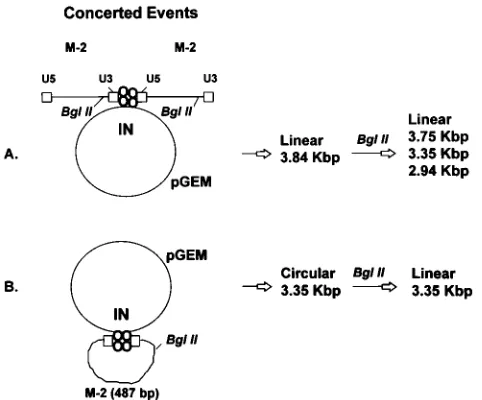
IN purified from avian myeloblastosis virus (AMV) is capa-ble of performing the concerted integration reaction (full-site event) using a 39OH recessed retrovirus-like DNA substrate (487 bp) as a donor substrate and circular DNA (2,867 bp) as a target (33). The most efficient concerted integration pathway required the participation of two termini located on separate donor molecules that were paired by IN for catalysis (Fig. 1A). With AMV IN, approximately 20% of all strand transfer prod-ucts were full-site donor-target recombinants (Fig. 1) (33). The other products were either half-site donor or donor-target reactions involving only one donor terminus per strand transfer reaction (half-site event). In order to investigate the
protein-protein and protein-DNA interactions involved in the concerted reaction, it was necessary to improve the efficiency of the full-site reaction. We have investigated parameters that influenced the assembly and stability of IN-donor complexes (preintegration complexes) and the subsequent concerted in-tegration reaction. Parameters studied included the donor-target and IN-donor molar ratios, superhelicity of the donor-target, monovalent cations, volume-excluding reagents, and the aprotic solvents dioxane and dimethyl sulfoxide (DMSO). Several of these parameters significantly influenced the assembly of IN-donor complexes. In comparison with previous results (33), solution conditions that produced a threefold increase in the assembly efficiency of IN-donor complexes that catalyzed con-certed events were identified.
MATERIALS AND METHODS
Bacteria and plasmids.Escherichia coli (strain CA224) possessing amber mu-tations in the lacZ gene and for tryptophan biosynthesis was used to select full-site recombinants that contained the SupF gene (33). SupF was located in the retrovirus-like DNA donor (M-2) that possesses U3 and U5 long terminal repeat termini (Fig. 1). Linear M-2 was isolated by NdeI digestion of a pUC19-based construct and purification from agarose gels. Sequencing of M-2 showed it to be 487 bp. It was previously estimated to be 528 bp by agarose gel electro-phoresis (33). The target DNA was supercoiled pGEM-3. Nicked circular pGEM was produced by DNase I digestion of supercoiled DNA in the presence of ethidium bromide (20).
Assay conditions.The standard reaction mixture contained 20 mM HEPES (N-2-hydroxyethylpiperazine-N9-2-ethanesulfonic acid) buffer (pH 7.5), 1 mM dithiothreitol, 5 mM MgCl2, 15% dioxane, 8% polyethylene glycol (PEG), and 330 mM NaCl. In some assays, the concentrations of NaCl, PEG, and dioxane or DMSO were varied. Purified AMV IN (22) was preincubated with 59-end-labeled M-2 on ice for 10 min in the standard reaction mixture (20ml). Supercoiled pGEM was added, and the samples were immediately incubated at 378C for 10 min unless otherwise indicated. The reaction products were purified as previ-* Corresponding author. Mailing address: St. Louis University
Health Sciences Center, Institute for Molecular Virology, 3681 Park Ave., St. Louis, MO 63110. Phone: (314) 8411. Fax: (314) 577-8406. Electronic mail address: [email protected].
7483
on November 9, 2019 by guest
http://jvi.asm.org/
ously described (33). Selected DNA products were digested by BglII to verify the identity of the reaction products (33) (Fig. 1). The DNA products were subjected to either 1% or 1.5% agarose gel electrophoresis using a Tris-borate-EDTA buffer. The gels were dried and exposed to X-ray films. The labeled products were quantitated by a Molecular Dynamics PhosphorImager.
Donor labeling, substrate stoichiometry, and the genetic selection of full-site donor-target recombinants.M-2 was 59end labeled with [g-32P]ATP and T4 polynucleotide kinase. The specific activity was between 2,000 and 5,000 cpm/ng. The molar ratio of dimeric IN to M-2 ends was usually set at 12 to 1 (66 ng or 50 nM to 15 ng, respectively), unless otherwise stated. The standard molar ratio of M-2 to pGEM was 1 to 1 with the concentrations set at 15 and 100 ng per reaction, respectively. Scale-up reactions maintained the same concentrations of IN and DNA substrates for isolation of the linear 3.84-kbp M-2–pGEM recom-binants that were the result of the full-site integration reaction. The full-site recombinant products were isolated from wet gels and ligated. The DNA was used to transform CA244 cells. Colonies were screened for plasmids that were analyzed by size, restriction enzyme digestion, and dideoxy DNA sequencing. Sequence analysis verified the 6-bp avian retrovirus target site duplication (15, 17, 18, 33).
The 39OH recessed ends of the 59-end-labeled M-2 were also filled in by Klenow DNA polymerase by using [a-32P]TTP and unlabeled dATP, resulting in the labeling of the penultimate T nucleotide (16). The double-labeled M-2 DNAs were digested by either XbaI, BglII, or EcoRI, and the fragments were analyzed on DNA sequencing gels and by a PhosphorImager. The results demonstrated that both the 59and the 39ends of the molecule contained nearly the same amount of radioactivity and were of the correct size, suggesting that more than 96% of the molecules were blunt ended.
RESULTS
Solution conditions affect the production of full-site recom-binants. Preincubation of donor M-2 with AMV IN on ice increases the yield of full-site recombinants in comparison with having M-2 and pGEM in the preincubation mixture prior to strand transfer (33). The major concerted products are linear 3.84-kbp DNAs, which result from insertion of two donor mol-ecules by IN into pGEM (Fig. 1A). The minor concerted prod-ucts are due to an M-2 unimolecular reaction with pGEM producing circular 3.35-kbp DNA (Fig. 1B). We have now investigated how solution chemistry affects the full-site inte-gration reaction.
The concerted insertion of two M-2 donors into supercoiled pGEM using 15% DMSO under standard assay conditions
with 0.33 M NaCl is shown in Fig. 2 (lane 2). The concerted DNA product represents ;20% of the total strand transfer population, including the circular half-site donor-target and donor-donor (M-2–M-2) products (33). The M-2–M-2 prod-ucts were produced only when the pGEM target was absent (data not shown). When DMSO was replaced with dioxane (Fig. 2, lanes 4 to 9 [0 to 25%, respectively]), the ratio of full-site to circular half-site products was significantly in-creased, with the maximum effect observed at 15 to 20% diox-ane (Fig. 2, ldiox-anes 7 and 8). Based on PhosphorImager data, the ratio of full-site to circular half-site recombinants obtained with 15% dioxane was approximately sixfold higher than that observed with 15% DMSO. The production of M-2–M-2 prod-ucts was also reduced with dioxane instead of DMSO (see also Fig. 3 and 5). The total quantity of all recombinants produced in the presence of 15% DMSO was approximately twofold higher than that produced with 15% dioxane (Fig. 2, lanes 2 and 7). In summary, both aprotic solvents stimulated the strand transfer reactions with dioxane, promoting the production of full-site events over half-site events in comparison with DMSO.
To verify that the full-site recombinants (linear 3.84-kbp DNA) produced with dioxane were the same as those pro-duced with DMSO (33), the donor-target DNA products were subjected to BglII digestion. The same BglII digestion products and the same preference for U3 insertions over U5 were ob-served with dioxane as those obtained with DMSO (data not shown; Fig. 1). To sequence individual full-site recombinants produced with dioxane, the linear 3.84-kbp recombinant DNA was isolated from wet agarose gels, ligated, and transformed into CA244 cells. Plasmids of 3.84 kbp were isolated from 20 colonies and sequenced. Seventeen recombinants had the avian 6-bp target site duplications. Two had a 5-bp host dupli-cation, and one had a 1-bp host duplication.
[image:2.612.59.300.70.270.2]The NaCl concentration (50 to 500 mM) in the preincuba-tion mixture, with or without dioxane, significantly affected both the concerted and the circular half-site reactions. Without dioxane (Fig. 3, lanes 9 to 15), higher salt concentrations in-creased the formation of preintegration complexes that were more capable of producing full-site products (lane 12 [0.3 M]). However, significant quantities of circular half-site products were also produced. With 15% dioxane (Fig. 3, lanes 1 to 8), the production of circular half-site products was suppressed at
[image:2.612.361.509.72.193.2]FIG. 1. Schematic of concerted integration of a retrovirus-like donor into a circular target by IN. (A) Two M-2 molecules (each 487 bp in length) are paired onto the circular pGEM target (2,867 bp) by a presumed IN tetramer. The strand transfer reaction produces a linear 3.84-kbp DNA. BglII digestion of the linear DNA results in products of three sizes (33). (B) One M-2 molecule is inserted into pGEM by IN, producing a nicked circular donor-target recombinant. Di-gestion of this recombinant by BglII produces a linear 3.35-kbp molecule.
FIG. 2. Enhancement of the concerted integration reaction in the presence of dioxane. IN was preincubated with M-2 at various dioxane concentrations with 0.33 M NaCl prior to strand transfer. The ratio of IN dimer to donor ends was 13 to 1. Lane 1, no IN with DMSO; lane 2, control with 15% DMSO instead of dioxane; lane 3, no IN with 15% dioxane; lane 4, no dioxane; lanes 5 to 9, 5, 10, 15, 20, and 25% dioxane, respectively. The labeled unused M-2 (p) that migrates slightly faster than the M-2–M-2 recombinants was the result of denaturation of the DNA during the 59end labeling procedure. The quantity of this denatured DNA was variable in different preparations (Fig. 3 and 5).
on November 9, 2019 by guest
http://jvi.asm.org/
the 0.3 and 0.35 M NaCl concentrations (lanes 5 and 6), with the full-site product being the major species. The formation of circular half-site and M-2–M-2 products with dioxane was now occurring in the 50 to 200 mM range (lanes 2 to 4). In sum-mary, the data suggest that dioxane suppressed the assembly of complexes that produced circular half-site products at the higher salt concentrations.
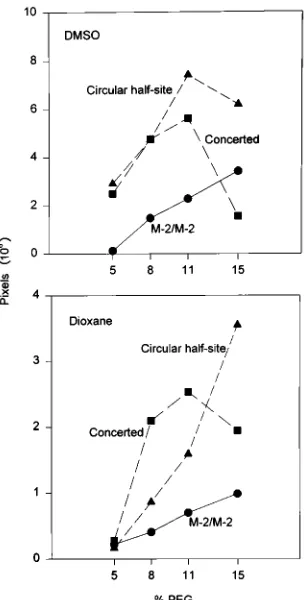
Volume-excluding reagents were shown to increase the in-tegration reaction catalyzed by IN in murine leukemia or avian retrovirus nucleoprotein complexes (5, 24). PEG also stimu-lated the formation of all recombinants by AMV IN whether in the presence of 15% DMSO or 15% dioxane (Fig. 4). Above 11% PEG, the concerted reaction was inhibited while M-2– M-2 and circular half-site M-2–pGEM recombinants were rel-atively unaffected.
We examined the effect of changing the standard M-2/ pGEM molar ratio (1 to 1) on the full-site reaction, anticipat-ing that, at higher donor-to-target ratios, the half-site reactions would be favored. The donor and IN were always preincubated together in the absence of pGEM prior to the strand transfer reaction. The concentration of the donor was held constant. Both the M-2–M-2 and the M-2–pGEM half-site reactions were approximately twofold higher at the donor/target ratio of 5 to 1 (data not shown). The full-site reaction was decreased proportionally at the higher donor/target ratios. At ratios of 2 to 1 through 0.5 to 1, there were no significant differences in the observed half-site or full-site ratios. At higher target con-centrations of 200 ng per reaction (donor/target ratio, 0.5 to 1), the strand transfer reactions were significantly inhibited prob-ably because of simple DNA competition effects. Similar re-sults were obtained in studies using either 15% dioxane or 15% DMSO.
To determine if supercoiling of the target had an effect on the formation of circular half-site or full-site products, nicked circular pGEM was used as target. With a nicked circular target, the quantities of half-site and full-site products pro-duced by AMV IN were identical to those obtained with su-percoiled pGEM (data not shown). The results suggest that specialized structures associated with supercoiled DNA were not necessary for efficient recognition by IN–M-2 complexes capable of performing the concerted reaction.
Assembly, stability, and target site selection properties of IN–M-2 complexes competent for concerted integration reac-tions.We wanted to investigate the assembly of IN–M-2
com-plexes in the preincubation mixture. A simple approach was to examine the effect of protein concentration on the formation of circular half-site and full-site products (Fig. 5 and 6). The preincubation mixtures contained 15% dioxane and 0.33 M NaCl, which were optimal for the full-site reaction. All strand transfer reactions were measured after 10 min at 378C, which was in the linear range of the reaction.
The assembly and catalysis of IN–M-2 complexes capable of producing full-site and circular half-site recombinants were measured (Fig. 5). It should be noted that the concerted re-combinants contain twice the quantity of radioactivity per mol-ecule contained by circular half-site recombinants. The near maximum production of full-site recombinants was achieved at an IN dimer-to-donor end ratio of 13 to 1 (Fig. 5, lane 3) (for comparison, DMSO was also used at this IN/donor ratio [lane 9]). At higher IN-to-donor ratios ($24; Fig. 5, lanes 6 to 8), the full-site reaction was more severely inhibited than the half-site reaction and more M-2–M-2 recombinants were produced.
[image:3.612.360.513.70.370.2]The assembly and stability of IN–M-2 complexes at two optimal IN-to-donor ratios (Fig. 5, lanes 3 and 4) were mea-sured. The time required for complex formation was less than 30 s, and complex formation was favored on ice rather than at 10 or 208C (data not shown). After assembly, the half-life of
FIG. 3. Combined effects of NaCl and dioxane on the concerted integration reaction. Complexes were formed at the IN dimer-to-M-2 end ratio of 12 to 1. The preincubation mixture contained various concentrations of NaCl with or without 15% dioxane. The strand transfer reaction was performed for 10 min at 378C. Lane 1, no IN; lanes 2 to 8, 0.05, 0.1, 0.2, 0.3, 0.35, 0.4, and 0.5 M NaCl, respectively. Lanes 9 to 15 were identical to lanes 2 to 8 except that no dioxane was present. The gel was exposed to X-ray film for 16 h with no screen.
FIG. 4. Effect of PEG on the strand transfer reactions of IN–M-2 complexes formed in the presence of DMSO or dioxane. IN–M-2 complexes were formed on ice in the presence of 15% DMSO or 15% dioxane and 0.33 M NaCl at the indicated PEG concentrations. The IN dimer-to-donor end ratio was 13 to 1. The strand transfer reactions were initiated by the addition of a supercoiled target and incubation for 10 min at 378C. The samples were processed and subjected to 1% agarose gel electrophoresis. Both gels were dried, and the labeled products on both gels were exposed simultaneously for PhosphorImager analysis. Equal quantities of labeled donors were used in the two experiments to allow direct comparison of product formation in the presence of DMSO with product for-mation in the presence of dioxane. The quantity of each recombinant was expressed in pixels.
on November 9, 2019 by guest
http://jvi.asm.org/
[image:3.612.61.295.74.203.2]IN-donor complexes capable of producing full-site and circular half-site M-2–pGEM recombinants on ice was approximately 20 min. Without dioxane present, the maximum assembly of both types of IN–M-2 complexes occurred after approximately 10 min on ice, although;70% were formed under 30 s. The half-life of the complexes without dioxane was the same as the half-life of those formed in the presence of dioxane.
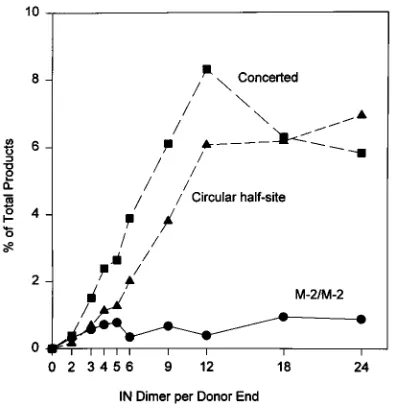
We wanted to measure the initial rate of catalysis at low ratios of IN dimer to donor ends. Quantitation of the data in Fig. 6 showed that after a 10-min reaction at 378C, both donor-target reactions were directly proportional to IN concentra-tion. The donor and target substrates appear to be nonlimiting,
because the same rate of strand transfer with pGEM was observed over a sixfold protein concentration range. Fifteen percent of the input M-2 was integrated into the targets at the IN dimer/M-2 end ratio of 12 to 1. At this ratio, 63% of integrated M-2 was inserted into pGEM as full-site reaction events.
The concerted integration reaction was directly proportional to the concentration of IN when the initial velocity was mea-sured (Fig. 6). We wanted to determine the rate of recombi-nation after extended times of incubation at protein concen-trations that promoted integration events at the same initial rate (Fig. 6;#12 IN dimers per M-2 end). At all three IN–M-2 ratios studied, the initial rate for the concerted reaction was maintained only for approximately 20 to 30 min (Fig. 7; data not shown). The data suggest that, under these assay condi-tions, AMV IN was not capable of turnover. At extended times (60 min) and at the highest protein concentration, 64% of input M-2 was integrated into pGEM, of which 63% was used for concerted events.
[image:4.612.342.528.69.365.2]Is there similarity in recognition of 3*OH recessed M-2 and blunt-ended M-2 by IN for trimming under solution conditions that favor concerted integration?Recognition of recessed M-2 and recognition of blunt-ended M-2 by AMV IN in complexes capable of concerted integration events may be distinct under different solution conditions. To investigate this possibility, 59-end-labeled M-2 was blunt-ended by a fill-in reaction using the Klenow polymerase. The penultimate T nucleotide which is
[image:4.612.88.265.73.243.2]FIG. 5. Effect of varying protein concentrations on full-site and half-site reactions in the presence of dioxane. IN–M-2 complexes were formed on ice at various IN-to-M-2 end molar ratios in the presence of 15% dioxane and 0.33 M NaCl. Lane 1, no IN; lanes 2 to 8, IN/M-2 ratios of 6.5, 13.5, 17.5, 20.5, 23, 27, and 40.5, respectively. Lane 9 is the same as lane 3 except that 15% DMSO was present. The dried gel was exposed for 15 h with no screen.p, denatured M-2.
FIG. 6. Determining the association of half-site and full-site IN–M-2 com-plexes with target DNA. IN–M-2 comcom-plexes were formed in the presence of 0.33 M NaCl, 15% dioxane, and various quantities of IN. The strand transfer reaction was performed for 10 min to measure the initial rate of the reaction. The percentage of total products for each recombinant produced in a reaction was determined by PhosphorImager analysis. For example, at a 12-to-1 protein/DNA ratio, 15% of M-2 was incorporated into the three products.
FIG. 7. Extended-duration strand transfer reactions at various IN–M-2 end molar ratios. IN–M-2 complexes were formed at various ratios (6, 9, and 12) which were in the linear range of the IN concentrations for stand transfer (Fig. 6). Three separate extended-duration reactions were performed at the indicated IN concentrations. Aliquots were removed at the indicated times. PhosphorIm-ager analysis was performed, and the percentage of donor substrate used in each M-2–pGEM recombinant was determined. Approximately 1% of the donor sub-strate was used to produce M-2–M-2 recombinants in each reaction.
on November 9, 2019 by guest
http://jvi.asm.org/
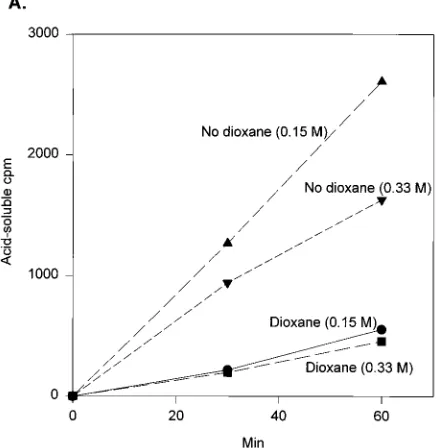
[image:4.612.80.277.467.669.2]released as a dinucleotide by AMV IN (16) was labeled. The optimum salt concentration is 0.15 M for release of the dinu-cleotide in the absence of aprotic solvents (16). The release of the labeled dinucleotide from M-2 and the subsequent strand transfer reactions were monitored (Fig. 8). The trimming re-action by IN was significantly higher in the absence of dioxane at either 0.15 M or 0.33 M NaCl than with dioxane present at the same salt concentrations (Fig. 8A). The circular half-site M-2–pGEM reaction predominated over the full-site reaction at both salt concentrations in the absence of dioxane (Fig. 8B, lanes 8 to 12). With dioxane, the ratio between the full-site and circular half-site M-2–pGEM products was increased with the 0.33 M NaCl reaction in comparison with the 0.15 M reaction (Fig. 8B, compare lanes 2 to 4 with lanes 5 to 7). Presently, we cannot exclude the possibility that IN is preferentially selecting for strand transfer recessed M-2 that was not blunt-ended in our donor preparations. The recessed M-2 donor is more ef-ficiently integrated by IN into pGEM than blunt-ended M-2 that must first be trimmed (Fig. 8B, compare lanes 1 and 7). The results suggest that with dioxane the recognition of blunt-ended M-2 by IN for 39OH trimming is different than that of recessed M-2 for strand transfer.
DISCUSSION
AMV IN efficiently pairs two M-2 molecules and inserts them in a concerted fashion into circular pGEM. The stag-gered gap at the site of insertion was predominately 6 bp in length, which is characteristic of host site duplications in avian retrovirus-infected cells. The major solution determinants for assembly of IN–M-2 complexes capable of efficient concerted reactions were 0.33 M NaCl, 15% dioxane, and PEG. Although DMSO (33) can replace dioxane as the aprotic solvent, dioxane appeared to stabilize or modify the conformation of IN or the IN–M-2 complexes better than DMSO, thereby enhancing the full-site reaction. The concerted integration reaction was di-rectly proportional to the concentration of IN over a sixfold range, and IN does not appear to turn over. Some of the above assembly and catalytic properties of IN were similar to those observed with Mu A transposase.
The monomeric Mu A transposase assembles into a tet-rameric complex capable of efficient transposition under spe-cific conditions. This assembly requires proper orientation of Mu ends on a single supercoiled donor molecule, integration host factors that interact with the donor transpositional en-hancer sequences, and divalent metal ions (3, 25, 28). With 15% DMSO and 0.15 M NaCl, none of the above factors except for the presence of a divalent metal ion are necessary for efficient assembly, cleavage, and strand transfer of Mu DNA by Mu A (3, 27). Likewise, the best conditions for as-sembly of complexes containing M-2 and AMV IN for the concerted integration reaction required only 15% dioxane, 0.33 M NaCl, and PEG. DMSO was similar to dioxane for stimulating both full-site and half-site reactions but failed to efficiently promote the full-site reaction (Fig. 2). In addition, similarly to AMV IN, Mu A transposase can also use two separate linear donor molecules besides its usual supercoiled donor substrate for the transposition reaction (1, 8, 27). These results suggest that the mechanisms of assembly of nucleopro-tein complexes for the two systems contain similarities. Cata-lytic and amino acid similarities between retrovirus INs, Mu A, and other recombinases have already been established (2, 9, 12, 23).
[image:5.612.69.290.76.300.2]AMV IN is a homodimer (19), and dimeric forms of other retrovirus INs are required for both the 39OH trimming and the half-site strand transfer reactions (11, 21, 30, 32). In com-parison, the monomeric Mu A transposase must assemble into a stable tetramer complex in the presence of the appropriate DNA substrates prior to being catalytically active. Complexes of dimeric IN and blunt-ended or 39OH recessed oligonucle-otides, with different stabilities, have been observed, suggesting that assembly of specific IN-DNA complexes is also a require-ment prior to 39OH trimming or half-site reactions (10, 31). In this report, we show that the assembly of complexes containing either recessed M-2 or blunt-ended M-2 by AMV IN may also
FIG. 8. Combined effects of NaCl and dioxane on the 39OH trimming of blunt-ended M-2 by IN and analysis of the strand transfer reactions. (A) Release of the labeled dinucleotide. The 59-end-labeled M-2 was made blunt ended as described in Materials and Methods. IN was preincubated with the same quantity (15 ng) of blunt-ended M-2 in the presence or absence of 15% dioxane. The concentration of NaCl was either 0.15 or 0.33 M. Scale-up reactions allowed for aliquots to be taken for both 39OH trimming and strand transfer reactions at the indicated times. Acid-soluble counts were used to measure the release of the labeled dinucleotide. As a control, IN did not release significant acid-soluble counts with only the 59-end-labeled M-2 as substrate. (B) Strand transfer anal-ysis. Lane 1, 60-min control strand transfer reaction using recessed M-2; lane 2, no IN with blunt-ended M-2; lane 3, 30 min; lane 4, 60 min. The same series of conditions was employed in each set of reactions except that there was no control lane with no IN for the reaction with 0.33 M NaCl and no dioxane.
on November 9, 2019 by guest
http://jvi.asm.org/
environment may be affecting the self-association, conforma-tional stability, or the solubility of IN (29).
ACKNOWLEDGMENTS
This work was supported in part by grants from the National Insti-tutes of Health (CA-16312 and AI-31334).
We thank Maunak Desi for technical assistance and Mark McCord and Andrew Belt for discussions.
REFERENCES
1. Baker, T. A., E. Kremenstova, and L. Luo. 1994. Complete transposition requires four active monomers in the Mu transposase tetramer. Genes Dev.
8:2416–2428.
2. Baker, T. A., and L. Lou. 1994. Identification of residues in the Mu trans-posase essential for catalysis. Proc. Natl. Acad. Sci. USA 91:6654–6658. 3. Baker, T. A., and K. Mizuuchi. 1992. DNA-promoted assembly of the active
tetramer of the Mu transposase. Genes Dev. 6:2221–2232.
4. Bowerman, B., P. O. Brown, J. M. Bishop, and H. E. Varmus. 1989. A nucleoprotein complex mediates the integration of retroviral DNA. Genes Dev. 3:469–478.
5. Brown, P. O., B. Bowerman, H. E. Varmus, and J. M. Bishop. 1987. Correct integration of retroviral DNA in vitro. Cell. 49:347–356.
6. Bukrinsky, M., N. Sharova, and M. Stevenson. 1993. Human immunodefi-ciency virus type 1 2-LTR circles reside in a nucleoprotein complex which is different from the preintegration complex. J. Virol. 67:6863–6865. 7. Bukrinsky, M. I., N. Sharova, T. L. McDonald, T. Pushkarskaya, W. Tarpley,
and M. Stevenson.1993. Association of integrase, matrix, and reverse tran-scriptase antigens of human immunodeficiency virus type 1 with viral nucleic acids following acute infection. Proc. Natl. Acad. Sci. USA 90:6125–6129. 8. Craigie, R., and K. Mizuuchi. 1987. Transposition of Mu DNA: joining of
Mu to target DNA can be uncoupled from cleavage at the ends of Mu. Cell
51:493–501.
9. Drelich, M. R., R. Wilhelm, and J. Mous. 1992. Identification of amino acid residues critical for endonuclease and integration activities of HIV-1 IN protein in vitro. Virology 188:459–468.
10. Ellison, V., and P. O. Brown. 1994. A stable complex between integrase and viral DNA ends mediates human immunodeficiency virus integration in vitro. Proc. Natl. Acad. Sci. USA 91:7316–7320.
11. Engelman, A., F. D. Bushman, and R. Craigie. 1993. Identification of dis-crete functional domains of HIV-1 integrase and their organization within an active multimeric complex. EMBO J. 12:3269–3279.
12. Engelman, A., and R. Craigie. 1992. Identification of conserved amino acid residues critical for human immunodeficiency virus type 1 integrase function in vivo. J. Virol. 66:6361–6369.
13. Farnet, C. M., and W. A. Haseltine. 1990. Integration of human
immuno-myeloblastosis virus integrase. J. Virol. 67:2628–2636.
19. Grandgenett, D. P., A. C. Vora, and R. D. Schiff. 1978. A 32,000-dalton nucleic acid-binding protein from avian retroviruses cores possesses DNA endonuclease activity. Virology 89:199–132.
20. Greenfield, L., L. Simpson, and D. Kaplan. 1975. Conversion of closed circular DNA molecules to single-nicked molecules by digestion with DNAase I in the presence of ethidium bromide. Biochim. Biophys. Acta
407:365–375.
21. Jones, K. S., J. Coleman, G. W. Merkel, T. M. Laue, and A. M. Skalka. 1992. Retroviral integrase functions as a multimer and can turn over catalytically. J. Biol. Chem. 287:16037–16040.
22. Knaus, R. J., P. J. Hippenmeyer, T. K. Misra, D. P. Grandgenett, V. R.
Muller, and W. M. Fitch.1984. Avian retrovirus pp32 DNA binding protein: preferential binding to the promoter region of long terminal repeat DNA. Biochemistry 23:350–359.
23. Kulkosky, J., K. S. Jones, R. A. Katz, L. P. G. Mack, and A. Skalka. 1992. Residues critical for retroviral integrative recombination in a region that is highly conserved among retroviral/retrotransposon integrases and bacterial insertion sequence transposases. Mol. Cell. Biol. 12:2331–2338.
24. Lee, Y., M. H., and J. M. Coffin. 1991. Relationship of avian retrovirus DNA synthesis to integration in vitro. Mol. Cell. Biol. 11:1419–1430.
25. Mizuuchi, M., T. A. Baker, and K. Mizuuchi. 1992. Assembly of the active form of the transposase-Mu DNA complex: a critical control point in Mu transposition. Cell 70:303–311.
26. Murphy, J. E., and S. P. Goff. 1992. A mutation at one end of Moloney murine leukemia virus DNA blocks cleavage of both ends by the viral integrase in vivo. J. Virol. 66:5092–5095.
27. Namgoong, S.-Y., M. Jayaram, K. Kim, and R. M. Harshey. 1994. DNA-protein cooperativity in the assembly and stabilization of Mu strand transfer complex. J. Mol. Biol. 238:514–527.
28. Surette, M. G., and G. Chaconas. 1992. The Mu transpositional enhancer can function in trans: requirement of the enhancer for synapsis but not strand cleavage. Cell 68:1101–1108.
29. Timasheff, S. N. 1993. The control of protein stability and associations by weak interactions with water: how do solvents affect these processes. Annu. Rev. Biophys. Biomol. Struct. 22:67–97.
30. Van Gent, D. C., C. Vink, A. A. M. Oude Groeneger, and R. H. A. Plasterk. 1993. Complementation between HIV integrase proteins mutated in differ-ent domains. EMBO J. 12:3261–3267.
31. Vink, C., R. A. Puras Lutzke, and R. H. A. Plasterk. 1994. Formation of a stable complex between the human immunodeficiency virus integrase pro-tein and viral DNA. Nucleic Acids Res. 22:4103–4110.
32. Vink, C., K. H. van der Linden, and R. H. A. Plasterk. 1994. Activities of the feline immunodeficiency virus integrase protein produced in Escherichia coli. J. Virol. 68:1468–1474.
33. Vora, A. C., M. McCord, M. L. Fitzgerald, R. B. Inman, and D. P.
Grand-genett.1994. Efficient concerted integration of retrovirus-like DNA in vitro by avian myeloblastosis virus integrase. Nucleic Acids Res. 22:4454–4461.