Rochester Institute of Technology
RIT Scholar Works
Theses Thesis/Dissertation Collections
12-2017
Automatic Protein Shake Freestyle Vending
Machine
Balaji Salunkhe
Follow this and additional works at:http://scholarworks.rit.edu/theses
This Master's Project is brought to you for free and open access by the Thesis/Dissertation Collections at RIT Scholar Works. It has been accepted for inclusion in Theses by an authorized administrator of RIT Scholar Works. For more information, please [email protected].
Recommended Citation
Automatic Protein Shake Freestyle Vending Machine
by Balaji Salunkhe
Graduate Paper
Submitted in partial fulfillment of the requirements for the degree of
Master of Science
in Electrical Engineering
Approved by:
Mr. Mark A. Indovina, Lecturer
Graduate Research Advisor, Department of Electrical and Microelectronic Engineering
Dr. Sohail A. Dianat, Professor
Department Head, Department of Electrical and Microelectronic Engineering
Department of Electrical and Microelectronic Engineering Kate Gleason College of Engineering
Rochester Institute of Technology Rochester, New York
Declaration
I hereby declare that except where specific reference is made to the work of others, the contents of this graduate paper are original and have not been submitted in whole or in part for consideration for any other degree or qualification in this, or any other University. This graduate paper is the result of my own work and includes nothing which is the outcome of work done in collaboration, except where specifically indicated in the text.
Acknowledgements
Abstract
Contents
Contents v
List of Figures vii
List of Tables viii
1 Introduction 1
2 Bibliographical Research 5
3 Idea Building 9
3.1 Machine Flow chart . . . 9
3.1.1 Option 1 - Customize your own shake . . . 11
3.1.2 Option 2 - Pre-designed shake . . . 12
3.1.3 Payment . . . 12
3.2 Finite State Machine (FSM) . . . 13
3.2.1 Mealy Machine . . . 13
3.2.2 Moore Machine . . . 14
3.3 FSM representation . . . 14
4 Design Description 17 4.1 Customize your own shake . . . 17
4.2 Pre designed shake . . . 19
4.3 Payment and Reorder . . . 21
4.4 Watchdog . . . 23
5 Results 25 5.1 FPGA Implementation . . . 25
5.2 ASIC Benchmarking . . . 27
Contents vi
References 30
I Source Code I-1
I.1 Customize your shake module . . . I-1
I.2 Pre-designed shake module . . . I-26
I.3 Payment and Reorder module . . . I-51
I.4 Watchdog module . . . I-60
I.5 Muscle Dispenser module . . . I-68
List of Figures
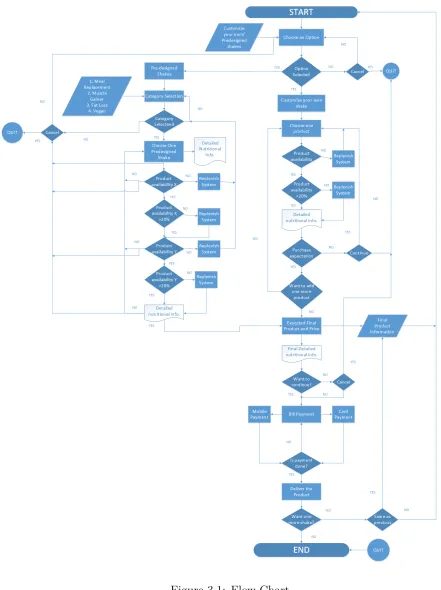
3.1 Flow Chart . . . 10
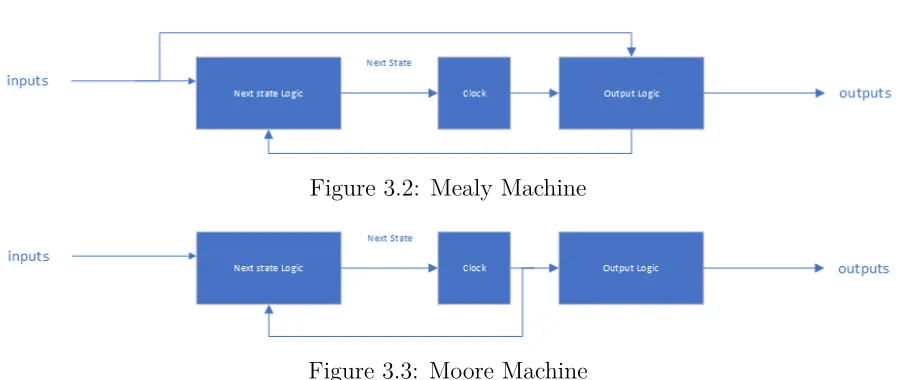
3.2 Mealy Machine . . . 14
3.3 Moore Machine . . . 14
3.4 FSM for protein shake vending machine . . . 15
4.1 State Machine for Customize your shake . . . 18
4.2 State Machine for Pre designed shakes . . . 20
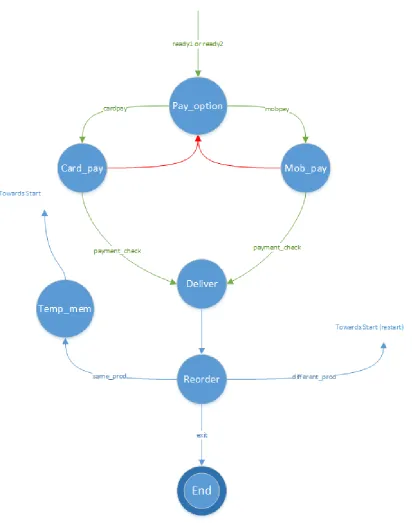
4.3 State machine for Payment and Reorder . . . 22
4.4 Watchdog . . . 24
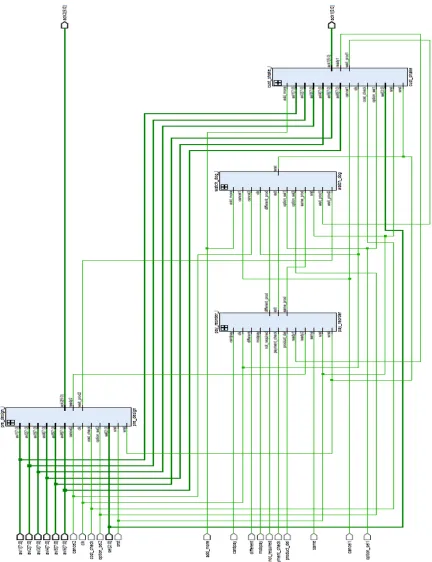
5.1 Schematic view of Design . . . 26
List of Tables
5.1 Xilinx Virtex 7 Implementation . . . 27
Chapter 1
Introduction
1.1 Vending Machines
2
setting up and can be installed in 24/7 service places. Vending machines discussed in
reference papers are based on CMOS, SED and Micro-controllers technology[1–5].
The vending machine culture is, too, old as per the history. The first kind of vend-ing machine was introduced in century 2-3 B.C. in Egypt. It was a mechanical machine which was created to sel water in Egypt. After that in the19th century, vending ma-chines for various functions were introduced during the industrial revolution in the United
Kingdom[6]. The first ever commercialized vending machine for post-cards, which can be
accessed through coins, was introduced in London.
1.2 Nutrition Supplementation[
7
]
1.2.1 Why is it needed?
In today’s world, people are becoming more careful about their health and physique. To achieve good physique and health, only workouts are not enough to achieve that level of fitness, people have to consume good quality nutritious food on proper intervals of time throughout the day, but in the real world, it’s really hard to get proper nutritious meals on time. In modern lifestyle, it is really difficult for a person to prepare food within no time without neglecting the nutrition factor. So another way to fulfill your daily requirement is through protein supplements. By a combination of solid foods and food supplements, one can achieve the proper nutrition fulfillment required for that perfect physique.
1.2.2 Varieties of Supplements
3
the micros of nutrition [8].
A) Meal replacement: This category stands for its name, it basically used in place of a meal. If in any case, a fitness enthusiast is going to miss a meal, this comes into action. One serving of meal replacement can give you enough calories to sustain for 2 to 4 hours. It usually contains a moderate amount of carbohydrates, a moderate amount of proteins and some amount of fats.
B) Mass gainer/ Muscle gainer: This category is a high calories nutrition category. Basically, it contains a high amount of carbohydrates and a moderate amount of proteins and fats. The ratio of carbohydrates-protein-fat varies along with the product.
C) Fat loss/ Maintenance: This category poses the purest form of protein nutrition. This is categorized into Whey, Isolate whey, and Hydrolyzed whey protein supplements. This is the very basic type which contains almost 80% to 100% of protein by weight per scoop. This is the most popular and widely used supplement type in the fitness world. This provides required protein blocks for muscle recovery.
D) Vegan: This category is for the vegan fitness enthusiast.
1.3 Objective:
The proposed protein supplement freestyle vending machine can offer a combination of affordability, convenience, and a variety of protein supplements for a niche market. The vending machine will act as a user-friendly catalyst for nutrition supplement distribution. The proposed paper is based on the FPGA (Field Programmable Gate Array) technology. FPGA based machines basically use minimum execution time, less power in comparison
to micro-controller based designs[9]. FPGAs are reprogrammable, they allow for rapid
4
1.4 Organization:
• Chapter 2: This chapter gives details about the articles, journals, papers and books which are used as a reference in building this project.
• Chapter 3: This chapter gives a brief explanation of idea or concept building with a flowchart. Global FSM of freestyle vending is described in detail.
• Chapter 4: Design implementation in parts described in this chapter. FSM for every major state is explained here.
• Chapter 5: This chapter outlines details about the benchmarking process on different technologies and implementation on FPGA.
Chapter 2
Bibliographical Research
[6] provides an introduction of unique services provided by the vending machine and also
future possibilities in the advancement of vending machine culture. Vending machines can be installed in various fields and for various purposes. The vending machine installation is more convenient than a physical store, almost 120 times more convenient. The vending
machines are called a “convenient unmanned shop”[6]. The joint venture of vending
ma-chine manufacturers and various commodities can enhance the user’s experience. Vending machines can be developed by using various technologies. They can be developed by using micro-controller, Aplication Specific Integrated Circuit (ASIC), Field Programmable Gate Array (FPGA), or Single Electron Devices (SED). All implementations are studied for this proposed paper.
[4] is giving an implementation of an automatic tea vending machine using SED. Single
Electron Devices have some pros, like they consume low power, high density of integration, and switching power, that means they can do the operation faster. Because of these
properties, SEDs are considered as the future of ULSI technology[4]. SEDs made up of
6
principle of Coulomb Blockade and provide a new way to understand digital logic [3, 10].
Implementation of a coffee vending machine by using SED is proposed in detail in [3]. The
Automated Beverage Dispenser (ABD) is discused in [11] including management of the
project. Under this report, the goal of ABD is to given as an efficient and cost-effective way of dispensing varieties of mixed drinks to their customer without any extra effort. The ABD provides freedom of customization to the customer, waiter, or other user so they can create the desired drink recipe. Also, the user can maintain a database for recipes and stock by using the menu bar.
The Automatic Beverage Dispenser based on Microcontroller technology, which is elim-inates manual operation for dispensing, is proposed in [1,5]. To eliminate the manual oper-ation for measurement, this paper used cup sensors. It also stops the overflowing of liquids because of user negligence by using the electronic keypad to give user inputs for desired quantity. Assembly language is used for implementation and then compiled in assembler
(MIDI – 51). This design is practically demonstrated on the AT89C52 microcontroller [1].
The FSM (Finite State Machine) vending machine with features of multi-select and
auto-billing is implemented and demonstrated in [12]. The Mealy machine model with four
states is created in this paper and successfully demonstrated on a Xilinx Spartan 3 FPGA board. An FPGA based machine is faster than CMOS based machine and SED based
machine[12]. If using a micro-controller based machine, then the user will have to change
the whole architecture even for small product changes[12]. Paper [9] is demonstrating the
same design explained in [12] , but on a Xilinx Virtex 5 FPGA board.
A vending machine for frozen food is designed by using conceptual modeling in the
paper[13, 14]. Conceptual modeling involves variables identification, finding simulation
7
to construct the required model for this vending machine [13]. The motivation behind
[15] is to develop a vending machine which can operate on low power. To achieve low
power operation [15] has used various power reduction techniques, where the machine is
tested on different frequencies to understand power consumption and also uses various IO standards to check best IO standard and frequency for power efficient vending machine. The comparison in a particular vending machine designed with 2 different FSM designs
is explained in [16]. For comparison, the author considered the aspects like area, timing
constraints, speed, and power dissipation. By comparing the results from 2 algorithms using the Altera Stratix FPGA family, the author is trying to find more reliable, more efficient and synthesizable designs for the vending machine.
Replenish system is one of the main features in this proposed paper. It is a smart feature which keeps the stock in order. If the products start hitting low-levels, the machine will start to take action for replenishing the products. The [2] is explaining an intelligent system to control the inventory of a variety of papers in the paper vending machine. This replenish system is implemented using fuzzy logic; the output of a fuzzy system represents 0-3 decimal
value and each value posses status and action to take [2]. The real-time replenish system
(RPS) with the help of GPRS and Wi-Fi technology is developed in [17, 18]. As per the
proposed paper, the RPS can gather information, such as sales volume and inventory level, and send it back to the data center of the vending machine company. This way they can control and provide the quality service. This can help vending machine companies to cut operating costs for the vending machine[17, 19].
The ways of payment are the important application in the vending machine. There are generally 3 means of payment: coin/cash payment, card payment (i.e. Debit/Credit card
payment), and mobile payment. [20, 21] proposes the idea of mobile payment by using IR
8
Field Communication (NFC) technology. In this process, the user will select an item and will connect with the vending machine through IR technology and then by taking help from the software running on the back-end server, the vending machine will complete the
bill payment process [20, 21]. This paper is proposes the hybrid method for payment i.e.
currency, manual mobile, and infrared mobile. In paper [22] the idea of payment through
the Short Message Service (SMS) is discussed. After deciding the item from the vending machine, the user can make payment though SMS and can finish the shopping process.
Cleanliness is also a main concern in the vending machine industry. [23] is proposing
a design with the help of actuators and sensors for the self-cleaning feature of a vending machine. This proposed design connects with the user through Bluetooth. The user adjust the coffee taste according to their preference and also can check the cleaning status of the vending machine. Actuators adjust materials for mixtures while sensors monitor the inner
environment of the vending machine [23]. Speech recognition can be a great feature in the
vending machine. To make vending machines more user-friendly paper [24] is proposing
Chapter 3
Idea Building
The idea is to develop a protein shake vending machine that works in a freestyle manner to give users the option of custom-made shakes for individuals who know their macro and micro requirements, and pre-calculated shakes for the individuals who don’t know their nutrition requirement but does know the physique goal. The paper explains the design of a vending machine that is versatile and easy for anybody to use.
3.1
Machine Flow chart
3.1 Machine Flow chart 10
[image:20.612.76.517.109.699.2]3.1 Machine Flow chart 11
3.1.1
Option 1 - Customize your own shake
3.1 Machine Flow chart 12
3.1.2
Option 2 - Pre-designed shake
If an individual decides to go with this option, an user gets the category selection screen. The user has to select one category out of 4 pre-designed categories for 4 different goals: Muscle Gain, Meal Replacement, Weight Loss, and Vegan. Each category has at least 1 pre-designed shake option with different nutritional value. Each pre-designed shake is a combination of 2 different types of macros. Once an individual makes up their mind about the wanted category and desired pre-designed shake, the machine starts further steps of availability check. The machine checks for two different threshold levels for 1 product out of 2 products for a selected pre-designed shake. If the product availability is 0, then the machine will inform ’Replenish system’ about this first, and then goes to category selection screen for an individual to go through other pre-designed shakes options. If the product is available, the machine will check for a threshold level check for 20%. If the product is below the threshold level of 20%, then the machine will inform this to ’Replenish system’, so the refilling process will start early. If it fails, then the machine will not send any message for refilling. After threshold check, either the product passes or fails, and the machine processes further to do availability check on a second product. It follows the same process like the first product.
3.1.3
Payment
3.2 Finite State Machine (FSM) 13
check for full expected payment, if full payment is received, the machine will create the desired protein shake and it will deliver it to the individual, else the machine will not go further until full payment is done. During this time, the machine will keep a copy of the finale product in its memory. So, if an individual wants to reorder same product, they don’t have to go through the same process again; the machine will access memory to get details about the finale product and will create the same product and will deliver it after full payment. If an individual doesn’t want to order the same product but they want to try something different then the machine will take them to the initial stage to start the entire process again. Once payment is recieved, the individual can’t cancel the process. Also, an individual can end the process after delivering product by pushing the exit button.
3.2
Finite State Machine (FSM)
The Finite State Machine representation is given in Figures 3.2 and 3.3. The FSM is a mathematical model used to design computer programs and sequential logic. The FSM is made up of numbers of state, the states come into work when there is expected inputs from the previous state. The outputs from current state drives next state. There are two types of FSM [25].
3.2.1
Mealy Machine
3.3 FSM representation 14
Figure 3.2: Mealy Machine
Figure 3.3: Moore Machine
3.2.2
Moore Machine
In a Moore machine, the output signals are derived by the current state only as shown in Fig. 3.3.
3.3
FSM representation
As shown in Fig. 3.4, state machine always starts with Initiate state. Cust_shake
(Cus-tomize your own shake), Pre_shake (Pre-designed shake), Payment, Deliver and Reorder are internal states. All these internal states also have sub-states within them. Those are
discussed in a Chapter4. After Initiate state, state machine moves into either Cust_shake
[image:24.612.82.535.86.276.2]3.3 FSM representation 15
[image:25.612.125.486.136.636.2]3.3 FSM representation 16
Chapter 4
Design Description
Fig. 4.1presents the FSM state diagram for the proposed vending machine. This chapter
explains in detail the design implementation of the FSM.
4.1
Customize your own shake
System reset or Watchdog reset resets the machine at the start as shown in Fig. 4.1.
4.1 Customize your own shake 18
[image:28.612.91.530.153.615.2]4.2 Pre designed shake 19
will go to the “Replenish at 0” state where the machine will raise a signal for product unavailability and send a message for immediate action. If the product is available, but availability is below the threshold level of 20%, then the machine will raise a signal for low availability in the “Replenish at 20” state, the machine will send a message to that affect, and move to the Purchase expectation state. If an individual is satisfied with the choice, then the machine will give output as ’ready1’ for further steps. If an individual wants to add more products, then the machine will save current product data in memory and go back to the product selection stage through the “Add_more_product” state to follow the selection process again. An individual can add two more products to the selection process for a maximum 3 products per transaction. An individual can cancel the purchase process if they don’t want to purchase by selecting Cancel.
4.2
Pre designed shake
Similar to the Cust_shake module, this module also initially gets System reset or Watchdog
reset to reset state machine as shown in Fig. 4.2. After, the state machine moves to
4.2 Pre designed shake 20
[image:30.612.79.528.104.658.2]4.3 Payment and Reorder 21
previous state, i.e. category select, and raise the signal for test fail and send it to replenish state i.e “Replenish at 0” state. If products are available, then the machine will check for threshold level test, if product availability is above the threshold level, i.e. 20%, then the machine move to the “Purchase” state directly, else it will raise a signal for replenishing system first in the “Replenish at 20” state, and then it will move forward to purchase expectation state. If the amount is reasonable for an individual, then the machine will send a ‘ready2’ signal out for further process, else the individual can cancel the process.
4.3
Payment and Reorder
The payment and reorder module is the final state for the completion of the protein shake
making process. As shown in Fig. 4.3, this module starts when it gets the signal ’ready1’
4.3 Payment and Reorder 22
[image:32.612.105.517.121.644.2]4.4 Watchdog 23
or pre-designed shake. If the customer doesn’t want to reorder, they only have to select the cancel button to exit the machine.
4.4
Watchdog
The function of the watchdog module is to check for customer response. If the customer
is using the machine then the watchdog starts for the counter as shown in Fig. 4.4. For
4.4 Watchdog 24
[image:34.612.217.394.113.620.2]Chapter 5
Results
5.1
FPGA Implementation
The required RTL for the automatic protein shake vending machine is designed using the Verilog Hardware Description Language (HDL). The tools used were the Xilinx Vivado Design Suite targeting a Xilinx Virtex 7 FPGA board. The standard flat test-bench code for behavioral verification was also developed in Verilog HDL. The design was tested under various circumstances to check its flexibility and reliability, and the design has success-fully gave expected outputs. The design successsuccess-fully cleared the synthesis and gate level
simulation. A top level schematic for vending machine RTL is shown in the Fig. 5.1.
Tab.5.1 tabulates the power, timing and device utilization for Xilinx Virtex 7FPGA.
The total power mentioned is the addition of total dynamic power and total leakage power. The design is has a worst case slack of 6nsfor a maximum operating frequency of 167M Hz.
5.1 FPGA Implementation 26
[image:36.612.82.514.112.674.2]5.2 ASIC Benchmarking 27
Table 5.1: Xilinx Virtex 7 Implementation
Properties/
Technologies Power (Dynamic + Leakage) Timing (slack) Utilization
XIlinx Virtex 7 0.246 W 6 ns 18%
5.2
ASIC Benchmarking
For ASIC benchmarking, the design is simulated and synthesized by using the Cadence
and Synopsys tools respectively. Tab. 5.2 tabulates the area, power and timing for the
various of target technologies. Results for the TSMC 180nm, TSMC 65nm, SEDK 90nm,
and SEDK 32nm technologies are mentioned in the table.
Out of all technologies, the 180nmtechnology has largest cell area as compared to rest of
the technologies, i.e. 8133um2. In 90nmtechnology, the design requires 4552um2area, and
a total power consumption of 21uW, the lowest power requirement among all technologies.
65nm technology requires the least cell area, i.e. 1118um2. Total power is the addition
of the total dynamic power and the total leakage power and is measured in micro-watts.
180nmtechnology consumes the highest power, but it is using the smallest leakage power.
Due to not having to over constraint the design, all technologies have almost the same timing. Out of all, the 65nm technology is the fastest design.
On the basis of area, power consumption, and timing the physical design implementa-tion in 90nm is most efficient.
Table 5.2: Comparison in ASIC technologies
Properties/
Technologies Area Power (Dynamic + Leakage) Timing (slack)
32 nm 1140um2 120uW 18.5138ns
65 nm 1118um2 26uW 18.5924ns
90 nm 4552um2 21uW 18.1832ns
Chapter 6
Conclusion
An Automatic Protein Shake Freestyle Vending Machine is successfully designed and im-plemented in this paper. The idea is to provide the highly nutritional meals to the fitness enthusiast at any time at any place. This vending machine is able to provide four types of the pre-designed sports nutrition shakes to the consumers, categories are meal replace-ment shakes, weight loss shakes, mass gaining shakes, and vegan shakes. Also, the vending machine gives the consumer authority to create their own protein shake as per their re-quirements.
A Finite State Machine (FSM) is used to design automatic protein shake freestyle vending machine. The FSM is made modular for future design improvements. This paper gives detail descriptions about all mid-level and low-level modules with the main top level module. Verilog HDL is used for the final RTL design. The final design is implemented on
Xilinx Virtex 7 FPGA board by using Xilinx Vivado tool. The design consumes 0.246W
power to run, with the 18% of hardware utilization.
A vending machine is also benchmarked in ASIC for 32nm, 65nm, 90nm, and 180nm
6.1 Future Goals 29
consumption, and timing results for all these mentioned technologies. The 65nmtechnology
is using least area, i.e. 1118um2. The power consumed by design in 90nm technology is
the most efficient, i.e. 21uW out of the all physical design implementations. On timing
analysis results the physical design on 90nm technology is the fastest, i.e. 18.1832ns. On
overall comparison the physical design implementation on 90nmtechnology is the best and
most efficient among all physical design implementations on trade off area allocation.
6.1
Future Goals
Automatic Protein Shake Freestyle Vending Machine has good future scope. Some of the possible future goals are mentioned.
• The real-life prototyping of the design is the most important future goal.
• The design in the paper is verified by using the flat testbench. A more detailed SystemVerilog testbench environment can be a future improvement.
• Speech recognition can be added to the system to operate the vending machine. This would be a great feature for disabled people.
• A more sophisticated self-cleaning feature can be added as a future improvement.
References
[1] E. C. Genevra, E. Mbonu, and K. Okafor, “An effective approach to designing and con-struction of microcontroller based self-dispense detecting liquid dispenser,” inAdaptive
Science & Technology (ICAST), 2014 IEEE 6th International Conference on. IEEE,
2014, pp. 1–7.
[2] A. H. V. Dela, N. A. J. Navarro, C. J. E. Roque, A. P. R. Villano, A. R. dela Cruz, E. C. Guevarra, E. A. Roxas, and R. R. P. Vicerra, “Fuzzy logic based replenishment
sys-tem for smart paper dispensing machine,” inHumanoid, Nanotechnology, Information
Technology, Communication and Control, Environment and Management (HNICEM),
2015 International Conference on. IEEE, 2015, pp. 1–7.
[3] B. Roy and B. Mukherjee, “Design of a coffee vending machine using single
elec-tron devices:(an example of sequential circuit design),” in Electronic System Design
(ISED), 2010 International Symposium on. IEEE, 2010, pp. 38–43.
[4] C. C. Singh, K. S. Kumar, J. Gope, S. Basu, and S. K. Sarkar, “Single electron device
based automatic tea vending machine,” ICTES 2007, 2007.
[5] A.-R. Oh and T.-H. Park, “Assembly sequence optimization of dispensers in smt in-line
References 31
[6] T. Yokouchi, “Today and tomorrow of vending machine and its services in japan,” in
Service Systems and Service Management (ICSSSM), 2010 7th International
Confer-ence on. IEEE, 2010, pp. 1–5.
[7] T. D. Armsey Jr and G. A. Green, “Nutrition supplements: Science vs hype,” The
physician and sportsmedicine, vol. 25, no. 6, pp. 76–116, 1997.
[8] J. R. Hoffman and M. J. Falvo, “Protein–which is best?” Journal of sports science &
medicine, vol. 3, no. 3, p. 118, 2004.
[9] V. V. Krishna, A. Monisha, S. Sadulla, and J. Prathiba, “Design and implementation of an automatic beverages vending machine and its performance evaluation using
xilinx ise and cadence,” inComputing, Communications and Networking Technologies
(ICCCNT), 2013 Fourth International Conference on. IEEE, 2013, pp. 1–6.
[10] K. K. Likharev, “Single-electron devices and their applications,” Proceedings of the
IEEE, vol. 87, no. 4, pp. 606–632, 1999.
[11] S. Istocka, “Automated beverage dispenser,”ideaexchange.uakron.edu, 2015.
[12] A. Monga and B. Singh, “Finite state machine based vending machine controller with auto-billing features,” arXiv preprint arXiv:1205.3642, 2012.
[13] F. Zainuddin, N. M. Ali, R. M. Sidek, A. Romli, N. Talib, and M. I. Ibrahim, “Concep-tual modeling for simulation: Steaming frozen food processing in vending machine,” in Computer Science and Information Technology, 2009. ICCSIT 2009. 2nd IEEE
International Conference on. IEEE, 2009, pp. 145–149.
References 32
logistics based on rfid, gps and gis,” International Journal of Internet Manufacturing
and Services, vol. 1, no. 3, pp. 294–304, 2008.
[15] G. Verma, A. Papreja, S. Shekhar, S. Maheshwari, and S. K. Virdi, “Low power
implementation of fsm based vending machine on fpga,” inComputing for Sustainable
Global Development (INDIACom), 2016 3rd International Conference on. IEEE,
2016, pp. 2054–2058.
[16] V. Vaid, “Comparison of different attributes in modeling a fsm based vending machine
in 2 different styles,” inEmbedded Systems (ICES), 2014 International Conference on.
IEEE, 2014, pp. 18–21.
[17] T. Poon, K. Choy, C. Cheng, and S. Lao, “A real-time replenishment system for
vending machine industry,” inIndustrial Informatics (INDIN), 2010 8th IEEE
Inter-national Conference on. IEEE, 2010, pp. 209–213.
[18] W. Wang and R. J. Brooks, “Empirical investigations of conceptual modeling and the
modeling process,” inSimulation Conference, 2007 Winter. IEEE, 2007, pp. 762–770.
[19] A. Rusdiansyah and D.-b. Tsao, “An integrated model of the periodic delivery
prob-lems for vending-machine supply chains,” Journal of Food Engineering, vol. 70, no. 3,
pp. 421–434, 2005.
[20] S. Azami and M. Tanabian, “Automatic mobile payment on a non-connected vending
machine,” in Electrical and Computer Engineering, 2004. Canadian Conference on,
vol. 2. IEEE, 2004, pp. 731–734.
[21] S. Z. Azami, N. Torabi, and M. Tanabian, “Modeling the customer behavior in the
References 33
Computer Engineering, 2004. Canadian Conference on, vol. 2. IEEE, 2004, pp.
815–818.
[22] W. Zhang and X. L. Zhang, “Design and implementation of automatic vending
ma-chine based on the short massage payment,” inWireless Communications Networking
and Mobile Computing (WiCOM), 2010 6th International Conference on. IEEE,
2010, pp. 1–4.
[23] K. Kim, D.-H. Park, H. Bang, G. Hong, and S.-i. Jin, “Smart coffee vending machine
using sensor and actuator networks,” in Consumer Electronics (ICCE), 2014 IEEE
International Conference on. IEEE, 2014, pp. 71–72.
[24] L. Jiahui and X. Rongkun, “Study on ticket vending machine system based on dtw
speech recognition algorithm,” in Control Conference (CCC), 2017 36th Chinese.
IEEE, 2017, pp. 10 468–10 473.
[25] N. H. Weste and D. Harris, CMOS VLSI design: a circuits and systems perspective.
Appendix I
Source Code
I.1
Customize your shake module
‘ t i m e s c a l e 1 ns / 1 ps
//
///////////////////////////////////////////////////////////////////////
// Author : B a l a j i Salunkhe . // Module Name : cust_shake // Project Name : Muscle Dispenser // Advisor : Mark Indovina
//
////////////////////////////////////////////////////////////////////////////////
‘ d e f i n e Product_sel 3 ’ b001
I.1 Customize your shake module I-2
‘ d e f i n e Replenish_at0 3 ’ b011
‘ d e f i n e Replenish_at20 3 ’ b100
‘ d e f i n e Purchase_exp 3 ’ b101
‘ d e f i n e Add_more_prod 3 ’ b110
module cust_shake ( s r s t , wrst , clk ,
option_sel1 , wait_prod1 , s e l ,
avl1 , avl2 , avl3 , avl4 , avl5 , avl6 , ack ,
I.1 Customize your shake module I-3
input
clk , //System c l o c k
s r s t , //System r e s e t
wrst ; // watchdog r e s e t
input
option_sel1 , // Option s e l e c t i o n s i g n a l
cancel1 ; // Exit from current p r o c e s s
input [ 7 : 0 ] avl1 , avl2 , avl3 , avl4 , avl5 , avl6 ; // Product a v a i l a b i l i t y check
input [ 2 : 0 ] s e l ; // Product # s e l e c t i o n
input
cost_check , // t o t a l Cost of product
add_more ; // For adding one more scoop
reg [ 1 : 0 ] counter ;
reg more ;
reg [ 5 : 0 ] c h e c k f a i l ; // product a v a i l a n i l i t y
I.1 Customize your shake module I-4
output reg [ 5 : 0 ] ack ; // Acknowledge s i g n a l f o r c h e c k f a i l s t a t u s
output reg ready1 ; //Ready s i g n a l f o r payment stage
output reg wait_prod1 ;
reg [ 2 : 0 ] s t a t e 1 ; // St ates
reg [ 2 : 0 ] temp_bit ; // to save product number
reg [ 8 : 0 ] Temp_mem; //To save e n t i r e order up to 3 products f o r
re−order
reg [ 5 : 0 ] prod ;
parameter Threshold_limit = 8 ’ d20 ;
always @(posedge c l k )
begin
i f ( s r s t == 1 | | wrst == 1)
begin
I.1 Customize your shake module I-5
c h e c k f a i l = 6 ’ b000000 ; ack = 6 ’ b000000 ;
Temp_mem = 9 ’ b000000000 ; counter = 1 ;
temp_bit = 3 ’ b000 ; s t a t e 1 = 3 ’ b000 ; prod = 6 ’ b000000 ;
end
e l s e i f ( option_sel1 == 1)
begin
// $ d i s p l a y ( " \n Custmize your own shake \ n " ) ;
case ( s t a t e 1 )
‘Product_sel :
begin
case ( s e l ) 3 ’ b001 :
begin
$ d i s p l a y ( " Product 1 s e l e c t e d " ) ;
temp_bit = 3 ’ b001 ; prod = 6 ’ b100000 ; wait_prod1 = 1 ’ b1 ; s t a t e 1 <=
I.1 Customize your shake module I-6
end
3 ’ b010 :
begin
$ d i s p l a y ( " Product 2 s e l e c t e d " ) ;
temp_bit = 3 ’ b010 ; prod = 6 ’ b010000 ; wait_prod1 = 1 ’ b1 ; s t a t e 1 <=
‘Threshold_check ;
end
3 ’ b011 :
begin
$ d i s p l a y ( " Product 3 s e l e c t e d " ) ;
temp_bit = 3 ’ b011 ; prod = 6 ’ b001000 ; wait_prod1 = 1 ’ b1 ; s t a t e 1 <=
‘Threshold_check ;
end
I.1 Customize your shake module I-7
begin
$ d i s p l a y ( " Product 4 s e l e c t e d " ) ;
temp_bit = 3 ’ b100 ; prod = 6 ’ b000100 ; wait_prod1 = 1 ’ b1 ; s t a t e 1 <=
‘Threshold_check ;
end
3 ’ b101 :
begin
$ d i s p l a y ( " Product 5 s e l e c t e d " ) ;
temp_bit = 3 ’ b101 ; prod = 6 ’ b000010 ; wait_prod1 = 1 ’ b1 ; s t a t e 1 <=
‘Threshold_check ;
// s t a t e <= ‘Purchase_exp ; end
I.1 Customize your shake module I-8
begin
$ d i s p l a y ( " Product 6 s e l e c t e d " ) ;
temp_bit = 3 ’ b110 ; prod = 6 ’ b000001 ; wait_prod1 = 1 ’ b1 ; s t a t e 1 <=
‘Threshold_check ;
end
d e f a u l t:
begin
$ d i s p l a y ( " Error in S e l e c t i o n " ) ;
s t a t e 1 <= ‘Product_sel ;
end endcase end
‘Threshold_check :
begin
case( prod ) 6 ’ b100000 :
i f ( avl1 == 0)
I.1 Customize your shake module I-9
c h e c k f a i l = 6 ’ b100000 ;
$ d i s p l a y ( " Product i s not a v a i l a b l e . Please try
d i f f e r e n t product . " ) ;
temp_bit = 3 ’ b000 ; s t a t e 1 <=
‘Replenish_at0 ;
end
e l s e i f ( avl1 < Threshold_limit )
begin
c h e c k f a i l = 6 ’ b100000 ; s t a t e 1 <=
‘Replenish_at20 ;
end e l s e
begin
s t a t e 1 <=
‘Purchase_exp ;
end
I.1 Customize your shake module I-10
i f ( avl2 == 0)
begin
c h e c k f a i l = 6 ’ b010000 ;
$ d i s p l a y ( " Product i s not a v a i l a b l e . Please try
d i f f e r e n t product . " ) ;
temp_bit = 3 ’ b000 ; s t a t e 1 <=
‘Replenish_at0 ;
end
e l s e i f ( avl2 < Threshold_limit )
begin
c h e c k f a i l = 6 ’ b010000 ; s t a t e 1 <=
‘Replenish_at20 ;
end e l s e
begin
s t a t e 1 <=
‘Purchase_exp ;
I.1 Customize your shake module I-11
6 ’ b001000 :
i f ( avl3 == 0)
begin
c h e c k f a i l = 6 ’ b001000 ;
$ d i s p l a y ( " Product i s not a v a i l a b l e . Please try
d i f f e r e n t product . " ) ;
temp_bit = 3 ’ b000 ; s t a t e 1 <=
‘Replenish_at0 ;
end
e l s e i f ( avl3 < Threshold_limit )
begin
c h e c k f a i l = 6 ’ b001000 ; s t a t e 1 <=
‘Replenish_at20 ;
end e l s e
I.1 Customize your shake module I-12
s t a t e 1 <=
‘Purchase_exp ;
end
6 ’ b000100 :
i f ( avl4 == 0)
begin
c h e c k f a i l = 6 ’ b000100 ;
$ d i s p l a y ( " Product i s not a v a i l a b l e . Please try
d i f f e r e n t product . " ) ;
temp_bit = 3 ’ b000 ; s t a t e 1 <=
‘Replenish_at0 ;
end
e l s e i f ( avl4 < Threshold_limit )
begin
c h e c k f a i l = 6 ’ b000100 ; s t a t e 1 <=
‘Replenish_at20 ;
I.1 Customize your shake module I-13
e l s e begin
s t a t e 1 <=
‘Purchase_exp ;
end
6 ’ b000010 :
i f ( avl5 == 0)
begin
c h e c k f a i l = 6 ’ b000010 ;
$ d i s p l a y ( " Product i s not a v a i l a b l e . Please try
d i f f e r e n t product . " ) ;
temp_bit = 3 ’ b000 ; s t a t e 1 <=
‘Replenish_at0 ;
end
e l s e i f ( avl5 < Threshold_limit )
begin
I.1 Customize your shake module I-14
s t a t e 1 <=
‘Replenish_at20 ;
end e l s e
begin
s t a t e 1 <=
‘Purchase_exp ;
end
6 ’ b000001 :
i f ( avl6 == 0)
begin
c h e c k f a i l = 6 ’ b000001 ;
$ d i s p l a y ( " Product i s not a v a i l a b l e . Please try
d i f f e r e n t product . " ) ;
temp_bit = 3 ’ b000 ; s t a t e 1 <=
‘Replenish_at0 ;
end
I.1 Customize your shake module I-15
begin
c h e c k f a i l = 6 ’ b000001 ; s t a t e 1 <=
‘Replenish_at20 ;
end e l s e
begin
s t a t e 1 <=
‘Purchase_exp ;
end
d e f a u l t:
begin
s t a t e 1 <= ‘Product_sel ;
end endcase end
‘Replenish_at0 :
begin
case( c h e c k f a i l ) 6 ’ b100000 :
begin
I.1 Customize your shake module I-16
$ d i s p l a y ( "
Acknowledgement sent ; R e f i l the Product 1 ASAP" ) ;
s t a t e 1 <= ‘Product_sel ;
end
6 ’ b010000 :
begin
ack = 6 ’ b010000 ; ready1 = 1 ’ b0 ;
$ d i s p l a y ( "
Acknowledgement sent ; R e f i l the Product 2 ASAP" ) ;
s t a t e 1 <= ‘Product_sel ;
end
6 ’ b001000 :
begin
ack = 6 ’ b001000 ; ready1 = 1 ’ b0 ;
$ d i s p l a y ( "
I.1 Customize your shake module I-17
ASAP" ) ;
s t a t e 1 <= ‘Product_sel ;
end
6 ’ b000100 :
begin
ack = 6 ’ b000100 ; ready1 = 1 ’ b0 ;
$ d i s p l a y ( "
Acknowledgement sent ; R e f i l the Product 4 ASAP" ) ;
s t a t e 1 <= ‘Product_sel ;
end
6 ’ b000010 :
begin
ack = 6 ’ b000010 ; ready1 = 1 ’ b0 ;
$ d i s p l a y ( "
Acknowledgement sent ; R e f i l the Product 4 ASAP" ) ;
s t a t e 1 <= ‘Product_sel ;
I.1 Customize your shake module I-18
6 ’ b000001 :
begin
ack = 6 ’ b000001 ; ready1 = 1 ’ b0 ;
$ d i s p l a y ( "
Acknowledgement sent ; R e f i l the Product 6 ASAP" ) ;
s t a t e 1 <= ‘Product_sel ;
end d e f a u l t:
begin
s t a t e 1 <= ‘Product_sel ;
end endcase end
‘Replenish_at20 :
begin
case( c h e c k f a i l ) 6 ’ b100000 :
begin
I.1 Customize your shake module I-19
$ d i s p l a y ( "
Acknowledgement sent ; R e f i l the Product 1 ASAP" ) ; s t a t e 1 <=
‘Purchase_exp ;
end
6 ’ b010000 :
begin
ack = 6 ’ b010000 ;
$ d i s p l a y ( "
Acknowledgement sent ; R e f i l the Product 2 ASAP" ) ; s t a t e 1 <=
‘Purchase_exp ;
end
6 ’ b001000 :
begin
ack = 6 ’ b001000 ;
$ d i s p l a y ( "
I.1 Customize your shake module I-20
Product 3 ASAP" ) ; s t a t e 1 <=
‘Purchase_exp ;
end
6 ’ b000100 :
begin
ack = 6 ’ b000100 ;
$ d i s p l a y ( "
Acknowledgement sent ; R e f i l the Product 4 ASAP" ) ; s t a t e 1 <=
‘Purchase_exp ;
end
6 ’ b000010 :
begin
ack = 6 ’ b000010 ;
$ d i s p l a y ( "
Acknowledgement sent ; R e f i l the Product 4 ASAP" ) ; s t a t e 1 <=
I.1 Customize your shake module I-21
end
6 ’ b000001 :
begin
ack = 6 ’ b000001 ;
$ d i s p l a y ( "
Acknowledgement sent ; R e f i l the Product 6 ASAP" ) ; s t a t e 1 <=
‘Purchase_exp ;
end
d e f a u l t:
begin
s t a t e 1 <=
‘Product_sel ;
end endcase
end
‘Purchase_exp :
begin
I.1 Customize your shake module I-22
$ d i s p l a y ( " Total c o s t of product = xxxxxx " ) ;
$ d i s p l a y ( " \n Products s e l e c t e d : %d " , counter ) ;
wait_prod1 = 1 ’ b0 ;
i f ( add_more )
begin
$ d i s p l a y ( " Yes , want to add more
product " ) ; Temp_mem [ 2 : 0 ] =
temp_bit ;
temp_bit = 3 ’ b000 ; counter = counter +
1 ; s t a t e 1 <=
‘Add_more_prod ;
end e l s e i f ( cost_check )
begin
Temp_mem [ 2 : 0 ] = temp_bit ; ready1 = 1 ’ b1 ; s t a t e 1 <=
I.1 Customize your shake module I-23
end e l s e i f ( cancel1 )
begin
$ d i s p l a y ( " Request canceled " ) ; temp_bit = 3 ’ b000 ;
s t a t e 1 <=
‘Purchase_exp ;
end e l s e
begin
s t a t e 1 <=
‘Purchase_exp ;
// ‘Product_sel ; end
end
‘Add_more_prod :
begin
i f ( counter > 3)
begin
I.1 Customize your shake module I-24
;
ready1 = 1 ;
end e l s e
begin
Temp_mem = {Temp_mem [ 5 : 0 ] , 3 ’ b000 } ;
s t a t e 1 <= ‘Product_sel ;
end end
d e f a u l t:
begin
s t a t e 1 <= ‘Product_sel ;
end
endcase end
e l s e
begin
// $ d i s p l a y ( " Error from Customize your own shake " ) ;
I.1 Customize your shake module I-25
I.2 Pre-designed shake module I-26
I.2
Pre-designed shake module
‘ t i m e s c a l e 1 ns / 1 ps
//
////////////////////////////////////////////////////////////////////////////////
// Author : B a l a j i Salunkhe . // Module Name : pre_design // Project Name : Muscle Dispenser // Adviser : Mark Indovina
//
////////////////////////////////////////////////////////////////////////////////
‘ d e f i n e Category_sel 3 ’ b001
‘ d e f i n e Threshold_check 3 ’ b010
‘ d e f i n e Replenish_at0 3 ’ b011
‘ d e f i n e Replenish_at20 3 ’ b100
‘ d e f i n e Purchase_exp 3 ’ b101
module pre_design ( s r s t ,
wrst ,
clk ,
I.2 Pre-designed shake module I-27
wait_prod2 , s e l ,
avl1 , avl2 , avl3 , avl4 , avl5 , avl6 , ack ,
cost_check , ready2 , cancel2 ) ;
input
s r s t , //System r e s e t
wrst , //Watchdog r e s e t
c l k ; //System c l o c k
input
option_sel2 , // Option s e l e c t i o n s i g n a l
cancel2 ; // Exit from current p r o c e s s
I.2 Pre-designed shake module I-28
input [ 2 : 0 ] s e l ; // Product # s e l e c t i o n
input cost_check ; // t o t a l Cost of product
reg [ 5 : 0 ] c h e c k f a i l ;
reg [ 6 : 0 ] prod ; //mr1 , mr2 , mg1 , mg2 , wl1 , wl2 , veg ;
output reg [ 5 : 0 ] ack ;
output reg ready2 ; //Ready s i g n a l f o r payment stage
output reg wait_prod2 ;
reg [ 2 : 0 ] s t a t e 1 ; // St ates
parameter Threshold_limit = 7 ’ d20 ;
always @(posedge c l k )
begin
i f ( s r s t == 1 | | wrst == 1)
begin
I.2 Pre-designed shake module I-29
c h e c k f a i l = 6 ’ b000000 ; ack = 6 ’ b000000 ;
s t a t e 1 = 3 ’ b000 ; prod = 6 ’ b000000 ;
end
e l s e i f ( option_sel2 == 1)
begin
// $ d i s p l a y ( " \n S e l e c t from Pre−Designed
shakes " ) ; case ( s t a t e 1 )
‘Category_sel :
begin
case ( s e l ) 3 ’ b001 :
begin
$ d i s p l a y ( " Meal
replacement 1 s e l e c t e d " ) ;
prod = 7 ’ b1000000 ; //mr1
= 1 ;
wait_prod2 = 1 ’ b1 ;
s t a t e 1 = ‘Threshold_check ;
I.2 Pre-designed shake module I-30
3 ’ b010 :
begin
$ d i s p l a y ( " Meal
replacement 2 s e l e c t e d " ) ;
prod = 7 ’ b0100000 ; //mr2
= 1 ;
wait_prod2 = 1 ’ b1 ; s t a t e 1 <=
‘Threshold_check ;
end
3 ’ b011 :
begin
$ d i s p l a y ( " Muscle g a i ne r 1 s e l e c t e d " ) ;
prod = 7 ’ b0010000 ; //mg1
= 1 ;
wait_prod2 = 1 ’ b1 ; s t a t e 1 <=
‘Threshold_check ;
end
3 ’ b100 :
I.2 Pre-designed shake module I-31
$ d i s p l a y ( " Muscle g a i ne r 2 s e l e c t e d " ) ;
prod = 7 ’ b0001000 ; //mg2
= 1 ;
wait_prod2 = 1 ’ b1 ; s t a t e 1 <=
‘Threshold_check ;
end
3 ’ b101 :
begin
$ d i s p l a y ( " Weight l o s s 1 s e l e c t e d " ) ;
prod = 7 ’ b0000100 ; // wl1
= 1 ;
wait_prod2 = 1 ’ b1 ; s t a t e 1 <=
‘Threshold_check ;
// s t a t e <= ‘Purchase_exp ; end
3 ’ b110 :
I.2 Pre-designed shake module I-32
$ d i s p l a y ( " Weight l o s s 2 s e l e c t e d " ) ;
prod = 7 ’ b0000010 ; // wl2
= 1 ;
wait_prod2 = 1 ’ b1 ; s t a t e 1 <=
‘Threshold_check ;
end
3 ’ b111 :
begin
$ d i s p l a y ( " Vegan s e l e c t e d " ) ;
prod = 7 ’ b0000001 ; // veg
= 1 ;
wait_prod2 = 1 ’ b1 ; s t a t e 1 <=
‘Threshold_check ;
end
d e f a u l t:
begin
$ d i s p l a y ( " Error in S e l e c t i o n " ) ;
I.2 Pre-designed shake module I-33
end endcase end
‘Threshold_check :
begin
case ( prod )
7 ’ b1000000 :
i f ( avl2 == 0)
begin
c h e c k f a i l = 6 ’ b010000 ;
$ d i s p l a y ( " I n g r e d i e n t i s not a v a i l a b l e , p l e a s e s e l e c t new product " ) ;
s t a t e 1 <=
‘Replenish_at0 ;
end
e l s e i f ( avl4 == 0)
begin
I.2 Pre-designed shake module I-34
$ d i s p l a y ( " I n g r e d i e n t i s not a v a i l a b l e , p l e a s e s e l e c t new product " ) ;
s t a t e 1 <=
‘Replenish_at0 ;
end
e l s e i f ( avl2 < Threshold_limit )
begin
c h e c k f a i l = 6 ’ b010000 ;
s t a t e 1 <=
‘Replenish_at20 ;
end
e l s e i f ( avl4 < Threshold_limit )
begin
c h e c k f a i l = 6 ’ b000100 ;
s t a t e 1 <=
‘Replenish_at20 ;
end e l s e
I.2 Pre-designed shake module I-35
s t a t e 1 <=
‘Purchase_exp ;
end
7 ’ b0100000 :
i f ( avl3 == 0)
begin
c h e c k f a i l = 6 ’ b001000 ;
$ d i s p l a y ( " I n g r e d i e n t i s not a v a i l a b l e , p l e a s e s e l e c t new product " ) ;
s t a t e 1 <=
‘Replenish_at0 ;
end
e l s e i f ( avl5 == 0)
begin
c h e c k f a i l = 6 ’ b000010 ;
I.2 Pre-designed shake module I-36
s t a t e 1 <=
‘Replenish_at0 ;
end
e l s e i f ( avl3 < Threshold_limit )
begin
c h e c k f a i l = 6 ’ b001000 ;
s t a t e 1 <=
‘Replenish_at20 ;
end
e l s e i f ( avl5 < Threshold_limit )
begin
c h e c k f a i l = 6 ’ b000010 ;
s t a t e 1 <=
‘Replenish_at20 ;
end e l s e
begin
s t a t e 1 <=
‘Purchase_exp ;
I.2 Pre-designed shake module I-37
7 ’ b0010000 :
i f ( avl1 == 0)
begin
c h e c k f a i l = 6 ’ b100000 ;
$ d i s p l a y ( " I n g r e d i e n t i s not a v a i l a b l e , p l e a s e s e l e c t new product " ) ;
s t a t e 1 <=
‘Replenish_at0 ;
end
e l s e i f ( avl3 == 0)
begin
c h e c k f a i l = 6 ’ b001000 ;
$ d i s p l a y ( " I n g r e d i e n t i s not a v a i l a b l e , p l e a s e s e l e c t new product " ) ;
s t a t e 1 <=
‘Replenish_at0 ;
I.2 Pre-designed shake module I-38
e l s e i f ( avl1 < Threshold_limit )
begin
c h e c k f a i l = 6 ’ b100000 ;
s t a t e 1 <=
‘Replenish_at20 ;
end
e l s e i f ( avl3 < Threshold_limit )
begin
c h e c k f a i l = 6 ’ b001000 ;
s t a t e 1 <=
‘Replenish_at20 ;
end e l s e
begin
s t a t e 1 <=
‘Purchase_exp ;
end
7 ’ b0001000 :
i f ( avl2 == 0)
I.2 Pre-designed shake module I-39
c h e c k f a i l = 6 ’ b010000 ;
$ d i s p l a y ( " I n g r e d i e n t i s not a v a i l a b l e , p l e a s e s e l e c t new product " ) ;
s t a t e 1 <=
‘Replenish_at0 ;
end
e l s e i f ( avl3 == 0)
begin
c h e c k f a i l = 6 ’ b001000 ;
$ d i s p l a y ( " I n g r e d i e n t i s not a v a i l a b l e , p l e a s e s e l e c t new product " ) ;
s t a t e 1 <=
‘Replenish_at0 ;
end
e l s e i f ( avl2 < Threshold_limit )
begin
I.2 Pre-designed shake module I-40
s t a t e 1 <=
‘Replenish_at20 ;
end
e l s e i f ( avl3 < Threshold_limit )
begin
c h e c k f a i l = 6 ’ b001000 ;
s t a t e 1 <=
‘Replenish_at20 ;
end e l s e
begin
s t a t e 1 <=
‘Purchase_exp ;
end
7 ’ b0000100 :
i f ( avl3 == 0)
begin
c h e c k f a i l = 6 ’ b001000 ;
I.2 Pre-designed shake module I-41
product " ) ;
s t a t e 1 <=
‘Replenish_at0 ;
end
e l s e i f ( avl3 < Threshold_limit )
begin
c h e c k f a i l = 6 ’ b001000 ;
s t a t e 1 <=
‘Replenish_at20 ;
end e l s e
begin
s t a t e 1 <=
‘Purchase_exp ;
end
7 ’ b0000010 :
i f ( avl4 == 0)
begin
I.2 Pre-designed shake module I-42
$ d i s p l a y ( " I n g r e d i e n t i s not a v a i l a b l e , p l e a s e s e l e c t new product " ) ;
s t a t e 1 <=
‘Replenish_at0 ;
end
e l s e i f ( avl4 < Threshold_limit )
begin
c h e c k f a i l = 6 ’ b000100 ;
s t a t e 1 <=
‘Replenish_at20 ;
end e l s e
begin
s t a t e 1 <=
‘Purchase_exp ;
end
7 ’ b0000001 :
i f ( avl6 == 0)
I.2 Pre-designed shake module I-43
c h e c k f a i l = 6 ’ b000001 ;
$ d i s p l a y ( " I n g r e d i e n t i s not a v a i l a b l e , p l e a s e s e l e c t new product " ) ;
s t a t e 1 <=
‘Replenish_at0 ;
end
e l s e i f ( avl6 < Threshold_limit )
begin
c h e c k f a i l = 6 ’ b000001 ;
s t a t e 1 <=
‘Replenish_at20 ;
end e l s e
begin
s t a t e 1 <=
‘Purchase_exp ;
end
I.2 Pre-designed shake module I-44
s t a t e 1 <= ‘Category_sel ;
endcase end
‘Replenish_at0 :
begin
case( c h e c k f a i l ) 6 ’ b100000 :
begin
ack = 6 ’ b100000 ;
$ d i s p l a y ( " Acknowledgement sent ; R e f i l the Product 1 ASAP" ) ; s t a t e 1 <= ‘Category_sel ;
end
6 ’ b010000 :
begin
ack = 6 ’ b010000 ;
$ d i s p l a y ( " Acknowledgement sent ; R e f i l the Product 2 ASAP" ) ; s t a t e 1 <= ‘Category_sel ;
end
6 ’ b001000 :
I.2 Pre-designed shake module I-45
ack = 6 ’ b001000 ;
$ d i s p l a y ( " Acknowledgement sent ; R e f i l the Product 3 ASAP" ) ; s t a t e 1 <= ‘Category_sel ;
end
6 ’ b000100 :
begin
ack = 6 ’ b000100 ;
$ d i s p l a y ( " Acknowledgement sent ; R e f i l the Product 4 ASAP" ) ; s t a t e 1 <= ‘Category_sel ;
end
6 ’ b000010 :
begin
ack = 6 ’ b000010 ;
$ d i s p l a y ( " Acknowledgement sent ; R e f i l the Product 5 ASAP" ) ; s t a t e 1 <= ‘Category_sel ;
end
6 ’ b000001 :
begin
I.2 Pre-designed shake module I-46
$ d i s p l a y ( " Acknowledgement sent ; R e f i l the Product 6 ASAP" ) ; s t a t e 1 <= ‘Category_sel ;
end
d e f a u l t:
s t a t e 1 <= ‘Category_sel ;
endcase
// $ d i s p l a y ( " Ack pre_d = %b " , ack ) ; end
‘Replenish_at20 :
begin
case( c h e c k f a i l ) 6 ’ b100000 :
begin
ack = 6 ’ b100000 ;
$ d i s p l a y ( " Acknowledgement sent ; R e f i l the Product 2 ASAP" ) ; s t a t e 1 <= ‘Purchase_exp ;
end
6 ’ b010000 :
begin
I.2 Pre-designed shake module I-47
$ d i s p l a y ( " Acknowledgement sent ; R e f i l the Product 2 ASAP" ) ; s t a t e 1 <= ‘Purchase_exp ;
end
6 ’ b001000 :
begin
ack = 6 ’ b001000 ;
$ d i s p l a y ( " Acknowledgement sent ; R e f i l the Product 3 ASAP" ) ; s t a t e 1 <= ‘Purchase_exp ;
end
6 ’ b000100 :
begin
ack = 6 ’ b000100 ;
$ d i s p l a y ( " Acknowledgement sent ; R e f i l the Product 4 ASAP" ) ; s t a t e 1 <= ‘Purchase_exp ;
end
6 ’ b000010 :
begin
I.2 Pre-designed shake module I-48
$ d i s p l a y ( " Acknowledgement sent ; R e f i l the Product 5 ASAP" ) ; s t a t e 1 <= ‘Purchase_exp ;
end
6 ’ b000001 :
begin
ack = 6 ’ b000001 ;
$ d i s p l a y ( " Acknowledgement sent ; R e f i l the Product 6 ASAP" ) ; s t a t e 1 <= ‘Purchase_exp ;
end
d e f a u l t:
s t a t e 1 <= ‘Category_sel ;
endcase end
‘Purchase_exp :
begin
$ d i s p l a y ( " \n Detailed n u t r i t i o n a l i n f o xxxxxxxxx " ) ;
I.2 Pre-designed shake module I-49
wait_prod2 = 1 ’ b0 ;
i f ( cost_check )
begin
ready2 = 1 ’ b1 ;
s t a t e 1 = ‘Purchase_exp ;
end
e l s e i f ( cancel2 )
begin
$ d i s p l a y ( " Request canceled " ) ;
s t a t e 1 = ‘Purchase_exp ;
end e l s e
begin
s t a t e 1 <= ‘Purchase_exp ;
end end
d e f a u l t:
begin
s t a t e 1 <= ‘Category_sel ;
end endcase end
I.2 Pre-designed shake module I-50
begin
// $ d i s p l a y ( " Error from Pre−designed shake
" ) ; end end
I.3 Payment and Reorder module I-51
I.3
Payment and Reorder module
‘ t i m e s c a l e 1 ns / 1 ps
//
////////////////////////////////////////////////////////////////////////////////
// Author : B a l a j i Salunkhe . // Module Name : pay_reorder // Project Name : Muscle Dispenser // Adviser : Mark Indovina
//
////////////////////////////////////////////////////////////////////////////////
‘ d e f i n e Card_pay 3 ’ b010
‘ d e f i n e Mob_pay 3 ’ b011
‘ d e f i n e D e l i v e r 3 ’ b100
‘ d e f i n e Reorder 3 ’ b101
‘ d e f i n e Pay_option 3 ’ b001
// ‘ d e f i n e
module pay_reorder ( s r s t ,
wrst ,
I.3 Payment and Reorder module I-52
ready1 , ready2 , cardpay , mobpay ,
payment_check , same ,
same_prod , d i f f e r e n t ,
different_prod , not_required , exit ,
product_del ) ;
input c l k ;
input s r s t , wrst ;
input
ready1 , ready2 , cardpay , mobpay ,
I.3 Payment and Reorder module I-53
input payment_check ;
input
same ,
d i f f e r e n t , not_required ;
output reg
same_prod ,
different_prod , e x i t ;
reg
[ 2 : 0 ] s t a t e ;
// reg
// done ;
// product_del ;
always @(posedge c l k )
begin
i f ( s r s t == 1 | | wrst == 1)
begin
I.3 Payment and Reorder module I-54
d iff er ent_pr od = 1 ’ b0 ; e x i t = 1 ’ b0 ;
s t a t e = 3 ’ b000 ;
end
e l s e i f ( ready1 == 1 ’ b1 | | ready2 == 1 ’ b1 )
begin case ( s t a t e )
‘Pay_option :
begin
i f ( cardpay == 1)
begin
s t a t e <= ‘Card_pay ;
end
e l s e i f (mobpay == 1)
begin
s t a t e <= ‘Mob_pay ;
end e l s e
begin end end
I.3 Payment and Reorder module I-55
begin
$ d i s p l a y( " \ t \n Card payment s e l e c t e d " ) ;
i f ( payment_check )
begin
$ d i s p l a y ( " Thank you f o r payment " ) ;
// done = 1 ;
s t a t e <= ‘ D e l i v e r ;
end e l s e
begin
s t a t e <= ‘Card_pay ;
end end
‘Mob_pay :
begin
$ d i s p l a y( " \ t \n Mobile payment s e l e c t e d " ) ;
i f ( payment_check )
begin
$ d i s p l a y ( " Thank you f o r payment " ) ;
// done = 1 ;
I.3 Payment and Reorder module I-56
end e l s e
begin
s t a t e <= ‘Mob_pay ;
end end
‘ D e l i v e r :
begin
$ d i s p l a y ( " \n Product i s ready to d e l i v e r \n " ) ;
// product_del = 1 ;
s t a t e <= ‘Reorder ;
end
‘Reorder :
begin
$ d i s p l a y ( " ∗∗∗∗∗∗∗∗∗∗∗∗∗∗∗∗∗∗∗∗∗ Fresh shake i s on the way , p l e a s e wait " ) ;
i f ( product_del == 1)
begin
i f ( same == 1)
I.3 Payment and Reorder module I-57
$ d i s p l a y ( "Want to order one more same shake , cause I l i k e d i t " ) ; same_prod = 1 ;
di fferent_prod = 0 ; e x i t = 0 ;
end
e l s e i f ( d i f f e r e n t == 1)
begin
$ d i s p l a y ( "Want to try something new " ) ; di fferent_prod = 1 ; same_prod = 0 ;
e x i t = 0 ;
end
e l s e i f ( not_required == 1)
begin
$ d i s p l a y ( " I am f u l l , Thank you f o r s e r v i c e "
) ; e x i t = 1 ;
same_prod = 0 ;
di fferen t_ prod = 0 ;
I.3 Payment and Reorder module I-58
begin end end
e l s e
begin
s t a t e <= ‘Reorder ;
end end
d e f a u l t:
begin
s t a t e <=
‘Pay_option ;
end endcase
end
e l s e
begin end
I.3 Payment and Reorder module I-59
I.4 Watchdog module I-60
I.4
Watchdog module
‘ t i m e s c a l e 1 ns / 1 ps
//
////////////////////////////////////////////////////////////////////////////////
// Author : B a l a j i Salunkhe . // Module Name : watch_dog
// Project Name : Muscle Dispenser // Adviser : Mark Indovina
//
////////////////////////////////////////////////////////////////////////////////
‘ d e f i n e Counter_20 2 ’ b01
‘ d e f i n e Counter_30 2 ’ b10
‘ d e f i n e Counter_40 2 ’ b11
module watch_dog ( clk ,
s r s t ,
// s e l ,
I.4 Watchdog module I-61
add_more , same_prod ,
different_prod , exit ,
option_sel1 , option_sel2 , wait_prod1 , wait_prod2 , cancel1 , cancel2 , wrst ) ;
input c l k ;
input s r s t ;
// input ready ;
input same_prod , di ff er en t_prod ;
input e x i t ;
input option_sel1 , option_sel2 ;
// input [ 2 : 0 ] s e l ; input add_more ;
// input cost_check ;
input wait_prod1 , wait_prod2 ;
I.4 Watchdog module I-62
output reg wrst ;
reg [ 5 : 0 ] count ;
reg [ 1 : 0 ] s t a t e ;
// wire c_sel ;
// a s s i g n c_sel = s e l [ 2 ] | | s e l [ 1 ] | | s e l [ 0 ] ;
always @(posedge c l k )
begin
i f( s r s t )
begin
count = 5 ’ b00000 ; s t a t e = 2 ’ b00 ;
end
e l s e i f ( option_sel1 == 1 ’ b1 | | option_sel2 == 1 ’ b1 )
begin
case ( s t a t e ) ‘Counter_20 :
begin
i f ( wait_prod1 == 1 ’ b1 | |
I.4 Watchdog module I-63
add_more == 1 ’ b1 )
begin
i f ( count == 20)
begin
$ d i s p l a y ( " Are you
s t i l l there ? " ) ; count = 5 ’
b00000 ; s t a t e <=
‘Counter_20 ;
end e l s e
begin
count = count + 1 ’ b1 ;
$ d i s p l a y ( " #####
SELECTION PROCESS TIMER = %d
I.4 Watchdog module I-64
s t a t e <=
‘Counter_20 ;
end end
e l s e
begin
count = 5 ’ b00000 ; s t a t e <= ‘Counter_30 ;
end end
‘Counter_30 :
begin
i f ( count == 30)
begin
i f ( same_prod == 1 ’ b0 && differen t_prod == 1 ’ b0
&& e x i t == 1 ’ b0 )
begin
wrst = 1 ’ b1 ;
$ d i s p l a y ( " System i s r e s e t t i n g " ) ;
I.4 Watchdog module I-65
s t a t e <= 2 ’ b00 ;
end e l s e
begin
s t a t e <=
‘Counter_40 ;
end end
e l s e i f ( wait_prod1 == 1 ’ b1 | | wait_prod2 == 1 ’ b1 | | cancel1 == 1 ’ b1 | | cancel2 == 1 ’ b1 | |
add_more == 1 ’ b1 )
begin
count = 5 ’ b00000 ; s t a t e <= ‘Counter_20 ;
end e l s e
begin
count = count + 1 ’ b1 ;
$ d i s p l a y ( "#### SYSTEM WATCH DOG TIMER = %d " ,
count ) ;
s t a t e <= ‘Counter_30 ;
I.4 Watchdog module I-66
end
‘Counter_40 :
begin
i f ( count == 40)
begin
wrst = 1 ’ b1 ;
$ d i s p l a y ( " System i s r e s e t t i n g " ) ;
count = 5 ’ b00000 ; s t a t e = 2 ’ b00 ;
end e l s e
begin
count = count + 1 ’ b1 ;
$ d i s p l a y ( "#### FORCING FOR RESET TIMER = %d " ,
count ) ;
s t a t e <= ‘Counter_40 ;
end end
d e f a u l t:
begin
I.4 Watchdog module I-67
end
endcase end
e l s e
begin
$ d i s p l a y ( " \ t \ t MUSCLE DISPENSER" ) ;
end
I.5 Muscle Dispenser module I-68
I.5
Muscle Dispenser module
‘ t i m e s c a l e 1 ns / 1 ps
//
////////////////////////////////////////////////////////////////////////////////
// Author : B a l a j i Salunkhe .
// Module