promoting access to White Rose research papers
White Rose Research Online
[email protected]
Universities of Leeds, Sheffield and York
http://eprints.whiterose.ac.uk/
This is an author produced version of a paper published in
Everyday
Technology for Independence and Care - AAATE 2011
.
White Rose Research Online URL for this paper:
Published paper
Clarke, Z., Judge, S., Heron, N., Langley, J., Hosking, I., Hawley, M.S. (2011)
User involvement in the early development of assistive technology devices In;
Everyday Technology for Independence and Care - AAATE 2011,
AAATE 2011,
Aug 31-Sep 1
201, Maastricht, Assistive Technology Research Series, 29, pp.
362-373
User Involvement in the Early
Development of Assistive Technology
Devices
Zoë CLARKEa,b,c,1, Simon JUDGEb,c,a, Nicola HERONa, Joe LANGLEYd, Ian HOSKINGe, Mark HAWLEYc,b,a
aDevices for Dignity, Healthcare Technology Cooperative
bBarnsley Hospital, Assistive Technology Team
c
Sheffield School of Health and Related Research d Lab forLiving, Sheffield Hallam University
e Engineering Design Centre, Cambridge University
Abstract.
Objective The importance of user involvement in design, development and
diffusion of all devices is widely accepted; however, the methods of achieving true user contribution to a design or development process are challenging. The challenges are increased when the target consumers for the device have disabilities that can make traditional methods of gaining user involvement at best difficult, and at worst impossible. The objective of this paper is to evaluate the effectiveness of a number of user involvement techniques employed on projects carried out by the authors.
Main Content Devices for Dignity (D4D), is one of two pilot Healthcare
Technology Cooperatives (HTCs) set up in January 2008. The principle for HTCs is to bring together health professionals, industry, academia and end users to create ‘technology pull’ and technology transfer into the National Health Service and as such, user involvement is a core element of D4D’s approach [1]. When embarking on a new project, D4D considers the most effective user involvement method and tailors the information gathering to the user population. Four delivery methods that have been used are discussed in this paper: Focus Groups; Online Surveys; Qualitative Interviews [2]; and Design Workshops [3, 4]. The approach taken to differentiate these common delivery methods to the needs of the HTC and to ensure that the methods used were appropriate for the intended participants will be discussed. The effectiveness of the methods in extracting appropriate data will also be evaluated.
Results The authors have successfully used the four delivery methodologies
highlighted to: provide evidence for unmet needs; develop specifications for new devices; progress from specification to early design ideas; and evaluate early designs.
Conclusion User involvement in device design, development and diffusion is
important; however, it requires careful consideration and differentiation of the appropriate methodology when working with potential consumers who have disabilities. The authors are formulating a strategy to ensure effective and timely user involvement in projects as this is key to ‘technology pull’ and technology transfer within a healthcare technology co-operative.
Keywords. User Involvement Methodologies, Technology Transfer
1
Introduction
Devices for Dignity (D4D) is one of two pilot Healthcare Technology Cooperatives (HTCs) in the UK [1]. These HTCs were launched in January 2008 with the aim of bringing together end users, health professionals, industry and academia to encourage ‘technology pull’ into the National Health Service (NHS). In launching the HTCs the Department of Health recognised that there is a paucity of transfer from academia and industry into the NHS or more importantly to patients.
D4D has three themes: Assistive Technology; Renal Technology; and Urinary Incontinence. Within all of these, D4D strives to advance the development of devices to meet identified and verified unmet clinical need. The projects within the portfolio enter from a number of sources; e.g. lone inventors, small/medium sized enterprises, healthcare professionals, patients, carers, academia. The resultant projects then become collaborative between a number of these groups.
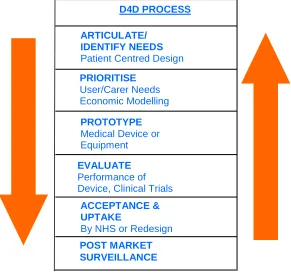
When projects are accepted into its portfolio, D4D follow an iterative process to move from unmet need through to a product. This process is illustrated in figure 1.
One of D4D’s key objectives throughout this process is to promote end user involvement or participation and this can occur within any of the stages. There are a number of potential methods for user involvement or participation which are well documented. However as a HTC, D4D needs to carefully consider the appropriate method is applied due to the mixed nature of the project teams (end users, healthcare professionals, academia, industry) and the potential time constraints due to issues such as planned manufacture dates or ethical processes.
This paper discusses four methods of user involvement which have been used, the results of using these methods and the challenges for potential groups undertaking these methods.
D4D PROCESS
ARTICULATE/ IDENTIFY NEEDS
Patient Centred Design
PRIORITISE
User/Carer Needs Economic Modelling
PROTOTYPE
Medical Device or Equipment
EVALUATE
Performance of Device, Clinical Trials
ACCEPTANCE & UPTAKE
By NHS or Redesign
[image:3.595.170.461.485.758.2]POST MARKET SURVEILLANCE
1.User Involvement Methods
1.1.Focus Groups
1.1.1. Description
D4D have trialled the use of focus groups for a number of projects. As highlighted in Figure 1 devices within D4D can be at a variety of stages and D4D have used focus groups within these stages as a method to enable progression to the next stage of development. When an unmet need is being considered a focus group provides a way of gathering together key stakeholders to generally discuss the highlighted unmet need, verify the need or the main aspects of the need and enable future planning. When a device is further through the development process a focus group provides an opportunity for key stakeholders to physically see the device or concept, explore how to use it and give feedback on the design and potential modifications required. A focus group can also provide feedback on the final, or commercially-ready, product to identify marketing strategies and provide evidence to be used to support adoption of the product. They also provide an opportunity to review other products or devices which meet a need if the requirement is to improve upon or redesign an existing device. Gibbs [5] more generally highlights the range of applications for focus groups.
Within D4D to date, the reasons chosen for undertaking focus groups can be summarised as follows:
• To provide a way of demonstrating the device/technology to gain feedback to a group of relevant professionals;
• To provide a way of demonstrating the device/technology to gain feedback from a group of relevant users/carers;
• To provide a way of verifying unmet need;
• To provide a way of formulating or verifying design specifications; and
• To identify people who could be involved in planning a more formal research project or sit on a steering committee for such a project
When considering whether a focus group is appropriate for a project D4D not only considers whether it will achieve the aim, e.g. gaining feedback from relevant health professionals, but also consider whether it is the most appropriate method for the target participants. One of the main areas of work within the Assistive Technology Theme for D4D is Alternative and Augmented Communication. End user participants for these projects are likely to have a speech and language disorder and hence careful consideration of how to facilitate and organise such a focus group for this group would be essential and that D4D would evaluate other methods of gaining this information from this group, e.g. face-to-face interviews. For involvement in unmet need identification, etc., having a number of people together in a focus group can provide a way of collecting views and opinions which it would not be possible to collect via other methods [5].
1.1.2.Application
To illustrate the types of results of focus groups held three examples have been chosen: The first of these is for a project which is considering development of a new design of neck brace for people with neurological conditions. Previous grant applications have been submitted and have been unsuccessful and so two user involvement strategies described in this paper have been used to tackle the feedback from the previous grant applications. A focus group was run following a local support group meeting to discuss the experiences of people with a neurological condition and their carers of issues around neck weakness and current neck supports. The aim of this was predominantly to consider the specific details of the unmet need for a neck support for this group of people and also early definition of key design requirements. This focus group enabled identification of the current issues with existing collars and identification of broad requirements which will be used within the next grant application and also to plan future end user involvement.
The second example is work D4D is undertaking to develop an accessible receptive language assessment for children with disabilities. A project is being undertaken in schools gaining feedback about the pilot tool from teachers and trialling the tool with a small number of children. The project team was also keen to gain feedback from speech and language therapists and so attended an Alternative and Augmentative Communication (AAC) special interest group to present the project. This enabled 15 specialist speech and language therapists to feedback on the pilot tool; give suggestions of features they would like to see; and also say how they felt it could be adopted into practice. Gathering the professionals together at the special interest group ensured wide discussion as they highlighted different experiences but also enabled them to physically see the assessment and ask questions about the tool to the project team. It also provided opportunity to feedback how the results of the audit which had been conducted via an online survey (discussed later in the paper), had been incorporated into the development. This is an example of using a focus group as part of the iterative development process for a tool.
The third example was again run following a meeting of a support group however this example was looking at a final prototype device to gain opinions on the final prototype and also feedback on what would motivate people to purchase the device, what price they would consider paying and features that they would like to see included in future models of the device. This provided the inventor with important feedback for the final stage of his pre-commercialisation work.
1.1.3.Evaluation
Through the experience to date of focus groups within D4D we have identified the following challenges:
• Identifying appropriate stakeholders and finding people that represent these stakeholders;
• Managing expectations of inventor/researchers;
• Choosing appropriate facilitator in terms of skills required and prior knowledge;
• Difficulties for some groups of participants to access e.g. those with physical disabilities, and/or those with speech and language disorders; and
• Ensuring the environment is appropriate and comfortable for enabling participants to look at the devices or technology.
We have also identified the following benefits:
• Relatively easy to set up and potential to be performed at times when groups are already meeting;
• Rich source of data for a variety of applications, as illustrated verifying unmet need, identifying key requirements, gaining feedback on new devices or existing devices from target users of devices/technology;
• Ability to establish a relationship with groups of participants which leads to potential for further involvement in a project; and
• Identification of further unmet needs or new devices either directly via the focus group or via establishing relationship with a group of participants.
1.2. Online Surveys
1.2.1.Description
Surveys or audits are a very well established method of gaining feedback from a large number of people [6]. Utilising the internet, i.e. utilising online surveys or audits, has the potential to access a wider audience, and potentially promote a better return rate for certain groups due to the prevalence of internet access. Paper based surveys or audits rely on a person not only completing the information but also returning it, and even using strategies such as including an envelope for posting the paper back, can result in relatively low return rates. In addition, for some participants with disabilities completing an online survey could be easier and potentially more independent than completing a paper based survey or they may feel more comfortable as offline they may feel more stigmatised by their disability [7]. There are, however, sampling issues related to an online survey or audit, as non-internet users are excluded. Careful consideration of whether a significant proportion of the target participants are likely to be non-internet users is required when considering this method of involvement. D4D have found targeted online surveys/audits useful for some projects. Within D4D to date we would summarise the reasons for choosing online surveys/audits as follows:
• When feedback from a larger group of participants is required; and
• To enable wider access to the survey/audit providing the target group are likely to be internet users.
1.2.2.Application
reviewed and then tested on a small cohort of target participants to gain feedback on both the content and more general features, e.g. time taken to complete. The audits were then revised based on this and placed online.
In both cases, but particularly for the paediatric wheelchair audit, targeted advertising was used via key contacts within relevant organisations and via relevant email forums.
Following closure of the online audits the quantitative results were collated and analysed and qualitative data was analysed to identify common themes.
The results of the two audits performed to date illustrated their benefit. For the audit of speech and language therapists 42 people responded. This provided validation for the potential need for the assessment we were proposing; it also provided information regarding what the speech and language therapists wanted to see in such an assessment and how they would prioritise this.
For the paediatric wheelchair project there were 114 wheelchair users, 190 carers and 164 professionals who responded which was a large response especially considering that the audit was online for only two weeks. A significant proportion of this data was free text and this was analysed using a qualitative thematic method [8]. Ten themes were identified which were used to support and add to the design specification for the paediatric wheelchair.
1.2.3.Evaluation
Through experience to date D4D identifies the challenges of online surveys/audits as follows:
• Appropriate design of survey/audit;
• Data constrained and dictated by questions asked;
• Balancing collection of quantitative versus qualitative data;
• Analysis of potentially large quantity of data;
• Identification of routes through which to advertise for maximum response; and
• Validating that participants are ‘real’ users or people with experiences relevant to questions.
The benefits can be summarised as follows:
• Recognition that for a number of the potential participants travelling to a focus group or workshop could be challenging or impossible so still providing a way to source data from these people; and
• Large potential cohort.
1.3.Qualitative Interviews
1.3.1.Description
device is likely to make the discussions more sensitive and hence not easy to discuss using a strategy such as a focus group.
1.3.2.Application
A project investigating users’ perceptions of the design of communication aids used qualitative interviews of communication aid users, followed by a national survey, as a method for engaging users in discussing the design of devices. These methods were chosen in order to allow researchers to obtain ‘base-line’ data that could provide a rich picture around the design of these devices. This aim of this investigation was to then enable industry to use the information to design more appropriate devices for users.
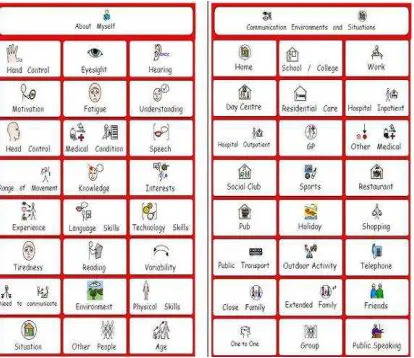
[image:8.595.205.412.392.571.2]There is an inherent difficulty in interviewing people with speech, language or communication needs in that they are often unable to give long and free-flowing responses to questions and there can be a difficulty in having an unstructured conversation around a topic. Resources were prepared, and used, during the interviews to aid involvement of the users in the interviews and this did have some success in helping participants investigate the issues around the topic (see Figure 2). There was a difficulty, however, in helping participants to discuss the topic in more general terms and the use of the resources did significantly lead the interviews.
Figure 2. Examples of symbolised interview prompt sheets (WLS symbols reproduced with permission)
The interviews often relied significantly on communication partners/carers ‘interpreting’ for the user and also often advocating on their behalf. This is likely to reflect the situation for these participants in most aspects of day-to-day life, but may have influenced the data by not allowing participants to voice their own opinions effectively.
chosen, however, suggests to consideration of other methods for future investigations around more specific topics of communication aid design.
1.3.3.Evaluation
Through the experience to date of qualitative interviews within D4D we have identified the following challenges:
• Identifying often difficult to reach stakeholders;
• Choosing appropriate interviewer in terms of skills required and prior knowledge;
• Ensuring there is an appropriate amount of time for discussions whilst considering the demands on the participants particularly if they may tire because of their medical condition; and
• High resource requirements both undertaking the interviews and detailed analysis of data.
We have also identified the following benefits:
• Method can ensure participants who may not be able to participant via other involvement strategies can be involved; and
• Delivers a rich source of data due to the qualitative collection method.
1.4.Design Workshop
1.4.1.Description
Unlike focus groups design workshops are targeted at the participants developing or refining designs rather than simply providing feedback on designs. D4D has explored the use of design workshops for exactly this reason. One of the examples described below illustrates this in that a design workshop was considered following two previous rejected grant applications. The feedback for these applications had been that the idea was good and the need was recognised but that the funders felt we needed to have more of an idea of a potential device solution. It was felt that a design workshop could enable one or more potential device solutions to be developed which could then be the basis to apply for grant funding.
1.4.2.Application
reasons for their choices about the various parts they had included from each scheme. During the formulation of the hybrid design, notes were taken to record the decision process for different parts.
The results of this workshop were reviewed by the stakeholder group for the project who decided based on their expertise and the input from the design workshop the features of the design to be taken to the next stage of development.
The second design workshop followed an inclusive design approach [3]. The principle of the two-day workshop was to explore using a prototype update of the Inclusive Design Toolkit [4] as an approach to devising solutions for three unmet needs, which had been highlighted to D4D. As such it had the dual purpose of providing training on the process while tackling real needs. The Inclusive Design Toolkit is an on-line resource and the elements used during the workshop included prototype updates that helped in the development of the second version of the Toolkit that was launched at the Include Conference in 2011 [9].
The Toolkit is based around three fundamental questions [10]: 1. What are the needs?
2. How can the needs be met? 3. How well are the needs met?
These questions are addressed by three groups of activities, which ‘explore’ the needs, ‘create’ potential solutions, and ‘evaluate’ their performance. This process of explore, create, and evaluate is an iterative process that allows improvement through prototyping and testing solutions. Even in the constraints of a 2-day workshop it is possible to iterate ideas that are conceived.
A group of designers, health professionals, academics and in one group end users was formed for each of the unmet needs. The two days were structured to provide instruction on each stage of the process and then time to undertake each stage of the process. The following exercises were undertaken, starting with an introduction to the process:
Overview of the design process
Exercise 1 - Understanding stakeholders
Exercise 2 - Bringing Users to Life with Personas Exercise 3 - Patient Journeys
Exercise 4 – Exclusion Audit Exercise 5 - Capturing Requirements Exercise 6 - Solving Problems Exercise 7 - Generating Solutions Exercise 8 - Evaluating Solutions
At the end of the two days each of the groups presented their concept summaries. Following this design workshop the concepts identified were evaluated by a subset of the group and for two of the unmet needs a follow up design workshop was held. At this the preferred idea from the evaluation was discussed and next steps established.
the demands solutions puts on the user’s capabilities. Having the headings gave the grid a much clearer visual structure while also aiding the correct use of the approach. The cards where also simple enough to allow rapid customisation to address specific requirements for the area being investigated. For example adding additional information headings that participants deemed it important to capture.
In addition to the physical cards an electronic version was made available in the form of a template spreadsheet. This allowed the groups to capture what they had written on the cards in electronic form as part of the exercise. This means an easily distributable electronic form is created and it also overcomes the problem of trying to read poor handwriting at a later stage. The use of cards and the spreadsheet record were subsequently refined and trialled with seven large companies from different industry sectors [12]. This approach has now become a key part of the new Inclusive Design Toolkit and allows a systematic approach to engaging with stakeholders including users.
A key emphasis of the workshop was including end users with other stakeholders. However at the workshop itself, end users were only available for one of the three groups. This provided an interesting insight for the organisers on the dynamics of groups with and without end users. Informal reflections during the workshop on the dynamics highlighted the following issues with the group with end users:
• The pace of the group in tackling the activities was much slower;
• The end users struggled to engage with aspects of the activities;
• The breadth and depth of the ideas generated was poorer; and
• The other two groups could be described as much more highly ‘energised’ in tackling the activities.
The following ideas to address these problems were suggested at the time:
• Recruit end users that are known to be confident and effective in engaging in this workshop format;
• Consider using pre-recorded user input such as video interviews and summaries of key insights backed with user quotes; and
• Involve users for only part of the workshop for example up front in exploring needs and at the end to help evaluate solutions.
Such reflections should be treated with caution due to the informal nature of how they were derived. However they are potentially useful insights and also indicate the importance of getting the details right in running such a workshop.
The use of the inclusive design approach resulted in concept designs for all three unmet needs. For two of the unmet needs these enabled a potential solution to be identified resulting in two grant applications to take the development to the next stage. For one of the three unmet needs two grant applications had previously been submitted and rejected. In both cases the main feedback had been that although the need was recognised, the reviewers had felt there needed to have been more work on developing an early solution prior to achieving grant funding. It was therefore felt that the design workshop could provide this and so facilitate taking the project to the next stage.
1.4.3.Evaluation
The design workshops in both formats have proved successful in meeting their aims. D4D would summarise the challenges of design workshops as follows:
• Ensuring that the input from end users is effective and does not impede idea generation; and
• Facilitating a multi-disciplinary design team, particularly when members may have disabilities or lack confidence in this format of engagement.
With the benefits identified as:
• Providing users of proposed devices involvement in the creative process, not simply in the identification of the unmet need or specification of the requirements;
• Formulation of a multi-disciplinary design team – users, health professionals, designers, engineers;
• Providing a strong user focus;
• A rapid way to develop ideas that address the concerns of stakeholders; and
• Opportunity to come up with a wide range of potential solutions
2.Conclusion
Involving users effectively is not necessarily straightforward however the benefits to the development and review of new devices have been evidenced in this paper. The four methods described in this paper are well known and well utilised within research however when considering them in device development to involve people with long term conditions or disabilities, making decisions about the key aim of involvement, the target participants is essential to get the best results; to both further the project and ensure the best possible outcome from the participants. Further work in refining and exploring these methods for device development within a HTC is required and D4D are keen to refine their user involvement and participation strategies, this has been highlighted by other work with similar target groups [13, 14, 15]. D4D reflect on user involvement and participation both in terms of the results gained for the project but importantly also the method used to achieve this involvement.
3.Acknowledgements
4.References
[1]Healthcare Industry Task Force. “Better Health Through Partnership – A programme for action”. Retrieved from
http://www.dh.gov.uk/en/Publicationsandstatistics/Publications/PublicationsPolicyAndGuidance/DH_4 094982?ssSourceSiteId=ab, 2004.
[2]S. Judge, G. Townend, G. Users’ Perceptions of Communication Aid Design. Retrieved from
http://www.devicesfordignity.org.uk/report, 2010.
[3]R. Coleman,. 1994. The Case for Inclusive Design - an Overview. Proceedings of the 12th Triennial Congress, International Ergonomics Association and the Human Factors Association, Canada. [4]Inclusive Design Toolkit, 2011. www.inclusivedesigntoolkit.com (accessed on: 21st May 2011)
[5]A.Gibbs, Focus Groups, Social Research Update, Issue 19, Surrey University.
http://sru.soc.surrey.ac.uk/SRU19.html (accessed on 21st May 2011)
[6]J.R. Evans, A. Mathur. The value of online surveys, www.emeraldinsight.com/1066-2243.htm (accessed on :21st May 2011)
[7]K. Wright, Researching Internet-Based Populations:Advantages and Disadvantages of Online Survey Research, Online Questionnaire Authoring Software Packages, and Web Survey Services.
http://jcmc.indiana.edu/vol10/issue3/wright.html?ref=BenimShopum.com (accessed on: 21st May 2011)
[8] J. Ritchie, J. Lewis. Qualitative Research Practice: A guide for Social Science Students and Researchers. SAGE Publications Ltd, 2006.
[9]Include 2011 International Conference, 2011. www.hhc.rca.ac.uk/2968/all/1/include-2011.aspx (accessed on: 21st May 2011)
[10] I.M. Hosking. Universal Design: From Awareness to Action. AARP International: The Journal, (Summer 2010), 73-76.
[11] International Standards Organisation, 2007. ISO 216:2007 Writing paper and certain classes of printed matter -- Trimmed sizes -- A and B series, and indication of machine direction
[12] I.M.Hosking, S.D.Waller, P.J.Clarkson. It is normal to be different: Applying inclusive design in industry. Interacting with Computers 22 (2010) 496–501
[13] R. Eisma, A. Dickinson, J. Goodman, O.Mival, A. Syme, L.Tiwari, Mutual inspiration in the development of new technology for older people, Include 2003, London 2003.
[14] . Searle, C. McCreadie, A. Turner-Smith, A. Tinker. Older people as partners in assistive technology research: The use of focus groups in the design process, Technology and Disability 14 (2002), 21–29. [15] L. Robinson, K. Brittain, S. Lindsay, D. Jackson, P. Olivier. Keeping In Touch Everyday (KITE)