White Rose Research Online URL for this paper:
http://eprints.whiterose.ac.uk/93761/
Article:
Zhang, W., Liu, W., Wu, S. et al. (1 more author) (2013) Joint DOA and Array Manifold
Estimation for a MIMO Array Using Two Calibrated Antennas. (Unpublished)
[email protected] https://eprints.whiterose.ac.uk/ Reuse
Unless indicated otherwise, fulltext items are protected by copyright with all rights reserved. The copyright exception in section 29 of the Copyright, Designs and Patents Act 1988 allows the making of a single copy solely for the purpose of non-commercial research or private study within the limits of fair dealing. The publisher or other rights-holder may allow further reproduction and re-use of this version - refer to the White Rose Research Online record for this item. Where records identify the publisher as the copyright holder, users can verify any specific terms of use on the publisher’s website.
Takedown
If you consider content in White Rose Research Online to be in breach of UK law, please notify us by
arXiv:1310.2960v1 [cs.IT] 10 Oct 2013
Joint DOA and Array Manifold Estimation for a
MIMO Array Using Two Calibrated Antennas
Wei Zhang
# ∗, Wei Liu
∗, Siliang Wu
#, and Ju Wang
##Department of Information and Electronics
Beijing Institute of Technology, Beijing, China
∗ Communications Research Group
Dept. of Electronic & Electrical Engineering
University of Sheffield, UK
Abstract—A simple scheme for joint direction of arrival (DOA)
and array manifold estimation for a MIMO array system is proposed, where only two transmit antennas are calibrated initially. It first obtains a set of initial DOA results by employing a rotational invariance property between two sets of received data, and then more accurate DOA and array manifold estimation is obtained through a local searching algorithm with several iterations. No strict half wavelength spacing is required for the uncalibrated antennas to avoid the spatial aliasing problem.
Index Terms—DOA estimation, antenna manifold, MIMO
radar, calibration, robust.
I. INTRODUCTION
A MIMO radar array system employs multiple transmit an-tennas for emitting orthogonal waveforms and multiple receive antennas for receiving the echoes reflected by the targets [1], [2], [3] and can exploit the waveform diversity to form a virtual array with increased degrees of freedom (DOFs) and a larger aperture compared to the traditional phased-array radar. It has been shown that MIMO radar can provide enhanced spatial resolution, achieve better target detection performance, and significantly improve the system’s parameter identifiability [3], [4], [5], [6].
Many techniques have been proposed for angle estimation in MIMO radar using traditional direction of arrival (DOA) algorithms, such as MUSIC [7] and ESPRIT [8], by assuming perfect knowledge of the array manifold. However, these algo-rithms are sensitive to uncertainties in the array manifold, and their performance will degrade significantly in the presence of array model errors [9], [10], [11]. On the other hand, it is time-consuming and expensive to calibrate the system in the case of large or time-varying arrays [10]. In addition, it is observed that in practice, even after initial calibration, antenna gain and phase errors still exist due to environmental changes and other factors [12]. To cope with the problem, in [13], a
MUSIC-based DOA estimation method in the presence of gain and phase errors was introduced. A subspace-based method for estimating the errors was proposed in [12]. Other methods were also proposed based on partially calibrated arrays [14], [11], [10]. Additionally, blind calibration is possible for non-Gaussian signals by using higher-order statistics [15], although with a very high computational complexity.
In this work, we address the problem of joint DOA and array manifold estimation with a multi-input multi-output (MIMO) array configuration [2], [5], where only two transmit antennas are fully calibrated, while the receive antennas are uncalibrated [16], [17]. Since the two transmit antennas trans-mit orthogonal waveforms, we can extract the received data associated with each transmit antenna. With the two transmit antennas well calibrated, a rotational invariance property be-tween the two sets of data can still be maintained without any knowledge of the array manifold of the uncalibrated side; then the ESPRIT algorithm can be used to find the initial DOAs of the targets. Starting with the initial DOA estimates, the antenna gains and phases can then be estimated through an appropriate modification of the MUSIC algorithm introduced in [13]. The estimated antenna gains and phases will be used in the more accurate estimation of DOAs via the MUSIC algorithm. This procedure will be repeated until some convergence criterion is met. The advantage of the scheme is that only two calibrated antennas are needed for high resolution DOA estimation and no specific requirement is imposed on the uncalibrated antennas. To our best knowledge, none of the existing DOA estimation methods for MIMO arrays has considered the joint DOA and array manifold estimation problem.
Consider a MIMO system with a uniform linear array (ULA) ofM antennas used for both transmitting and receiv-ing. For simplicity of notation and without loss of generality, we assume that the first two antennas are perfectly calibrated. The steering vector of the ULA is then given by
a(θ) = [1, e−j2πdsin(θ)/λ, α3ejφ3e−j2π2dsin(θ)/λ,· · ·,
αNejφNe−j2π(M−1)dsin(θ)/λ]T (1)
where [·]T denotes the transpose operation, θ is the angle of
the pointing direction,dis the inter-element spacing,λis the signal wavelength, and αi and φi denote the gain and phase
errors, respectively. Assume that K targets are present. The output of the matched filters at the receiver is given by [5]
x[n] =
K X
k=1
a(θk)⊗a(θk)bk[n] +n[n]
= Ab[n] +n[n] (2)
where θk is the DOA of the kth target,⊗ is the Kronecker
product,bk[n] =βkej2πfdn, withβkbeing the complex-valued
reflection coefficient of thekth target andfdbeing the Doppler
frequency, b[n] = [b1[n], b2[n],· · ·, bK[n]]T,
A= [a(θ1)⊗a(θ1),· · · ,a(θK)⊗a(θK)] (3)
is the overall transmit-receive or virtual array manifold, and
n[n]is the white noise vector with a powerσ2.
Assume that all target-reflected signals and noise are uncor-related. Then we have
Rx = E[x[n]x[n]H] =ARbAH+σ2I
= UsΛUHs +σ2UnUHn (4)
where E[·] and [·]H denote expectation and
Hermi-tian transpose, respectively, Rb = E[b[n]b[n]H], Λ =
diag{λ1,· · ·, λK} consists of the K principal eigenvalues
of Rx, Us is the signal subspace, specified by the principal
eigenvectors of Rx, and the remaining eigenvectors Un is the
noise subspace. In practice, Rx will be replaced by Rˆx =
1
L PL
n=1x[n]x[n]H, whereLis the number of snapshots. The MUSIC algorithm for DOA estimation for MIMO radar can be constructed as [18], [19]
f(θ) = 1/[a(θ)⊗a(θ)]HUnUHn[a(θ)⊗a(θ)]. (5)
TheKlargest peaks off(θ)indicate the DOAs of the targets. It requires the spacing between two adjacent antennas to be within a half wavelength to avoid estimation ambiguity.
For ESPRIT estimator [20], it is based on the signal subspace Us. Let Us,1 be the subset of Us, which relates to
the first to the(M−1)-th transmit antennas, and Us,2 be the
s M
antennas. We then have the following relationship
Us,2=Us,1TeQeT−e1 (6)
where Te is an unknown nonsingular matrix and Qe is a
diagonal matrix, with its kth main diagonal element being e−j2πdsin(θk)/λ. Thus, the DOAs can be found from the
eigenvalues of (UHs,1Us,1)−1UHs,1Us,2.
III. PROPOSEDMETHOD
In this section, we first perform an initial DOA estimation using the two sets of received data associated with the first and the second transmit antennas by applying the ESPRIT algorithm, then the gain and phase errors can be estimated using the initial DOA results by applying a MUSIC-based approach.
A. Estimating initial DOAs
Since the array manifold is unknown, we can not apply the traditional subspace-based methods directly. To solve the problem, define A1and A2as the first and the secondM rows of A, respectively, with
A1 = [a(θ1),· · · ,a(θK)], (7)
A2 = [e−j2πdsin(θ1)/λa(θ1),· · · , e−j2πdsin(θK)/λa(θK)]
= A1Q (8)
where Q is anM×M diagonal matrix, withe−j2πdsin(θk)/λ
being its kth main diagonal element.
Although there are model errors in both A1 and A2, a rotational invariance property between A1 and A2 is still maintained, which enables the use of ESPRIT for DOA estimation. A and Us have a relationship determined by a
unique nonsingular matrix T as
A=UsT. (9)
Define U1 and U2 as the first and second M rows of Us,
respectively. We have
A1 = U1T, (10)
A2 = U2T=A1Q. (11)
Then,
U2=U1TQT−1. (12)
Now using the traditional ESPRIT technique, the main diago-nal elements of Q can be obtained via eigendecomposition of (UH1U1)−1UH1U2. Since the two transmit antennas have been well calibrated,{θk}Kk=1 can be obtained easily from Q.
can be estimated accurately without any knowledge of array model errors. Additionally, in this initial DOA estimation, the proposed ESPRIT-based method imposes less constraints on the spacing of the uncalibrated part, which can be arranged to be much larger than a half-wavelength for a high-resolution DOA estimation.
B. Estimating array manifold
From (5), with exactly known Rx, the DOAs can also be
found by solving the following equation [13]:
[a(θ)⊗a(θ)]HU
nUHn[a(θ)⊗a(θ)] = 0. (13)
The actual steering vector can also be expressed as
a(θ) = Γ¯a(θ) (14)
where Γ = diag[1,1, α3ejφ3,· · ·, α
MejφM] and ¯a(θ) =
[1, e−j2πdsin(θ)/λ,· · ·, e−j2π(M−1)dsin(θ)/λ]T. Therefore, the
estimate of antenna gains and phases can be obtained using the initially estimated DOAs as follows:
min
K X
k=1
Γ¯a(ˆθk)
⊗ Γ¯a(ˆθk) H
UnUHn
Γ¯a(ˆθk)
⊗ Γ¯a(ˆθk)
= min
δ K X
k=1
[Vkδ]HUnUHn[Vkδ]
subject to δHe1= 1, δHe2= 1 (15)
whereδis theM2×1gain and phase vector, with its elements being the diagonal elements of [Γ⊗Γ], Vk = diag[¯a(ˆθk)⊗
¯
a(ˆθk)], withθˆkbeing the initial DOA estimate of thekth target,
e1 = [1,0,· · ·,0]T and e2 = [0,1,0,· · ·,0]T. It should be noted that both the(M+ 1)-th and the(M + 2)-th elements of δ should also be equal to 1; however, we find that the above two constraints are able to give a satisfactory result. The problem in (15) can be rewritten as
min
δ δ
HZδ subject to δHe=fT (16)
where Z=PKk=1VHk UnUHnVk, e= [e1,e2], andf = [1,1]T. Its solution is given by
δ=Z−1e[eHZ−1e]−1fT. (17)
Using the estimates (17), the DOAs can be estimated from the K highest peaks of the following function:
f(θ) = 1
diag[δ][¯a(θ)⊗a¯(θ)]HUnUHn
diag[δ][¯a(θ)⊗¯a(θ)].
(18) Since a set of initial DOA estimates has already been obtained, we can search for each DOA estimate over a small DOA region corresponding to each initial DOA estimate. Thus, the inter-element spacing of the uncalibrated array does not have to be
smaller than half wavelength to avoid estimation ambiguity. Actually, we can increase the inter-element spacing of the uncalibrated array to improve the accuracy of estimation.
The proposed joint DOA and array manifold estimation scheme is summarized as follows:
1) Estimate the initial DOAs using the ESPRIT algorithm.
2) Estimate the array manifold using (17).
3) Use the results in Step 2 to find updated DOAs by local searching through (18).
4) Repeat Steps 2 and 3 until some convergence criterion is satisfied. One such a criterion could be the difference between the estimation results of the last round and the current one. When this difference is smaller than a pre-set threshold value, we can then stop the iteration.
Note that we have assumed implicitly that the antenna positions have been calibrated, and we consider the fixed uncalibrated gain and phase errors only. This is because the calibration of array position is more convenient than the calibration of gain and phase which may vary due to envi-ronmental changes. On the other hand, the position error can be transformed into phase errors. However, the phase errors caused by position errors are not fixed for the targets because the targets have different DOAs. In such a case, a simple way is to obtain the gain and phase errors corresponding to each target, i.e. we should estimate the gain and phase errors when obtaining one target’s DOA other than all the DOAs.
C. Complexity analysis
To estimate the sample covariance matrix, a computational complexity of O(M4L) is needed. The eigendecomposition operation needs a computational complexity ofO(M6). The proposed ESPRIT requires a computational complexity of O(M3). In the estimation of array manifold, the computational complexity of O(M6n) is needed, where n is the iteration number. Therefore, the proposed scheme has at least a com-plexity ofO(M6n+M6+M4L+M3).
D. Cram´er-Rao Bound for Uncalibrated Array
In this section, we derive the stochastic CRB for uncal-ibrated array by extending the results of [11], [21]. Define hi = αiejφi, i=3, · · ·, M, as the gain and phase error that
corresponds to the ith sensor and the (2M −4 +K)×1 vectorηηη= [θθθT, ξξξT, ζζζT]T containing the unknown parameters,
where
θθθ = [θ1,· · · , θK]T (19)
ξξξ = [Re{h3},· · ·,Re{hM}]T (20)
x[n] =N {0,Rx} (22)
where N {·,·} is the complex Gaussian distribution. The unknown parameters include the elements of ηηη, the noise variance σ2, and the parameters of the source covariance matrix {[Rb]ii}iK=1 and{Re{[Rb]ij},Im{[Rb]ij};j > i}Ki,j=1. Considering the problem with respect to the parameters of the source covariance matrix and the noise variance, the(2M− 4 +K)×(2M −4 +K) Fisher information matrix can be written as [11], [21]
[F(ηηη)]i,j=
2L σ2Re
n
traceW∂A
H
∂ηj
P⊥A∂A
∂ηi o
(23)
where P⊥A = I−A(AHA)−1AH is the M ×M orthogonal
projection matrix and theK×K matrix W=Rb(AHARb+
σ2I)−1AHAR
b. Then the CRB matrix is CRB=F−1.
IV. SIMULATIONS
Simulations are carried out to investigate the performance of the proposed method compared with the traditional ESPRIT estimator in [20] and the MUSIC estimator. We consider a MIMO array with M = 10 antennas and half-wavelength spacing. The first two antennas are perfectly calibrated.K= 3 targets are located at 10◦, 20◦, and30◦, respectively. Results
from 100simulation runs are averaged to give the root mean square error (RMSE) of the estimates. For all simulations, the number of snapshots L = 100 is used. We first study
5 10 15 20 25 30
10−4 10−3 10−2 10−1 100
SNR (dB)
RMSE (degree)
Proposed ESPRIT−based
Proposed MUSIC−based with 5 iterations Traditional ESPRIT
[image:5.612.316.561.136.298.2]Traditional MUSIC CRB (Uncalibrated Array) CRB (Calibrated Array)
Fig. 1. RMSEs of DOA estimation versus input SNR.
the performance of the proposed ESPRIT-based algorithm for initial DOA estimation. The antenna gain and phase errors are assumed to have a uniform distribution: αk ∈ [0.8,1.2]and
φk ∈[−π/10, π/10].αk andφk change from run to run while
remaining constant for all snapshots. Fig. 1 shows the RMSE results versus input SNR. We see that the gain and phase errors have significantly degraded the performance of the traditional
is quite robust and has a much better performance. In this figure, we also showed the result of our proposed method with 5 iterations, and a clear improvement can be observed compared to the initial estimation.
0 1 2 3 4 5 6 7 8
10−2 10−1
Iteration number
RMSE (degree)
[image:5.612.53.297.460.619.2]Proposed MUSIC−based CRB (Uncalibrated Array)
Fig. 2. RMSEs of DOA estimation versus iteration number.
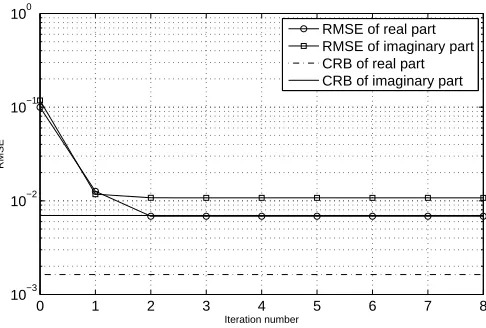
In the second example, the effect of the iteration number on the performance of the proposed method is demonstrated. The input SNR is set to 20 dB and the antenna gain and phase errors are set as (the diagonal elements ofΓ)
[1,1,1.13e−j0.020,0.89ej0.180,1.1ej0.130,1.05e−j0.038, 0.98ej0.101,0.90e−j0.057,1.15e−j0.187,0.88e−j0.247]. (24) The RMSE for DOA estimation versus the iteration number is shown in Fig. 2 and the result for unknown parameters estimation is shown in Fig. 3. Clearly the first or two iterations have already led to an accurate enough result.
0 1 2 3 4 5 6 7 8
10−3 10−2 10−1 100
Iteration number
RMSE
RMSE of real part RMSE of imaginary part CRB of real part CRB of imaginary part
Fig. 3. RMSEs of gain and phase estimation versus iteration number.
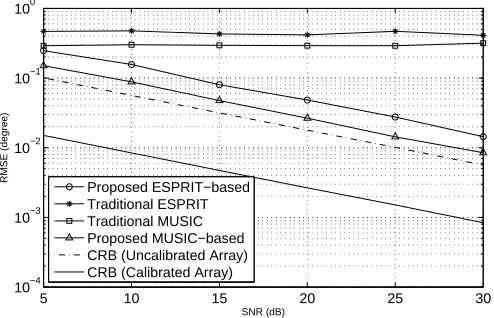
[image:5.612.317.560.511.675.2]between the uncalibrated antennas is set to2λfor the proposed method, and0.5λfor the other methods. The other parameters remain the same as in Example 1. The results are shown in Fig. 4. We can see that the proposed ESPRIT-based initial estimation has achieved a higher accuracy compared to Fig. 1, and the performance of the proposed method is much better than the corresponding result of Example 1 and significantly outperforms the other considered algorithms.
5 10 15 20 25 30
10−4 10−3 10−2 10−1 100
SNR (dB)
RMSE (degree)
[image:6.612.52.299.177.336.2]Proposed ESPRIT−based Traditional ESPRIT Traditional MUSIC Proposed MUSIC−based CRB (Uncalibrated Array) CRB (Calibrated Array)
Fig. 4. RMSEs of DOA estimation versus input SNR.
V. CONCLUSIONS
A joint DOA and array manifold estimation scheme for a MIMO array system has been proposed, where only two antennas at the transmit side are initially calibrated, while the remaining part of the system is completely uncalibrated. By exploiting the rotational invariance property between two sets of received data associated with the two calibrated antennas, the ESPRIT algorithm is first employed to give a set of initial DOA estimation results, which is then used by the following MUSIC-based algorithm for the joint estimation. Additionally, the proposed scheme does not require the adjacent antenna spacing in the uncalibrated part to be within a half wavelength, which provides further improvement to the estimation.
REFERENCES
[1] J. Li and P. Stoica, MIMO Radar Signal Processing. New York: Wiley, 2009.
[2] E. Fishler, A. M. Haimovich, R. S. Blum, L. J. Cimini, D. Chizhik, and R. A. Valenzuela, “Spatial diversity in radars-models and detection performance,” IEEE Transactions on Signal Processing, vol. 54, no. 3, pp. 823–838, March 2006.
[3] A. Hassanien and S. A. Vorobyov, “Phased-MIMO radar: A tradeoff between phased-array and MIMO radars,” IEEE Transactions on Signal
Processing, vol. 58, no. 6, pp. 3137–3151, June 2010.
[4] W. Zhang, W. Liu, J. Wang, and S. L. Wu, “DOA estimation of coherent targets in MIMO radar,” in Proc. IEEE International Conference on
Acoustics, Speech, and Signal Processing, Vancouver, Canada, May
2013, pp. 3929–3933.
[5] J. Li and P. Stoica, “MIMO radar with colocated antennas,” IEEE Signal
Processing Magazine, vol. 24, no. 5, pp. 106–114, Sept. 2007.
[6] W. Zhang, W. Liu, J. Wang, and S. L. Wu, “Joint transmission and reception diversity smoothing for direction finding of coherent targets in MIMO radar,” IEEE Journal of Selected Topics in Signal Processing, Feb. 2014, DOI: 10.1109/JSTSP.2013.2285520.
[7] R. O. Schmidt, “Multiple emitter location and signal parameter-estimation,” IEEE Transactions on Antennas and Propagation, vol. 34, no. 3, pp. 276–280, Mar. 1986.
[8] R. Roy and T. Kailath, “ESPRIT-estimation of signal parameters via ro-tational invariance techniques,” IEEE Transactions on Acoustics Speech
and Signal Processing, vol. 37, no. 7, pp. 984–995, Jul. 1989.
[9] B. Friedlander, “A sensitivity analysis of the MUSIC algorithm,” IEEE
Transactions on Acoustics, Speech and Signal Processing, vol. 38,
no. 10, pp. 1740–1751, Oct. 1990.
[10] P. Parvazi, M. Pesavento, and A. B. Gershman, “Direction-of-arrival esti-mation and array calibration for partly-calibrated arrays,” in Proc. IEEE
International Conference on Acoustics, Speech, and Signal Processing,
May 2011, pp. 2552–2555.
[11] C. M. S. See and A. B. Gershman, “Direction-of-arrival estimation in partly calibrated subarray-based sensor arrays,” IEEE Transactions on
Signal Processing, vol. 52, no. 2, pp. 329–338, Feb. 2004.
[12] V. C. Soon, L. Tong, Y. F. Huang, and R. Liu, “A subspace method for estimating sensor gains and phases,” IEEE Transactions on Signal
Processing, vol. 42, no. 4, pp. 973–976, Apr. 1994.
[13] B. Friedlander and A. J. Weiss, “Direction finding in the presence of mutual coupling,” IEEE Transactions on Antennas and Propagation, vol. 39, no. 3, pp. 273–284, Mar. 1991.
[14] A. Weiss and B. Friedlander, “DOA and steering vector estimation using a partially calibrated array,” IEEE Transactions on Aerospace and
Electronic Systems, vol. 32, no. 3, pp. 1047–1057, July 1996.
[15] J. Kim, H. J. Yang, B. W. Jung, and J. Chun, “Blind calibration for a linear array with gain and phase error using independent component analysis,” IEEE Antennas and Wireless Propagation Letters, vol. 9, pp. 1259–1262, 2010.
[16] W. Zhang, W. Liu, S. L. Wu, and J. Wang, “Direction-of-arrival estima-tion in partially calibrated subarray-based MIMO arrays,” in Proc. the
Constantinides International Workshop on Signal Processing, January
2013.
[17] ——, “Robust DOA estimation for a MIMO array using two calibrated transmit sensors,” in Proc. the IET International Radar Conference, Xi’an, China, Apr. 2013.
[18] X. Zhang, L. Y. Xu, L. Xu, and D. Xu, “Direction of departure (DOD) and direction of arrival (DOA) estimation in MIMO radar with reduced-dimension MUSIC,” IEEE Communications Letters, vol. 14, no. 12, pp. 1161–1163, Dec. 2010.
[19] J. He, M. N. S. Swamy, and M. O. Ahmad, “Joint DOD and DOA estimation for MIMO array with velocity receive sensors,” IEEE Signal
Processing Letters, vol. 18, no. 7, pp. 399–402, Dec. 2011.
[20] D. Chen, B. Chen, and G. Qin, “Angle estimation using ESPRIT in MIMO radar,” Electronics Letters, vol. 44, no. 12, pp. 770–770, June 2008.