White Rose Research Online [email protected]
Universities of Leeds, Sheffield and York
http://eprints.whiterose.ac.uk/
This is an author’s pre-print version of a paper published in International Journal of Language and Communication Disorders.
White Rose Research Online URL for this paper:
Published paper
Baxter, S., Enderby, P., Judge, S., Evans, P. (2012) Barriers and facilitators to use of high technology augmentative and alternative communication devices: a systematic review and qualitative synthesis, International Journal of Language and Communication Disorders, 47 (2), pp. 115-129
1
Systematic review of the literature on barriers and facilitators to use of high technology augmentative and alternative communication devices
Susan Baxter, School of Health and Related Research, University of Sheffield, UK,
Pam Enderby, School of Health and Related Research, University of Sheffield, UK
Philippa Evans, School of Health and Related Research, University of Sheffield, UK
Simon Judge, Barnsley District General Hospital, Barnsley, UK
s.judge@
Corresponding author:
Susan Baxter
Section of Public Health
School of Health and Related Research
Regent Court
30 Regent Street
Sheffield
S1
Ema
Telephone: 0114
Fax:
Key words: augmentative and alternative communication, systematic review, assistive technology
2
Abstract
Background: There has been a rapid growth in recent years of available technologies for
individuals with communication difficulties. Research evidence to underpin these
interventions is currently under-developed however, with practitioners having a limited body
of work to draw on, and the suggestion that devices may have limited functional usage.
Aims: To review the literature reporting views of users, families and staff in regard to high
technology augmentative and alternative communication (AAC) devices. The work aimed to
combine standard systematic review methods with qualitative synthesis techniques to identify
potential barriers and facilitators to provision and ongoing use of this technology.
Main Contribution: The review highlights the range of factors that can impact on provision
and use of high tech AAC, which practitioners should consider and address where needed in
the intervention process. These include: ease of use of the device; reliability; availability of
technical support; the voice/language of the device; the decision-making process; the time
taken to generate a message; family attitudes and roles; other people’s responses; service
provision; and the knowledge and skills of staff. The work outlines how systematic review
methods may be applied to the consideration of published material that is not reporting
intervention data, and how this may provide valuable information to inform future studies.
Conclusions: Practitioners should be aware of barriers and facilitators to successful use when
making recommendations, and have considered how barriers, where present, might be
overcome. Aspects of service delivery such as ongoing technical support and staff training
may require further consideration. The synthesis of evidence describing views of users and
providers, and findings regarding the process of intervention, can provide valuable data to
3
Introduction
Augmentative and alternative communication (AAC) strategies and devices have great
potential to improve the lives of individuals with communication difficulties by promoting
independence, the development of social relationships and enhancing education (Johnston et
al., 2004). While there has been a rapid growth in available options and technologies in recent
years it has been reported that practitioners face challenges in successfully implementing
AAC. Authors have highlighted that there is a paucity of research evidence to underpin
recommendations (Campbell et al. 2002; Schlosser, 2003); and that users may have limited
access to available systems or services (McNaughton and Bryan, 2007, National Joint
Committee for the Communication Needs of Persons with Severe Disabilities, 2002;
Kent-Walsh et al. 2008). Concerns have also been raised that devices may have limited functional
usage (Jacobs et al. 2004).
AAC can involve adding to (augmenting) natural speech or writing, or can be utilised
as an alternative to spoken communication or writing. It includes unaided modes that rely on
a user’s body to convey messages; for example gestures, signs and facial expressions. Also, it
includes aided communication modes that require additional materials or devices. Within the
category of aided AAC there is a commonly-used further subdivision of high technology
(high tech) versus low technology (low tech) aided options. Low tech systems or devices
encompass communication books or boards (non-electric), written words on paper,
photographs, line drawings and pictograms. High tech systems are usually considered to
include speech generating devices (SGDs), which are termed voice output communication
aids (VOCAs) in the North American literature, and speech generating device software on
personal computers or laptops. personal computers or laptops used as a communication aid to
4
providing access to personal computers or laptops enabling them to be used as a
communication aid.
Reviews regarding the effectiveness of AAC have tended to consider predominantly
low tech aids, with evidence suggesting positive outcomes from use of the Picture Exchange
Communication System (Bondy & Frost, 1998) in particular. Systematic reviews including
high tech aids (for example Schlosser and Blischak, 2001; Schlosser and Wendt, 2008;
Sigafoos et al., 2009; Lancioni et al., 2006; Lancioni et al., 2001; Binger and Light, 2008)
suggest that these devices can be beneficial, although highlight that much available evidence
is inconclusive. Authors emphasise the considerable individual variation in outcomes
following intervention, and the weak evidence regarding generalisation and maintenance of
usage (Schlosser and Lee, 2000). In addition, Mirenda et al. (2001) highlighted that research
is needed to investigate whether high tech aids offer advantages over less expensive options.
Objectives
While high tech AAC technology is a rapidly growing field, the evidence underpinning
intervention is currently underdeveloped, with diversity in reported outcomes suggesting a
need to further explore this individual variation. If practitioners and potential users are to
make informed recommendations and choices, having knowledge regarding the process of
implementation and ongoing usage of available technology is essential. This review was
therefore undertaken in order to investigate the potential barriers and facilitators to high tech
AAC provision and its ongoing use. As the aim of the analysis was to explore process factors
rather than effectiveness, the review examined and synthesised data from studies reporting
the views and perceptions of AAC users or staff providing the devices. This evidence was in
5
There is growing recognition of the value of extending systematic review methods to
include evidence from sources other than experimental studies (Garrett and Thomas, 2006).
Methods of meta-synthesis and thematic synthesis are being developed to address this need to
consider wider evidence (Dixon-Woods et al. 2001). In this article, the methodology that was
used to search for and identify relevant literature is outlined, together with a description of
the process of data analysis. The second section presents a synthesis of the results, followed
by a discussion of the method, and implications for service delivery and research.
Methods
Relevant published literature was identified via searching of the Cinahl, Cochrane library,
Embase, Medline, Psychinfo, CSA, and Web of Science electronic databases. Search terms
used related firstly to conditions (for example learning disability, cerebral palsy, Parkinson’s
Disease), secondly impairment terms (such as language disorder, communication
impairment), together with AAC terms (such as speech generating device, assistive aids) and
in addition, commonly used devices (such as Cannon Communicator, Minspeak,
Touchtalker). The full search strategy is available from the authors if required. In addition to
this electronic database searching, the reference list of included papers and review papers
were scrutinised for any additional citations of potential relevance.
The review considered studies carried out in communication impaired populations
(excluding solely hearing impaired) published in peer-reviewed journals between 2000 and
2010 that were reported in English. As the review aimed to be a “state of the art review”
(Grant & Booth, 2009), rather than standard effectiveness review there were no restrictions
in terms of study design or formal quality appraisal. The review encompassed “high
technology” communication devices only. For the purposes of this work high technology
6
communication methods or devices which cannot be described as low tech. Thus signing,
gesture, communication books, communication boards, alphabet boards, writing and drawing,
and pictures/symbols not used with a computer were outside the remit. Papers which reported
both high and low technology were included, with the data relating to high technology only
extracted. The use of computers for a treatment tool/therapy only (rather than as an assistive
device), and technology which promotes access to computers/switches to overcome physical
disabilities was also outside the scope of the review.
Data were analysed using principles of thematic synthesis (Thomas & Harden, 2008)
to establish recurring perceptions across the included papers. In this approach the themes
from the included papers form the data to be considered, with these compared and contrasted
in a process akin to primary qualitative data analysis. The synthesis may simply highlight
recurring findings across the set, or may use the data to develop new interpretations and
create meta-themes which were not present in the primary papers.
Results
Selection of publications for review
All the retrieved literature was screened at title and abstract level for relevance, and those that
had potential for inclusion were taken through to full paper appraisal and extraction of data.
Inclusions and exclusions were checked by a second member of the research team. The
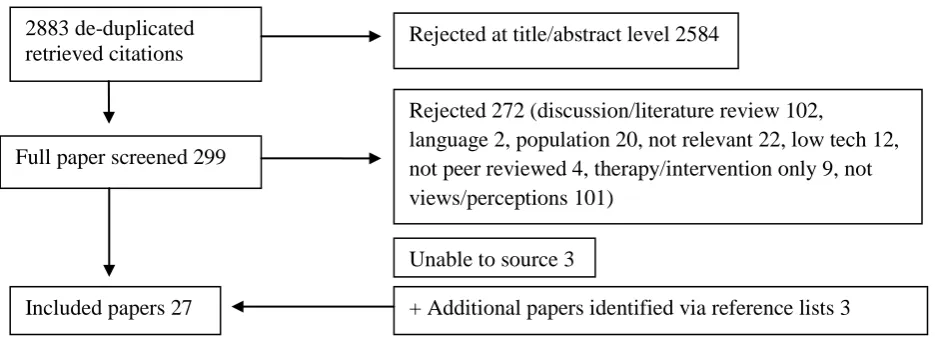
searches identified 27 papers which reported AAC users, families of users or staff perceptions
regarding barriers or facilitators to provision and successful usage of high tech AAC devices.
Figure 1 provides a summary of the process of inclusion and exclusion, indicating how
7
Figure 1 Flow chart illustrating the inclusion and exclusion process
The publications reviewed encompassed both findings from qualitative studies and survey
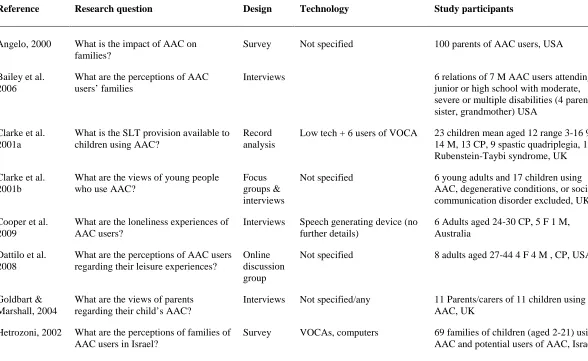
data. Table 1 provides a summary of the included studies. Analysis and synthesis of the
themes from the primary studies indicated a number of factors impacting on the take up and
use of high tech AAC devices. These factors were: ease of use; reliability; technical support;
the voice and language of the device; the decision-making process; the role of the family;
staff training, the speed of generating a message, responses from other people; and service
delivery issues such as staff training, and access to services.
Ease of use
Eight papers highlighted issues regarding the ease of learning and using high tech devices.
Bailey et al. (2006) interviewed relatives of AAC users attending junior or high schools with
multiple disabilities. The participants described how ease of use and care of the devices was
a significant factor in enhancing the AAC user’s experiences. The time taken to programme
the system was reportedly an important aspect of ease of use. Survey data (Angelo, 2000)
found that 25% of parents agreed that their child’s device was difficult to use at home (50%
disagreed). Hodge (2007) reported views of both parents of children using AAC and adult
users. Participants described how devices needed to be secured to a wheelchair in order to 2883 de-duplicated
retrieved citations
Full paper screened 299
Rejected at title/abstract level 2584
Rejected 272 (discussion/literature review 102,
language 2, population 20, not relevant 22, low tech 12, not peer reviewed 4, therapy/intervention only 9, not views/perceptions 101)
Included papers 27
Unable to source 3
8
use them successfully, with physical impairments also making usage slow or inefficient
leading to frustration. Rackensperger et al. (2005) echoed this, reporting how for some users
physically operating a device was a challenge, with devices difficult to use apart from when
seated in a customised wheelchair.
McCord and Soto (2004) interviewed young people with Cerebral Palsy (CP) who had
used AAC for at least one year. The authors reported a perception that the technology was
mysterious and complex. Similarly McNaughton et al. (2008) described views of parents and
a user that a lack of confidence with technology influenced attitudes to it. Respondents
identified that learning how to programme a device was a major challenge. Parents of users
described the benefits of learning from other parents, with the provision of Help functions in
devices described as being valuable. Marshall and Golbart (2008) found that parents
expressed concerns that high tech aids were effortful, and had experience of difficulties with
systems. Adult AAC users with CP in the Smith and Connolly (2008) paper reported that
their own limited knowledge and skills presented a significant barrier to usage.
Reliability
Eleven papers described the limited reliability of devices. Bailey et al. (2006) identified the
time taken to repair AAC systems and described poor reliability as a key barrier. Participants
in the Cooper et al. (2009) study reported issues with the battery running out, devices being
broken or not working, or devices not being set up properly. Of the parents surveyed by
Angelo (2000) 11% agreed that the system needed repair too often, however 60% disagreed.
Opinion voiced by young people using AAC (Clarke et al. 2001a) was that systems were
heavy, complex and broke down frequently. Dattilo et al. (2007) also reported frustrations
9
Adult AAC users in the O’Keefe et al. (2007) paper identified the improved
performance of devices as being a research priority. These experiences of device breakdown
and time taken to repair were also described by teachers in the Kent-Walsh and Light (2003)
study. A survey (Hetzroni, 2002) provided figures of 47% of parents of child AAC users
describing breakdowns as “all the time”, 17% “usually, 13% sometimes, 10% “hardly” and
13% “never”. Users in the Rackensberger et al. (2005) paper described how technology
breakdowns made it difficult for them to make progress in learning to use devices, and how
device breakdowns were “a disaster”. Similarly, Hodge (2007) found that technical problems
were a common cause of frustration, particularly with the more sophisticated devices.
Technical support
The barrier of limited availability of technical support was outlined in papers by Bailey et al.,
(2006); Dattilo et al. (2007); Hodge, Smith and Connolly (2008); Rackensberger et al. (2005);
Parette et al. (2000); and Soto et al. (2001). Family members described their own limitations
in regard to technical aspects of equipment, with support needing to be readily available
(Bailey et al. 2006; Parette et al. 2000). A study in America (Datillo et al. 2007) identified a
particular issue with getting devices repaired or maintained via the Medicare system. Users in
the Smith and Connolly (2008) work reported that few had assistance for programming or
maintenance when they were provided with their devices. Of 18 adults with CP in Ireland
who completed this survey, seven reported that they contacted their speech and language
therapist for maintenance, and six reported that they had no one to contact (no details of other
participant responses). Teachers in the Soto et al. (2001) paper, identified back up services
and support being in place as essential requirements for successful introduction and use of
AAC. They described technophobia amongst some staff as a barrier to introduction, together
10
Voice/language of the device
Six papers described limitations of systems in terms of the quality or appropriateness of the
voice or words being generated. McCord et al. (2004) investigated the perceptions of
Mexican-American families and found that the language of the device was the primary
barrier to use at home. Also, it was reported that the speech synthesiser was difficult to
understand by some family members who did not speak English as a first language. Lund
and Light (2007) similarly highlighted cultural issues, with the lack of devices having two
languages available being a limiting factor for some users. Bailey et al. (2006) reported
limited vocabularies as being an obstacle to effective usage. Also, the frustration when
spelled words were mispronounced by speech generating devices. Datillo et al. (2006)
described the challenge of using devices out of doors when they cannot be heard above
background noise. Clarke et al. (2001) reported the perception of some young people that it
was embarrassing when a device didn’t use their own voice.
Making decisions
Four papers described views regarding the involvement of users and user’s families in
decisions regarding an AAC device. McNaughton et al. (2008) reported a perception of
failure to include parents in selection of a device. Parette et al. (2000) highlighted the
importance of involving families in decision-making. A survey of family members’
perceptions (Bailey et al. 2006) found that the role of participants in decision-making varied.
Expectations regarding how much involvement they should have were also described as
varying. In one paper adult users described how they benefitted from taking a lead role in
11
Time generating a message
Five papers identified negative perceptions regarding the time that AAC devices take to
formulate a message. The slowness of communication was raised in particular by those using
text-based devices in the Hodge (2007) study. Adult users in the Cooper et al. (2009) and
Dattilo et al. (2007) papers described how the time taken to formulate a message was a major
challenge in using devices. Family members in another study (McCord & Soto, 2004)
reported that they often chose to communicate via other methods due to the inherently slow
response of AAC devices. Lund and Light (2007) echoed these views, describing the need for
technology that was faster, and could keep pace with a user’s thoughts.
Family
Nine papers highlighted the significance of the family members in successful implementation
of an AAC system. Rackensberger et al. (2005), Lund and Light (2007), and Parette et al.
(2000) reported a need for family support. McNaughton et al. (2008) identified the important
role of parents in teaching usage of a device. Speech and language therapists in the Iacono
and Cameron (2009) and Johnson et al. (2006) studies perceived that family attitudes could
act as a barrier to implementation. Marshall and Golbart (2008) described positive family
support, with none of the parents in this study expressing concern over the introduction of
AAC with some preferring that had been introduced earlier. The paper by Angelo (2000)
explored perceptions of family role and responsibilities in regard to AAC. In this survey,
more than half the families reported that one parent (most often the mother) had the majority
of the AAC device-related roles and responsibilities, with this impacting on personal time
availability. Only 7% however agreed or strongly agreed that the device was a burden.
12
parents to fund AAC resources themselves, with a requirement also to build up high levels of
specialist or technical information.
Other people’s responses
Five studies described how other people’s responses and attitudes could impact on use of an
AAC device. Marshall and Golbart (2008) reported parental perceptions that familiar adults
were generally considered to respond positively and be willing to interact with an AAC user,
however interactions with other people could be less positive. McNaughton et al. (2008)
suggested that it is important for users to have skills of asking questions, not just answering
them. The authors recommended that users should have a means of introducing the system to
others; be taught to a variety of means to deal with breakdowns; and that there should be
education for people who may interact with a user. Rackensberger et al. (2005) described a
need for “social and strategic knowledge” to make use of a device, for example how to gain
attention and how to introduce the device to unfamiliar people. The Smith and Connolly
(2008) study identified that the communication partner was the factor most likely to influence
use of an aid. Participants with aphasia (True et al. 2009) reported that the audience (along
with the content of the message and their mental and physical state) could make
communication more or less challenging.
Other factors
One survey paper (Johnson et al. 2006) provided a detailed analysis of factors perceived by
speech and language therapists relating to success or abandonment of AAC systems. This
work developed a survey tool via focus group input that was returned by 275 members of an
AAC special interest group in the USA. The study outlined a rank order for the top 20
factors for success and abandonment. It further carried out factor analysis to group these
13
consultants; attitude of realism, ownership and valuing the system; and finally the system
characteristics and fit between user abilities and system.
Service provision
Lund and Light (2007) outlined a perception of a lack of availability of local AAC services,
and in particular a lack of services for adult users. Difficulties in accessing a specialist
evaluation were also described by parents and AAC users in the McNaughton et al. (2008)
study. Nine papers were found that described other aspects of service provision. Five of these
investigated the delivery of services in a school setting. Clarke et al. (2001a) reported that
provision in the UK in terms of the amount of therapy, seemed related to educational
placement rather than individual needs. Children in mainstream school received fewer hours
of therapy provision than those in special schools (p<0.001). The study also found that 42%
of direct therapy took place in classrooms, and in special schools this was 87% group work.
This study also found that children using VOCAs received more therapy (median 85.8 hours)
than those using low tech aids (median 38.2 hours). This finding was identified by the authors
as probably due to practice and provision in one particular special school however, the
clinician views data supported that high tech aids might require more therapy due to them
being more complicated.
Staff training
The need for staff to have an adequate level of skills and knowledge was highlighted by six
papers. Soto et al. (2001) carried out focus groups with teachers, teaching assistants and
parents. They reported lack of training for staff was a significant barrier to successful
implementation of systems. A lack of expertise in schools was also echoed by Hodge (2007).
Lund and Light (2007) outlined limited expertise of local professionals, a lack of
14
also described a negative attitude towards AAC amongst some professionals. Golbart and
Marshall (2004) described how parents often reported that professionals did not have
sufficient experience or expertise in the area of AAC. Clarke et al. (2001b) analysed school
records and described the amount of official training of staff by communication specialists as
“minimal”. Parette et al. (2000) found that family members appreciated professionals being
honest about their level of knowledge, and wanted clear, accurate and trustworthy
information including accurate timelines regarding the process of acquiring equipment.
Iacono and Cameron (2009) found wide variation in speech and language therapists’
(SLTs) reported knowledge and skills in AAC. Wormnaes and Malek in Egypt (2004)
reported that 14 of the 30 SLT respondents felt that they had no or some knowledge about
AAC, while 13 described themselves as quite knowledgeable. Four respondents identified
that a lack of AAC knowledge and skills would preclude them from using AAC with a client.
In the UK, Mathews (2001) surveyed 320 speech and language therapists in various clinical
settings. This study found that 57% reported experiencing training in AAC as part of
pre-qualification training and 60% had accessed training since pre-qualification (mostly on signing).
The majority of respondents categorised their skills in high tech AAC as none (31%) or
general knowledge/awareness (37%). Forty nine percent identified that it would be useful to
access AAC training, with training aimed at a whole SLT team in a locality with ongoing
support from a trainer.
Two papers explored whether providing specific AAC training to school staff could
have positive impacts. Schlosser et al. (2000) evaluated training for staff who were involved
in supporting a ten year old male with CP who had used a dynamic display VOCA, low tech
symbols and a personal computer. The authors concluded that that the training was effective
in promoting the integration of technology resulting in increased participation of the student
15
was described as useful by participants. McMillan (2008) also evaluated the impact of a
training package. This study carried out in Australia provided a “teacher professional
development package” to four staff working with four students who used SGDs. The author
found an increase in student initiations using the high tech aid following training, but no
impact on level of responses.
Kent-Walsh and Light (2003) examined the perceptions of teachers who had AAC
users in their mainstream class. The participants described the importance of a team approach
to inclusion with good communication, group planning and problem-solving and a specific
need for careful transition planning. External specialists such as speech and language
therapist and technology consultants were identified as crucial assistance required. They
identified the need for a positive attitude, the important role of classmates and realistic
curriculum goals. In another study, school participants in the Soto et al. (2001) paper echoed
the importance of team collaboration, with AAC training and administrative support also
being pre-requisite conditions for successful integration of AAC users.
Discussion
The purpose of this systematic review was to identify and describe the current state of
knowledge regarding factors which may impact on the provision and ongoing use of
high-tech AAC devices. Analysis and synthesis of the literature indicates that the provision and
use of high tech AAC devices is subject to a wide variety of factors, which may act as
barriers or facilitators to successful outcomes. These factors encompass: ease of use of the
device; device reliability; availability of technical support; the voice/language of the device;
the process of making decisions regarding choice of a device; the time taken to generate a
message; family attitudes, perceptions and roles; other people interacting with an AAC user;
16
indicate that these elements are important for practitioners to consider and address where
needed in the intervention process.
The review also highlights the complexity which must be unravelled by researchers
endeavouring to evaluate and compare outcomes from intervention studies. The range of
factors identified by this review may go some way towards explaining the differences in
individual outcomes reported in the experimental literature. If the evidence base regarding
potential benefits from AAC intervention is to be strengthened, there is a need for high
quality studies including the use of controlled designs. Pring (2006) however discusses the
limitations of many controlled clinical outcome studies due to poor definition of the therapies
being studied, clients receiving different therapies and amount of therapies, and poor
definition or heterogeneity of the treated clients. This review further emphasises the
challenge of conducting high quality effectiveness studies (conducted under clinical rather
than ideal conditions) by outlining the wide range of elements impacting on outcomes.
Reviews such as this that explore and report evidence regarding implementation of
interventions are required in order to ensure comparison across different arms of a study.
This work has illustrated how evidence from studies which are not reporting
effectiveness data can be synthesised using systematic review methods. Increasing
recognition of the value of qualitative research has led the drive for wider evidence to be
considered in systematic reviews, with influential organisations such as The Cochrane
Collaboration investigating ways of combining different forms of data in reviews. The work
outlined in this article used the method of thematic synthesis to analyse qualitative and survey
data in order to identify factors underpinning the provision of therapy interventions. We
argue that systematic review of this type of evidence has been able to provide further
understanding of studies investigating clinical effectiveness, and can be a useful contribution
17
This study was intended to be a “state of the art review” considering all available
evidence. We therefore did not carry out a formal quality appraisal of papers as is usually the
case for standard systematic reviews. The critical appraisal of qualitative studies is an area of
considerable debate. Some authors argue that it may not be feasible or appropriate to
construct hierarchies for qualitative designs (Dixon-Woods et al., 2001) however many
frameworks are in existence (Lewis et al., 2006) and may be considered by future reviews of
this type.
A reasonable body of evidence was found describing the views and perceptions of
AAC users, parents and family of users, staff providing services and also teaching staff.
These data are an important supplement to quantitative outcomes data, however would not
have been considered in a traditional systematic review. Writers (Lund and Light, 2006) have
highlighted the debate concerning how AAC intervention outcomes should evaluated.
Short-term outcomes (such as the number of communication utterances made using a device pre
and post intervention) offer a temptingly measurable evaluation. However, ongoing usage for
communication in real-life settings may be the only outcome that is of importance. This
review has indicated the range of factors which underpin whether a device is functionally
useful, such as how often it is working and whether it meets the needs of families for whom
English is a second language. These elements may be a helpful contribution to the
consideration of functional usage outcomes.
In addition to providing information for researchers, the review suggests that aspects
of high tech AAC service delivery may need addressing. Concerns were reported regarding
the availability of specialist provision and knowledge and skill levels of practitioners. There
was some evidence that providing training for school staff, and working practices such as
team working could positively influence usage of a device. Further work evaluating the
18
AAC service delivery that seem worthy of further consideration are: the need for ongoing
advice regarding technical issues; maintenance and repair; and the influence of attitudes and
responses from those interacting with AAC users.
Conclusions
The implementation of high tech AAC interventions may be affected by a range of factors
that can be barriers or facilitators to successful outcomes. Practitioners should be aware of
these elements when making recommendations, and have considered how barriers, where
present, might be overcome. The review has also suggested that aspects of service delivery
such as ongoing technical support and staff training may require further consideration. It has
been argued that the synthesis of evidence describing views of users and providers, and the
process of intervention, can provide helpful data to inform intervention studies and outcome
19
Table 1 Studies included in the review
Reference Research question Design Technology Study participants
Angelo, 2000 What is the impact of AAC on families?
Survey Not specified 100 parents of AAC users, USA
Bailey et al. 2006
What are the perceptions of AAC users’ families
Interviews 6 relations of 7 M AAC users attending
junior or high school with moderate, severe or multiple disabilities (4 parents, sister, grandmother) USA
Clarke et al. 2001a
What is the SLT provision available to children using AAC?
Record analysis
Low tech + 6 users of VOCA 23 children mean aged 12 range 3-16 9 F 14 M, 13 CP, 9 spastic quadriplegia, 1 Rubenstein-Taybi syndrome, UK
Clarke et al. 2001b
What are the views of young people who use AAC?
Focus groups & interviews
Not specified 6 young adults and 17 children using
AAC, degenerative conditions, or social communication disorder excluded, UK
Cooper et al. 2009
What are the loneliness experiences of AAC users?
Interviews Speech generating device (no further details)
6 Adults aged 24-30 CP, 5 F 1 M, Australia
Dattilo et al. 2008
What are the perceptions of AAC users regarding their leisure experiences?
Online discussion group
Not specified 8 adults aged 27-44 4 F 4 M , CP, USA
Goldbart & Marshall, 2004
What are the views of parents regarding their child’s AAC?
Interviews Not specified/any 11 Parents/carers of 11 children using AAC, UK
Hetrozoni, 2002 What are the perceptions of families of AAC users in Israel?
Survey VOCAs, computers 69 families of children (aged 2-21) using
20
Hodge, 2007 What are the experiences of AAC users?
Interviews VOCAs – single message (BIGmack), static multi-message device, dynamic multi-message device (DynaMyte, DynaVox), text-based device (Lightwriter), Voice amplifier.
31 individuals. 12 children (parents of younger children interviewed), 19 adults (often with a communication partner present), users of a communication aid lending library, UK
Iacono & Cameron, 2009
What are the knowledge and perceptions regarding AAC of SLTs working with pre-school children?
Interviews Not specified 14 SLTs, Australia
Johnson et al. 2006
What are the factors contributing to success of AAC use?
Interviews + survey
Not specified Focus groups – 28 SLTs
Survey – 275 SLTs (271 with special interest in AAC), USA
Kent-Walsh & Light, 2003
What are the experiences of teachers in regard to children using AAC in mainstream classrooms?
Interviews Not specified 11 teachers, USA
Lasker & Garrett, 2006
Does a screening test enable optimum decision-making regarding choice of AAC device?
Case studies
Stored message systems (eg contextual messages on digitised voice output aid, communication notebook)
4 participants, 1 F 3 M aged 54-65 years of age. Aphasia due to haemorrhagic infarct (1), CVA (3), USA
Lund & Light, 2007
What factors may be important in outcomes for AAC users?
Interviews Low tech + computer software - Co:Writer, Write:OutLoud, WiVik WiVox, Speaking Dynamically Pro + DecTalk speech synthesiser,
Lightwriter, Dynavox 3100
21
Marshall & Goldbart, 2008
What are the experiences of parents who have children using AAC?
Interviews Low + high tech aids 10 mothers + 1 father of children using AAC + 2 long term foster carers. Children (11) aged from 3-10, 9 CP, 6 intellectual disabilities, 2 impaired hearing, 1 epilepsy, UK
Matthews, 2001 How knowledgeable are SLTs regarding AAC?
Survey All 320 SLTs working in any field, UK
McCord & Soto, 2004
What are the perceptions of AAC amongst Mexican-American families?
Interviews and observatio n
DeltaTalker, Dynavox 4 Mexican-Americans 3 CP 1 post-meningitis aged 7, 20,15, 14 who used AAC for at least one year and their families, USA
McMillan, 2008 Can training teachers impact on student use of SGDs
Before & after
“SGD system” with symbols 4 M aged 8-12, autistic spectrum disorders. 4 F teachers in special classrooms for students with intellectual disabilities, 3-57 years teaching experience in SEN, Australia
McNaughton et al. 2008
What are parents’ perceptions of learning AAC technology?
Internet focus group
Low + Dynavox, Liberator with Unity, Pathfinder, AlphaSmart with word prediction
7 parents, user age 6-30 CP, USA
O’Keefe et al. 2007
What are AAC user views regarding research priorities?
Focus groups
Communication display, LightWrighter, Text to speech laptop, Pathfinder, Liberator
5 M 1 F aged 31-34, Cerebral palsy + spinal cord injury.
5 F 2 M facilitators (spouse, attendant, parent or worker), Canada
Parette et al. 2000
What are the views of families on AAC device decision-making?
Focus groups and interviews
All AAC devices 58 participants, 23 family members of
22
Rackensperger et al. 2005
What are user views of AAC technologies?
Internet focus group
SGD devices – Dynavox 3100, Pathfinder, Liberator, all participants had used at least 4 low tech or high tech systems at some point
7 adults CP, aged 21-41 years, USA
Smith & Connolly, 2008
What are the views of adult AAC users?
Survey completed online/in person
DeltaTalker, Laptop PC, Lightwriter, Dynavox, Alphatalker, Pathfinder, BigMak + communication board
18 adults with CP, aged 19-42, Ireland
Schlosser et al. 2000
Does training the school staff have benefits for an AAC user’s participation? Before & after, 4 months + survey + foucs group
Boardmaker, Overlay Maker for Intellikeys, Click-It screen scanning software, word prediction programme, utilities for enhancing operating systems, Discover Switch
Teacher, 2 assistants, programme support teacher, SLT, OT, library resource teacher, parent involved with a 10 year old M with CP, Canada
Soto et al. 2001 What are the issues surrounding the inclusion of AAC users in mainstream schools?
Focus groups
All (not specified) 30 participants, 7 support teachers, 4 parents, 7 SLTs, 6 teachers, 6 teaching assistants, range of experience with AAC from 3 to over 11 years, USA
True et al. 2009 What are the perceptions of users of SentenceShaper To Go?
Interviews SentenceShaper To Go 7 participants with aphasia following CVA, 5 F 2 M aged 45-77, USA
Wormnaes & Malek, 2004
What are the perceptions of SLTs in Egypt regarding AAC?
Survey All 30 SLTs working with individuals with
23
References
ANGELO, D., 2000, Impact of Augmentative and Alternative Communication Devices on
Families. Augmentative and Alternative Communication,16, 37-4.
BAILEY, R. L., PARETTE, H. P., STONER, J. B., ANGELL, M. E. and CARROLL, K.,
2006, Family Members' Perceptions of Augmentative and Alternative Communication
Device Use. Language, Speech, and Hearing Services in Schools, 37, 50-60.
BINGER, C. and LIGHT, J., 2008, The morphology and syntax of individuals who use AAC:
research review and implications for practice. Augmentative and Alternative Communication,
24, 123-138.
BONDY, A. and FROST, L., 1998, The picture exchange communication system. Seminars
in Speech and Language, 19, 373-389.
CAMPBELL, L., BALANDIN, S. and TOGHER, L., 2002, Augmentative and alternative
communication use by people with traumatic brain injury: a review. Advances in Speech
Language Pathology, 4, 89-94.
CLARKE, M., MCCONACHIE, H., PRICE, K. and WOOD, P., 2001, Speech and language
therapy provision for children using augmentative and alternative communication systems.
European Journal of Special Needs Education, 16, 47-54.
CLARKE, M., MCCONACHIE, M., PRICE, K. and WOOD, P., 2001, Views of young
people using augmentative and alternative communication systems. International Journal of
Language and Communication Disorders, 36, 107-115.
COOPER, L., BALANDIN, S. and TREMBATH, D., 2009, The loneliness experiences of
young adults with cerebral palsy who use alternative and augmentative communication.
Augmentative and Alternative Communication, 25, 154-164.
DATTILO, J., ESTRELLA, G., ESTRELLA, L. LIGHT, J., MCNAUGHTON, D. and
24
adults who use augmentative and alternative communication. Augmentative & Alternative
Communication, 24, 16-28.
DIXON-WOODS, M., FITZPATRICK, R. And ROBERTS, K., 2001, Including qualitative
research in systematic reviews: opportunities and problems. Journal of Evaluation in Clinical
Practice, 2, 125-133.
GARRETT, Z. and THOMAS, J., 2006, Systematic reviews and their application to research
in speech and language therapy: a response to T. R. Pring’s “Ask a silly question: two
decades of troublesome trials (2004). International Journal of Language and Communication
Disorders, 41, 95-105.
GOLDBART, J. and MARSHALL, J., 2004, "Pushes and Pulls" on the Parents of Children
who use AAC. Augmentative and Alternative Communication, 20,194-208.
GRANT, M. and BOOTH, A. (2009). A typology of reviews: an analysis of 14 review types
and associated methodologies, Health Information and Libraries Journal, 26, 2, 91-108.
HETZRONI, O., 2002, Augmentative and alternative communication in Israel: Results from
a family survey. Augmentative and Alternative Communication, 18, 255-266.
HODGE, S., 2007, Why is the potential of augmentative and alternative communication not
being realized? Exploring the experiences of people who use communication aids. Disability
& Society, 22, 457-471.
IACONO, T. and CAMERON, M., 2009, Australian speech-language pathologists'
perceptions and experiences of augmentative and alternative communication in early
childhood intervention. Augmentative and alternative communication, 25, 236-249.
JACOBS, B. D., 2004, Augmentative and Alternative Communication (AAC) for adults with
severe aphasia: Where we stand and how we can go further. Disability and Rehabilitation, 26,
25
JOHNSON, J., INGLEBRET, E., JONES, C. and RAY, J., 2006, Perspectives of speech
language pathologists regarding success versus abandonment of AAC. Augmentative &
Alternative Communication, 22, 85-99.
JOHNSTON, S. S., REICHLE, J. and EVANS, J., 2004, Supporting augmentative and
alternative communication use by beginning communicators with severe disabilities.
American Journal of Speech-Language Pathology, 13, 20-30.
KENT-WALSH, J. S., 2008, Tales from school trenches: AAC service-delivery and
professional expertise. Seminars in Speech and Language, 29, 146-154.
KENT-WALSH, J. S. & LIGHT, J., 2003, General Education Teachers' Experiences with
Inclusion of Students Who Use Augmentative and Alternative Communication.
Augmentative and Alternative Communication, 19, 104-124.
LANCIONI, G., O’REILLY, M. & BASALI, G., 2001, Use of microswitches and speech
output systems with people with severe/profound intellectual or multiple disabilities: a
literature review. Research in Developmental Disabilities, 22, 21-40.
LASKER, J. and GARETT, L., 2006, Using the Multimodal Communication Screening Test
for Persons with Aphasia (MCST-A) to guide the selection of alternative communication
strategies for people with aphasia. Aphasiology,2, 217-232.
LEWIS, J., SPENCER, L., RITCHIE, J. And DILLON, L., 2006, Appraising quality in
qualitative evaluations: approaches and challenges. In J. Popay (ed), Moving Beyond
Effectiveness in Evidence Synthesis: methodological issues in the synthesis of diverse
sources of evidence (London: National Institute for Health and Clinical Excellence), pp
61-72.
LUND, S. K. and LIGHT, J., 2007, Long-term outcomes for individuals who use
augmentative and alternative communication: Part III -contributing factors. Augmentative
26
LUND, S. K. and LIGHT, J., 2006, Long-term outcomes for individuals who use
augmentative and alternative communication: part I--what is a "good" outcome?
Augmentative & Alternative Communication, 22, 284-299.
MARSHALL, J. and GOLDBART, J., 2008, 'Communication is everything I think.'
Parenting a child who needs Augmentative and Alternative Communication (AAC).
International Journal of Language & Communication Disorders, 43, 77-98.
MATTHEWS, R., 2001, A survey to identify therapists' high-tech AAC knowledge,
application and training. International Journal of Language & Communication Disorders, 36
Suppl, 64-69.
MCCORD, M. and SOTO, G., 2004, Perceptions of AAC: An Ethnographic Investigation of
Mexican-American Families. Augmentative and Alternative Communication, 20, 209-227.
MCMILLAN, J. (2008). Teachers Make It Happen: From Professional Development to
Integration of Augmentative and Alternative Communication Technologies in the Classroom.
Australasian Journal of Special Education, 32, 199-211.
MCNAUGHTON, D., RACKENSPERGER, T., BENEDEK-WOOD, E., KREZMAN, C.,
WILLIAMS, M. and LIGHT, J., 2008, "A child needs to be given a chance to succeed":
parents of individuals who use AAC describe the benefits and challenges of learning AAC
technologies. Augmentative & Alternative Communication, 24, 43-55.
MCNAUGHTON, D. and BRYEN, D., 2007, AAC technologies to enhance participation and
access to meaningful societal roles for adolescents and adults with developmental disabilities
who require AAC. Augmentative & Alternative Communication, 23, 217-229.
MIRENDA, P., 2001, Autism, augmentative communication and assistive technology: what
do we really know? Focus on Autism and other Developmental Disabilities, 16, 141-151.
NATIONAL JOINT COMMITTEE FOR THE COMMUNICATION NEEDS OF PERSONS
27
communication services and supports: Concerns regarding the application of restrictive
eligibility policies (Rockville: American Speech-Language Hearing Association).
O'KEEFE, B., KOZAK, N. and SCHULLER, R., 2007, Research priorities in augmentative
and alternative communication as identified by people who use AAC and their facilitators.
Augmentative & Alternative Communication, 23, 89-96.
PARETTE, H., BROTHERSON, M. and HUER, M., 2000, Giving families a voice in
augmentative and alternative communication decision-making. Education & Training in
Mental Retardation & Developmental Disabilities, 35, 177-190.
PRING, T., 2006, Systematic reviews require a systematic approach to therapy research: a
reply to Garrett and Thomas (2005). International Journal of Language and Communication
Disorders, 41, 107-110.
RACKENSPERGER, T., KREZMAN, C., MCNAUGHTON, D., WILLIAMS, M. and
D’SILVA, K., 2005, "When I first got it, I wanted to throw it off a cliff": The challenges and
benefits of learning AAC technologies as described by adults who use AAC. Augmentative
and Alternative Communication, 21, 165-186.
SCHLOSSER, R. and WENDT, O., 2008, Effects of augmentative and alternative
communication intervention on speech production in children with autism: a systematic
review. American Journal of Speech-Language Pathology, 17, 212-230.
SCHLOSSER, R., 2003, Roles of speech output in augmentative and alternative
communication: Narrative review. Augmentative and Alternative Communication, 19, 5-27.
SCHLOSSER, R. and BLISCHAK, D., 2001, Is there a role for speech output in
interventions for persons with autism? Focus on Autism and other Developmental Disorders,
28
SCHLOSSER, R., MCGHHIE-RICHMOND, D. BLACKSTIEN-ADLER, S., MIRENDA,
P., ANTONIUS, K. and JANZEN, P., 2000, Training a school team to integrate technology
Journal of Special Education Technology, 15, 31-44.
SIGAFOOS, J., GREEN, V., SCHLOSSER, R., O’REILLY, M., LANCIONI, G., RISPOLI,
M. And LANG, R., 2009, Communication Intervention in Rett syndrome: a systematic
review. Research in Autistic Spectrum Disorders, 3, 304-318.
SOTO, G., MULLER, E., HUNT, P. and GOETZ, L., 2001, Critical Issues in the Inclusion of
Students Who Use Augmentative and Alternative Communication: An Educational Team
Perspective. Augmentative and Alternative Communication, 17, 62-72.
THOMAS, J., and HARDEN, A., 2008, Methods for the thematic synthesis of qualitative
research in systematic reviews. BMC Medical Research Methodology, 8, 45. doi:
10.1186/1471-2288-8-45.
TRUE, G., BARTLETT, M., FINK, R., LINEBARGER, M. and SCHWARZ, M., 2010,
Perspectives of persons with aphasia towards SentenceShaper To Go: a qualitative study.
Aphasiology, 29, 1032-1050.
WORMNAES, S. and MALEK, Y., 2004, Egyptian Speech Therapists Want More
Knowledge about Augmentative and Alternative Communication. Augmentative and