85
Copyright © 2018. IJEMR. All Rights Reserved.
Volume-8, Issue-1 February 2018
International Journal of Engineering and Management Research
Page Number: 85-93
Comparative Study of Economic Progression of Women before and
after Availing Micro Credit
Dr. R. Sorna Priya1 and M. Sathiya2
1Assistant Professor,P.G. and Research Department of Commerce, Ayya Nadar Janaki Ammal College, INDIA 2Assistant Professor, Department of Commerce, (B.com PA), Sri Ramasamy Naidu Memorial College, Sattur, Tamil Nadu,
INDIA
1Corresponding Author: [email protected]
ABSTRACT
Microcredit is a small amount of money loaned to a client by a bank or other institution. Microfinance refers to loans, savings, insurance, transfer services, microcredit loans and other financial products targeted at low-income clients. Micro finance provides opportunity to the poor for getting sufficient amount of credit easily to start any income generating activity. Least formal and official obligation made the uneducated poor comfortable to get credit. Hence the researcher involved in analyzing the economic progression of women in Sivakasi and the data is collected from 200 respondents through pre – tested interview schedule with help of simple random sampling technique. The study suggests from its analysis to enrich their upliftment at economic level.1
Keywords-- Micro insurance, Micro credit, Working
capital
I.
INTRODUCTION
Micro finance for the poor and women has received extensive recognition as a strategy for poverty reduction and for women’s economic empowerment. There are good reasons to target women. Gender equality turns out to be good for everybody. The World Bank reports that societies that discriminate on the basis of gender have greater poverty, slower economic growth, weaker governance, and a lower standard of living. Women are poorer and more disadvantaged than men. The UNDP’s Human Development Report, 1995 found that 70% of the 1.3 billion people living on less than $1 a day are women. Studies in Latin America, and elsewhere show that men typically contribute 50-68% of their salaries to the collective household fund, whereas women “tend to keep nothing back for themselves.” Because “women contribute decisively to the well-being of their families,” investing in women brings about a multiplier effect. Again, every micro finance institution
has stories of women who not only are better off economically as a result of access to financial services, but who are empowered as well. Simply getting cash into the hands of women (by way of working capital) can lead to increased self-esteem, control and empowerment by helping them achieve greater economic independence and security, which in turns gives them the chance to
contribute financially to their households and
communities.
2
II.
STATEMENT OF THE PROBLEM
In olden days, women were prohibited to take part in any social proceedings and not given roles in decision making in their family. The situation was even worst in rural and remote areas. Now the situation has been changed. Women are free from those restrictions. Further, micro credit enables the women to be away from the vulnerable and underprivileged position. Micro credit allows the women members to upgrade their living standard, contribute an handful benefits to their household and also to be literate. NGO and other financial institutions came forward to provide microfinance through self-help group. The government of Tamilnadu has implemented an initiative to encourage the women to empower themselves. They believe that a woman is the less credit risk and often benefits the whole family and the economic development of the country. Microcredit is provided with an aim to empower women socially, economically and psychologically. Thus the researcher had an interest to analyse the impact of microcredit on women progression in Sivakasi.
III.
REVIEW OF LITERATURE:
86
Copyright © 2018. IJEMR. All Rights Reserved.
considerably increased income, but has also developed regular saving habits among women. Apart from enhancing their social and psychological empowerment it has also enabled women to participate in household decision making through economic empowerment. Women’s empowerment requires an ultimate change in the development scheme not only at the micro level but also at the macro level to challenge gender subordination at the micro-level. Microfinance should focus on the combination of both the aims that is the combination of women’s empowerment with sustainability. This can be achieved only with the extensive discussion with women, examination of their needs, strategies and limitations, and a process of negotiation between women and development agencies.3
Bikash Dutta (2015) has given suggestion in his study to examine the role of self help groups in rural development of India.The Self Help Groups have contributed in a lot of development of Socio-Economic status of the rural people, Government initiatives Self Help Groups provides some financial assistance to its members by their increasing saving account, credits, KCC reflects overall economic as well as social development, which leads to increasing SHG day to day and their linkage with finance also increasing.4
Dipti Baghel and A.K.Shrivastava (2015) have stated that both social and economic indicators have significant positive impact on Socio-Economic development of rural women in Durg District. This study suggested that government should take initiatives to
promote income generating activities so that women can be economically developed.5
John Agyekum(2015) Microfinance serves both the unbanked and under-banked and reduces poverty. Microfinance is the provision of financial services to low-income clients through micro-credit, compulsory savings, micro-insurance within the reach of millions who are classified as too poor to be financed by the universal banks. Microfinance often teargas women and as such has become a critical tool in empowering women.6
IV.
OBJECTIVES OF THE STUDY:
To know the socio-economic profile of the beneficiaries
To investigate the pupose of Savings. To study the purpose of loan.
To investigate the impact of micro credit on economic progeression.
To give findings and suggestions based on the study..
HYPOTHESES
There is no significant difference between the socio-progression of the respondents before availing credit and after availing credit.
There is no significant difference between the economic-progression of the respondents before availing credit and after availing credit.
Table1: Socio-economic profile of respondents
S.No Particulars No. of respondents Percentage(%)
Age wise classification
1 Below 25 5 5.00
2 26-35 55 27.50
3 36-45 108 54.00
4 46 Above 32 16.00
Total 200 100.00
Marital wise classification
1 Married 165 82.50
2 Unmarried 6 3.00
3 Widow 18 9.00
4 Separated 11 5.50
Total 200 100.0
Educational qualification of Respondents
1 literate 114 57.00
2 Illiterate 86 43.00
Total 50 100.0
Children Wise classification
1 0 6 3.00
2 0-2 140 70.00
3 3-5 47 23.50
4 Above 5 7 3.50
Total 200 100.0
Monthly income
87
Copyright © 2018. IJEMR. All Rights Reserved.
2 10001-20000 75 37.50
3 20001-30000 56 28.00
4 Above 30000 12 6.00
200 100.0
Table 1 shows that out of 200 respondents, 108 respondents fall in the age group between 36 to 45 years, 165 members are married, 140 members are having 0 to 2 children and 75m beneficiaries are having monthly income between Rs.100001 to 20000.
V.
RANK THE PURPOSE OF
SAVINGS
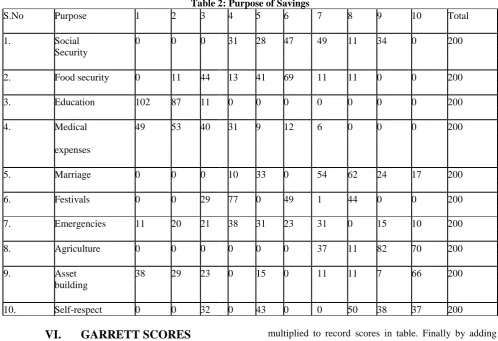
The Researcher has collected the data relating to purpose of savings. To identify the most preferred purpose of savings, the researcher has used Garrett’s ranking method. The below Table 2 shows the result.
Table 2: Purpose of Savings
S.No Purpose 1 2 3 4 5 6 7 8 9 10 Total
1. Social 0 0 0 31 28 47 49 11 34 0 200
Security
2. Food security 0 11 44 13 41 69 11 11 0 0 200
3. Education 102 87 11 0 0 0 0 0 0 0 200
4. Medical 49 53 40 31 9 12 6 0 0 0 200
expenses
5. Marriage 0 0 0 10 33 0 54 62 24 17 200
6. Festivals 0 0 29 77 0 49 1 44 0 0 200
7. Emergencies 11 20 21 38 31 23 31 0 15 10 200
8. Agriculture 0 0 0 0 0 0 37 11 82 70 200
9. Asset 38 29 23 0 15 0 11 11 7 66 200
building
10. Self-respect 0 0 32 0 43 0 0 50 38 37 200
VI.
GARRETT SCORES
The Garrett ranks are calculated by using appropriate Garrett ranking formula. Then based on the Garrett ranks, the Garrett table value is ascertained. The Garrett table values and scores of each rank in table are
multiplied to record scores in table. Finally by adding each row, the total Garrett score is obtained.
Per cent Position = 100 (Rij – 0.5)/Nj
Rji = Rank given for ith item by the jth sample respondents
Nj = Total rank given by the jth sample respondents
Table 3: Calculation of Garret Value
S.No Purpose of SHG (100) Rij-0.5/Nij Garret Value
1. Social security 1-0.5/10= 5 82
2. Food security 2-0.5/10 = 15 70
3. Education 3-0.5/10 = 25 63
Medical Expenses 4-0.5/10 = 35 58
5. Marriage 5-0.5/10 = 45 52
6. Festivals 6-0.5/10 =55 54
7. Emergencies 7-0.5/10 =65 42
88
Copyright © 2018. IJEMR. All Rights Reserved.
9. Asset building 9-0.5/10 =85 30
10. Self-respect 10-0.5/10 =95 18
Source: Calculated value
Table 3 shows the Garret scores. Firstly, the Garret ranks are calculated by using appropriate Garret ranking formula. Then based on the Garret ranks, the garret table value is ascertained.
VII.
CLASSIFICATION ON THE BASIS
OF PURPOSE OF LOAN (AMOUNT)
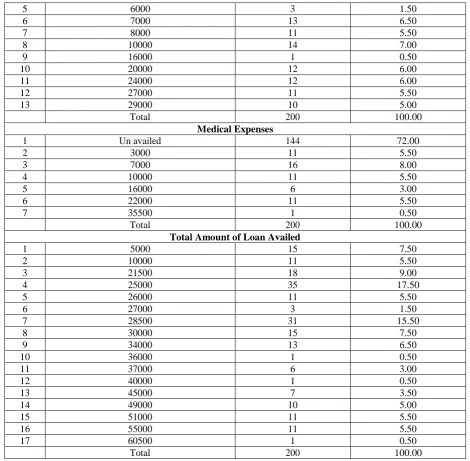
The researcher has also analyzed the purpose of loan and it is shown in the Table
Table 4: Classification on the Basis of Purpose of Loan
S.No Purposes(Amount of Loan Availed) Respondent Per cent
Household Expenses
1 Un availed 141 70.50
2 1000 12 6.00
3 5000 26 13.00
4 6000 20 10.00
5 13000 1 0.50
Total 200 100.00
Agriculture
1 Un availed 200 100.00
Total 200 100.00
Animal husbandry
1 Un availed 200 100.00
Total 200 100.00
Asset Building
1 Un availed 162 81.00
2 7500 20 10.00
3 20000 18 9.00
Total 200 100.00
Emergency/Marriage
1 Un availed 164 82.00
2 10000 19 9.50
3 11500 11 5.50
4 20000 6 3.00
Total 200 100.00
Repayment of Existing Loans
1 Un availed 185 92.50
2 7000 1 0.50
3 9000 3 1.50
4 20000 11 5.50
Total 200 100.00
Other Income Generating Activities
1 Un availed 74 37.00
2 5000 23 11.50
3 12000 11 5.50
4 15000 25 12.50
5 20000 34 17.00
6 30000 15 7.50
7 35000 11 5.50
8 45000 7 3.50
Total 200 100.00
Education
1 Un availed 79 39.50
2 1000 6 3.00
3 1500 18 9.00
89
Copyright © 2018. IJEMR. All Rights Reserved.
5 6000 3 1.50
6 7000 13 6.50
7 8000 11 5.50
8 10000 14 7.00
9 16000 1 0.50
10 20000 12 6.00
11 24000 12 6.00
12 27000 11 5.50
13 29000 10 5.00
Total 200 100.00
Medical Expenses
1 Un availed 144 72.00
2 3000 11 5.50
3 7000 16 8.00
4 10000 11 5.50
5 16000 6 3.00
6 22000 11 5.50
7 35500 1 0.50
Total 200 100.00
Total Amount of Loan Availed
1 5000 15 7.50
2 10000 11 5.50
3 21500 18 9.00
4 25000 35 17.50
5 26000 11 5.50
6 27000 3 1.50
7 28500 31 15.50
8 30000 15 7.50
9 34000 13 6.50
10 36000 1 0.50
11 37000 6 3.00
12 40000 1 0.50
13 45000 7 3.50
14 49000 10 5.00
15 51000 11 5.50
16 55000 11 5.50
17 60500 1 0.50
Total 200 100.00
Source: Primary data
Table 4 observed that out of 200 respondents, 13.00 per cent (26) of the respondents have availed loan of Rs.5,000 to meet out their household expenses, 10.00 per cent (20) of the respondents have availed loan of Rs.7,500 for asset building, 9.50 per cent (19) of the respondents have availed loan of Rs.10,000 for the purpose of meet out emergency/marriage expenses, 5.50 per cent (11) of the respondents have availed loan of Rs.20,000 for the purpose of repayment of existing loan, 17.00 per cent (34) of the respondents have availed loan of Rs.20,000 to generate income, 9.00 per cent (18) of the respondents have availed loan of Rs.1500 in order to meet out educational expenses of their children, 8.00 per cent of the respondents have availed loan of Rs.7,000 for
the purpose of meet out medical expenses and 17.50 per cent (35) of the respondents have availed loan to a maximum of Rs.25000.
It is clear that most (17%) of the respondents have availed loan of Rs.20000 to generate income
VIII. CHANGES ON
SOCIO-ECONOMIC STATUS AFTER AVAILING
CREDIT
Table 5 shows the information about changes on socio-economic status after availing credit and it is shown in the Table 5.
Table 5: Changes on Socio-Economic Status After Availing Credit
S.No Changes Respondents Percentage
90
Copyright © 2018. IJEMR. All Rights Reserved.
Total 200 100.00
Source: Primary data
The above table 5 expressed that among 200 respondents, 100.00 has improved either in the aspects of social or economic or both after availing credit through SHG.
It is evident that majority (100.00%) of the respondents opined that their status has improved either
in the aspects of social or economic or both after availing credit through SHG.
IX.
ECONOMIC PROGRESSION
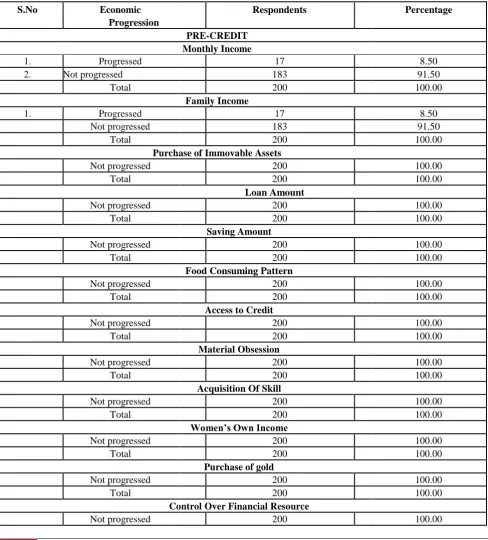
The researcher has investigated the economic progression of the respondents and it is shown in the Table 6
Table 6: Economic Progression
S.No Economic Respondents Percentage
Progression
PRE-CREDIT Monthly Income
1. Progressed 17 8.50
2. Not progressed 183 91.50
Total 200 100.00
Family Income
1. Progressed 17 8.50
Not progressed 183 91.50
Total 200 100.00
Purchase of Immovable Assets
Not progressed 200 100.00
Total 200 100.00
Loan Amount
Not progressed 200 100.00
Total 200 100.00
Saving Amount
Not progressed 200 100.00
Total 200 100.00
Food Consuming Pattern
Not progressed 200 100.00
Total 200 100.00
Access to Credit
Not progressed 200 100.00
Total 200 100.00
Material Obsession
Not progressed 200 100.00
Total 200 100.00
Acquisition Of Skill
Not progressed 200 100.00
Total 200 100.00
Women’s Own Income
Not progressed 200 100.00
Total 200 100.00
Purchase of gold
Not progressed 200 100.00
Total 200 100.00
Control Over Financial Resource
91
Copyright © 2018. IJEMR. All Rights Reserved.
POST-CREDIT Monthly Income
1. Progressed 138 69.00
Not progressed 62 31.00
Total 200 100.00
Family Income
1. Progressed 138 69.00
Not progressed 62 31.00
Total 200 100.00
Purchase of Immovable assets
1. Progressed 55 27.50
Not progressed 145 72.50
Total 200 100.00
Loaning Amount
1. Progressed 200 100.00
Total 200 100.00
Saving Amount
1. Progressed 200 100.00
Total 200 100.00
Food Consuming Pattern
1. Progressed 184 92.00
Not progressed 16 8.00
Total 200 100.00
Access to Credit
1. Progressed 200 100.00
Total 200 100.00
Material Obsession(aspects at home)
1. Progressed 173 86.50
Not progressed 27 13.50
Total 200 100.00
Acquisition of Knowledge
1. Progressed 184 92.00
Not progressed 16 8.00
Total 200 100.00
Women’s Own Income
1. Progressed 151 75.50
Not progressed 49 24.50
Total 200 100.00
Purchase of gold
1. Progressed 132 66.00
Not progressed 68 34.00
Total 200 100.00
Control Over Financial Resource
1. Progressed 184 92.00
Not progressed 16 8.00
Total 200 100.00
Expenditure on Cosmetics (Personality Development)
Not progressed 200 100.00
92
Copyright © 2018. IJEMR. All Rights Reserved.
Total 200 100.00
Expenditure On Cosmetics
1. Progressed 136 68.00
Not progressed 64 32.00
Total 200 100.00
Source: Primary data
Table 6 analysed economic status of the respondents before availing micro-credit, out of 200 respondents, 100.00 per cent (200) of the respondents have not preferred to purchase immovable assets before availing micro-credit, 100.00 per cent (200) of the respondents have not preferred to avail loan, 100.00 per cent (200) of the respondents have not saved any amount before availing micro-credit, 100.00 per cent (200) of the respondents have not preferred loan for having better food consuming pattern, 100.00 per cent (200) of the respondents have not preferred to access credit, 100.00 per cent (200) of the respondents have not preferred pre-credit material obsession, 100.00 per cent (200) of the respondents have not acquired knowledge in the pre-credit period, 100.00 per cent (200) of the respondents did not earn income in the pre-credit period, 100.00 per cent of the respondents have not purchased gold, 100.00 per cent (200) of the respondents did not have control over financial resource, 100.00 per cent (200) of the respondents did not prefer spend on cosmetics.
Economic status of the respondents after availing microcredit is analysed in the table above and it is observed that out of 200 respondents, 100.00 per cent (136) of the respondents have preferred to avail loan, 100.00 per cent (200) of the respondents prefer to save,100.00 per cent (200) of the respondents prefer to access credit, 92.00 per cent (184) of the respondents have control over financial resource, 92.00 per cent (184) of the respondents have interest to acquire knowledge, 92.00 per cent (184) of the respondents show interest on their food consuming pattern, 86.50 per cent (173) of the respondents have preferred for material obsession, 75.50 per cent (151) of the respondents support that women should have income, 72.50 per cent
(145) of the respondents have not preferred to purchase immovable assets, 69.00 per cent (138) of the respondents have monthly income, 69.00 per cent (138) of the respondents have preferred post-credit family income, 68.00 per cent of the respondents prefer to spend on cosmetics and 66.00 per cent (132) of the respondents prefer to invest in gold.
It is clear from the above table that the economic status of the respondents were not progressive before availing micro-credit as 100 per cent of the respondents were not in the condition to purchase immovable assets and gold, did not have access to credit, habit of savings, chance to acquire knowledge, no own income, did not have control over financial resources. But after availing availing micro-credit their economic status has been progressing as they have monthly income, family income, saving habit and control over financial resources.
X.
PAIRED SAMPLE T-TEST
Significant difference between the economic-progression of the respondents before availing credit and the economic-progression of the respondents after availing credit”.
The researcher has analysed the economic-progression of the respondents in the aspects of before and after availing microcredit by applying paired sample T-test.
“There is no significant difference between the economic-progression of the respondents before availing credit and the economic-progression of the respondents after availing credit”.
Table 7: Calculated Value of Economic-progression
S.No Particulars Mean No. of
respondents
Std. Deviation
Std. Error Mean
Sig(2 tailed)
1 Pre-credit 14.8400 200 4.12547 0.29171
0.000
2 Post-credit 23.3750 200 2.71315 2.71315
From the above Table 7, it is expressed that the mean value of economic-progression before availing credit is 14.8400, standard deviation of economic-progression before availing credit is 4.12547 and standard error mean value of economic-progression before availing credit is 0.29171.Mean value of economic-progression after availing credit is 23.3750, standard deviation of economic-progression after availing credit is 2.71315 and standard error mean value of economic-progression after availing credit is 0.19185.It is vivid that the paired sample T-test value
(.000) is less than the acceptable significance value (0.05).
The null hypothesis is rejected. Hence “There is significant difference between the economic-progression of the respondents before availing credit and the economic-progression of the respondents after availing credit”.
93
Copyright © 2018. IJEMR. All Rights Reserved.
1. It is observed from the study that majority (54.0%) of the respondents are under the age group of 36 to 45 years.
2. It is evident that most (50.0%) of the respondents are hindu.
3. It is obvious from the study that majority (82.5%) of the respondents are married.
4. It is disclosed that majority (70.0%) of the respondents are having children between 0 to 2.
5. It is vivid from the analysis that majority (57.00%) of the respondents are literate.
6. It is found that most (37.50%) of the members are having Rs.10000 to 20000 as their family income. 7. It is inferred that (100.00%) of the respondents said that their saving amount has increased after joining SHG.
8. It is inferred that most (13.50%) of the respondents have saved Rs.100 per month after joining SHG.
9. From the Garret Ranking Method, The Respondents ranked the purposes of savings and gave first Rank to social security, second rank to food security, third rank to education, fourth rank to medical expenses, fifth rank to festivals, sixth rank to marriage, seventh rank to emergencies, eighth rank to agriculture, ninth rank to asset building and tenth rank to Self-respect.
10. It is clear that no one has availed loan for the purposes like agriculture and animal husbandry. Most of the respondents (43.50%) have availed loan for educational purpose.
11. It is evident that majority (100.00%) of the respondents opined that their status has improved either in the aspects of social or economic or both after availing credit through SHG.
12. It is clear from the above table that the economic status of the respondents were not progressive before availing micro-credit as 100 per cent of the respondents were not in the condition to purchase immovable assets and gold, did not have access to credit, habit of savings, chance to acquire knowledge, no own income, did not have control over financial resources. But after availing availing micro-credit their economic status has been progressing as they have monthly income, family income, saving habit and control over financial resources 13. Paired sample T-test has been administered to find out the significant difference between economic- progression of the respondents before availing credit and economic-progression of the respondents after availing credit. The test revealed that “there is significant difference between the economic-progression of the respondents before availing credit and the economic-progression of the respondents after availing credit”.
XII.
SUGGESTIONS
1. The researcher suggest the self-help groups to influence the women who are below 35 years of age to join SHG.
2. The beneficiaries of SHG can earn maximum Rs.10000 by investing a small amount. Hence, the Government could increase the subsidy. So that they could develop their business.
3. Except business, the members have availed loan especially for their children’s education especially. Hence the researcher suggests reducing the interest rate for educational loan.
4. Development and awareness programmes should be conducted in the members’ residential origin and thus it enables all the members to take part in the training programme without fail and also motivate the non-members to become non-members of SHG.
5. The government may provide interest free loan for widow and unsupported women.
6. For ensuring women progression, self-help groups must be continued for long period.
XIII.
CONCLUSION
Self-help groups are actively involved in uplifting their members’ living standard and make them capable of providing jobs to others. With the aid of SHGs, women can utilize their potentials with 100%. Exclusively, the SHGs members are somewhat benefitted rather than those who are not members of the same. The study presents that the micro credit has a positive impact on women’s economic progression and the economic status of the respondents after availing credit is increased when compared the same with before availing credit.
REFERENCE
[1] Kamrmarkar K. G. (1999). Rural credit and self help groups, Microfinance needs and concepts in india. New Delhi, India: Sage Publications.
[2] Arti Mudaliar & Ayushi Mathur. (2015). Women empowerment through microfinance. International Journal of Arts, Humanities and Management Studies, 1(2), 58-65.
[3] Bikash Dutta. (2015). Rural development through self help groups: An overview. Indian Journal of
Applied Research, 5(4), 70-78.
[4] Dipit Baghel, & A.K. Shrivastav. (2015). Role of SHG in socio-economic development of rural women: A study on drug district of chattisgarh, International
Journal of Multidisciplinary Management Studies, 5(11),
1-23.
[5] John Agykum Addae. (2015). Effect of microfinance on women’s empowerment: Review of the literature.