White Rose Research Online
[email protected]
Universities of Leeds, Sheffield and York
http://eprints.whiterose.ac.uk/
This is a copy of the final published version of a paper published via gold open access
in Proceedings of the Royal Society A.
This open access article is distributed under the terms of the Creative Commons
Attribution Licence (
http://creativecommons.org/licenses/by/3.0
), which permits
unrestricted use, distribution, and reproduction in any medium, provided the
original work is properly cited.
White Rose Research Online URL for this paper:
http://eprints.whiterose.ac.uk/78780
Published paper
, 20130009, published 24 April 2013
469
2013
Proc. R. Soc. A
Samuel Hawksbee, Colin Smith and Matthew Gilbert
three-dimensional plasticity problems
Application of discontinuity layout optimization to
References
9.full.html#ref-list-1
http://rspa.royalsocietypublishing.org/content/469/2155/2013000
This article cites 21 articles, 1 of which can be accessed free
This article is free to access
Subject collections
(200 articles)
mechanical engineering
(30 articles)
civil engineering
Articles on similar topics can be found in the following collections
Email alerting service
the box at the top right-hand corner of the article or click Receive free email alerts when new articles cite this article - sign up inherehttp://rspa.royalsocietypublishing.org/subscriptions
go to:
Proc. R. Soc. A
rspa.royalsocietypublishing.org
Research
Cite this article:Hawksbee S, Smith C, Gilbert M. 2013 Application of discontinuity layout optimization to three-dimensional plasticity problems. Proc R Soc A 469: 20130009.
http://dx.doi.org/10.1098/rspa.2013.0009
Received: 4 January 2013 Accepted: 28 March 2013
Subject Areas:
civil engineering, mechanical engineering
Keywords:
limit analysis, plasticity, discontinuity layout optimization, three-dimensional analysis
Author for correspondence:
Matthew Gilbert
e-mail: [email protected]
Application of discontinuity
layout optimization to
three-dimensional plasticity
problems
Samuel Hawksbee, Colin Smith and Matthew Gilbert
Department of Civil and Structural Engineering, University of
Sheffield, Mappin Street, Sheffield S1 3JD, UK
A new three-dimensional limit analysis formulation that uses the recently developed discontinuity layout optimization (DLO) procedure is described. With DLO, limit analysis problems are formulated purely in terms of discontinuities, which take the form of polygons when three-dimensional problems are involved. Efficient second-order cone programming techniques can be used to obtain solutions for problems involving Tresca and Mohr–Coulomb yield criteria. This allows traditional ‘upper bound’ translational collapse mechanisms to be identified automatically. A number of simple benchmark problems are considered, demonstrating that good results can be obtained even when coarse numerical discretizations are employed.
1. Introduction
The formal theorems of plastic limit analysis provide the theoretical framework necessary to allow direct evaluation of the load required to cause collapse of a body or structure, without the need for intermediate calculation steps. While early work in the field focused on the development of hand-type limit analysis methods, which are still widely used in engineering practice, more recent research has focused on the development of computational methods, such as finite-element limit
analysis [1–3]. Computational limit analysis methods
have successfully been used to obtain bounds on the collapse load for plane strain problems, providing a rapid and robust means of evaluating safety. However, application of limit analysis techniques to
three-dimensional problems has been more limited.
2
rspa.r
oy
alsociet
ypublishing
.or
g
Pro
c
R
So
c
A
469:
20130009
...
This is unfortunate since engineers are increasingly seeking to model the real three-dimensional geometry of a given problem, rather than a two-dimensional idealization.
Research on three-dimensional problems has focused primarily on exploiting the potential of finite-element limit analysis formulations, making use of optimization techniques to obtain upper or lower bound solutions. The effectiveness of a given formulation is normally closely linked to that of the optimization technique used to obtain solutions, and the yield criterion is key in determining which optimization technique is appropriate for a particular formulation.
Park & Kobayashi [4] were among the first to develop a limit analysis formulation for
three-dimensional problems, referred to as the ‘rigid-plastic finite-element method’. Their approach involved relaxing the flow rule to obtain a direct estimation of the collapse load. Rigid-plastic finite elements have successfully been used to investigate a wide range of metal-forming applications. However, the method appears only to have been applied to von Mises or Drucker– Prager materials, and the solutions obtained do not have clear upper or lower bound status within the context of the fundamental theorems of plastic limit analysis.
Lyamin & Sloan [5,6] proposed a three-dimensional finite-element limit analysis formulation
that used nonlinear programming to obtain solutions. Their formulation could be applied to problems involving any yield function that is everywhere differentiable. However, this precludes direct use of the Mohr–Coulomb yield criterion owing to the singularity that exists at the apex
of the Mohr–Coulomb cone. Consequently, Lyamin & Sloan [5] proposed the use of a hyperbolic
smoothing technique to create an approximated yield surface, differentiable everywhere. More
recently Krabbenhøft et al. [7] and Martin & Makrodimopoulos [8] have used semidefinite
programming (SDP) to create formulations capable of handling the Mohr–Coulomb yield function directly. However, at present SDP algorithms are relatively immature, limiting the size of problems that can be solved.
Chen et al.[9] used fully rigid finite elements to obtain upper bound solutions for three-dimensional slope stability problems. A distinguishing feature of their formulation is that, since the elements themselves are not free to deform, deformations can only take place along discontinuities lying at predefined element boundaries. An advantage of this approach is that the form of the critical failure mechanism is clear, aiding interpretation by engineers. However, a major disadvantage is that the topology of the finite-element mesh used will often have a major influence on the form of the mechanism identified, which may be very different in form to the true critical mechanism. A principal aim of the research described in the present paper was to develop a method that overcomes this obvious drawback, allowing a much wider range of failure mechanisms to be modelled, and without having to turn to SDP algorithms to obtain a solution. The development of such a method is described, and its efficacy demonstrated through application to various benchmark problems considered in the literature.
2. Solution of three-dimensional rigid finite-element problems
The three-dimensional rigid finite-element (or ‘rigid block’) method applied to Mohr–Coulomb
materials by Chen et al. [9] used quadratic programming to obtain solutions. However, such
a problem can alternatively be recast as a second-order cone programming (SOCP) problem. Optimization problems taking this form can be efficiently be handled by modern interior-point
algorithms, similar to those used to solve linear programming problems [10].
To explain how this is achieved, it is convenient to use an orthogonal coordinate system
local to each discontinuity, comprising axes n, s and t, where n is a unit vector normal to
the discontinuity and s andt are unit vectors in the plane of the discontinuity. Considering
translational mechanisms, the Mohr–Coulomb yield criterion can now be enforced for stress resultants acting on the plane of the discontinuity by equations (2.1) and (2.2)
3
rspa.r
oy
alsociet
ypublishing
.or
g
Pro
c
R
So
c
A
469:
[image:5.493.90.400.40.232.2]20130009
...
N
S T P
p
n
S T
P
N
S T N
(a) (b)
P
Figure 1.Mohr–Coulomb yield criteria: (a) yielding discontinuity between two rigid blocks showing normal forceN, resultant shear forcePand its componentsSandT; (b) conic yield surface whereNˆis the normal axis (tension positive) andˆSandTˆ
are orthogonal shear axes. The displacement jump orthogonal to the yield surface is shown, wherenandpare the normal displacement and shear plastic multiplier, respectively.
and
P=S2+T2, (2.2)
wherecandφare the material cohesion and angle of shearing resistance andais the face area
of the discontinuity. HereN,S andT denote the normal force and shear traction components
along then,sandtaxes, respectively, andPis the maximum shear traction on the discontinuity,
as indicated infigure 1. Similarly, the associative flow rule for a Mohr–Coulomb material can be
expressed by equations (2.3) and (2.4)
ptanφ−n=0 (2.3)
and
p≥s2+t2, (2.4)
where n, s andt denote the component of the relative jump in displacement rate across the
discontinuity in then,sandtdirections, respectively, andpis a plastic multiplier, as indicated in
figure 1. (Note that henceforth, ‘energy dissipation’ and ‘displacement’ will be used as shorthand for ‘rate of energy dissipation’ and ‘rate of displacement’, respectively.) Using equation (2.4), it is now possible to formulate the problem as an SOCP problem.
In the formulation outlined earlier, individual three-dimensional elements of material are rigid, and not free to deform. It therefore seems natural to use a formulation where the problem is posed entirely in terms of discontinuities. The discontinuity layout optimization (DLO)
procedure, outlined for two-dimensional plane plasticity problems by Smith & Gilbert [11], is
posed entirely in terms of discontinuities, and its potential application to three-dimensional problems is therefore considered here. An advantage of DLO is that it can inherently model singularities, such as those that exist at the edge or corner of an indentor or foundation footing. Conversely, finite elements, both rigid and deformable, generally require refinement
of the mesh in the regions of singularities [12], or alternatively the use of higher order shape
functions [13] in order to obtain reasonable results. The aim of this paper is to develop a
4
rspa.r
oy
alsociet
ypublishing
.or
g
Pro
c
R
So
c
A
469:
20130009
...
3. Discontinuity layout optimization
(a) Background
DLO is a direct limit analysis method, which means that it can directly provide an estimate of the maximum load sustainable by a solid body, without intermediate calculation steps. DLO can be used to generate upper bound plasticity solutions and associated collapse mechanisms.
The DLO procedure for plane strain problems is outlined in figure 2. Firstly, the initial
problem is discretized using nodes distributed across the body under consideration. Potential
discontinuity lines (e.g. ‘slip-lines’), along which jumps in displacements d can occur, are set
up by linking each node to every other node, and optimization is used to identify the subset of discontinuities active in the critical failure mechanism. Provided a sufficiently large number of nodes are employed, this allows a very wide range of potential mechanisms to be considered.
For plane strain problems, the corresponding optimization problem is given in equations (3.1)– (3.5), posed entirely in terms of potential discontinuities [11],
minλfTLd= −fTDd+gTp, (3.1)
subject to
Bd=0, (3.2)
Np−d=0, (3.3)
fTLd=1 (3.4)
and p≥0. (3.5)
In equation (3.2), compatibility is enforced explicitly at each node via a suitable compatibility
matrixBcontaining direction cosines. Equation (3.3) enforces the flow rule on each discontinuity
by introducing a vector of plastic multiplierspand a suitable flow matrixN, while equation (3.4)
ensures the work done by the live loads (fL) equals unity (where here the term ‘live loads’ is taken
to encompass all loads that are to be varied as part of the optimization process). Equation (3.1) is
the objective function, where the goal is to obtain the minimum load factorλby minimizing the
work done by dead loads (fD) and internal plastic energy dissipationgTp(wheregcontains the
corresponding dissipation coefficients).
Linear programming is then used to obtain the minimum value ofλ, seeking the optimal values
of the problem variables indandp. The critical subset of potential discontinuities, defining the
critical mechanism, is also identified, as indicated infigure 2d.
In this formulation, various intersections between discontinuities (or ‘crossover points’) occur throughout the problem domain. However, the displacement along each discontinuity remains unchanged either side of a ‘crossover point’, and hence compatibility is inherently maintained.
(b) Three-dimensional formulation
In the following sections a three-dimensional formulation is developed, using a three-dimensional grid of nodes and polygonal discontinuities. While any simple polygonal shape, or combination of simple polygonal shapes, may be used for the discontinuities, triangular discontinuities provide the most flexibility and will be used in the numerical examples. However, for the sake of clarity when describing the method, discontinuities of both rectangular and triangular shape will
be used. In general, when using triangular discontinuities there will be a total ofn(n−1)(n−2)/6
potential discontinuities, wherenis the total number of nodes used to discretize the problem (cf.
a total ofn(n−1)/2 potential line discontinuities in a plane strain problem). As with plane strain
5
rspa.r
oy
alsociet
ypublishing
.or
g
Pro
c
R
So
c
A
469:
[image:7.493.81.417.201.350.2]20130009
...
(a) (b) (c) (d)
Figure 2.Stages in DLO procedure, after [14]: (a) starting problem (surcharge applied to block of material close to a vertical edge); (b) discretization of domain using nodes; (c) interconnection of nodes with potential discontinuities; (d) identification of critical subset of potential discontinuities using optimization (giving the layout of slip-lines in the critical failure mechanism).
nD
nE nE
nD
nC nB
nA nA
nB nC
O A
B
C
D E
A¢
D¢ E¢
C¢
(a)
vDE vEA
vAB
vBC
vCD (b)
Figure 3.Solid bodies meeting at a common edge, (a) prior to, and (b) after movement, with prisms separated by discontinuities
−−→
OOXX, whereX=A,B. . .E. For clarity,Ohas not been shown, but lies in the planeABCDE.
(i) Compatibility
In plane strain DLO, compatibility is enforced at nodes. In three-dimensional DLO, compatibility
is conveniently enforced along shared edges.Figure 3shows a set of triangular prisms sharing
a common edge OO and with absolute displacements,vAB tovEA. The prisms are separated
by rectangular discontinuities OOXX, whereX=A, B. . .E. Each discontinuity OOXX has
a normal nX and a relative displacement jump vX that denotes the difference in absolute
displacement of the prisms meeting at this discontinuity. It follows from this definition that
equation (3.6), which involves summing all relative displacement jumps around edgeOO, must
hold
(vEA−vAB)+(vAB−vBC)+(vBC−vCD)+(vCD−vDE)+(vDE−vEA)=0. (3.6)
A sign convention for determining the directions ofnAtonEandvAtovEis presented in
appendix A. Using this sign convention and the vertex ordering infigure 3b, the following must
also be true along edgeOO:
vA+vB+vC+vD+vE=0. (3.7)
Compatibility can be similarly enforced along the remaining edges, using the sign convention given in appendix B. Moreover, equation (3.7) can be reformulated for each edge. Before
proceeding, it is first necessary to use coordinate systems local to each discontinuityi
6
rspa.r
oy
alsociet
ypublishing
.or
g
Pro
c
R
So
c
A
469:
[image:8.493.57.441.61.222.2]20130009
...
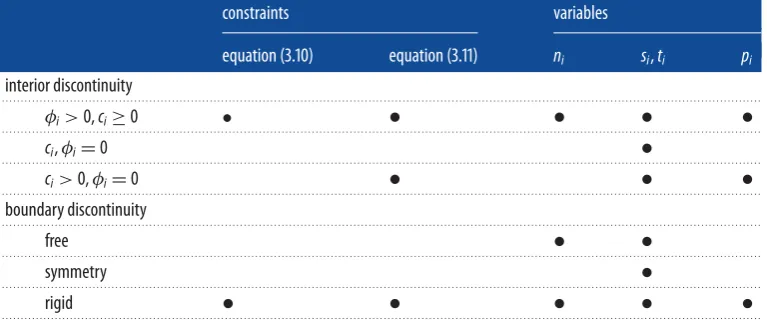
Table 1.Discontinuity flow rule conditions: applicable constraints and variables.
constraints variables
equation (3.10) equation (3.11) ni si,ti pi
interior discontinuity
. . . .
φi>0,ci≥0 •
•
•
•
•
. . . .
ci,φi=0
•
. . . .
ci>0,φi=0
•
•
•
. . . .
boundary discontinuity
. . . .
free
•
•
. . . .
symmetry
•
. . . .
rigid
•
•
•
•
•
. . . .
where Ti is a 3×3 transformation matrix converting local to global displacement jumps. Ti
is chosen such that one axis aligns with ni, the unit column vector in the normal direction
using the ‘right-hand screw rule’; the two remaining orthogonal axes,siandti, are in the plane
of discontinuity i such thatTi= {nisiti}. Alsodi= {nisiti}T, where ni, si and ti are the local
displacement jumps across discontinuityiin theni,siandtidirections, respectively. Compatibility can now be enforced for each edgej(j=1, 2,. . .,l) as follows:
i∈Sj
Bijdi=0, (3.9)
where Sj is a subset of the total number of discontinuitiesmthat contains the discontinuities
meeting at edgej, andBijis a local compatibility matrix equal tokijTi, wherekij is defined in
appendix B.
The DLO procedure results in intersections and overlaps between discontinuities that do not coincide with nodal connections; however, compatibility at these is enforced implicitly, as demonstrated in appendix C.
(ii) Flow rule
The local coordinate system described allows the associative flow rule for a Mohr–Coulomb material to be enforced using equations (2.3) and (2.4). Taking advantage of SOCP, the flow rule
on a discontinuityican be restated as follows:
pitanφi−ni=0 (3.10)
and
pi≥
s2
i +t2i, (3.11)
where pi is a plastic multiplier and where φi is the angle of friction on discontinuity i.
Equation (3.10) is a linear constraint and equation (3.11) is a second-order cone. In matrix form, equation (3.10) can be stated as follows:
Np−dn=0, (3.12)
wherednis a subset ofdcontaining only the displacement jumps normal to discontinuitiesi(i=
1,. . .,m),p is a global vector containing plastic multipliers andm is now the total number of
discontinuities in the problem.N is a globalm×m matrix enforcing the flow rule and equal
to diag(tanφ1, tanφ2,. . ., tanφm). However, depending on the material properties, it may not be
7
rspa.r
oy
alsociet
ypublishing
.or
g
Pro
c
R
So
c
A
469:
20130009
...
(iii) Dissipation function
The energy dissipated on a given discontinuity i is given by gipi, where gi is a dissipation
coefficient equal toicda, the integral of the cohesive strength over the areaaof discontinuityi.
In the case of uniform cohesive strength across discontinuityi, the dissipation coefficientgi=aici,
whereaiandciare, respectively, the area and cohesion of the discontinuity.
On overlapping regions, the upper bound status of the solution is maintained, as demonstrated in appendix C.
(c) Mathematical formulation
A three-dimensional kinematic formulation for a cohesive-frictional body discretized using m
polygonal discontinuities andledges can be summarized as follows:
minλfTLd= −fTDd+gTp, (3.13)
subject to
Bd=0, (3.14)
Np−dn=0, (3.15)
fTLd=1 (3.16)
and pi≥
s2
i +t2i ∀i∈ {1,. . .,m}, (3.17)
wherefD andfL are vectors containing, respectively, the specified dead and live loads. Hered
contains displacement jumps across the discontinuities,dT= {n1,s1,t1,n2,s2,t2,. . .,tm}, whereni
is the displacement jump normal to discontinuityi,siandtiare the displacement jumps within
the plane of discontinuityiandgis a vector of dissipation coefficients. HereBis a suitable 3l×3m
compatibility matrix,Nis a suitablem×mflow matrix anddn(a subset ofd) is a vector containing
the normal displacement jumps,dTn= {n1,n2,. . .,nm}. Alsop is a vector of plastic multipliers,
pT= {p1,p2,. . .,pm}, wherepiis the plastic multiplier for discontinuityigiven by equation (3.17).
The optimization variables are the displacement jumps ind(anddn) and the plastic multipliers
inp. The objective function and the first three constraints are linear. The final constraints on the
plastic multipliers pi are second-order cones, so that the formulation is amenable to solution
using SOCP. The problem can also be posed in an equilibrium form, established using duality principles [15].
(d) Boundary conditions and loads
Many common boundary conditions can readily be modelled simply by using a reduced number
of variables and constraints, as indicated in the second half oftable 1. This for example shows that
a discontinuity on a rigid boundary is dealt with in exactly the same manner as a discontinuity in the interior of a domain.
Dead and live loads fTD and fTL in equations (3.13) and (3.16) are now defined such that
fTD= {fn
D1,fD1s ,fD1t ,fD2n ,. . .,fDtm}andfTL= {fLn1,fLs1,fL1t ,fL2n,. . .,fLtm}, wherefDni,fDsi,fDtiandfLni,fLsi,fLti
are, respectively, the dead and live loads acting in theni,siandtidirections on discontinuityi.
Areas of flexible loading can be applied directly to the discontinuities with no special treatment. Rigid loads can be applied using a discontinuity covering the whole loaded area and reducing the degrees of freedom of underlying discontinuities appropriately.
At an external boundary, after taking account of any overlapping regions, displacement jumps
must equal the absolute displacement of that boundary. HencefDi andfLiare simply the local
dead and live loads, respectively, on discontinuity i, resolved in the direction defined by the
local coordinate system when applied at boundary discontinuityi. For discontinuities within a
body, the contents offDi andfLi can be obtained by summing up the total overlying dead or
8
rspa.r
oy
alsociet
ypublishing
.or
g
Pro
c
R
So
c
A
469:
20130009
...
self weight only, and assuming this is applied in the negativezdirection, the contribution to the
summation made by discontinuityiis as follows:
fTDidi=Widi, (3.18)
whereWiis a 1×3 row vector containing the components in theni,siandtidirections of the total
weight of the column lying vertically above discontinuityi.
(e) Summary of procedure
Steps in the DLO procedure for three-dimensional problems can be summarized as follows:
— discretize the problem using nodes; — connect nodes to create edges;
— join edges to create polygonal discontinuities; — set-up problem, using equations (3.13)–(3.17); and — solve the resulting SOCP problem.
4. Numerical examples
To evaluate the potential of the method, various three-dimensional examples are now considered. Unless stated otherwise, all computations were performed using a workstation equipped with 2.6 GHz AMD Opteron 6140 processors, 8 GB RAM and running 64 bit Scientific Linux.
The MOSEKinterior-point solver with SOCP capability was used [16]. The default settings of
the optimizer were used, including the pre-solve feature. The CPU times reported are for the optimizer only, including the time taken for the pre-solve routine to execute, but excluding the time taken to read in and set up a given problem.
Prior to solving, various measures were taken to condition and/or reduce the size of a given problem. Firstly, the coefficients in the objective function (3.13) and unit displacement constraint (3.16) were scaled as necessary to ensure the problem was well posed. Secondly, as overlapping edges do not provide any extra degrees of freedom, these were removed. Thirdly, discontinuities covering areas that could be reconstructed by combining several discontinuities covering smaller areas were removed. Fourthly, noting that the formulation naturally results in
3(n−1) linear dependencies in the constraint matrix, wherenis the total number of nodes, such
linear dependencies were identified and removed prior to passing the problem to the optimizer. Lastly, while the basic DLO procedure involves positioning nodes on a Cartesian grid, the use of other nodal arrangements is possible, and, where clearly indicated, regular grids with differing
x,yandzspacings are used in this paper. However, it should be noted that an adaptive solution
procedure capable of dramatically reducing problem size (e.g. of the sort described in [11] for
plane strain problems) was not used in the numerical studies described herein. Thus the size of a problem increases rapidly as nodal resolution is increased, and consequently only relatively small problems are considered here.
(a) Compression of a block
The unconfined compression of a square block with shear strength parametersc,φbetween two
perfectly rough rigid platens has previously been considered by Martin & Makrodimopoulos
[8], who have obtained upper and lower bound solutions for this problem. This problem will
therefore be used as a benchmark for the proposed three-dimensional DLO procedure. For the
geometry shown infigure 4, the objective is to find the ratio of the average bearing pressureqto
cohesive shear strengthc.
Symmetry means that only 1/16 of the block needs to be modelled, as indicated infigure 4.
Nodes were initially positioned on a Cartesian grid (i.e. equal nodal spacings in thex,yandz
9
rspa.r
oy
alsociet
ypublishing
.or
g
Pro
c
R
So
c
A
469:
[image:11.493.56.439.277.376.2]20130009
...
2
2 1
z
x y
Dz
Dy
Dx
Figure 4.Compression of a block: problem geometry, nodal spacings (x,yandz) and the 1/16 of the volume modelled, owing to symmetry.
Table 2.Compression of a block: comparison with benchmark solutions. Upper bound (UB) solutions from Martin & Makrodimopoulos [8] have been used to benchmark the present solutions, and their lower bound (LB) solutions are also listed for information;=x=y=z.
benchmark discontinuities
φ(◦) UB LB spacing total no. active (%) solution difference (%) CPU (s)
0 2.305 2.230 41 7704 2.7 2.319 0.60 12
. . . .
1
6 117 936 2.7 2.314 0.39 9700
. . . .
30 10.06 8.352 1
4 7704 10 12.48 18 2.0
. . . .
1
6 117 936 4.0 11.69 10 5000
. . . .
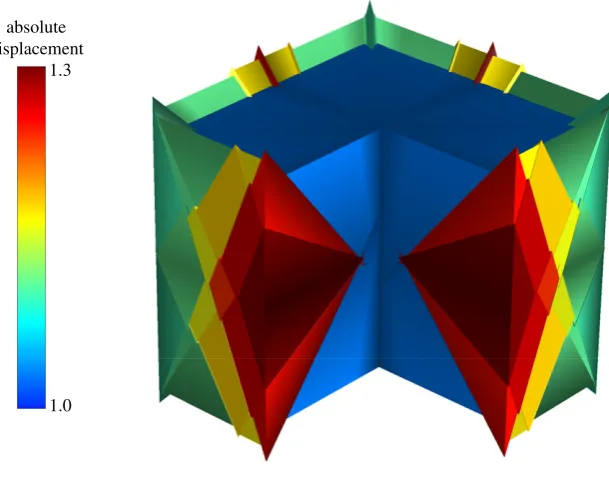
For φ=0◦, the best new solution presented is close (within 0.39%) to the benchmark upper
bound solutions of Martin & Makrodimopoulos [8]. A representative collapse mechanism is
shown infigure 5. In the case ofφ=30◦, the best new solution compares less favourably with
the benchmark (difference 10%).
Noting that the active discontinuities infigure 5radiate from the centre, it is of interest to
investigate the effect of using different nodal spacings in thexdirection compared with those
in theyandzdirections. Results for theφ=0◦case for various nodal spacings are presented in
table 3.
Firstly, it is evident that a solution matching the best reported value of 2.314 presented previously could be obtained in only 0.22 s, compared with 9700 s previously. This is because only a small subset of the discontinuities present previously are now included. Secondly, it is evident that it has been possible to improve on the benchmark upper bound solution (the best DLO solution of 2.304 is slightly less than the value of 2.305 obtained by Martin &
Makrodimopoulos [8]).
(b) Punch indentation
The bearing capacity of a perfectly rough square indenter resting on the surface of a purely
cohesive Tresca material is now considered. The value of interest is once again the ratio q/c,
otherwise known as the bearing capacity factorNc. Salgadoet al.[17] have established upper and
lower bounds for a variety of indenter embedment depths and geometries using finite-element
limit analysis. Gourvenec et al.[18] have modified the upper bound mechanism proposed by
10
rspa.r
oy
alsociet
ypublishing
.or
g
Pro
c
R
So
c
A
469:
[image:12.493.96.401.42.282.2] [image:12.493.55.443.356.470.2]20130009
...
absolute displacement
1.3
1.0
Figure 5.Compression of a block: typical failure mechanism forφ=0 case (x,y,z=14).
Table 3.Compression of a block: use of different nodal grid spacings. Upper bound (UB) solutions from Martin & Makrodimopoulos [8] have been used to benchmark the present solutions, and their lower bound (LB) solutions are also listed for information;x=1.
benchmark discontinuities
φ(◦) UB LB spacingy,z total no. active (%) solution difference (%) CPU (s)
0 2.305 2.230 14 356 29 2.319 0.60 0.04
. . . .
1
6 1500 30 2.314 0.39 0.22
. . . .
1
8 4452 26 2.309 0.18 1.9
. . . .
1
12 23 100 21 2.307 0.072 50
. . . .
1
18 133 884 16 2.304 −0.043 1800
. . . .
Table 4.Punch indentation: comparison with benchmark solutions. Upper bound (UB) solutions from Vicenta da Silva & Antão [21] have been used to benchmark the present solutions, and lower bound (LB) solutions from Salgadoet al. [17] are also listed for information.
benchmark discontinuities
UB LB spacing total no. active (%) solution difference (%) CPU (s)
6.051 5.52 12 157 17 6.521 7.8 0.02
. . . .
1
4 7365 4.6 6.405 5.9 13
. . . .
1
6 114 310 1.6 6.226 2.9 6400
. . . .
[20] and Vicente da Silva & Antão [21] have also established upper bounds for a number of
indenter geometries bearing onto the material surface. The best reported upper and lower bounds
for a square indenter are included intable 4.
The problem geometry used is shown infigure 6. While both Michalowski [20] and Gourvenec
11
rspa.r
oy
alsociet
ypublishing
.or
g
Pro
c
R
So
c
A
469:
[image:13.493.135.360.42.171.2] [image:13.493.90.409.221.402.2]20130009
...
1
1
2 2
1 2
z
x y
D D
D
Figure 6.Punch indentation: problem geometry, nodal spacing, and the 1/8 of the volume modelled, owing to symmetry.
absolute displacement
1.0
0.2 0
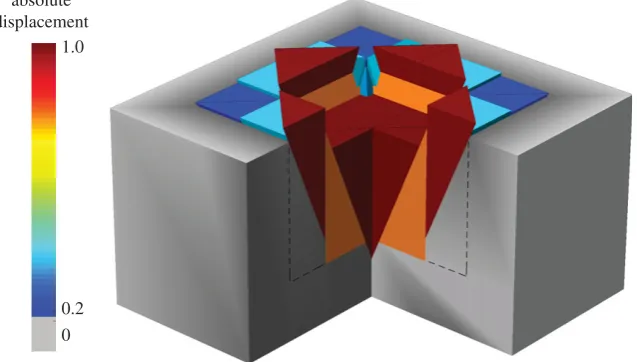
Figure 7.Punch indentation: representative failure mechanism (=1/2,φ=0) (dashed lines indicate extent of domain modelled).
bound solutions, owing to Vicente da Silva & Antão [21] and Salgadoet al.[17], respectively, have taken advantage of the four planes of symmetry inherent in the problem geometry. Therefore, only
1/8 of the problem has been modelled, as indicated infigure 6.Table 4presents new solutions for
three nodal spacings, with all nodes positioned on a Cartesian grid (i.e. equal nodal spacings
in thex,yandzdirections). These solutions compare well with the best reported upper bound,
especially considering the comparatively low nodal resolutions employed. Also, following the initial study, access to a workstation with 16 GB RAM allowed consideration of a finer numerical
discretization (with=1/8), resulting in an improvedNc=6.102 (difference 0.84%).
A representative failure mechanism is shown infigure 7. It should be noted that the critical
mechanisms for all three nodal grids extend up to the fixed boundaries. However, extending the problem domain relative to the foundation quickly leads to impractically large problem sizes, so this issue was not investigated further.
(c) Anchor in a purely cohesive soil (
φ
=
0)
Consider a perfectly rough anchor of widthBembedded at a depthHin a purely cohesive Tresca
soil, as shown infigure 8. Immediate breakaway (i.e. no suction or transmission of tensile stresses)
12
rspa.r
oy
alsociet
ypublishing
.or
g
Pro
c
R
So
c
A
469:
[image:14.493.134.364.42.212.2]20130009
...
B
B
Dx Dy
Dz z
x y
W
W H
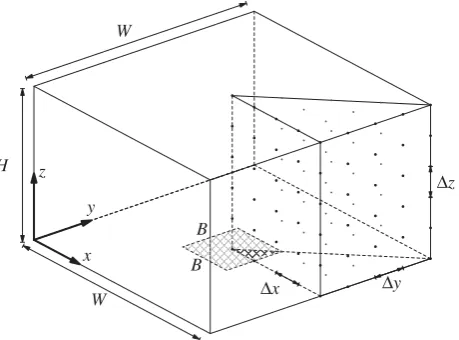
Figure 8.Anchor: problem geometry, nodal spacings (x,yandz) and the 1/8 of the volume modelled, owing to symmetry.
problem needs to be modelled, as shown infigure 8. VariousH/Bratios have been considered by
fixingB=2,W=10,x=y=1,z=H/4 and varyingH.
Merifieldet al.[22] used a lower bound finite-element limit analysis procedure to establish
bounds on the break-out factor at various embedment depths. The break-out factorNc0 for an
anchor in a weightless cohesive soil is defined as average bearing pressureq divided by the
cohesive strengthc. For a soil with unit weightγ, Merifieldet al.[22] defined the break-out factor
Ncγ as
Ncγ=Nc0+γH
c . (4.1)
Failure mechanisms can be classified as ‘shallow’, where the failure mechanism extends up from the anchor to the soil surface, and ‘deep’, where the mechanism involves only localized
deformations around the anchor, and where the break-out factor Nc∗ is independent of the
embedment depthH. For a given ratioγ /c, the deep mechanism becomes critical at depths greater
than or equal toHcr. If both deep and shallow mechanisms are considered,Ncγ must be less than
or equal toNc∗. Merifieldet al.[22] established a lower bound onNc∗≈11.9. Forγ /c=0, Merifield
et al.[22] foundHcr≈7.
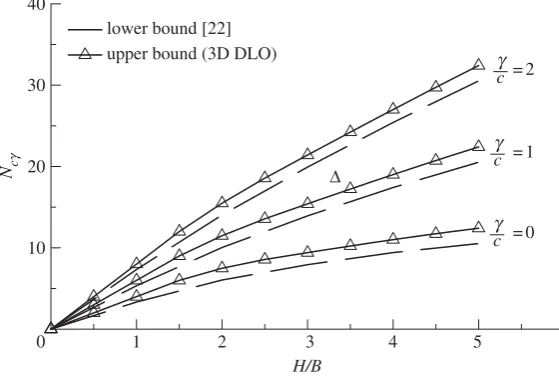
Figure 9 shows break-out factors for shallow failures at various embedment depths. These
show good agreement with those reported by Merifieldet al. [22] whenγ /c=0 and H<Hcr.
Furthermore, the results forγ /c=1 andγ /c=2 are consistent with the relationship described
in equation (4.1). The mechanisms developed did not extend to the lateral fixed boundary,
suggesting thatNcandNcγ were not influenced by the extent of the domain modelled.
(d) Anchor in a purely frictional soil
Now consider a perfectly rough anchor of widthBembedded at depthHin a purely frictional
soil with an angle of shearing resistanceφ=30◦and a unit self weightγ. Assuming an associative
flow rule, only mechanisms that extend to the surface are possible. The break-out factorNγ in this
case can be expressed as
Nγ =γq
H (4.2)
whereqis the average pressure on the anchor. Merifieldet al.[23] used a lower bound
finite-element analysis procedure to establish bounds on the break-out factor for various angles of
13
rspa.r
oy
alsociet
ypublishing
.or
g
Pro
c
R
So
c
A
469:
[image:15.493.105.385.45.235.2] [image:15.493.106.387.274.474.2]20130009
...
Nc
g
H/B
0 1 2 3 4 5 6
10 20 30 40
c =2
D
g
cg =1
c =0 g lower bound [22]
upper bound (3D DLO)
Figure 9.Anchor: cohesive soil break-out factors.
Ng
0 10 20
H/B
upper bound f=30°[24] lower bound f=30° [23]
upper bound f=30° (3D DLO GRID 1) upper bound f=30° (3D DLO GRID 2)
1 2 3 4 5 6
Figure 10.Anchor: frictional soil break-out factors using nodal grids GRID 1 and GRID 2.
given in equation (4.3), obtained by assuming a simple rigid block mechanism,
Nγ=1+H
B tanφ
2+π
3Htanφ
. (4.3)
Using nodal grids of the form shown in figure 8and fixing B=2,W=10,x=y=1,z=
H/4 (denoted GRID 1) and varying H, a very close fit to equation (4.3) has been found for
0.5≤H/B≤2.5 (figure 10). Above this range, the mechanism reaches the lateral fixed boundary
and no solution was obtained. The critical mechanism is relatively simple, and very similar results
can be obtained using an alternative grid, whereB=2,W=16,x=y=1,z=H (denoted
GRID 2). GRID 2 also has been used to determineNγ for 2.5<H/B≤5, which also compare well
14
rspa.r
oy
alsociet
ypublishing
.or
g
Pro
c
R
So
c
A
469:
20130009
...
5. Discussion
As can be seen in §4, the three-dimensional DLO procedure is capable of obtaining results comparable with those found in the literature. Also in one case an improved upper bound solution was found. A key benefit of the procedure is that it can automatically identify traditional ‘upper bound’ mechanisms, obviating the need for these to be found manually, as has hitherto been necessary. Such mechanisms are generally easy to visualize and can be checked by hand if required. Thus, a potentially useful application of the method is in helping designers identify critical mechanisms for subsequent use in hand calculations. While only translational mechanisms are currently identified, experience gained applying plane strain DLO to practical problems has indicated that solutions of acceptable accuracy for engineering purposes can often be obtained, even for problems where rotational modes are critical. Additionally, mechanisms that include continuous deformations can be captured by using high concentrations of active discontinuities.
However, refining the nodal grid even slightly leads to a large increase in the number of potential discontinuities, which means that problems can quickly become impractically large using currently available computational power. Thus enhancements to improve performance are required. One potential approach is to implement an adaptive solution procedure, similar to that
proposed for plane strain problems by Smith & Gilbert [11]. With the latter procedure a subset
of the total number of potential discontinuities is used in the initial optimization. The solution is then assessed, and discontinuities deemed most likely to improve it are added. A further optimization is then performed and the process repeated until a rigorous termination criterion is met, ensuring that the numerical solution is the same as would have been obtained had all potential discontinuities been included in the optimization at the outset. For all problems considered in this paper, the percentage of discontinuities with non-zero displacements was small, suggesting that a similar adaptive solution procedure might be effective, ensuring that the number of discontinuities modelled in the optimization problem is kept to a minimum. Developing such a procedure is therefore a topic for future research.
6. Conclusions
— A new three-dimensional plasticity formulation has been described. The formulation uses the DLO procedure to directly identify critical translational collapse mechanisms. Planar triangular discontinuities, which interconnect nodes distributed across the domain, are employed and SOCP is used to identify the optimal subset of discontinuities, which define the geometry of the collapse mechanism.
— A key benefit of the DLO procedure is that it can automatically identify traditional ‘upper bound’ collapse mechanisms, obviating the need for these to be found manually, as has hitherto been necessary.
— Despite the use of comparatively coarse nodal discretizations, reasonably good correlation with literature benchmark solutions has been observed. Furthermore, the best upper bound solution for the compression of a purely cohesive block between two perfectly rough platens problem reported in the literature has been improved upon. — The use of an adaptive solution procedure, similar to that successfully used in plane strain
DLO, is likely to allow finer nodal discretizations to be treated. This has therefore been identified as a topic for future research.
Appendix A. Sign convention
In DLO, the optimization problem is formulated purely in terms of displacement jumps across a set of potential discontinuities. This requires a consistent sign convention to be adopted.
Figure 11ashows two triangular prisms separated by a discontinuityABCmoving with absolute
15
rspa.r
oy
alsociet
ypublishing
.or
g
Pro
c
R
So
c
A
469:
[image:17.493.107.389.41.163.2]20130009
...
v2
v1
A
B C
(a)
n
A
B C
(b)
n
A
B C
(c)
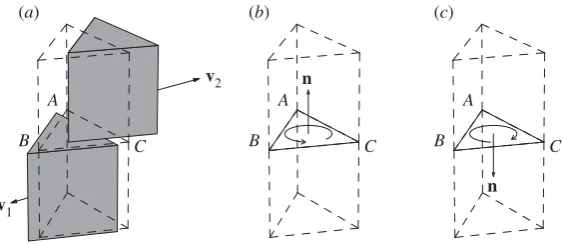
Figure 11.Sign convention: (a) two triangular prisms separated by a discontinuityABC, the dashed outline shows the original positions of the prisms; (b) discontinuity vertex ordering−→ABC; (c) discontinuity vertex ordering−ACB→.
must equal either v1−v2 orv2−v1. Using the ‘right-hand screw rule’, the normaln to the
discontinuity can be determined for a particular ordering of the vertices, as demonstrated in
figure 11b,cfor discontinuityABC.vABCis simply defined asv+−v−, wherev+andv−are the
velocities of the blocks on thenpositive andnnegative sides of the discontinuity, respectively,
for the chosen ordering of the vertices.
Appendix B. Convention for selecting the vertex ordering parameter
k
ij
A sign convention is necessary for equations (3.7) and (3.9) to be valid along edge j (where
j=1, 2,. . .,land wherelis the total number of edges used to discretize the problem). Taking
account of the sign convention, these equations can be rewritten as follows:
i∈Sj
kijvi=0 (B 1)
and
i∈Sj
kijTidi=
i∈Sj
Bijdi=0, (B 2)
whereSjis the subset of all discontinuities meeting at edgej.kij= ±1 depends on the relative
vertex orderings of discontinuityiand edgej.
Each discontinuityi(i=1, 2,. . .,m) is defined by a subsetDiof the total nodesn, wheremis the
total number of discontinuities andDicontains the vertices of discontinuityi. Discontinuityihas a
boundary formed by a subsetKiof the total number of edgesl. Each edgej(j=1, 2,. . .,l) is defined
by subsetEjof the total nodesn, whereEjcontains the two vertices of edgej. The following is
a suitable convention for selectingkijfor all edgesj(j=1, 2,. . .,m) and all discontinuitiesi(i=
1, 2,. . .,m).
(i) For each discontinuityi(i=1, 2,. . .,m), define a positive ordering of the vertices inDi.
The two vertices of each edgej(j∈Ki) must be adjacent in this ordering. The ordering
defined is cyclical (i.e. the first vertex is adjacent to the last) and is also used to defineni
(see appendix A).
(ii) For each edgej(j=1, 2,. . .,l), define a particular ordering of the verticesEjas positive.
(iii) For each edgej(j=1, 2,. . .,l) and discontinuityi(i∈Sj) with common vertices{X,Y} =
Di∩Ej, compare the orderings ofXandYin the positive orderings ofEjandDidefined
in (i) and (ii), respectively, noting that the ordering ofDiin (i) is cyclical. If these orderings
16
rspa.r
oy
alsociet
ypublishing
.or
g
Pro
c
R
So
c
A
469:
20130009
...
D C
B
A
E F G
H
(a)
D C
B
A
E F G
H
I3 I4 I5
I1 I2 I6
(b)
Figure 12.Crossovers: (a) discontinuity−→ABCD, displacement jumpvABCD, intersecting discontinuity−→EFGH, displacement jump
vEFGH; (b)−→ABCDsplit into−−→ABI2I1and−−→I1I2CD, both with a displacement jumpvABCD;−→EFGHsplit into−−→I1I2I6I5,−−→I3I4I2I1,−−−→EI3I1I5Hand
−−−→
I4FGI6I2, all with a displacement jumpvEFGH.
Appendix C. Crossovers and overlaps
(a) Crossovers
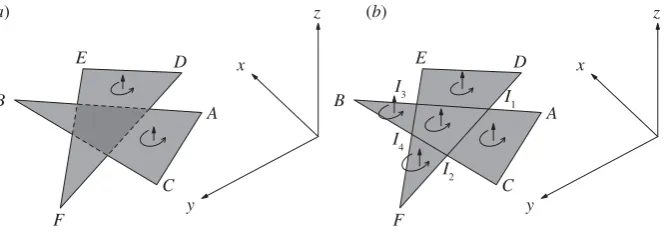
Intersections between discontinuities can occur, much as in plane strain DLO problems. The intersections between discontinuities on different planes are line segments or ‘crossovers’. Compatibility is implicitly ensured at these crossovers rather than being explicitly enforced. This can be demonstrated using the two intersecting rectangular discontinuities, as shown in
figure 12a. In figure 12b, the discontinuities are split into smaller discontinuities so that the crossover is eliminated. In DLO, it is assumed that the displacement jump across each of these smaller discontinuities is equal to that of its parent, taking account of the conventions in appendices A and B. It is clear that equation (B 1) is satisfied for the new edges and the original crossover itself must also be compatible.
(b) Overlaps
Intersections also occur between discontinuities in the same plane, resulting in ‘overlaps’. As
with crossovers, compatibility is implicitly ensured. Infigure 13a, two overlapping discontinuities
are shown. These are divided in figure 13b so that the original overlap is eliminated, but
two overlapping discontinuities −−−−→I1I3I4I2ABC and−−−−→I1I3I4I2DEF remain. Discontinuities located on
different planes and sharing edges AB, BC, EF and FD are similarly divided (not shown
in figure 13). The displacement jump for each new discontinuity equals that of its parent discontinuity, taking account of the conventions in appendices A and B. Using equation (B 1),
it is simple to prove that compatibility is maintained and that the displacement jumpvIon the
overlapping regionI1I3I4I2equalsvABC+vDEF.
CalculatingpABC,pDEFandpIfrom equation (3.11), it is clear thatpABC+pDEF≥pIsince these
terms are not added vectorially in the SOCP solver. It can therefore be concluded that overlaps will overestimate both the dilation and energy dissipated. This is equivalent to the overlapping
region having a cohesive strength c and angle of frictionφ greater than those of the original
17
rspa.r
oy
alsociet
ypublishing
.or
g
Pro
c
R
So
c
A
469:
[image:19.493.84.418.41.158.2]20130009
...
x
y
z
A
C B
D E
F
(a) (b)
x
y
z
A
C B
D E
F I3
I4 I2
I1
Figure 13.Overlaps: (a) a discontinuity−→ABC, displacement jumpvABC, overlapping a discontinuity−DEF→, displacement jump
vDEF; (b)−→ABCsplit into−−→AI1I2C,−−→I1I3I4I2ABCand−→I3BI4, each with a displacement jumpvABC;−DEF→split into−−→DEI3I1,−−→I1I3I4I2DEFand
−→
I2I4F, each with a displacement jumpvDEF.
tend to avoid such overlaps where these result in more energy being dissipated than necessary. Therefore, the significance of these overlaps is likely to reduce with increasing nodal resolution.
The load distribution across discontinuitiesABCandDEFis unknown and can be interpreted
in any manner consistent with the work done by vABC,vDEF andvI. Note that the load
on I1I3I4I2,LI, cannot be the sum of the loads on −−−−→I1I3I4I2ABC and−−−−→I1I3I4I2DEF, LABCI andLDEFI ,
respectively (i.e.LI=LABCI +LDEFI ). Load distributions resulting inLI=LABCI =LDEFI will always
be consistent with the work done.
References
1. Lysmer J. 1970 Limit analysis of plane problems in soil mechanics.J. Soil Mech. Found. Div.
ASCE96, 1311–1334.
2. Sloan SW. 1988 Lower bound limit analysis using finite elements and linear programming.
Int. J. Numer. Anal. Methods Geomech.12, 61–77. (doi:10.1002/nag.1610120105)
3. Makrodimopoulos A, Martin CM. 2006 Lower bound limit analysis of cohesive-frictional
materials using second-order cone programming.Int. J. Numer. Methods Eng. 66, 604–634.
(doi:10.1002/nme.1567)
4. Park JJ, Kobayashi S. 1984 Three-dimensional finite element analysis of block compression.
Int. J. Mech. Sci.26, 165–176. (doi:10.1016/0020-7403(84)90051-1)
5. Lyamin AV, Sloan SW. 2002 Lower bound limit analysis using non-linear programming.Int. J.
Numer. Methods Eng.55, 573–611. (doi:10.1002/nme.511)
6. Lyamin AV, Sloan SW. 2002 Upper bound limit analysis using linear finite elements and
non-linear programming.Int. J. Numer. Anal. Methods Geomech.26, 181–216. (doi:10.1002/nag.198)
7. Krabbenhøft K, Lyamin AV, Sloan SW. 2008 Three-dimensional Mohr–Coulomb limit analysis
using semidefinite programming.Commun. Numer. Methods Eng.24, 1107–1119. (doi:10.1002/
cnm.1018)
8. Martin C, Makrodimopoulos A. 2008 Finite-element limit analysis of Mohr–Coulomb
materials in 3D using semidefinite programming.J. Eng. Mech.134, 339–347. (doi:10.1061/
(ASCE)0733-9399(2008)134:4(339))
9. Chen J, Yin J, Lee CF. 2003 Upper bound limit analysis of slope stability using rigid elements
and nonlinear programming.Can. Geotech. J.40, 742–752. (doi:10.1139/T03-032)
10. Alizadeh F, Goldfarb D. 2003 Second-order cone programming.Math. Program. Ser. B95, 3–51.
(doi:10.1007/s10107-002-0339-5)
11. Smith C, Gilbert M. 2007 Application of discontinuity layout optimization to plane plasticity
problems.Proc. R. Soc. A463, 2461–2484. (doi:10.1098/rspa.2006.1788)
12. Lyamin AV, Sloan SW, Krabbenhøft K, Hjiaj M. 2005 Lower bound limit analysis with adaptive
remeshing.Int. J. Numer. Methods Eng.60, 1961–1974. (doi:10.1002/nme.1352)
13. Makrodimopoulos A, Martin CM. 2007 Upper bound limit analysis using simplex strain
elements and second-order cone programming. Int. J. Numer. Anal. Methods Geomech. 31,
18
rspa.r
oy
alsociet
ypublishing
.or
g
Pro
c
R
So
c
A
469:
20130009
...
14. Gilbert M, Smith C, Haslam I, Pritchard T. 2010 Application of discontinuity layout
optimization to geotechnical limit analysis problems. InProc. 7th European Conf. Numerical
Methods Geotechnical Eng.(NUMGE), Trondheim, Norway(eds T Benz, S Nordal), pp. 169–174. CRC Press.
15. Boyd S, Vandenberghe L. 2004Convex optimization. Cambridge, UK: Cambridge University
Press.
16. Mosek. 2011TheMOSEKoptimization tools manual. Seehttp://www.mosek.com. Copenhagen,
Denmark: Mosek ApS.
17. Salgado R, Lyamin AV, Sloan SW, Yu HS. 2004 Two and three-dimensional bearing capacity of
foundations on clay.Géotechnique54, 297–306. (doi:10.1680/geot.2004.54.5.297)
18. Gourvenec S, Randolph M, Kingsnorth O. 2006 Undrained bearing capacity of square and
rectangular footings.Int. J. Geomech.6, 147–157. (doi:10.1061/ASCE1532-3641(2006)6:3(147))
19. Shield RT, Drucker DC. 1953 The application of limit analysis to punch-indentation problems.
J. Appl. Mech.20, 453–460.
20. Michalowski RL. 2001 Upper-bound load estimates on square and rectangular footings.
Géotechnique51, 787–798. (doi:10.1680/geot.2001.51.9.787)
21. Vicente da Silva MV, Antão AN. 2008 Upper bound limit analysis with a parallel mixed finite element formulation.Int. J. Solids Struct.45, 5788–5804. (doi:10.1016/j.ijsolstr.2008.06.012) 22. Merifield RS, Lyamin AV, Sloan SW, Yu HS. 2003 Three-dimensional lower bound
solutions for stability of plate anchors in clay. J. Geotech. Geoenviron. Eng. 129, 243–253.
(doi:10.1061/(ASCE)1090-0241(2003)129:3(243))
23. Merifield RS, Lyamin AV, Sloan SW. 2006 Three dimensional lower-bound solutions for the
stability of plate anchors in sand.Géotechnique56, 123–132. (doi:10.1680/geot.2006.56.2.123)
24. Murray EJ, Geddes JD. 1987 Uplift of anchor plates in sand. J. Geotech. Eng.113, 202–215.

![Figure 2. Stages in DLO procedure, after [edge);(14]: (a) starting problem (surcharge applied to block of material close to a verticalb)discretizationofdomainusingnodes;(c)interconnectionofnodeswithpotentialdiscontinuities;(d)identificationofcritical subset of potential discontinuities using optimization (giving the layout of slip-lines in the critical failure mechanism).](https://thumb-us.123doks.com/thumbv2/123dok_us/7978273.201627/7.493.81.417.201.350/procedure-surcharge-discretizationofdomainusingnodes-interconnectionofnodeswithpotentialdiscontinuities-identificationofcritical-discontinuities-optimization-mechanism.webp)
![Table 2. Compression of a block: comparison with benchmark solutions. Upper bound (UB) solutions from Martin &for information;Makrodimopoulos [8] have been used to benchmark the present solutions, and their lower bound (LB) solutions are also listed � = �x = �y = �z.](https://thumb-us.123doks.com/thumbv2/123dok_us/7978273.201627/11.493.56.439.277.376/compression-comparison-benchmark-solutions-solutions-information-makrodimopoulos-solutions.webp)