Random Component Threshold Models in a Customer Satisfaction
Evaluation
Ayoub Saei, Soroush Alimoradi
Abstract
The degree of customer satisfaction is measured on an ordinal scale in evaluating a customer opinion programme. Two random component threshold models are fitted to the results data. Estimation of the parameters in the models and variance components are given by residual maximum likelihood method. The predicted values of the probability of selecting a specific response category are given for all customers. A threshold is selected and customers are then divided into happy and unhappy groups.
Random Component Threshold Models in a Customer Satisfaction
Evaluation
Ayoub Saei
Southampton Statistical Sciences Research Institute, University of Southampton,
Highfield
Southampton SO17 1BJ, UK
Soroush Alimoradi
Department of Mathematical Sciences, Isfahan University of Technology, Isfahan
84154, Iran
Summary: The degree of customer satisfaction is measured on an ordinal scale in
evaluating a customer opinion programme. Two random component threshold models
are fitted to the results data. Estimation of the parameters in the models and variance
components are given by residual maximum likelihood method. The predicted values
of the probability of selecting a specific response category are given for all customers.
A threshold is selected and customers are then divided into happy and unhappy
groups.
1
.
Introduction
The response variable in evaluating
a customer opinion programme usually
measures the degree of customer’s
sa-tisfaction based on some categories.
The categories are usually ordinal
sca-les, e.g., excellent, good, not bad, and
bad. The response category may
de-pend on the data selection method
(face-face or mail), customer
sub-activities and production lines in a firm
or company. The programme is often
aimed at finding out what factors
influence customers to make particular
response category choice. The
pro-gramme is also aimed at assessing the
firm and identifying customers who are
or are not satisfied by product and
services.
The customer’s opinion on product and
services is usually a multiple response
(responses to the different questions).
Thus, model needs to account for
va-riations between and within customers.
The aim of this paper is to relate the
response variable to the random
cus-tomer effect acting in the presence of
some other covariates and factors. This
paper shows how random component
threshold models can provide a very
good approach to the analysis of the
customer opinion data.
Random component threshold
mo-dels are fitted by Gianola and Foully
(1983) and Harville and Mee (1984)
using a Bayesian approach. A
nume-rical inte-gration approach along with
the EM algorithm is proposed by
Jansen (1990 and 1992). The
genera-lized linear mixed models are proposed
by Schall (1991), Breslow and Clayton
(1993) Wolfinger (1993), McGilchrist
(1994), Nelder and Lee (1996) and Lee
and Nelder (2001a, 2001b). The model
fitting approaches are applied to the
random component threshold models
by Zhaorong et al (1992) and Saei and
McGilchrist (1996), Crouchley (1995),
Ten Have (1996) for multivariate ordered
(1998) to longitudinal ordinal response
data.
Section 2 explains the customer
satis-faction programme. The models and
the estimation approach are given in
section 3. Section 4 proposes a
predict-tion method for selecting a particular
response category. Results of
appli-cation of the methods to the customer
opinion data are presented in section 5.
The last section provides discussion on
the method and results.
2
.
Customer Satisfaction Study
Mobarekeh Steel Complex (MSC)is the main supplier of steel products in
Iran and one of the major suppliers in
the region. The market research of the
MSC sent out questionnaires to
eva-luate the customer’ s opinion on
pro-duct and services. A total of 202
natio-nal customers within 9 sub-activities
were randomly assigned to two types
of data collection (face to face and
mailing). The degree of satisfaction of
each customer was recorded according
to an ordinal response scale (1 = very
good, 2 = good, 3 = not bad, 4 = bad
and 5 = very bad). There are three
different production lines at MSC, hot
rolling, cold rolling and pickling
(washing Acid). The customers from 9
different sub-activities are used
ducts from one, two or all three
pro-duction lines. The sub-activities are
pipe and profile makers (1), tank,
cylinder and container makers (2),
home accessories makers (3), steel
industries (4), other user of steel sheet
(5), heavy steel equipment (6), steel
sheet cooperation users (7), motor
vehicle makers (8), water, oil and gas
pipe makers (9). The data set is
available from first author.
3.
Models and Estimation
The response variable Y is an
ordinal random variable, which is
as-sumed to arise from grouping an
under-lying continues random variable. Let Yis
to bethevalue of ordinal response
2,…, 13) for customer i, i = 1, 2,...,
202; Yis can take on values 1, 2, ..., 5.
The distribution of Yis depends on the
linear predictor ηis in which involves a
vector of p known regression variables
xis and the customer random effect ui.
Two random component threshold models
are defined. The threshold parameters
(cut-points) are assumed constant over the
questions in the first model. This is called
a question independent random
compo-nent threshold model. The model is
(3.1) P(Yis≤k = G(θk - ηis)
where θk are threshold parameters for k
= 1, 2,..., 5. The G(.) is a cumulative
distribution function for the
unobser-vable continuous random variable Vis
with conditional mean ηis and
exam-ples of G are given in McCullagh and
Nelder (1989). Here the model is a
proportional odds model in which G is
the cumulative distribution function for
a logistic distribution. Results for other
models such the proportional hazards
model or standard threshold model
considered by McCullagh and Nelder
(1989) are consistent with the
propor-tional odds model.
The threshold parameters are
depen-dent on the questions in the second
model. This model replaces θk by θks in
(3.1) and it is called a question
depen-dent random component threshold model.
The model is
(3.2) P(Yis≤k = G(θks - ηis)
where θks is thethreshold parameter for
question s. Because of the small
num-ber of observations in category 5, the
categories 5 (very bad) and 4 (bad) are
combined, reducing the number of
categories under consideration to 4.
Thus observation for customer i on
question s ( i = 1, 2, …, 202; s = 1,
2,…, 13) is coded as 1 = very good, 2
= good, 3 = not bad and 4 = bad; k = 1,
2, 3, 4. For the model (3.1), the
and θs4 are reacted as θ0 and θ4 in the model (3.2). The threshold parameters
are collected into a vector .
We consider two different models
of the linear predictor ηis in (3.1) and
(3.2). The first model assumes ηis to be
a linear function of a vector xis of p covariates as well as a random
customer effects u1i to account for variation that is not explained by the
values in xis. That is
(3.3) ηis = xisc +u1i
where is an unknown vector of the
regression coefficients. The customer
random effects u1i are independent normal variables with zero means and
variances ϕ1 for i = 1, 2,… , 202. In the second model ηis includes an
extra random effect u2i, allowing a possible change in variance and pattern
of association on the second and
following questions for a customer.
This is consistent with the idea that the
customers respond differently to the
questions. This model is
(3.4) ηis = xisc +u1i + δsu2i
where δs = 0, s = 1; δs = 1, s = 2, 3, ...,
13 and u1iand u2i are normal variables with zero means and variances ϕ1 and
ϕ2 respectively and covariance bet-ween them ϕ3. The u1i is the customer effect at baseline (on the first
ques-tion), and u2i measures the average de-viation from that value on the second
and following questions. It is important
to realise that a negative value for uˆ 2i
implies a lager decline in ηis, so that
lower (very good, good) Y
obser-vations are likely.
Let u1 (u11 ,u12 ,...,u1N)c and
) ..., , ,
( 21 22 2
2 u u u N c
u be the customer
random effect vectors at baseline (on
the first question) and on the second
and following questions. In general the
model for = (ηis, i = 1, 2,… ,N = 202,
s = , 2, … , ni = 13) can be expressed as
K=;E+=X, where X is a known
matrix of the regression variables, Z =
Z2] and u=(u1′ ,u′2)′ under (3.4). The
random vectors u = u1 and )
, ( 1′ ′2 ′ = u u
u are distributed as
multi-variate normal with zero mean vectors
and variance-covariance matrices A =
ϕ1ΙN and A =
N N
N N
I I
I I
2 3
3 1
ϕ ϕ
ϕ ϕ
respecti-vely, where IN is an identity matrix of
order N = 202. An outline of the
esti-mation method is given in Appendix
A.
4
.
Customer Response Prediction
Individual reaction on the products andservices by MSC is an important factor in
the customer satisfaction study. The notion
of sensitive customers is also important to
the MSC. The prediction approach here is
an extension of Anderson and Albert
(1981) to include random effects in the
linear predictor.
The observable variable Yisis
catego-rised value of unobservable continuous
variable Vis with conditional mean of ηis, i.e., Yis= k⇔θk - 1 - ηis < Vis - ηis
≤ θk- ηis. This yields P(Yis= k) = G(θk
- 1- ηis) - G(θk - 1 - ηis) and P(Yis= k) = G(θsk - ηis) - G(θs(k – 1) - ηis) under models (3.1) and (3.2) respectively.
The G(.) is a cumulative distribution
for the unobservable continuous
varia-ble Vis and given in section 3. The
pre-dicted ηˆ and estimated values is θˆ sk
allow a predicted value for Yis, say Yˆ , is
Yˆ = is k⇔θˆs(k−1) < ηˆ is ≤θˆ sk
under the model (3.2). The cumulative
probability of second category
res-ponse, P(Yˆ is ≤ 2) = G(θˆ -sk ηˆ ), is then is
selected as a threshold in identifying
happy and unhappy customers of the
MSC.
5
.
Results
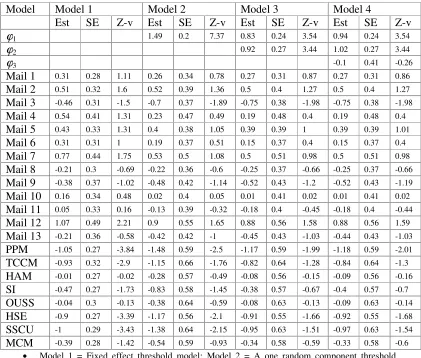
Table 1 shows the parameter
esti-mates and associated standard errors
for four question dependent threshold
models fitted to the customer
satisfac-tion data. Model 1 is a fixed effect
threshold model, fitted via ML. Model
2 is a one random component threshold
4 are threshold models with
indepen-dent and depenindepen-dent random
compo-nents respectively. These models are
also fitted via REML. The significance
of the parameters in the models can be
judged by comparing the estimated
values with their asymptotic standard
errors. It is important to realize that a
negative coefficient for a regression
variable in X Zu means that
is decreased for an increase in X
com-ponent values, so that values are
increased and lower Y observations are
likely. This is also true for predicted
values of u, i.e., a negative predicted
value of the random effect further
shifts to the left and increases the
probability of observing a lower value
(very good, good) for Y.
The results show that there is a
statis-tically significant variation between
customers with REML estimated value
1
ˆ
ϕ = 0.94 and standard error of 0.44.
The results also show that the customer
effect does significantly change over
questions. The REML estimate of the
variance of carrying over question
ran-dom effect is ϕˆ2= 1.01 with standard
error of 0.5. However, the results did
not support a significant correlation
between two random components u1 and u2 with REML estimated corre-lation value of ρˆ = -0.11. The REML
estimates ϕˆ1 and ϕˆ2 show that
varia-tion between customers increases from
first question to the second question.
The predicted values of the second
random component (uˆ ) were used to 2i
identify customers who showed greater
changes (increase or decrease over
questions) and 30 customers were
identified for further study.
Let be the vector of s, s =
1,2,… 13. A Wald test which compares
ˆ )] ˆ [var(
ˆc 1 = 17.43 (under Model 4)
to a 2 13
χ value is not significant. Thus,
the results do not support a significant
difference between two methods of
mai-ling) on overall. In contrast model 1
shows marginally significant effect of
the method of collecting data with
ˆ )] ˆ [var(
ˆ 1
c = 20.5.
The sub-activities have calculated
Chi-Square of 16.5 (under Model 4) which
is greater than 2 8
χ at 5% significant
le-vel. This indicates that there is a
signi-ficant variation between sub-activities
on the product and services by MSC.
The REML estimated values are
nega-tive indicating that there is evidence
that sub-activities are happy with
pro-duct and services by MSC.
The threshold parameters do also
change significantly over questions.
Fi-gure 1 shows the estimated threshold
parameters over 13 questions.
There-fore, a suitable model to analysis
cus-tomer satisfaction data is the question
dependent random components
thre-shold model. Question independent
models may lead to a wrong decision
about factors in the model.
Table 2 shows the predicted
proba-bility and cumulative probaproba-bility under
Model 4. The questions 9 (the manner
of claim back dealing with
nonconfor-ming product with customer demands)
and 13 (technical support) by MSC
have C2 (predicted cumulative
proba-bilities for response category good (2))
of 0.28 and 0.43 respectively. These
are small and showing that customers
are not happy with the manner of claim
back and technical support. Customers
are very happy with the product quality
from the hot and cold rolling sections
of MSC with C2 of 0.76 and 0.77
respectively. The results (not given
here) support the previous conclusions
that there is no significant difference in
cumulative probabilities for response
category good (2) between two
methods of collecting data.
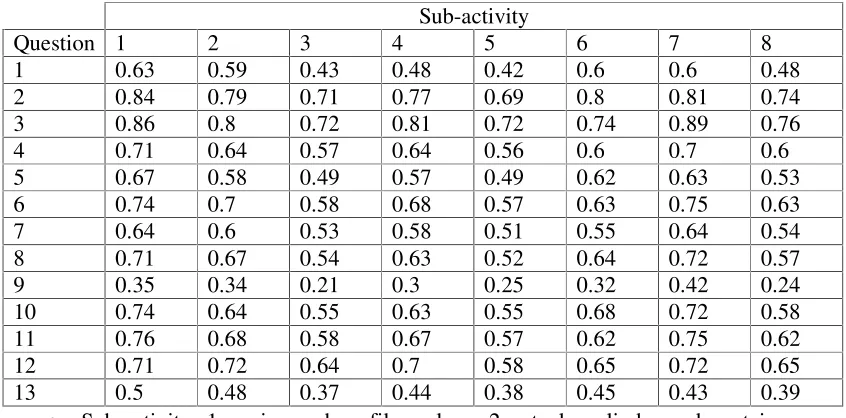
Table 3 shows the predicted
cumu-lative probabilities for response
cate-gory good (2) for sub-activities. The
also not happy with the manner of
claim back by MSC with C2 smaller
than 50%. The pipe and profile and
tank, cylinder and container makers are
50 - 50 with technical support by
MSC. The sub-activities home
acces-sories makers, steel industries and
other user of the steel sheets have C2
less than 50% for the first question
(familiarity with MSC and its
pro-ducts). The results also show that all 8
sub-activities are happy with product
quality from the hot and cold rolling
sections of the MSC. The results (not
reported in here) show that almost 10%
and 21% of customers are happy (with
C2 greater than 60%) by the manner of
claim back and technical support of the
MSC. Figures 2 and 3 show the
pre-dicted cumulative probabilities for
response category good (y = 2) for all
202 customers. The results indicate
that almost 44% of the customers are
not happy with questions 1 (familiarity
with the MSC), 2 (dimensions
tole-rance by the hot rolling section) and 7
(dimensions tolerance by the pickling
section) with C2 less than 0.5.
6
.
Discussion
Two random component threshold
models are fitted to the customer’ s
opinion data. The threshold parameters
are independent of the question in the
first model whereas they are varying
by questions in the second model. The
models are called question independent
and question dependent random
com-ponent threshold models. The results
of the application indicate that the
thre-shold parameters do change
signifi-cantly over questions. Therefore, a
suitable model for analysing customer
satisfaction data is the question
depen-dent random components threshold
model. Question independent models
are led to a wrong decision about
factors in the model. The results of
question independent random
compo-nent threshold models indicate that
bet-ween two types of collecting data
whereas question dependent random
component threshold models do not
support such a conclusion.
We have also introduced a second
random component into the linear
pre-dicttor to allow possible change in
variance and pattern of association on
the second and following questions.
The results of application show that the
customer effect changes significantly
over questions. However, there is no
evidence of dependence between two
random components. Models lead to a
wrong decision about factors if the
significant random effects and
depen-dence between them are not included.
The estimation approach also provides
predicted values of random effects that
are very useful in identifying happy
and unhappy customers.
Appendix A
Let y be the observation vector of
the ordinal response variable Y. Let
be the corresponding vector of linear
combination of explanatory variables
and random components, given by
Zu
X ; u is the vector of
ran-dom components and X and Z are
regression and incidence matrices. Let
l1 be the log-likelihood function of y observations conditional on the value
of the random component vector u and
let l2 be the logarithm of the probability density function of u. The
functions l1 and l2 are
] |
| ln . )[ 2 / 1 (
ln
1 2
202 1
13 1 1
u A u
A
c
¦ ¦
const l
l i s δis ∆is
where
) G(
)
G( y is y 1 is
is θ is η θ is η
∆ and
) G(
)
G( sy is s(y 1) is
is θ is η θ is η
∆
under models (3.1) and(3.2)
respecti-vely. The δis is one if ith customer
uses product or service of the sth
ques-tion, zero otherwise. Penalised
likely-hood (PL) estimates ~, ~ and u~ are
obtained by maximising l = l1 + l2 with respect to , and u respectively.
initial step in finding ML and REML
estimates of ϕj and ϕ3 via Anderson
(1973) and Henderson (1973)
algori-thm. The iterative procedure used to
obtain the ML and REML estimators
and their approximate
variance-covariance matrices can be specified as
follows:
(a) Let Iθ to be an identity matrix of dimension equal to the number of the rows
in T, X* =
»¼ º «¬ ª Z X I 0 0 0
θ and k =0. Starting from initial values
0, 0 , u0, ϕj0
and ϕ30 (hence A0), the estimating equations are:
(3) » » » ¼ º « « « ¬ ª » ¼ º « ¬ ª c » » » ¼ º « « « ¬ ª » » » ¼ º « « « ¬ ª k k k k k k k k k u A V X V u u 1 0 1 1 1 * 1 1 1 1 0 0 / l / l ∂ ∂ ∂ ∂ where » » » ¼ º « « « ¬ ª ¸¸¹ · ¨¨© § » ¼ º « ¬ ª c c c c c 1 0 * 1 2 1 2 1 2 1 2 * 0 0 0 0 0 0 0 0 / / / / A X X V k k k k k k k k l l l l ∂ ∂ ∂ ∂ ∂ ∂ ∂ ∂ ∂ ∂ ∂ ∂ , k k k k k k k
k l l l l
l ∂ ∂ ∂ ∂ ∂ ∂ c ∂ ∂ ∂ c ∂ ∂ ∂ c
∂ / , / , / , / and 21/
1 2 1
2 1
1 are evaluated
at initial estimates of the parameters.
(b) Once iterations of (3) have converged to ~ and u~ , let ~ X~Zu~,
B ∂2l1/∂~∂~c, T* =[T*jj′]=[A−01+ZTBZ]−1, ajj′ =tr(T*jj′ +T*j′j)+2u~′j~uj′
andaj = tr(T*jj)+~u′j~uj for j ,j′=1 ,2.The ML estimates of ϕj and ϕ3 are
(4) ] 2 -[2 ˆ ] ) / ( ) / ( ) / ( [ ˆ 1 20 10 2 10 1 20 30 12 2 30 12 20 10 ) ( 3 30 2 30 2 30 1 ) ( − ′ ′ ′ ′ ′ − − + + = − + + = N a a a N a a N a a N ML jj j j j j j ML j ϕ ϕ ϕ ϕ ϕ ϕ ϕ ϕ ϕ ϕ ϕ ϕ ϕ ϕ ϕ ϕ
for j = 1, 2.
The preceding two steps are then repeated, with k =0, and initial values set to ~,
~,
u~ , ϕ ˆ and
) ( 3
Once this iterative process has converged, the asymptotic variance-covariance matrix
for the ML estimators ϕML (ϕˆ1(ML) ,ϕˆ2(ML),ϕˆ3(ML))c is
(5) var( ) 2
>
1 2 23@
1jj jj jj
ML r r r
ϕ
where r1jj′ =tr[A(∂A/∂ϕj)A(∂A/∂ϕj′)]
,
r2 jj′ =tr[T*(∂A/∂ϕj)T*(∂A/∂ϕj′)]and
)] / ( ) / ( [ *
3jj tr j j
r ′ = A ∂A ∂ϕ T ∂A ∂ϕ ′ .
Let 33 32 31 23 22 21 13 12 11 V V V V V V V V V
denote the
partitions of the matrix V
correspond-ding to the dimensions of , and u,
similarly let
= − 33 32 31 23 22 21 13 12 11 1 T T T T T T T T T V .
Replacing 7* by T
33 in (4) and (5) yields REML estimates ϕˆj(REML) and
) ( 3
ˆREML
ϕ and their corresponding
asymptotic variance-covariance matrix.
References
Anderson, T.W. (1973),
“Asymptotica-lly efficient estimation of
covarian-ce matricovarian-ces with linear structure,”
Annals of Statistics, 1 135 - 141.
Anderson, J. A. and Philips, P. R.
(1981), “Regression, discrimination
and measurement models ordered
categorical variables,” Journal of
Applied Statistics, 30, 22 - 31.
Breslow, N.E. and Clayton, D.G.
(1993), “Approximate inference in
generalised linear mixed models,”
Journal of the American Statistical
Association, 88,9 - 25.
Crouchley, R. (1995), “A random
effects model for ordered
category-cal data,” Journal of the American
Statistical Association 90, 489 -
498.
Gianola, D. and Foulley, I.J. (1983),
“Sire evaluation for ordered
catego-rical data with a threshold model,”
Genetics Selection Evaluation.
Harville, D.A. and Mee, R.W. (1984),
analysing ordered categorical data,”
Biometrics 40, 393 - 944.
Henderson, C.R.(1973b), Maximum
likelihood estimation of variance
components, unpublished
manus-cript.
Jansen, J. (1990), “ On the statistical
analysis of ordinal data when extra
variation is present,” Applied
Statistics 39, 75 - 84.
Jansen, J. (1992), “ Statistical analysis
of ordinal data from experiments
with nested errors,” Computational
Statistics & Data Analysis 13, 319 -
330.
McCullagh, P. and Nelder, J.A. (1989),
Generalized linear models. Second
Ed. London: Chapman and Hall.
McGilchrist, C.A. (1994), “ Estimation
in generalized mixed models,”
Journal of the Royal Statistical
Society, Series B 56, 61 - 69.
Nelder, J.A. and Lee, Y. (1996),
“ Hierarchical generalized linear
models,” Journal of the Royal
Statistical Society, Series B 58, 619
- 678.
Lee, Y. and Nelder, J.A. (2001a),
“ Hierarchical generalized linear
models: A synthesis of generalised
linear models, random effect model
and structured dispersions,”
Biomet-rika, 88, 987 - 1006.
Lee, Y. and Nelder, J.A. (2001b),
“ Modelling and analysing
corre-lated non-normal data,” Statistical
Modelling, 1, 3 - 16.
Saei, A. and McGilchrist, C.A. (1996),
“ Random component threshold
models,” Journal of Agricultural,
Biological and Environmental
Statistics, 1, 288 - 296.
Saei, A. and McGilchrist, C. (1998),
“ Longitudinal threshold models with
random components,” The
Statisti-cian , Series D 47, 365 - 375.
Schall, R (1991), “ Estimation in
generalised linear models with
ran-dom effects,” Biometrika 78, 719 -
Ten Have T. (1996), “ A mixed effects
model for multivariate ordinal
response data including correlated
discrete failure time with ordinal
responses,” Biometrics, 53, 473 -
491.
Wolfinger, R. (1993), “ Laplace’ s
approximation for nonlinear mixed
models,” Biometrika 80, 791 - 796.
Zhaorong, J., McGilchrist, C.A. and
Jorgensen, M.A. (1992), “ Mixed
model discrete regression,”
[image:15.612.105.526.273.631.2]Biomet-rical Journal34, 691 - 700.
Table 1: REMLestimate of parameters (Est), standard error (SE) and Z-v = (Est/SE).
Model Model 1 Model 2 Model 3 Model 4
Est SE Z-v Est SE Z-v Est SE Z-v Est SE Z-v
ϕ1 1.49 0.2 7.37 0.83 0.24 3.54 0.94 0.24 3.54
ϕ2 0.92 0.27 3.44 1.02 0.27 3.44
ϕ3 -0.1 0.41 -0.26
Mail 1 0.31 0.28 1.11 0.26 0.34 0.78 0.27 0.31 0.87 0.27 0.31 0.86
Mail 2 0.51 0.32 1.6 0.52 0.39 1.36 0.5 0.4 1.27 0.5 0.4 1.27
Mail 3 -0.46 0.31 -1.5 -0.7 0.37 -1.89 -0.75 0.38 -1.98 -0.75 0.38 -1.98
Mail 4 0.54 0.41 1.31 0.23 0.47 0.49 0.19 0.48 0.4 0.19 0.48 0.4
Mail 5 0.43 0.33 1.31 0.4 0.38 1.05 0.39 0.39 1 0.39 0.39 1.01
Mail 6 0.31 0.31 1 0.19 0.37 0.51 0.15 0.37 0.4 0.15 0.37 0.4
Mail 7 0.77 0.44 1.75 0.53 0.5 1.08 0.5 0.51 0.98 0.5 0.51 0.98
Mail 8 -0.21 0.3 -0.69 -0.22 0.36 -0.6 -0.25 0.37 -0.66 -0.25 0.37 -0.66
Mail 9 -0.38 0.37 -1.02 -0.48 0.42 -1.14 -0.52 0.43 -1.2 -0.52 0.43 -1.19
Mail 10 0.16 0.34 0.48 0.02 0.4 0.05 0.01 0.41 0.02 0.01 0.41 0.02
Mail 11 0.05 0.33 0.16 -0.13 0.39 -0.32 -0.18 0.4 -0.45 -0.18 0.4 -0.44
Mail 12 1.07 0.49 2.21 0.9 0.55 1.65 0.88 0.56 1.58 0.88 0.56 1.59
Mail 13 -0.21 0.36 -0.58 -0.42 0.42 -1 -0.45 0.43 -1.03 -0.44 0.43 -1.03
PPM -1.05 0.27 -3.84 -1.48 0.59 -2.5 -1.17 0.59 -1.99 -1.18 0.59 -2.01
TCCM -0.93 0.32 -2.9 -1.15 0.66 -1.76 -0.82 0.64 -1.28 -0.84 0.64 -1.3
HAM -0.01 0.27 -0.02 -0.28 0.57 -0.49 -0.08 0.56 -0.15 -0.09 0.56 -0.16
SI -0.47 0.27 -1.73 -0.83 0.58 -1.45 -0.38 0.57 -0.67 -0.4 0.57 -0.7
OUSS -0.04 0.3 -0.13 -0.38 0.64 -0.59 -0.08 0.63 -0.13 -0.09 0.63 -0.14
HSE -0.9 0.27 -3.39 -1.17 0.56 -2.1 -0.91 0.55 -1.66 -0.92 0.55 -1.68
SSCU -1 0.29 -3.43 -1.38 0.64 -2.15 -0.95 0.63 -1.51 -0.97 0.63 -1.54
MCM -0.39 0.28 -1.42 -0.54 0.59 -0.93 -0.34 0.58 -0.59 -0.33 0.58 -0.6
x Model 1 = Fixed effect threshold model; Model 2 = A one random component threshold model; Model 3 = A two independent random components threshold model; Model 4 = A two random components threshold model
x Mail i is the mail effect for the question i, i = 1, 2,… , 13
x Water, oil and gas pipe makers and face – face effects are fixed at zero for identifiably x PPM = pipe and profile makers, TCCM = tank, cylinder and container makers, HAM = home
Table 2: REML predicted probability and cumulative probability of the response categories.
Category Cumulative
Question 1 2 3 4 C1 C2 C3
1 0.09 0.43 0.38 0.1 0.09 0.52 0.9 2 0.3 0.46 0.22 0.02 0.3 0.76 0.98 3 0.3 0.47 0.2 0.03 0.3 0.77 0.97 4 0.19 0.43 0.25 0.13 0.19 0.62 0.87 5 0.21 0.35 0.31 0.12 0.21 0.56 0.87 6 0.2 0.44 0.26 0.09 0.2 0.64 0.9 7 0.14 0.42 0.33 0.11 0.14 0.56 0.89 8 0.18 0.44 0.27 0.12 0.18 0.62 0.89 9 0.06 0.23 0.36 0.35 0.06 0.29 0.65 10 0.1 0.54 0.31 0.05 0.1 0.64 0.95 11 0.09 0.55 0.34 0.02 0.09 0.64 0.98 12 0.08 0.58 0.33 0.01 0.08 0.66 0.99 13 0.11 0.32 0.27 0.31 0.11 0.43 0.7
x Category: 1 = very good, 2 = good, 3 = not bad and 4 = bad
x Cumulative: C1 = P(Y ≤ 1), C2 = P(Y ≤ 2) and C3 = P(Y ≤ 3).
Table 3: REML predicted cumulative probability of the second category, (good), for 8 sub-activities.
Sub-activity
Question 1 2 3 4 5 6 7 8
1 0.63 0.59 0.43 0.48 0.42 0.6 0.6 0.48 2 0.84 0.79 0.71 0.77 0.69 0.8 0.81 0.74 3 0.86 0.8 0.72 0.81 0.72 0.74 0.89 0.76 4 0.71 0.64 0.57 0.64 0.56 0.6 0.7 0.6 5 0.67 0.58 0.49 0.57 0.49 0.62 0.63 0.53 6 0.74 0.7 0.58 0.68 0.57 0.63 0.75 0.63 7 0.64 0.6 0.53 0.58 0.51 0.55 0.64 0.54 8 0.71 0.67 0.54 0.63 0.52 0.64 0.72 0.57 9 0.35 0.34 0.21 0.3 0.25 0.32 0.42 0.24 10 0.74 0.64 0.55 0.63 0.55 0.68 0.72 0.58 11 0.76 0.68 0.58 0.67 0.57 0.62 0.75 0.62 12 0.71 0.72 0.64 0.7 0.58 0.65 0.72 0.65 13 0.5 0.48 0.37 0.44 0.38 0.45 0.43 0.39
[image:16.612.104.527.387.596.2]Figure 1: REML estimates of the threshold parameters on each 13 questions.
-4 -1 2 5
1 2 3 4 5 6 7 8 9 10 11 12 13
Question
E
st
im
at
e Theta 1
[image:17.612.187.425.290.405.2]Theta 2 Theta 3
Figure 2: REML predicted cumulative probability of the response category 2 ( P(Y≤2)) for the question 9 (the manner of claim by MSC).
0 0.4 0.8
1 52 103 154
Customer
Pr
ed
ic
te
d
V
al
u
e
Figure 3: REML predicted cumulative probability of the response category 2 ( P(Y≤2)) for the question 13 (Technical support by MSC).
0 0.4 0.8
1 52 103 154
Customer
Pr
ed
ic
te
d
V
al
[image:17.612.189.423.489.591.2]