Inaccurate Reputation Sources
Jigar Patel, W.T. Luke Teacy, Nicholas R. Jennings, and Michael Luck Electronics & Computer Science, University of Southampton, Southampton SO17,
1BJ, UK
{jp03r, wtlt03r, nrj, mml}@ecs.soton.ac.uk
Abstract. This research aims to develop a model of trust and reputa-tion that will ensure good interacreputa-tions amongst software agents in large scale open systems in particular. The following are key drivers for our model: (1) agents may be self-interested and may provide false accounts of experiences with other agents if it is beneficial for them to do so; (2) agents will need to interact with other agents with which they have no past experience. Against this background, we have developedTRAVOS
(Trust and Reputation model for Agent-based Virtual OrganisationS) which models an agent’s trust in an interaction partner. Specifically, trust is calculated using probability theory taking account of past in-teractions between agents. When there is a lack of personal experience between agents, the model draws upon reputation information gathered from third parties. In this latter case, we pay particular attention to handling the possibility that reputation information may be inaccurate.
1
Introduction
Computational systems of all kinds are moving toward large-scale, open, dynamic and distributed architectures, which harbour numerousself-interestedagents. The Grid is perhaps the most prominent example of such an environment and is the context of this paper. However, in all these environments the concept of self-interest, which is endemic in such systems, introduces the possibility of agents interacting in a way to maximise their own gain (perhaps at the cost of another). Therefore, in such contexts it is essential to ensure good interaction between agents so that no single agent can take advantage of the others in the system. In this sense, good interactions can be defined as those in which the expectations of the interacting agents are fulfilled; for example, if the expectation of one of the agents is recorded as a contract which is then fulfilled by its interaction partner, it is a good interaction. We view the Grid as a multi-agent system (MAS) in which autonomous soft-ware agents, owned by various organisations, interact with each other. In partic-ular, many of the interactions between agents are conducted in terms of Virtual Organisations (VOs), which are collections of agents (representing individuals or organisations), each of which has a range of problem-solving capabilities and resources at its disposal. A VO is formed when there is a need to solve a problem
P. Herrmann et al. (Eds.): iTrust 2005, LNCS 3477, pp. 193–209, 2005. c
or provide a resource that a single agent cannot address. Here, the problem of assuring good interactions between individual agents is further complicated by the size of the Grid, and the large number of agents and interactions between them. Nevertheless, solutions to these problems are integral to the wide-scale acceptance of the Grid and agent-based VOs [4].
It is now well established that computationaltrust is important in such open systems [10]. Specifically, trust provides a form of social control in environments in which agents are likely to interact with others whose intentions are not known. It allows agents within such systems to reason about the reliability of others. More specifically, trust can be utilised to account for uncertainty about the willingness and capability of other agents to perform actions as agreed, rather than defecting when it proves to be more profitable. For the purpose of this work, we use an adaptation of the definition offered by Gambetta [5], and define trust to bea particular level of subjective probability with which an agent assesses that another agent will perform a particular action, both before the assessing agent can monitor such an action and in a context in which it affects the assessing
agent’s own action.
Trust is often built over time by accumulating personal experience with oth-ers, and using this experience to judge how they will perform in an as yet unob-served situation. However, when assessing our trust in someone with whom we have no direct personal experience, we often ask others about their experiences with this individual. This collective opinion of others regarding an individual is known as the individual’s reputation and it is the reputation of a trustee that we use to assess its trustworthiness, if we have no personal experience.
Given the importance of trust and reputation in open systems and their use as a form of social control, several computational models of trust and reputation have been developed, each with requirements for the domain to which they apply (see [10] for a review of such models). In our case, the requirements can be summarised as follows. First, the model must provide a trust metric that represents a level of trust in an agent. Such a metric allows comparisons between agents so that one agent can be inferred as more trustworthy than another. The model must be able to provide a trust metric given the presence or absence of personal experience. Second, the model must reflect an individual’s confidence
The remainder of this paper is organised as follows. Section 2 presents the basic TRAVOS model. Following from this, Section 3 provides a description of how the basic model has been expanded to include the functionality of handling inaccurate opinions from reputation sources. A scenario using these mechanisms is then presented in Section 4. Section 5 presents related work. Finally, Section 6 concludes the paper and provides an outline for future work.
2
The TRAVOS Model
TRAVOS equips an agent (the truster) with two methods for assessing the trust-worthiness of another agent (the trustee). First, the truster can make the assess-ment based on the direct interactions it has had with the trustee. Second, the truster may assess the trustworthiness of another based on the reputation of the trustee.
2.1 Basic Notation
In a MAS consisting of n agents, we denote the set of all agents as A = {a1, a2, ..., an}. Over time, distinct pairs of agents {ax, ay} ⊆ A may interact with one another, governed by contracts that specify the obligations of each agent towards its interaction partner. An interaction betweena1and a2is
con-sidered successful by a1 ifa2 fulfils its obligations. From the perspective of a1,
the outcome of an interaction betweena1anda2is summarised by a binary
vari-able1, O
a1,a2, whereOa1,a2 = 1 indicates a successful (andOa1,a2 = 0 indicates an unsuccessful) interaction2 for a
1 (Equation 1). Furthermore, we denote an
outcome observed at timetasOt
a1,a2, and the set of all outcomes observed from timet0to time tasOna1:t,a2.
Oa1,a2 =
1 if contract fulfilled bya2
0 otherwise (1)
At any point of time t, the history of interactions between agents a1 and a2 is
recorded as a tuple, Rt
a1,a2 = (mta1,a2, nta1,a2) where the value of mta1,a2 is the number of successful interactions of a1 with a2, while nta1,a2 is the number of
unsuccessful interactions ofa1 witha2. The tendency of an agenta2 to fulfil or
default on its obligations to an agenta1, is governed by its behaviour. We model
the behaviour ofa2towardsa1, denotedBa1,a2, as theintrinsicprobability with which Oa1,a2 = 1. In other words, Ba1,a2 is the expected value of Oa1,a2 given
1 Representing a contract outcome with a binary variable is a simplification made
for the purpose of our model. We concede that in certain circumstances, a more expressive representation may be appropriate.
2 The outcome of an interaction from the perspective of one agent is not necessarily
the same as from the perspective of its interaction partner. Thus, it is possible that
complete information abouta2’s decision processes and all environmental factors
that effect its capabilities (Equation 2). For simplicity, we admit the subscripts forB when the identity of the interacting agents is irrelevant to the discussion.
Ba1,a2 =E[Oa1,a2], whereBa1,a2∈[0,1] (2) In TRAVOS, each agent maintains alevel of trust in each of the other agents in the system. Specifically, the level of trust of an agent a1 in an agent a2,
denoted asτa1,a2, representsa1’s assessment of the likelihood of a2 fulfilling its
obligations. The confidence of a1 in its assessment of a2 is denoted as γa1,a2. Confidence is a metric that represents the accuracy of the trust value calculated by an agent given the number of observations (the evidence) it uses in the trust value calculation. Intuitively more evidence would result in more confidence. The precise definitions and reasons behind these values are discussed in Sections 2.2 and 2.3 respectively.
2.2 Modelling Trust
The first basic requirement of a computational trust model is that it should provide a metric for comparing the relative trustworthiness of different agents. From our definition of trust, we consider an agent to be trustworthy if it has a high probability of performing a particular action which, in our context, is to fulfil its obligations during an interaction. This probability is unavoidably subjective, because it can only be assessed from the individual viewpoint of the truster, based on the truster’s personal experiences.
In light of this, we have adopted a probabilistic approach to modelling trust, based on the individual experiences of any agent in the role of a truster. If a truster, agent a1, has complete information about a trustee, agent a2, then,
according to a1, the probability that a2 fulfils its obligations is expressed by
Ba1,a2. In general, however, complete information cannot be assumed; the best we can do is to use the expected value ofBa1,a2given the experience ofa1, which
we consider to be the set of all interaction outcomes it has observed. Thus, we define the level of trust τa1,a2 at time t, as the expected value of Ba1,a2 given the set of outcomesO1:t
a1,a2 (3).
τa1,a2 =E[Ba1,a2|O1:a1t,a2] (3) The expected value of a continous random variable is dependent on the
probability density function (pdf) used to model the probability that the
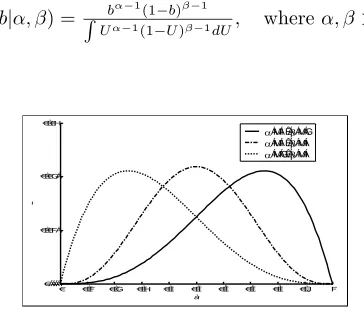
The general formula for beta distributions is given in Equation 4. It has two parameters,αandβ, which define the shape of the density function when plotted. Examples, plotted forB with various parameter settings are shown in Figure 1; here, the horizontal axis represents the possible values of B, while the vertical axis gives therelative probability that each of these values is the true value for
B. The most likely (expected value) of B is the curve maximum. The width of the curve represents the amount of uncertainty over the true value of B. If α
andβ both have values close to 1, a wide density plot results, thus representing a high level of uncertainty about B. In the extreme case of α = β = 1, the distribution is uniform, with all values ofB considered equally likely.
f(b|α, β) = bα−1(1−b)β−1
Uα−1(1−U)β−1dU, whereα, β >0 (4)
E
I
[image:5.595.215.397.246.402.2]
Fig. 1.Example beta plots, showing how the beta curve shape changes with the pa-rametersαandβ
Against this background, we now show how to calculate the value of τa1,a2 based on the interaction outcomes observed by a1. First, we must find values
for α and β that represent the beliefs of a1 about a2. Assuming that prior to
observing any interaction outcomes witha2, a1believes that all possible values
forBa1,a2 are equally likely, thena1’s initial settings forαandβ areα=β = 1.
Based on standard techniques, the parameter settings in light of observations are achieved by adding the number of successful outcomes to the initial setting of α, and the number of unsuccessful outcomes to β. In our notation, this is given in Equation 5. Then the final value for τa1 is calculated by applying the standard equation for the expected value of a beta distribution (Equation 6) to these parameter settings.
α=m1:t
a1,a2+ 1 and β=n
1:t
a1,a2+ 1 wheretis the time of assessment (5)
E[B|α, β] = α
2.3 Modelling Confidence
In the previous section, we showed how an agent can establish trustworthiness so that it can be used to compare the trustworthiness of different agents. How-ever, this method is susceptible to two problems created by the need for ade-quate evidence (observations) to calculate a meaningful value for trust. Firstly, an agent may not have interacted with another agent for which it is calcu-lating a level of trust. This means that it has no personal experience and
mta1,a2 = nta1,a2 = 0. Secondly, an agent may have had few interactions and observed outcomes with another. In both these cases, the calculated value of
τa1,a2 will be a poor estimate for the actual value of Ba1,a2. Intuitively, hav-ing observed many outcomes for an event will lead to a better estimate for the future probability for that event (assuming all other things are equal). These problems create the need for an agent to be able to measure its
con-fidence in its value of trust. To this end, we incorporate a confidence metric
in TRAVOS, based on standard methods of calculating confidence intervals taken from statistical analysis.
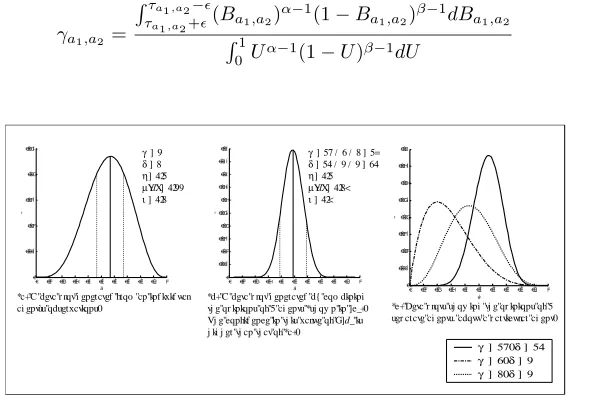
Specifically, the confidence metricγa1,a2 is a measure of the probability that the actual value ofBa1,a2 lies within an acceptable level of error aboutτa1,a2. It is calculated using Equation 7. The acceptable level of error influences how confident an agent is given the same number of observations. For exam-ple, if the number of observations remains constant, a larger value of causes an agent to be more confident in its calculation of trust than a lower value of.
γa1,a2 =
τa1,a2−
τa1,a2+(Ba1,a2)
α−1(1−
Ba1,a2)β−1dBa1,a2
1
0 Uα−1(1−U)β−1dU
[image:6.595.165.462.412.610.2](7) E I D$EHWDSORWJHQHUDWHGIURPDQLQGLYLGXDO DJHQW·VREVHUYDWLRQV A B E %;E= G E I A B E %;E= G E$EHWDSORWJHQHUDWHGE\FRPELQLQJ WKHRSLQLRQVRIDJHQWVVKRZQLQ>F@ 7KHFRQILGHQFHLQWKLVYDOXHRI(>E@LV KLJKHUWKDQWKDWRID E I F%HWDSORWVVKRZLQJWKHRSLQLRQVRI VHSDUDWHDJHQWVDERXWDSDUWLFXODUDJHQW AB AB AB
2.4 Modelling Reputation
Until now, we have only considered how an agent uses its own direct observa-tions to calculate a level of trust. However, by using confidence, we can specify a decision-making process in an agent to lead it to seek more evidence when required. In TRAVOS, an agent a1 calculates τa1,a2 based on its personal ex-periences with a2. If this value of τa1,a2 has a corresponding confidenceγa1,a2 below that of a predetermined minimum confidence level, denoted θγ, then a
1
will seek the opinions of other agents about a2 to boost its confidence above
θγ. These collective opinions form a2’s reputation and, by seeking it, a1 can
effectively obtain a larger set of observations.
Thetrue opinion ofa3 at timet, about the trusteea2, is the tuple,Rta3,a2= (mt
a3,a2, nta3,a2), defined in Section 2.1. In addition, we denote thereported opin-ion of a3 about a2 at time t as ˆRta3,a2 = ( ˆmta3,a2,ˆnta3,a2). This distinction is
important because a3 may not reveal Rta3,a2 truthfully. The truster, a1, must
form a single trust value from all such opinions that it receives. An elegant and efficient solution to this problem is to enumerate all the successful and un-successful interactions from the reports that it recieves (see Equation 8). The resulting values, denoted Na1,a2 and Ma1,a2 respectively, represent the reputa-tion ofa2from the perspective ofa1. These values can then be used to calculate
shape parameters (see Equation 9) for a beta distribution, to give a trust value determined by opinions provided from others. In addition, the truster takes on board any direct experience it has with the trustee, by adding its own values for
na1,a2 andma1,a2 with the same equation. The confidence valueγa1,a2 for this combined distribution will be higher than for any of the component opinions, because more observations will have been taken into account (see Figure 2).
Na1,a2= p
k=0
ˆ
nak,a2, Ma1,a2 = p
k=0
ˆ
mak,a2, where p= number of reports (8)
α=Ma1,a2+ 1 and β=Na1,a2+ 1 (9) The desirable feature of this approach is that, provided Conditions 1 & 2 hold, the resulting trust value and confidence level is the same as it would be if all the observations had been observed directly by the truster itself.
Condition 1. The behaviour of the trustee must be independent of the identity of the truster it is interacting with. Specifically, the following should be true:
∀a2 ∀a3, Ba2,a1 =Ba3,a1.
the case of a rater’s opinion of a trustee, it is possible that the rater has an in-centive to misrepresent its true view of the trustee. Such an inin-centive could have a positive or negative effect on a trustee’s reputation; if a strong co-operative relationship exists between trustee and rater, the rater may choose to overesti-mate its likelihood of success, whereas a competitive relationship may lead the rater to underestimate the trustee. Due to these possibilities, we consider the methods of dealing with inaccurate reputation sources an important requirement for a computational trust model. In the next section, we introduce our solution to this requirement, building upon the basic model introduced thus far.
3
Filtering Inaccurate Reputation Reports in TRAVOS
Inaccurate reputation reports can be due to the reputation report provider being malevolent or having incomplete information. In both cases, an agent must be able to assess the reliability of the report passed to it. The general solution to coping with inaccurate reputation reports is to adjust or ignore opinions judged to be unreliable (in order to reduce their effect on the trustee’s reputation). There are two basic approaches to achieving this that have been proposed in the literature; these can be referred to as endogenous and exogenous methods. The former techniques attempt to identify unreliable reputation information by considering the statistical properties of the reported opinions alone (e.g. [12, 3]). The latter techniques rely on other information to make such judgements, such as the reputation of the source, or the relationship with the trustee (e.g. [1]).Many proposals for endogenous techniques assume that inaccurate or unfair raters will generally be in a minority among reputation sources. Based on this assumption, they consider reputation providers whose opinions deviate in some way from mainstream opinion to be those most likely to be inaccurate. Our so-lution is also based on an endogenous approach, but we make our judgements on an individual basis — we judge a reputation provider on the perceived accuracy of its past opinions, rather than its deviation from mainstream opinion. More specifically, we calculate the probability that an agent will provide an accurate opinion given its past opinions, and later observed interactions with the trustees, for which those opinions were given. Using this value, we reduce the distance be-tween a rater’s opinion and the prior belief that all possible values for an agent’s behaviour are equally probable. Once all the opinions collected about a trustee have been adjusted in this way, the opinions are aggregated using the technique described in Section 2.4.
In the following subsections we describe this technique in more detail: Section 3.1 describes how the probability of accuracy is calculated and then Section 3.2 shows how opinions are adjusted and the combined reputation obtained.
3.1 Calculating the Probability of Accuracy
With this in mind, our goal is to calculate the probability that ˆτa3,a2 =Ba1,a2. We denote this probability asρa1,a3 — the accuracy ofa3according toa1. Ifa1
had observed sufficient direct interactions with a2, then it would already have
the means to calculate this probability: it is given using the beta pdf (Equation 4) with parameters set using a1’s direct experience with a2. Unfortunately, the
very reason thata1 seeks reputation information abouta2 is because its direct
experience witha2is not enough to make such a judgement accurately. However,
we can avoid this problem by taking advantage of the fact that Oa1,a2 is con-ditionally independent of the identity of a2 given Ba1,a2. In other words, if we
had a set of agents C ⊆ A, and∀ak ∈ C,∀al ∈ C, Ba1,ak =Ba1,al, then
regard-less of which member of C we interacted with, the probability of that member fulfilling its obligations would be the same. This means that we could calculate
E[Ba1,ak] using not only the outcomes of interactions withak, but the outcomes of all interactions with any member of C. In light of this, we can derive a beta probability function based on the outcomes of all interactions for which a rater gives the same value for ˆτ — regardless of which agents these opinions were given for. Using the parameter settings of this distribution, we can use Equation 4 to calculateρa1,a3 for a given value of ˆτa3,a2.
Two problems must be solved before this solution can work in practice. First, the number of possible values of ˆτa3,a2 is infinite — we cannot in general expect to see the same value of ˆτa3,a2 more than once, so will never observe enough contracts to estimateρa1,a3 confidently. Second, for the same reason,ρa1,a3 will always be vanishingly small. We solve both of these problems by approximation. All possible values for ˆRa3,a2 are split into bins according to the expected value and standard deviation of the resulting beta distribution (Equation 10); a single beta distribution is generated from all observations for which ˆRa3,a2 belongs to a given bin. For each bin, the probability that the true value ofBa1,a2lies within the range of expected values belonging to that bin is calculated — it is this value that we use forρa1,a3. Calculation of this value is done by integrating Equation 4 over the expected value range of the bin.
σ=
αβ
(α+β)2(α+β+ 1)whereσis the standard deviation (10)
3.2 Adjusting the Reputation Ratings
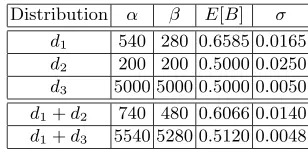
expected value will move. However, the relationship between the change in the expected value, and the standard deviation is non-linear. Consider as an example three distributions d1, d2 and d3, with shape parameters, expected value and
standard deviation (denotedσ) as shown in Table 1; the results of combiningd1
[image:10.595.227.381.211.287.2]with each of the other two distributions are shown in the last two rows.
Table 1.Example beta distributions and the results of combining them
Distribution α β E[B] σ d1 540 280 0.6585 0.0165
d2 200 200 0.5000 0.0250
d3 5000 5000 0.5000 0.0050
d1+d2 740 480 0.6066 0.0140
d1+d3 5540 5280 0.5120 0.0048
As can be seen, distributionsd2 and d3 have identical expected values with
standard deviations of 0.025 and 0.005 respectively. Although the difference be-tween these values is small (0.02), the result of combining d1 with d2 is quite
different from combiningd1andd3. Whereas the expected value in the first case
falls approximately between the expected values ford2andd1, in the latter case,
the relatively small parameter values of d1 compared to d3 mean thatd1 has
virtually no impact on the combined result. Obviously, the reason for this is due to our method of reputation combination (Equation 8), in which the parame-ter values are summed. This is an important observation because it shows how, if left unchecked, an unfair rater could purposely increase the weight an agent puts in its opinion by providing very large values for m and n, which in turn determineαandβ.
In light of this, we adopt an approach that significantly reduces very high parameter values unless the probability of the rater’s opinion being accurate is very close to 1. Specifically, we reduce the distance between the expected value and standard deviation of the rater distribution, and the uniform distribution,
α=β = 1, which represents a state of no information; we denote the standard deviation of this uniform distribution as σunif orm and its expected value as
Eunif orm. Returning to our example scenario of a rater agenta3 providing an
opinion to agent a1 about agent a2, this is performed according to Equations
11 and 12 respectively. In these equations, we use the over-bar, for example ¯
α, to indicate that we are referring to the adjusted distribution. Adjusting the expected value as well as the standard deviation in this way results in a more conservative estimate. This is important in cases in which few more reliable ratings are available to mediate the expected value of the combined reputation.
¯
E=Eunif orm+ρa1,a3·(E−Eunif orm) (11) ¯
adjusted values for ˆma3,a2 and ˆna3,a2. It can be shown that the adjusted param-eter values ¯αand ¯β, can be calculated according to Equation 13 and Equation 14. The new values for ˆma3,a2 and ˆna3,a2 are then given by subtracting the prior parameter settings from the adjusted distribution parameters (Eqn. 15).
¯
α=E¯
2−E¯3
¯
σ2 −E¯ (13)
¯
β =(1−E¯)
2−(1−E¯)3
¯
σ2 −(1−E¯) (14)
¯
ma3,a2 = ¯α−1 , n¯a3,a2 = ¯β−1 (15)
4
TRAVOS in Action
This section provides an agent-based VO scenario in which we demonstrate the use of TRAVOS. We begin by stating that there is a need to create a VO to meet a specific requirement to provide a composite multimedia communication service to an end user. The composite consists of the following basic services: text messaging, HTML content provision and phone calls (this example is taken from [9]). Now, assume agenta1has identified this need and wishes to capitalise on the
market niche. However, a1 only has the capability to provide a text messaging
service. It can only achieve its goal by forming a VO with an agent that can supply a service for phone calls and one for HTML content. For simplicity, we assume that each agent in the system has the ability to provide only one service. Agenta1 is aware of three agents that can provide a phone call service, and its
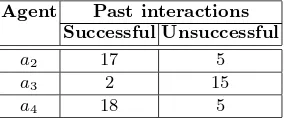
[image:11.595.236.378.513.572.2]interaction history with these is shown in Table 2. Similarly, it is aware of three agents that are capable of providing HTML content, and its past interactions with these entities are given in Table 3.
Table 2.Agenta1’s interaction history with phone call service provider agents
Agent Past interactions Successful Unsuccessful
a2 17 5
a3 2 15
a4 18 5
Table 3.Agenta1’s interaction history with HTML content service provider agents
Agent Past interactions Successful Unsuccessful
a5 9 14
a6 3 0
[image:11.595.234.380.624.683.2]Agent a1 would like to choose the most trustworthy phone call and HTML
content service provider from the selection. The following describes how this is achieved using TRAVOS. Before we calculate which of the possible candidates are the most trustworthy, we must specify certain parameters that a1 requires.
First, we specify the level of error thata1is willing to accept when determining
the confidence in a calculated trust value as = 0.2. Second, we specify that
θγ= 0.95, below whicha
1 will seek other’s opinions about the trustee.
4.1 Calculating Trust and Confidence
Using the information from Tables 2 and 3, a1 can determine the number of
successful interactions n, and the number of unsuccessful interactions m, for each agent it has interacted with. Feeding these into Equation 5,a1 can obtain
shape parameters for a beta distribution function that represents the behaviour of each service provider agent. For example, the shape parameters αand β, for
a2, are calculated as follows:
Using Table 2: na1,a2= 17,ma1,a2= 5.
Using Equation 5: α= 17 + 1 = 18and β= 5 + 1 = 6.
The shape parameters for each agent are then used in Equation 6 to calculate a trust value for each agent that a1 is assessing. For example, the trust value
τa1,a2 fora2 is calculated as follows:
Using Equation 6: τa1,a2= αα+β =
18
18+6 = 0.75.
Fora1to be able to use the trust values it obtains for each agent, it must also
determine the confidence it has in the calculated trust value. This is achieved by using Equation 7 and the variable (which in this scenario has been set to 0.2). For example, the confidence γa1,a2 that a1 has in the trust value τa1,a2 is calculated as shown below:
Using Equation 7:
γa1,a2 =
τa
1,a2− τa1,a2+ B
α−1(1−B)β−1dB 1
0 Uα−1(1−U)β−1dU
=
0.55 0.95 Bα−
1(1−
B)β−1dB
1
0 Uα−1(1−U)β−1dU
[image:12.595.154.465.454.488.2]= 0.98
Table 4.Agenta1’s calculated trust and associated confidence level for HTML content and phone call service provider agents
Agent α β τa1,axγa1,ax a2 18 6 0.75 0.98
a3 3 16 0.16 0.98
a4 19 6 0.76 0.98
a5 10 15 0.40 0.97
a6 4 1 0.8 0.87
a7 19 12 0.61 0.98
The shape parameters, trust values and associated confidence for each agent,
it is clear that the trust values for agents a2, a3 and a4, all have a confidence
above θγ (=0.95). This means that a
1 does not need to consider the opinions
of others for these three agents. Agent a1 is able to decide thata4 is the most
trustworthy out of the three phone call service provider agents and chooses it to provide the phone call service for the VO.
4.2 Calculating Reputation
The process of selecting the most trustworthy HTML content service provider is not as straightforward. Agenta1has calculated that out of the possible HTML
service providers,a6has the highest trust value. However, it has determined that
the confidence it is willing to place in this value is 0.87, which is below that of
θγ and means thata
1 has not yet interacted witha6 enough times to calculate
a sufficiently confident trust value. In this case,a1 has to use the opinions from
other agents that have interacted witha6, and form a reputation value fora6that
it can compare to the trust values it has calculated for other HTML providers (a5 anda7).
Lets assume that a1 is aware of three agents that have interacted witha6,
denoted bya8,a9anda10, whose opinions abouta6are (15,46), (4,1) and (3,0)
respectively. Agent a1 can obtain beta shape parameters based solely on the
opinions provided, by using Equations 9 and 8, as shown below:
Opinions from providers: a8= (15,46), a9= (4,1) anda3= (3,0)
Using Equation 8: N = 15 + 4 + 3 = 22, M = 46 + 1 + 0 = 47
Using Equation 9: α= 22 + 1 = 23, β= 47 + 1 = 48
Having obtained the shape parameters, a1 can obtain a trust value for a6
using Equation 6, as follows:
Using Equation 6: τa1,a6= αα+β =
23
23+48 = 0.32
Nowa1is able to compare the trust in agentsa5,a6anda7. Before calculating
the trustworthiness ofa6, agenta1considereda6to be the most trustworthy (see
Table 4). Having calculated a new trust value for agenta6(which is lower than
the first assessment), agenta1now regardsa7as the most trustworthy. Therefore
a1 choosesa7 as the service provider for the HTML content service.
4.3 Handling Inaccurate Opinions
The methoda1 uses to assess the trustworthiness ofa6, as described in Section
4.2, is susceptible to errors caused by reputation providers giving inaccurate information. In our scenario, suppose a8 provides the HTML content service
too, and is in direct competition with a6. Agent a1 is not aware of this fact,
which makes a1 unaware thata8 may provide inaccurate information abouta6
to influence its decision on which HTML content provider agent to incorporate into the VO. If we look at the opinions provided by agents a8, a9 and a10,
a positive opinion of a6, whereas agent a8 provides a very negative opinion.
Suppose that a8 is providing an inaccurate account of its experiences with a6.
We can use the mechanism discussed in Section 3 to allow a1to cope with this
inaccurate information, and arrive at a better decision that is not influenced by self-interested reputation providing agents (such as a8).
Before we show how TRAVOS can be used to handle inaccurate information, we must assume the following. Agent a1 obtained reputation information from
a8, a9 and a10 on several occasions, and each time a1 recorded the opinion
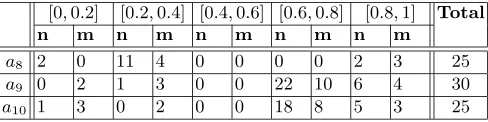
provided by a reputation provider and the actual observed outcome (from the interaction with an agent to which the opinion is applied). Each time an opinion is provided, the outcome observed is recorded in the relevant bin. Agent a1
keeps information of like opinions in bins as shown in Table 6. For example, ifa8
provides an opinion that is used to obtain a trust value of 0.3, then the actual observed outcome (successful or unsuccessful) is stored in the 0.2< E[B]≤0.4 bin.
Using the information shown in Table 6, agenta1can calculate the weighting
to be applied to the opinions from the three reputation sources by applying the technique described in Section 3.1. In so doing, agent a1 uses the information
from the bin, which contains the opinion provided, and integrates the beta dis-tribution between the limits defined by the bin’s boundary. For example, a8’s
opinion falls under the 0.2< E[B]≤0.4 bin. In this bin, agenta1has recorded
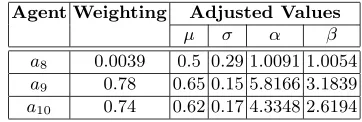
that n = 15 andm = 3. Thesen and m values are used to obtain a beta dis-tribution, using Equations 4 and 5, which is then integrated between 0.2 and 0.4 to give a weighting of 0.0039 for a6’s opinion. Then, by using Equations 11
and 12, agenta1 can calculate the adjusted mean and standard deviation of the
[image:14.595.214.395.473.534.2]opinion, which in turn gives the adjustedαandβ parameters for that opinion. The results from these calculations are shown in Table 5.
Table 5.Agenta1’s adjusted values for opinions provided bya8,a9 anda10
Agent Weighting Adjusted Values
µ σ α β a8 0.0039 0.5 0.29 1.0091 1.0054
a9 0.78 0.65 0.15 5.8166 3.1839
a10 0.74 0.62 0.17 4.3348 2.6194
Summing the adjusted values forαandβ from Table 5,a1can obtain a more
reliable value for the trustworthiness of a6. Using Equation 4, a1 calculates a
trust value = 0.62 for a6. This means that from the possible HTML content
providers,a1now seesa6 as the most trustworthy and selects it to be a partner
in the VO. Unlikea1’s decision in Section 4.2 (when a7 was chosen as the VO
Table 6.Observations made bya1given opinion from a reputation source.nrepresents that the interaction (to which the opinion applied) was successful, and likewisemmeans unsuccessful
[0,0.2] [0.2,0.4] [0.4,0.6] [0.6,0.8] [0.8,1] Total
n m n m n m n m n m
a8 2 0 11 4 0 0 0 0 2 3 25
a9 0 2 1 3 0 0 22 10 6 4 30
a10 1 3 0 2 0 0 18 8 5 3 25
5
Related Work
There are many computational models of trust, a review of which can be found in [10]. Generally speaking, however, models not based on probability theory (e.g. [6, 11, 8]) consist of calculating trust from hand-crafted formulae that yield the desired results. For the purpose of our work, we only consider models that are similar to TRAVOS in the manner of calculating trust.
Probabilistic approaches are not commonly used in the field of computational trust, but there are a couple of such models in the literature. In particular, the Beta Reputation System (BRS) [7] is a probabilistic trust model like TRAVOS, which is based on the beta distribution. The system is specifically designed for online communities and is centralised. It works by users giving ratings to the performance of other users in the community. Here, ratings consist of a single value that is used to obtain positive and negative feedback values. The feedback values are then used to calculate shape parameters that determine the reputation of the user the rating applies to. However, BRS does not show how it is able to cope with misleading information.
Whitby et al. [12] also build on the BRS and show how it can be used to filter unfair ratings, either unfairly positive or negative, towards a certain agent. In their model, the ratings for an individual are stored in a vector, which is then used to obtain an aggregated reputation value for that individual (represented as a beta distribution). However, this method is only effective when there are sufficient ratings to allow successful identification of unfair ratings. Filtering in this manner disregards the possibility of ratings that may seem unfair, but which truthfully represent the perspective of the rater (as the rater may have an inaccurate view of the world). In TRAVOS, no opinion is disregarded, and, instead, the consistency between the reputation provider’s opinion and the actual behaviour of an individual to which the opinion refers forms the weight that is to be placed in opinions provided by that particular reputation source.
6
Conclusions and Future Work
for assessing the trustworthiness of others in situations both in which the agents have interacted before and share past experiences, and in which there is little or no past experience between the interacting agents. Establishing the trustworthi-ness of others, and then selecting the most trustworthy, gives an agent the ability to maximise the probability that there will be no harmful repercussions from the interaction. In particular, through the example scenario, we have demonstrated how TRAVOS can be used to handle inaccurate opinions expressed by reputation providers. Here, reputation providers are requested to provide opinions about a certain individual when an agent is not confident in the amount of evidence it has in order to assess the trustworthiness of that individual. In this situation, it is particularly important that the opinions that are given are accurate and based on past experiences. By using TRAVOS, an agent ensures that opinions from inaccurate reputation sources are not given equal weighting to those from accurate sources in the aggregation of reputation. This gives the agent the ability to handle inaccurate information effectively.
In the short term, we will be carrying out empirical analysis on TRAVOS, and evaluating it against similar approaches. As it stands, TRAVOS assumes that the behaviour of agents does not change over time, but in many cases this is an unsafe assumption. In particular we believe that agents may well change their behaviour over time, and that some will have time-based behavioural strategies. Future work will therefore include the removal of this assumption and the use of functions that allow an agent to take into account the fact that very old experiences may not be relevant in predicting the behaviour of an individual. In addition we will extend the model to represent a continuous outcome space, instead of the current binary outcome space. Further extensions to TRAVOS will include using the rich social metadata that exists within a VO environment in the calculation of a trust value. Thus, as described in Section 1, VOs are social structures, and we can draw out social data such as roles and relationships that exist both between VOs and VO members. The incorporation of such data into the trust metric should allow for more accurate trust assessments to be formed.
References
1. S. Buchegger and J. Y. L. Boudec. A robust reputation system for mobile ad-hoc networks ic/2003/50. Technical report, EPFL-IC-LCA, 2003.
2. M. DeGroot and M. Schervish. Probability & Statistics. Addison-Wesley, 2002. 3. C. Dellarocas. Mechanisms for coping with unfair ratings and discriminatory
be-havior in online reputation reporting systems. InICIS, pages 520–525, 2000. 4. I. Foster, N. R. Jennings, and C. Kesselman. Brain meets brawn: Why grid and
agents need each other. InProceedings of the 3rd Int. Conf. on Autonomous Agents and Multi-Agent Systems, pages 8–15, 2004.
7. R. Ismail and A. Jøsang. The beta reputation system. InProceedings of the 15th Bled Conference on Electronic Commerce, Bled, Slovenia, 2002.
8. A. Moukas, G. Zacharia, and P. Maes. Amalthaea and histos: Multi-agent systems for www sites and reputation recommendations. In M. Klusch, editor,Intelligent Information Agents, chapter 13. Springer-Verlag, 1999.
9. T. J. Norman, A. Preece, S. Chalmers, N. R. Jennings, M. Luck, V. Dang, T. D. Nguyen, V. Deora, , J. Shao, A. Gray, and N. J. Fiddian. Agent-based formation of virtual organisations. Knowledge-Based Systems, 17(2–4):103–111, May 2004. 10. S. D. Ramchurn, D. Hunyh, and N. R. Jennings. Trust in multi-agent systems.
Knowledge Engineering Review, 19(1), 2004.
11. J. Sabater and C. Sierra. Regret: A reputation model for gregarious societies. In