Reduced-Complexity Near-Optimum Genetic Algorithm Assisted Multiuser Detection for Synchronous Multicarrier
CDMA
Hua Wei and Lajos Hanzo
School
of
ECS, University of Southampton, SO17 IBJ, UK. Tel: +4423-8059-3125, Fax: +4423-8059-450XEmail:lh'@ecs.soton.ac.uk, http://www-mobile.ecs.soton.ac.uk
Abmocr-In this contribution B Geneti< Algorithm (CA) assisted Multiuspr De- lector (MUD) designed for MC-CDMA is inuetigated in the center1 of freqrequency selective Rnyloigh fading cham&. The achievable BER pgrformtnce of the CA as.
&led MUD as well ss ill nearfar resisfElnco are invetigaled for a range of parame- ter values. It is shown thal the p m p d CA assisted MUD is capable ofsignifionlly
redvciq, the complexity in compariran lo LLI of Verdu'i optimum MUD. For exam- ple, when supporting K = 20 WIS. the number of l i b l i h d hnrtian evalu3ifiom is reduced by a factor of 1300.
I. MTRODUCTION
Multicanier CDMA (MC-CDMA) [I-31 is a novel transmission technique, which combines DS-CDMA and Orthogonal Frequency Division Multiplexing (OFDM) L4-71. In MC-CDMA system, in- stead of applying spreading sequences in the time domain for spread- ing each hit, we employ spreading sequences in the frequency do- main. Hence, we are capable of achieving frequency diversity gain at the cost of a Educed spreading gain. Numerous Multiuser Detec- tion (MUD) schemes have been proposed in the literature [X-IO]. The Minimum Mean Square Error (MMSE) MUD has been described for example in [3,8], while an Interference Cancellation (IC) based MUD has been proposed in [3,9].
In [ I l l , the Maximum Likehood (ML) MUD designed for MC-
CDMA has been considered. In this specific MUD, the receiver con- shucts all the possible combinations of the transmitted signals of all users and employs the estimated channel uansfer function for gener- ating all the possible received signals, in order to find the one, which has the smallest Euclidean distance from the received signal. Hence, the ML detection based MUD designed for MC-CDMA is capable of achieving a near-single-user performance. However. it requires the calculation of the 2K number of possible received signal comhina- tions of the K users supported in conjunction with Binary Phase Shift Keying (BPSK) modulation. In other words, the ML detection based MID'S complexity will increase exponentially with the number of users K. Hence the complexity imposed will become excessive, when the number of users K is high. Therefore, in this treatise we will in- voke Genetic Algorithms (CA) [12. 131 for reducing the complexity of the ML detection based MUD employed in MC-CDMA system. The CA-based MUD was first proposed by Juntti er al. [I41 for a syn- cluonous DS-CDMA system communicating over an Additive White Gaussian Noise (AWGN) channel. Yen ef al. [3] [15-17] funher im- proved the performance of the CA-based MUD. demonstrating that the performance of the CA-based MUD approaches the single-user performance bound at a significantly lower compumional complex-
Achowldgcmentr: me work rrpavd in h i s w rhrr ro-d p? of & Wirplrrr Ennbllng TeL- niiqutr work m a 01 Ulr Cnc 2 Rcranrch P m g m m e of Ur vlmul Cemc ofrrcrllrnce in Mobile and
Per" Communicmionr. Mobile VCE. www.mobilescc.mm. uhorr funding N ~including UIP R o t EPSRC. ii -fully achnoulcdgcd. F d y deeded rechnicd rrpm 00 &is rewvch wdulrbk ID Indurvid Mcmkrr ofMohilr VCE.
I I /
Fig. 1. m umsminer of B MC-CDMA system
ity. than that of Verdu's optimum MUD [IS]. In our investigations we assume that each subcanier obeys independent Rayleigh fading. More explicitly, we will investigate the performance of this specific C A assisted MUD as a function of the affordable detection complex- ity.
This contribution is organized as follows. Section I1 describes the model of the synchronous MC-CDMA system considered. Section 111 highlights the operating principle of the GA assisted MUD designed
for a synchronous MC-CDMA system, while Section IV characterises the achievable performance. Finally, Section V offers our conclu- sions.
n.
TRANSMITTERLet us consider the bit-synchronous MC-CDMA system illustrated in Figure 1, which employs both time- nndfreqaency-dornoin spread- ing. More explicitly, observe in Figure I that the ith hit b f ) of the kth user is spread in the frequency-domain to M parallel subcar- riers, each conveying an N-chip time-domain spreading sequence ck,,,,(t), m = 1,.
.
.
,
h.1 spanning the bit-duration (0,Tb).
Hence we have TbIT, = N, whereTa
andT,
are the bit duration and chip duration, respectively. Each of the M N-chip time-domain spread- ing sequences is mapped to a different subcanier. In other words. a single-carrier system occupying the same bandwidth a the multicar- rier system considered would use a spreading sequence having NM chips/bit, and both of these systems have a processing gain of NM.Hence. the transmitted signal of the kth user associated with the m t h subcanier can be expressed in an equivalent lowpass representation
[image:1.614.328.531.179.361.2]where Ebk is the kth user's signal energy per bit. Furthermore, b r ) E
(1, -I), I; = 1,
. . . ,
h7 denotes the ith transmitted bit of the kth user, while the kth user's signature waveform is c k , , ( t ) , k = 1 , .. .
,
h'. m = 1,.. . ,
A J that is assigned to the mth subcarrier, which again has a length of N chips, yielding:N-1
cr.,(t) =
c
$,,p(t - nTJ, m = 1,. ..
, M ,
(2).l=D
where T, is the chip duration. N is the number of chips per hit asso- ciated with each subcarrier and we have Tb/T, =
N.
Again, the total processing gain is N M , while p ( t ) is the rectangula chip waveform employed. which can be expressed as:1 O < t < T ,
o
otherwise. (3)Without loss of generality, we assume that the signature waveform
ck,,(t) used for spreading the hits to N chips in the time-domain and mapping them to a total of M suhcaniers in the frequency-domain for
all the K users has unity energy, which can be written as:
cZ,,(t)dt = 1 k = l , . . . , K , m = 1
, . _ . ,
M . (4)Each user's signal sc,,(t) transmitted on the mth suhcanier is as-
sumed to propagate over an independent non-dispersive single-path Rayleigh fading channel and the fading envelope of each path is statis- tically independent for all the users. Hence, the single-tap narrowband Channel lmpulse Response (CIR) of the kth user on the m t h suhca-
"er can be expressed as: yk,,S**,-, where the amplitude ~ k , , is
a Rayleigh distributed random variable. while the phase $hr,m is uni- formly distributed between [0,2~).
Having described the transmitter and the channel, the received sig- nal on the mth subcarrier can be expressed as:
lTb
( 5 )
where
h
'
is the number of users supported and n(t) is the Gaussian noise process with a variance of N0/2. [image:2.617.325.511.71.247.2]IIL
GA ASSISTED MUD FOR MC-CDMAFigure 2 shows the schematic of the GA assisted MUD employed in a synchronous MC-CDMA system. The first step of the receiver's operation is the demodulation of all the subcanier signals. This is followed by Matched Filtering (MF') for each of the K users and the outputs of the K users' matched filters are input to the CA-based MUD. It is more convenient to express the associated signals in mauix and vectorial formats, when the sum of the trmsmitted signals of all users can be expressed as:
r,(t) = C,W,Ab
+
n, ( 6 )C I < . A I ( t )
Fig. 2 . Schcmtic ofrhe GA wsisled MUD aided MC-CDMA bwe station meivcr
where we have
cm
= [ C l , m ( t ) > .. .
,CK,m(t)] W, = diag[yl,,&'.'",. . .
,?~,,d"+'"A = d i a g [ e g . . , * ] (7)
b = (bi,
...,
b K ]n = [ n l , . . .,nK]'.
Based on Equation 6 , the output vector 2, of the hank of matched filters pomayed in Figure 2 can be formulated as [ I X ] :
(8)
zm
= [Zl,,,...,
ZK.",]= R,W,Ab+n
where we have
and the elements p::) of the m u i x R, are the auto- and cross- correlation of the spreading code, which can be expressed as:
/I;,)=
lTb
C3,m(t)Ck,m(t)dt. (10)According to [I51 [ I X ] , the optimum multiuser detector of the mth subcarrier will maximize the following objective function:
R,(b) = 2Re[bTAW,Z,] - bTAW,R,W,Ab, (11)
where the superscript
*
indicates the conjugate complex version of a mauix. Therefore, combining the contributions of a total of Af par- allel subcaniers. the objective function to he maximized in the con- text of an optimum multiuser detected MC-CDMA system can k ex- [image:2.617.314.532.402.507.2]BinSW niubtioo
.
FimsValvrE"d"PS0"
pressed as:
(12) A I
= x { 2 R e [ b T A W , Z , ] -
bT%,
R
,
W: A b}Hence the decision rule for Verdu's optimum CDMA multiuser detection scheme based on the maxinium likelihood criterion is to choose the specific K-user bit combination b , which maximizes the metric of Equation 12. Hence. we have to find
(13)
The maximization of Equation 12 is a combinatorial optimisation problem, which requires an exhaustive search for each of the J = ZK combinations of b. in order to find the one that maximizes the metric of Equation 12. Explicitly. since in case of binary mansmissions there are J = 2" possible combinations of b, the optimum multiuser de- tector has a complexity that increases exponentially with the number of users IC.
Hence, we invoked a GA for finding a solution near to the maxi- mum of the objective function defined by the metric of Equation 12 without an exhaustive search. Again, the legitimate solutions are the
THE
I
P a r a m e t e nTABLE I
$SIC SLMULATTION PARAMETERS USED BY THE GA ASSISTED M U D
MC-CDMASYSTEM
AIDED
J = 2" number of possible combinations of the K-bit vector b. During the CA's operation, each individual of the GA [IS] will o k e the form of a K-bit vector corresponding to the K users' uansmit- ted hits during a single hit interval. which can be denoted for the pth individual of the G A as b,(y) = (6p,l(y),
.
. .
,6,,ti(y)]. wherey, y = 1,.
. .
.
Y denotes the yth generation, and p, p = 1,.. .
,
P
denotes the pth individual in the CA's mating pool.
We creme the initial biased population with the aid of the Maximum Ratio Combining (MRC) based matched filter outputs, which are suh- jected to hard decision, rather than randomly generating the initial population at the commencement of a GA assisted search. Explic- itly, according to [I]. the MRC-combined ou!put vector ~ M R C of the matched filter output can be expressed as: bnrnc = [bl,.blnc,.
. .
,
b,i,wnc], where we have:A,
* = 1
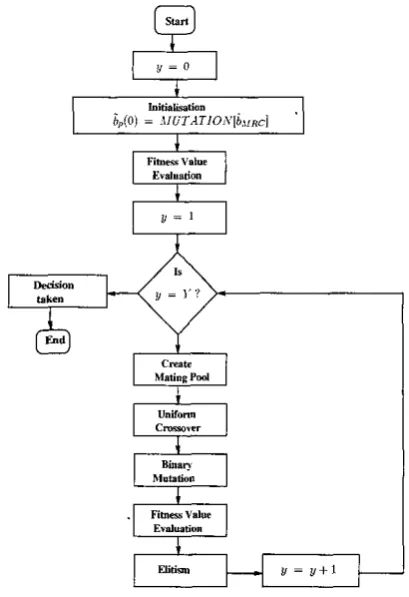
Having generated b n r ~ c . we adopt n 'mutated version of the hard decision vector b n i R c for creating each individual in the initial pop- ulation, where each bit of the vector b n r n c is toggled according to the mutation probability used. Hence, the first individual of the pop- ulation, namely bp(0). can he written as:
6,(0) = M U T A T I O N [ ~ A I R ~ ] , (15)
To elaborate a little further, Figure 3 shows the flowchart of the GA assisted MUD, which follows the philosophy of [3.16]. We will char- acterise the performance of the G A assisted MUD in the following section.
IV.
PERFORMANCE OF GA ASSISTED MUD AIDEDSYNCHRONOUS MC-CDMA
The basic parameters of the GA used in our simulations a x listed in Table 1. Let us first relate the achievable performance of the pro- posed CA-aided MUD to that of the well-understood M-algorithm (MA) in Figure 4. when communicating over B non-dispersive Gaus-
sian channel. More specifically, the system studied employed a ran- dom spreading code having a length of N = 31 in the context of
[image:3.613.82.287.68.367.2]f
X
W
m
X Y
m
Eb/NOIdml E b / l a t d B l
fig. 4. BER performance of lhe GA and MA assisted MUDS for lranrmission OYU
AWGN channel in c o n j ~ c ~ i c m with merent detection-complexity conli,ourations of
P . Y = M . K , whenrupponing K = 10 US=. All the otherpwvneam a x
described in Table 1.
Fig. 6. BFR performance ofthe GA assisted MUDdesigned for a bit-synchronous MC-
CDMA system. using r 32-chip Wash code The number of U Y ~supponed was IC = 20. Then~mkr~fgcneralionrwaiY = 10andIhepapulrlionsilewasP = 40, 80, 120, 160 and 200. The remaining pvrvmeterr ar specified in Table 1.
The number of r u k m i c n war A f = 4 and each sukurrier experienced vncomlaled nanowbandRayleigh fading. The complexity d u c t i o n faclorwas Z K / ( P . Y ) .
P;)oY=lo
+
p-4oY=10+
100
* * / E L k = U d B . * = z , . . .
10-1 L * / E b l r = l O d B , L = z , ... A-
10-2
m
10-3
10 I S 20
10-6
E ~ / N o l a l
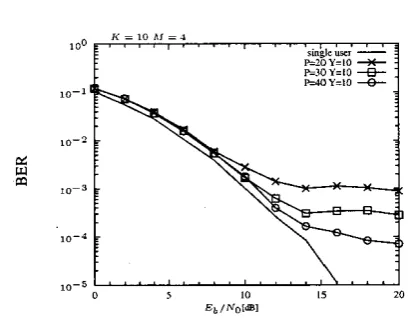
Fix. 5. BER performance Of lhe CA arrirled MUD &signed for a bit-synchronous MC- CDMA system. using a 32ihip Wdsh code. The number of US= supponed war li = 10. The number of generations wa! Y = 10 and the populdion size was P = 20, 30and.10.Theremainingprrhm~lrrsarsspec~edinTableI. Thenumber of subcadem was A I = 4 and each svkarricrcrpolcnced uncomlated n m w b a n d Rayleigh fading. The mmplexiry d w t i o n factor wDs Z K / ( P . Y).
BPSK modulation. For the sake of comparison, the GA-aided and the M-algorithm systems concerned were configured for maintaining
a similar complexity. SpecificaVy, the GA-aided evaluates its objective function seen in Equation 11 (P
.
Y) number of times. By contrast, it can be shown that the MA-based MUD requires ( K.
M )number of objective function evaluations, although we note that its objective function is different from that of the C A and was not explic- itly included here for reaons of space economy. As seen in Figure 4 for the specific scenario of K = Y, the GA-aided MUD outperforms the M-algorithm, when we have M = P
5
ooJwhich justifies our GA-based investigations.From Figures 5 and 6 we observe that the GA assisted MUD'S per- formance improves, when the population size P increases. For ex- ample, for EslNo values below 14dB a near-single-user performance can be achieved for K = 10 users, when evaluating the objective function of Equation 12. which imposes a complexity on the order of O(P
.
Y ) = O(40. 10) = O(400). as seen in Fig 5 . Further-10-4
[
10 I 5 20
Ea/Notdml
Fig. 1. BFR performance of the GA assisted MUD dsripcd for a hit-synchronous MC- CDMA system when Ihe power of lhe interfering w m was varied
.
The number ofusers supponed was K = 10. The number of snerations was Y = 10 and the population size was P = 40. The miio of lhe reference use^ to interfering uec power was = 0 , 6 . IOdB, k = 2 . . . . , K . mp?ectiveiy. The remaining pmnetcn ar s p e c s 4 in Table 1. me number of sukurrias war "4 = 4 and each
sukmier experienced uncomlared n m w b a n d Rayleigh fading. 'The compleriry
b*
ductionfactorwuas 2 " / ( P . Y).
more, when the number of users K is increased to 20, the GA assisted MUD has a complexity of O(P
.
Y) = O(160. 10) = O(1600). as [image:4.612.316.532.58.212.2] [image:4.612.79.281.67.212.2]seen in Fig 6. We can see in Figure 7 that the GA assisted MUD is also near-far resistant, provided that we perfectly know the channel parameters. More explicitly, the GA assisted MUD exhibits a high robustness against power control errors. Figure 8 shows the BER per- formance as a function of the number of users h'. We can infer from Figure 8 that the GA assisted MUD required a population population size P in excess of 80 for achieving a near-single-user performance, when the number of users K is higher than 14. We can observe in Figure 9 that GA assisted MUD is capable of significantly reducing the complexity of Verdu's optimum MUD. For example, the complex- ity was reduced by a factor of 1300, when the number of users was
[image:4.612.76.281.70.411.2] [image:4.612.75.282.254.413.2] [image:4.612.314.516.293.431.2]W m
Fig. 8. BERperformanceaf~eGArrriiledMliDasa~rdonof~henumherofuprr K
lorthepopulaiunsiierofP = d o . 80, 120. 160, 2 0 0 , a n d f o r Y = 1Ogener- ationr. We had Ea/A‘o = lUdB. The remaining pvvnelers are specihed in Table I. The number of sukanien was AI = 3 und each aubemimer experienced unmmlated nmnwbmd Rayybigh fadin%. The compleriry reduction factor w35 Z K / ( P . V).
20 Numtmoiuwa K
Fig. 9. The compleriry reduction faclor of
&
was defined as fhe m i 0 of the nvmkr of objective h c t i o n ~ompufaiions nq-d for appmachiog the single-uwr bound at rBFRof lO-’.when ~~mmvnicingovcrr-chmnousenvlmnmenr. where P i sthe population size, and Y is fhe number Of genentions. while K is the number of supponed. The remrinig prrameleo are spccihed in Table I.
h‘
= 20.V. CONCLUSIONS AND FUTURE WORK
In conclusion, the G A assisted MUD is capable of significantly reducing the detection complexity in comparison to Verdu’s optimum MUD. especially when the number of users supported is higher than
K = 15. When channel coding techniques are employed, the GA assisted MUD has the potentid of funher reducing the complexity imposed. Our future work will comparatively study the performance versus complexity trade-offs of F A versus M-Algorithm [I91 based MUDS. Another important area of further study is the employment of multilevel modulation schemes both with and without various trellis coded error protection schemes.
VI. REFERENCES
[I] R. Prasad and S. Hara, “Overview of multicanier CDMA,”IEEE Communicurions Maga:ine, pp. 126-1 33, December 1997.
121 R. Prasad and S.
H a ,
“Overview of multi-carrier CDMA,” in Pmceedings of rhe IEEE Inremarional Symposium on Spread Spectrum Techniques and Applicarions (ISSSTAJ, (Mainz, Ger- many), pp. 107-1 I?. 22-25 September 1996.L. Hanzo, M. Munster, B. J. Choi, and T. Keller, OFDM and MC-CDMA. John Wiley and IEEE Press, 2003,960 pages. L. Hanzo, L. L. Yang. E. L. Kuan. and K. Yen, Sirigle- and Mulri-Currier CDMA. John Wiley and IEEE Press, 2003. 1070 pages.
L. Hanzo, W. Webb, and T. Keller. Single- and Mulri-carn‘er Quadrarure Amplirude Modularion. John Willey & Sons, Ltd, 2000.760 pages.
J. Bingharn, “Multicarrier modulation for data transmission: An idea whose time has come:’ IEEE Communications Magazine. pp. 5-14, May 1990.
S. Weinstein and P. Eben, “Data Trasmission by freqency- division multiplexiing using the discrete Fourier transform,” IEEE Transcations on Com,nunicarions Terlinolugy vol. 19, pp. 628-634, Oct 1971.
S. L. Miller and B. I. Rainbolt, “MMSE Detection of Multicar- rier CDMA:’ IEEE Jounial on Selected Areas in Cornmunica- rions, vol. 18. pp. 2356-2362. Nov 2ooO.
P. Zong, K. Wang, and Y. Bar-Ness. “Partid Sampling MMSE Interference Suppression in Asynchronous Multicariner CDMA System:’ IEEE Jounial on Selected Areas in Communicarions.
vol. 19, pp. 1605-1613, August 2001.
[IO] X. Cui and T. S. Ng, “Pelfornu” of Asynchronous Onhog- o n 4 Multicanier CDMA System in Freqencey Selective Fad- ing Channel:’ IEEE Transucrions on Communications, vol. 47, pp. 1084-1091. July 1999.
[ I l l M. Schnell and S. Kaiser, “Diversity Considerations for MC- CDMA S y s t e m in Mobile Communications,” in Proceedings OfIEEEISSSTA 1996, pp. 131-l35,1996.
[I21 D. E. Goldberg, Genetic Algorithms in Search, qprimizarion, andMachineLeaming. ISBN0201 157675. MA U S A Addison- Wesley, August 2001.
I131 M. Mitchell, An Inrmducrion to Generic Algorithms. Cam- brdige, Massachusetts: Ml? Press, 1996.
[I41 M. J. Juntti, “Genetic Algorithms for Multiuser Detection in Synchronous CDMA:’ IEEE lnremarional Symposium on Infor- marion T h e o p , p. 492, 1997.
1151 K. Yen and L. Hanzo, “Hybrid Genetic Algorithm Based Mul- tiuser Detection Schemes for Synchronous CDMA Systems,” in Pmceedings 51st IEEE Veliicular Technology Conference, (Tokyo, Japan), pp. 14W1404. 18 May 2000.
[I61 K. Yen and L. Hanro. “Genetic algorithm assisted joint mul- tiuser symbol detection and fading channel estimation for syn- chronous CDMA systems:’ IEEE Joumal on Selected Areas in Communicarions. vol. 19, pp. 985 -998, June 2001.
[I71 K. Yen and L. Hanzo, “Genetic algorithm assisted multiuser de- tection in asynchronous CDMA communications:’ in Pmceed- ings of the IEEE Inremotional Conference on Conimunicarions. vol. 3 , pp. 826 -830.2001,
131
14)
(51
[6]
[7]
181
191
[I81 S. Verdu, MulriuserDetecrion. Cambridge Press, 1998. [I91 L. Wei, L. K. Rasmussen, and R. Wynvas, “Near Optimum
Tree-Search Detection Schemes for Bit-Synchronous Multiuser CDMA Systems over Guassian and Two-Path Raylei&-Fading Channels:’ IEEE Transactions on Communicarions, vol. 45, pp. 691-700, June 1997.
[image:5.613.86.288.69.210.2] [image:5.613.83.288.227.420.2]