City, University of London Institutional Repository
Citation
:
Zhu, R. ORCID: 0000-0002-9944-0369 and Xue, J-H. (2017). On the orthogonaldistance to class subspaces for high-dimensional data classification. Information Sciences, 417, pp. 262-273. doi: 10.1016/j.ins.2017.07.019
This is the accepted version of the paper.
This version of the publication may differ from the final published
version.
Permanent repository link:
http://openaccess.city.ac.uk/id/eprint/20734/Link to published version
:
http://dx.doi.org/10.1016/j.ins.2017.07.019Copyright and reuse:
City Research Online aims to make research
outputs of City, University of London available to a wider audience.
Copyright and Moral Rights remain with the author(s) and/or copyright
holders. URLs from City Research Online may be freely distributed and
linked to.
City Research Online: http://openaccess.city.ac.uk/ [email protected]
On the orthogonal distance to class subspaces for
high-dimensional data classification
Rui Zhua, Jing-Hao Xuea,∗
aDepartment of Statistical Science, University College London, London WC1E 6BT, UK
Abstract
The orthogonal distance from an instance to the subspace of a class is a
key metric for pattern classification by the class subspace-based methods.
There is a close relationship between the orthogonal distance and the residual
standard deviation of a test instance from the class subspace. In this paper,
we shall show that an established and widely-used relationship, between the
residual standard deviation and the sum of squares of the residual PC scores,
is not precise, and thus can lead to incorrect results, for the inference of
high-dimensional data which nowadays are common in practice.
Keywords: Classification, high-dimensional data, orthogonal distance,
principal component analysis (PCA), soft independent modelling of class
analogy (SIMCA).
1. Introduction
1
In class subspace-based classification methods, a subspace is first learned
2
in the training phase for each class separately from its training data. Then in
3
∗Corresponding author. Tel.: +44-20-7679-1863; Fax: +44-20-3108-3105 Email addresses: [email protected](Rui Zhu),[email protected]
the test phase, these learned class subspaces are utilised to predict the label
4
of a new test instance, by comparing the distances from the test instance to
5
the class subspaces, in terms of certain distance metrics. For example, in a
6
widely-used classifier for spectral data called soft independent modelling of
7
class analogy (SIMCA) [28], principal component (PC) subspaces are learned
8
for individual classes. Similar to SIMCA, another popular PCA-based
clas-9
sification approach has been extensively adopted in process control in
engi-10
neering, such as fault detection and diagnosis [20, 16, 15, 25]. Besides
classi-11
fication methods, some clustering methods also aim to seek low-dimensional
12
subspaces for better clustering results [13, 23, 22].
13
In the above two classification approaches, associated with the PC
sub-14
spaces, two distance metrics (or statistics) are often adopted to achieve
pat-15
tern classification [3, 17, 18, 20, 16, 15, 25, 29]: 1) the orthogonal distance
16
(OD), also known as the Q-statistic or the squared prediction error, i.e. the
17
squared orthogonal Euclidean distance from a test instance to a PC subspace;
18
and 2) the score distance (SD), also known as the Hotelling’s T2 statistic,
19
i.e. the squared Mahalanobis distance from the projection of a test instance
20
to the centre of a PC subspace [17]. The distributions of OD and SD have
21
also been studied extensively, in order to find a proper acceptance area for
22
classification; recent work includes [17], [18], [19], [30] and [21]. Also in
23
recent years, a linear combination of these two distances is often used to
24
classify a test instance: the test instance is assigned to the class with the
25
minimum value of the linear combination [3].
26
There is a close relationship between the OD (from a test instance to a
27
class subspace) and the residual standard deviation of the test instance to
the class subspace. Moreover, Maesschalck et al. [9] show that the residual
29
standard deviation based on the residual matrix can be equivalently
calcu-30
lated from using the residual PC scores based on the PC score matrix. This
31
work has been cited over a hundred times, including methodological
develop-32
ments [4, 10, 8], reviews [24, 14] and applications [5, 2, 6, 27, 7]. The recent
33
work studying the distributions of OD and SD [17, 18, 19] also adopted the
34
formulae in [9] following [10].
35
However in this paper, we shall point out that the relationship presented
36
in [9], between the residual standard deviation and the sum of squares of the
37
residual PC scores, is notprecise for the inference of high-dimensional data.
38
To distinguish the training and test scenarios, we shall establish the
no-39
tation of two ODs, respectively, as follows.
40
1. The OD vk,l from the training instance l to the subspace of class k
41
that was learned from all training instances. It is closely related to
42
the residual standard deviation sk,0 of class k, which will be defined in
43
Section 2.1.
44
2. The OD vk,new from the new test instance to the subspace of class k.
45
It is closely related to the residual standard deviationsk,new of the new
46
test instance to class k, which will be defined in Section 2.2.
47
In short, the difference between vk,l and vk,new is that vk,l is the OD for the
48
training instance while vk,new is the OD for the test instance.
49
The contributions of this paper are as follows. First, although
Maess-50
chalck et al. [9] establish formulae for sk,0 and sk,new using the residual PC
51
scores, we shall show that their formula for sk,new is only precise when the
52
training data of classkhave more instances than predictor features, i.e. when
the number of instances (denoted bynk) is larger than the number of features
54
(denoted by p). In other words, we shall show that, when the training data
55
of class k are high-dimensional (i.e. nk ≤ p, also called “large p, small n” in
56
the statistical literature), the calculation of sk,new in [9] is not precise.
57
Second, because of the above results, we shall point out that, for
high-58
dimensional data, although the OD vk,l can be accurately calculated by
fol-59
lowing the (precise) formula of the residual standard deviation sk,0 in [9],
60
the OD vk,new cannot be accurately calculated by following the (imprecise)
61
formulae of the residual standard deviation sk,new in [9]. Consequently,
in-62
ference results of the studies that calculated the ODs for high-dimensional
63
data using the formulae in [9] can be imprecise.
64
Because nowadays high-dimensional data are commonly present in
pattern-65
recognition tasks, it is of great interest to practitioners to point out the
im-66
precise calculation of the ODs for high-dimensional data if we follow the
67
formulae in [9], as well as to suggest that the formulae in [28] should be
68
adopted in this “large p, small n” paradigm.
69
2. The calculations of OD in [9]
70
The following calculations are all for class k. The subscripts p, q and r
71
denote the number of columns in matrices U,D,V andT; for example,Vp
72
indicates that there are pcolumns in matrix Vp of class k.
73
2.1. The training phase of class k
74
Suppose X ∈ Rnk×p is the training set of class k, in which there are n
k
75
training instances (or say training samples) and each instance is represented
apply the reduced singular value decomposition (SVD) to the column-centred
78
training set X(c):
79
X(c)=UqDq(Vq)T , (1)
where Uq ∈Rnk×q and Vq ∈ Rp×q are the two matrices containing left and
80
right singular vectors as columns, respectively, and Dq ∈Rq×q is a diagonal
81
matrix with singular values {λ1 ≥ λ2 ≥ · · · ≥ λq ≥ 0}. The parameter
82
q ≤min(p, nk−1) is the rank of X(c).
83
In PCA, the rows of Tq = UqDq ∈ Rnk×q are known as PC scores and
84
the columns of Vq are known as PCs. Suppose the first r (r ≤ q) PCs are
85
selected to build the PC subspace for class k, then
86
X(c) =Tr(Vr)T +E , (2)
whereTr ∈Rnk×r;Vr∈Rp×r; andE∈Rnk×pis the training residual matrix
87
of class k.
88
In [9], the residual standard deviation of classkis expressed in two forms:
89
sk,0 =
v u u t
1 DoFk,0
nk
X
l=1
p X
j=1
(elj)2 = v u u t
1 DoFk,0
nk
X
l=1
q X
i=r+1
(tli)2 (3)
where DoFk,0 = (q−r)(nk−r−1), elj is the (l, j)-entry of residual matrix
90
E representing the residual of thelth instance for thejth variable, and tli is
91
the (l, i)-entry of score matrix Tq representing the score of the lth instance
92
for the ith PC.
93
The OD from thelth training instance to the subspace of class k,vk,l, is
originally defined as Pp
j=1(elj)
2. Thus Pnk
l=1v
k,l is proportional to (sk,0)2,
95
nk
X
l=1
vk,l = (sk,0)2(q−r)(nk−r−1). (4)
In [9], it follows from (3) that Pnk
l=1v
k,l can be calculated as
96
nk
X
l=1
vk,l =
nk
X
l=1
q X
i=r+1
(tli)2 . (5)
2.2. The test phase for class k
97
In the test (prediction) phase, to decide whether a new instance xnew
98
belongs to class k or not, xnew is first centred by using the means of the
99
variables of the training dataX of classk, and the result is denoted byxk,new(c) .
100
Then projectingxk,new(c) to the PC subspace of classk with the selectedrPCs,
101
we can obtain
102
xk,new(c) =tk,newr (Vr)T +ek,new , (6)
where tk,new
r ∈ R1
×r and ek,new ∈
R1×p are two vectors of the PC score and 103
the residual, respectively, of the new instance when it is fitted to the subspace
104
of class k.
105
In [9], the residual standard deviation of the new instance is also expressed
106
in two forms:
107
sk,new =
v u u t
1
DoFk,new
p X
j=1
(ek,newj )2 =
v u u t
1
DoFk,new
q X
i=r+1
(tk,newi )2, (7)
where DoFk,new = (q−r), ek,newj and tk,newi denote the jth element of the
residual vector ek,new and the ith element of the PC score vector tk,new
r ,
109
respectively.
110
The OD from the new instance to the subspace of class k, vk,new, is
111
originally defined as Pp
j=1(e
k,new
j )2. Thus vk,new is proportional to (sk,new)2,
112
vk,new = (sk,new)2(q−r). (8)
In [9], it follows from (7) that vk,new can be written as
113
vk,new =
q X
i=r+1
(tk,newi )2 . (9)
To determine the class of xnew, the residual standard deviation sk,new
114
of xnew is compared to the residual standard deviation sk,0 of the training
115
instances of classk [9]. The F-test statistic used in [9] to determine whether
116
the two residual variances are significantly different is expressed as
117
Fk,new = (s
k,new)2
(sk,0)2 = Pq
i=r+1(t
k,new
i )2 (nk−r−1)
Pnk
l=1
Pq
i=r+1(tli)2
. (10)
3. Discussion of vk,l and vk,new 118
The calculations forvk,0 andvk,new in [9] use formulae (5) and (9),
respec-119
tively. We shall show that, while formula (5) is correct for both the cases of
120
nk> p and nk ≤p, formula (9) is only valid when nk > p.
121
3.1. vk,l
122
The OD vk,l is originally defined on the basis of the residual matrix E.
123
The calculation of vk,l in (5), which was defined in [9], is on the basis of the
PC score matrix Tr. This is due to the relationship that
125
nk
X
l=1
p X
j=1
(elj)2 =
nk
X
l=1
q X
i=r+1
(tli)2 . (11)
This relationship is true for both the cases of nk> p and nk ≤p, as we shall
126
show in the following two subsections, respectively.
127
3.1.1. nk> p
128
When nk > p, we have q = p (assume that no feature is a linear
com-129
bination of others), and thus Vq ∈Rp×p is a square matrix. It follows that
130
Vq(Vq)T = (Vq)TVq=Ip.
131
Let xl
(c) ∈R
1×p denote the l-th training instance in class k, i.e. the l-th
row of X(c). For every xl(c) (l = 1, . . . , nk), we have xl(c) =x l
(c)Vq(Vq)T and
p X
j=1
(elj)2 =||xl(c)−x l
(c)Vr(Vr)T||22
=||xl(c)Vq(Vq)T −xl(c)Vr(Vr)T||22
=||tlq(Vq)T −tlr(Vr)T||22
=
q X
i=r+1
(tli)2 , (12)
where || · ||2 denotes the Euclidean norm of a vector, and tlq and tlr are the
132
lth row of Tq and Tr, respectively. Therefore (11) and thus (5) are correct
133
when nk> p.
3.1.2. nk≤p
135
Whennk≤p, we haveq= rank(X(c))≤nk−1< p, and thus Vq ∈Rp×q
136
is not square. It follows that (Vq)TVq =Iq but Vq(Vq)T 6=Ip.
137
Suppose we apply the full SVD toX(c):
138
X(c) =UnkDˆp(Vp)
T
, (13)
where Unk ∈ R
nk×nk and V
p ∈ Rp×p denote the two matrices containing nk
139
left and p right singular vectors as columns, respectively, and ˆDp ∈ Rnk×p 140
is a matrix with singular values {λ1 ≥ λ2 ≥ · · · ≥ λnk−1 ≥ λnk = 0} on the
141
main diagonal.
142
To make the explanation more clear, we expand ˆDp ∈Rnk×p to a square
143
matrix Dp ∈ Rp×p by adding zeros because the singular values associated 144
with the last (p−q) PCs are zeros when nk ≤ p. Matrix Unk ∈ R
nk×nk is
145
also expanded to Up ∈Rnk×p using (p−nk) unit-length column vectors that
146
are randomly calculated to be orthogonal to the previous column vectors.
147
Thus we have
148
X(c)=UnkDˆp(Vp)
T =U
pDp(Vp)T, (14)
where Up ∈Rnk×p and Vp ∈Rp×p denote the matrices containing pleft and
149
p right singular vectors, respectively, and Dp ∈ Rp×p is a diagonal matrix 150
with singular values {λ1 ≥ λ2 ≥ · · · ≥ λq ≥ λq+1 = · · · = λp = 0}. Since
151
Vp ∈Rp×p is square, we have Vp(Vp)T = (Vp)TVp =Ip.
152
LetTp = UpDp ∈ Rnk×p denote the PC scores. Let tli denote the (l, i
)-153
entry of score matrixTp representing the score of thelth instance for theith
154
PC.
Letml denote the residual from using the firstqPCs to reconstructxl (c):
ml =xl(c)−x(lc)Vq(Vq)T. We calculate the sum of squares of the residuals
in ml for the l-th instance:
||ml||22 =||xl(c)−xl(c)Vq(Vq)T||22
=||xl(c)Vp(Vp)T −xl(c)Vq(Vq)T||22
=||tlp(Vp)T −tlq(Vq)T||22 . (15)
The sum of ||ml||2
2 for all nk training instances is
156
nk
X
l=1
||ml||2
2 =
nk
X
l=1
p X
i=q+1
(tli)2 = p X
i=q+1
(λi)2 . (16)
The second equation in (16) can be shown as follows. X(c)=UpDp(Vp)T ⇒
157
(Up)TX(c)Vp =Dp ⇒(Up)TTp =Dp. For the ith singular valueλi in Dp,
158
we have (λi)2 = (uTi ti)2 =tTi uiuTi ti =tTi ti = Pnk
l=1(tli)2, whereui andti are
159
the ith columns ofUp and Tp, respectively.
160
Since the last (p−q) singular values are zeros, Pnk
l=1||ml||22 = 0. Because
161
each term in the sum Pnk
l=1||m
l||2
2 is nonnegative, ||ml||22 = 0 for all l (l =
162
1, . . . , nk). Thus we have xl(c) =x(lc)Vq(Vq)T, which means that the first q
163
PCs can perfectly reconstruct the training instances in class k. Using the
164
same proof as in (12), we can show that (11) and thus (5) are also true for
165
nk≤p.
166
Therefore,vk,l can be correctly calculated by using (5) for both the cases
167
of nk> p and nk ≤p.
3.2. vk,new
169
The ODvk,newis originally defined in terms of the residual vectorek,new[28],
170
while following [9] vk,new is formulated in (9) by using the PC score tk,newr of
171
the new sample. We shall show that the formula (9) is valid when nk > p
172
but not valid when nk ≤p, in the following two subsections, respectively.
173
3.2.1. nk> p
174
Whennk> p, we haveq =p, and thusVq ∈Rp×p is a square matrix. As
175
before, Vq(Vq)T = (Vq)TVq =Ip. Since xk,new(c) =xk,new(c) Vq(Vq)T, we have
176
p X
j=1
(ek,newj )2 =
q X
i=r+1
(tk,newi )2 . (17)
Using a proof similar to (12) by replacing xl(c) with xk,new(c) , we can readily
177
show that (17) and thus (9) are correct for nk > p.
178
3.2.2. nk≤p
179
When nk ≤ p, we have q = rank(X(c)) < p, and thus Vq ∈ Rp×q is not
180
square. Again, it follows that (Vq)TVq=Iq but Vq(Vq)T 6=Ip.
181
Letmk,new denote the residual from using theqPC vectors to reconstruct
xk,new(c) : mk,new =xk,new
(c) −x
k,new
(c) Vq(Vq)
of the residuals in mk,new:
||mk,new||22 =||xk,new(c) −xk,new(c) Vq(Vq)T||22
=||xk,new(c) Vp(Vp)T −xk,new(c) Vq(Vq)T||22
=||tk,newp (Vp)T −tk,newq (Vq)T||22
=
p X
i=q+1
(tk,newi )2 , (18)
where || · ||2 denotes the Euclidean norm of a vector.
182
However, unlike the case for the training data, Pp
i=q+1(t
k,new
i )2 is not
183
necessarily equal to zero for a p-dimensional test instance. Thus xk,new(c) 6=
184
xk,new(c) Vq(Vq)T, which means that the new test instance cannot be perfectly
185
reconstructed by the first q PC vectors.
186
Hence, if we rewrite
xk,new(c) =xk,new(c) Vq(Vq)T +mk,new
=xk,new(c) Vr(Vr)T + (xk,new(c) Vq(Vq)T −xk,new(c) Vr(Vr)T) +mk,new ,
(19)
we have
ek,new = (xk,new(c) Vq(Vq)T −xk,new(c) Vr(Vr)T) +mk,new
= (tk,newq (Vq)T −tk,newr (Vr)T) + (tk,newp (Vp)T −tk,newq (Vq)T)
and
p X
j=1
(ek,newj )2 =||ek,new||22
=||tk,newp (Vp)T −tk,newr (Vr)T||22
=
p X
i=r+1
(tk,newi )2
=
q X
i=r+1
(tk,newi )2+
p X
i=q+1
(tk,newi )2 . (21)
Comparing (21) with (17), we can find an additional term Pp
i=q+1(t
k,new
i )2 in
187
(21), and this term may not be zero. It follows that (17) and thus (9) are
188
not valid when nk ≤p.
189
Whennk ≤p,Ppi=q+1(tk,newi )2 is hard to estimate because the last (p−q)
190
PCs are randomly calculated by satisfying the orthogonal condition.
Never-191
theless, it can be harmful to the classification of the new instance of
high-192
dimensional “large p, small n” data, if we use (9) to calculate vk,new which
193
omitsPp
i=q+1(t
k,new
i )2, because the decision making for classification is based
194
on vk,new.
195
4. Experiments
196
In the following experiments, take SIMCA as an example: we compare
197
the SIMCA with the OD defined originally in [28] (denoted by SIMCA) and
198
the SIMCA with the OD calculated by following [9] (denoted by SIMCA-D),
199
evaluating them on both simulated and real datasets. We aim to show that
200
the additional term Pp
i=q+1(t
k,new
i )2 can be important for classifying
dimensional data. To simplify the experiment settings, we discuss the effect
202
of Pp
i=q+1(t
k,new
i )2 on two-class classification in the experiments. The effect
203
of Pp
i=q+1(t
k,new
i )2 on multi-class classification can be readily extended.
204
4.1. Classification rule
205
New test instances can be classified by following the classification rule of
206
the robust SIMCA (RSIMCA) [3], which is a linear combination of the OD
207
and the SD of a new test instance (Here our notations of OD and SD are
208
both for squared distances). That is, a new test instance is classified to the
209
class with the minimum value of
210
γOD
k
ck OD
+ (1−γ)SD
k
ck SD
, (22)
where ODk =vk,new; SDk = (tk,newr )TΛ−r1tk,newr , in which Λr is the diagonal
211
matrix of the r largest eigenvalues for the PC subspace; ck
SD = χ2r;0.975; and
212
ckOD = (ˆµ+ ˆσz0.975)3, in which ˆµ and ˆσ are the mean and the standard
213
deviation of the square roots of vk,l.
214
Since ODk is the only term that is different between SIMCA and
SIMCA-215
D, the value of the second term in (22) does not affect the difference between
216
SIMCA and SIMCA-D. We force the value of the second term in (22) to zero
217
by setting γ = 1, to simplify the experiments.
218
4.2. Validation criterion
219
We use the overall misclassification percentage (MP) as the validation
220
criterion following the experiments in [3]. We use the one-assignment-rule
221
suggested in [3], i.e. a test sample is assigned to one of the known classes
with the smallest F-value, to simplify the calculation of the MP and obtain
223
unambiguous final results. The MP is defined as
224
MP =
K X
k=1
ntk/Nt , (23)
where nt
k denotes the the number of wrongly assigned test samples in class
225
k and Nt denotes the total number of test samples.
226
4.3. Datasets
227
4.3.1. Simulated datasets
228
Simulated datasets are generated by following the experiments in [18].
229
Assume that a sample vectorxis the sum of two independent normal random
230
components:
231
x=δ+, (24)
where
232
δ ∼N(µ,Σ) and∼N(0, σ2I) . (25)
Based on the above assumption, the samples of the two classes are drawn
233
from N(µ1,Σ1+σ12I) and N(µ2,Σ2+σ22I), respectively.
234
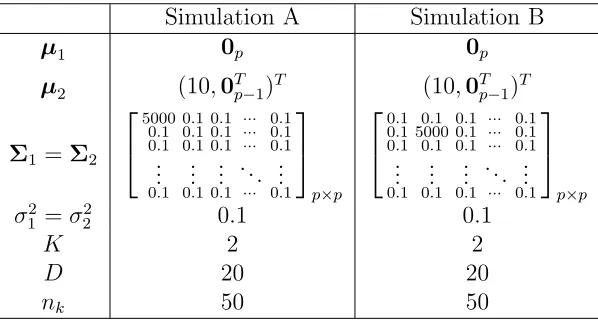
Two sets of parameters, simulation A and simulation B, are devised to
235
show the following two situations, respectively: 1) Pp
i=q+1(t
k,new
i )2 is not
236
important for classification; and 2) Pp
i=q+1(t
k,new
i )2 may be important for
237
classification. The details of the two simulation settings are summarised in
238
Table 1.
239
For each simulation setting, we generate 20 datasets with different nk/p
240
ratios to explore the difference between SIMCA and SIMCA-D with respect
Table 1: Simulation settings. Notation: K, number of classes;D, number of datasets;nk,
number of samples in each class
Simulation A Simulation B
µ1 0p 0p
µ2 (10,0T
p−1)T (10,0Tp−1)T
Σ1 =Σ2
5000 0.1 0.1 ··· 0.1 0.1 0.1 0.1 ··· 0.1 0.1 0.1 0.1 ··· 0.1
..
. ... ... ... ...
0.1 0.1 0.1 ··· 0.1
p×p
0.1 0.1 0.1 ··· 0.1 0.1 5000 0.1 ··· 0.1 0.1 0.1 0.1 ··· 0.1
..
. ... ... ... ...
0.1 0.1 0.1 ··· 0.1
p×p
σ21 =σ22 0.1 0.1
K 2 2
D 20 20
nk 50 50
top. In each dataset, 50 samples are generated for each class, from which 25
242
samples are selected as the training set and the rest as the test set, i.e. n1
243
and n2 are fixed to 25 for all the datasets. The 20nk/pratios are 1.5, 1, 0.7,
244
0.5, 0.3, 0.1, 0.09, 0.08, 0.07, 0.06, 0.05, 0.04, 0.03, 0.02, 0.01, 0.009, 0.008,
245
0.007, 0.006 and 0.005; and the corresponding p’s are 17, 25, 36, 50, 83, 250,
246
278, 313, 417, 500, 625, 833, 1250, 2500, 2778, 3125, 3571, 4167 and 5000.
247
Among these settings, nk/p = 1.5 (i.e. p = 17) indicates a low-dimensional
248
dataset while other ratios indicate high-dimensional datasets.
249
It is clear in Table 1 that the only difference between simulation A and
250
simulation B is the values of Σ1 and Σ2, which determines the importance
251
of Pp
i=q+1(t
k,new
i )2 for classification. In both simulations, the first
dimen-252
sions of the feature vectors contain major discriminative information since
253
µ11 = 0 and µ21 = 10, while other dimensions contain little discriminative
254
information since µ1i = µ2i = 0 (i 6= 1). Therefore, the variance of the
255
first dimension determines how the discriminative information between two
classes is distributed to the PCs. The discriminative information left in the
257
residuals for classification is determined by the discriminative information in
258
the first few PCs used in the class subspace.
259
If the first dimension has the largest variance and the discriminative
in-260
formation is concentrated on the first PC which is definitely used in the class
261
subspace, i.e. (Σ1)11 = (Σ2)11 = 5000 in simulation A, then Pp
j=1(e
k,new
j )2
262
is not very discriminative (or say unimportant for classification) and so is
263
Pp
i=q+1(t
k,new
i )2. In contrast, if the first dimension has a small variance and
264
contributes randomly to the PCs, i.e. (Σ1)11= (Σ2)11 = 0.1 in simulation B,
265
then the discriminative information may not be concentrated on the first few
266
PCs that are used in the class subspace. In this case, Pp
j=1(e
k,new
j )2 can be
267
discriminative (or say important for classification) and so bePp
i=q+1(t
k,new
i )2.
268
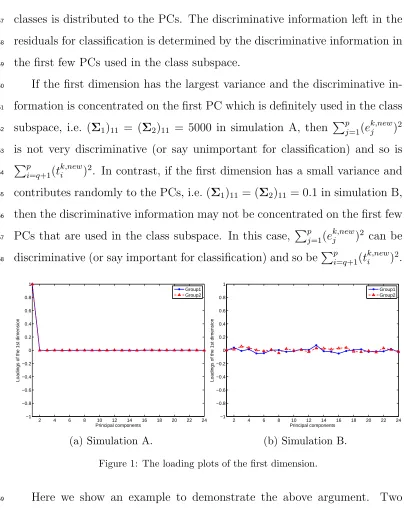
2 4 6 8 10 12 14 16 18 20 22 24
−1 −0.8 −0.6 −0.4 −0.2 0 0.2 0.4 0.6 0.8 1 Principal components
Loadings of the 1st dimension
Group1 Group2
(a) Simulation A.
2 4 6 8 10 12 14 16 18 20 22 24
−1 −0.8 −0.6 −0.4 −0.2 0 0.2 0.4 0.6 0.8 1 Principal components
Loadings of the 1st dimension
Group1 Group2
[image:18.612.97.501.115.625.2](b) Simulation B.
Figure 1: The loading plots of the first dimension.
Here we show an example to demonstrate the above argument. Two
269
datasets with p= 1250 are generated. Applying PCA separately to the two
270
classes of each dataset, we obtain the PCs for each class. We record the
first entries of all the PCs in each class, i.e. Vq(1,:), and plot them against
272
the PCs sorted in decreasing order of singular values, as shown in Figure 1
273
for simulation A and simulation B, respectively. These loadings indicate the
274
contributions of the first dimensions of the feature vectors to the PCs.
275
In simulation A, the absolute loadings of the first PC are close to one while
276
those of other PCs are close to zeros, which indicates that the discriminative
277
information between the two classes is concentrated on the the first PC.
278
Since the first PC is definitely used to build the class subspace,Pp
j=1(e
k,new
j )2
279
contains little discriminative information from the first dimension. Thus, as
280
a part of Pp
j=1(e
k,new
j )2,
Pp
i=q+1(t
k,new
i )2 is not important for classification.
281
In simulation B, the loadings are distributed randomly around zero, which
282
indicates that the discriminative information is spread over all PCs.
There-283
fore, Pp
j=1(e
k,new
j )2 may contain discriminative information important for
284
classification and so be Pp
i=q+1(t
k,new
i )2.
285
4.3.2. Real datasets
286
A low-dimensional dataset (the iris data) and three high-dimensional
287
datasets (the Phenyl data, the meat data and the fat data) are used in
288
the experiments.
289
The iris dataset [12] contains 150 samples with three classes: each class
290
contains 50 samples. Each sample is described by four features.
291
The Phenyl dataset is provided in the R package, ‘chemometrics’. The
292
dataset consists of 600 mass spectrum of chemical components, with 300
293
compounds contain the phenyl substructure and 300 compounds do not
con-294
tain the substructure. Each spectra contains 658 mass spectral features. We
with 50 contain the phenyl substructure and 50 do not contain the structure.
297
The meat dataset [1] consists of 108 spectra of meat spectra measured at
298
1051 wavelengths, with 55 chicken samples and 54 turkey samples.
299
The fat dataset [11] consists of 193 spectra of finely chopped meat, with
300
122 meat samples of less than 20% fat and 71 samples of larger than 20%
301
fat. Each spectrum is measured at 100 wavelengths.
302
4.4. Experiment settings
303
For the iris data and the Phenyl data, we randomly select 25 samples
304
from each class to generate the training set. For the meat data, we randomly
305
select 27 chicken samples and 27 turkey samples for training. For the fat
306
data, we randomly select 35 samples of less than 20% fat and 35 samples
307
of larger than 20% fat for training. The remaining samples of each dataset
308
generate the test set.
309
We repeat this procedure 100 times and perform the two methods, SIMCA
310
and SIMCA-D, on each training-test split.
311
In both methods, the number of PCs are chosen using the criterion that
312
the variance explained is more than 85% for all classes. Thus the numbers
313
of PCs, r, are the same for the two methods.
314
4.5. Results
315
4.5.1. Simulated datasets
316
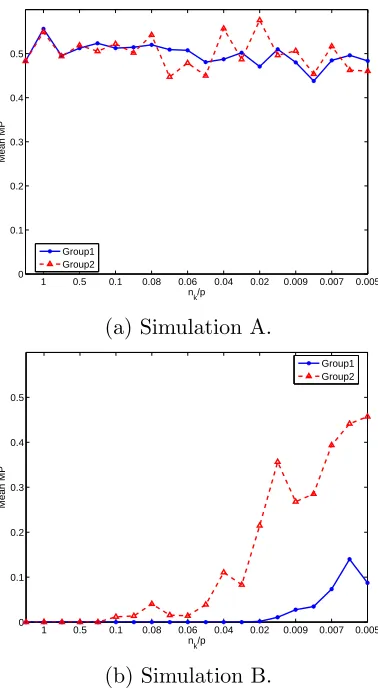
To explore the effect of the nk/p ratio on the performances of SIMCA
317
and SIMCA-D, we plot the the mean MP against the nk/pratio in Figure 2
318
for simulation A and simulation B, respectively. It is clear that the mean
319
MPs of SIMCA and SIMCA-D are the same when nk/p = 1.5, i.e. in the
1 0.5 0.1 0.08 0.06 0.04 0.02 0.009 0.007 0.005 0
0.1 0.2 0.3 0.4 0.5
nk/p
Mean MP
Group1 Group2
(a) Simulation A.
1 0.5 0.1 0.08 0.06 0.04 0.02 0.009 0.007 0.005
0 0.1 0.2 0.3 0.4 0.5
nk/p
Mean MP
Group1 Group2
[image:21.612.211.400.215.560.2](b) Simulation B.
low-dimensional situation, in each of the simulation settings, as indicated by
321
the leftmost points in each panel of Figure 2.
322
However, the relative performances of SIMCA and SIMCA-D are different
323
for the two simulations whennk/p≤1, i.e. in the high-dimensional situation.
324
In simulation A, the mean MPs of the two methods are similar for allnk/p
325
ratios, as shown in Figure 2a. This indicates that ignoring Pp
i=q+1(t
k,new
i )2
326
in the calculation of the OD does not affect the classification results in this
327
simulation, because in this case Pp
i=q+1(t
k,new
i )2 is not important for
classifi-328
cation. In addition, since the residuals are not discriminative, the mean MP
329
varies around 0.5.
330
In simulation B, the difference between the mean MPs of the two methods
331
becomes larger as nk/p becomes smaller (i.e. when the data are higher
di-332
mensional), as shown in Figure 2b. Since in this simulation the first few PCs
333
used in class subspaces contain little discriminative information, the residual
334
Pp
j=1(e
k,new
j )2 is important for classification. SIMCA performs pretty well
335
for almost all the nk/p ratios because Pp
j=1(e
k,new
j )2 captures the
discrimi-336
native information for classification. In contrast, SIMCA-D, which only uses
337
Pq
i=r+1(t
k,new
i )2 for classification and ignores Pp
i=q+1(t
k,new
i )2, cannot capture
338
the discriminative information in Pp
i=q+1(t
k,new
i )2 and can be suboptimal in
339
classification, especially when nk/pis small (i.e. when the data dimension is
340
high). For example, the mean MP of SIMCA-D worsens to around 0.4 when
341
nk/p decreases to 0.008.
342
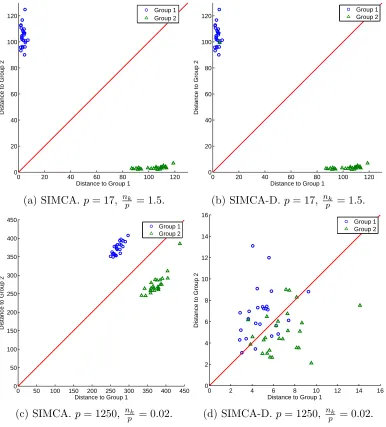
In addition for simulation B, we show an example of howPp
i=q+1(t
k,new
i )2
343
affects the classification performance using the Coomans’ plots. Figure 3
344
shows the Coomans’ plots of the test samples on one training-test split of
0 20 40 60 80 100 120 0
20 40 60 80 100 120
Distance to Group 1
Distance to Group 2
Group 1 Group 2
(a) SIMCA.p= 17, nk
p = 1.5.
0 20 40 60 80 100 120
0 20 40 60 80 100 120
Distance to Group 1
Distance to Group 2
Group 1 Group 2
(b) SIMCA-D.p= 17, nk
p = 1.5.
0 50 100 150 200 250 300 350 400 450 0
50 100 150 200 250 300 350 400 450
Distance to Group 1
Distance to Group 2
Group 1 Group 2
(c) SIMCA. p= 1250, nk
p = 0.02.
0 2 4 6 8 10 12 14 16
0 2 4 6 8 10 12 14 16
Distance to Group 1
Distance to Group 2
Group 1 Group 2
(d) SIMCA-D.p= 1250, nk
[image:23.612.114.500.178.605.2]p = 0.02.
each simulated dataset. The Coomans’ plot [26] shows the orthogonal
dis-346
tance from the test samples to two class subspaces at the same time. In
347
our experiments, the horizontal and vertical axes denote the ODs to Group
348
1 and Group 2, respectively. In Figure 3, the red reference line divides the
349
Coomans’ plot into two parts: in the upper triangular part, the distance to
350
Group 1 is smaller than that to Group 2; in the lower triangular part, it is
351
the other way around.
352
Since SIMCA and SIMCA-D have the sameq and r, the Coomans’ plots
353
reflect the difference between the ODs of these two methods.
354
When nk/p = 1.5 (i.e. low-dimensional), the Coomans’ plots of the two
355
methods are the same. Whennk/p= 0.02 (i.e. high-dimensional), the Coomans’
356
plots of the two methods are different. We observe large differences between
357
the values of ODs in Figure 3c and Figure 3d, which indicates that the value
358
of Pp
i=q+1(t
k,new
i )2 is large. Including Pp
i=q+1(t
k,new
i )2 can perfectly separate
359
the two groups as shown in Figure 3c; however, omittingPp
i=q+1(t
k,new
i )2
re-360
sults in a mixture of the two groups as shown in Figure 3d. This indicates
361
that the additional termPp
i=q+1(t
k,new
i )2 is important for classification in this
362
high-dimensional simulated dataset.
363
4.5.2. Real datasets
364
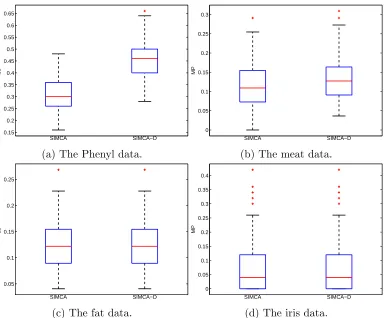
Figure 4 shows the box plots of the MP for the real datasets. In the
high-365
dimensional Phenyl data and the high-dimensional meat data, SIMCA-D
366
provides worse classification performance than the original SIMCA. However,
367
in the high-dimensional fat data, SIMCA-D and SIMCA provides the same
368
classification results. The results suggest that SIMCA-D can provide worse
369
classification results than SIMCA for some high-dimensional real datasets. In
0.15 0.2 0.25 0.3 0.35 0.4 0.45 0.5 0.55 0.6 0.65
SIMCA SIMCA−D
MP
(a) The Phenyl data.
0 0.05 0.1 0.15 0.2 0.25 0.3
SIMCA SIMCA−D
MP
(b) The meat data.
0.05 0.1 0.15 0.2 0.25
SIMCA SIMCA−D
MP
(c) The fat data.
0 0.05 0.1 0.15 0.2 0.25 0.3 0.35 0.4
SIMCA SIMCA−D
MP
[image:25.612.116.501.226.544.2](d) The iris data.
the low-dimensional iris dataset, the two methods provide the same results.
371
This pattern for the real datasets is consistent with that for the simulated
372
datasets.
373
5. Conclusion
374
We have investigated the formulae in [9] of calculating two ODs,vk,l and
375
vk,new. We have shown that the formula forvk,new in [9] is not valid for
high-376
dimensional data (i.e. whennk ≤p). The experiments on both the simulated
377
datasets and the real datasets have confirmed that the formula following [9]
378
can result in worse classification performance than the original one in [28].
379
Therefore, we suggest that the original formulae in [28] for calculating the
380
ODs, rather than the formulae in [9], should be used for the classification
381
of high-dimensional data which have more features than samples (i.e. when
382
nk≤p).
383
Acknowledgment
384
The authors would like to thank the reviewers for their constructive
com-385
ments.
386
References
387
[1] T. Arnalds, J. McElhinney, T. Fearn, G. Downey, A hierarchical
dis-388
criminant analysis for species identification in raw meat by visible and
389
near infrared spectroscopy, Journal of Near Infrared Spectroscopy 12 (3)
390
(2004) 183–188.
[2] S. Bicciato, A. Luchini, C. Di Bello, PCA disjoint models for multiclass
392
cancer analysis using gene expression data, Bioinformatics 19 (5) (2003)
393
571–578.
394
[3] K. V. Branden, M. Hubert, Robust classification in high dimensions
395
based on the SIMCA method, Chemometrics and Intelligent Laboratory
396
Systems 79 (1) (2005) 10–21.
397
[4] A. Candolfi, R. De Maesschalck, D. Jouan-Rimbaud, P. Hailey, D.
Mas-398
sart, The influence of data pre-processing in the pattern recognition of
399
excipients near-infrared spectra, Journal of Pharmaceutical and
Biomed-400
ical Analysis 21 (1) (1999) 115–132.
401
[5] A. Candolfi, R. De Maesschalck, D. Massart, P. Hailey, A.
Harring-402
ton, Identification of pharmaceutical excipients using NIR spectroscopy
403
and SIMCA, Journal of Pharmaceutical and Biomedical Analysis 19 (6)
404
(1999) 923–935.
405
[6] Q. Chen, J. Zhao, H. Zhang, X. Wang, Feasibility study on
qualita-406
tive and quantitative analysis in tea by near infrared spectroscopy with
407
multivariate calibration, Analytica Chimica Acta 572 (1) (2006) 77–84.
408
[7] N. C. da Silva, M. F. Pimentel, R. S. Honorato, M. Talhavini, A. O.
Mal-409
daner, F. A. Honorato, Classification of Brazilian and foreign gasolines
410
adulterated with alcohol using infrared spectroscopy, Forensic science
411
international 253 (2015) 33–42.
412
[8] M. Daszykowski, K. Kaczmarek, I. Stanimirova, Y. Vander Heyden,
B. Walczak, Robust SIMCA-bounding influence of outliers,
Chemomet-414
rics and Intelligent Laboratory Systems 87 (1) (2007) 95–103.
415
[9] R. De Maesschalck, A. Candolfi, D. Massart, S. Heuerding, Decision
416
criteria for soft independent modelling of class analogy applied to near
417
infrared data, Chemometrics and Intelligent Laboratory Systems 47 (1)
418
(1999) 65–77.
419
[10] R. De Maesschalck, D. Jouan-Rimbaud, D. L. Massart, The
Maha-420
lanobis distance, Chemometrics and Intelligent Laboratory Systems
421
50 (1) (2000) 1–18.
422
[11] F. Ferraty, P. Vieu, Nonparametric Functional Data Analysis: Theory
423
and Practice, Springer Science & Business Media, 2006.
424
[12] R. A. Fisher, The use of multiple measurements in taxonomic problems,
425
Annals of Eugenics 7 (2) (1936) 179–188.
426
[13] L. Jiao, F. Shang, F. Wang, Y. Liu, Fast semi-supervised clustering
427
with enhanced spectral embedding, Pattern Recognition 45 (12) (2012)
428
4358–4369.
429
[14] N. Kumar, A. Bansal, G. Sarma, R. K. Rawal, Chemometrics tools used
430
in analytical chemistry: An overview, Talanta 123 (2014) 186–199.
431
[15] B. Mnassri, E. M. EI Adel, B. Ananou, M. Ouladsine, Fault detection
432
and diagnosis based on PCA and a new contribution plot, IFAC
Pro-433
ceedings Volumes 42 (8) (2009) 834–839.
[16] B. Mnassri, M. Ouladsine, et al., Reconstruction-based contribution
ap-435
proaches for improved fault diagnosis using principal component
analy-436
sis, Journal of Process Control 33 (2015) 60–76.
437
[17] A. L. Pomerantsev, Acceptance areas for multivariate classification
de-438
rived by projection methods, Journal of Chemometrics 22 (11-12) (2008)
439
601–609.
440
[18] A. L. Pomerantsev, O. Y. Rodionova, Concept and role of extreme
ob-441
jects in PCA/SIMCA, Journal of Chemometrics 28 (5) (2014) 429–438.
442
[19] A. L. Pomerantsev, O. Y. Rodionova, On the type II error in SIMCA
443
method, Journal of Chemometrics 28 (6) (2014) 518–522.
444
[20] M. Rafferty, X. Liu, D. M. Laverty, S. McLoone, Real-time multiple
445
event detection and classification using moving window PCA, IEEE
446
Transactions on Smart Grid 7 (5) (2016) 2537–2548.
447
[21] O. Y. Rodionova, P. Oliveri, A. L. Pomerantsev, Rigorous and
compli-448
ant approaches to one-class classification, Chemometrics and Intelligent
449
Laboratory Systems 159 (2016) 89–96.
450
[22] R. Shang, Z. Zhang, L. Jiao, C. Liu, Y. Li, Self-representation based
451
dual-graph regularized feature selection clustering, Neurocomputing 171
452
(2016) 1242–1253.
453
[23] R. Shang, Z. Zhang, L. Jiao, W. Wang, S. Yang, Global
discriminative-454
based nonnegative spectral clustering, Pattern Recognition 55 (2016)
455
172–182.
[24] V. Ur´ıˇckov´a, J. S´adeck´a, Determination of geographical origin of
alco-457
holic beverages using ultraviolet, visible and infrared spectroscopy: A
458
review, Spectrochimica Acta Part A: Molecular and Biomolecular
Spec-459
troscopy 148 (2015) 131–137.
460
[25] P. Van den Kerkhof, J. Vanlaer, G. Gins, J. F. Van Impe, Analysis
461
of smearing-out in contribution plot based fault isolation for statistical
462
process control, Chemical Engineering Science 104 (2013) 285–293.
463
[26] B. G. Vandeginste, D. L. Massart, Handbook of Chemometrics and
464
Qualimetrics, Elsevier Science, 1998.
465
[27] E. E. Waddell, M. R. Williams, M. E. Sigman, Progress toward the
466
determination of correct classification rates in fire debris analysis II:
467
utilizing soft independent modeling of class analogy (SIMCA), Journal
468
of Forensic Sciences 59 (4) (2014) 927–935.
469
[28] S. Wold, Pattern recognition by means of disjoint principal components
470
models, Pattern Recognition 8 (3) (1976) 127–139.
471
[29] R. Zhu, K. Fukui, J.-H. Xue, Building a discriminatively ordered
sub-472
space on the generating matrix to classify high-dimensional spectral
473
data, Information Sciences 382-383 (2017) 1–14.
474
[30] Y. Zontov, O. Y. Rodionova, S. Kucheryavskiy, A. Pomerantsev,
DD-475
SIMCA: A MATLAB GUI tool for data driven SIMCA approach,
476
Chemometrics and Intelligent Laboratory Systems 167 (2017) 23–28.