©
DOI: 10.1534/genetics.105.043125
Identification of Genetic Loci That Interact With
cut
During Drosophila Wing-Margin Development
Joshua J. Krupp,*
,†Lauren E. Yaich,
‡Robert J. Wessells* and Rolf Bodmer*
,1*The Burnham Institute, La Jolla, California 92037,†Neuroscience Program, University of Michigan, Ann Arbor, Michigan 48109 and‡Biological and Health Sciences Division,
University of Pittsburgh, Bradford, Pennsylvania 16701 Manuscript received March 10, 2005 Accepted for publication May 11, 2005
ABSTRACT
The Drosophila selector genecutis a hierarchal regulator of external sensory organ identity and is required to pattern the sensory and nonsensory cells of the wing margin. Cut performs the latter function, in part, by maintaining expression of the secreted morphogen encoded bywingless (wg). We find that Cut is required for wing-margin sensory organ specification in addition to and independently of Wg maintenance. In addition, we performed a genetic modifier screen to identify other genes that interact withcutin the reg-ulation of wing-margin patterning. In total, 45 genetic loci (35 gain-of-function and 10 loss-of-function loci) were identified by virtue of their ability to suppress the wing-margin defects resulting from gypsy retrotransposon-mediated insulation of thecutwing-margin enhancer. Further genetic characterization identified several subgroups of candidatecutinteracting loci. One group consists of putative regulators of gypsy insulator activity. A second group is potentially required for the regulation of Cut expression and/or activity and includeslongitudinals lacking, a gene that encodes a family of BTB-domain zinc-finger transcription factors. A third group, which includes a component of the Brahma chromatin remodeling complex encoded by moira, affects the level of Cut expression in two opposing ways by suppressing the gypsy-mediated ctK
phenotype and enhancing the non-gypsyct53dphenotype. This suggests that the Brahma complex modulates
both enhancer-controlled transcription and gypsy-mediated gene insulation of thecutlocus.
S
ELECTOR genes are hierarchal regulators of devel- transcriptional and cell-signaling networks that indi-opmental programs controlling tissue and cell-type rectly link selector gene activity with realizator functions diversification. The highly conserved Hox class of ho- (reviewed inMannandCarroll 2002;Hombriaand meotic selector genes, which control the specification Lovegrove 2003). Thus, to understand how selector of regional identity along the anterior/posterior axis, genes define alternative developmental states, it is neces-exemplifies the ability of selector genes to instructively sary to identify the downstream regulatory networks, as direct the selection between alternative developmental well as the realizator genes, which ultimately carry out states. For instance, gain-of-function mutations in the the selected developmental program.Hox geneAntennapedia(Antp), resulting in the inappro- TheDrosophila melanogastergenecutis a neural selec-priate expression of Antp protein in imaginal antennal tor gene, which establishes the developmental program tissue, lead to complete antenna-to-leg transformations directing external sensory (ES) organ identity. The pe-(Schneuwly et al. 1987). It has been proposed that ripheral nervous system is composed of diverse types of selector genes function by coordinating the serial activ- sensory organs, including ES organs (cuticular mecha-ity of “realizator” genes (i.e., those genes that intimately nosensory and chemosensory sensilla) and chordotonal affect basic cellular processes directing cell growth, organs (subcuticular proprioceptive organs). Although shape, migration, proliferation, and death, among oth- morphologically dissimilar, these sensory organs share ers;Garcia-Bellido1975). Identified realizator genes molecular and developmental similarities suggestive of include3-tubulin(Kremseret al.1999) andcentrosomin a common evolutionary origin (reviewed in Lai and (Heueret al.1995), both of which affect cyto-architec- Orgogozo2004). During embryonic and pupal devel-tural organization, the cell adhesion molecule encoded opment Cut is specifically expressed in the neuroepithe-byConnectin (Gould and White 1992), and the pro- lial-derived sensory organ precursor cells (SOP cells) apoptotic genereaper(Lohmannet al.2002). In addition from which emerge the lineage-related cells of individ-to the immediate regulation of realizaindivid-tor gene activity, ual ES organs (Blochlinger et al.1990). Loss of cut selector genes also control and integrate intermediary function results in the morphological and molecular
transformation of ES organs into chordotonal organs (Bodmer et al. 1987; Merritt 1997). Conversely, the 1Corresponding author:The Burnham Institute, 10901 N. Torrey Pines
Rd., La Jolla, CA 92037. E-mail: [email protected] ubiquitous misexpression of Cut transforms
nal organs into ES organs (Blochlingeret al. 1991). mal tissue development (Elliset al.2001; Sinclairet al.2001;Luonget al.2002). Constitutive overexpression The overexpression of Cut directs ES organ identity
only in cells predetermined with proneural character of Cux1 results in multiple organ hyperplasia, a pheno-type partially attributable to the downregulation of the (i.e., ES and chordotonal organ SOP cells) and acts in
concert with factors common to these early precursor cyclin kinase inhibitor p27kip1 (Ledford et al. 2002).
Consistent with these results, the DNA-binding ability cells to direct ES organ identity. Thuscutrepresents a
neural selector gene, the presence or absence of which of CDP/Cux1 is post-translationally regulated in a cell-cycle-dependent manner (Coqueretet al.1998;Moon is sufficient to direct alternative sensory organ fates. It
is not known what downstream targets or realizator et al.2001;Santaguidaet al.2001;Gouletet al.2004), suggesting that CDP/Cux1 may act as part of a transcrip-genes Cut regulates to instruct ES organ identity. The
only putative Cut transcriptional target implicated in tional network controlling the G1/S phase transition.
Less is known about the function of murineCux2. How-sensory organ specification is the genebereft(bft), which
is required for bristle morphogenesis (Hardimanet al. ever, the dynamic expression pattern ofCux2mRNA in the central nervous system, particularly in the subventri-2002).
cutis involved in the development of several embry- cular zone and upper cortical layers of the developing telencephalon, suggests that Cux2 regulates a pool of onic and adult tissues, including the Malpighian tubules
(Liuet al.1991;LiuandJack1992), posterior spiracles cycling precursor cells predetermined to generate up-per-layer cortical neurons (Zimmeret al.2004).
Interest-(HuandCastelli-Gair1999), egg chamber (Jackson
and Blochlinger 1997; Jackson and Berg 1999), ingly, murine Cux1 and human CDP have been shown
to functionally substitute for Drosophila Cut during em-flight muscles (Sudarsanet al.2001), and wing margin
(Micchelliet al.1997). Additionally, the level of Cut bryonic development (Ludlowet al. 1996;Grueberet al. 2003), signifying a high degree of structural and expression regulates the degree of dendritic branching
in a subset of multiple dendritic neurons (Grueberet functional conservation. It is not clear, however, if mam-malian CDP/Cux1 genes act as selector genes in their al.2003). It is not clear ifcutacts as a selector gene in
the development of these tissues (Liu andJack1992; native developmental context.
HuandCastelli-Gair1999). In the developing wing, To identify genes that interact with Drosophila cut,
cutis required for proper patterning of the wing margin we conducted complementary gain-of-function and loss-via complex interactions with multiple signaling path- of-function genetic suppressor screens. For this pur-ways, including the Wingless (Wg) and Notch pathways pose, we created ⬎2000 new Drosophila lines, each (Micchelli et al. 1997). The absence of Cut activity carrying a unique insertion of the modular UAS/GAL4-leads to the nonautonomous degeneration of wing tis- based Gene Search (GS) vector (Tobaet al.1999). The sue, producing the classical “cut” wing phenotype (Jack GS vector contains bidirectional upstream activating se-et al.1991). Degeneration of margin cells prefigures the quences (UAS), which bind the transcriptional activator development of several rows of ES organs arrayed along Gal4. Under the control of wing-margin-specific Gal4 the anterior wing margin. It is conceivable that Cut is expression, genes located near the GS vector insertion required early to convey a survival signal, most likely site were misexpressed and scored according to their via the maintenance of Wg expression (Johnstonand ability to suppress the adultcutwing phenotype. Addi-Sanders2003), in addition to a later role in the specifi- tionally, 158 deficiency chromosomes (second and third
cation of margin ES organ identity. chromosomes) coveringⵑ50% of the genome were tested
cutencodes a highly conserved homeodomain tran- for the ability to dominantly suppress thecutallelectK. Of
scription factor with three novel DNA-binding domains, the genes that were identified through these screens, the termed CUT repeats (Blochlingeret al.1988;Andres BTB-domain zinc-finger gene longitudinals lacking (lola) et al.1994;Moonet al.2000). Vertebratecuthomologs, and several genes encoding subunits of the Brahma chro-including mouseCux1andCux2(Valarcheet al.1993; matin-remodeling complexes were investigated further
Quaggin et al. 1996;Zimmer et al. 2004) and human with regard to their interaction with cut during
wing-CDP (Neufeldet al. 1992), are postulated to regulate margin development. The genetic interactions between cell growth and terminal differentiation. In diverse sys- these genes and cut suggest that they are involved in tems, Cut homologs functionally interact with the regu- modulating the level of Cut expression and thus act latory regions of developmentally active genes, includ- together with Cut to pattern wing-margin tissues. ing humanhistone H4(van Wijnenet al.1996;Gupta
et al.2003),lactoferrin(Khanna-Guptaet al.1997, 2003),
myeloid cytochrome heavy chain(gp91-phox;Skalniket al. MATERIALS AND METHODS 1991;Lievenset al.1995), andDNA polymerase␣
(Trus-Drosophila strains and culture:D. melanogasterstocks were cottet al.2003), as well as mouseN-CAM(Valarche
reared on standard cornmeal/molasses media at room tempera-et al.1993) andimmunoglobulin heavy chain(IgH) (Wang ture or at 18⬚. Crosses were initiated and maintained at 25⬚. The et al.1999), among others. The targeted disruption of cm, ct53d, andyw67c23, ct2slines were provided by D. Dorsett. The
amorphiclola5D2,lolaORE76, andlolaORE120alleles and the
der-selectivelolaORC4andlolaORE119alleles were provided by E. Gini- and ctK/Y;C96-Gal4/⫹ controls. The controls showed a
com-pletely penetrant (⬎99%) ctK wing phenotype, as
demon-ger and are described elsewhere (Goekeet al.2003).
Trans-genicUAS-BrmK804R,UAS-osas2,UAS-OsaRD[11c], andUAS-OsaAD[20e] strated by numerous discontinuities (i.e., gaps) in the regular
array of wing-margin sensory bristles and frequent incisions lines were provided by J. Treisman and are described
else-where (Elfringet al.1998;Collinset al.1999). TheGS-V[1] of wing tissue. The expressivity of thectKwing phenotype was
identical for both controls. In the initial testing of all 2066 GS stock was a generous gift from T. Aigaki (Tobaet al.1999).
ThectK,ct6,mor1,brm2,snr1[01319], UAS-wg,UAS-p35, and all lines and the 158 deficiencies, 20–40 males of the genotypes
ctK;GS*/C96-Gal4orctK;Df/⫹were examined. In addition,
fe-deficiency lines were obtained from the Bloomington Stock
Center. Thect53d and ct2s stocks carry overlapping deletions males were examined for dominant effects. Due to the
preva-lence of dominant effects that enhanced thectKphenotype
ofⵑ500 bp and 1.6 kb, respectively, of thecutwing-margin
enhancer, which is positionedⵑ⫺80 kb upstream of the first resulting from the overexpression of the various GS insertions, we opted not to characterize these lines further. Those lines exon (Liu et al.1991; Mogilaet al.1992). The ctKand ct6
alleles result from insertions of the gypsy retrotransposon be- (GS or deficiency) that were found to suppress thectK
pheno-type were retested. GS lines were retested by crossing to both tween the wing enhancer and the first exon. ThectKinsertion
is located ⫺6 kb upstream of the 5⬘-most exon (Liu et al. ctK; C96-Gal4andctKalone to determine if suppression resulted
from overexpression or from gene disruption. In all cases, 1991), whereas thect6 insertion is located proximal to the
wing enhancer (Dorsett 1993). Descriptions of the other ⬎100 ctK males were screened in the retests. Identical but
independent crosses produced similar results in the majority gene mutations and deficiency chromosomes can be found
on FlyBase (http://flybase.boi.indiana.edu). of cases. To confirm the interaction withcut, GS lines were secondarily tested for the ability to interact withct53d;
C96-TheC96-Gal4driver line carries aP{GawB}insertion at the
70D locus near theC96 gene; a gene required for viability Gal4. The presence of discontinuities in the anterior wing margin ofct53d/Y ;C96-Gal4/UAS-lacZand ct53d/Y ;C96-Gal4/⫹
and imaginal disc development (GustafsonandBoulianne
1996;Kimand Boulianne1998). Flies homozygous for the controls were less penetrant (ⵑ50–60%) than with ctK,
allowing increases (enhancement) or decreases (suppression) P{GawB}C96insertion are homozygous viable and wing
devel-opment is normal. TheP{GawB}C96insertion directs Gal4 ex- in penetrance to be scored. To maintain consistency, all crosses were performed withcutalleles in the presence of the pression in a broad stripe straddling the dorsoventral boundary
of the wing imaginal disc, which corresponds to the anlage of P{GawB}C96insertion. The presence ofP{GawB}C96did not influence the interaction between any of the loss-of-function the adult wing margin and the cells expressing Cut.P{GawB}C96
-driven Gal4 expression is unaffected by hypomorphiccutmuta- mutations andcut.
Individual GS insertion lines were scored according to their tions.
Deficiency screen:Prior to initiating the deficiency screen, ability to suppress or enhance the penetrance of thecutwing phenotype. For our purposes, only a discrete region of the thectKstock was isogenized for the second and third
chromo-somes by first crossing females from a wild-type Oregon-R anterior wing margin, consisting of the region stretching from the proximal-most point of the anterior wing margin to the stock to males from the double balancer stockctK/Y;Pin/CyO;
D/TM6B. Individual F1⫹/ctK;⫹/CyO;⫹/TM6Bfemales were distally located intersection of the L1 and L2 wing veins (see Figure 1C), was scored. This region was chosen because it backcrossed toctK;Pin/CyO;D/TM6Bmales. Stable isogenic
ctK;⫹/⫹;⫹/⫹stocks were maintained by crossing balanced encompasses most of the triple row of innervated sensory
bristles and can be easily examined in anesthetized intact F2ctK;⫹/CyO;⫹/TM6Bsiblings derived from individual F1
females. ThectK stock was again isogenized after the initial animals with their wings tucked back in the resting position.
In cases in which discontinuities were not observed within screen and interacting deficiencies were rechecked. The use
of two different isogenic stocks controlled for any phenotypes this region of individual experimental wings, the cut wing phenotype was considered suppressed. Conversely, in cases in caused by differences in genetic background. To test for genetic
interactions, female flies homozygous forctK were crossed to which discontinuities were observed, regardless of the number
of bristles affected, thecut wing phenotype was considered male flies containing the deficiency chromosome (Df) over a
marked balancer. The wings of male progeny that werectK/Y; not suppressed. The scoring system is based on “all or none”
suppression and therefore does not take into account individ-Df/⫹ were examined for a decrease in the penetrance of the
ctKphenotype (see below). ual variation in either the frequency or the severity of margin
bristle loss of individual wings. The degree of penetrance
Generation and screening of GS vector insertion lines:The
GS vector as described by Toba et al. (1999) contains two correlated well with the degree of severity. In Table 2, “suppres-sion ofctK” was calculated for each genotype by dividing the
copies of the sequence UAS (originating formSaccharomyces
cerevisiae) adjacent to a core promoter. UAS/core promoter number of wings suppressed by the total number of wings scored. The ability of deficiency chromosomes to affectctKand
sites are proximal to the terminal inverted repeat sequences
located at either end of theP-element vector and oriented as ct53dwas scored in a similar manner. To quantify phenotypes,
dissected wings of each genotype were dehydrated in absolute to mediate transcription outward in both directions.
Indepen-dent GS vector insertion lines were generated by mobilizing ethanol, mounted in Canada Balsam:methyl-salicylate (1:3), and photographed at 10⫻magnification using a digital cam-the GS vector, located on aCyOchromosome, with⌬2-3
trans-posase (Robertsonet al.1988). The reinsertion of the mobi- era (Canon Power Shot S45) mounted on a compound micro-scope (Zeiss, Axioplan). For each genotype, a representative lized GS vector was identified via the expression of the
mini-whitegene. Independent reinsertion events in the second and image of a median wing phenotype was selected from a photo-graphic series.
third chromosomes were balanced withSM5-TM6, a reciprocal
translocation balancer. Stable stocks were maintained over the Molecular analysis of GS vector insertion lines:Genomic sequences flanking the 5⬘-end and/or the 3⬘-end of the GS SM5-TM6balancer or, if possible, in a homozygous state.
To identify genetic loci that suppress thectKwing pheno- vector insertions were recovered by inverse PCR. Total DNA
isolated from individual GS vector insertion lines was digested type, three male flies from each of 2066 individual GS lines,
with insertions on the second or third chromosomes, were withSau3AI (with 5⬘primer set) orMspI (with 3⬘primer set) and ligated under dilute conditions according to the protocol crossed to six females of the genotypew,ctK;C96-Gal4. The
vector was amplified by PCR using the following GS-vector-specific primer sets: GS[5⬘] (GS[5⬘R]—5⬘-CCG TAG ACG AAG CGC CTC TAT TTA TAC T-3⬘ and GS[5⬘L]—5⬘-CCT CTC AAC AAG CAA ACG TGC ACT GAA) and GS[3⬘] (GS[3⬘R]—5⬘-CGC TGT CTC ACT CAG ACT CAA TAC GAC A-3⬘ and GS[3⬘L]—5⬘-GCT TAG CTT TCG CTT AGC GAC GTG TTC A-3⬘). PCR products were sequenced using the GS[5⬘L] or GS[3⬘R], as used in the initial amplification reac-tion. Sequence analysis was performed using the BLASTN program administered by the National Center for Biotechnol-ogy. This allowed GS vector insertion sites to be precisely located and known or predicted genes immediately flanking the insertion site to be identified. The Apollo Genome Annota-tion and CuraAnnota-tion Tool, Version 1.3.5 (Lewiset al.2002) was used to establish the proximity of individual GS insertions to flanking genes. The GS vector insertion site was determined for 66 of 79 GS lines that suppressed thectKphenotype. The
“locus” heading in Table 2 represents the known or predicted gene closest to and downstream of the GS insertion.
In situ hybridization, immunohistochemistry, and X-Gal staining: In situ hybridization to third instar wing discs was performed as described by Sturtevant et al.(1993) using digoxigenin (DIG)-labeled RNA probes and visualized using alkaline phosphatase conjugated␣-DIG antibody (Roche; 1:200). To generatelolaandpipsqueak(psq) RNA probes, coding DNA sequences from both loci were amplified by PCR using gene-specific primer sets lola[766bp](lola[A]—5⬘-GTC CTC GTC ATC GCC TTG-3⬘andlola[B]—5⬘-GAA CAG TAC GAC AAA CAT CC-3⬘) andpsq[644bp](psq[A]—5⬘-GTA GCG ATA GCG TGC CAG-3⬘; andpsq[B]—5⬘-GCT GCT GAA ACA CGG ACG-3⬘)]. PCR products were cloned into the pGEM-T Easy Vector (Promega, Madison, WI). Immunohistochemistry on third in-star wing discs was performed according to standard tech-niques. Dissected third instar wing discs were fixed with 4% formaldehyde/NaPO4, washed with PBS/0.5% Triton X-100
Figure1.—Cut is expressed in the wing margin and is re-(PBST), and blocked with PBST/4% BSA. Antibodies were
quired for the development of the margin sensory bristles. used at the following dilutions: ␣-Wg (1:50; 4D4,
Develop-(A) In the third larval instar wing disc, Cut is expressed in a mental Studies Hybridoma Bank),␣-Ct (1:20; 2B10, DSHB),
stripe of cells 3–4 cells wide (arrow), corresponding to the
␣-Gal (1:40; 40-1a, DSHB), and horseradish peroxidase
con-Wg organizer. These Cut-expressing cells are the precursor jugated␣-mouse (1:200; Bio-Rad, Richmond, CA).In situ
de-cells of the stout and slender margin mechanosensory bristles. tection of-galactosidase activity in dissected third instar wing
(B)C96-Gal4drives expression in a pattern overlapping the imaginal discs was carried out as described byGlaseret al.
Cut-expressing cells. (C) The anterior wing margin, delimited (1986).
by the L1 wing vein, is composed of a triple row of sensory bristles. Positioned on the dorsal wing surface is a single row of slender-shaft recurved chemosensory bristles (inset, solid
RESULTS arrowhead) adjacent to a row of stout-shaft mechanosensory
bristles (inset, open arrowhead). Ventral and out of the plane
Cut is required independently of Wingless
mainte-of focus is the third bristle row composed mainte-of slender
mechano-nance to specify wing-margin sensory organs:The pre- and chemosensory bristles.
sumptive wing margin of the third instar larval wing disc consists of a stripe of Cut-expressing cells located at the
dorsal/ventral boundary, a region corresponding to the wing-margin development, we prevented degeneration of margin tissue incutmutants by (1) maintaining Wg Wg organizer (Figure 1A). Patterning of the wing
mar-gin, which contains an organized array of chemosensory expression ectopically and (2) preventing apoptotic cell death through the misexpression of the baculovirus cas-and mechanosensory bristles (Figure 1C), is regulated
in part by the secreted morphogen, Wg (Phillipsand pase inhibitor p35.
ThectK,ct6, andct2salleles display acutwing
pheno-Whittle1993;JohnstonandEdgar1998;Johnston
and Sanders 2003; Duman-Scheel et al. 2004). Cut type characterized by incised wing-blade tissue and
de-creased numbers of margin bristles (Figure 2, A–C). activity is required to maintain Wg expression in the
presumptive wing margin, which otherwise degenerates Whereas thectKallele primarily disrupts margin bristle
development,ct6andct2sdisrupt both blade tissue and
cell nonautonomously. Since degeneration of wing
tis-sue prefigures the development of the margin sensory margin bristle development. The margin-specific over-expression of UAS-cut directed by theC96-Gal4 driver bristles, it has been difficult to resolve the autonomy of
Cut function in margin sensory organ specification. To significantly rescues thecutwing phenotype (Figure 2, D–F). In hemizygousctK/Ymutant males, the large
Figure2.—The requirement forcutin patterning the wing margin is independent of its role in maintaining Wg expression. All genotypes were reared at 25⬚, excepting G–I, which were raised at 18⬚. (A–C) The Lethal I cutallele,ctK, and the two cut
alleles,ct6 andct2s, display large discontinuities in the margin bristles (solid arrowheads), in addition to incised margin and
blade tissue (open arrowheads). (D–F)C96-Gal4-directed overexpression ofUAS-ct5suppresses the wing defects incutmutants. Although the large discontinuities in the anterior margin bristles ofctKare suppressed, the total number of sensory bristles is
only partially restored, likely reflecting a dominant Cut misexpression phenotype (see J). (G–I) Overexpression of UAS-wg suppresses the degeneration of wing-blade tissue incutmutants, but is unable to restore margin bristles. ( J) The overexpression ofUAS-ct5in heterozygousctKfemales disrupts anterior margin bristle development. A similar effect was observed in wild-type
individuals. (K and L) Blocking apoptosis by overexpression ofUAS-p35partially suppresses the loss of blade and margin tissue, but is unable to suppress the loss of margin bristles.
continuities in the regular array of anterior margin bris- incomplete rescue. However, since a similar reduction in margin bristle number is observed when Cut is over-tles are rescued by Cut overexpression, but the total
number of margin bristles remains less than that of expressed in heterozygous ctK/⫹ females (Figure 2J),
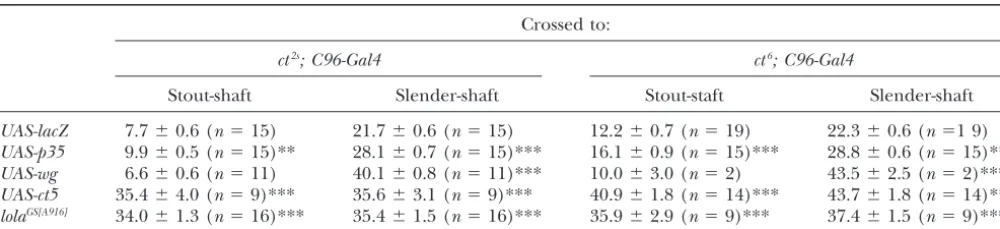
TABLE 1
Rescue of anterior wing-margin sensory bristles
Crossed to:
ct2s; C96-Gal4 ct6; C96-Gal4
Stout-shaft Slender-shaft Stout-staft Slender-shaft
UAS-lacZ 7.7⫾0.6 (n⫽15) 21.7⫾0.6 (n⫽15) 12.2⫾0.7 (n⫽19) 22.3⫾0.6 (n⫽1 9) UAS-p35 9.9⫾0.5 (n⫽15)** 28.1⫾0.7 (n⫽15)*** 16.1⫾0.9 (n⫽15)*** 28.8⫾0.6 (n⫽15)*** UAS-wg 6.6⫾0.6 (n⫽11) 40.1⫾0.8 (n⫽11)*** 10.0⫾3.0 (n⫽2) 43.5⫾2.5 (n⫽2)*** UAS-ct5 35.4⫾4.0 (n⫽9)*** 35.6⫾3.1 (n⫽9)*** 40.9⫾1.8 (n⫽14)*** 43.7⫾1.8 (n⫽14)***
lolaGS[A916] 34.0⫾1.3 (n⫽16)*** 35.4⫾1.5 (n⫽16)*** 35.9⫾2.9 (n⫽9)*** 37.4⫾1.5 (n⫽9)***
Summation of dorsal and ventral slender-shafted mechano- and chemosensory bristles and stout-shafted mechanosensory bristles located within the region stretching from the hinge-proximal anterior wing margin to the L1/L2 wing-vein intersect. Standard error of mean is given. Wild-type wings display an average of 68.8⫾0.6 dorsal and ventral slender bristles and 69.8⫾ 0.6 stout-shafted bristles. Statistical significance was determined using Student’s t-test; **,P⬍0.01; ***,P⬍0.001. Although there is some evidence of improvement in slender bristle number resulting from the misexpression of eitherUAS-p35or UAS-wgmisexpression, the number of stout bristles is only minimally affected in either instance.
morphology, we prefer the alternative interpretation in maintaining Wg expression. However, the possibility that a Wg signal, in addition to Cut activity, is required that a complete rescue is confounded by a dominant
negative effect resulting from Cut overexpression (see for margin bristle specification cannot be excluded.
Gain- and loss-of-function suppressor screens of the
alsoLudlowet al.1996). Cut overexpression also
par-tially restores blade tissue and margin bristles of thect6 cut wing phenotype: Having determined the dual
re-quirement of cut to maintain margin cell survival and and ct2s alleles (Figure 2, E and F). In particular, the
number of stout mechanosensory bristles is significantly to specify margin bristle identity, we carried out comple-mentary loss-of-function and gain-of-function suppres-rescued (Table 1).
Ectopically supplying Wg in the presumptive wing sion screens of thectKphenotype to identify genes that
interact with cutduring wing-margin patterning.ctK is
margin ofctK,
ct6, and
ct2smutants also suppresses the
loss of wing-blade tissues, including the slender recurved classified as a Lethal Icutallele, as defined by its failure to complement all cut mutant alleles except for the chemosensory bristles, but does not rescue the loss of
the stout mechanosensory bristles (Figure 2, G–I, and kinked femurclass (Jack1985). Placed in transto acut null allele,ctKis characterized by both semilethality and
Table 1). In several hypomorphic cut mutations,
al-though Cut expression is disrupted in the mechanosen- the transformation of embryonic ES organs into chordo-tonal organs. Unlike other Lethal I alleles, however, adult sory and non-innervated bristles of the wing margin,
expression in the precursor cells of the slender chemo- males that are hemizygous for thectKallele are viable and
display a completely penetrantcutwing-margin phenotype sensory bristles is unaffected (Jacket al. 1991). It has
been proposed that loss of Cut expression in the wing (Figure 2A). Because of these characteristics, we reasoned thatctKwould provide a uniquely sensitized background
margin results in the failure of the mechanosensory and
non-innervated bristles to differentiate, followed by the in which genetic suppressor screens could be designed to identify genes involved in both wing-margin patterning cell nonautonomous degeneration of the margin.
There-fore, it is possible that the loss of the slender chemosen- and sensory bristle specification.
In an initial approach, we carried out a dominant sory bristles is a secondary effect resulting from
degener-ation of the margin, rather than a cell autonomous effect loss-of-function suppression screen using available cyto-logical deficiencies coveringⵑ50% of the genome. Male resulting from the loss of Cut expression. We propose
that by ectopically expressing Wg incutmutants we sup- flies from each deficiency line were crossed to females homozygous forctK, and thecutwing phenotype of the
press the degeneration of wing-margin tissue, which
in-cludes the slender chemosensory bristles, resulting from resulting male progeny—hemizygyous for ctK and
het-erozygous for the deficiency chromosome—was scored. the failure of Cut-dependent maintenance of Wg
expres-sion. Only those cells that actually fail to express Cut The capacity of each deficiency chromosome to domi-nantly suppressctKwas quantitatively assessed according
(i.e., the precursor cells of the stout mechanosensory
bristles) fail to be rescued by the misexpression of Wg. to their ability to reduce the overall penetrance ofctK
-associated discontinuities in the anterior wing-margin Thus, we propose that Wg is unable to promote sensory
bristle development independently of Cut function and sensory bristles (materials and methods). The results of this screen are summarized in Table 2. Df(2L)Prl, suggest that Cut is required autonomously for sensory
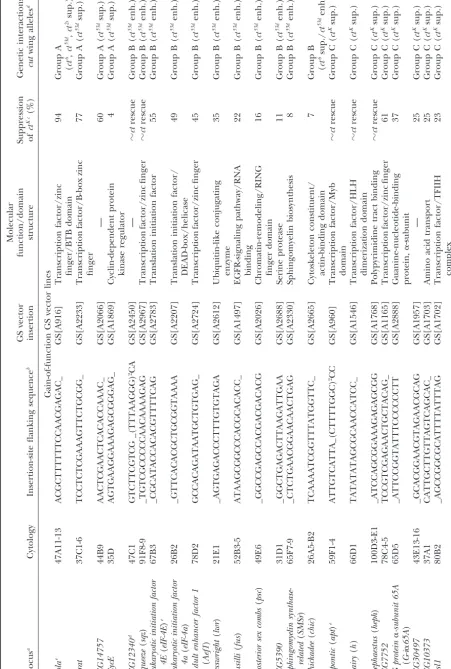
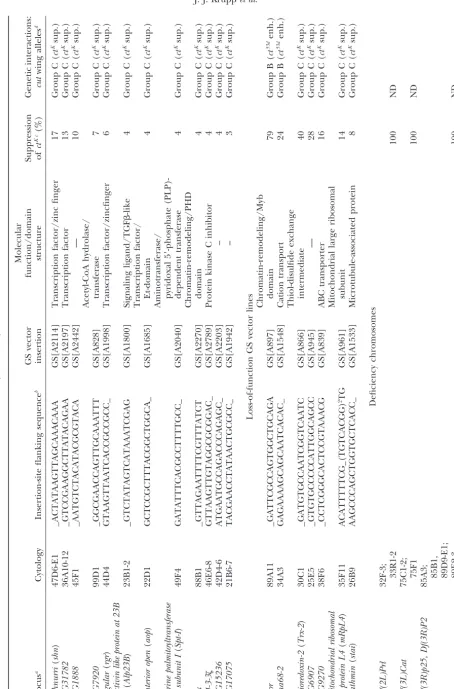
TABLE 2 (Continued) Molecular GS vector function/domain Suppression Genetic interactions: Locus a Cytology Insertion-site flanking sequence b insertion structure of ct Kc (%) cut wing alleles d schnurri ( shn ) 47D6-E1 _ACTATAAGTTAGCAAACAAA GS[A2114] T ranscription factor/zinc finger 1 7 G roup C ( ct Ksup.) CG31782 36A10-12 _ GTCCGAAGGCTTATACAGAA GS[A2197] T ranscription factor 13 Group C ( ct Ksup.) CG1888 45F1 _ AATGTCTACATACGCGTACA GS[A2442] — 10 Group C ( ct Ksup.) Acetyl-CoA hydrolase/ CG7920 99D1 _ GGCGAACCAGTTGCAAATTT GS[A828] transferase 7 G roup C ( ct Ksup.) regular ( rgr ) 44D4 GTAAGTTAATCACCGCCGCC_ GS[A1998] T ranscription factor/zincfinger 6 G roup C ( ct Ksup.) Activin like protein at 23B ( Alp23B ) 23B1-2 _GTCTATAGTCATAAATCGAG GS[A1800] S ignaling ligand/TGF  -like 4 Group C ( ct Ksup.) Transcription factor/ anterior open ( aop ) 22D1 GCTCCGCTTTACGGCTGGCA_ GS[A1685] E t-domain 4 G roup C ( ct Ksup.) Aminotransferase/ Serine palmitoyltransferase pyridoxal 5 ⬘ -phosphate (PLP)-subunit I ( Spt-I ) 49F4 GATATTTCACGCCTTTTGCC_ GS[A2040] d ependent transferase 4 G roup C ( ct Ksup.) Chromatin-remodeling/PHD trx 88B1 _ GTTAGAATTTTCGTTTATCT GS[A2270] d omain 4 G roup C ( ct Ksup.) 14-3-3 46E6-8 GTTAAGTTGTAGGCGCGGAC_ GS[A2789] P rotein kinase C inhibitor 4 Group C ( ct Ksup.) CG15236 42D4-6 ATGAATGCCAGACCCAGAGC_ GS[A2203] – 4 G roup C ( ct Ksup.) CG17075 21B6-7 TACGAACCTATAACTGCGCC_ GS[A1942] – 3 G roup C ( ct Ksup.) Loss-of-function G S vector lines Chromatin-remodeling/Myb mor 89A11 _GATTCGCCAGTGGCTGCAGA GS[A897] domain 79 Group B ( ct 53d enh.) Vha68-2 34A3 GAGAAAAGCAGCAATCACAC_ GS[A1548] C ation transport 2 4 G roup B ( ct 53d enh.) Thiol-disulfide exchange thioredoxin-2 ( Trx-2 ) 30C1 _ GATGTGCCAATCGGTCAATC GS[A866] intermediate 40 Group C ( ct Ksup.) CG6907 25E5 _ GTGTGCCCCCATTGGCAGCC GS[A945] — 2 8 G roup C ( ct Ksup.) CG9270 38F6 _ CCTCGGGCACTCCGTAAACG GS[A839] ABC transporter 16 Group C ( ct Ksup.) mitochondrial ribosomal Mitochondrial large ribosomal protein L4 ( mRpL4 ) 35F11 ACATTTTTCG_(TGTCACGG) 2TG GS[A961] subunit 1 4 G roup C ( ct Ksup.) stathmin ( stai ) 26B9 AAGCCCAGCTGGTGCTCACC_ GS[A1533] M icrotubule-associated protein 8 Group C ( ct Ksup.) Deficiency chromosomes Df(2L)Prl 32F-3; 33R1-2 100 ND Df(3L)Cat 75C1-2; 75F1 100 ND Df(3R)p25, D f(3R)P2
85A3; 85B1, 89D9-E1; 89E2-3
100
ND
(
continued
pressed ctK. Unlike the Df(3R)p25-Df(3R)P2 dual defi- shown to encode positive regulators of Cut expression
and including the genes vestigial, Chip, and Nipped-B, ciency chromosome, neither Df(3R)p25 nor Df(3R)P2
alone was able to suppressctK. It is possible that the two respectively, were tested for an interaction withctK. Only
Df(2R)nap1showed an interaction in the wing. Df(2R) deficient genomic regions cooperate to suppressctK, or
an unrelated second-site mutation present only in the nap1enhanced the wing phenotype of hemizygousctK
males and produced a mild dominantcutwing pheno-dual deficiency may be responsible for the suppression.
A fourth deficiency,Df(3R)sbd105, partially suppressedctK type in heterozygousctK females. This is consistent with
previous evidence suggesting that Nipped-B facilitates the as assessed by a decrease in the severity of margin bristle
loss, but did not reduce the overall penetrance of the activation of cutexpression (Rollins et al. 1999, 2004). Deficiencies covering other regulators ofcut expression, phenotype.Df(3R)sbd105coversmoira(mor), a gene
encod-ing a core subunit of the Brahma (BRM) chromatin- includingscallopedandmastermind, were not tested (Mor-cilloet al.1996).
remodeling complex. Genetic interactions betweencutand
components of the BRM complex are examined below. We also conducted a complementary gain-of-function screen using the modular GS system of misexpression The ctK allele results from the insertion of a gypsy
retrotransposon into thecut locus ⵑ6 kb upstream of (Tobaet al.1999). The margin-specific Gal4 driver, C96-Gal4, was used to drive expression of genes located prox-the first exon, where it partially disrupts prox-the regulation
of embryonic and adult Cut expression (Jack1985;Jack imal to 2066 unique insertions of the GS vector (materi-als and methods). The ability of individual GS lines andDeLotto1995). In wing tissue, the gypsy element
functions by insulating the activity of the distal wing- to suppress ctK was scored as described above. In total,
3.8% of the GS vector insertions (79/2066), represent-margin enhancer from the proximal promoter, resulting
in the loss of Cut expression specifically in the wing ing at least 42 distinct loci, were found to suppress the ctKphenotype (Table 2). Insertions at 35 loci suppressed
margin. At least two genes are known to be directly
required for gypsy-mediated gene insulation:Suppressor thectKphenotype in response to Gal4-dependent
misex-pression. The seven remaining loci suppressed without of Hairy wing[Su(Hw)] andmodifier of mdg 4[mod(mdg4)]
(Hoover et al. 1992; Gause et al. 2001; Ghosh et al. theC96-Gal4driver and presumably act as dominant loss-of-function suppressors ofctK. In addition, a large number
2001). The ctK allele is unusual in that it contains a
mutated gypsy insulator with a partial deletion of the of gain-of-function GS lines (319/2066) enhanced thectK
phenotype, as determined by an increase in the severity Su(Hw)-binding region, which presumably makes it
more sensitive to moderate decreases in the activity of of margin tissue loss. Due to the large number of ctK
-enhancing loci, we opted not to characterize them further Su(Hw) and mod(mdg4) (Hooveret al.1992). As part
of the deficiency screen, two deficiencies, Df(3R)red1 and instead focused on the suppressing loci.
As previously stated, it is possible that genes identified and Df(3R)e-N19, respectively covering Su(Hw) and
mod(mdg4), were tested for an interaction withctK. Al- by the ability to suppressctKmay result from an
interac-tion with thecutregulatory region or, alternatively, with though loss-of-function mutations in both genes have
been shown to dominantly suppressctK(Hooveret al. the gypsy insulator or a gene required for gypsy insulator
activity. To distinguish between these possibilities and 1992;Gauseet al. 2001), our screen failed to identify
either deficiency. In the case of mod(mdg4), however, to further characterize the interaction withcut, we exam-ined the ability of the candidate GS suppressor lines to mutations that suppressctK behave as antimorphic
al-leles in that they suppress the wing phenotype more modify the wing phenotype of the weakct53dallele. In
contrast toctK, thect53dallele results from a partial
dele-strongly than null alleles do. This could account for why
we did not identifyDf(3R)e-N19as a dominant suppres- tion (ⵑ500 bp) of the minimal cut wing-margin en-hancer (defined as a region ofⵑ2.7 kb) and does not sor ofctK. Similarly, the chromosome deficienciesDf(2R)
vg-B,Df(2R)Px4, andDf(2R)nap1, covering loci previously contain gypsy-derived elements (Jack et al. 1991;
TABLE 2 (Continued)
ND, not determined.
aGene or predicted gene located closest to the insertion site and positioned in the 5⬘–3⬘orientation relative to the GS vector. bGenomic sequence of the coding strand (5⬘–3⬘orientation) flanking the site of GS vector insertion (underscore).
cGS insertion lines were crossed toctK; C96-Gal4females. Male progeny of the genotypectK/Y; GS[*]/C96-Gal4were scored.
The percentage of suppression is equal to the number of wings displaying a complete suppression ofctK-associated gaps in the
anterior margin sensory bristles divided by the total number of wings scored. Cases in which ctKsuppression resembled the
dominant phenotype resulting from the overexpression of Cut are represented by “苲cutrescue.” The suppression ofctKfor all
GS vector insertion lines is significant (Pⱕ0.01). Less than 1.0% of negative control males (ctK/Y; UAS-lacZ/C96-Gal4) were
suppressed.
Mogilaet al.1992). Thect53dallele disrupts Cut expres- The RNA-binding protein Fus is involved in regulating
cell growth in the wing disc and, similarly to eIF-4F, may sion primarily in the presumptive wing tip, which
corre-sponds to a severe loss of wing tissue in the distal-most affect the translation of Cut target genes (Wakabay-ashi-Itoet al.2001;Raisinet al.2003). The differential region of the adult wing. The genetic interaction data
with ct53dare summarized in Table 2. interaction of group B candidates with variouscutalleles
likely reflects either direct or indirect effects on both Candidate suppressor loci were classified into three
groups according to the genetic interaction withctKand gypsy insulator activity andcutwing-enhancer-mediated
transcription. It will be of interest to determine if group ct53d. Group A loci suppress bothctK andct53dand are
expected to represent candidate regulators or effectors B loci regulate gene insulation and transcription via common mechanisms.
of cut activity. The interaction withct53dindicates that
group A loci do not suppress thectK wing phenotype A subgroup of gaof-function candidate genes,
in-cludingHephaestus(heph), suppress thectKwing-margin
simply by interfering with gypsy activity. In contrast, group B loci suppressctKand enhance
ct53d, suggesting patterning defects to a degree comparable to the
UAS-Cut rescue; the large discontinuities in the triple-row a more complex interaction with the cutlocus during
wing-margin patterning. This may include direct inter- bristles are mitigated, but the total number of sensory bristles is less than normal. Heph is expressed in the ference with gypsy insulator activity, in addition to being
required for cut wing enhancer activity. It should be presumptive wing and encodes a polypyrimidine tract binding protein that binds to and regulates RNA stability noted that all group B loci, except a subgroup that
suppressed the ctK equivalent to the UAS-Cut rescue, (Dansereau et al. 2002). Heph appears to attenuate
Notch signaling downstream of the binding of the Notch do not adversely affect wing development when
misex-pressed in heterozygouscutmutant females. Thus, en- ligand, Delta, andheph⫺ clones cause the nonautono-mous formation of wing-margin structures (Dansereau hancement of the wing phenotype in hemizygous ct53d
mutant males is unlikely due to misexpression alone. et al.2002). How the overexpression of Heph and pre-sumably the attenuation of Notch signaling suppresses Finally, group C includes candidate loci that suppress
onlyctK and are therefore presumed to interfere with ctKis not clear. It is possible that Heph may affect the
activity of the gypsy insulator, since overexpression of gypsy activity. For instance, one gain-of-function
sup-pressor contains a GS insertion near trithorax (trx), a Heph did not produce an appreciable alteration of the ct53dwing phenotype.
gene previously shown to enhance gypsy insulator
activ-ity when mutated (GerasimovaandCorces1998). longitudinals lacking is required for cut-dependent wing-margin patterning:Twenty-one GS vector lines with Group A consists of four candidate loci that suppress
bothctKandct53dand includesbrain tumor(brat),CyclinE insertions at 12 unique locations proximal to the coding
region oflolawere identified by their ability to suppress (CycE), andlola.bratencodes a tumor-suppressor protein
(Franket al.2002) andCycEa cell cycle regulator control- the ctK allele (lolaGS[A916]; Figure 3, A and B). AlllolaGS
insertions require the C96-Gal4driver, indicating that ling the G1/S phase transition (Richardsonet al.1993,
1995). Thus, both may act to suppress the wing phenotype suppression results from GS-vector-mediated overex-pression.lolaGS[A916]-mediated suppression of thectK
phe-by influencing cell growth and proliferation. The genetic
interaction withlolais explored further below. notype is robust with 94% ofctKmutant wings displaying
a normal triple row of sensory bristles (Table 2). The Group B consists of 12 candidate loci, including two
genes encoding components of the eukaryotic transla- ct53d,ct6, andct2salleles are also strongly suppressed by
lolaGS[A916](Figure 3, C–H, and Table 1), demonstrating
tion initiation factor 4F complex (eIF-4F), eIF-4A and
eIF-4E (reviewed in Gebauer andHentze 2004). eIF- that the interaction withcutin the wing margin is not allele specific. In addition to reversing the loss of sensory 4A and eIF-4E regulate translation downstream of the
insulin/target of rapamycin signaling pathway and as bristles, lolaGS[A916]
suppresses the loss of blade tissue, a phenotype thought to result from a failure of Cut to main-such act globally to regulate cell growth and
prolifera-tion (Mironet al.2003). Overexpression of eIF-4E and tain Wg expression (Micchelliet al.1997).lolaGS[A916]may
interact withcutboth during Wg-dependent patterning eIF-4A may relieve putative cell growth or survival
defi-cits associated with the loss ofcutactivity by enhancing of the wing margin and during the specification of mar-gin bristles.
the translation of Cut target genes. Similarly, group B
candidate geneslesswright(lwr) andfussilli(fus) are also lolaand its neighboring genepsqare both positioned in the proper orientation to be overexpressed by inser-involved in regulating cell growth or proliferation of
wing imaginal tissue. Some heterozygous mutants oflwr, tions of the bidirectional GS vector proximal to the 5⬘ region oflola. Usingin situhybridization with bothlola -a gene encoding -a ubiquitin-like conjug-ating enzyme,
exhibit wings severely reduced in size (EppsandTanda andpsq-specific RNA probes, we found the expression of both genes to be elevated in wing imaginal discs 1998). Lwr has been shown to be required for the
nu-clear import of Bicoid during early embryogenesis(Epps in response to C96-Gal4-driven overexpression of the lolaGS[A916]line (Figure 4, A and B). However,
semiquanti-andTanda 1998). It is possible that Lwr plays a role in
Figure 3.—lolainteracts genetically withcut during wing-margin development. (A–H) The overexpression of lolaGS[A916]can
suppress the wing phenotype ofctK(B),ct6(D), ct53d (F), andct2s(H); compare toUAS-lacZnegative control wings (A, C, E,
and G). Solid arrowheads in A represent discontinuities in the anterior wing margin; open arrowheads in D, F, and H represent rescue of margin tissues. (I and J) Loss-of-functionlolaalleles enhance sensory bristle loss in the anterior wing margin ofct53d.
(I) A single copy of the amorphiclolaORE76allele aggravates thect53d wing phenotype (compare to E). ( J) Penetrance ofct53d
-associated gaps in the sensory bristles of the anterior margin of wings heterozygous for variouslolaalleles.lolaEY8332andlolaEY10040
are gain-of-function insertions of the EPgy2Pelement;lolaKG09113is a loss-of-function insertion of the suppressorPelement;lola5D2,
Figure 4.—Overexpression oflola in the wing imaginal disc rescues Cut expression and induces ectopic Wg expression. (A and B)In situhybridization demonstrates that the expression of bothlolaandpsqmRNA are in-duced in response toC96-Gal4-directed misex-pression oflolaGS[A916](solid arrowheads). (C)
lolamRNA is expressed ubiquitously in wild-type wing imaginal tissue. Staining is largely restricted to the cytoplasm of wing disc cells and excluded from the nuclei (inset, open arrowhead), indicting that the ubiquitous staining is not the result of nonspecific bind-ing of the lola riboprobe. The lola-specific riboprobe used in A and C recognizes alllola mRNA isoforms. (D–F) Overexpression of lolaGS[A916]rescues Cut expression inct53d
mu-tant wing imaginal tissue. (D) In third instar wing imaginal disc tissue, wild-type Cut ex-pression at the dorsoventral boundary is un-affected by a single copy of theP{GawB}C96 insertion (i.e.,C96-Gal4). (E) Cut expression is reduced at the presumptive distal wing tip (open arrowhead) inct53dmutants. (F)
C96-Gal4-directed overexpression oflolaGS[A916]
res-cues Cut expression at the presumptive distal wing tip where Cut expression is normally lost in ct53d mutants (solid arrowhead). (G
and H) Overexpression oflolaGS[A916]induces
ectopic Wg expression. (G) ptc-Gal4 drives expression along the anteroposterior axis of the wing disc. (H) The Wg expression do-main overlaps that of Cut at the dorsoventral boundary. (I) ptc-Gal4-directed misexpres-sion oflolaGS[A916]results in ectopic Wg
expres-sion in cells adjacent to the dorsoventral boundary (solid arrowheads).
are consistently elevated in response to GS-vector-di- modifying effects of heterozygous lola loss-of-function alleles on the wing-margin phenotype ofct53d. The
amor-rected overexpression driven by heatshock-Gal4 (data
not shown). Thus, suppression of the cutmutant wing phiclolamutationslolaORE76
,lolaORE120
, andlola5D2
contain disruptions in the open reading frame of the N-terminal phenotype is most likely due to the overexpression of
Lola. constant region present in all Lola isoforms and disrupt
all known lola function (Goeke et al. 2003). The pres-lolaencodes a family of BTB-domain zinc-finger
tran-scription factors previously shown to regulate multiple ence of one mutant copy oflolaORE76,lolaORE120, or lola5D2
results in a dramatic enhancement in the severity of the aspects of peripheral and central neuron axonal
guid-ance (Ginigeret al.1994;Maddenet al.1999;Crowner ct53dphenotype in that the anterior margin bristles show
multiple discontinuities (Figure 3, I and J). Wing-blade et al.2002). Thelolalocus is complex, encoding at least
20 different protein isoforms, each expressed in a par- tissue adjacent to the area of missing margin bristles is minimally affected bylola mutations, indicating that tially distinct pattern (Goeke et al. 2003;Horiuchi et
al.2003). Seventeen of the isoforms each contain unique margin cells with compromised cut activity have the greatest sensitivity to disruptions inlola. Of the decision-zinc-finger domains, indicating that each isoform may
regulate a unique set of target genes. To determine selective alleles,lolaORE119, but notlolaORC4, enhances thect53d
phenotype (Figure 3J), implying that the interaction if lola is involved in margin development, and if lola
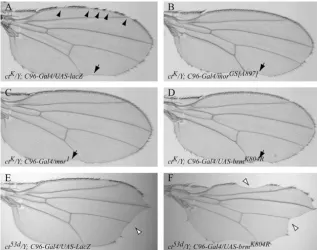
Figure5.—The Brahma complex interacts genetically withcut during wing-margin de-velopment. (A–D) ThectK-associated loss of
margin bristles is suppressed by disrupting the Brahma complex subunits, Mor and Brm. (A)ctKmutant wings consistently show
nu-merous discontinuities in the stout mechano-sensory margin bristles (arrowheads). (B and C) Heterozygous loss-of-functionmoira muta-tions, morGS[A897] and mor1, suppress
com-pletely thectK-associated loss of sensory
bris-tles along the anterior wing margin. (D) Margin-specific overexpression of UAS-brmK804Rsuppresses thectKwing phenotype in
the anterior margin.C96-Gal4-directed over-expression of UAS-brmK804Rhad no effect on
wing development when misexpressed in an otherwise wild-type genetic background. Note that the posterior incisions of wing-blade tissue are not rescued by disrupting Mor or Brm function (arrows in A–D). (E and F) Thect53dwing allele is differentially
affected, as compared toctK, by the
disrup-tion of the Brahma complex activity. (E) The ct53dwing phenotype is characterized by the
severe loss of wing-blade tissue at the distal wing tip (open arrowhead) and by infrequent gaps in the anterior wing-margin sensory bristles. (F) The overexpression of UAS-brmK804Renhances both the loss of wing-blade tissue (open arrowheads) and sensory bristles. Note that the anterior and posterior
wing margin is similarly affected.
isoforms. In contrast tolola, loss-of-function psqalleles posterior boundary using the patched-Gal4 driver ( ptc-Gal4; Figure 4G), ectopic Cut expression was not ob-did not affect thect53dphenotype (data not shown). If
lolainteracts withcutduring wing-margin development, served (data not shown). In contrast,ptc-Gal4-directed lolaGS[A916]overexpression resulted in ectopic Wg protein
as our genetic data suggest,lolashould be expressed in
wing imaginal tissue. Indeed, using a riboprobe that in cells immediately adjacent to the dorsoventral bound-ary (Figure 4, G–I). AlthoughlolaGS[A916]can be active in
recognizes all variantlolamRNA transcripts, we found
thatlolais ubiquitously expressed throughout the wing wing-blade cells, as shown by ectopic Wg expression, rescued Cut expression remains confined to the margin disc (Figure 4C). Together, these results suggest that
lolacooperates withcutin wing-margin development. cells, suggesting that some unknown factor, other than Lola, is involved in restricting Cut expression to margin
Overexpression of lolaGS can rescue Cut expression
and ectopically induce Wg:The overexpression data are cells.
These results suggested thatlolamay be required for consistent with lola acting genetically downstream of
cutin wing-margin patterning, but do not rule out the wild-type wing-margin morphogenesis. To test this, we generated somatic clones oflolamutant cells using the possibility thatlola suppresses the wing phenotype by
restoring Cut expression in the wing discs ofcutregula- FLP/FRT method (Xu and Rubin 1993). In homozy-gouslolamutant clones located adjacent to or bisecting tory mutants. To determine if thelolaGSline rescues Cut
expression, we examined the pattern of Cut protein in the wing margin, neither Cut expression nor the mor-phology of wing-margin bristles is disrupted (data not ct53d wing imaginal discs in either the presence or the
absence of drivinglolaGS[A916]in the wing margin. In
ct53d shown). Thus, it appears that
lola, although sufficient to rescue decreased levels of Cut expression, is not abso-mutant discs, Cut expression is reduced throughout the
wing margin and completely absent at the presumptive lutely required for Cut expression and margin develop-ment of otherwise wild-type wing discs, but strongly in-wing tip, corresponding to the region of the adult in-wing
most visibly disrupted (Figure 4, D and E). Overexpres- fluences the development of wings with compromised cutactivity.
sion oflolaGS[A916]in the wing margin rescues Cut
expres-sion in ct53d mutants (Figure 4F), indicating that lola Disruption of Brahma complex activity suppresses the
ctK phenotype:Among the GS lines able to completely
may be involved in regulating Cut expression.
AlthoughC96-Gal4-driven expression at the presump- rescue the ctK phenotype, we identified a GS vector
insertion in the first exon ofmor(designatedmorGS[A897];
tive margin is broader than the normal Cut expression
domain (Figure 4A), ectopic Cut is not observed outside Figure 5, A and B, and Table 3). On the basis of its failure to complement the lethality of hypomorphicmor1
of the margin cells in response to lolaGS[916]. Similarly,
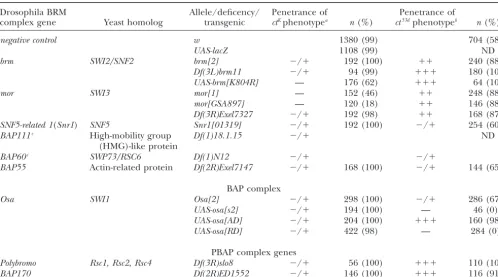
loss-of-func-TABLE 3
Summary of the genetic interactions between Brahma complex genes andcutalleles
Drosophila BRM Allele/deficency/ Penetrance of Penetrance of
complex gene Yeast homolog transgenic ctKphenotypea n(%) ct53dphenotypeb n(%)
negative control w 1380 (99) 704 (58)
UAS-lacZ 1108 (99) ND
brm SWI2/SNF2 brm[2] ⫺/⫹ 192 (100) ⫹⫹ 240 (88)
Df(3L)brm11 ⫺/⫹ 94 (99) ⫹⫹⫹ 180 (100) UAS-brm[K804R] — 176 (62) ⫹⫹⫹ 64 (100)
mor SWI3 mor[1] — 152 (46) ⫹⫹ 248 (88)
mor[GSA897] — 120 (18) ⫹⫹ 146 (88)
Df(3R)Exel7327 ⫺/⫹ 192 (98) ⫹⫹ 168 (87) SNF5-related 1(Snr1) SNF5 Snr1[01319] ⫺/⫹ 192 (100) ⫺/⫹ 254 (60)
BAP111c High-mobility group Df(1)18.1.15 ⫺/⫹ ND
(HMG)-like protein
BAP60c SWP73/RSC6 Df(1)N12 ⫺/⫹ ⫺/⫹
BAP55 Actin-related protein Df(2R)Exel7147 ⫺/⫹ 168 (100) ⫺/⫹ 144 (65)
BAP complex
Osa SWI1 Osa[2] ⫺/⫹ 298 (100) ⫺/⫹ 286 (67)
UAS-osa[s2] ⫺/⫹ 194 (100) — 46 (0) UAS-osa[AD] ⫺/⫹ 204 (100) ⫹⫹⫹ 160 (98) UAS-osa[RD] ⫺/⫹ 422 (98) — 284 (0)
PBAP complex genes
Polybromo Rsc1, Rsc2,Rsc4 Df(3R)slo8 ⫺/⫹ 56 (100) ⫹⫹⫹ 110 (100)
BAP170 Df(2R)ED1552 ⫺/⫹ 146 (100) ⫹⫹⫹ 116 (91)
Results from genetic interaction studies are summarized:n, the total number of wings scored; ND, not determined;⫺/⫹, no effect;⫺and⫹, the degree to which the penetrance of thecutwing phenotype in the anterior wing margin was suppressed and enhanced, respectively.
aThe wings of the genotypectK/Y;[specified BRM complex gene]/C96-Gal4were scored for suppression of anterior margin bristle
loss. The penetrance of thectKwing phenotype is given as a percentage of total wings displaying gaps in the anterior wing margin
sensory bristles. Note that the negative control experiments (wandUAS-lacZ) display a completely penetrantctKwing phenotype
(ⵑ99%).
bThe wings of the genotype ct53d/Y; [specified BRM complex gene]/C96-Gal4 were scored for either the suppression or the
enhancement of thect53d wing phenotype. Note that the negative control experiment (w) displays an incompletely penetrant
ct53dwing phenotype (ⵑ58%).
cBAP111andBAP60were recombined onto bothctKandct53dX chromoxomes. The phenotype of females heterozygous for
the respective deficiencies and homozygous for thecutmutations was compared to females homozygous for thecutmutations only.
tion allele (data not shown). In addition,morGS[A897]sup- mor encodes a core component of the Drosophila
SWI/SNF-related ATP-dependent chromatin remodel-pressedctK independently of the presence of the
C96-Gal4driver. To determine if a reduction ofmorfunction ing complex, the BRM complex (Crosbyet al. 1999). The BRM complex is a multimeric complex containing is indeed responsible for suppression, we tested the
ability of mor1 to interact with
ctK. Adult males of the the core catalytic subunit encoded by
brm, and it governs an epigenetic mechanism through which the restructur-genotypectK
/Y; mor1/⫹display a near-complete
restora-tion of anterior wing-margin structures normally dis- ing of nucleosomal DNA establishes and maintains pat-terns of gene expression (or repression) during devel-rupted or missing in ctK mutants, including L1
wing-vein tissue and triple-row sensory bristles (Figure 5C opment (for review, see Becker andHorz 2002). To determine if loss-of-functionmormutations suppressed and Table 3). Surprisingly, the deficienciesDf(3R)sbd105
(deficiency suppressor screen) andDf(3R)Exel7327(Ta- ctKvia a reduction in BRM complex activity, severalbrm
alleles were tested for the ability to interact withctKin
ble 3), both covering themorlocus, only weakly suppress
the severity of thectKphenotype. It is not clear why the the wing margin. Contrary to mormutations, both the
amorphicbrm2allele (KennisonandTamkun1988) and
hypomorphicmoralleles suppressctKmore strongly than
amordeficiency does. Perhaps thecutwing phenotype thebrm deficiency,Df(3L)brm11, failed to suppress the ctKphenotype (Table 3). Perhaps the level of Mor
pro-is particularly sensitive to the level of Mor activity, or
the deficiencies have accumulated modifier mutations tein is limiting with regard to Brm activity and the sup-pression of thectK phenotype.
that are not present in morhypomorphs, which act to