Rochester Institute of Technology
RIT Scholar Works
Theses
Thesis/Dissertation Collections
12-2014
A Transformation-Based Foundation for
Semantics-Directed Code Generation
Arthur Nunes-Harwitt
Follow this and additional works at:
http://scholarworks.rit.edu/theses
Recommended Citation
A Transformation-Based Foundation for
Semantics-Directed Code Generation
by
Arthur Nunes-Harwitt
A dissertation submitted in partial fulfillment of the
requirements for the degree of Doctor of Philosophy
in the B. Thomas Golisano College of
Computing and Information Sciences
Ph.D. Program in Computing and Information Sciences
Rochester Institute of Technology
Author signature
Approved by
Director of Ph.D. Program Date
December 2014
c
B. THOMAS GOLISANO COLLEGE OF COMPUTING AND INFORMATION SCIENCES
ROCHESTER INSTITUTE OF TECHNOLOGY ROCHESTER, NEW YORK
CERTIFICATE OF APPROVAL
The Ph.D. Degree Dissertation of Arthur Nunes-Harwitt has been examined and approved by the
dissertation committee as complete and satisfactory for the dissertation requirement for Ph.D. degree
in Computing and Information Sciences
Dr. Matthew Fluet Date
Dr. James Heliotis Date
Dr. William McKeeman Date
Dr. S. Manian Ramkumar Date
Dissertation Examination Chairperson
Dr. Axel Schreiner Date
Dissertation Co-Supervisor
Dr. Pengcheng Shi Date
Dissertation Supervisor
A Transformation-Based Foundation for Semantics-Directed
Code Generation
by
Arthur Nunes-Harwitt
December 2014
Abstract
Interpreters and compilers are two different ways of implementing programming
lan-guages. An interpreter directly executes its program input. It is a concise definition of the
semantics of a programming language and is easily implemented. A compiler translates
its program input into another language. It is more difficult to construct, but the code that
it generates runs faster than interpreted code.
In this dissertation, we propose a transformation-based foundation for deriving
com-pilers from semantic specifications in the form of four rules. These rules give apriori
ad-vice for staging, and allow explicit compiler derivation that would be less succinct with
partial evaluation. When applied, these rules turn an interpreter that directly executes
its program input into a compiler that emits the code that the interpreter would have
executed.
We formalize the language syntax and semantics to be used for the interpreter and
the compiler, and also specify a notion of equality. It is then possible to precisely state
the transformation rules and to prove both local and global correctness theorems. And
although the transformation rules were developed so as to apply to an interpreter
writ-ten in a denotational style, we consider how to modify non-denotational interpreters so
that the rules apply. Finally, we illustrate these ideas by considering a larger example: a
Acknowledgements
I am forever grateful to my advisor Professor Axel Schreiner. He not only saw my
po-tential, but he also played an active role in actualizing it when I thought all hope was
lost. Further, he tirelessly read draft upon draft of my papers, always providing helpful
suggestions. I would like to acknowledge Professor Pengcheng Shi for his support and
advice. He made sure to slow me down when I was too eager to rush ahead, and he made
sure to push me forward when I needed it. I am thankful to Professor Bill McKeeman for
nudging my research in its current direction. I am thankful to Professor Matthew Fluet
for carefully reading my proofs and reading drafts of my papers. I am thankful to
Pro-fessor Jim Heliotis for his helpful discussions. I would also like to acknowledge Melissa
Nunes-Harwitt for providing helpful feedback on all of my papers.
Professor Linwei Wang generously offered LATEX assistance.
Dr. Arthur C. Nunes Jr., Professor Axel Schreiner, Melissa Nunes-Harwitt, Professor
Stanislaw Radziszowski, Menachem Kiria, and Professor Hossein Shahmohamad helped
me eliminate errors in my epigraphs.
I am grateful for the encouragement of Brent Devere, and my gratitude also goes to all
To my father, and to my mother, for setting an example. I humbly follow in your path.
We choose to [. . . ] do these [. . . ] things, not because they are easy, but because
they are hard, because that goal will serve to organize and measure the best of
our energies and skills. . . .
Contents
Abstract v
Acknowledgements vi
Contents ix
List of Figures xiii
1 Introduction 1
1.1 A Semantics-Directed Approach to Code Generation . . . 2
1.2 Overview . . . 3
2 Background and Related Work 4 2.1 Historical Overview . . . 5
2.2 Compiler Generators . . . 7
2.3 Partial Evaluation . . . 11
2.4 Staged Computation . . . 14
3 The Transformation Technique by Example 18
3.1 A Small Example . . . 19
3.1.1 Currying Dynamic Variables . . . 19
3.1.2 Code Via Quoting . . . 20
3.1.3 Lambda Lowering . . . 21
3.1.4 Expression Lifting . . . 22
3.1.5 Rule Ordering . . . 23
3.2 A Longer Example . . . 23
3.2.1 Currying . . . 26
3.2.2 Lambda lowering . . . 26
3.2.3 Expression lifting . . . 27
3.2.4 Quoting . . . 28
3.2.5 Output . . . 29
3.3 Summary . . . 30
4 A Formal Model 31 4.1 The Interpreter Language . . . 31
4.2 The Transformation Rules . . . 35
4.3 Local Correctness . . . 37
4.4 Global Correctness of a Sum Language Example . . . 40
4.4.1 Applying the Transformations . . . 42
4.4.2 Correctness . . . 43
4.5 Global Correctness of an Abstract Denotational Example . . . 44
4.5.1 Applying the Transformations . . . 46
5 Beyond Denotational Interpreters 50
5.1 Disentangling the Static and the Dynamic . . . 51
5.1.1 Unification Example . . . 51
5.1.2 Applying the Technique: A First Attempt . . . 53
5.1.3 Revising the Algorithm . . . 54
5.2 Introducing Explicit Fixed-Points . . . 55
5.2.1 Example: While Loops . . . 55
5.2.2 Example: Regular Expressions . . . 56
5.3 Replacing Text with Denotation . . . 58
5.3.1 Interpreters Manipulating Terms . . . 59
5.3.2 Environments Containing Terms . . . 64
5.4 Summary . . . 67
6 A Larger Example: PROLOG 68 6.1 A Naïve Interpreter . . . 69
6.2 Efficiency and Denotation . . . 71
6.3 Improving Unification . . . 74
6.4 Currying and Lambda Lowering . . . 77
6.5 More Lambda Lowering . . . 79
6.6 Expression Lifting . . . 80
6.7 Code Generation . . . 81
6.8 Performance . . . 83
6.9 Summary . . . 85
7 Future Work 86 7.1 Relationship to Partial Evaluation . . . 86
7.3 Additional Rules . . . 87
7.4 Additional Languages . . . 90
7.5 Automation . . . 91
8 Conclusion 94 8.1 The Transformation Technique . . . 94
8.2 Denotational Interpreters and Beyond . . . 95
8.3 Comparison to Partial Evaluation and Staging . . . 95
8.4 Practical Benefits . . . 96
List of Figures
4.1 Interpreter language syntax. . . 32
4.2 Interpreter language semantics. . . 34
4.3 Interpreter language term equality. . . 35
4.4 Transformations . . . 36
Chapter
1
Introduction
ĽŸĎ
,ĚŽŸĚŰŃŮĚŚŤŊĆŸŽŐĎ
ĽŸĎ
,ĚĽŇ{ŞĽŚĚŐĎĚ-ĽĂČĄĎĘ
.ŞČĆŐĚŞŸĞŐĎĘ
If one translates a verse literally, he is a fabulator – but if he adds to it, he is a blasphemer and a libeller.
B. Talmud Kiddushin 49a
Acompileris a computer program that when executed translates1sourcecode, or input code, totargetcode, or output code; it is understood that the source code is in some fixed high-level programming language and that the target code has the same meaning as the
source code.
What approaches are there that ensure that the target code preserves the semantics
of the source code? One approach is to guess what the target code should look like and
then prove that it preserves the semantics after the fact. Another approach is to derive
1Often the word “compiler” is used when translating to a low-level language, and the word “translator”
CHAPTER 1. INTRODUCTION
the target code from a semantic specification such as an interpreter. We argue that certain
transformations are an effective means of doing exactly that.
1.1
A Semantics-Directed Approach to Code Generation
Commonly, compilers are implemented via a syntax-directed approach which involves
writing code to generate instructions for each piece of abstract syntax. The code to be
generated isnotderived from any specification; rather it is chosen by the compiler writer in an ad-hoc fashion. In contrast, a semantics-directed code generator is a code generator
that has been derived from a semantic specification. Semantics-based approaches to code
generation have a number of benefits: correctness, ease of implementation,
maintainabil-ity, and rational justification. Two techniques for semantics-based code generation are
partial evaluationandstaging.
Like Burstall and Darlington [17], the concern here is on fundamental rules for
deriv-ing programs. Their approach involves ideas at the core of equational reasonderiv-ing: foldderiv-ing
and unfolding. Instead, here the focus is on an extension of theλ-calculus [8, 19, 38]
for-mulation of theS-m-ntheorem [59, 70].
This thesis makes the following contributions. It identifies a transformation technique
in the form of four essential rules, and proves properties about those rules. An analysis
shows how this transformation technique can be applied to a class of interpreters even
broader than the class of denotational-style interpreters. Case studies suggest the utility
of these transformation rules and the transformation approach in general for deriving a
compiler from an interpreter.
This approach to creating compilers has the same benefits as other semantics-based
ap-proaches. These benefits are particularly valuable for domain-specific languages (DSLs)
ad-1.2. OVERVIEW
vantages include the ability to derive a compiler, and the possibility of naturally adding
additional stages to the transformation sequence so as, for example, to use more
sophis-ticated algorithms. In contrast to other work in staging, the advantage is a more formal
foundation for program transformation.
1.2
Overview
The rest of this thesis examines the transformation technique in detail. Chapter 2 is
de-voted to the various ideas related to the transformation technique. Chapter 3 introduces
the transformation technique informally. Chapter 4 formalizes the notions here so as to
state the rules precisely and to prove correctness results. Although the inspiration for the
transformation technique is denotational semantics, chapter 5 investigates to what extent
interpreters written in other styles may be modified so that the transformation technique
can be applied. Chapter 6 considers a more significant example: a PROLOG
implementa-tion. Chapter 7 outlines some thoughts concerning additional work that might be done.
Chapter
2
Background and Related Work
Gutta cavat lapidem non bis, sed saepe cadendo; sic homo fit sapiens non bis, sed saepe legendo.
A drop hollows out the stone by falling not twice, but many times; so too is a person made wise by reading not two, but many books.
Giordano Bruno
The ideas discussed in this thesis lie in the intersection of three related areas: compiler
generation, partial evaluation, and staged computation. A historical section introduces
2.1. HISTORICAL OVERVIEW
2.1
Historical Overview
The term compilerwas first used by Grace Hopper [48, 62] to describe program genera-tion software. These early compilers gathered together, or compiled, subroutines from
subroutine libraries to form whole programs. Mike Karr [57] suggests that John Backus
referred to his FORTRAN project as a ‘compiler’ project to emphasize the utility of the
project independent of the ambitious translation aspect.
Every programmer has had the experience of finding a bug in even the simplest
pro-gram. Writing bug-free software is challenging. Frederick Brooks [15] observes that there
are layers to the challenge of writing bug-free software. He defines aprogramming system
as software that consists of a collection of coordinated, interacting programs, and he
de-fines aprogramming productas software that will be run and maintained by others. Brooks suggests that a programming systems component is three times more difficult1 than an
ordinary program, and that a programming systems product is nine times more difficult.
At the very least, a compiler is inherently a component of a system involving the
oper-ating system, an editor, and perhaps other programs involved in writing the source and
running the target code. As such, a compiler is quite difficult to write. Indeed, a
well-known series of compiler texts [2–4] emphasizes the difficulty of writing a compiler by
depicting the complexity of compiler design as a dragon.
It is possible, and it is quite typical, to split a compiler into two components: the front-end, and theback-end. The front-end involves computations associated with the source such as lexical analysis, parsing, and type-checking. The back-end involves computations
associated with the target such as optimization and code-generation. The advantage of
splitting a compiler into front-end and back-end components is that it is then possible to
re-use the front-end for multiple targets and the back-end for multiple source languages.
CHAPTER 2. BACKGROUND AND RELATED WORK
Further, it is common to refine this division one step further by tripartitioning the
com-piler into the front-end, the middle-end, and the back-end. The front-end then performs
tasks associated with input such as lexical analysis and parsing. The middle-end
per-forms tasks that manipulate internal representations such as type-checking, generation
of intermediate-code, and optimization. The back-end involves computations associated
with output such as target-optimization and generation of target-code. The front-end,
middle-end, and back-end all have posed challenges.
Early programming language efforts used ordinary English to specify the syntax; the
associated ad-hoc parsers required tremendous effort to develop. When working on Algol
58, John Backus [7] made an important breakthrough2 when he introduced BNF3
nota-tion to express a context-free grammar (CFG) that specified the syntax. Because the class
of CFGs was so clearly specified, it was not long before general parsing algorithms (e.g.,
CYK, Earley), parsing algorithms for the regular subset, and linear time compiler-oriented
parsing algorithms appeared (e.g., Precedence Parsing, LL(k), LR(k), and LALR(k)).
Fur-ther, tools (e.g., XA [69], lex [65], and yacc [49]) emerged that effectively translated little
more than formal specifications into efficient parsing programs.
Code generation in early programming language efforts also involved ad-hoc
tech-niques. But there have been many advances in code-generation technology as well. In
particular, for back-ends tree-tiling [4, 80] and declarative machine descriptions [33] have
been used to specify at various levels how assembly code should be generated.
Unfor-tunately, for the generation of intermediate-code in middle-ends, ad-hoc techniques
con-tinue to be used; indeed, compiler textbooks take a ‘cookbook’ approach.
A principled approach to intermediate-code generation goes under the heading
semantics-2It may be that Backus was influenced by Chomsky [14] or Post [105]. In any case, the ideas seem to have
been in the air, and it was he who introduced them to the programming language community.
3There is a disagreement about whether BNF stands for ‘Backus Normal Form’ or ‘Backus Naur Form.’
2.2. COMPILER GENERATORS
directed compiler generation. Diehl [34] observes that a compiler generated from a semantic specification has the following advantages: correctness, ease of implementation — only
the specification needs to be written from scratch, maintainability — only the
specifica-tion needs to be modified, and raspecifica-tional justificaspecifica-tion for the code generated. For automatic
(middle-end) compiler generation, some form ofpartial evaluation[51] (i.e., a program spe-cialization technique) is typically used; although occasionally other approaches are used.
The idea ofstaging[56,74,87] (i.e., separating a computation into one that runs earlier and another that runs later) is more general than partial evaluation and may refer to automatic
or manual approaches to generation. These techniques have been leveraged to partially
or fully systematize code-generation. Nevertheless, the success achieved with front-ends,
namely the ability to automatically translate a specification into an efficient program, in
the realm of intermediate-code generation remains elusive.
2.2
Compiler Generators
Narrowly speaking, a compiler generator is a program that accepts a specification of a source languageSthat describes both the syntax (S) and semantics, accepts a specification
of a target languageT that describes both the syntax (T) and semantics, and generates a
compiler that acceptsS programs and generatesT programs. Broadly speaking, we use
the term even if aspects are missing (e.g., the parser, or the target specification) or an
interpreter is generated instead.
The first compiler generator is Peter Mosses’ Semantic Implementation System (SIS)
[73]. The specifications for syntax and semantics are tightly integrated. The lexical and
CHAPTER 2. BACKGROUND AND RELATED WORK
is quite slow.
Another pioneering compiler generator was CERES by H. Christiansen and Neil D.
Jones. Mads Tofte [101] subsequently simplified the CERES compiler generator by
ob-serving that a compiler generator is a kind of compiler. He appears to deemphasize the
use of a general partial evaluator.
Peter Lee [63, 64] criticizes Mosses’ work and others [79] and points out that the
gen-eration process, the generated compiler and the target code generated by the generated
compiler are all too slow and inefficient. Lee puts the blame squarely on denotational
semantics [95, 102]. In particular, he identifies the following four problems: (1) lack of separability— when certain features are added, the entire semantics must be rewritten4; (2) poor semantic engineering— the static and dynamic aspects are blurred5; (3) minimal-ist semantic explication— some language features are described at a very high level that provide no hint of low-level implementation (e.g., no distinction is made between
param-eters and other variables); and (4)lack of modularity— there are no semantic modules, and interaction with the store relies on specific concrete mathematical details. While Lee
pre-serves the compositional6 aspect of denotational semantics, he replaces the details with
a two level semantics: a macrosemantics and a microsemantics. The macrosemantics is
expressed in a prefix-form operator expression (POE), which appears to be a standardized abstract syntax. The microsemantics can be expressed in a number of ways ranging from
a high-level denotational semantics to a low-level assembly language description.
How-ever, the different microsemantics are not required to agree; for example, the assembly
language semantics for array indexing does no bounds checking. Lee’s system generates
4Subsequently, some in the denotational camp addressed this problem using the category theoretical
con-struct ofmonads[36, 71, 91, 93].
5This blurring of the the static and dynamic aspects can also be seen as an advantage [42] allowing for a
simpler description of the meaning.
6Acompositional[102] semantics is one in which the meaning of an expression is a function of the meaning
2.2. COMPILER GENERATORS
compilers that can parse, statically type-check, and generate assembly code; further, it is
able to generate faster compilers that generate faster code. However, it is not clear how
flexible his compiler generator is, nor is it clear how confident one can be in its correctness.
In contrast, Jesper Jørgensen [54, 55] generates a realistic compiler for a Haskell-like
language that is specified using denotational semantics. Jørgensen calls the language he
implements BAWL. It resembles Miranda even more closely than Haskell. The
specifi-cations for syntax and semantics are not tightly integrated. The lexical and grammatical
structure is expressed in a form suitable for a YACC-like parser generator. Programs are
assumed to be type correct; there is no attempt at type-checking. Jørgensen does
dis-cuss how a meta-interpreter would allow the denotational definition language to be used
directly, and he gives some small examples. He further speculates that determining
bind-ing times might be easier with this approach. Nevertheless, the denotational semantics
is hand-translated7into Scheme [58, 92] and then the resulting interpreter is enhanced to
perform ‘optimizations.’ If performed at run-time, the ‘optimizations’ would slow down
execution; however, they are designed so that the partial evaluator will perform them
dur-ing the static phase. The resultdur-ing compiler which targets Scheme, when coupled with an
optimizing Scheme compiler, performs better than a non-optimizing Miranda compiler
from Research Software Limited. However, an experimental optimizing research
com-piler from Chalmers University has even better performance.
Charles Consel and Siau Cheng Khoo [24] generate a simple PROLOG[32,104] compiler that is specified using denotational semantics. Issues of syntax specification are ignored.
The denotational semantics is hand-translated into side-effect-free Scheme, and a partial
evaluator is used to create a compiler that targets Scheme. Consel and Khoo report that
compiled code runs six times faster than interpreted code, but they do not compare their
compiler to other PROLOGimplementations. This compiler suffers from a number of
CHAPTER 2. BACKGROUND AND RELATED WORK
sues. First, because their partial evaluator does not support side-effects, their approach
cannot take advantage of more sophisticated unification algorithms. Second, their
ex-amples of compiled programs show duplications of the database. Third, the generated
compiler cannot handle recursive PROLOGprograms; recursion causes their compiler to
loop.
In order to demonstrate a new technique for doing binding time analysis, Olivier
Danvy and René Vestergaard [29] generate a compiler for a simplified Pascal-like
lan-guage. Issues of syntax specification and type-checking are ignored. The denotational
semantics is hand-translated into Scheme, where all globals have been turned into
pa-rameters because their binding time analyzer requires its input to be closed. Their partial
evaluator is then used to create a compiler that targets Scheme. Danvy and Vestergaard
report that generated code runs four times faster than interpreted code. In addition, they
point out that their compiler generates code that resembles three-address code [3,4];
how-ever, it may be that that is a result of the semantics being expressed in a low level style.
Stephan Diehl [34] generates compilers for two simple languages. Issues of syntax
are ignored. From the specified big-step operational semantics [84, 102], an abstract
ma-chine is generated together with a compiler that targets that abstract mama-chine. Diehl’s
system does this by first transforming the big-step operational semantics into a small-step
operational semantics [84, 102]. This transformation is accomplished by recording the
ad-ditional information of the big-step derivation tree in an auxiliary context data structure.
Thenpass-separation8ensures that instructions either introduce other instructions or mod-ify the context data, but not both. The capability of generating instructions for an abstract
machine is impressive, but the kind of abstract machine generated is restricted to what is
embodied in the transformation algorithm.
Michael J. A. Smith [90] focuses on the meta-level and provides a complete
2.3. PARTIAL EVALUATION
directed compiler generator: SEMCOM. Syntax and semantics are specified in two parts: the dynamic semantics and the static semantics. The dynamic semantics take the form
of an operational semantics (either big or small step) involving concrete syntactic forms,
from which an interpreter is generated. The static type system is powerful enough to
express polymorphic type systems and is used to generate the lexer, parser, and
type-checker. The comprehensiveness of the SEMCOM specification language is impressive;
however, it generates only interpreters, not compilers.
There have been various approaches to constructing compiler generators. As of yet,
no approach has been competitive with hand-crafted compilers. Partial evaluation is an
approach often taken for constructing a compiler generator. We explore this idea next.
2.3
Partial Evaluation
Partial evaluation[51] is a transformation technique for specializing programs. Program specialization can mean simply replacing some of a function’s parameters with values;
however, specialization is usually understood to involve using those values to perform
some of the computation that does not depend on the remaining parameters. Jones et. al.
[51] suggest that Lionello A. Lombardi first used the term ‘partial evaluation’ essentially
as it is used today; however, Lombardi’s 1964 paper [66] does not seem to contain the
phrase ‘partial evaluation,’ and instead discusses ‘incremental computation.’ In the same
year as Lombardi’s paper, Peter J. Landin [61] used the term ‘partial evaluation’ when
discussing mechanisms for expression evaluation. Rodney M. Burstall and John
Darling-ton [17] provide the conceptual foundation for partial evaluation:unfolding, or expanding definitions, andfolding, or reducing definitions.
Kleene’s S-m-ntheorem establishes that the minimal form of specialization is
CHAPTER 2. BACKGROUND AND RELATED WORK
that performs partial evaluation. Lionello A. Lombardi hinted at the use of a program to
do partial evaluation. Yoshihiko Futamura [42] was the first to clearly describe a partial
evaluator and point out what are now known as the first and second Futamura
projec-tions: that a partial evaluator can be used to do compilation and to create compilers.
The Futamura projections concern the following observations. We model a
program-ming language Las a three-tuple L = hE, L, Di, whereD is the set of data that the
lan-guage processes, L ⊆ Dis the set of program representations, and E : L×D∗ → Dis the evaluator that maps a program representation and inputs to output. Given a
pro-gramming languageL, a partial evaluatormhas the property that for anyLprograme,
(Ee(d1, d2)) = (E (Em(e, d1))d2). Now first observe that ifeis an interpreter forL2and
pis anL2program, then(Ee(p, d)) = (E(Em(e, p))d). Thus(Em(e, p))can be regarded
as the target code, andλp.(Em(e, p))can be regarded as a compiler. Second, observe that
(Em(e, p)) = (E (E m(m, e))p). Thus we can reify the previous compiler abstraction as
(Em(m, e)); i.e., the partial evaluator is applied to itself.
In order to create a compiler using a partial evaluatorm,m must be self-applicable.
Futamura [42] and other early researchers [10,35] were unable to construct a partial
evalu-ator with this property. One point of view is that the problem was that the partial
evalua-tor could not tell which which specializations were important and which were not. Jones,
Sestoft, and Søndergaard [52, 53] identified important specializations with ‘obvious’ ones
— specializations that could be identified via static analysis. They then made a distinction
betweenonlinepartial evaluators (i.e., those that in a single phase decide what to special-ize and then perform that specialization) andofflinepartial evaluators (i.e., those that have two phases: one which performs abinding time analysisthat determines what specializa-tion should take place, and one which performs the specializaspecializa-tions that the analysis
indi-cated). Their offline partial evaluator ‘mix’ was the first capable of self-application; it was
2.3. PARTIAL EVALUATION
Anders Bondorf and Olivier Danvy designed the offline self-applicable partial
evalu-ator Similix [13]. The language it handled was a subset of Scheme that included mutable
global variables. It also improved on previous efforts by better preserving termination
properties and by avoiding code duplication.
Charles Consel created the offline self-applicable partial evaluator Schism [20, 21].
Ini-tially, the language was restricted to a first-order side-effect-free subset of Scheme, but it
was subsequently expanded to allow higher-order functions as well.
Subsequent partial evaluators such as Tempo [22, 23] were frequently extensions of
well-established partial evaluators such as Schism.
The cogen approach [12, 99] is an alternative to traditional partial evaluation. Like the
technique presented in this thesis, the emphasis is on generating a code generator. The
cogen approach borrows from the ideas involved in off-line partial evaluation. To create a
code generator, a binding time analysis is performed and the input program is annotated.
Instead of using the annotated program for partial evaluation, the annotations are reified
to generate the generator. Then the generator can be used for partial evaluation, if desired.
PGG [99, 100] is a partial evaluator that follows the cogen approach. According to Neil
D. Jones [50], it is one of the most sophisticated partial evaluation programs available at
the time of this writing.
Recently, despite beliefs that only offline partial evaluators could be self-applicable,
Robert Glück [43] developed anonlineself-applicable partial evaluator. The language is a flowchart language that allows recursive calls. Glück observes that no new techniques
were used but rather the order of the techniques and recursive polyvariant specialization
were the key to the implementation.
Early partial evaluators had trouble with assignment and/or higher-order functions
[20, 21]. Although contemporary partial evaluators are more powerful, they are not
par-CHAPTER 2. BACKGROUND AND RELATED WORK
tial evaluator can be challenging because partial evaluation algorithms are quite
compli-cated [29]. Some prefer manual staging because it is more transparent. We consider this
idea next.
2.4
Staged Computation
Astaged computation is a computation that is organized so that part of the computation occurs at one stage, or time, and the rest of the computation occurs at another. Partial
evaluation is a technique for staging; however, this notion has broader scope and includes
(and today usually refers to) manual techniques.
LISPprogrammers have long enjoyed a kind of staging in the form of theevaloperator and macros. Further, LISP[58, 68, 92, 94] dialects have always had a quotation mechanism
[9, 68] which has facilitated meta-programming. Theevaloperator allows staging in that
s-expressions can be constructed that look like programs. These programs can then be
evaluated by theevaloperator in the global environment9. Macros allow staging in that
arbitrarily complex programs can be written that generate code in the form of an abstract
syntax tree usually expressed as an s-expression10. This generated code is executed later11
with the non-macro portion of the program.
It appears that Ulrik Jørring and William L. Scherlis [56] were the first to use the term
‘staging.’ In their provocative paper, they show many examples of turning small
inter-preters into code generators. However, they are somewhat vague about the details of
transforming an interpreter. They comment, “[We] reorder computations a bit to separate
the stages...” but they do not explain how to do so.
A year later, Marc Feeley’s paper [37] appears concerning a closure-based approach
9As of R5RS [58], Scheme allows environments other than the global environment to be specified. 10Dialects of Scheme have used explicit abstract syntax representations [92].
2.4. STAGED COMPUTATION
to code generation. Although he does not reference Jørring and Scherlis and he does
not characterize his approach as one involving a transformation, his presentation of an
interpreter and a compiler side by side is suggestive. Feeley is very practical and has
performance results to show that his approach yields simple but high performing
imple-mentations.
Flemming Nielson and Hanne R. Nielson [75] view staging from the perspective of
implementing a traditional compiler for functional programming languages. They are
concerned that with the proliferation of higher-order functions there remains a lot of
com-putation that can be done at compile time but discovering this comcom-putation requires a
careful analysis. To aid such analyses, they introduce ‘two-level languages.’
Rowan Davies and Frank Pfenning [31] extend the work of Nielson and Nielson and
develop a multi-level language. Again following Nielson and Nielson they develop a type
system for binding-time analysis. Davies and Pfenning have in mind that the analysis
should be specifically useful for partial evaluation. Their type system is based on modal
logic and allows for theevaloperator but not for open terms.
Since open terms are occasionally needed in partial evaluation, Rowan Davies [30]
developed a type system based on linear-time temporal logic. This type system allows for
open terms by abandoning the soundness of the evaloperator12. This limitation entails
that theevaloperator is not allowed.
Subsequently, Walid Taha and Tim Sheard [98] argue that multi-stage languages are
useful programming languages and should not just be viewed as an intermediate
lan-guages in a compiler (or other programming language oriented program). Although
Jørring and Scherlis are not referenced, Nielson and Nielson, and Davies and Pfenning
are referenced. Nevertheless they develop their own type system and deliver the
pro-gramming language MetaML. Unfortunately, this design is unsound because free
CHAPTER 2. BACKGROUND AND RELATED WORK
ables may be encountered during evaluation. Taha, Benaissa, and Sheard [97] correct the
soundness issue.
Eugenio Moggi, Walid Taha, Zine El-Abidine Benaissa, and Tim Sheard [72, 96] return
to the design of the type system for MetaML. Their new approach borrows much from
Davies and Pfenning. They succeed in integrating both the linear-time temporal logic and
the modal logic providing MetaML with a sound type system that allows for both theeval
operator and open terms.
Tim Sheard and Simon Peyton Jones [88] add meta-programming features to Haskell.
Their approach differs from MetaML. The emphasis is on compile time meta-programming
like LISPmacros. Unfortunately, also like LISPmacros the type system does very little to
ensure correctness.
Cristiano Calcagno, Walid Taha, Liwen Huang, and Xavier Leroy [18] explore an
al-ternative meta-programming implementation and extend OCaml to MetaOCaml. Their
implementation makes use of abstract syntax trees, gensym, and reflection. They report
that this new implementation yields respectable performance.
More recently, Aleksandar Nanevski and Frank Pfenning [74] extend the work of
Davies and Pfenning and incorporate into that logic some of the ideas from MetaOCaml
involving generated names. ν-abstraction is added to the language and a set of names
qualifies the modal operator. Thus their calculus and type system go beyond closed terms
and allow both open terms and the sound use of the theevaloperator with only a single
modal operator.
2.5
Summary
At one end of the spectrum, partial evaluation is a mostly automatic program
2.5. SUMMARY
the spectrum, staged computation is a mostly manual technique for specializing code. It
involves writing code that given a single input, does as much computation as possible,
and returns a function or function text that characterizes the rest of the computation that
depends on additional inputs. However, issues remain for both of these approaches.
Deriving a compiler using partial evaluation is cumbersome. Such a derivation is more
challenging than deriving a string-matching algorithm [28] because compiler generation
requires the partial evaluation of a traditional partial evaluator on the interpreter, or a
binding time analysis when using a cogen-based partial evaluator.
Further, partial evaluators have shortcomings both because they are automatic and
because they are not as automatic as claimed. Because they are automatic, they cannot
replace transparent definitional algorithms with more sophisticated algorithms. Fully
au-tomatic partial evaluators are often slow and/or generate slow code. Yet fully auau-tomatic
partial evaluators often do not succeed in eliminating static computation [29]. Thus
man-ual “binding time improvements” are needed to help the partial evaluator. Coming up
with the right improvements can be challenging because partial evaluation algorithms
are often quite complicated.
And so constructing a compiler completely automatically is unreasonable.
Neverthe-less, there should be a rational basis for compiler construction. The ideas of staging [56]
hint that a manual approach may be feasible, but they provide no notion of how to
con-struct the staged program.
This thesis presents a manual transformation technique that can be used to derive a
compiler from an interpreter. Because it is a manual technique, improved algorithms can
be introduced at any point. But even though the it is a manual technique, the
Chapter
3
The Transformation Technique by
Example
Kako@i-to matematik skazal, qto nasladenie ne v otkrytii istiny, no v iskanii ee.
A mathematician once said: pleasure lies not in discovering truth, but seeking it.
Leo Tolstoy
The motivation for the transformation technique comes from several places: Marc
Feeley’s closure based approach to code generation [37], Kleene’s S-m-ntheorem, and
denotational-semantics [95, 102]. The transformation technique involves applying four
rules: currying, lambda lowering, expression lifting, and quoting. To build intuition, we
3.1. A SMALL EXAMPLE
larger example.
3.1
A Small Example
In this section, the transformation rules are motivated by the desire to both specialize and
generate text. For the sake of brevity, mathematical functions are used as examples.
3.1.1 Currying Dynamic Variables
Currying is a mathematical trick to make all functions take one argument; it transforms a
function of two or more arguments into a function of one argument that returns a
func-tion. For example, the multiplication functionm(x, y) =x×ybecomesm(x) =λy.x×y.
If we have in mind that xis known statically, but y is known dynamically, then
apply-ing the curried form to a statically known value specializes the multiplication function.
For example, applyingm to2results in the following term: m(2) = λy.2×y. Thus the
application of a curried function is a form of code generation.
Many programming languages, especially today, allow for first-class functions. In
Scheme [58], the multiplication example looks as follows.
(define (m x y) (* x y))
When curried, it becomes the following.
(define (m x) (lambda (y) (* x y)))
However, applyingmto2yields an opaque result rather than the desired term.
CHAPTER 3. THE TRANSFORMATION TECHNIQUE BY EXAMPLE
> (m 2) #<procedure>
3.1.2 Code Via Quoting
To fix the problem in section 3.1.1, we want to see the text of the function rather than
the function itself (which may not be displayable). To return text, rather than a function,
we can use Scheme’s quotation and un-quotation mechanisms: backquote and comma.
The lambda expression is quoted and the lambda expression’s local free variables are
unquoted. Upon making this change, the term comes out as expected, although noweval
is needed to actually apply this function.
(define (m x) ‘(lambda (y) (* ,x y)))
> (m 2)
(lambda (y) (* 2 y))
But consider the following more complicated example of raisingbto the nth power
using a recursive function and what happens when applying these currying and quoting
transformations.
(define (p n b) ; original (if (= n 0)
1
(* b (p (- n 1) b))))
(define (p n) ; curried (lambda (b)
(if (= n 0) 1
3.1. A SMALL EXAMPLE
(define (p n) ; quoted ‘(lambda (b)
(if (= ,n 0) 1
(* b ((p (- ,n 1)) b)))))
> (p 3) (lambda (b)
(if (= 3 0) 1 (* b ((p (- 3 1)) b))))
The result this time is inadequate because a substantial amount of static computation
remains. In particular, the conditional does not depend on the parameterband should not
be there. The code generated also assumes a run-time environment in which the curried
form ofpthat returns a number is defined. Of course, the goal is to eliminate the need for
such a run-time function.
3.1.3 Lambda Lowering
To fix the problem in section 3.1.2, we need to evaluate the test in the conditional. A way
to do that is to move the function with the formal parameterbinside the conditional after
currying. Upon making this sequence of transformations, applying the code generating
function does yield a simpler term.
; original
; curried
(define (p n) ; lambda lowered (if (= n 0)
(lambda (b) 1)
(lambda (b) (* b ((p (- n 1)) b)))))
(define (p n) ; quoted (if (= n 0)
‘(lambda (b) 1)
CHAPTER 3. THE TRANSFORMATION TECHNIQUE BY EXAMPLE
> (p 3)
(lambda (b) (* b ((p (- 3 1)) b)))
While the result here is better, it is still inadequate because we have not yet eliminated
the reference to the functionp.
3.1.4 Expression Lifting
To fix the problem in section 3.1.3, we need to evaluate the recursive call. Since it resides in
aλ-expression, the only way to evaluate the expression is to lift it out. Upon making this
sequence of transformations, applying the code generating function yields an ungainly
but fully simplified term1.
; original
; curried
; lambda lowered
(define (p n) ; expression lifted (if (= n 0)
(lambda (b) 1)
(let ((f (p (- n 1))))
(lambda (b) (* b (f b))))))
(define (p n) ; quoted (if (= n 0)
‘(lambda (b) 1)
(let ((f (p (- n 1))))
‘(lambda (b) (* b (,f b))))))
1This example is intended merely to illustrate the four transformation rules. A more serious algorithm for
3.2. A LONGER EXAMPLE
> (p 3) (lambda (b)
(* b ((lambda (b)
(* b ((lambda (b)
(* b ((lambda (b) 1) b))) b)))
b)))
Although ideally the generated code would be more readable, we can make it more
pleasant looking by post-processing2.
(lambda (b) (* b (* b (* b 1))))
3.1.5 Rule Ordering
When applying the rules above, they are performed in the following order. First the
func-tion is curried. Then the lambda lowering and expression lifting rules are applied
repeat-edly until those rules can no longer be applied. Finally the quoting rule is applied to all
λ-expressions derived from the curried function.
3.2
A Longer Example
To illustrate the technique, consider the application of regular expression matching. A
regular expression matching interpreter takes a regular expression and a string, and
de-termines if the string is in the language denoted by the regular expression. Often, the
regular expression is fixed, and we would like the code that answers whether a string is
in the language denoted by that fixed regular expression.
2The post-processing consists of copy-propagation and dead-code elimination. Again, we only make this
CHAPTER 3. THE TRANSFORMATION TECHNIQUE BY EXAMPLE
Definition 1. Aregular expression is one of the following, where the predicate testing each option is in parentheses.
• The empty string. (null?)
• A character in the alphabet. (char?)
• The union of two regular expressions. (or?)
• The concatenation of two regular expressions. (cat?)
• The Kleene star of a regular expressions. (star?)
The matching algorithm is expressed in Scheme using continuation passing style; the
continuation (k) is the property that must be satisfied by the remainder of the string. In
the code below, a string is represented as a list of characters (cl).
(define (match regexp cl k) (cond ((null? regexp) (k cl))
((char? regexp) (if (null? cl)
#f
(and (eq? (car cl) regexp) (k (cdr cl))))) ((or? regexp)
(or (match (exp1<-or regexp) cl k) (match (exp2<-or regexp) cl k))) ((cat? regexp)
(match (exp1<-cat regexp) cl
(lambda (cl2)
(match (exp2<-cat regexp) cl2 k)))) ((star? regexp)
(let loop ((cl2 cl)) (or (k cl2)
(match (exp<-star regexp) cl2
(lambda (cl3)
3.2. A LONGER EXAMPLE
When regexp is the empty string, match invokes the continuation on the
charac-ter list. Note that the initial continuation verifies that the characcharac-ter list is empty. When
regexp is a character, matchchecks that the first character in the character list is that
character, and invokes the continuation on the tail of the character list. Whenregexpis a
union,matchfirst tries the first option, and if that fails it backtracks and tries the second
option. When regexp is a concatenation, match recursively matches the first
compo-nent and adds a check for the second to the continuation. Whenregexpis a Kleene star,
matchloops checking if either the continuation is satisfied (i.e., Kleene star corresponds
to the empty string) or the pattern to be repeated is matched; thus the shortest prefix is
matched.
In the following sections, we will now apply the technique to this interpreter and
CHAPTER 3. THE TRANSFORMATION TECHNIQUE BY EXAMPLE
3.2.1 Currying
A compiler for regular expressions must be a function that takes a regular expression;
hence the dynamic parameters are clandk. They are removed from the top-level
pa-rameter list and put into the papa-rameter list of the λ-expression. The recursive calls are
modified to account for this new protocol.
(define (match regexp) (lambda (cl k)
(cond ((null? regexp) (k cl)) ((char? regexp)
(if (null? cl) #f
(and (eq? (car cl) regexp) (k (cdr cl))))) ((or? regexp)
(or ((match (exp1<-or regexp)) cl k) ((match (exp2<-or regexp)) cl k))) ((cat? regexp)
((match (exp1<-cat regexp)) cl
(lambda (cl2)
((match (exp2<-cat regexp)) cl2 k)))) ((star? regexp)
(let loop ((cl2 cl)) (or (k cl2)
((match (exp<-star regexp)) cl2
(lambda (cl3)
(if (eq? cl2 cl3) #f (loop cl3))))))) (else (error ’match "match’s input is bad")))))
3.2.2 Lambda lowering
Since(cond (e1 e2) ...) ≡ (if e1 e2 (cond ...)), it is possible to apply the
conditional form of the lambda lowering rule several times. The lambda just below the
definition inmatchis lowered into each branch of the cond-expression3.
3An exception to the rule is made in the error case; the lambda is not lowered. The motivation is practical:
3.2. A LONGER EXAMPLE
(define (match regexp)
(cond ((null? regexp) (lambda (cl k) (k cl))) ((char? regexp)
(lambda (cl k) (if (null? cl)
#f
(and (eq? (car cl) regexp) (k (cdr cl)))))) ((or? regexp)
(lambda (cl k)
(or ((match (exp1<-or regexp)) cl k) ((match (exp2<-or regexp)) cl k)))) ((cat? regexp)
(lambda (cl k)
((match (exp1<-cat regexp)) cl
(lambda (cl2)
((match (exp2<-cat regexp)) cl2 k))))) ((star? regexp)
(lambda (cl k)
(let loop ((cl2 cl)) (or (k cl2)
((match (exp<-star regexp)) cl2
(lambda (cl3)
(if (eq? cl2 cl3) #f (loop cl3)))))))) (else (error ’match "match’s input is bad"))))
3.2.3 Expression lifting
Since the recursive calls have been curried and do not depend on the dynamic variables,
it is possible to lift them out of the lowered lambdas. In this example, it is clear that the
CHAPTER 3. THE TRANSFORMATION TECHNIQUE BY EXAMPLE
(define (match regexp)
(cond ((null? regexp) (lambda (cl k) (k cl))) ((char? regexp)
(lambda (cl k) (if (null? cl)
#f
(and (eq? (car cl) regexp) (k (cdr cl)))))) ((or? regexp)
(let ((f1 (match (exp1<-or regexp))) (f2 (match (exp2<-or regexp))))
(lambda (cl k) (or (f1 cl k) (f2 cl k))))) ((cat? regexp)
(let ((f1 (match (exp1<-cat regexp))) (f2 (match (exp2<-cat regexp)))) (lambda (cl k)
(f1 cl (lambda (cl2) (f2 cl2 k)))))) ((star? regexp)
(let ((f (match (exp<-star regexp)))) (lambda (cl k)
(let loop ((cl2 cl)) (or (k cl2)
(f cl2 (lambda (cl3)
(if (eq? cl2 cl3) #f
(loop cl3))))))))) (else (error ’match "match’s input is bad"))))
3.2.4 Quoting
Now each λ-expression is quoted. The Scheme backquote syntax is used to allow some
sub-expressions to be evaluated. In particular, non-global free variables are unquoted in
3.2. A LONGER EXAMPLE
(define (match regexp)
(cond ((null? regexp) ‘(lambda (cl k) (k cl))) ((char? regexp)
‘(lambda (cl k) (if (null? cl)
#f
(and (eq? (car cl) ,regexp) (k (cdr cl)))))) ((or? regexp)
(let ((f1 (match (exp1<-or regexp))) (f2 (match (exp2<-or regexp))))
‘(lambda (cl k) (or (,f1 cl k) (,f2 cl k))))) ((cat? regexp)
(let ((f1 (match (exp1<-cat regexp))) (f2 (match (exp2<-cat regexp)))) ‘(lambda (cl k)
(,f1 cl (lambda (cl2) (,f2 cl2 k)))))) ((star? regexp)
(let ((f (match (exp<-star regexp)))) ‘(lambda (cl k)
(let loop ((cl2 cl)) (or (k cl2)
(,f cl2 (lambda (cl3) (if (eq? cl2 cl3)
#f
(loop cl3))))))))) (else (error ’match "match’s input is bad"))))
3.2.5 Output
When the regular expression isa∗(a∪b), the simplified output becomes the following4.
4Although this example is more elaborate, it too is merely intended to be illustrative. The algorithm to
CHAPTER 3. THE TRANSFORMATION TECHNIQUE BY EXAMPLE
(lambda (cl k) (let ((k
(lambda (cl2)
(or (if (null? cl2) #f
(and (eq? (car cl2) #\a) (k (cdr cl2)))) (if (null? cl2)
#f
(and (eq? (car cl2) #\b) (k (cdr cl2)))))))) (let loop ((cl2 cl))
(or (k cl2)
(let ((cl cl2)
(k (lambda (cl3)
(if (eq? cl2 cl3) #f (loop cl3))))) (if (null? cl)
#f
(and (eq? (car cl) #\a) (k (cdr cl)))))))))
3.3
Summary
The transformation technique is not difficult to perform manually. By using four rules
(the transformation technique) we can turn an algorithm that computes a result into an
algorithm that generates code to compute the result. Finally, we see that the generated
code is respectable, but not breathtaking. The code that is generated can be no more
Chapter
4
A Formal Model
Μεταβάλλον ἀναπαύεται
Even as it changes, it stands still.
Heraclitus
The examples from chapter 3 illustrate how a procedure can be modified so that it
generates aλ-term. There the transformation rules were described informally. Here, we
will describe them formally. In order to do so, it is first necessary to articulate a suitable
language for writing interpreters. Once the interpreter language and the transformation
rules have been articulated, it is possible to prove correctness results.
4.1
The Interpreter Language
The examples in chapter 3 are written in Scheme. More generally, we are inspired by
Scheme, Common LISP, ML, and Haskell. Therefore, it is natural to construct a model
interpreter language based on the call-by-valueλ-calculus; this calculus is extended with
constants, conditionals, and quotation (see figure 4.1). Constants and conditionals are
CHAPTER 4. A FORMAL MODEL
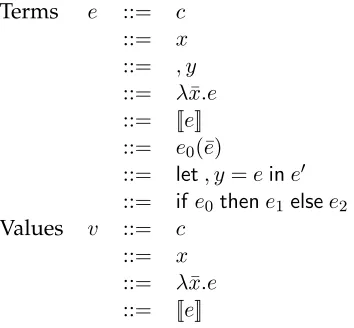
Terms e ::= c
::= x ::= , y ::= λx.e¯ ::= [[e]] ::= e0(¯e)
::= let, y=eine0 ::= ife0thene1elsee2
Values v ::= c
::= x ::= λx.e¯ ::= [[e]]
letx=eine0is syntactic sugar. (See below.)
[image:47.612.228.405.97.261.2]eval(e)is syntactic sugar. (See below.)
Figure 4.1: Interpreter language syntax.
application of a lambda expression, orabstraction1.
Definition 2. The formletx=eine0is syntactic sugar for(λx.e0)(e).
Definition 3. The formletx1 =e1,· · · , xn=enineis syntactic sugar for
letx1=e1 in · · ·letxn=enine.
There have been various approaches for describing program text in the context of the
λ-calculus2[72, 74, 96]. Quotation and thelet-form associated with quotation are inspired
by Nanevski and Pfenning [74] and require more discussion.
In LISP, both programs and data are parenthesized expressions. Data is distinguished from programs by putting a quotation mark in front. Thus(+ 2 3)performs addition,
but‘(+ 2 3)is a list. In the interpreter language above,+(2,3)performs addition and
1We use the term “abstraction” when discussing both the meta-language (interpreter language) and the
language.
2Other models of computation such as Turing machines and recursive function theory naturally
4.1. THE INTERPRETER LANGUAGE
[[+(2,3)]] is data. The notation here differs somewhat from LISP in that LISP allows an arbitrary form to be quoted; thus‘(1 2 3)is simply a list of numbers. While the
in-terpreter language syntax allows the term[[1(2,3)]], there is no other interpretation other
than application and so the term does not make sense. LISPalso makes it possible to
sub-stitute values into a quoted form. The comma operator is used to unquote an expression.
Thus the LISPexpression(let ((y 2)) ‘(+ ,y 3))evaluates to a list whose second component is2. In the interpreter language above, the comma is not an operator; rather a
second kind of variable is introduced, the comma-variable, which is intended to resemble
LISP’s application of the comma operator to a variable. Thelet-form for comma-variables is used for substituting into a quoted expression. In the interpreter language, the comma
example is writtenlet , y = 2 in[[+((, y),3)]]. Further, it is natural to use thislet-form to
define the operatoreval.
Definition 4. The formeval(e)is syntactic sugar forlet, y=ein, y.
The meaning of this interpreter languageλ-calculus is mostly standard (see figure 4.2).
A functionδ is assumed that characterizes how constant/primitive operators act on
val-ues. Again, the approach to modeling quotation requires some discussion. In LISP, we
have that(let ((y ‘(+ 3 4))) ‘(* 2 ,y))evaluates to the list(* 2 (+ 3 4)).
This can be understood as removing the quotation and replacing the comma-variable with
the unquoted term. In LISP, the body of thelet-form cannot be a comma-variable; in LISP
the comma operator must appear inside a quasi-quote form. However, in the interpreter
language it is possible. Observe that when the body of thelet-form is the comma-variable,
the quoted term is unquoted thereby implementing theevaloperator.
But what should the result be when applying evalto an unquoted value, and more
CHAPTER 4. A FORMAL MODEL
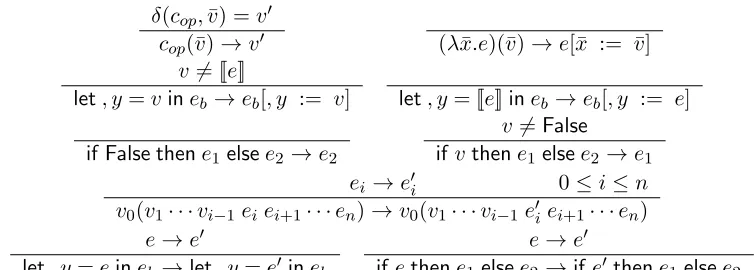
δ(cop,v¯) =v0
cop(¯v)→v0 (λx.e¯ )(¯v)→e[¯x := ¯v]
v6= [[e]]
let, y=vineb→eb[, y := v] let, y= [[e]]ineb →eb[, y := e]
if False thene1elsee2 →e2
v6=False ifvthene1 elsee2 →e1
ei→e0i 0≤i≤n
v0(v1· · ·vi−1eiei+1· · ·en)→v0(v1· · ·vi−1 e0iei+1· · ·en)
e→e0
let, y=eineb →let, y=e0ineb
e→e0
[image:49.612.124.501.95.230.2]ifethene1elsee2 →ife0thene1elsee2
Figure 4.2: Interpreter language semantics.
the discussion of syntax above, there was an example in which a comma-variable was
bound to the unquoted value2. However, the following example exposes a complication;
consider(let ((y (list 1 2 3))) ‘(car ,y)). It evaluates to the list(car (1
2 3)), which is not what we wanted; we wanted the list (car ’(1 2 3)). Should
something additional happen with unquoted values or not? We argue that the example
with the2, andnotthe example with the list, gets at the essence and that the anomaly with the list is due to unfortunate syntax. If we could write something like(let ((y [1 2
3])) ‘(car ,y)) in LISP, there would not be a problem3. And so the rule for the
let-form with comma-variables is merely to replace the comma-variable with the already
unquoted value.
Reduction can be extended to an equivalence relation by making sure the relation is
reflexive, symmetric, and transitive (see figure 4.3). In addition, when making arguments
it is useful to be able to say that sub-structural equality implies equality. Hence the
equa-tional rules for structural equality are added.
3Lurking in the background is the issue of equality. Scheme has the operatoreq?which is not extensional.
4.2. THE TRANSFORMATION RULES
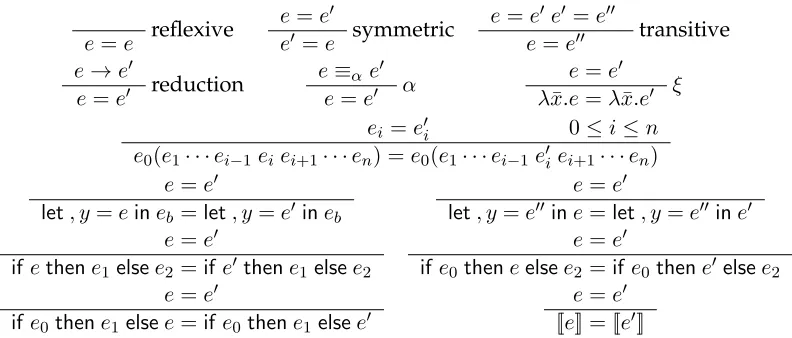
e=e reflexive
e=e0
e0 =e symmetric
e=e0 e0 =e00
e=e00 transitive e→e0
e=e0 reduction
e≡αe0 e=e0 α
e=e0 λx.e¯ =λx.e¯ 0 ξ ei =e0i 0≤i≤n
e0(e1· · ·ei−1eiei+1· · ·en) =e0(e1· · ·ei−1e0i ei+1· · ·en)
e=e0
let, y=eineb =let, y=e0ineb
e=e0
let, y=e00ine=let, y=e00ine0 e=e0
ifethene1 elsee2 =ife0thene1elsee2
e=e0
if e0theneelsee2=ife0 thene0 elsee2
e=e0
ife0thene1elsee=ife0thene1elsee0
[image:50.612.117.513.95.264.2]e=e0 [[e]] = [[e0]]
Figure 4.3: Interpreter language term equality.
4.2
The Transformation Rules
In chapter 3, we mentioned that the transformation technique was inspired by
denota-tional semantics. That is because a denotadenota-tional definition can be understood as a
com-piler: given a term, we are free to evaluate the recursive calls and derive aλ-term. Yet the
call-by-value evaluation strategy prevents reducing the applications inside abstractions.
The key idea behind the transformations is the following: An expression within an
ab-straction cannot be evaluated, and so the code is restructured so that the expression is no
longer within the abstraction. The formal transformations are in figure 4.4.
Rules (4.1) and (4.2) are about currying. The equivalence of functions and their curried
counterparts is well known. Although the rules are expressed as local changes, rule (4.2)
must be applied completely using non-local assumptions and information.
Rules (4.3) and (4.4) are about lambda lowering. These rules involve moving an
ex-pression that is just inside an abstraction and does not depend on the parameters of an
abstraction out of the abstraction. In particular, if the abstraction body is a conditional,
CHAPTER 4. A FORMAL MODEL
λ¯s,d.e ,¯ →λs.λ¯ d.e¯ (4.1)
ec( ¯es,e¯d),→ec( ¯es)( ¯ed) (4.2)
ifecis an expression that reduces to a curried function.
λx.¯ifethene1elsee2 ,→ifethen(λx.e¯ 1)else(λx.e¯ 2) (4.3)
ifxi∈/ FV(e)
λx.¯letz=eineb,→letz=einλx.e¯ b (4.4)
ifxi∈/ FV(e)andz6=xi
λx.e¯ 0[u := e],→letz=einλx.e¯ 0[u := z] (4.5) ifzis fresh andxi∈/ FV(e)
letz1 =e1in · · · letzn=eninλd.e ,¯ → (4.6)
let , z1 = e1 in · · ·
let , zn = enin
[[λd.e¯ [z1 :=, z1]· · ·[zn :=, zn]]]
when FV(λd.e¯ ) ={z1, . . . , zn}, each, ziis fresh, andFV(ei)∩ {z1, . . . , zn}=∅for eachi
The transformation relation is denoted by,→.
4.3. LOCAL CORRECTNESS
conditional as specifying one of two abstractions. Or, if the abstraction body defines an
intermediate value that does not depend on the parameters, we may regard the definition
as occurring outside the body of the abstraction.
Rule (4.5) is expression lifting. This rule is similar to lambda lowering insofar as both
involve moving an expression out of an abstraction. However, with expression lifting, the
entire expression is moved completely out of the abstraction if it does not depend on the
parameters of the abstraction. Typically, the expression being lifted is an application.
Rule (4.6) is about quotation. It transforms an expression that returns an abstraction
into an expression that returns the text that represents that abstraction. Note that the
rule states that the variables that become comma-variables are exactly those that are in
scope from the surroundinglet. In practice, we relax this restriction slightly and allow a
function’s formal parameters to be unquoted without being in alet. Following the formal
requirement of the rule in that case is trivial but wordy.
4.3
Local Correctness
The correctness of rules (4.3), (4.4), and (4.5) relies only on local reasoning. Note that they
all assume that the evaluation ofeterminates. If that is not the case, looping outside of an
abstraction is always observed, but looping inside an abstraction is observed only if the
abstraction is called. In practice, it is clear for rules (4.3) and (4.4) whether or note
termi-nates: typically it is a call to a structure predicate and it does not loop. The termination of
ein rule (4.5) is more subtle. If it is a recursive call on sub-structure it will terminate. If
it is a recursive call on the same structure it will not terminate. Otherwise, termination is
not obvious.
For rule (4.3), concerning lambda lowering for a conditional, we first need a technical
CHAPTER 4. A FORMAL MODEL
Lemma 1. Ife→∗ vthen(ifethene1elsee2)→∗(ifvthene1elsee2).
Informally, the argument for the correctness of rule (4.3) is that ifereduces to a value
v, then the body of the abstraction depends onv. When false, the body ise2; otherwise
the body ise1. And that is what the right-hand-side says.
Theorem 1. Ife→∗ v, andxi ∈/ FV(e)then(λx.¯ifethene1elsee2) = (ifethenλx.e¯ 1elseλx.e¯ 2).
Proof. By case analysis onv.
• Supposev6=False.
λx.¯if ethene1elsee2=λx.¯ifvthene1elsee2
=λx.e¯ 1
=ifvthenλx.e¯ 1elseλx.e¯ 2
=ifethenλx.e¯ 1elseλx.e¯ 2
• Supposev=False.
The argument is similar.
For rule (4.4), concerning lambda lowering for a let-binding, we first need a technical
lemma. (The proof of the lemma is in appendix A.)
Lemma 2. Ife→∗ vthen(letz=eineb)→∗(letz=vineb).
Informally, the argument for the correctness of rule (4.4) is that ifereduces to a value
4.3. LOCAL CORRECTNESS
substitutesvforzin the abstraction, but it passes right through and becomes a
substitu-tion inebsincezis distinct from the formal parameters.
Theorem 2. Ife→∗ v,z6=xi, andxi ∈/ FV(e)then(letz=einλx.e¯ b) = (λx.¯letz=eineb).
Proof.
letz=einλx.e¯ b =letz=vinλx.e¯ b
= (λx.e¯ b)[z := v]
=λx.¯(eb[z := v])
=λx.¯letz=vineb
=λx.¯letz=eineb
For rule (4.5), concerning expression lifting, we first need a technical lemma. (The
proof of the lemma is in appendix A.)
Lemma 3. Ife0 =vthen(e[u := e0]) = (e[u := v]).
Informally, the argument for the correctness of rule (4.5) is that ifereduces to a value
v, then the body of the abstraction on the left-hand-side will replaceuwithv. Theleton
the right-hand-side also ultimately replaces u withv since the substitution for z passes
CHAPTER 4. A FORMAL MODEL
Theorem 3. If e0 →∗ v, z is fresh, andxi ∈/ FV(e0) then (let z = e0 in λx.e¯ [u := z]) =
(λx.e¯ [u := e0]). Proof.
letz=e0inλx.e¯ [u := z] =letz=vinλx.e¯ [u := z] = (λx.e¯ [u := z])[z := v]
=λx.¯(e[u := z][z := v])
=λx.e¯ [u := v]
=λx.e¯ [u := e0]
With rule (4.6), the transformed expression reduces to a different value from the
orig-inal, and so here the notion of correctness is different.
4.4
Global Correctness of a Sum Language Example
Correctness for rule (4.6) means that applying theevaloperator to the text that results from
applying the transformed interpreter results in the same value that the original interpreter
yields. Rule (4.6) requires non-local information and assumptions; it must be applied to
all branches of a conditional. Here we consider a concrete sum language example. For the
sake of brevity, we write the evaluator in pseudo-code based onMLand Haskell that can
readily be translated into the interpreter language. It is used to implement a simple sum
language evaluator for a language involving numbers, variables, and sums. The evaluator
4.4. GLOBAL CORRECTNESS OF A SUM LANGUAGE EXAMPLE
First it is necessary to define the sum language. We can imagine thatN refers to a set
of numbers,V refers to a set of variables, andSis a constructor that builds syntactic sums.
Definition 5. Given setsN andV,L(N, V)is the smallest set satisfying the following.
• n∈L(N, V)ifn∈N, and
• x∈L(N, V)ifx∈V, and
• S(t1, t2)∈L(N, V)ift1, t2 ∈L(N, V).
Now we can define the sum language evaluator. We can imagine thatais the operator
that applies an environment to a variable, and thatpis the plus function.
E :L(N, V)×R→N
E(n, ρ) =n
E(x, ρ) =a(ρ, x)
E(S(t1, t2), ρ) =p(E(t1, ρ),E(t2, ρ))
Note that the interpreter language in figure 4.1 does not include a form in which
a function is defined by a set of equations. Rather, this pseudo-code is shorthand for
the following term, where E is a variable, ⊥ is a constant, Y is the call-by-value
fixed-point/recursion operator,t ∈ N refers to a number predicate,t ∈ V refers to a variable
predicate,s?is the sum predicate, ands1ands2 are the sum selectors.
letE =Y(λf. λ(t, ρ).
ift∈N thent
else ift∈V thena(ρ, t)
else if s?(t)thenp(f(s1(t), ρ), f(s2(t), ρ))
CHAPTER 4. A FORMAL MODEL
4.4.1 Applying the Transformations
In the following sub-sections, we will now apply the technique to this evaluator and
de-rive a code generator.
Currying and Lambda Lowering
A compiler for sum expressions must be a function that takes a sum expression. The
dynamic parameter is the environment variable ρ because values for variables are not
known until run-time. This parameter is removed from the top-level parameter list and
put into the parameter list of theλ-expression. The recursive calls are modified to account
for this new protocol. Since, in this shorthand, currying involves introducing a λand
moving a parameter from the left of the equal-sign to the right, lambda lowering occurs
as well.
E1(n) =λρ.n E1(x) =λρ.a(ρ, x)
E1(S(t1, t2)) =λρ.p(E1(t1)(ρ),E1(t2)(ρ))
Expression Lifting
Since the recursive calls have been curried and do not depend on the dynamic variables,
it is possible to lift them out of the lowered lambdas. It is clear that the calls will halt since
the recursive calls are always on smaller structures.
E2(n) =λρ.n
E2(x) =λρ.a(ρ, x)
4.4. GLOBAL CORRECTNESS OF A SUM LANGUAGE EXAMPLE
Quoting
Now eachλ-expression is quoted, and thelet-bound variables are unquoted.
E3(n) = [[λρ.n]] E3(x) = [[λρ.a(ρ, x)]]
E3(S(t1, t2)) =let, f1 =E3(t1),