Rochester Institute of Technology
RIT Scholar Works
Theses
Thesis/Dissertation Collections
2002
Derivation of the required elements for a definition
of the term middleware
Maya Mathew
Follow this and additional works at:
http://scholarworks.rit.edu/theses
This Thesis is brought to you for free and open access by the Thesis/Dissertation Collections at RIT Scholar Works. It has been accepted for inclusion
in Theses by an authorized administrator of RIT Scholar Works. For more information, please contact
.
Recommended Citation
Derivation of the Required Elements
for a Definition of the Term
Middleware
By
Maya Mathew
Thesis submitted in partial fulfillment of the requirements for the
degree of Master of Science in Information Technology
Rochester Institute of Technology
B. Thomas Golisano College
Of
Computing and Information Sciences
May 2002
-Rochester Institute of Technology
B. Thomas Golisano College
Of
Computing and Information Sciences
Master of Science in Information Technology
Thesis Approval Form
Student Name:
Maya Mathew
Thesis Title:
Derivation of the Required Elements for a Definition
of the Term Middleware
Thesis Committee
Name
Prof. William Stratton
Chair
Prof. Andy Phelps
Committee Member
Signature
Date
?-/
z
/qL-.--I
I
:-.P.:...::ro~f.~J~e;.:..:.ff...::L:.:::a.=..:sk~y
~
17,
d-fIoJ--.
Thesis Reproduction Permission Form
Rochester Institute of Technology
B. Thomas Golisano College
Of
Computing and Information Sciences
Derivation of the Required Elements
For a Definition of the Term Middleware
I, Maya Mathew, hereby grant permission to the Wallace Library of the
Rochester Institute of Technology to reproduce my thesis in whole or in part.
Any reproduction must not be for commercial use or profit.
~-_-_-TABLE OF CONTENTS
Abstract
page
3
I.
Overview
page
4
II.
A
Survey
of
Proposed Definitions
of
Middleware
page
5
III.
General Concepts
and
Terms
page
19
IV.
Middleware Related
Concepts, Protocols,
and
Software
products
page
23
V.
Deriving
the
core elements of a
definition
of
Middleware
page
49
VI.
Conclusion
page
59
APPENDIX A. Major Assertions Made
by
the
Definitions
in Section I
page
60
APPENDIX B. Products
categorized as
Middleware
page
61
Abstract
Thirteen contemporary definitions
of
Middleware
were
analyzed.
The
definitions
agree
that
any
software
that
can
do
the
following
should
be
classified
as
Middleware
(1)
provide
service
that
provides
transparent
application-to-application
interaction
across
the network,
(2)
act as a
service
provider
for distributed
applications,
and
(3)
provide
services
that
are
primarily
used
by
distributed
applications
(e.g.,
RPCs,
ORBs,
Directories,
name-resolution
services,
etc.) Most definitions
agree
that
Middleware is
that
level
of
software
required
to
achieve
platform,
location,
and
network
transparency.
There is
some
discrepancy
about
the
OSI
levels
at
which
middleware operates.
The majority
of
definitions limit it
to
levels
5,
6,
and
7.
Additionally,
almost
half
of
the
definitions
do
not
include
database
transparency
as
something
achieved
by
Middleware,
perhaps
due
to the
ambiguous classification
of
ODBC
and
JDBC
as
software.
Assuming
that the
number
of
times
a service
is
mentioned,
the
majority
of
the
definitions
rank
services
associated
with
legal
access
to
an application as core
to
Middleware,
along
with
valid,
standardized
APIs
for
application
development
as core
to the
Overview
There
is
no
doubt
that
Middleware
is
a
big
business
today.
Consider
the
analysis
completed
by
Altaian
and
Schulte:
The
market
for
integration
middleware
is
growing
quickly,
both
in
terms
of revenue and
in
the
number
of
vendors
and products
that
participate
in
the
market.
Product
license
revenue
for integration
broker
suites
will grow
to
almost
$1
billion in
2000,
up from
$240
million
in 1998
and
$490
million
in 1999.
Counting
the
related
support and
service
business,
the total
revenue
for
the
integration
broker
middleware vendors
is
almost
twice
these
figures. This
rapid
growth reflects
the
widespread need
to
integrate
applications
and
the
improve
the
effectiveness
of off-the-shelf middleware
to
reduce
the
time
and effort
required
to
accomplish
the
goal of
integration.
(Altaian &
Schulte,
2000)
But
what
exactly is Middleware? As
we
shall see
in
this
paper,
many
sources
offer
definitions for
the term.
Unfortunately,
these
definitions vary in both breadth
and scope.
So many different definitions have been
offered,
in
fact,
that,
with
considerable
sarcasm,
Information Week
states
that
Middleware
can
be
defined
as
"(1)
a
hodgepodge
of software
technologies;
(2)
a
buzzword;
(3)
a
key
to
developing
client/server
applications."
(cited
in
Orfali,
Harkey
&
Edwards, 1999,
p.
44)
and
Clara H.
Parkes,
the
editor
of
DBMS
Magazine,
asserts
that
Middleware "is
now everywhere and
everything,
so pervasive
that
it
has
passed
into
the
realm
of a
non-entity",
(cited
in
Orfali,
Harkey
&
Edwards, 1999,
p.
44)
Given
the
ubiquity
of
the
term,
we
undertake
in
this
paper
to
review
many
of
these
definitions in
order
to
seek out
the
commonalities
among
them
and
to
craft a
We have
collected several
published
definitions
of
the
term
Middleware. We
have
also created a set of questions
that
we
feel
are
related
to the
general
idea
of
Middleware
should
be.
The
questions are:
Should Middleware
provide
software
that
provides
or
supports
transparent
and
"seamless"
distributed
environments?
Where
should
Middleware be
required
to
provide
transparency?
At
what
layers
of
the
OSI
model
does
(or should) Middleware
operate?
What
services must
be
supplied
by
Middleware?
Presumably,
if
a
majority
of
the
definitions
we
have
collected
provide
the same,
or similar
answers, to these questions,
it
will
strengthen a
common
definition
of
the term
while
helping
us
eliminate
those
aspects
that
are
particular
to
one
definition but
not shared
by
all.
II.
A
Survey
of
Proposed Definitions
of
Middleware
After
a rigorous and
thorough
discussion,
the
participants
of
the
Middleware
workshop
held
at
the
International Center
for Advanced Internet Research
(ICIAR)
in December 1998
used
the
OSI
model
to
set
boundaries
on
the term.
They
roughly
characterize
Middleware
as
"those
services
found
above
the
transport
(i.e.,
over
TCP/IP)
layer
set
of
services,
but below
the
application
environment
(i.e.,
below
application-level
APIs)". (Aiken
et
al,
2000,
p.
4)
The workshop
also concluded
the
following:
Middleware may have
components and services
that
only
exist
in
the
persistent
infrastructure,
but it
will
also
have
components
that
enable
and
support end-to-end
(i.e.
application
to
application or
host
to
host)
interaction
across multiple
autonomous administrative
domains. A
set
of core
persistent middleware
services
is
required
to
support
the
development
of
a
richer
set
of
middleware services
which can
be
aggregated
or
upon which
applications will
be based.
The
particular
set
of such services utilized
by
an
application or
process will
be
a
function
of
the
requirements
of
the
application
field
or
affinity group
(e.g.,
network management
or
high energy
physics
applications) wishing
to
utilize
the
network
or
distributed
data/computation
infrastructure.
Some basic
and
core middleware
services
include,
but
are not
limited
to:
directories,
name/address
resolution
services,
security
services
(i.e.,
authentication,
authorization,
accounting,
and
access
control),
network
management,
network
monitoring, time servers,
and accounting.
A
second
level
of
important
middleware
services,
which
builds
upon
these
core set
of
services,
may
include
accounting/billing,
resource
managers,
single sign-on
services,
globally
unique
names,
etc."
(Aiken
et
al,
p.
23-24)
The Software
Engineering
Institute
at
Carnegie Mellon
defines
Middleware
as
"connectivity
software
that
consists
of a
set
of
enabling
services
that
allow
multiple
processes
running
on
one
or
more
machines
to
interact
across
a
network."
(Bray,
1997)
Under
the
SEI
scheme, these
enabling
services are:
Transaction processing
(TP)
monitors
that
provide
tools
and
an
environment
for
developing
and
deploying
distributed
applications.
Remote Procedure Calls
(RPCs)
that
enable
the
logic
of an
application
to
be
distributed
across
the
network.
Program
logic
on
remote
systems
can
be
executed as
simply
as
calling
a
local
routine.
Message-Oriented Middleware
(MOM)
that
provides
program-to-program
data
exchange, enabling
the
creation
of
distributed
applications.
MOM is
analogous
to
in
the
sense
it is
asynchronous and
requires
the
recipients
of
messages
to
interpret
their
meaning
and
to
take
appropriate
action.
Object Request Brokers
(ORBs)
that
enable
the
objects
that
comprise an
application
to
be distributed
and shared across
heterogeneous
networks.
Webopedia
(Webopedia,
'middleware')
defines
the
term
in
a
similar
fashion.
Middleware is
the
"software
that
connects
two
otherwise separate
applications",
therefore,
"distinct from import
and
export
features
that
may be built
into
one
of
the
applications."
It
connects
two
sides of
an application
and passes
data between
them.
Webopedia identifies
the
following
as
Middleware
software
categories:
TP
Monitors
Distributed
Computing
Environment
(DCEs)
RPC
systems
ORBs
Database
access systems
and
MOMs
The Internet 2
Consortium
(Internet2)
defines
the
term
Middleware
as
a
layer
of
software,
or
"glue",
but
this
layer
of software
is clearly
restricted
to that
between
the
network and
the
applications.
Here,
Middleware
software
provides
a more specific
and well-defined set of services such as
identification,
authentication, authorization,
directories,
and
security in
the
form
of certification.
The Network Design Manual
(Network
Computing,
1995)
defines
the term
by listing
the
services
it
supplies
to
client and server.
They
describe
two
sets of
services,
basic
and advanced.
The
basic
functions
are:
Client/server
connectivity.
Middleware
to
provide
the
mechanism
by
which
network applications
handle
formatting
of
data
for
transport
and
communication
across
the
network.
Platform
transparency.
Middleware
that
hides
the
differences
between
platform specific
encoding
(e.g.,
between EBCDIC
and
ACSII).
Network
Transparency
and
Isolation.
Middleware
that
makes
networking
choices
transparent to
application
programmers.
Application
and
Tool
Support.
Middleware
that
is
responsible
for
presenting
its
own
Application
Programming
Interface
(API)
to
client
applications
that
might
use
it,
and
(for
most
generic
Middleware)
to
the
server as well.
Language
Support. Middleware
that
provides
transparency
across
different
SQL dialects.
RDBMS Support: Middleware
that
provides
a
level
of
transparency
Some
of
the
advanced services
Middleware
supplies are:
Single System
Login. Most
advanced
Middleware
services
let
the
user
login
in only
once
to the
Middleware's
security,
which
in
turn
handles
authentication across
different
RDBMSs.
Enhanced
Security.
Some Middleware
vendors offer
better security
options
like
card
key
solutions,
fingerprint
readers,
and
data
encryption
of
sensitive
data.
Location Transparency. Advanced Middleware
solutions
offer
centralized
naming
services
with
some
level
of
distribution.
Application Oriented Services. Different
application
services
like
transaction
monitoring
and
message
queuing may be
provided.
Database
oriented services.
Some Middleware may
allow multiple
RDBMSs
to
join
transparently.
Management.
Some
vendors offer
products
to
monitor
the
health
of
their
Middleware
networks.
Interaction
with
other
network services.
Support for
other vendors
services
(security, directory,
management)
can
make
Middleware
fit
into
the
existing
enterprise
networking
environment much
more easily.
David Linthicum
(1997,
ch.
3)
asserts
that
Middleware
gives
developers
an
easy
way
to
get
at external
resources
via a common set of application
services such
as
an
API."
External
resources
may include
a
database
server,
a
queue,
a
3270
terminal,
or
access
to
real-time
information
(e.g.,
a
real-time stock
market
feed).
Linthicum
goes on
further
to
say
that
Middleware
is "a
means of
connecting
clients
to
servers
without
having
to
negotiate
through
many
operating systems,
network,
and
resource server
layers."
Linthicum
classifies
Middleware
products
into
one of
two
categories:
(1)
Primitive
Middleware,
and
(2)
Database-oriented
Middleware.
Primitive Middleware
is
that
Middleware
layer
that
ties together
many
different
systems
to
create
a single
logical
system.
Linthicum
refers
to
Primitive
Middleware
as a
"virtual
system"
Middleware,
or
"the plumbing
and
wiring
of
distributed
computing".
He
classifies
that
following
as
Primitive
Middleware:
~
remote procedure calls
(RPCs)
-message-oriented
Middleware
(MOM)
~
object request
brokers
(ORBs)
the
distributed
computing
environment
(DCE)
~
TP
monitors,
and other mainframe access
Middleware (such
as
APPC,
APPN,
and
CPI-C)
He
states
that these
products are all network and
platform-independent
and
that
they
facilitate
communication
through
a
known
platform-independent
API
found
on
each platform
of
the
client/server
system.
Database-oriented
Middleware,
in
contrast,
refers
to
Middleware built specifically
for
database
access.
Database-oriented Middleware may
use a primitive
Middleware
layer,
such as
RPC
or
messaging, to
move
information
to
and
from
a
database. Microsoft's Open Database
Connectivity (ODBC)
is
a good
example of
a
widely
used
database-oriented Middleware. Others include
JDBC,
IBI's
EDA/SQL,
and
many
other products.
Nathan Muller
in his Encyclopedia
of
Voice
and
Data
Networking
defines
Middleware
as
"a
broad category
of
software
that
facilitates
connectivity between
applications,
databases,
or
processes-usually in
enterprise client/server
environments-despite
differences
in underlying
communications
protocols,
operating
systems,
platforms,
database
formats,
and
other application
services".
(Muller, 2000,
Part
III.
M
-middleware)
He
sites
application
programming
interfaces
(APIs)
and remote procedure calls
(RPCs)
as examples of
Middleware.
According
to
Sybase
(DirectConnect, 1999),
Middleware's
original role was
that
of
data
access.
Today, however,
Sybase
asserts
that
Middleware is
expected
to
provide
the
following
additional
functionality
Simplify
access
to the
multiple
databases,
applications,
platforms,
and objects
common
in
today's
computing
environments
-9-Integrate existing
systems
easily
with new
technology
as
it
emerges
Improve
the scalability,
performance
and
reliability
of
today's
2-tier
client/server applications
by
making
it
simple
to
implement
multi-tier
client/server systems
Provide
the
flexibility
to
partition applications
between different
computers
and platforms
Simplify
administration of
the
distributed
environment
by
supporting
proprietary
as
well
as
industry
standard management solutions
They
significantly broaden
the term
when
they
assert
that
Middleware
must
be
able
to
address
any-to-any computing
relationships.
This includes:
Any
client,
whether a standard
desktop
application,
a
Web
object,
or
even
a
mobile client
-
Any data-desktop,
relational,
non-relational,
or complex
Any
architecture-Internet/Intranet,
client/server, multi-tier, mainframe,
object-oriented,
or message-based
Any
platform-Windows,
Windows
NT, UNIX,
Internet,
mid-range,
MVS,
VSE
Any
location-centralized, distributed,
centributed, geographic,
or remote
In her
book,
DCOM
Explained,
Rosemary
Evans
defines Middleware
as
"off
the
shelf
connectivity
software,
which supports
distributed
processing"
at
runtime and
software
that
is
"used
by
developers
to
build distributed
software."
(1998,
ch.
2)
It
is
the
software
that
binds
the
parts
of a
heterogeneous
system
together.
She
goes
on
to
say
that
whereas network
software
handles
the
communication
between
one
machine
and
another,
Middleware
provides
the
developer
with
services
that
support process-to-process communication across
the
network.
Thus,
she says
She
classifies
Middleware
products
into
two
groups:
Database
connectivity
products,
or
products provided
by
companies
such
as
Intersolv,
Information
Builders, Shadow, Oracle,
and
Sybase
with
their
ODBC
(Open Database
Connectivity)
drivers
and
gateways.)
Other connectivity
products
not associated with
database
connectivity.
These
include
MOM (Message-Oriented
Middleware),
ORBs (Object Request
Brokers),
RPC (Remote Procedure
Call),
and
DTPMs (Distributed
Transaction
Processing
Middleware).
In
their
book High Performance
Client/Server,
Chris
Loosley
and
Frank Douglas
propose
a more
limited
definition
of
Middleware.
(1997,
ch.
15)
They
define
Middleware
as
'the
provider of services
to
support
client-server
computing'
and
as
'the
enabler of
interprocess
communications
by
providing
an application
programming interface
(API)
that
isolates
the
application programmer
from
the
details
of
the
low-level
network communication
formats
and protocols
(FAPs).
Under
their scheme,
some of
the
services
that
Middleware
provides
to
support
client-to-
server communication are as
follows:
Directory
services,
to
assist
in routing
client
requests
to the
location
of
their
intended
servers.
Security
services, to
prevent unauthorized
clients
from
connecting
to
a server.
Message
construction,
or
marshaling
or
packing
the
parameters
of
the
client
request
into
a message
to
send
to
the
server-and
then
unmarshaling
(unpacking)
them
at
the
receiving
end.
Character
set
translation,
to
support
interoperation
between
client and server
platform
that
use
different
character
formats. (In OSI
terms,
this
function
belongs
at
layer
6,
the
presentation
layer,
but Middleware
product
functions
do
not
always
follow
the
OSI Reference
Model,
especially
at
the
upper
layers.)
The
authors assert
that there
is
little
agreement
on an
organizing
framework
for
Middleware,
and
choose
to
name
the
three
major classes
of
Middleware according
to
"presentation", "application",
and
"data"
-the three
kinds
of
logic found in
a
typical
enterprise
information-processing
application.
A brief description
of each
of
these
Middleware
classes
follows:
Distributed
Presentation Middleware Distributed
presentation
Middleware is
the
combination of
a
Web browser
on
the
client
workstation, the
HTTP
protocol,
and a
Web
server
acting
together.
In
the
future,
the
authors
see
more
sophisticated protocols
based
on
DCOM
and
CORBA
emerging,
which
will
move components
or
"applets"
containing
presentation
logic
to the
client,
thereby
blurring
the
distinction between
this
layer
and
the
other
two.
Database Middleware The Database Middleware
ships
the
SQL
requests
over
the
network
to the
DBMS
and
later
returns
data in
the
other
direction
to the
application.
Fat
client
applications
issue SQL
requests
to
a relational
DBMS
such as
DB2,
Informix,
Oracle. SQL
Server,
or
Sybase.
These SQL
requests
are
handled
by
proprietary database Middleware
supplied
by
the
DBMS
vendor.
The
other most common examples of
database Middleware
are
database
gateways,
typically
supporting
an
ODBC API.
that
provide remote
database
access.
Application
Middleware
Application
Middleware
includes
the
following
categories of products :
~
Point-to-point,
or
direct messaging Middleware
(P2P)
Remote
procedure call
-
MQMs
-ORBs
Distributed Transaction Monitors
Application
Middleware,
in
contrast
to the
other
two.
is
much
more
like
a
general-purpose
programming language. It
allows
two
user-written
components communicate
in any way
that
suits
the
application
designer
and
developer.
The
choice of
the
desired
communication
style
is
the
key
application
design decision. Of
the
many
styles of
communication
used
by
processes,
the
three
most popular are:
conversations
object messages
These
styles
are
implemented
as
interface
standards
such
as
CPI-C,
the
OSF7DCE
RPC,
and
CORBA,
respectively.
Message
queuing introduces
an
additional style and uses
its
own
API,
such as
IBM's Message
Queuing
Interface
(MQI). Application Middleware
not
only
connects
distributed
processes
but
also
can
interconnect different
types
of
Middleware.
Orfali
and
Company
(Orfali
et
al,
1999,
p.
44)
offer one of
the
broadest
definitions
of
the
term
Middleware.
They
refer
to
it
as
the
slash
("/")
in
the
term
"client/server".
Clearly,
this
goes
well
beyond
the
boundaries
set
by
the
ICIAR
workshop
participants.
Middleware
begins
with
the
client side
that
is
used
to
invoke
a
service,
and
it
covers
transmission
of
the
request
over
the
network
and
transmission
back
of
the
resulting
response.
However,
Middleware
does
not
include
the
software
that
provides
the
actual service
(that
falls
into
the
server
application's
domain),
nor
does it include
the
database. On
the
client
side,
it does
not
include
the
user
interface
(that
falls
into
the
client application's
domain).
Middleware
makes
the
middle
tier
in
n-tier
environments
act as a single
system,
and provides a platform
for running
server-side
components,
balancing
their
loads,
managing
the
integrity
of
transactions,
maintaining high availability
and
securing
the
environment.
Orfali
and
Company
further
propose a new metaphor
for
describing
Middleware in
n-tier client/server
environments
in
terms
of
"pipes"
and
"platforms".
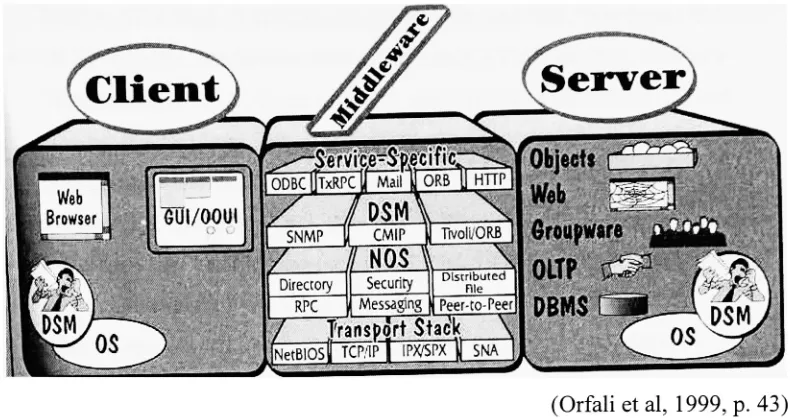
Figure 1
illustrates
different
services
that
Orfali
et.al.,
classify
as
middleware
based
on
their
'pipes'
and
'platform7
metaphor.
(Orfali
etal,
1999,
p.
43)
Figure 1
:
Middleware
products/services
Pipes
provide
the
inter-component (and
inter-application)
communication
services,
e.g.,
RPCs,
MOMs
and
ORBs,
Secure Socket Layer
(SSL)
and
Lightweight
Directory
Access Protocol (LDAP).
Pipes
can
be further
classified
into:
General
pipes
provide
the
substrate
for
most
client/server
interactions.
They
include
the
communication
stacks,
distributed
directories,
authentication
services,
network
time,
remote
procedure
calls,
and
queuing
services.
The
category
also
includes
network
operating
system
extensions such as
distributed
file
and
print services.
Products
that
fall into
the
general
Middleware category include
LDAP, X.00, firewalls,
and
digital
certificate
servers.
SSL, DCE, MS-RPC,
Named
Pipes, TCP/IP, APPC,
IPX/SPX,
and
NetBIOS.
Also included in
this category
are
the
MOM
products offered
by
Service-specific
Pipes
accomplish
a
particular client/server
type
of
service.
They
include
database-specific
Middleware
such
as
ODBC, JDBC, SQLJ,
DRDA, EDA/SQL, SAG/CLI,
OLE
DB,
OQL
and
SQL*Net
from
ORACLE
OLTP-specific
Middleware
such
as
Tuxedo's ATMI
and
/WS,
Encina's
Transactional
RPC,
X/Open's TxRPC
and
XATMI,
CORBA's
OTS
and
Microsoft's
DTC
and
TIP.
Groupware-specific
Middleware
such
as
MAPI, VIM,
JavaMail.
SMTP,
Web/NNTP,
s/MIME,
POP3, IMAP, Workflow,
Lotus Notes.
Object-specific
Middleware
such as
CORBA/HOP
from
OMG,
Microsoft's
COM+,
and
Javasoft's RMI-over-IIOP.
Internet-specific
Middleware
such
as
HTTP, CGI, XML,
and
SET.
System-management-specific Middleware
such as
SNMP,
CMIP, RMON,
DMTF, WFM, JMAPI, WEBEM,
and
ORBs
Platforms
are application servers
that
run
the
server-side components.
They
can
be
used across multiple
operating
systems
to
provide a unified view
of
the
distributed
environment, e.g.,
TP
Monitors,
Object Transaction Monitors
and
Web
Application
Servers.
Newton
offers
a
definition
of
Middleware
that
falls
completely into
the
realm of
telephony.
He
asserts
that:
Middleware
is
software
that
sits
between layers
of
software
to
make
the
layers
below
and
on
the
side
work with
each
other.
Middleware
could
be
almost
any
software
in
a
layered
software
stack.
In
computer
telephony,
Middleware
tends to
be
software
that
sits
right
above
that
part of
the
operating
system
dealing
with
telephony
-TSAPI in
Netware
and
TAPI in
Windows
-but below
the
computer
telephony
application
above
it
that the
user
sees on
their
desktop.
In
short,
Middleware is
software
invisible
to the
user
which
takes
2
or
more
different
applications
and makes
them
work
seamlessly
together.
(Newton, 2001,
p.
442)
In
a
presentation
to the
Gartner Group's
Application
Integration
Conference
in
November
of
1999,
Roy
Schulte(1999,
p.
3)
offered yet
another
definition
of
the
15-term.
He
defined Middleware
as
"runtime
system
software
that
directly
enables
application-level
interactions
among
programs
in
a
distributed computing
environment."
He further
elaborated
that
middleware services
generally
belong
to
one
of
three
layers
of
the
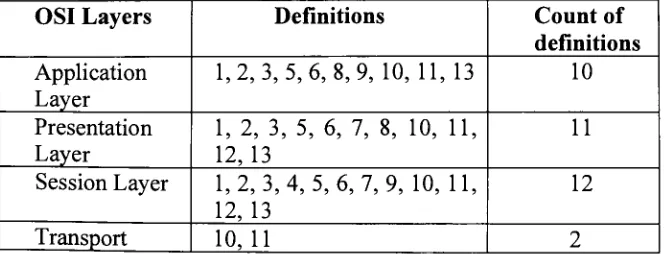
OSI
model:
the
Session
layer
presentation
layer
-application
layer
Middleware
provides
useful
functions like
routing,
DBMS
access,
file
access,
queuing,
load
balancing
and
security
to
name a
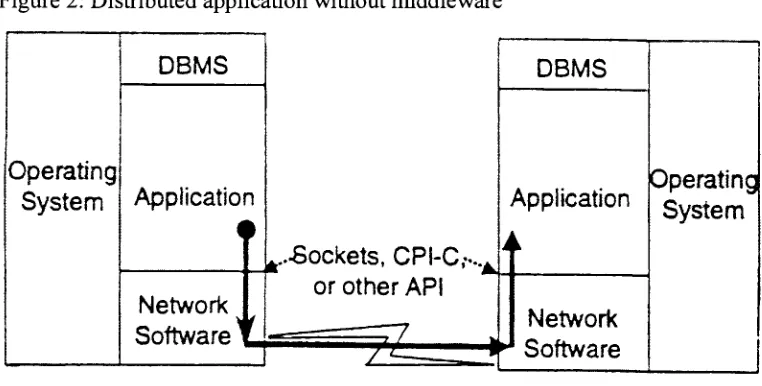
few. He further
adds
that
implementing
a
distributed
application without middleware
is
impractical,
as
it
requires
the
application
developer
to
write
to
low-level
interfaces
like
TCP-IP
[image:19.556.84.465.351.544.2]sockets and
handle
many
communication-related
chores.
He
illustrates
this
type
of
an application
with
the
diagram
shown
in Figure 2:
Figure 2: Distributed
application
without middleware
Operating
System
DBMS
Application
Network
Software
t.
^..-Sockets,
CPI-C,-..^
or other
API
DBMS
Application
Network
Software
Operating
System
With
regards
to the
taxonomy
of
middleware,
he
divides
middleware
into
two
layers,
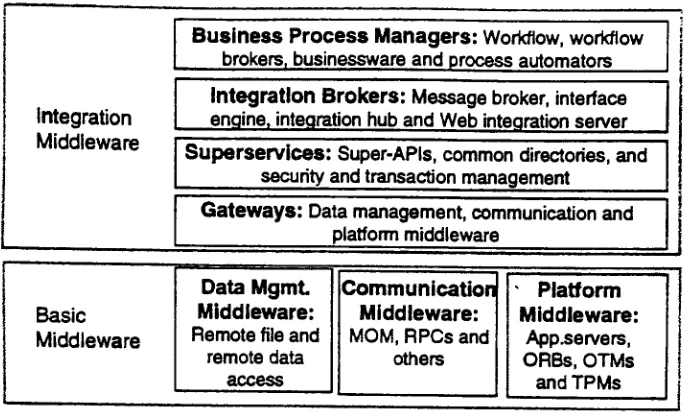
Integration
Middleware
and
Basic Middleware. Gartner's
middleware
Integration
Middleware
Business
Process
Managers:
Workflow,
workflow
brokers,
businessware
and process
automatons
Integration Brokers: Message
broker,
interface
enqine,
integration
hub
and
Web
inteqration
server
Superservices:
Super-APIs,
common
directories,
and
security
and
transaction
management
Gateways:
Data management,
communication
and
platform
middleware
Data
Mgmt.
Communication
'
Platform
Basic
Middleware:
Middleware:
Middleware:
Middleware
Remote file
and
MOM,
RPCs
and
App.servers,
remote
data
others
ORBs,
OTMs
[image:20.556.101.444.65.272.2]access
and
TPMs
Figure: 3 Gartner's Middleware
taxonomy
Basic Middleware
is
a
type
of middleware
used
by
a single
distributed
application.
It
is
made
up
of
the
following
sub-layers:
Data Management
software,
or software related
to
remote
database
access,
such as
ODBC
drivers
Communication
Middleware,
or software
that
shields
the
application
developer
from
having
to
deal
with
communication chores
like
marshalling,
routing, addressing,
etc.
Examples
of
this type
of software are
RPCs
and
MOMs
Platform
Middleware,
or a communications software
"superset"
that
insulates
programmers
from
the
operating
system
i.e. It
provides
memory
management
and
operating
system process
management
services
in
addition
to
communication
services.
Examples include Object Request Brokers
and
Application
Servers
Integration
Middleware,
is
a
superset of
Basic Middleware. It
can
help
connect
independently
designed
application systems or
it may be
used
in
a
single or
extended
application
system where
programs
or
DBMSs
run
on
dissimilar
platforms.
This layer
is
made
up
of
four
sub-layers.
From
the
layer
closest
to the
Basic
layer
to the
farthest,
these
layers
are
as
follows:
Gateways,
the
software
that
handles
communication
between dissimilar
protocols.
It
intercepts
communications
sent and converts
it
into
a
form
understandable
by
a
dissimilar
recipient.
Superservices
which provide
some common
functionality
(eg:
directory,
transaction
management,
security,
etc)
across
2
or
more
operating
systems.
They
enable a
common,
super-
API
to
function
across
disparate underlying
technologies
Integration
Brokers,
the
sublayer
that
provides
transformation
(e.g.,
message
translation,
both
syntactic
and
semantic)
and
flow
automation
(e.g.,
context-based routing)
at
the
application
layer
of services
Business Process
Managers,
the
sublayer
that
oversees,
coordinates
and
integrates
a
business
process
through
its business life
cycle.
As
noted earlier
in
this paper, the
wide variance
in
these
definitions have led
several sources
to
state
that the term
Middleware
is defined
either relative
to those
defining
it,
ill-defined
altogether,
or,
perhaps
so
broad in
scope as
to
be
useless.
Perhaps
the
clearest
indication
of
this
was
voiced
by
the
ICIAR Middleware
workshop
participants,
who asserted
that
the
many definitions
of
the
term
might
be dependent
not
on
what
is
being
defined,
but
by
whom
the
term
is
being
defined
,
and on
why
a
definition
is
being
sought.
They
stated
it
in
this
fashion:
The
Workshop
participants agreed on
the
existence of
Middleware,
but quickly
made
it
clear
that the
definition
of
Middleware
was
dependent
on
the
subjective perspective of
those
trying
to
define
it.
Perhaps
it
was
even
dependent
on
when
the
question
was
asked,
since
the
Middleware
of
yesterday
(e.g.,
Domain
Name
Service,
Public
Key
Infrastructure,
and
Event
Services)
may
become
the
fundamental
network
infrastructure
of
tomorrow.
Application
environment
users
and programmers see
everything below
the
API
as
Middleware.
Networking
gurus
see
anything
above
IP
as
Middleware.
Those
working
on
applications,
tools,
and
between
TCP
and
the
API,
with
some
even
further classifying
Middleware into
application-specific
upper
Middleware,
generic
middle
Middleware,
and
resource-specific
lower Middleware.
(Aiken
et
al,
2000,
p.
3)
III.
General Concepts
and
Terms
The
definitions
of
Middleware
above
-and
the
discussion
that
follows
~
require
the
use of several concepts and
terms
used within
the
Information
Technology
field.
In
this
section we
list
and
then
cite
definitions for
them.
API
API (application
program
interface)
is
a set
of
routines,
protocols,
and
tools
for
building
software
applications;
a good
API
makes
it
easier
to
develop
a
program
by
providing
all
the
building
blocks
that
programmer
uses
to
assemble
an
application
(webopedia,
'API'). A
callable
API
does
not require
a
pre-compiler
to
convert
SQL
statements
into
code, to
compile
them,
and
then
bind
them
to
a
database.
Instead,
a callable
API
allows you
to
create and
execute
SQL
statements at run
time.
Client
A
client provides
the
user
interface for
the
services
a system
provides.
(Orfali
et
al,
1999,
p.
91-95)
All
client applications request
the
services
from
a server.
Clients
can
be
classified
into
three
categories:
non-GUI,
GUI
and
OOUI.
A
non-graphical user
interface
(non-GUI)
client generates client
requests with
a
minimum of
human interaction
(e.g.,
Automatic
Teller
Machines,
barcode
readers,
robots and
daemon
programs).
A Graphical User
Interface
(GUI)
is
a
graphical
rendition
of a
"command
line"
dialog
that
is
used
in
dumb
terminal/mainframe
interaction
(e.g.,
OLTP-type
business
applications and
front-end
clients
to
database
servers).
The
Object-Oriented User
Interface
(OOUI)
is
a
highly
iconic,
object-oriented
interface
that
lets
you
directly
manipulate
objects
on
a
screen
(e.g.,
decision-support
applications
and
stockbroker workstations).
Data
Encryption Standard
(DES)
See
Encryption
Datagram
A
datagram is
a packet
that
includes both
source
and
destination
addresses
provided
by
the user,
rather
than
by
the
network.
(Fiebel,
2000,
Part
I D
-datagram)
A
datagram
can also
contain
data. A
message might
be
sent as
multiple
datagrams,
which
may
be
delivered
to
the
destination
in
nonconsecutive order.
Receipt
of
a
datagram is
not
acknowledged.
Datagram
routing
takes
place
at
the
Network
layer
of
the
OSI
reference
model.
Datagram
transmission
takes
place at
the
Data-Link
layer.
Datagram
services are
provided
in
connectionless
(as
opposed
to
connection-oriented)
transmissions.
Because
connectionless
transmissions
do
not
necessarily
deliver
datagrams in
order,
datagram
services cannot
guarantee
successful
message
delivery. Receipt
verification
is
the
responsibility
of
a
higher-level
protocol,
which must
be
able
to
assemble
the
message
from
the
datagrams. Protocols
that
provide
this type
of
service
include
UDP (User
Datagram
Protocol)
in
the
Internet's
TCP/IP
protocol
suite,
CLNP
(Connectionless Network
Protocol)
in
the
OSI
reference
model,
and
DDP
(Datagram
Delivery Protocol)
in
the
AppleTalk
protocol suite.
Encryption
"Data
encryption
is
a
method of
scrambling information
to
disguise its
original
content.
It
is
the
only
practical
means
of
protecting
information
transmitted
over communications
networks,
but
it
can
also
be
used
to
protect
stored
data.
Encryption
methods
come
in
two
forms:
hardware
or software.
Of
the
two,
hardware-based
encryption
provides
more
speed
and
security."
(Muller, 2000,
Part III
L-
LAN
Security)
Two
predominant
approaches
to
electronic encryption are
based
on shared cipher
keys
and public cipher
keys.
information.
Each
pair of users who
need
to
exchange messages must
agree on
a private
key
and use
it
as a
cipher
to
encode and
decode
their
messages.
Data
Encryption Standard
(DES)
is
based
on
shared private
keys. Public
cipher
keys
use
two
keys:
a public
key
and a
private
key. The
public
key
is listed in
directories
and
is
available
for
all
to
see.
Anybody
can
send
an
encrypted
message encoded with
the
public
key
as
cipher; the
receiver
decodes
its
with
the
private
key.
RSA
is
based
on public
shared
keys.
Message
The
message
is
a
delivery
mechanism
for
service
requests and
replies.
(Orfali
etal,
1999,
p.
15)
Network
A
network
consists
of
computers,
called
nodes
or
computers
which
are
connected
to,
or can communicate
with,
each
other
in
some way.
(Fiebel,
2000,
N
-Network)
The
nodes
run
special
software
for
initiating
and
managing
network
interactions. With
the
help
of
networking
software,
nodes
can
share
files
and
resources,
and
tasks
can
be distributed
over multiple
machines
on
some
networks.
The
following
are
the
main
hardware
components
of a network:
Nodes: Computers
and network
interface
cards
(NICs)
Topology: Logical
and physical
Connection
elements:
Cabling,
wiring
centers,
links,
and so on
Auxiliary
components:
Peripheral
devices,
safety
devices,
and
tools
The
software components
include
the
following:
Networking
systems:
Network
operating
system
(NOS)
and
workstation
software
Resources,
Drivers
and
various
types
of
server
software,
e.g.,
authentication,
intranet,
and
Web
servers.
Tools,
Utilities,
LAN
analyzers,
network
monitoring software,
and
configuration
managers.
Applications,
Network-aware
software
Peer-to-peer
communications
Most early
client/server
applications
were
implemented using
low-level,
conversational,
peer-to-peer
protocols
-such as
sockets,
TLI, CPIC/APPC,
NetBios
and
Named
Pipes. (Orfali
et
al,
1999,
p.
159)
There
were
fewer
alternatives
then.
These
are
hard
to
code and
maintain,
so
they
are
losing
their
popularity.
Instead,
programmers are
now
using Remote Procedure
Calls,
MOMs,
and
ORBs,
which
provide
higher levels
of abstraction.
Pragma
ORBs
provide global
identifiers
-called
Repository
IDs
-to
uniquely
and
globally
identify
a component and
its interface
across
multi-vendor
ORBs
and
repositories.
The repository IDs
are
generated
via
pragmas
in IDL. The
pragma
specifies
whether
to
generate
them
via
DCE Universal Unique
Identifiers(UUIDs)
or
via a
user-supplied unique prefix appended
to
IDL-scoped names.
(Orfali
et
al,
1999,
p.
483)
Server
A
server provides services
to
clients.
Based
on
the type
of services servers
provide,
a
listing
of some of
the
different
servers and
the
services
they
provide
is
given
below:
File Servers:
They
are useful
for sharing files
across a network.
Database
Servers: Here
the
client passes
SQL
as messages
to the
server and
the
server processes
the
SQL
and sends
the
results
back
to the
client.
Transaction
Servers: Here
the
client
invokes
remote
procedures
(or services)
that
reside
on
the
server
with
a
SQL
database
engine.
These
remote
procedures on
the
server execute a
group
of
SQL
statements.
The
network
exchange
consists
of
a
single
request/reply
message
(as
opposed
to the
database
server's
approach
of
one
request/reply
message
for
each
SQL
Groupware
servers:
They
address
the
management
of
semi-structured
information
such as
text,
image,
mail,
bulletin
boards,
and
the
flow
of
work.
Web
Application
Servers:
Basically,
a
web server returns
documents
when
clients ask
for
them
by
name.
The
client
and server
communicate
using
an
RPC
like
protocol called
HTTP.
(Orfali
etal,
1999,
p.
16-20)
Some
typical
server
functions include
waiting
for
client
initiated
requests,
executing
numerous requests at
the
same
time,
protecting
the
integrity
of
shared
resources,
providing
different levels
of
service
priority
to
its
clients,
initiate
and
run
background
tasks
and
be
robust
and
scalable.
(Orfali
et
al,
1999,
p.
82)
Servers may
also provide
extended
services
that
exploit
the
distributed
potential of networks.
Some
of
these
services
include supporting
different
communication
stacks,
facilities for extending
the
file
and print
services over
the network,
support
for
Binary
Large
Objects
(BLOBs)
and
global
directories,
authentication
and
authorization
services,
system
management,
synchronization of
time
on
networks,
database
and
transaction
services,
etc.
IV. Middleware Related
Concepts, Protocols,
and
Software
products
To
aid
in
our
analysis,
we now
list
the
different
concepts, protocols,
and software
products
mentioned
in
the
definitions
given
in Section 1
of
this
paper.
We
present
them
here
with
a short
description for
each.
APPC
See System Network Architecture
(SNA)
APPN
See System Network Architecture
(SNA)
CGI
CGI
(Common
Gateway
Interface)
is
the
method
by
which a
web
server can
obtain
data from
(or
send
data
to)
databases, documents,
and
other
programs,
and present
that
data
to
viewers via
the
web.
(Hamilton,
1
999)
CMIP
CMIP
short
for Common
Management Information
Protocol,
and
pronounced
see-mip,
an
OSI
standard protocol
used
with
the
Common Management
Information
Services
(CMIS).
CMIS
defines
a
system
of
network
management
information
services.
CMIP
was
proposed as
a replacement
for
the
less
sophisticated
Simple Network Management Protocol
(SNMP)
but has
not
been widely
adopted.
CMIP
provides
improved security
and
better
reporting
of unusual network
conditions,
(webopedia, 'CMIP')
COM+
COM+,
or
the
next generation of
COM,
was
developed
to
make
COM
more
programmer-friendly
and consistent across
Microsoft
languages.
Eventually,
COM+
was
to
provide
"a
shared common run
time
that
hides
most of
COM's
nastiness
from developers
-including
the
IDL,
class
factories,
reference
counting,
unknown
negotiations,
class registration and
type
libraries."
(Orfali
etal,
1999,
p.
522)
CORBA
CORBA
(Common Object Request Broker
Architecture)
allows
intelligent
[object]
components
in
different locations
on a network
to
discover
each
other
and
then to
interoperate
with each
other over an object
bus. (Orfali
et
al,
1999,
p.
474)
The
CORBA
process responsible
for
this
is
the
Object
Request Broker
(ORB). It
provides
global
identifiers
called
Repository
IDs
that
uniquely
and
globally
identify
a
component and
its interface
across
multi vendor
ORBs
and
Interface Definition
Language
(IDL)
is
used
to
specify
a
component's
attributes,
the
parent classes
it inherits
from,
the
exceptions
it
raises, the
typed
events
it
emits,
and
the
methods
its
interface
supports,
including
the
input
and
output parameters and
their
data
types.
CORBA OTS
See Common Object Request Broker Architecture
CORBA/IIOP
See Common Object Request Broker Architecture
CPI-C:API
See System Network
Architecture;
See
also
TP Monitor
DCE
"The Distributed
Computing
Environment
(DCE)
from
the
Open Software
Foundation
(OSF)
creates
an open
Enterprise/NOS
environment
that
spans
multiple
architectures, protocols,
and
operating
systems.
DCE
provides
key
distributed
technologies,
including
a remote
procedure
call,
a
distributed
naming
service,
a
time
synchronization
service,
a
distributed file
system,
a
network
security
service,
and a
threads
package."
(Orfali
et
al,
1999,
p.
184)
DCE
RPC
DCE
provides an
Interface Definition Language
(IDL)
and a compiler
that
facilitates
the
creation of
RPCs. The IDL
compiler creates portable
C
code
stubs
for
both
the
client and server sides
of
the
application.
The
stubs are
compiled
and
linked
to the
RPC
run-time
library,
which
is
responsible
for
finding
servers
in
a
distributed
system,
performing
the
message
exchanges,
packing
and
unpacking
message parameters
and
processing any
errors
that
occur.
The
most powerful
feature
of
the
DCE RPC
is
that
it
can
be
integrated
with
the
DCE security
and
naming
services.
(Orfali
et
al,
1999,
p.
185)
Data
warehouse
Richard Hackathorn defines
a
warehouse as
"a
collection
of
data
objects
that
have
been inventoried
for distribution
to
a
business
community".
(Orfali
et
al,
1999,
p.
271)
A
warehouse
is
an
active
intelligent
store
of
data
that
can
manage and aggregate
information from many
sources,
distribute
it
where
needed,
and activate
business
policies.
Digital
certificates
A
digital
certificate
is
an electronic
file
that
serves as
a container
for
a
public
key. (Orfali
et
al,
1999,
p.
150-151)
It
serves as
a
user's
electronic
ID. As
an
example,
an
X.500
certificate contains a
variety
of
information,
including
the
owner's public
key
the
owner's
name,
some attributes
associated with
the
owner, the
name of
the
encryption
algorithm, the
issuer
of
the
certificate and
an expiration
date. The Secure Electronic Transactions
(SET)
protocol
uses
dig