Copyright © The Author(s). 2015. All Rights Reserved. Published by American Research Institute for Policy Development DOI: 10.15640/jpbs.v3n2a1 URL: http://dx.doi.org/10.15640/jpbs.v3n2a1
1University of Liverpool, School of Psychology, Eleanor Rathbone Building, Bedford Street South, Liverpool, L69 7ZA, U.K.
Do we believe in experts? The power of any view
Paul Christiansen
1, Sara Waring
1, Louise Almond
1& Joanna Lorek
1Abstract
This paper examines whether source credibility (whether advice is from an expert or novice source) influences judgments, and moderates the impact of orthodoxy (degree of typicality) on belief change (extent to which decision makers alter judgments). 109 members of the public completed a questionnaire involving an investigation into a series of child sex offenses. Participants were asked to read a description of offenses and then to i) numerically estimate the guilt of two suspect descriptions (orthodox vs. unorthodox), and following the presentation of an offender profile (matching either the orthodox / unorthodox suspect and provided by either an expert / novice source), to ii) reevaluate their guilt judgments for both suspects. Results revealed two key findings. First, in support of previous research, offender profiles were found to significantly alter judgments of suspect guilt in line with the content of the profile description. Second, source credibility had no significant impact on belief change and did not moderate the impact of profile orthodoxy on belief change. Thus, decision makers were equally willing to alter their judgments regardless of whether the information was from an expert or novice source and contained orthodox or unorthodox information. The implications of these findings for police and jurors are discussed.
Keywords:Experts; Decision-making; Offender profiling; Source credibility
Organizations often create subgroups of expert advisors to assist decision makers with framing problems in new ways (Schotter, 2003), enabling them to obtain unique information and perspectives (Phillips, Mannix, Neale, & Gruenfeld, 2004) that can improve decision accuracy (Johnson, Budescu, & Wallsten, 2001), reduce decision biases (Yaniv, 2004), and increase decision confidence (Van Swol & Sniezek, 2005). Expert advice serves as a source of information (Budescu & Rantilla, 2000) that can be very influential in decision processes (Steginga, Pinnock, Gardner, & Dunn, 2002), especially when decisions are important (Harvey & Fischer, 1997). Although the success of any decision is dependent on the quality of information evaluated (Kray & Galinsky, 2003), not all advice may be of a high quality (Waring, Alison, Cunningham, & Whitfield, 2013). Identifying factors that affect the influence of advice poses implications for improving decision quality.
In contrast, the latter is evidence driven (Canter & Youngs, 2009) and advocates clearly structuring reports so that statements can be scrutinized in terms of strength of support (Alison, Smith, & Morgan, 2003b). Accordingly, the UK has shifted toward contemporary styles of profiling (Alison, McLean, & Almond, 2007). However, traditional profiling is still frequently used in many countries, despite evidence indicating the value of the contemporary approach for improving advice quality (Alison et al., 2003b).
Given that not all profiling advice is evidence driven and that such advice has the potential to steer the direction of criminal investigations, the issue of what factors affect its influence over judgments of suspect guilt is of great importance. Evidence suggests that offender profiles are particularly influential when unorthodox (atypical) and incongruent (dissimilar to the judge’s opinion; Alison et al., 2012). However, research is required to establish whether the reason that such advice is influential is due to the perceived expertise of the source. Accordingly, we advance the research of Alison et al. (2012) by examining the impact of source credibility (whether or not the advisor is an expert) on advice influence (the extent to which decision makers alter their judgments of suspect guilt). In line with expertise research, we argue that source credibility will have a significant impact on advice influence.
Source credibility and orthodoxy
The term ‘source credibility’ is used here to refer to the level of experience an advisor possesses. In particular, we distinguish between advice that is either provided by an expert or a novice (in this context, a professor versus a student). Research demonstrates that decision makers do not view all advice to be equally valuable (Yaniv & Kleinberger, 2000), and that expertise is one factor to affect this assessment of advice worth. Within the literature on persuasion, research demonstrates that source expertise influences the formation of judgments and decisions (Bohner, Ruder, & Erb, 2002). Credible advisors are much more persuasive in changing decision makers’ opinions than less credible advisors (Sparks & Rapp, 2011), even when expert opinions conflict with the decision maker’s original perspective (Bochner & Insko, 1966).
The ability for expert advice to implicitly alter attitudes, referred to as the expert heuristic (Klucharev, Smidts, & Fernández, 2008), may be explained by dual process models. These models argue that information is either processed in an effortful and systematic manner with attention focused on the content of the message, or following a set of established heuristics that rely on simple adaptable rules to reduce the need for systematically processing information (Reimer, Mata, & Stoecklin, 2004). Persuasion research indicates that decision makers prefer to rely on simplifying heuristic cues rather than investing time and effort into evaluating a message (Eagly & Chaiken, 1984). Source credibility and expertise have been found to act as heuristic cues across many areas including leadership (Mugny, Tafani, Falomir, et al., 2000), eye witness testimony (Spellman & Tenney, 2010), and communication (Bochner & Insko, 1966). Overall, research demonstrates that experts have a much greater influence over decision processes than novices (Jungermann & Fischer, 2005).
Advancing on the research of Alison et al. (2012), we argue that source credibility moderates the influence of advice orthodoxy on belief change. The findings of Alison et al’s (2012) study demonstrated that the orthodoxy (how stereotypical) and congruence (the extent to which advice matches the decision maker’s original opinion) of profiling advice affects how influential it is in altering judgments of suspect guilt. In particular, when a profile is unorthodox, the similarity between the profile and decision maker’s beliefs significantly alters guilt judgments. However, when the profile is orthodox, advice similarity has no significant impact on guilt judgments. This research found that overall, profiling advice is most influential when unorthodox and incongruent. We argue that whether orthodox or unorthodox advice is most influential will depend on how credible the source is.
given that any new information provided by an advisor has the potential to conflict with previously held preferences.
In order to reconcile these disparities, we argue that source credibility moderates the impact of orthodoxy on belief change. Accordingly, when advice originates from a novice source, orthodox advice will be most influential as decision makers will be reluctant to rely on non-stereotypical information due to the low credibility of the source.
However, when advice originates from an expert source, unorthodox advice will be most influential due to decision makers perceiving the source to possess greater expertise and therefore being willing to accept the non-stereotypical information.
Method Participants
Using opportunity and snowball sampling, 109 participants were recruited from the general public. Overall, 35% (n=38) of the sample were male and 65% (n=71) were female, with an age range of 18-69 and a median age of 21 years.
Design and procedure
A 2-within (orthodoxy: orthodox suspect / unorthodox suspect) 2-between (profile type: orthodox profile / unorthodox profile), 2-between (author: expert / novice) 2–within (time: pre profile / post profile) mixed design was used. The dependent variable was the participants’ perceived probability that the suspect was guilty. The questionnaire and procedure were adapted from that used by Marshall and Alison (2007) and Alison et al. (2012). All participants were told that the study was entirely voluntary and involved a discussion of a series of sexual assaults against young girls. They were advised that, should the material cause any discomfort or distress, they were not obliged to take any further part in the study. It was also explained that all their responses would remain confidential, anonymous, and that their answers would not be identifiable. Upon consenting to take part in the study, participants were then asked to imagine that they were a Senior Investigating Officer in charge of investigating this series of offenses. They were presented with background information on a series of sexual offenses against children followed by details of two possible suspects (Orthodox and Unorthodox)
At this stage (Time 1-Pre profile), participants were asked to estimate the probability that each suspect was guilty of the series of offences. Probability judgments were recorded on a scale ranging from 0% (‘absolutely no chance that he is guilty’) to 100% (‘it is absolutely certain that he is guilty’). The participants were then presented with one of four profiles (Time 2-Post profile): 1) Orthodox profile written by an Expert; 2) Orthodox profile written by a Novice; 3) Unorthodox profile written by an Expert; and 4) Unorthodox profile written by a Novice. All were then asked once more to estimate each of the two suspects’ probability of guilt. Participants were then debriefed and the objectives of the questionnaire were explained.
Materials
The materials were taken from Marshall and Alison (2007) and involved a scenario that represented a series of sex offenses against children.
Background information
Suspect information
Participants were presented with two suspect descriptions. The orthodox suspect was designed by Marshall and Alison (2007) to be congruent with the orthodox ‘prototype’ child molester described in the literature. This suspect was described as a 44-year-old male, unemployed, and having had only one previous girlfriend. In contrast, the unorthodox suspect was designed to be at odds with this, while remaining plausible in view of the statistics for this kind of offender. This suspect was therefore described as a socially stable, 26-year-old married male working in a postal sorting office. Care was taken to maintain evidential consistency between the suspects.
Therefore, the physical appearance of both suspects was consistent with the victims’ physical description of the assailant. For both suspects, participants were also told that they had been identified following the broadcast of an E-FIT, they owned a pornography collection and lived locally (see Marshall & Alison 2007 for a full comparison between the characteristics of the two suspects).
Offender profiles
Participants were presented with one of two offender profile descriptions. The details of the profile consisted of the sort of statements in so called ‘traditional trait-based profiles’ (Alison, McLean, & Almond, 2007). The orthodox profile was designed to be congruent with the orthodox suspect’s description and included claims such as “the offender will usually be sexually inexperienced or sexually inadequate”. The unorthodox profile was designed to be congruent with the description of the unorthodox suspect, including claims such as “the offender will be sexually exploratory”. Both profiles predicted that the offender will live locally and own a pornography collection (see Marshall & Alison, 2007, for a detailed comparison between the orthodox and unorthodox profile).
Author of the offender profile
The offender profiles received by the participants were written by two different authors (Expert / Novice). Half of the sample received an offender profile which they were told had been written by Professor Paul Steven, who “works as a lecturer at the University of Liverpool and was asked to assist the police in creating an offender profile, which he thought was suitable for this series of sexual assaults”. They were told that Professor Stevens had 20 years previous experience in this field, both as an academic and a practitioner assisting the police. The remaining half of the sample received an offender profile which they were told had been written by an MSc student who “is currently studying at the University of Liverpool and was asked to create an offender profile which she thought was suitable for this series of sexual assaults”. They were told that this student did not have any direct experience of creating offender profiles for the police. However, she was currently studying forensic psychology.
Data preparation and analysis
Due to the distribution of the guilt ratings these variables were log transformed so that they met parametric assumptions. All ANOVA analyses are conducted on the log transformed data. Planned comparisons usingt-tests were conducted on significant main effects and interactions; descriptive statistics (Mean ±SD) given in the presentation of planned comparisons refer to the log transformed data. If Levene’s test for equality of variances was violated thent-test results were confirmed with non-parametric tests.
Results
Post-profile: Analysis of the guilt ratings pre and post-profile - main effects and interactions between defendant orthodoxy, author and profile type.
orthodoxy on perceived guilt (F(1,105)=9.92,p= .002, ηp² = 0.086). This was the result of perceptions of guilt for
the orthodox suspect (3.39 ±0.48) being higher than that of the unorthodox suspect (3.16 ±0.56). There was also a significant main effect of time, (F(1,105)=15.30,p < .001, ηp² = 0.13); as overall guilt ratings (collapsed across
both suspects) declined from time one (3.34 ±0.33) to time two (3.21 ±0.36). This finding is a product of participants assigning more definitive guilt to the suspect that is congruent to the profile they were given and reducing guilt perceptions in the incongruent suspect, which consequently reduces overall perceptions of guilt assigned. There was no evidence for significant main effect of profile (F(1,105)=0.25, p > .1, ηp² = 0.002), or
author (F(1,105)=1.034,p> .1, ηp² = 0.010).
As expected, no significant two-way interactions were found for time and profile (F(1,105)=2.24,p> .1, ηp² = 0.02), time and author (F(1,105)=0.40, p > .1, ηp² = 0.000), time and suspect orthodoxy (F(1,105)=0.69, p > .1, ηp² = 0.007), suspect orthodoxy and author (F(1,105)=3.43, p = .067, ηp² = 0.032) or profile and time
(F(1,105)=0.23, p > .1, ηp² = 0.000). There was however the predicted suspect orthodoxy by profile interaction
(F(1,105)=67.30,p <.001, ηp² = 0.391), although this was carried by the effect of the profile on time two guilt
ratings described below.
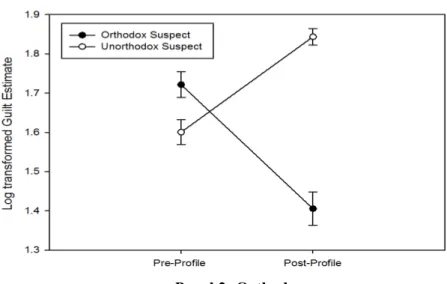
Fig 1: Graphs showing the effect of the profile on perceived guilt of orthodox and unorthodox suspects. Effects shown separately for participants given the unorthodox profile (panel 1) and orthodox profile
(panel 2). Panel 1: Unorthodox
In direct replication of Alison et al. (2012), there was the significant three way interaction between time, suspect orthodoxy and profile (F(1,105)=7.40, p < .001, ηp² = 0.591). The presentation of the orthodox profile
resulted in significant decreases in guilt rating for the unorthodox suspect from time one (1.62 ±0.25) to time two (1.28 ±0.45;t(56) = 5.99,p<.001) and increases in guilt for the orthodox suspect from time one (1.74 ±0.25) to time two (1.89 ±0.12; t(56) = -5.56, p < .001). Similarly, the presentation of an unorthodox profile caused significant increases in guilt for the unorthodox suspect from time one (1.61 ±0.23) to time two (1.84 ±.15;t(51) = -8.59,p< 0.001) and a concurrent decrease in guilt ratings for the orthodox suspect from time one (1.72 ±0.24) to time two (1.41 ±.31; t(51) = 8.99, p < .001; see Figure 1). Significantly, there was no four way interaction between time, suspect, profile and author (F(1,105)=1.08, p=.30, ηp² = 0.010). Taken together this suggests that
although the contents of the profile are hugely influential on assigning guilt to participants, this effect occurs regardless of the expertise of the author.
Discussion
source credibility had no significant impact on advice influence and did not moderate the impact of orthodoxy on belief change. The implications of these findings are discussed below.
The finding that offender profiles caused participants to significantly shift their judgments of suspect guilt in line with the message of the profile is congruent with previous studies conducted within this field (Alison et al., 2012; Marshall & Alison, 2007). Collectively, these findings demonstrate that offender profiles are highly influential in altering judgments of suspect guilt. Within the present study, there was no significant difference in the amount of guilt assigned by participants who received the orthodox or unorthodox profiles. However, the profile did cause participants to revise where they assigned this guilt. Accordingly, in addition to increasing judgments of guilt for the suspect matching the profile received, participants also significantly reduced the guilt assigned to the suspect who did not match the profile.
These findings pose implications for two aspects of the criminal justice system. First, there is the potential for offender profiles to alter police decisions regarding the prioritization of resources and judgments relating to arrest and charge during criminal investigations. Second, offender profiles may affect jurors’ judgments of suspect guilt within criminal courts. Although offender profiles are not admissible within UK courts, profilers are admissible as expert witnesses in some courts around the world, including the USA. It is worth noting that the profiles provided in this study were reflective of the traditional style of profiling in which statements made were vague and unsubstantiated (Alison et al., 2003a). Whilst the present participant sample consisted of members of the public rather than serving police officers, the previous study by Alison et al. (2012) contained a mixture of officers and members of the public and found no significant difference in the influence of profiles on judgments of suspect guilt between these two groups. Together, these findings indicate the potential for officers and jurors alike to be influenced by unsubstantiated statements.
Alison et al. (2012) and Marshall and Alison (2007) previously suggested that a potential reason for the significant influence of unsubstantiated profiles on judgments of guilt was the expertise of the profile source. A vast body of research into the expertise heuristic demonstrates that expert sources have a greater influence over judgments and decisions than novice sources (Jungermann & Fischer, 2005; Sparks & Rapp, 2011). However, counter to this previous body of research, we found no significant difference in the influence of profiles provided by an expert source compared to a novice source.
Thus, participants were equally willing to be influenced by unsubstantiated information provided by both experts and novices alike. Further, counter to arguments that expertise would affect the impact of profile orthodoxy on influence; there was no significant difference in the influence of orthodox and unorthodox profiles provided by expert or novice sources. Participants were equally willing to be influenced by typical and atypical information, regardless of source credibility.
It is possible that willingness to take any advice regardless of source credibility may be due to unfamiliarity with the situation. It is unlikely that participants within the current sample had previous direct experience of attempting to derive the guilt of a sex offender and so the situation would be novel. Accordingly, participants were unlikely to have developed heuristics for addressing this situation, making them willing to be guided by any form of advice. It is possible that if the situation was one in which participants possessed some experience (e.g. financial decisions) then they would be more discriminative of the credibility of the source of advice. However, further research is required to identify whether the novelty of the situation affects criticality in assessing the value of advice provided.
future studies to identify whether source credibility is as equally irrelevant to police officers as it is to members of the public. As police officers possess a greater level of experience in judging suspect guilt than members of the public, it may be that they are more discriminative of the credibility of the source of such advice. But given the importance of decisions made by police officers and jurors alike, current findings highlight the necessity of drawing attention to the need for criticality to officers and jurors when evaluating the quality of advice provided. It may be that officers and jurors require training in developing these skills. Findings also highlight the need to ensure that profiles are clearly structured and that statements are supported by evidence to allow officers to judge the veracity and strength of such advice.
References
Alison, L. (2005). The forensic psychologist’s casebook: Psychological profiling and criminal investigation. Devon: Willan.
Alison, L., Almond, L., Christiansen, P., Waring, S., Power, N., & Villejoubert, G. (2012). When do we believe experts? The power of the unorthodox view.Behavioral Sciences & the Law, 30(6), 729 – 748.
Alison, L., McLean, C., & Almond, L. (2007). Profiling suspects. In T. Newburn, T. Williamson, & A. Wright (Eds.),Handbook of Criminal Investigation(pp. 493–516). Cullompton, UK: Willan.
Alison, L., Smith, M., Eastman, O., & Rainbow, L. (2003a). Toulmin’s philosophy of argument and its relevance to offender profiling.Psychology, Crime and Law, 9, 173–183.
Alison, L. J., Smith, M. D., & Morgan, K. (2003b). Interpreting the accuracy of offender profiles. Psychology, Crime and Law, 9, 185–195.
Allport, G. W. (1937).Personality: A Psychological Interpretation. New York: Henry Holt and Company. Blau, T. H. (1994).Psychological Services for Law Enforcement. Chichester: Wiley.
Bochner, S., & Insko, C. A. (1966). Communicator discrepancy, source credibility, and opinion change. Journal of Personality and Social Psychology, 4(6), 614–621.
Bohner G., Ruder, M., & Erb, H. P. (2002). When expertise backfires: Contrast and assimilation effects in persuasion.British Journal of Social Psychology, 41(4), 495–519.
Budescu, D. V., & Rantilla, A. K. (2000). Confidence in aggregation of expert opinions.Acta Psychologica, 104, 371-398.
Canter, D., & Youngs, D. (2009). Investigative Psychology: Offender Profiling and the Analysis of Criminal Action. Chichester: John Wiley and Sons.
Eagly, A.H., & Chaiken, S. (1984). Cognitive theories of persuasion. Advances in Experimental Social Psychology, 17,267–359.
Frey, D., Schulz-Hardt, S., & Stahlberg, D. (1996). Information seeking among individuals and groups and possible consequences for decision-making in business and politics. In E. Witte, and J. Davis (Eds.),
Understanding Group Behavior. Vol II: Small Group Processes and Interpersonal Relationships (pp. 211-225). Mahwah, NJ: Erlbaum.
Harvey, N., & Fischer, I. (1997).Taking advice: Accepting help, improving judgment, and sharing responsibility. Organizational Behavior and Human Decision Processes, 70(2), 117–133.
Johnson, T. R., Budescu, D.V., & Wallsten, T.S. (2001). Averaging probability judgments: Monte Carlo analyses of diagnostic value.Journal of Behavioral Decision Making, 14,123-140.
Jungermann, H., & Fischer, K. (2005). Using expertise and experience for giving and taking advice. In T. Betsch & S. Haberstroh (Eds.), The Routines of Decision Making (pp. 157-173). Mahwah, NJ: Lawrence Erlbaum.
Klucharev, V., Smidts, A., & Fernández, G. (2008). Brain mechanisms of persuasion: How “expert power” modulates memory and attitudes.Social Cognitive and Affective Neuroscience, 3(4), 353–366.
Kray, L. J., & Galinsky, A. D. (2003). The debiasing effect counterfactual mindsets: Increasing the search for disconfirmatory information in group decisions.Organizational Behavior & Human Decision Processes, 91, 69-81.
Marshall, B., & Alison, L. (2007). Stereotyping, congruence and presentation order: Interpretative biases in utilising offender profiles.Psychology, Crime & Law, 13,285–303.
Mugny, G., Tafani, E., Falomir, P., et al. (2000). Source credibility, social comparison, and social influence.
Revue Internationale de Psychologie Sociale, 13, 151–175.
Phillips, K. W., Mannix, E. A., Neale, M.A., & Gruenfeld, D. H. (2004). Diverse groups and information sharing: The effects of congruent ties.Journal of Experimental Social Psychology, 40,497-510.
Reimer, T., Mata, R., & Stoecklin, M. (2004). The use of heuristics in persuasion: Deriving cues on source expertise from argument quality.Current Research in Social Psychology, 10(6), 69–84.
Schotter, A. (2003). Decision-making with naïve advice.American Economic Review, 93,196-201.
Sparks, J. R., & Rapp, D. N. (2011). Readers’ reliance on source credibility in the service of comprehension.
Journal of Experimental Psychology: Learning, Memory, and Cognition, 37(1), 230–247.
Spellman, B. A., & Tenney, E. R. (2010). Emerging trends in psychology and law research: Credible testimony in and out of court.Psychonomic Bulletin and Review, 17(2), 168–173.
Steginga, S. K., Pinnock, C., Gardner, M., & Dunn, J. (2002). Peer support groups for prostate cancer: A snapshot in 2002.Cancer Forum, 26(3), 169-172.
Van Swol, L. M., & Ludutsky, C. L. (2007). Tell me something I don't know: Decision makers' preference for advisors with unshared information.Communication Research, 34, 297-312.
Van Swol, L. M., & Sniezek, J. A. (2005). Factors affecting the acceptance of expert advice. British Journal of Social Psychology, 44(3),443-461.
Waring, S., Alison, L., Cunningham, S., & Whitfield, K. (2013). The impact of accountability on motivational goals and quality of advice provided in crisis negotiations.Psychology, Public Policy & Law, 19(2), 137-150.
Yaniv, I. (2004). The benefit of additional options.Current Decisions in Psychological Science, 13,75-78. Yaniv, I., & Kleinberger, E. (2000). Advice taking in decision making: Egocentric discounting and reputation