The Influence of Advertising on Consumer Purchasing Intention of the Proton.
RIDHWAN BIN MOHAMED
UNIVERSITI TEKNIKAL MALAYSIA MELAKA
I hereby confirm that I have examined this project paper entitled:
The Influence of Advertising on Consumer
Purchasing Intention of the Proton.
By
RIDHWAN BIN MOHAMED
I hereby acknowledge that this project paper has been accepted as part fulfilment for the degree of Bachelor of Technology Management (Hons) in High Technology
Marketing Signature
: ...
Supervisor
: ...
Date : ...
Signature
: ...
Panel
: ...
The Influence of Advertising on Consumer Purchasing Intention of the Proton.
RIDHWAN BIN MOHAMED
Report submitted in fulfilment of the requirement for the degree of Bachelor of Technology Management (Hons) in High Technology Marketing
Faculty of Technology Management and Technopreneurship Universiti Teknikal Malaysia Melaka
DECLARATION
I declare that this project is the result of my own research except as cited in the references. The research project has not been for any degree and is not concurrently
submitted in candidature of any other degree.
Signature : ...
Name : ...
DEDICATION
This research paper is lovingly dedicated to my respective parents who have been my constant source of inspiration. They have given unconditional support with my studies. I am honored to have them as my parents. Thank you for giving me a chance to prove and improve myself through all my walk of life. To all my family thank you for believing me for allowing me to further my studies. Lastly to my sister, hoping that with this research I have proven to you that there is no mountain higher as long as Allah is on our side. I hope that you could be motivated to further your studies to enhance your potential.
ACKNOWLEDGEMENT
Alhamdulillah. Thanks to Allah, whom with His willing giving me an opportunity to complete this research paper entitled “The Influence of Advertising on Consumer Purchasing Intention of the Proton.” to fulfil the compulsory requirements of Technical University of Malaysia Melaka (UTeM) and the Faculty of Technology Management and Technopreneurship (FPTT). I would like to thank, without implicating, to my fellow classmates, supervisor, lectures, family and friends for helping me working on this research project.
I would like to express my deepest thanks to Pn. Nor Azan Binti Abd. Gani a senior lecturer at FPTT and also assigned as my supervisor who had guided me for the task during two semester in session 2013/2014. Also sincere appreciation and thanks to Dr. Chew Boon Cheong and Dr. Ismi Rajiani for sharing their experience and knowledge in the Research Methodology and Marketing Research subject that really helped me through the writing of this research.
Lastly, deepest thanks and appreciation to my family members, their endless support, encouragement, and full support during the report completion from the beginning till the end.
ABSTRACT
Advertising is a communication tools that aimed to convince the audience regardless whether they are viewers, readers or listeners. Usually advertising will makes people seeks the information, evaluation of alternatives, as well as make purchase decision. This paper investigates the relationship between independent variables which are verbal, visual and ethnocentrism.
The evolution of advertisement dates back into the ancient times. Societies used symbols, and pictorial signs to attract their product users. Over centuries, these elements were used for promotion of products. In the early ages, these were handmade and were produced at limited scale for promotions. Later on, this phenomenon used and gained strength more intensively for promotional purposes. Today’s modern environment, advertisements have become one of the major sources of communicational tool between the manufacturer and the user of the products.
ABSTRAK
Pengiklanan meruoakan sebuah alatan pemasaran yang bertujuan mendapatkan perhatian pengguna dengan cara penglihatan mereka, pendengaran mereka dan pembacaan mereka. Pada kebiasaanya, pemasaran berupaya memangkinkan audiens untuk mendapat sesuatu informasi, menilai alternative barangan di pasaran dan juga membuat tindakan pembelian. Kertas kajian ini mengkaji kesan pengiklanan terhadap keinginan untuk membeli kereta Proton. Dari sudut lisan, visual dan etnosentrism.
Evolusi pengiklanan bermula awal sejak zaman kuno lagi. Masyarakat menggunakan symbol dan gambar untuk menarik minat audiens untuk membeli barangan mereka. Lama kelamaan, elemen ini digunakan sebagai alatan pemasaran. Pada peringkat permualaan, aktiviti ini digunakan untuk barangan buatan sendiri dengan skala yang kecil. Lama kelamaan, fenomena ini digunakan secara meluas bagi tujuan pengkomersilan. Dalam persekitaran yang serba moden ini, pengiklanan menjadi satu faktor penting di antara pengeluar dan pengguna.
ix
TABLE OF CONTENTS
CHAPTER CONTENT PAGES
DECLARATION iv
DEDICATION v
ACKNOWLEDGEMENT vi
ABSTRACT vii
ABSTRAK viii
TABLE OF CONTENT ix
LIST OF TABLE xii
LIST OF FIGURE xiii
LIST OF ABBREVIATION AND SYMBOLS xiv
LIST OF APPENDICES xv
CHAPTER 1 INTRODUCTION 1
1.1 Background of the Study 1
1.2 Problem Statement 3
1.3 Research Objective 6
1.4 Scope, Limitation and Key Assumptions of the
Project. 7
1.5 Research Hypothesis 8
1.6 Significance of the Study 9
1.7 Summary 11
x
CHAPTER CONTENT PAGES
CHAPTER 2 LITERATURE REVIEW 12
2.1 Advertisement 12
2.2 Verbal 13
2.3 Visual 17
2.4 Ethnocentrism 20
2.5 Purchase Intention 21
2.3 Summary
2.4 Theoretical Framework 21 22
CHAPTER 3 RESEARCH METHOD 23
3.1 Introduction 23
3.2 Research Design 24
3.3 Methodological Choices 26
3.4 Primary and Secondary Data Sources 27
3.5 Location of Research 28
3.6 Method of Primary Data Collection 29
3.7 Time Horizon 29
3.8 Research Instruments 30
3.10 Conclusion 33
CHAPTER 4 RESULT & ANALYSIS 34
4.1 Introduction 34
4.2 Respondent Demography 35
4.3 Reliability Analysis 44
4.4 Product Moment Correlation 48
4.5 Hypothesis Testing with Simple Linear
Regression 49
xi
CHAPTER 5 DISCUSSION 57
5.1 Introduction 57
5.2 Main Findings 57
5.3 Research Objective 58
5.4 Cross Tabulation between Respondents Monthly Income with type of Proton Model Purchased 61
5.5 Limitations 63
CHAPTER 6 CONCLUSION AND RECOMMENDATIONS 65
6.1 Conclusion 65
6.2 General Recommendations 66
6.3 Recommendations for Future Research 66
REFERENCE 68
xii
LIST OF TABLE
TABLE TITLE PAGES
Table 3.1 Likert Scale used in the questionnaire. 30
Table 3.2 Cronbach’s Alpha Coefficient Range 28
Table 4.1 Statistics of the Respondent 35
Table 4.2 Sex of Respondent 35
Table 4.3 Marital Status of the Respondent 36
Table 4.4 Age of the Respondent 37
Table 4.5 Profession of the Respondent 39
Table 4.6 Monthly Income of the Respondent. 40
Table 4.7 Knowledge of the Car Type 42
Table 4.8 Model of Car Purchased 43
Table 4.9 The Cronbach’s Alpha Coefficient Range and its Strength of
Association 45
Table 4.10 Reliability Statistics of Verbal Influencing Factors 45 Table 4.11 Reliability Statistics of Visual Influencing Factors 46 Table 4.12 Reliability Statistics of Ethnocentrism Influencing Factors 46 Table 4.13 Reliability Statistics of Purchase Intention 46
Table 4.14 Summary of the Reliability Analysis 47
Table 4.15 Correlations 48
Table 4.16 Summary of the Correlation 49
Table 4.17 Model Summary of Verbal Influencing Factors towards
Purchase Intention. 50
Table 4.18 Coefficients of Verbal Influencing Factors towards Purchase
Intention 50
xiii
Table 4.20 Model Summary of Visual Influencing Factors towards
Purchase Intention. 53
Table 4.21 Coefficients of Visual Influencing Factors towards Purchase
Intention 53
Table 4.22 ANOVA of Visual Influencing Factors towards Purchase 53 Intention
Table 4.23 Model Summary of Verbal Influencing Factors towards
Purchase Intention. 55
Table 4.24 Coefficients of Verbal Influencing Factors towards Purchase
Intention 55
Table 4.25 ANOVA of Verbal Influencing Factors towards Purchase 55 Intention
Table 4.26 Summary of the Hypothesis Testing 57
xiv
LIST OF FIGURES
FIGURES TITLE PAGES
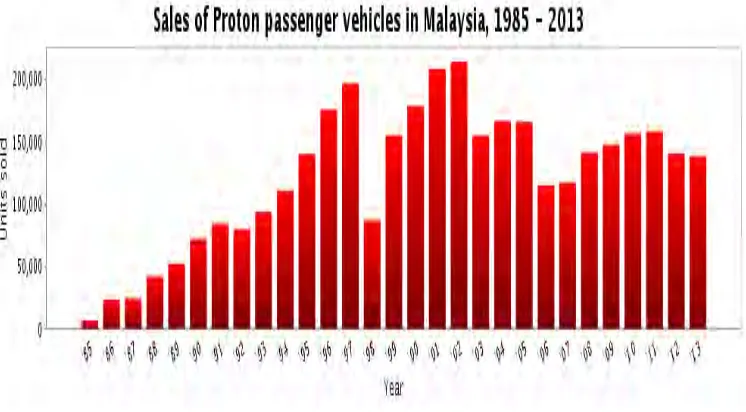
Figure 1.1 Sales of Proton 4
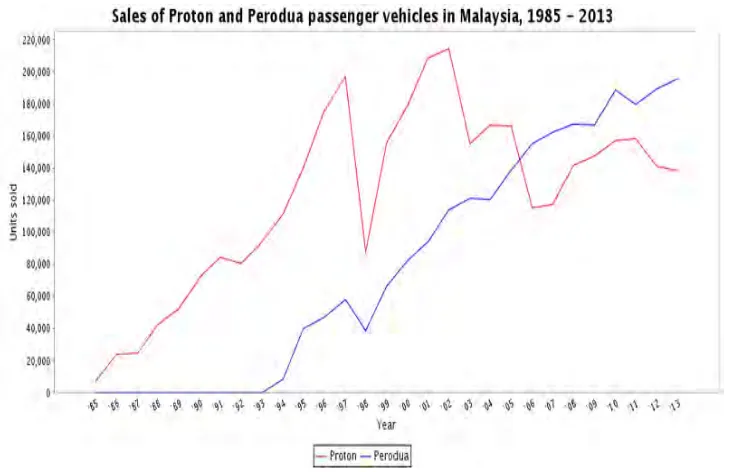
Figure 1.2 Sales of Proton Vs Sales of Perodua 5
Figure 2.1 Theoretical Framework 22
Figure 4.1 Respondent’s Gender Status 36
Figure 4.2 Respondent’s Marital Status 37
Figure 4.3 Respondent’s Age Group 38
Figure 4.4 Respondent’s Profession 40
Figure 4.5 Respondent’s Monthly Income 41
Figure 4.6 Respondent’s Model Type Knowledge 42
Figure 4.7 Respondent’s Model of Car Purchased 44
Figure 4.8 Hypothesis Analysis between Verbal Influencing Factors
towards Purchase Intention 52
Figure 4.9 Hypothesis Analysis between Visual Influencing Factors
towards Purchase Intention 54
Figure 4.10 Hypothesis Analysis between Ethnocentrism Influencing Factors
towards Purchase Intention 56
xv
LIST OF ABBREVIATION AND SYMBOLS
ABBREVIATION TITLE
FPTT Fakulti Pengurusan Teknologi Dan Teknousahawanan R Correlation of Coefficient
R² Coefficient of Determination
SPSS Statistical Package for Social Science UTeM Universiti Teknikal Malaysia Melaka X1 Verbal Advertising (Independent Variable) X2 Visual Advertising (Independent Variable) X3 Ethnocentrism Influence (Independent Variable) Y Purchasing Intention of Proton (Dependent Variable)
xvi
LIST OF APPENDICES NO. TITLE
1 Questionnaire Sample
1
CHAPTER 1
INTRODUCTION
1.1 Background of the Study
Marketing is the activity, set of institutions, and processes for creating, communicating, delivering, and exchanging offerings that have value for customers, clients, partners, and society at large. Marketing identifies unfulfilled needs and desires. It defines, measures and quantifies the size of the identified market and the profit potential. It pinpoints which segments the company is capable of serving best and it designs and promotes the appropriate products and services. Mikes Sprouse stated that effective marketing is a two-way communication that combines both art and science. It is a discipline with no end game that must be constantly honed, tweaked, and tested. Effective marketing builds relationships and inspires trust. The key to effective marketing is getting the communication mix correct for the brand, product or service, understanding how it best interacts with customers or users in the most conducive and accepting environment.
2
products. It is the goods itself or services that offered by a company to its customers. The second is price. It is the amount of money paid by customers to purchase the products. The third is place or distribution. It is the activities that makes the products available to consumers. The last one is promotion. It is the activity that communicate the products feature and benefits and persuade customers to purchase the products. An effective marketing strategy combines the 4 Ps of the marketing mix. It is designed to meet the company’s marketing objectives by providing its customers with value. The 4 Ps of the marketing mix are related, and combine to establish the product’s position within its target markets.
Promotion refers to raising customer awareness of a product or brand, generating sales, and creating brand loyalty. Promotion is also found in the specification of five promotional mix or promotional plan. These elements are personal selling, advertising, sales promotion, direct marketing, and publicity. There are different ways to promote a product in different areas of media. Promoters use internet advertisement, special events, endorsements, and newspapers to advertise their product. Many times with the purchase of a product there is an incentive like discounts, free items, or a contest. This method is used to increase the sales of a given product.
3
Purchase intention is the degree by which consumer were motivated and influenced to trigger the purchase momentum. This is an important indicator for estimating consumer behavior. When consumer have a positive purchase intention, it will form a positive attitude to purchase the products. Purchase intent is an important measure of brand health. It is often measured in advertising effectiveness studies. Usually, this study conduct to measure whether an advertising campaign or marketing program has increased consideration.
1.2 Problem Statement
In Malaysia, Proton Holdings Berhad (PROTON) was a well- known local automobile manufacturer. It was established in 1983 as the sole national car company until 1993, when Perusahaan Otomobil Nasional Sendirian Berhad (Perodua). The concept of national car was first popularized by Tun Dr. Mahathir bin Mohamed, the former Prime Minister of Malaysia, which aiming to enhancing the Malaysian industry. Initially, the company owned by the government of Malaysia through Khazanah Nasional and was headed by its founder, Dr. Mahathir himself. After venturing with Mitsubishi Motors, Proton Saga was launched on 9 July 1985 as a first national car. It was based on Mitsubishi Lancer Fiore model.
4
Figure 1.1: Sales of Proton
5
Figure 1.2: Proton Sales Vs Perodua Sales
Serving in domestic markets, Proton challenged by Perodua. Started out as a complement to Proton, and not a competitor Perodua has overtaken the title to become the best Malaysian’s bestselling automobile manufacturer. Perodua manage to sell in greater numbers due to their cheaper pricing range and better designs from their parent company, Toyota.
Thus, to win back the domestic market, Proton should be more focus on their marketing strategies. Marketing activities has become a very crucial elements to market the car and to get consumer awareness about the presence of this kind of products. Advertising is one of the famous marketing strategy to appeal and to please consumer to attract consumer awareness. There are various way of advertising that used by the company in order to please, appeal and motivating consumer to buy their products.
6
the car. This studies observe the relations of visual advertising influence, verbal advertising influence and ethnocentrism advertising influence.
Research Question
1. What is the relationship between visual advertising influences on consumer purchasing intention of the Proton?
2. What is the relationship between verbal advertising influences on consumer purchasing intention of the Proton?
3. What is the relationship between ethnocentrism influences on consumer purchasing intention of the Proton?
1.3 Research Objective
In this research, several objective are to be studied:
1. To identify the relationship between visual advertisement influences on consumer’s purchasing intention of Proton.
7
3. To identify the relationship between ethnocentrism influences on consumer’s purchasing intention of Proton.
1.4 Scope, Limitation and Key Assumption of the Research
1.4.1 Scope
This study scope is on the advertisement influence on national car users purchasing intention to buy the national car. The advertisement influence scopes were the verbal, visual and ethnocentrism elements only. Research were conduct to identify whether all that three elements will have a positive reaction with the purchase intention.
1.4.2 Limitation
8
1.4.3 Key Assumption of the Research
Researcher believe that there will be a positive relationship between all the variable of the advertising influences towards the consumer purchase intention to buy the national car. It was because the support from the literature that all those things were very strong factors to triggering the purchase intention in the context of advertisement.
1.5 Hypothesis
After the researcher has identified the importance of each variable and established a theoretical framework, the researcher is in positioning to test whether the relationships are valid or not. Hypotheses can be defined as a logically conjectured relationship between two or more variables expressed in the form of a testable statement (Sekaran, 2003). The hypothesis's studied are:-
(i) Hypothesis 1
H0: The visual elements in the advertising will not influence the consumer purchase
intention of the Proton.
H1: The visual elements in the advertising will influence the consumer purchase
intention of the Proton.