bulletin of the european atomic energy community
september 1967 vol. VI no. 3
i '
, ¿
H
*
»
*
C O N T E N T S
Inside the A V R pebblebed reactor in Jülich: a heatexchanger.
66 NEUTRON TECHNIQUES IN CONDENSED
STATE PHYSICS
V I C T O R R A I E V S K I , Head o f Reactor Physics D e p a r t m e n t , Ispra Establishment o f Euratom's Joint Research C e n t r e
75 EASTATOM—A NEW ROUTE TO UNKNOWN
RESEARCH LITERATURE
D R . G Ü N T H E R R E I C H A R D T , Jülich Nuclear Research C e n t r e , Germany
78 FILM DOSIMETRY—A T H I N G OF THE PAST? D R . K L A U S B E C K E R , Central Radioprotection D e p a r t m e n t , Jülich Nuclear Research C e n t r e , Germany
84 THE PROBLEM OF RADIOACTIVE WASTE
STORAGE IN THE COMMUNITY
G A S T O N G R I S O N , D i r e c t o r a t e G e n e r a l Research and T r a i n i n g , Euratom
for
89 THE EFFECT OF NUCLEAR TECHNOLOGY
ON CONVENTIONAL INDUSTRY
M A N F R E D SI E B K E R a n d H E RI BE R T D A L D R U Ρ, D i r e c t o r a t e G e n e r a l f o r Industry and Economy, Euratom
Quarterly Information Bulletin of the
Euro-pean Atomic Energy Community (Euratom)
1967-3
Five editions:
English, German, French, Italian and Dutch
Published and edited by
Euratom, Directorate-General
Dissemination ofinformation,
51-53 rue Belliard, Brussels 4.
Telephone:
13
40 90
Subscriptions:
For details on how to subscribe please see
order form facing last page.
The Euratom Commission or any persons
acting on its behalf disclaim all liability w i t h
respect t o the completeness of the
in-formation contained in this periodical as
well as t o any damage which might result
from the use of information disclosed or of
equipment, methods or processes described
therein.
Picture credits: Cover: BBC/Krupp
Reak-torbau G m b H , Mannheim (Germany); pp.
71 and 74: Narzul, Euratom JRC, Ispra;
p. 91 : BBC/Krupp; p. 92: Fissler KG,
Idar-Oberstein (Germany); p. 96: CEN, Mol
(Belgium).
Sales office:
Agence et Messageries de la Presse (AMP)
34, rue du Marais
Brussels 1
Belgium
Y e a r l y subscription rates:
United Kingdom 18/-; United States $3.50;
Basic r a t e :
Europe: 125 Belgian Francs
Other countries: 175 Belgian Francs
Single copies:
United Kingdom 6/; United States $ 1 .
Quarterly information Bulletin of the European Atomic Energy Community (Euratom)
1967-The Community's mission is to create the conditions necessary for the speedy estab-lishment and growth of nuclear industries in the Member States and thereby contrib-ute to the raising of living standards and the development of exchanges with other countries (Article 1 of the Treaty Instituting the European Atomic Energy Community).
T h e E u r a t o m I n f o r m a t i o n and D o c u m e n t a t i o n C e n t r e recently prepared statistics on t h e origin of t h e " n u c l e a r " documents covered by its a u t o m a t i c docu-m e n t a t i o n systedocu-m.
It e m e r g e d t h a t 3 8 % of t h e i t e m s in its collection originated in t h e U n i t e d States. N e x t c o m e t h e East European countries, includ-ing t h e U S S R , w i t h 2 1 % , t h e C o m m u n i t y countries w i t h 1 8 % , t h e U n i t e d K i n g d o m w i t h 8 % and Japan w i t h 5%.
These figures show t h a t m o r e t h a n a q u a r t e r of the documents in t h e collection c o m e f r o m Eastern Europe and Japan, i.e. f r o m countries using languages which most Westerners regard as "difficult". T h e size of this p r o p o r t i o n is f u r t h e r proof t h a t W e s t e r n research scientists can no longer afford to be ignorant of t h e results achieved by t h e i r opposite numbers w o r k i n g in those countries.
A t t h e same t i m e , however, w e m a y well w o n d e r if t h e col-lection is really c o m p l e t e , and w h e t h e r t h e figure for Eastern Europe and Japan ought not t o be y e t higher.
N e u t r o n í<*<*liii¡<pi<\s in
condensed state physics
V I C T O R RAIEVSKI, Head of Reactor Physics Department, Ispra, Establishment of Euratom's Joint Research Centre
N E U T R O N PHYSICS is certainly less f a m i l iar t o t h e nonspecialist scientific public than highenergy physics. The l a t t e r at once evokes the large accelerators which are needed t o produce highenergy particles, and which have likewise stimulated the g r o w t h of this branch o f physics by reason o f t h e huge investments involved and t h e resultant concentration of efforts. The CERN 30 Gev s y n c h r o t r o n , f o r instance, cost 22 m i l l i o n dollars.
Though s t i l l unperceived by t h e general public, a similar g r o w t h is t a k i n g place in t h e sphere o f n e u t r o n physics, and u n questionably t h e sheer magnitude o f t h e funds and investments entailed in this branch o f physics w i l l help t o l i f t i t o u t o f the e x p e r t s ' c o r n e r and on t o t h e f r o n t page w i t h its companion, highenergy physics. Take, f o r instance, t h e cost, in dollars, o f building intense n e u t r o n sources—15 m i l lion f o r t h e nuclear reactors that recently came i n t o operation in t h e U n i t e d States, 30 m i l l i o n f o r t h e new American and European projects, 150 m i l l i o n f o r the Canadian p r o j e c t . Even more i m p o r t a n t than this spectacular aspect, t h e con s t r u c t i n g o f these huge machines w i l l lead t o a concentration o f effort w i t h i n special ised installations, and t o p r o g r a m m e coordination on an international scale, which has already s t a r t e d .
liquids, is o f practical value. Condensed state physics, by enabling us t o understand t h e reasons f o r these p r o p e r t i e s and revealing new ones, opens t h e way t o major developments in all branches of technology.
C e r t a i n o f these applications, such as t h e s t i l l q u i t e recent discovery o f t h e properties o f semiconductors and t h e i r use in elec t r o n i c s , are among t h e most w i d e l y k n o w n t h o u g h not t h e most i m p o r t a n t ; o t h e r s such as lasers, masers, Josephson junctions, o r t h e Gunn effect, are beginning t o reach public notice. The lastnamed is a v e r y good example o f systematic research on p r o p erties w i t h a view t o t h e i r practical application. The object was t o produce a crystal w i t h negative electric resistance which could be used as an oscillator t o generate highfrequency electromagnetic waves. The physicists found t h e answer t h r o u g h t h e i r w o r k on t h e phenomenon of variation in t h e apparent mass o f the electrons in a crystal subjected t o stress. It should not be f o r g o t t e n , m o r e o v e r , that o u r knowledge of materials is founded on condensed state physics.
In o r d e r t o understand the properties o f m a t t e r in the condensed state, i t is essential t o k n o w its s t r u c t u r e and t h e nature of t h e forces o f interaction t h a t are e x e r t e d between the atoms.
done in this field t o d e t e r m i n e t h e s t r u c t u r e even o f such everyday substances as w a t e r .
. . . and t h e d y n a m i c s of m a t t e r . . .
Essentially, solids cohere t h r o u g h electro static forces, w i t h a slight c o n t r i b u t i o n f r o m magnetic forces. In general these forces are not u n i f o r m l y e x e r t e d but are predominant in certain directions. One o f t h e aims of condensed state physics is t o d i s c o v e r t h e intensity and direction o f t h e s e i n t e r a c t i n g f o r c e s .
If a nucleus is shifted o u t o f its e q u i l i b r i u m position, i t moves back t o i t w i t h an oscil lating m o t i o n w h i c h is characteristic o f these binding forces. In fact, a disturbance of this s o r t w i l l t r i g g e r off collective atom movements that propagate t h r o u g h the crystal at nearly the speed of sound, much like a wave.
This phenomenon can be described as a propagating disturbance, t o which an energy and a m o m e n t u m and t h e r e f o r e a mass can be assigned. T h e r e is n o t h i n g t o prevent us f r o m regarding i t as a special kind of particle. Physicists have named i t t h e " p h o n o n " . For solid state physics also has its " s t r a n g e " particles, and the phonon is only one o f several, such as the " m a g n o n " and t h e " e x c i t o n " .
C o n d e n s e d s t a t e physics:
Knowledge o f t h e p r o p e r t i e s of m a t t e r in t h e condensed state, i.e. o f solids and
Figure 1 : The photograph shows a particular type of crystal monochromator. This is the instrument installed at the Solid State Physics Department (M. Meriel), C E N , Saclay, France.
research on t h e s t r u c t u r e . . .
The s t r u c t u r e may be crystalline, meaning that an assembly o f atoms representing a u n i t cell is reproduced regularly lattice wise, r a t h e r like a wallpaper p a t t e r n . One t h e n has t o d e t e r m i n e t h e lattice's symme t r y p r o p e r t i e s and t h e arrangement o f t h e atoms in t h e assembly f o r m i n g t h e u n i t cell. T h e r e is s t i l l a great deal of research t o be
. . . by means of n e u t r o n s
The s t r u c t u r e o f m a t t e r can be determined by observing the diffraction o f waves o f a length comparable t o that of t h e distance between t h e atoms o f the crystal, generally of t h e o r d e r o f o n e angström (1 Å = 10"β
N e u t r o n techniques [n condensed state physics
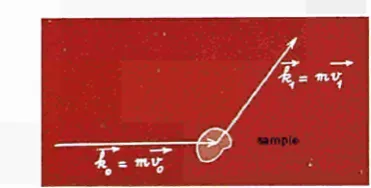
Figure 2:
An incident neutron of velocity v
0is scattered by the sample; its postscattering
velocity is
v,.
Whereas Xrays are scattered by electrons,
neutrons are scattered by nuclei, and it
happens that the wavelength needed for
diffraction experiments corresponds t o
neutrons with an energy of the order of
25 mev (millielectronvolts), which are
produced in abundance in nuclear reactors.
The principle of structure determination
by Xray or neutron diffraction is as follows.
A parallel beam of radiations strikes the
crystal. Each atom of the crystal scatters the
beam in all directions, and the resultant
scattered radiation is measured at a distance
with a counter. If the atoms are evenly
distributed, the waves interfere and form
images of the radiation source in certain
preferential directions known as "Bragg
directions". These directions furnish a
means of determining the nature of the
lattice, and from the intensity diffracted in
these directions one can determine the
arrangement of the atoms inside each unit
cell making up the lattice. The scattering is
elastic, i.e. the direction of the radiation
is changed but not its energy ; it is coherent,
for the waves interfere t o give rise t o
Bragg peaks.
Neutron diffraction is particularly impor
tant to the study of structures containing
light nuclei, to magnetic structures, and t o
the study of the dynamics of matter. The
importance of neutrons in research on
dynamics must be emphasised. Owing t o
its mass, at equal momentum the neutron's
energy is about a hundred thousand times
weaker than that of the X quantum. The
energy transferred t o the crystal in a
collision is of the same order of magnitude
as the neutron's incident energy. Hence
the variation in the neutron's momentum
and energy can be exactly measured; in the
case of the Xray the energy variation is
about a hundred millionth and can only be
measured in certain very special cases by
using the Mössbauer effect.
The techniques used in neutron phy
sics
. . .
The measuring principle is extremely
simple. Neutrons of energy E
0and mo
mentum k
0= m v
0are selected. One
measures their energy E, and momentum
k, = m v, after scattering by the sample of
matter under study. By reason of the law of
conservation of energy and momentum,
the differences E
0—E, and k
0—k, showthe
energy and momentum transferred to the
sample (Fig. 2). One also measures the
fraction of incident neutrons which, after
scattering, have the characteristics (E, k,).
These quantities provide all the data needed
to determine the structure and dynamics
of the substance.
The technique consists in selecting neutrons
with the desired energy and momentum.
The neutrons produced by fission in reactor
fuelelements are slowed down in a modera
tor, and their velocity distribution is close
to that of molecules of a gas of the same
mass at the
moderator
temperature.
The intensity of these neutrons in the
moderator is characterised by the flux, i.e.
the number of neutrons crossing one
square centimetre per second in the
moderator.
In the reactors used for this sort of research,
the flux is from 10
12to 10'
5n/cm
2.sec
1. The
beams are formed by neutrons that cross
Figure 3:
Bragg scattering:
the waves
scattered in direction
Ö
will interfere if the
optical path AOB is a whole multiple of the
wavelength
λ.
The Bragg condition for reflec
tion of the first order is AOB = 2d sin
θ = λ.
the outer surface of the moderator and
escape along channels through the reactor
shielding. They emerge via an angular
aperture bounded by collimators—thin
steel plates positioned inside the channels
and parallel with their axis. It is a simple
task to select the direction of momentum
by this process, but not so easy to select
the energies. This can be done in two ways:
. . .
selection by Bragg diffraction
. . .
We have already seen that a neutron beam,
on striking a crystal, is scattered in certain
preferential directions, called Bragg direc
tions. The neutrons scattered in those
directions have a certain definite energy.
If d is the distance between a series of
lattice planes and θ the angle of incidence
of the neutron beam, the Bragg selection
depending on angle θ for neutrons of
wavelength λ is given by the relation
λ = 2 d sin θ
This is the equivalent of the familiar
equation for optical lattices and corresponds
t o the same phenomenon; neutrons of
wavelength λ will be scattered
2in the
direction θ if the difference of phase of the
scattered waves is a multiple of 2ττ in that
direction. Placing the sample studied or the
detector in the direction Ö amounts to
selecting, out of the neutrons of all energies
impinging on the crystal, the ones whose wa
velength satisfiesthe Bragg equation, (fig 3).
A t this point it will help if we explain the
relation between the energyselection and
the directionselection of the single crystal
diffracted beam.
If we consider a neutron beam of angular
aperture dö with a spectrum of energies,
impinging on a crystal along a direction Θ,
all the neutrons inside the angle dö whose
wavelength satisfies the Bragg equation
1. The neutron flux (neutrons of any energy
and any direction) is written φ. If the
energy and velocity are to be specified,
one writes φ (Ε, Ω), φ is the integral of
φ(Ε, Ω) over all values of energy and velocity.
2. It does not matter i f we speak of neutrons
of energy E, or of velocity v, or of wave
length λ : these quantities are interrelated
by the equations:
[image:8.595.31.217.123.217.2]will be diffracted. Thus one gets a diffracted
beam of aperture dö, and the wavelengths
of these neutrons will bewithin a range dA.
The energy selection dE/E = 2dA/A will de
pend on the angle selection do. To find
this dependence, we have only to differenti
ate the Bragg equation, which gives:
d A _ do
~Ã~~tgô"
Large diffraction angles facilitate selection.
But the physicist is not concerned only
with selection; another important charac
teristic is intensity, i.e. the number of
neutrons received per unit of time. Efficient
selection results in loss of intensity, and for
each separate experiment a compromise
has to be sought between these two
conditions.
The device used to select neutrons of a
given energy by Bragg diffraction is called
a crystal monochromator (Figs.
1
and 4).
. . .
and selection by timeofflight
In this method, the neutron beam emerging
from a reactor channel is chopped into very
short lengths, generally of a few micro
seconds (ys), by a rotating shutter (Fig. 5).
This consists of a diametrical slit in an
absorbent disc spinning very fast opposite
the beam collimator. The beam can only
pass through during the very short time
that the collimator and the slit are in line
(twice per revolution); each time, neutrons
of all energies in that batch fly forward.
The faster outstrip the slower ones, and the
batch strings out as it advances. In the beam
path, at a certain distance (the flight base)
from the disc, a counter is placed; synchro
nised with the disc, it opens for a very brief
time, usually equal to the disc aperture
time, and with an adjustable timelag after
the start of the batch. It will readily be seen
that with the right timelag the counter
will record the neutrons of the energy
desired.
The ratio dt/l is a measure of the selectivity
of a given installation, where dt is the pulse
duration and I is the flight base. It has
become customary to express this selectivity
in microseconds per metre (μ5/ηη).
The pulse repetition rate is a factor that
has to be allowed for. it must not be so fast
that the fastest neutrons in one batch can
catch up the slowest in the batch ahead.
By using suitable filters, one can limit the
energy range of neutrons allowed into the
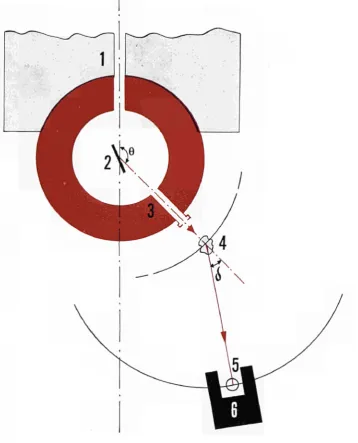
Figure 4:
The neutrons leaving the reactor traverse collimator 1, are diffracted by crystal 2
(e.g. copper) at an angle
θ
selected by collimator 3 and strike the sample 4. The detector 5, inside
a shield 6, can be used for analysing the intensity of the neutrons scattered by the sample as a
function of the angle S. In modern crystal spectrometers a programme is employed for automatic
analysis.
beam and slightly increase the frequency of
repetition.
I f f is the pulse repetition frequency, it can
be shown that the selectivity is simply a
function of the product f.dt, that is, of the
time during which neutrons are admitted
into the beam. Clearly, therefore, good
selectivity depends on a short admission
time. As with the crystal monochromator,
the price of selectivity is a loss of intensity.
This device is known as the timeofflight
monochromator, or "chopper" (Fig. 6).
At first sight it appears that the chopper
rejects more neutrons than the crystal
monochromator does; a quick analysis
shows that this is not so.
The chopper is linked with a multichannel
selector which distributes the neutrons
received by the detector over a set of
counters according to their timelag (Fig. 7).
Each counter registers only neutrons of a
given energy, but all the neutrons in the
batch are utilised.
Given equal selectivity, both systems reject
the same number of neutrons, but they do
so in different ways.
[image:9.595.196.555.25.469.2]N e u t r o n techniques in condensed state physics
[image:10.595.35.392.347.703.2]of monochromator, and it soon becomes
extremely difficult to analyse the respective
merits of the different combinations; in
these circumstances it is not surprising that
even the experts find it hard to decide
which are best. Two international meetings
were held in 1966 to study this problem
and the question of neutron sources, the
first at Dubna (USSR), organised under the
auspices of the International Atomic Energy
Agency in July, and the second at Santa Fe
(USA), organised by the European Nuclear
Energy Agency. They undoubtedly gave a
great impetus to ideas on this subject.
Figure 5: Principle of the chopper. In (a) the neutron batch has just been formed; black dots
represent the fast, white the slow, and grey the medium-velocity neutrons in the batch.
Diagram (b) shows the batch an instant later.
d i r e c t i o n of r o t a t i o n
(a)
O
beamchannel
flight distance of length I
(b)
_Q_
O O
neutron packet
•*Q
Intense neutron sources:
Neutrons are produced in nuclear reactions;
the reactions used by intense neutron
sources are either fission or reactions with
charged particles. One important
charac-teristic is the heat released per neutron
produced. As this heat has to be carried
off, it governs the size of the source-cooling
device. Table I gives some of the values for
the nuclear reactions generally used.
Table I:
R e a c t i o n s
(e, n) 5 0 M e v e l e c t r o n s f i s s i o n , U 2 3 5 fast f i s s i o n . Pu 2 3 9
s p a l l a t i o n , B i ( p , x n ) 1,000 M ev H e a t i n Mi
g e n e r a t e d , ; v a v a i l a b l e
n e u t r o n
6 0 0 160 100 30
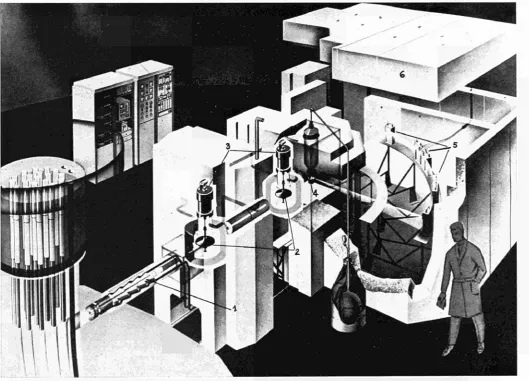
Figure 6 : Velocity-selecting neutron monochromator (chopper). The neutron beam leaving the reactor traverses collimator 1 and then the slits in two rotors. The monoenergetic neutrons strike the sample 4 and are analysed by the time-of-flight technique with the detectors 5. The shielding 6 ensures that the experimental installation is biologically safe. This dual-rotor device permits energy selection before and after scattering (in cases of inelastic scattering).
giving p r o t o n s a n energy o f some 1,000 Mev. This device has been proposed by the Canadians as an intense n e u t r o n source f o r a vast research p r o g r a m m e ranging f r o m condensed state physics t o high-energy physics. N o device o f this kind is being used f o r condensed state physics at the present t i m e , however.
Fission reactions are used in nuclear reac-t o r s , w h i c h are reac-the major class o f inreac-tense n e u t r o n sourcesforcondensed state physics. The nuclear reactors used f o r these e x p e r i -ments are usually in continuous o p e r a t i o n , a system which is not suitable f o r the t i m e -of-flight m e t h o d . For a chopper w i t h an admission t i m e of 1 % , f o r example, a
continuous reactor produces 9 9 % of dead-loss neutrons, and this useless o u t p u t engenders heat which has t o be carried off.
If t h e reactor could deliver these neutrons in pulses and in t i m e w i t h the chopper, w i t h t h e same average p o w e r i t w o u l d provide a n e u t r o n beam 100 times m o r e intense. In that case, t h e reactor itself being a pulsed source, t h e chopper can be removed o r replaced by a simpler device serving only t o cut off the pulse tail w h i c h is always present in a pulsed reactor. O w i n g t o the v e r y s h o r t d u r a t i o n and high repe-t i repe-t i o n rarepe-te of repe-the pulse, repe-the fasrepe-t n e u repe-t r o n reactor is the most suitable f o r this purpose.
This relatively recent concept is being developed rapidly.
. . . t h e s t a t i o n a r y r e a c t o r . . .
A p a r t f r o m t h e IBR reactor at Dubna (USSR), all t h e reactors used today f o r condensed state physics are of the c o n t i n u -ous type. The first was the CP7 reactor at the A r g o n n e C e n t r e (USA), w h i c h w e n t
[image:11.595.22.552.107.488.2]■Γ··\
\
W^=m^
^L
y
/^Èfyti
\rrf
\
4
\
/
/
ρϊΡ^--***)»^ >
<K/y
Z? /
j
ΊΕΪΙ
!
'/
ê*0
5%* ·..
M^r~*
/ \ s ä L /
N A ^ S ^ Ì Ì * » .
Air-1 \
\ \
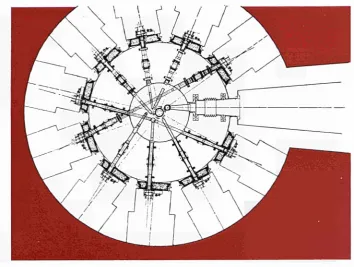
Figure 8 : Horizontal cross-section of the Grenoble GFHFR, showing the core, moderator and horizontal channels for beam extraction. (Extract from the paper by Messrs. K. H. Beckurts and R. Dautray: "Project Studies for the Franco-German High Flux Reactor", AEC-ENEA Seminar on Intense Neutron Sources—Santa Fe, USA, September 19-23, 1966).
fluxes o f t h e o r d e r o f 1015n.cm2./sec, are k n o w n as HFR (High Flux Reactors); i t is n o t a very well-chosen name, b u t w e w i l l b o w t o this recent custom and keep t h i s generic t e r m .
[image:12.595.215.570.14.281.2]The HFR reactors have many characteristics in c o m m o n . They consist of a ring-shaped core made up of fuel elements in t h e f o r m o f highly enriched u r a n i u m plates, clad in a l u m i n i u m and cooled by a stream of heavy o r light w a t e r . The core is v e r y under-moderated. Moderation takes place mainly in an external reflector o f heavy w a t e r , w h e r e the moderated n e u t r o n flux attains its highest value and w h e r e t h e ends of the
Figure 7: Principle of the multichannel selec-tor. The detector pulses are selected according to their time gap t since the moment the neutron batch was formed. An individual distribution for one batch is represented here. Modern selectors have over 1,000 channels.
detector I *
0 0 0 I
n
0 I I I I I I In
1 0 0 8 0,
n e u t r o n beam o u t l e t channels emerge. The p o w e r density is considerable, 1-2 M W / I on average, rising t o 5 M W / I in certain parts of t h e core. The heat flux on t h e fuel element surfaces reaches 400-700 W / c m2, and in o r d e r t o e x t r a c t i t t h e cooling w a t e r has t o circulate at speeds o f 10-15 m/sec. Obviously cooling conditions of this s o r t are not f a r f r o m t h e t e c h n o l o g i -cal l i m i t , and, s h o r t o f singularly expensive contrivances, i t is agreed t h a t t h e highest economically feasible increase o v e r present flux values is o f t h e o r d e r o f 2-3.
T h e r e are t h r e e reactors o f this t y p e in o p e r a t i o n today—SM2 ( N e w Melekes, USSR, 1961), HFIR (Oak Ridge, USA, 1965),
HFBR (Brookhaven, USA, 1965), and t h r e e o t h e r s at t h e design stage—AARR ( A r g o n n e , USA), UKHFBR ( U K ) , and GFHFR ( G r e n o b l e , France). The HFBR is typical o f this reactor generation. It produces a f l u x of 0.6 . 101 5n. cm2.sec f o r a p o w e r o f 40 M W (Fig. 8). The French have i n t r o d u c e d t h e concept o f " e f f i c i e n c y " , expressed in f l u x per u n i t p o w e r . The HFBR has an efficiency o f 1.5.10". n.cm2.sec.MW.
The j o i n t Franco-German GFHFR project is fairly similar in design t o t h e HFBR, but its i m p r o v e d core design raises t h e p o w e r t o 55 M W and t h e efficiency t o 1.8.1013. Thus i t w i l l have t w i c e as high a flux as t h e HFBR.
The particular i n t e r e s t o f this project, h o w e v e r , lies n o t in t h e doubled f l u x b u t in
its cold source. This is a volume o f l i q u i d hydrogen positioned inside t h e reactor, w h i c h serves t o moderate t h e n e u t r o n s at a t e m p e r a t u r e far l o w e r than that o f t h e reflector, thus affording a ten times g r e a t e r flux o f t h e v e r y long wavelength neutrons w h i c h are especially i m p o r t a n t in these researches.
. . . and t h e pulsed r e a c t o r
The only c u r r e n t l y operating pulsed reactor used f o r condensed state physics is t h e IBR
[image:12.595.34.212.624.723.2]ending against o r inside t h e hydrogen m o d e r a t o r f r o m w h i c h issue t h e n e u t r o n beams used in t h e e x p e r i m e n t s .
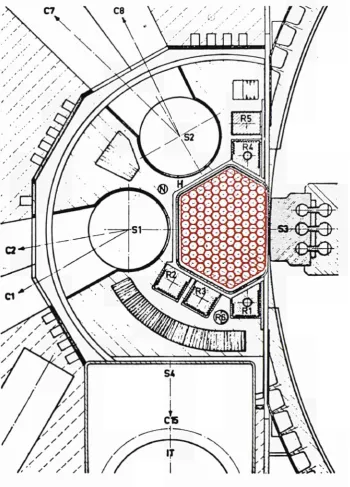
The p o w e r pulse is produced by a sharp periodic reactivity rise caused by the rapid r o t a t i o n of a large-diameter wheel which carries either a sample of fissile material o r a reflector sample. In the f o r m e r case, t h e sample enters the core t h r o u g h a s l o t ; this is the solution adopted in /BR, and i t limits its p o w e r . In the l a t t e r case, the solution adopted f o r h i g h - p o w e r devices, the t r a j e c t o r y is tangent t o the core. The SORA project designed by Euratom is characteristic o f high power pulsed reactors. The core volume is 6 l i t e r s , t h e average p o w e r 1 M W . The p o w e r density, 0.15 M W / I , is low compared w i t h that of the
HFR and even the fast power-generating reactors (0.5-1 M W / I ) . In this respect the project may be considered very cautious, and t h e r e are o t h e r projects o r designs (Brookhaven, U S A - H a r w e l l , U K ) at a less advanced stage than SORA b u t w i t h p o w e r density values t e n times as high (Fig. 10). The reactivity pulse is obtained by r o t a t i n g a b e r y l l i u m reflector f i t t e d on a wheel 190cm in diameter at a speed o f 5 0 r p s . The p o w e r pulse has a d u r a t i o n of 50 [is and a m a x i m u m amplitude o f 300 M W , and the n e u t r o n flux in t h e hydrogen moderators reaches a value o f 4 . 10, 5n.cm2.sec. The n e u t r o n spectrum depends on t h e modera-t o r modera-t e m p e r a modera-t u r e and g e o m e modera-t r y , w h i c h can be modified. The fast and epithermal n e u t r o n pulse is o f the same d u r a t i o n as the p o w e r pulse. It is longer f o r t h e t h e r m a l n e u t r o n s , o w i n g t o t h e thermalisation phenomenon, and reaches about 60-1 OOus. A l t h o u g h somewhat long, this pulse dura-t i o n is admirably suidura-table f o r dura-time-of-flighdura-t e x p e r i m e n t s w i t h t h e r m a l o r cold neutrons. Resolution is d e t e r m i n e d by the time-of-flight base and in certain e x p e r i m e n t s , using y e r y long flight bases, i t is helpful t o use an ingenious device developed by Professor Maier-Leibnitz of the U n i v e r s i t y o f Munich, w h i c h consists of polished metallic tubes in w h i c h the beam neutrons are propagated by t o t a l reflection off t h e walls. The p o w e r pulse d u r a t i o n can be substantially s h o r t -ened by coupling the pulsed reactor w i t h an accelerator, w h i c h is used t o inject neutrons into the reactor core f o r a v e r y s h o r t t i m e , o f microsecond o r d e r , at the instant w h e n the reactor reactivity pulse reaches its peak value.
In t h e case o f SORA, t h e accelerator
envis-Figure 9: Horizontal cross-section of the central part of the SORA pulsed reactor. The core, an assembly of U 235 or Pu 239 fuel elements, is contained in a hexagonal vessel H. The hydrogen moderators S, (cold neutrons) and S2 (thermal neutrons) are contained in the metal reflector. Each
source feeds three pairs of channels, i.e. four horizontal channels situated at two different levels
(C,, C J (C7, CB) and two slightly sloped. Pulsing is produced by sweeping the beryllium block S3,
[image:13.595.204.555.123.611.2]N e u t r o n techniques in condensed state physics
Figure 10:
View of the
SORA
pulsed reactor. The revolving axis not shown in Fig. 8 can be seen
here at 1. The beryllium block
S
3is
carried by one of the arms of the propellor P. The channels
fed by the sources are plainly visible here, with their position at two different levels and their
slope.
aged, a linacelectron machine, would have a
maximum output of 50 MW and an average
beam power of 50 kW, producing 5 . 10'
4n.
sec on average. This source is multiplied
by about 300 in the reactor. The reactor's
peak power reaches 2,000 MW and the pulse
du ration is shortened to 6 μ3. The epitherm
al neutron flux is raised to seven times its
reactor-only value.
Conclusion
At the end of 1966, there were three
high-flux reactors in operation — one in the
USSR and two in the USA. From initial
conception to start-up they took an average
of ten years, roughly half of which were
spent in working out the detailed project,
construction and acceptance tests. We may
thus take it for granted that those countries
can now look forward to some five years
free of com pet i t ion f rom any West Eu ropean
reactor. Their physicists can therefore
settle down to their researches undisturbed,
and their Western European colleagues can
only follow their work in the publications
that will shortly start to flow.
An initial attempttoget a high-flux reactor
designed and built in Western Europe was
made in 1963, under the aegis of the
European Nuclear Energy Agency.
Although
technically this attempt led to an interesting
project, it foundered in political waters.
Following this failure, Euratom on one side
and France and Germany on the other
developed two entirely different but
remarkably complementary projects. They
embody original features which entitle
Western Europe's physicists to be present
in this field and to contribute to its develop
ment. From the technical standpoint, these
projects have reached the point where
construction can be started. It was decided
in December 1966 to build the
GFHFR.
The
decision on
SORA
is to be considered in
1967.
There is wide concern today over the
growing scientific and technical gap between
the European Community and the other
industrially advanced countries, a gap that
is still widening. Similarly there is much
talk of concentrating and co-ordinating
efforts. Let us hope that all this concern
will lead shortly to some real action; the
scientific and technical foundations are
already there, and all that is lacking is the
decision to go ahead. (EUBU 6-11)
Ka sí ¿i
i
o m - a n ew r o u t e
to
ii ii know I I r e s e a r c h l i t e r a t u r e
DR. G Ü N T H E R R E I C H A R D T , Jülich Nuclear Research Centre, Germany
The Jülich Nuclear Research Centre, in collaboration with Euratom, has set up a service which, for certain narrow research fields, locates, procures, notifies and, on request, translates unknown but important literature of the East European and Oriental countries. Lists of such literature are published in the monthly journal Transatom Bulletin
under the title Eastatom. They contain a limited selection under twelve different subject-headings and cover published scientific works in obscure languages which are not yet available in translation and do not yet feature in Nuclear Science Abstracts.
RESEARCH HAS A L W A Y S been concerned w i t h the u n k n o w n . The individual research-e r is at all timresearch-es possresearch-essresearch-ed w i t h thresearch-e urgresearch-e t o advance on remote and imaginative goals, b u t t h e scientific e x p e r i m e n t a t i o n and technological development w o r k that lead t o these goals are often so onerous as t o be beyond the intellectual and financial resources o f the individual. In such cases t h e r e is only one s o l u t i o n : t o enlist the co-operation o f researchers at home and abroad w h o are w o r k i n g on identical o r similar projects, insofar as t h e i r results have been published and the corresponding documents are readily available.
T h e p r o b l e m o f u n k n o w n research
l i t e r a t u r e
It is t h e r e f o r e a question of bringing u n k n o w n l i t e r a t u r e t o l i g h t , f o r i t is an u n f o r t u n a t e fact that in Germany, f o r example, many research results remain in obscurity f o r a very considerable t i m e ,
sometimes as long as six o r eight years. There are various reasons f o r this, and shortage o f funds is only one of t h e m . Prof. F. Seitz1, President of the National Academy of Sciences, Washington, has remarked that in W e s t e r n Germany t h e organisation and documentation o f scientific research have scarcely changed since before the first w o r l d w a r ; they are based " o n t h e i n s t i t u t e system w h i c h was developed almost a century a g o " .
The greatest efforts t o b r i n g u n k n o w n
l i t e r a t u r e t o light—and it is p r i m a r i l y the l i t e r a t u r e published in t h e Eastern countries that constitutes this c a t e g o r y — w e r e made by t h e Americans after the shock they sustained as a result o f t h e launching of the Soviet sputnik in 1957: this is evident today f r o m the nearly 200 Soviet journals which
have been completely translated into
I. F. Seitz: Wissenschaft im Vormarsch, Stifter-verband-Schriftenreihe zur Förderung der Wissen-schaft, Vol. I I , No. 9, I962.
A Chinese member of the Eastatom staff, Mr. Sun, with Chinese dictionaries and periodicals.
Eastatom - a new route to unknown research literature
English and from the numerous translated
monographs.
Nuclear Science Abstracts increased its
coverage of Eastern-bloc literature from
6% in 1957 to 16% in 1964.
Nevertheless, many very important
contri-butions—articles scattered throughout
nu-merous journals, concealed research
re-ports, theses and patents—are neither
translated nor reported and consequently
remain unknown for quite a long time.
Examples can easily be found of research
results which have escaped notice
alto-gether or have only belatedly come to
light.
The malignolipin test, which was published
in Japan in 1958, was not reported in
Medical News until 1964, despite the fact
that Italian institutes had been working
on it in the meantime. The effective
cross-section measurements of many
radionucli-des have appeared in Soviet publications,
but are nonetheless still being sought. How
many people know of the proof of damage
to uranium fuel elements in a current of
C0
2? Or the experience acquired with the
Calder-Hall-type fuel elements that were
used in a Japanese nuclear energy centre?
Or the Polish work on breeding in thermal
reactors? Or the work on
ultracentrifuga-tion that has been done in Communist
China on the basis of the results obtained
by the German researchers Prof. Groth and
Dr. Beyerle? Or the Russian studies on
cytostatics? Or the conference held at
Kiev in 1964 at which there were 111
individual papers on genetics and
radio-biology? Or the Finnish work on a new
cement for shielding purposes in reactor
construction?
What does Eastatom offer?
It
is now possible to discover and to obtain
in translation hitherto unknown research
literature in obscure languages which is
not as yet included in Nuclear Science
Abstracts and has not yet been translated.
The European Atomic Energy Community,
recognising the deficiency, organised a
form of collaboration with the Jülich
Nuclear Research Centre whereby a
special service was set up at the latter's
central library which, in certain narrow
research fields, seeks out and procures
important unknown literature of East
European and Oriental countries, states the
titles in English and, on request, furnishes
translations at a reduced rate.
Since January 1966, these lists of important
unknown literature have been appearing
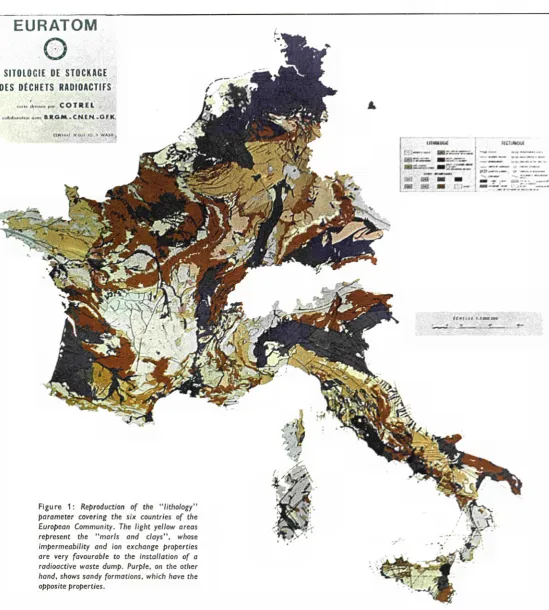
Map showing the quantities of literature from Eastern countries available in the central library
of Jülich Nuclear Research Centre.
monthly in Transatom Bulletin as Section III
under the title Eastatom. The literature
titles are given in English. The
subject-matter is arranged under the following
twelve heads: physics, chemistry,
mathe-matics and computers, geology, mineralogy
and meteorology, biology and medicine,
metals, ceramics and other materials,
engineering and equipment, reactor
techno-logy, isotope production and separation,
industrial applications of isotopes and
radiations, isotopes and radiations in
agriculture and food preservation, health
and safety. This literature is available at the
central library of the Jülich Nuclear
Re-search Establishment and can be ordered
either as photostats or as translations into
English, German, French, Italian or Dutch.
Translations are supplied at a reduced price
amounting to about 40% of the true cost.
A particular advantage for the individual
scientist is that this list provides him with
a selection of only about ten titles per
month in each field, i.e. only
120-150
titles
in all. Thanks to this "homeopathic"
method there is no danger that the scientist
will be offered "off-the-peg" goods; on the
contrary, every effort is made to cater for
his particular requirements by furnishing a
specific and perhaps not unimportant
contribution, the evaluation of which will
take little time, but should constitute a
useful pointerfor many research projects.
The information thus offered relates to the
gaps in the notification of technical
litera-ture, to the blank spaces on the "chart of
nuclear research". Naturally, only published
scientific papers in the Eastern languages
as far as the Pacificare indicated; no account
istaken ofthe invisiblespectrum of internal,
confidential and secret reports. The
Ameri-cans have already realised the value of this
contribution and are enthusiastically
orde-ring the literature announced in Section III
of Transatom Bulletin. In Europe, however,
there is still a lack of response, although it
has long been recognised that many
specta-cular scientific successes in nuclear research
are also being achieved in the countries
covered by Eastatom. It would be a pity
if foreign researchers were to make earlier
and better use of the time-saving routes
that we point out than do our own
insti-tutes in the European Community.
(EUBU
6-12)
(After an article originally published
in Atomwirtschaft, December 1966).
An Eastatom employee making punched tapes on the BIMA.
Report stond from the reading room 'of the central library of Jülich Nuclear Research
Centre, with Eastern abstract journals and reports.
PERSONNEL DOSIMETRY, i.e. the integrat ed measurement o f the radiation received by the individual w o r k e r in the course of his employment, r i g h t f u l l y occupies a central position in practical r a d i o p r o t e c t i o n . Its purpose is not only t o ensure compliance w i t h t h e legal provisions concerning maximum permissible doses but also t o determine the t r e a t m e n t t o be given an injured w o r k e r in the event of a possible accident, t o supply evidence f o r any litiga t i o n which may take place and t o f o r m the basis of statistical analysis. However, t h e part played by film dosimetry in this field — t h e t e r m s film dosimetry and personne/ dosimetry are v i r t u a l l y synonymous f o r many laymen—has been the subject o f considerable controversy in recent times. It has been said t h a t " T h e Middle Ages o f personnel dosimetry, in which the personal dose was determined f r o m the reddening of skin and blackening of films is nearly o v e r " . In point of fact, film dosimetry is a method by which over half a million radiation w o r k e r s are con stantly kept under surveillance t h r o u g h o u t
the w o r l d w i t h the approval and backing of national and international a u t h o r i t i e s . Comparison o f this process w i t h the ex t r e m e l y inaccurate method occasionally used in the twenties f o r estimating radiation damage f r o m t h e intensity of reddening o f the skin ("erythemdosis") w o u l d certainly be rejected by many experts w h o today still regard film dosimetry as the best available method.
For example, they point o u t that f o r over t w e n t y years film dosimetry has been t h e only technique t o be applied in civil per sonnel dosimetry on a large scale, a large amount of experience having been acquired w i t h this m e t h o d . The m o r e recent techni ques, however, which are based on solid state physics and have o f late been tending t o oust film dosimetry more and m o r e , have so far not been tested t o any great e x t e n t . This argument is countered by advocates o f glass and thermoluminescent dosimetry w i t h the remark that f o r all its drawbacks, w h i c h w e r e w e l l k n o w n at t h e t i m e , t h e use o f films was introduced after
t h e w a r only because no o t h e r methods available then were suitable f o r cheap mass dosimetry. N o w , however, intensive efforts t o develop beter techniques have proved successful, so t h a t t h e r e is no longer any reason f o r retaining this m e t h o d . The argument concern ing insufficient experience is not valid, either, since good results have been obtained in o t h e r fields such as military and civil defence personnel dosi m e t r y over the last 15 years (e.g. w i t h five million glass dosimeters in the US Navy). F u r t h e r m o r e , recent comparisons between film and solid dosimeters have tended more
F i l m dosime
Fig. 1 : Dose recorded on a personnel dosimeter in a case of wholebody Irradiation versus the actual dose in various critical organs (male and female sex glands, bone marrow) for X and gamma radiation of different energy and incidence (data supplied by A. R. Jones, Health Phys. 12,663,1966.)
dose absorbed ¡n the ovaries bone marrow
0.03 0.04 0.06 Ο.ΟΘ0.Ι 0.15 0.2 0.3 0.4 0.6 0.8 photon energy, Mev
radiation from Ο Ο O O in front X X X X behind Ο Ο Ο Ο all round
and more t o demonstrate the s u p e r i o r i t y o f the l a t t e r .
The advocates of film dosimetry also point t o the considerable investments which film dosimetry demands in t h e way of equipment and personnel and t o the carefully developed organisation of a central mass surveillance system using films, which w o u l d become superfluous o r at least r e q u i r e modification if another method w e r e introduced. A l l fundamental innovations do in fact involve certain technical and administrative difficulties and necessitate new investments; the problem is, before t h e necessary changeover takes place, t o examine t h o r o u g h l y w h e t h e r the expense and t r o u b l e are warranted by the material and financial advantages t o be gained f r o m a new technique.
Such a changeover could not, of course, be carried o u t suddenly but, in view o f the present scope o f personnel dosimetry, w o u l d have t o be effected gradually, beginning w i t h nuclear installations, f o r example. O n the o t h e r hand, such a move becomes m o r e complicated and expensive the longer i t is put off.
another at all international congresses dealing w i t h this field o r among smaller groups of experts, could be continued for a long t i m e . What, then, is the actual situation w i t h regard t o film dosimetry, is the question which w i l l be asked by the outsider, the passive " c u s t o m e r " of the personnel dosimetry centres.
Basic l i m i t s of personnel d o s i m e t r y
In any attempt t o answer this question mention must first be made of the very limited amount of information t o be
ob-genetic radiation effect t o be expected. O f the various stages between the dosimeter reading and this effect o r its medically discernible manifestation, shown in Fig. 2 w i t h the possible e r r o r factors, only the first stage, namely the accuracy of the dosimeter, w i l l be considered here. Fig. 2 is also intended t o show how an isolated dosimeter reading, at best, only possesses any value f o r information purposes if carefully and critically evaluated by an e x p e r t .
This situation can be simplified if, in the statistical evaluation of a large number of
ding the latest solid-state dosimeters for example, are not capable of taking certain important types of radiation such as intermediate neutrons, which may consti-t u consti-t e up consti-t o 90 % of consti-the consti-toconsti-tal dose in consti-the vicinity of the reactor, and many problems still have t o be solved w i t h regard t o the dosimetry of high-energy photons, neutrons and charged particles, such as those observed in the neighbourhood of accelerators.
X and g a m m a radiation
For the most frequent case, namely
per-try - a thing
1
of the past?
DR. KLAUS BECKER, Central Radioprotection Department, Jülich Nuclear Research Centre, Germany
tained f r o m any personnel dosimeter, however accurate. Even under ¡deal con-ditions, a personnel dosimeter w i l l only give the dose at the location of the dosi-meter, not the whole-body dose. In ex-ceptional cases, such as the well-known exposure of a person t o gamma rays of about 1 Mev or neutrons of about 10 Mev, the dose reading on a reliable dosimeter w i l l agree w i t h the whole-body dose o r the dose in a particularly sensitive critical organ t o w i t h i n about 4; 5 0 % , but in the majority of cases matters are much more complicated. It is usually quite impossible t o determine w i t h any reason-able probability whether a person w i t h a dosimeter reading of, say, 5 rad has actually received a higher whole-body or gonad dose than somebody whose dosimeter showed a reading of 2 rad. Fig. 1 shows more recent values comparing the influence of the direction of intensities of X and gamma radiation of various energies on the correlation between the dose picked up by the organ and the dosimeter reading. In the event of partial irradiation o r faulty readings, of course, the situation is even more complicated.
The dose reading therefore provides only a very indirect indication of the somatic o r
individual measurements carried out on several persons over a limited period o r on one person over a long period, the e r r o r s , which in certain cases may frequently be high, can be partially offset.
Furthermore, w i t h small doses, roughly in the o r d e r of magnitude of 1 /10th of the permissible maximum values, major e r r o r s are perfectly tolerable owing t o the high safety factors applied in defining the tolerance values. Finally, the dosimeter fulfils only a symbolic, administrative o r instructional function in many cases anyway, so that its reliability is then of l i t t l e impor-tance.
On the other hand, the experts are agreed that in the event of higher doses, especially in the somatically interesting range (acci-dental irradiation) of about 100-700 rad, the maximum possible accuracy should be aimed at, e r r o r s of more than ± 10-20% considerably complicating the decision as t o what therapeutic steps should be taken. But which dosimeters meet these require-ments best of all, relatively speaking? The answer is that there is no ideal dosimeter for all the important ranges, i.e. f o r the medical and nuclear ranges and for that of possible high accidental exposures. Also, all the dosimeters now in existence,
inclu-sonnel dose monitoring in medical and nuclear centres, in which the majority of the dose comesfrom X and gamma radiation in the energy range f r o m about 20 kev t o 2 Mev, the main advantages and drawbacks of the various types o f dosimeter can be outlined as follows.
Owing t o the fact that a photographic image, i.e. an X-ray picture of the badge used each t i m e , is obtained during its evaluation, the film dosimeter can provide certain information which it is difficult o r impossible t o obtain w i t h solid-state dosi-meters. For instance, dark spots on the film are an indication of surface contamina-t i o n , while high-definicontamina-tion reproduccontamina-tion of the edges of the metal filters in the film badge suggests brief isolated irradiation, and even the nature of the filter image can yield data concerning the direction of incidence of the radiation. Using specially designed film dosimeters, moreover, it is possible t o detect radioactive gas (radon, t r i t i u m ) .
Fig. 2: Diagrammatical representation of the relationship between the dosimeter reading and
any individual somatic or genetic damage, with the major corrections to be applied.
dosimeter and, if regarded as a single
dosi-meter (i.e. leaving aside the fact that
solid-state dosimeters can be used over and over
again), cheaper too.
Solid-state dosimeters
A t the same time modern glass and
thermo-luminescent dosimetry, the basic principles
of which are shown diagrammatically in
Fig. 3, is far superior to films in several
important respects.
1. Greater accuracy
The literature occasionally reports
relative-ly favourable values for the accuracy
ob-tained with film dosimeters in laboratory
experiments (in a recent British publication,
for example, 80-90% of the film values
were found within ± 40% of the dose
applied, although the maximum deviation
was admittedly 25 times the irradiation
dose).
Such data might well arouse the impression
in a casual reader that this is the actual
accuracy that can be obtained in practice.
In fact these values were always measured
under extremely ¡deal laboratory conditions
and represent the best accuracy which can
be obtained with film dosimeters under the
following particularly favourable conditions:
experienced, well-trained evaluation staff,
optimised dosimeters and good dosimeter
films, head-on irradiation with a narrow
beam of mono-energetic X or gamma
radiation of simple composition, dose range
from about 0.05 to 100 rad, energy range
from about 25 to 1,250 kev, absence of beta
or soft X-radiation, test and control films
stored under ¡deal climatic conditions, etc.
But even under these conditions, which in
practice are obviously only rarely
en-countered, occasional "mavericks", i.e.
films which give a dose reading which is
wrong by a factor of 5 or more, cannot be
avoided.
However, if the testing conditions are
brought more into line with actual practice,
i.e. irradiation at an angle, complicated
mixed irradiation and storage of the test
films over several weeks at varying
tempera-ture and air humidity, it is only in
excep-tional cases that the dose readings agree
with the actual dose values applied to
within i 30-50%, and the percentage of
films which give completely false readings
or cannot be evaluated at all is very large.
It is obvious that the statistical, legal or
medical value of such film dosimeter
readings, which, while they may well be
correct to within + 30 or 50%, may also be
wrong by a factor of 5, 10 or more with a
probability which is extremely difficult to
estimate, is very limited. On the other
hand, an average deviation of ± 10% and a
maximum deviation of ± 30% was obtained,
for example, with suitably encapsulated
glass dosimeters under identical conditions,
similar to those encountered in practice.
The superior accuracy of solid-state
dosi-meters has been corroborated over and
over again in the last few years by numerous
studies carried out, in particular, in the
USA (comparisons of film and
thermo-luminescent dosimeters) and Germany
(comparisons of film and glass dosimeters).
Under ideal laboratory conditions, for
example, it is possible to evaluate glass
dosimeters with a standard deviation of
less than ± 1 % .
2. Greater sensitivity
Fig. 3: Schematic representation of the evaluating process for a thermoluminescent dosimeter (above) and a glass dosimeter (below).
3. Less energy- and direction-dependence
Some solid-state dosimeters, such as l i t h i u m f l u o r i d e and l i t h i u m borate, show no d i s t u r b i n g energy-dependence after about
10 kev, w h i l e in o t h e r cases (glass, calcium fluoride) the energy-dependence between about 30-50 kev and several Mev can be reduced t o a m i n i m u m by suitable encapsu-lation. H o w e v e r , should a f i l t e r analysis be r e q u i r e d , i.e. additional i n f o r m a t i o n on the effective quantum energy, this can easily be done w i t h several solid-state detectors as in the case o f film dosimeters. Using suitable pairs o f glass dosimeters, f o r example, X - r a d i a t i o n o f over 15 kev can be measured and its energy d e t e r m i n e d . As opposed t o films, m o r e o v e r , t h e readings on p r o p e r l y encapsulated solid-state dosi-meters are independent o f the angle o f incidence o f the radiation.
4. Weather resistance
As opposed t o films, w h i c h are sensitive t o numerous outside influences such as l i g h t , laboratory gases and vapours, atmospheric h u m i d i t y , increased t e m p e r a t u r e , etc., solid-state dosimeters can be stored f o r almost unlimited periods both before and after use and still retain t h e i r p r o p e r t i e s . The resistance o f t h e radiation effect t o fading is particularly i m p o r t a n t , a change o f only 5 % in t h e reading being found, f o r example, o v e r a three-year period in glass dosimeters.
5. Simplified evaluation and organisation
U n l i k e films, solid-state dosimeters can be evaluated by inexperienced personnel anywhere, e.g. in the open air, w i t h i n a space of a few seconds, w i t h relatively simple, f r e q u e n t l y portable equipment (a compact battery-operated glass dosimeter reader is shown in Fig. 4 as an example). Immediate evaluation is particularly i m p o r -tant in the case o f accident d o s i m e t r y . The cost of maintaining a permanent personal m o n i t o r i n g system using solid-state dosimeters is much l o w e r (roughly 25%) than w i t h t h e film m e t h o d . The
organisation can be simplified appreciably. For instance, one d o s i m e t e r can be allocated permanently t o one particular person and the reading taken every week o r every m o n t h as w i t h rod dosimeters.
6. Greater measuring range
Whereas a dose-measuring film covers only t w o o r t h r e e o r d e r s of magnitude o f t h e dose, solid-state dosimeters can be used f o r obtaining measurements w i t h constant high accuracy o v e r at least six o r d e r s o f magnitude of t h e dose (roughly 0.01 t o 10,000 rad).
7. Re-useability
U n l i k e films, solid-state dosimeters can f r e q u e n t l y be regenerated by t e m p e r a t u r e t r e a t m e n t .
Glass o r l i t h i u m fluoride?
A m o n g t h e various types of solid-state dosimeters developed, t w o subtances have particularly favourable properties f o r prac-tical personnel d o s i m e t r y : silver activated phosphate glass and l i t h i u m fluoride in Teflon-foils. The main advantage of this latter is t h e v e r y low energy-dependence. O w i n g t o t h e i r thinness, t h e LiF-containing foils are particularly suitable f o r beta dosi-m e t r y and f o r f i n g e r - t i p dosi-measuredosi-ments. H o w e v e r , l i t h i u m f l u o r i d e also has a number o f undesirable properties and one consider-able drawback, which is common t o all thermoluminescent techniques, namely that the radiation effect is erased by the measuring process. As a result, d o u b t f u l o r particularly i m p o r t a n t values cannot be measured again and, apart f r o m the i n s t r u -ment reading, t h e r e is no indication o f the measurement w h i c h can be checked. It may be felt, o f course, as is the opinion of t h e authorities r e s p o n s i b l e f o r t h e American reactor test installation at Idaho Falls, that t h e i n s t r u m e n t reading stored in a punched card is also sufficient (the film dosimeters w e r e recently replaced by LiF-Teflon at this centre).
Film dosimetry — a thing of the past?