HISTORICAL PERFORMANCE PRACTICE OF THE
PRÉLUDE NON MESURÉ
AND ITS RELATIONSHIP TO
RECORDING AND PERFORMANCE
Ariana Jane Odermatt
Australian National University
A thesis submitted for the partial fulfilment of the requirements of the degree of
Master of Philosophy, School of Music,
The Australian National University.
© Copyright by Ariana Jane Odermatt 2018
Unless otherwise acknowledged in the text, this thesis represents the original research of the author
SIGNED: ...
HISTORICAL PERFORMANCE PRACTICE OF THE
PRÉLUDE NON MESURÉ
AND ITS RELATIONSHIP TO
RECORDING AND PERFORMANCE
ABSTRACT
‘A Prelude is a free composition, in which the imagination gives rein to any fancy that may present itself’ (François Couperin: L'art de toucher Le Clavecin, 1716)1
The enigmatic prélude non mesuré was a short-lived genre characterised by rhythmically free
croches blanches (‘flagged white notes’, rather than white quavers)2 and sweeping lines and
slurs that were generally notated without specific reference to rhythm or metre. Some of the lines appear to bind the tones into harmonic groups and to articulate cadential and rhythmic units, but the inherent freedom encoded in the notation presents a broad, complex interpretive scope to present-day performers. Given composers' scant written and notational indications as to how they intended the works to be performed, this research seeks to address ways of interpreting the genre in an informed historical sense, whilst surveying current performing practices within Louis Couperin’s Prélude non mesuré in D minor to inform the author’s own performance.
Extant préludes non mesurés are contained within two manuscript sources (Parville and Bauyn), while commentary addressing performance interpretation of the notation is limited to three source documents specifically referencing the prélude non mesuré: Nicolas Lebègue’s preface to his Pièces de clavessin (1677), correspondence between Lebègue and an Englishman called Mr. William Dundass (1684), and the preface to François Couperin’s L’art de toucher Le Clavecin
(1716). Lebègue and F. Couperin note the difficulty of creating a prelude accessible to all keyboardists. These prefaces present four stylistic aspects pertinent to the current enquiry: 1) restriking chords, 2) note placement, 3) line interpretations and 4) rhythmic variety.
Given the limited scope of period performance instructions and the nebulous form of notation characteristic of the form, this dissertation considers a significant work in the genre—Louis
1 François Couperin, L’Art de Toucher Le Clavecin (Wiesbaden: Breitkopf & Härtel, 1933), 33. 2 Shirley Thompson, “Once More into the Void: Marc-Antoine Charpentier’s ‘Croches Blanches’ Reconsidered,” Early Music 30, no. 1 (2002): 91, http://www.jstor.org/stable/3519281
Couperin’s Prélude non mesuré in D minor—in light of Lebègue and F. Couperin’s commentaries on the manuscript notation.
As a means of informing contemporary performing practices, this study draws on period commentary and notational practices evident in the manuscripts, building an analytical framework that explores contemporary interpretive approaches to the prélude non mesuré. This structure underpins the analysis of selected recordings by a representative sample of distinguished artists from early to contemporary recordings,3 including Ruggero Gerlin, Gustav
Leonhardt, Colin Tilney, Skip Sempé and Christophe Rousset. In addition, the research reflects upon the author's practical application of the analytical findings through performance. The process will apply knowledge derived from the analysis of the five contemporary recordings based on the period performance instructions to develop an informed interpretation, while providing evidence to support performative decisions, advancing keyboard performance practice by informing the stylistic awareness and creative endeavours of twenty-first-century practitioners in respect to the prélude non mesuré.
3 José A Bowen, “Finding the Music in Musicology: Performance History and Musical Works,” in
TABLE OF CONTENTS
ABSTRACT ... 3
LIST OF ILLUSTRATIONS... 6
LIST OF TABLES ... 6
INTRODUCTION ... 7
CHAPTER ONE – HISTORICAL SOURCES AND CURRENT LITERATURE ... 11
CONTEXT OF THE STUDY ... 11
COMPOSERS AND THEIR OUTPUT ... 12
INFLUENCE OF THE LUTE ... 15
COMPOSITIONAL STYLE OF THE PRÉLUDE NON MESURÉ ... 16
USE OF ORNAMENTS WITHIN THE PRÉLUDES NON MESURÉS ... 18
ACCIDENTALS ... 23
PRIMARY SOURCES CONTAINING PRÉLUDES NON MESURÉS ... 24
EDITIONS ADDRESSING THE PRÉLUDE NON MESURÉ ... 25
SOURCE DOCUMENTS ADDRESSING THE PRÉLUDE NON MESURÉ ... 26
THEMES EMERGING WITHIN SECONDARY SOURCES ADDRESSING THE PRÉLUDE NON MESURÉ ... 29
USE OF CURVED LINES ... 30
MULTIPLE PURPOSES OF LINES IN THE PRÉLUDES NON MESURÉS ... 32
CHAPTER TWO ... 36
PHONOMUSICOLOGICAL SOURCES RELATING TO THE PRÉLUDE NON MESURÉ ... 36
DISCOGRAPHY OF PERFORMANCES OF THE D MINOR PRÉLUDE NON MESURÉ ... 38
PERFORMERS SELECTED ... 40
COMPARATIVE ANALYSIS OF SELECTED (RECORDED) PERFORMANCES ... 41
INSTRUMENTS ... 43
PITCH AND TEMPERAMENT ... 45
SOURCE DOCUMENTS ... 47
ASPECTS OF CHORD PLAYING ... 48
NOTE PLACEMENT ... 53
LINE INTERPRETATIONS ... 56
RHYTHMIC VARIETY ... 58
CONCLUSIONS ... 65
APPENDIX ... 73
LIST OF ILLUSTRATIONS
Figure 1: Denis Gaultier: Livres de tablature des Pièces de Luth – Courante ... 15
Figure 2: Louis Couperin: Prélude non mesuré: D minor (opening chord) ... 16
Figure 3: Jean-Henri d’Anglebert: Pièces de Clavecin, Prélude non mesuré: F major: opening passage ... 17
Figure 4: Jean-Philippe Rameau: Prélude non mesuré: A minor: extract ... 17
Figure 5: Louis Couperin: Prélude non mesuré: A minor: opening passage ... 19
Figure 6: Louis Couperin: Prélude non mesuré: D minor: Example of port de voix ... 20
Figure 7: Louis Couperin: Prélude non mesuré: D minor: Example of a tremblement... 21
Figure 8: Louis Couperin: Prélude non mesuré: D minor: Example of a coulé ... 21
Figure 9: Louis Couperin: Prélude non mesuré: D minor: example of a pincé ... 22
Figure 10: Louis Couperin: Prélude non mesuré: D minor: Example of a pincé 3L1 ... 22
Figure 11: Louis Couperin: Prélude non mesuré: D minor: Example of a fully notated pincé .... 23
Figure 12: Louis Couperin: Prélude non mesuré: D minor: Example of a fully notated pincé .... 23
Figure 13: Elisabeth-Claude Jacquet de la Guerre: Prélude non mesuré: D minor: extract ... 23
Figure 14: Louis Couperin: Prélude non mesuré: D minor: opening passage ... 30
Figure 15: Louis Couperin: Prélude non mesuré: D minor: Bar 10 ... 31
Figure 16:Louis Couperin: Prélude non mesuré: D minor: opening passage ... 33
Figure 17: Louis Couperin: Prélude non mesuré: F major: opening passage ... 33
Figure 18: Louis Couperin: Prélude non mesuré: F major: Bar 4 ... 33
Figure 19: Louis Couperin: Prélude non mesuré: C major: Bar 6 ... 34
Figure 20: Louis Couperin: Prélude non mesuré: C major: Bar 9 ... 34
Figure 21: Nicolas Lebègue: Les Pièces de Clavessin: Prélude: extract ... 35
Figure 22:Louis Couperin: Prélude non mesuré: D minor: opening chord ... 50
Figure 23: Johann Froberger: Toccata Number 1 in A minor FbWV 101: opening passage ... 59
Figure 24: Louis Couperin: Prélude non mesuré: A minor: opening passage ... 59
Figure 25: Louis Couperin: Prélude non mesuré: D minor: Bar 4 ... 61
Figure 26: Louis Couperin: Prélude non mesuré: D minor: Bar 2 ... 62
LIST OF TABLES
Table 1: Represents the editions of Louis Couperin’s unmeasured preludes ... 25Table 2: Discography of Prélude non mesuré in D minor ... 39
Table 3: Duration of the first section and the full Prélude non mesuré in D minor ... 42
Table 4: Recordings of Louis Couperin Prélude non mesuré in D minor: first section ... 43
INTRODUCTION
This thesis seeks to explore the prélude non mesuré (unmeasured prelude), a genre that has fascinated modern keyboardists since its rediscovery in the mid-twentieth century. The inherent freedom presented by this genre’s notation creates possibilities for a broad and complex interpretive scope. While visually beautiful, the scores generally provide a performer with only pitch and note order, omitting conventional rhythmic indications. Although the use of barlines is minimal, the sweeping lines and slurs provide a variety of intuitive and semi-intuitive directions for the performer, potentially encoding indications of articulation and duration, while appearing to bind groups of tones into harmonic groups. It is at the discretion of the performer to identify and emphasise points of harmonic and melodic interest to ensure a performance that is uniquely convincing and musically satisfying.
There are approximately fifty préludes non mesurés written by eight composers, all French nationals, extant within two manuscripts: the Parville manuscript discovered in Italy in 1968, and the Bauyn manuscript, which dates from approximately 1690. Louis Couperin (1626–1661) had the most extensive output of préludes non mesurés, writing sixteen such works. He remained faithful to the arpeggiated croches blanches style (‘flagged white notes’, rather than white quavers).4 L. Couperin composed exclusively in the croches blanches style, providing no
rhythmic indications.
Only three source documents provide specific interpretative instructions for the prélude non mesuré: written correspondence between Nicolas Lebègue (1631–1702) and Englishman William Dundass in 1684, Lebègue’s preface to his Pièces de clavessin in 1677, and the 1716 treatise L’art de toucher Le Clavecin by François Couperin (1668–1733), who was the nephew of Louis Couperin. Exploration of the secondary sources reveals a broad body of literature addressing the prélude non mesuré, yet no research examines and compares multiple recordings of the same work to analyse varying interpretations. Christophe Rousset also makes this observation in his album booklet, “It would be interesting to look at the history of the interpretation of unmeasured preludes, from the first recordings by Ruggero Gerlin in 1956 to the present day, and to see how the different attempts to “clarify” Louis Couperin’s intentions have resulted in a fluidity that is characteristic in the first place of the visual score, or
4 Thompson, “Once More into the Void: Marc-Antoine Charpentier’s ‘Croches Blanches’ Reconsidered.” 91.
Notenbild”.5 Of the limited extant research analysing recordings of the prélude non mesuré, the most common prelude to be analysed is the Prélude non mesuré in C major by L. Couperin.6,7 To
date there are nineteen commercially released recordings of L. Couperin’s Prélude non mesuré
in D minor.
This study will compare and analyse performers’ recorded interpretations spanning a fifty-year period to trace the extent to which modern interpretations of idiosyncrasies and performance style within the prélude non mesuré have changed. This thesis will synthesize the literature and compare recordings in order to critically inform twenty-first century harpsichordists and to establish trends in recent performances of this repertoire. This study contributes to other scholarly efforts and fields of research, and endeavours to clarify L. Couperin’s intentions.
Recordings by selected keyboardists to be analysed include performances by Ruggero Gerlin (1899–1983), Gustav Leonhardt (1928–2012), Colin Tilney (b. 1933), Christophe Rousset (b. 1961), and Skip Sempé (b. 1958). Recordings were selected based on their contributions to the field in terms of performance and research, and the release dates of the recordings span a period of several decades.
As a means of creating new knowledge to inform contemporary keyboard practice, the study focuses specifically on the Prélude non mesuré in D Minor by L. Couperin, examining how interpretations vary in consideration of four stylistic aspects found in the source commentary:
• “Restriking chords” or the restriking of chords to sustain the sound of the harmony;
• “Note placement” or how to play each note one after the other;
• “Line interpretations” or how lines are used to indicate the length of time a note is held, while the other hand continues its movement to preserve harmonies; and
• “Rhythmic variety” or how to play in a rhythmically uninhibited style.
5 Rousset, Christophe. “Louis Couperin”. AP006, 2010, 16.
6 Donna Dean Beccia-Schuster, “Interpretation of the unmeasured preludes of Louis Couperin as applied to Prelude No. 9 in C major” (MM diss, California State University, 1991).
This enquiry will ascertain if over a fifty-year period, recordings have become characterised by more or less rhythmic variety, and how such variety of rhythm might be interpreted in light of commentary within the primary sources. If the hypothesis is that rhythmically neutral notation encourages a wide variety of interpretation, then it follows that these interpretations might differ in variation through the twentieth century, with rhythmic variety perhaps increasing in later recordings. Components to be investigated within the four stylistic aspects listed above include:
a) how the lines provide performance indications and how players approach the interpretation of these lines in their performances;
b) variances in pitch and tuning temperament used;
c) the difference in execution of the first section of the prelude, including duration and variances in tempi;
d) the analysis of points of harmonic and visual interest, such as the interpretation of the opening and closing chords;
e) the inclusion of additional notes, and the difference in note placement; and
f) the interpretation and execution of ornaments, including the use of notes inégales (unequal notes).8
One might surmise that rhythmic variety will increase in the later recordings, as the burgeoning historical performance practice movement provides performers with the stylistic knowledge required to inform interpretations.
In order to analyse variances in performance style presented by the notational practices evident within the scores, the current study compares established performers' interpretations within various recordings, which is a methodology employed by José Bowen,9 and Stephen Emmerson.10 Bowen discusses the concept that a composition “changes through both the
creation and reception of performances—that the music goes beyond the notes on the score, embracing the act of performing the work, and that the work is also what you hear.”11
8 Frederick Neumann, “The Notes Inégales Revisited,” The Journal of Musicology 6, no. 2 (1988): 146, doi:10.2307/763711
9 Bowen, “Finding the Music in Musicology: Performance History and Musical Works”. 424-251. 10 Stephen Emmerson; Angela Turner, Around a Rondo: Behind the Performance: Preparing Mozart’s
Rondo in A Minor, K. 511 for Performance on Fortepiano, 2006.
Emmerson’s research tracks his process of interpretation of Mozart’s Rondo in A minor, K. 511 moving from a modern piano to fortepiano. His methodology includes analysing various recordings of the work, reading source documents, and receiving lessons from mentors to “contributing to the changing way I understood and interpreted this piece.”12 Nicholas Cook
suggests although treatises from the period were initially considered authoritative, the written word tended to be “ambiguous at best and unintelligible at worst” and open to many varying interpretations.13
Investigation of such characteristics will enable this investigation to establish if the lines have greater meaning beyond the modern understanding of harmonic articulation. By adopting documented musicological practices, this investigation will survey the five recordings, examining variances in performers’ improvisatory interpretations of the prélude non mesuré. To develop a useful understanding of the limited notation governing both melody and rhythm within the
prélude non mesuré, it is expedient for twenty-first century musicians to examine such idiosyncrasies through recordings and the act of performance. Taking a methodology adopted by Emmerson,14 I will then use the results of the analysis to inform my own presentation of the Prélude non Mesuré in D minor. It is anticipated that the knowledge gained through the detailed analysis of significant recordings in this thesis will provide present-day keyboardists with new knowledge to facilitate their exploration of the prélude non mesuré genre through the pursuit of performance informed by historical research.
12 Emmerson, Around a Rondo: Preparing Mozart’s Rondo in A Minor for Performance on Fortepiano. 13 Nicholas Cook, Beyond the Score (New York: Oxford University Press, 2013), 27.
CHAPTER ONE – HISTORICAL SOURCES AND CURRENT LITERATURE
CONTEXT OF THE STUDY
This chapter contains an overview of the préludes non mesurés (unmeasured preludes) and the composers who contributed to this genre. It will consider the period when the genre came to prominence and discuss its origins, presenting an analysis of the harmonic structure and the influences deriving from lute manuscripts. It will also explore the compositional styles of composers as evidenced by different notational possibilities, the use of ornaments and accidentals within the scores, as well as the possible influence of eighteenth-century mechanical instruments. Finally, this chapter will introduce the written literature available on the prélude non mesuré, including primary and secondary sources. François Couperin and Nicolas Lebègue were the only contemporaneous contributors to the limited extant instructional literature on performance of the prélude non mesuré. More recent research has been undertaken by practitioners including Colin Tilney, Alan Curtis and Bruce Gustafson. Contemporary literature provides a wider context, including discussions regarding meter and notation, rhythmic interpretation, ornamentation, the use of lines and how these lines might relate to harpsichord resonance, as well as the use of accidentals. Practitioners, most notably Curtis15 and Tilney,16
contributed to the field by publishing modern editions, bringing this music to generations of harpsichordists.
Oxford Music Online defines the term prélude non mesuré as ‘a term usually reserved for a body of seventeenth-century harpsichord preludes that are written without orthodox indications of rhythm and metre’17 and is predominantly associated with lute and harpsichord music of the
seventeenth century. The same resource defines the term prelude as ‘a term of varied application that, in its original usage, indicated a piece that preceded other music whose tonic, mode, or key it was designed to introduce; was instrumental (the roots ludus and Spiel mean ‘played’ as opposed to ‘sung’); and was improvised (hence the French préluder and the German präludieren, meaning ‘to improvise’).18 Improvised keyboard preludes originated from
lute preludes—the earliest examples dating from approximately 1630—and were used as a way to test an instrument before commencing playing.
15 Alan Curtis, Pièces de Clavecin (Paris: Heugel & Cie., 1970).
16Colin Tilney, The Art of the Unmeasured Prelude for Harpsichord, France, 1660 - 1720 (London: New York: Schott & Co. Ltd, 1991).
17 Davitt Moroney, “Prélude Non Mesuré,” Grove Music Online. Oxford University Press, accessed 22 March 2014.
In 1684 Lebègue stated: “A prelude is nothing more than a preparation for playing the pieces in a certain key”,19 a concise observation, which might suggest that the act of performing in this
improvised style was setting the scene, preparing the listener for the harmonic anchor. Although various methods of notating this kind of music were developed, unmeasured notation became obsolete by the time F. Couperin published his book of preludes L'art de toucher le clavecin in 1716. F. Couperin felt that performers had lost the art of realising the unmeasured notation and that the notation itself had lost its essence: its deliberate and beguiling ambiguity. However, given the continued use of the notation, and the differing approaches that this method of writing encouraged, it could be assumed that performers of the time were able to realise the croches blanches style.
COMPOSERS AND THEIR OUTPUT
The exact birth date of Louis Couperin is undocumented. However, if Titon du Tillet’s claim is correct that L. Couperin died at the age of thirty-five, then the latter was born in 1626 in Chaumes-en-Brie, near Paris. Although L. Couperin is known for his chamber, organ, and sacred works, it is his sixteen préludes non mesurés that have intrigued scholars around the world. L. Couperin developed the highest number of préludes non mesurés available exclusively in manuscript sources utilised by professional players or composers. His notational approach provides the performer with the least amount of interpretative direction, with the onus falling on the keyboardist to consider a performance that moves beyond the harmonic structure to ultimately execute the work in an improvisatory style or in the manner of a composer. The availability of printed keyboard music saw a gradual increase in manuscripts from around 1670, providing composers the opportunity to experiment with different formats and notations, while providing a richer understanding of the préludes non mesurés interpretation, while removing the necessity for the presence of a teacher.
Lebègue was one of the first composers to experiment with préludes non mesurés, as seen in his books of suites published in 1677 and 1687.20 Curtis notes “that Lebègue’s preludes were
unpopular with the performing public, either because of his particular style of notating them, or, more likely, because of the difficulties involved in the interpretation of these pieces, even
19 Bruce Gustafson, “The Art of the Unmeasured Prelude for Harpsichord: France 1660-1720 by Colin Tilney,” Music & Letters 74, no. 4 (1993): 648, doi:10.1017/CBO9781107415324.004
for the 17th century performer.”21 However, as Lebègue published two books containing five préludes non mesurés, his preludes cannot have been greatly unpopular with the public.22
Lebègue did acknowledge in the preface to Les Pièces de Clavessin the “great difficulty in rendering this method of preluding intelligible enough for everyone”. Lebègue’s notational style varies from that of L. Couperin. The former employs standard note values rather than semibreves, but excludes a time signature. He irregularly uses diagonal barlines in all but the first prelude.
Jean-Henri d’Anglebert’s (1629–1691) self-published book23 of 1689 contained three préludes non mesurés, with two versions provided.24 One version was notated in the croches blanches
style25 of L. Couperin without the use of barlines. The second version provided greater rhythmic
guidance through standard note values mixed with semibreve notation, the more regular use of barlines, and the inclusion of more ornaments aligned with an elaborate ornament chart. There is a fourth Prélude non mesuré in C major, written in the croches blanches style, which lacks a second rhythmical version. By providing two versions d’Anglebert recognised the préludes non mesurés may have been difficult to interpret, and the more rhythmical versions clarify musical ideas for players. Moroney notes there are three anonymous preludes contained in the Parville source that are not found in Bauyn—these could also be attributed to d’Anglebert, as they have the characteristics of d’Anglebert’s writing.
Elisabeth-Claude Jacquet de la Guerre (1665–1729) is another composer who contributed significantly to the genre, with four préludes non mesurés in her 1687 publication Pièces de clavessin. Jacquet de la Guerre was the only other composer to contribute a measured middle section between two unmeasured sections. Like L. Couperin, the measured sections were the only place she used barlines. However, the unmeasured sections include lines to indicate when two notes should be played together.
21 Alan Curtis, “Unmeasured Preludes in French Baroque Instrumental Music.” (B.Mus diss, University of Illinois, 1956) 84.
22 Richard Troeger, “The French Unmeasured Harpsichord Prelude,” Early Keyboard Journal, 1992, 92. 23 D’Anglebert, Pièces de Clavessin Avec La Manière de Les Jouer: Diverses Chaconnes, Ouvertures et
Autres Airs de M. de Lully Mis Sur Cet Instrument.
24 Curtis, “Unmeasured Preludes in French Baroque Instrumental Music," 98.
25 Thompson, “Once More into the Void: Marc-Antoine Charpentier’s ‘Croches Blanches’ Reconsidered,” 91.
Of the remaining préludes non mesurés, Louis Nicolas Clérambault (1676–1749) wrote two, Louis Marchand (1669–1732) composed one and Gaspard Le Roux (c.1660–1707) produced four. While Jean-Philippe Rameau (1683–1764) contributed only one prelude, it is the only prelude to include a repeat of an unmeasured section, before commencing a measured passage. Nicolas Siret (1663–1754) composed one prelude without barlines. Roux continued L. Couperin’s semibreve style of writing in his four pieces, although he did not replicate L. Couperin’s style of the vertical lines. He did include figures beneath the bass line, guiding the performer as to the overall harmonic structure of the piece.
There remain twenty-three anonymous preludes that exist within manuscript sources. Tilney notes that these pieces offer examples of simple improvisation that players should not find too difficult to interpret.26 By the time of François Couperin’s publication L’Art de toucher le Clavecin, which included eight fully measured preludes, some publishers had taken to removing the unmeasured format from reprinted volumes. It is unclear if this was due to the difficulty of interpreting the préludes non mesurés, or if it was a result of the inconvenience in engraving the compositions.
There existed no specific “composer” and “performer” roles in the seventeenth century, and it was not until the later eighteenth century that these roles started to be conceptually separated. Beghin notes that “the ideal of the composer-performer is ubiquitous in almost all eighteenth-century treatises on performance, especially those on playing the keyboard, where the listener may be easily led to assume that the player also is the composer.”27 It is possible that the
increasing divergence of the two roles throughout the eighteenth century became a factor influencing the decline of the prélude non mesuré genre. This may be due to the responsibility being placed on the composer to identify and emphasise points of harmonic and melodic interest with the use of lines and rhythmic indications, therefore removing the need for the performer to improvise. Although musicians from the seventeenth century could not resist the temptation to ornament and adapt the score,28 a present-day practitioner might consider
playing only what was written.
26 Tilney, The Art of the Unmeasured Prelude for Harpsichord, France, 1660 - 1720. vol. 3, 1.
27 Tom Beghin, The Virtual Haydn: Paradox of a Twenty-First-Century Keyboardist (Chicago, London: The University of Chicago Press, 2015), 60.
28 John Spitzer and Neal Zaslaw, “Improvised Ornamentation in Eighteenth-Century Orchestras,” Journal
INFLUENCE OF THE LUTE
There are many similarities between the lute and the harpsichord – for example, both are plucked instruments. Extant treatises refer to the role of both instruments in accompaniment: a large number of lute pieces were transcribed for keyboard instruments, allowing harpsichordists to adopt styles including dance forms. Both instruments use the arpeggiated style of playing developed in the seventeenth century known today as style luthé or brisé
(broken style: playing parts successively rather than simultaneously).29
Buch notes the seventeenth-century word brisé referred to a type of ornament. During his research, Buch was unable to find evidence to suggest that the term style brisé had been used prior to the twentieth century.30Style brisé is considered an improvisatory style based on
harmonic and contrapuntal formulae and without clear harmonic structure, whereby the performer does not play notes simultaneously, but rather in an arpeggiated style.31As with
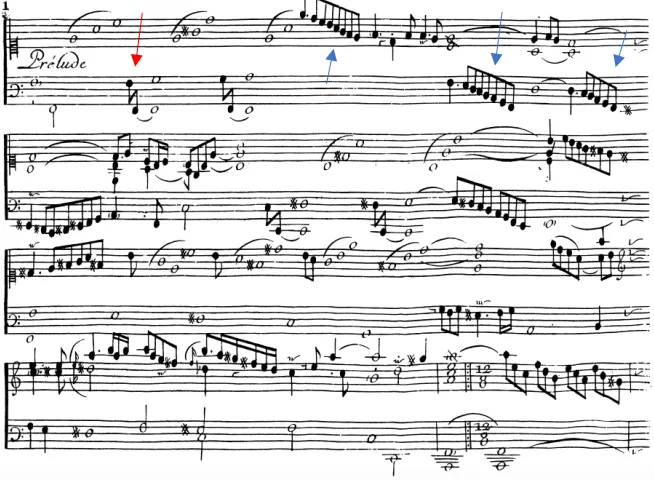
keyboard preludes, the préludes non mesurés for lute often contain few rhythmic indications and composers provided rhythms above the tablature for other genres, (see Fig. 1). In the first bar, the straight line above and below the first set of ‘g’ represents a crochet beat.32 Where a
[image:15.595.213.435.506.635.2]note lacks rhythmic indication, the composer intended the next note to be the same value (for example the following ‘f’ would also be a crochet (see red arrow)). Figure 1 presents some features, as will be noted in other examples, such as sweeping lines to convey the length a note is to be held, for example bars 7 and 9 (see blue arrows). There is also the use of vertical alignment to indicate when two notes should be played together, such as bars 1 and 2.
Figure 1: Denis Gaultier: Livres de tablature des Pièces de Luth – Courante (Source: Gaultier, n.d. [1680], p.72)
29 David Ledbetter, Harpsichord and Lute Music in 17th-Century France (London: MacMillan Press Ltd, 1987), 33.
30 David J Buch, “‘Style Brise, Style Luthe,’ and the ‘Choses Luthees,’” The Musical Quarterly 71, no. 1 (1985): 52, http://www.jstor.org/stable/948172.
31 Ledbetter, Harpsichord and Lute Music in 17th-Century France, 33.
32 For the purposes of this thesis, scientific pitch notation is used to identify note names. The sequence of octaves for C is as follows: (C4 equals middle C) C0, C1, C2, C3, C4, C5, C6, C7, C8, C9.
COMPOSITIONAL STYLE OF THE PRÉLUDE NON MESURÉ
Two styles are associated with the prélude non mesuré: the toccata style(Italian toccare: to touch, referencing the testing of a keyboard),and the tombeaux style. Four of L. Couperin’s
préludes non mesurés are identified as toccatas, with two free outer sections and a measured fugal central section (numbers 1, 3, 6 and 12). Prelude No 6 ‘Prélude de Monsieur Couperin à l’imitation de Monsieur Froberger’ is derived from Johann Jakob Froberger’s (1616–1667) first organ toccata, showing a connection between the two forms. The tombeaux style was for pieces written in memory of deceased teachers, patrons and friends. Moroney notes “the tombeau-allemande style, in measured notations, is characterised by a slow tempo and a freedom of rhythm”. Three of L. Couperin’s préludes non mesurés (numbers 2, 4 and 13) are written in this tombeau-allemande style.33
[image:16.595.164.492.388.477.2]L. Couperin and Le Roux use croches blanches to indicate pitch, while utilising lines to designate notes to be sustained, or to show harmonic structure, reflecting the influence of French lutenists (see Fig. 2).34
Figure 2: Louis Couperin: Prélude non mesuré: D minor(opening chord) (Source: Tilney, 2009. Volume 1 Facsimiles, p.1)
The second style is exemplified in Jacquet de la Guerre’s four préludes of 1687 and d’Anglebert’s
préludes published two years later. In such works, sustained harmonic notes are indicated by semibreves, and passing notes are shown with either quaver or semiquaver note values, although the note value is not to be taken literally. In contrast to Jacquet de la Guerre, d’Anglebert occasionally tied a quaver to a semibreve where notes were harmonically significant. D’Anglebert concludes a section of harmonic importance with a barline (see Fig. 3):
33 Davitt Moroney, "Prélude non mesuré." Grove Music Online. Oxford University Press, accessed 22 March 2014.
Figure 3: Jean-Henri d’Anglebert: Pièces de Clavecin, Prélude non mesuré: F major (opening passage) (Source: Tilney, 2009. Volume 1 Facsimiles, p.83)
The third style used by Lebègue, Clérambault, Marchand, Rameau and Siret employs rhythmic note values from the breve to the demisemiquaver. It retains a level of improvisation as necessary, while demonstrating characteristics of a measured composition. Troeger notes “that much multiple-value prelude notation shows passages whose rhythmic and even metric coherence makes them essentially measured; and that many “unmeasured” passages in single- or dual-value notation fall into regular patterns that strongly suggest explicit rhythmic/metric treatment”.35 This can be seen in the solitary example by Rameau (see Fig. 4). The first line
begins with a croches blanches style showing quavers before intervals to be articulated (see red arrow). The melody proceeds to three descending passages that could be executed in a measured style (see blue arrows):
Figure 4: Jean-Philippe Rameau: Prélude non mesuré: A minor (extract) (Source: Tilney, 2009. Volume 1 Facsimiles, p.96)
35 Ibid., 91.
[image:17.595.162.489.430.670.2]Reasons why composers provided this additional rhythmic information to a style intended to be improvisatory is worth noting. It may imply they felt the prevailing style of notation did not adequately provide the information required for performers to interpret the prélude non mesuré
in the appropriate manner. It may also suggest a lack of knowledge as to how to interpret the
préludes non mesurés. The absence of barlines and coherent metrical symmetry may also simply emphasise to the player that the piece should be performed without too rigid an application of tactus.
USE OF ORNAMENTS WITHIN THE PRÉLUDES NON MESURÉS
L. Couperin was the only composer to use both shorthand ornament symbols, and to fully realise ornaments in large-note notation within the body of the music. The two most common ornament symbols used by L. Couperin were the tremblement (trill) and the pincé (mordent).36
Given the performance conventions of the day, it might be assumed that L. Couperin’s written out ornaments were meant to be executed with the exact number of notes notated. Further hypothesis suggests they were simply longhand indications of ornaments that were often denoted by symbols, and therefore intended to be realised more freely to replicate the idea of the préludes non mesurés. One could also say the symbol lacked specificity, as ornament symbols were interpreted differently depending on prevailing performance conventions in different countries. By choosing to write out the ornament without abbreviations or symbols, L. Couperin is ensuring a performer has the correct information for the execution of the ornament, as per his ornamentation style, removing one factor that may contribute to a performers uncertainty in their interpretation of this free genre. Cook, however, suggests it is unclear as to the exact purpose of written out ornamentation, as it could have been a guide for beginners, a guide for good practice or the pursuit to reproduce what a composer intended.37
It is for the performer to decide if they wish to execute written out tremblements exactly as written, or if they simply use it as example, in order to maintain the improvisatory nature of the performance. The nature of the préludes non mesurés remove the worry about rhythm, giving a beginner the more ability to concentrate of other elements, such as written out ornaments. By providing a written out ornament, the beginner is provided with a realisation before being introduced to the ornament symbols.
36 The ornament table referenced in this thesis is from a contemporary of L. Couperin: d’Anglebert’s
Pièces de clavecin publication, 1689. See Appendix. 37 Cook, Beyond the Score, 27.
The use of ornaments indicated in this manner may also have been influenced by mechanical instruments. Automatic instruments from the eighteenth century provide the modern scholar more context than treatises, as every ornament needed to be precisely pinned on the surface of a barrel for the automatic instrument to play the composition correctly. The barrel showed how ornaments were interpreted in real musical settings when compared with the ornament tables provided by composers.38
In 1775 Marie Dominique Joseph Engramelle (1727–1805) wrote a treatise called La tonotechnie ou L’art de noter des cylindres. Unlike François Couperin and Carl Philipp Emanuel Bach (1714– 1788) who wrote about how to interpret and perform ornaments, Engramelle’s intended audience were the arrangers of mechanical organ music. Engramelle provided a description of the processes within ornamentation, creating a shorthand in preparation for the pinning of a score. As time (horizontal) progresses evenly, pitches are shown on the score accordingly in configurations (vertical). Visually the two styles appear similar, and the prélude non mesuré
[image:19.595.178.473.439.529.2]could conceptually be the prototype for the pinned scripts of later barrel organs in the eighteenth century. This style of composing gave the composer/performer freedom from the constrictions of metre, and resulted in a visually satisfying way to convey musical intentions. For example, the composer could write out an arpeggio in a wholly realised form (see Fig. 5).
Figure 5: Louis Couperin: Prélude non mesuré: A minor (opening passage) (Source: Tilney, 2009. Volume 1 Facsimiles, p.17)
Musicians of L. Couperin’s time were expected to embellish.39 Treatise authors wrote against
the culture of pervasive embellishment, when addressing eighteenth-century orchestral practices. Johann Joachim Quantz (1697–1773) explained this widespread practice of improvised ornamentation referring to the influence of the solo and lower-class playing styles. “Musicians are accustomed to ornamenting their parts when they play concertos or sonatas; they persist in the practice when they play in orchestras.”40 Musicians who accompanied dance
music in informal social settings would continue their habit of including additional ornaments
38 David Fuller, “An Introduction to Automatic Instruments,” Early Music 11, no. 2 (1983): 166, http://www.jstor.org/stable/3137828
39 Spitzer and Zaslaw, “Improvised Ornamentation in Eighteenth-Century Orchestras.", 533. 40 Ibid., 541.
when they were in the more refined orchestral setting.41 When joining in the argument that
soloists make poor ripienists, Leopold Mozart (1719–1787) felt that few soloists could read music proficiently, due to their habits of including additional notes and ornaments.42 This
statement supports the view that composers wanted musicians to play the score exactly as written and saw the rise of the performer as someone who had a completely different role from the composer. Zaslaw notes these statements imply that improvised ornamentation infiltrated orchestral playing from virtuoso, soloistic, literate practice, along with the non-notated tavern practice. The act of improvising was considered by many in the seventeenth and eighteenth centuries to be a core competency expected of any court and church musician. One need only consider the famous improvisational skills of J.S Bach, Buxtehude and d’Anglebert.
Within L. Couperin’s préludes non mesurés thereare clear examples of four specific types of ornament: tremblement, coulés, port de voix (see Fig. 6) and pincé, which are notated and expressed in an idiosyncratic fashion. One can find examples of these ornamentswithin the
Prélude non mesuré in D minor (see Fig. 6 – 12 below). Ornaments were used to offer the performer a guide as to which notes to accentuate as they were generally accompanied by strong beats. These beats also correlated with harmonic change, which would also result in an accent at the start of a group of beats
.
43Figure 6: Louis Couperin: Prélude non mesuré: D minor: Example of port de voix (7R9-11 – red arrow identifies 7R9)
(Source: Tilney, 2009. Volume 2 Modern Transcriptions, p.2)
As a means of referencing a specific note, Tilney uses the following method: the first number refers to the bar number; ‘L’ refers to the left hand, ‘R’ to the right hand; the final number references the note’s placement.44The tremblement figure (Fig. 7: 4L1-14) creates parallel fifths,
41 Ibid., 541. 42 Ibid., 544.
43 Richard Troeger, “Metre in Unmeasured Preludes,” Early Music 11, no. 3 (1983): 343, http://www.jstor.org.virtual.anu.edu.au/stable/3138021
44 In Prélude non mesuré in D minor, 1L1 references to the note in bar 1 that is the first left hand note (D3/D2); 10R6 refers to bar 10, and the sixth note in the right hand (C4). 1R3-6 refers to the first bar, right hand notes – third until the sixth (B♭4 – F#4 – G4 – E4). Multiple notes that are vertically aligned are considered as one within this system. Given the simplicity of such a referencing system, the present study employs a similar approach.
albeit alternating in a diminished fifth, therefore technically acceptable. Given the diminished interval created, L. Couperin may have written this ornament in large-note notation in order to confirm his intentions, and to ensure a performer didn’t amend the F# to an F natural. Examples
[image:21.595.223.429.149.226.2]demonstrate two parts built around a third part with the D.45
Figure 7: Louis Couperin: Prélude non mesuré: D minor:Example of a tremblement (4R1-14)
(Source: Tilney, 2009. Volume 2 Modern Transcriptions, p.2)
L. Couperin also fully writes a cadence beginning from below, rather than using the symbol (5L1-15), as suggested in d’Anglebert’s ornament table (Appendix 1). There is no clear indication as to why he chose to thoroughly notate this ornament. Perhaps he was visually balancing the activity between the two hands, and by writing out the full ornament, the left hand is an equal to the right hand. It also suggests the right hand is to linger on the previous notes of harmonic importance, rather than rushing into the ascending scale passage.
The literature presents three examples of the written out coulé, each with a line connecting the first to the third note (see Fig. 8 – red arrows). As the second note is not also attached to a line, it appears to be a passing note between the two outer notes. L. Couperin may have chosen to write these ornaments out in full, in order to avoid writing the first and third note as a chord, and to retain the visual flow of the music.
Figure 8: Louis Couperin: Prélude non mesuré: D minor: Example of a coulé (6R22-24 and 7R6-8)
(Source: Tilney, 2009. Volume 2 Modern Transcriptions, p.2)
45 William Drabkin, “Consecutive Fifths, Consecutive Octaves,” Grove Music Online, Oxford University Press, accessed January 31, 2017.
[image:21.595.240.405.594.679.2]The only example of a pincé illustrated with a sign is in the left hand, rather than written out fully. This is likely due to fact that the preceding note in the right hand (3R3) is the same F#3 and
[image:22.595.264.386.151.242.2]L. Couperin may have used the symbol to avoid confusion (Fig. 9).
Figure 9: Louis Couperin: Prélude non mesuré: D minor: example of a pincé
(Source: Tilney, 2009. Volume 2 Modern Transcriptions, p.2)
In addition to the ornaments identified by Tilney that utilise a sign (Fig 10), two examples of written out pincé are found in the first section of the Prélude non mesuré (Figs. 11 and 12). Although both examples are not part of a rising melodic passage, they are at the peak of each short musical statement. It is not possible for these written out ornaments to be turns, as they are not preceded by a tremblement. Both examples preface the downward falling melody pattern found at the beginning of the piece (1R3-7). In writing out this ornament rather than using a symbol, L. Couperin is supplying the third of each chord. In the first example (4R16-18), this helps the listener to identify the harmonic progression, where he moves from a G major to a G minor chord. The notes do not have any lines attached to suggest that this passage should be accentuated. In the second example, the ornament provides variety to the melodic passage, as L. Couperin uses the same opening figure (1R3-7: see Fig. 14) six times within a two-bar section. Again, this example does not have any lines attached to indicate that the notes should be sustained at all. This suggests that these examples are written out ornaments, and not of harmonic importance that need to continue to sound. In both examples, a musician could execute these notes as up-beats, playing them quickly before leaning on the following note, which has harmonic importance.
Figure 10: Louis Couperin: Prélude non mesuré: D minor: Example of a pincé (3L1)
[image:22.595.275.374.642.719.2]Figure 11: Louis Couperin: Prélude non mesuré: D minorExample of a fully notated pincé (4R16-18 – red
arrow identifies 4R16)
[image:23.595.122.536.83.263.2](Source: Tilney, 2009. Volume 2 Modern Transcriptions, p.2)
Figure 12: Louis Couperin: Prélude non mesuré: D minorExample of a fully notated pincé (6R15-17 – red
arrow identifies 6R15)
(Source: Tilney, 2009. Volume 2 Modern Transcriptions, p.2)
ACCIDENTALS
By the end of the seventeenth century, it was standard practice for barlines to indicate the termination of accidentals.46 However, as there are no regularly occurring barlines within many
[image:23.595.164.490.388.644.2]of préludes non mesurés, composers returned to the earlier seventeenth-century standard practice of re-notating an accidental as required, as noted in Lebègue’s second prelude, third stanza, and Jacquet de la Guerre’s first prelude, third stanza (see Fig. 13, red arrows):
Figure 13: Elisabeth-Claude Jacquet de la Guerre: Prélude non mesuré: D minor (extract) (Source: Tilney, 2009. Volume 1 Facsimiles, p.72)
46 David Hiley, “Accidental,” Grove Music Online, Oxford University Press, 2001,
PRIMARY SOURCES CONTAINING PRÉLUDES NON MESURÉS
As noted earlier, there are approximately fifty extant préludes non mesurés, with the majority contained within two manuscripts together considered to be the most valuable sources of French keyboard music. The Bauyn and the Parville manuscripts contain most known keyboard pieces by L. Couperin, amongst other French composers. There is also a significant privately owned manuscript containing works by L. Couperin, Chambonnières and d’Anglebert. This document helps to clarify the derivation of works, as it contains all of L. Couperin’s organ works (with date and location noted). However, access to the manuscript is strictly controlled, and to date the full manuscript has not been published. Of these three manuscripts, the Bauyn is considered to be the more reliable of editions, although the Parville does provide alternative suggestions that are also considered credible.47
The Parville manuscript was discovered in Italy in 1968, and dates from approximately 1670. The Bauyn manuscript dates from approximately 1690 and is said to have belonged to the Bauyn d’Angervilliers family.48 The Bauyn manuscript was brought to modern attention by Guittard in
1901 in his study on Chambonnières’s music. Dating of the document has since been revised over the years and still no accurate date has been assigned. Research by the likes of Moroney (2014), Gustafson (1977) and Fuller (n.d.) have led researchers to believe that the much of the Bauyn manuscript’s contents were copied into the source two or three decades after the works were composed.49 It contains 149 compositions, of which fifty-six are attributable to (Mr)
Coupprain, Couprain, Couprin and Couperin (various misspellings of the Couperin surname). Couperin is never referred to by his full name and it is not clear which Couperin wrote the works. Ten préludes non mesurés are common to both Parville and Bauyn. Bauyn contains four that are not in Parville, and the Parville contains two not found in Bauyn.
The Bauyn manuscript consists of 345 works and provides primary sources for half of L. Couperin’s harpsichord compositions. The manuscript collection is broken into three parts. The first section contains Chambonnières (118 pieces, introduction of manuscript), the second section L. Couperin (122 pieces) and the third section contains pieces by other composers such
47 David Chung, “The Port de Voix in Louis Couperin’s Unmeasured Preludes: A Study of Types, Functions and Interpretation,” in Performer’s Voices across Centuries and Cultures (London: Imperal College Press, 2012), 59–84, 59.
48 Manuscrit Bauyn, Pièces de Clavecin c.1660, ed. Minkoff Reprint, Res. Vm7 6 (Paris: Bibliothèque Nationale, 1977), 2.
49 David Chung, “The Bauyn Manuscript: Harpsichord Music from the Seventeenth Century,” Music
as d’Anglebert, Lebègue and Gilles Hardel (c. 1611—d. unknown), as well as transcriptions of works by lutenists such as Denis Gautier (1597 or 1603—1672), René Mesangeau (late sixteenth century–1638) and others. There are also works by two composers outside France: Giralamo Frescobaldi (1583—1643) and Froberger. Frescobaldi taught Froberger, and Frescobaldi’s influence on the toccata style was passed from Froberger to L. Couperin.50 Although many of
the composers were French, the widespread distribution of these manuscripts suggests the style extended beyond France into Italy, Germany and Scotland.
EDITIONS ADDRESSING THE PRÉLUDE NON MESURÉ
Although this research is not specifically concerned with modern editions, it is worth addressing that notable performers, such as Moroney, Curtis and Tilney have released their own interpretations, based on their interpretation of the Bauyn and Parville manuscripts (see Appendix 2). In total there have been seven editions:
EDITION DATE SOURCE(S)
Anne Chapelin-Dubar 2009 Collation, readings from Bauyn preferred
Glen Wilson 2003 Collation, readings from Bauyn preferred
Colin Tilney 1991 Collation, readings from Bauyn preferred
Davitt Moroney 1985 Collation, readings from Bauyn preferred
Alan Curtis 1970 Collation, readings from Parville preferred
Thurston Dart 1959 Bauyn
[image:25.595.117.539.361.580.2]Paul Brunold 1936 Bauyn
Table 1: Represents the editions of Louis Couperin’s unmeasured preludes, as released by Chung. 51
Chung notes a discrepancy between the two manuscripts in Louis Couperin’s D minor Prélude non mesuré. Using Tilney’s edition (see Appendix 2), note 2L1 (see footnote 44) is written as A2, as per the Parville edition. However, the Bauyn manuscript shows this note as F2. Of the five editions to utilise both editions Curtis, Wilson and Chapelin-Dubar choose the Bauyn F2, and
50 Ledbetter, Harpsichord and Lute Music in 17th-Century France, 90.
51 Chung, “The Port de Voix in Louis Couperin’s Unmeasured Preludes: A Study of Types, Functions and Interpretation.”, 72.
Moroney and Tilney using the A2. For this research the Tilney edition has been chosen, due to availability and ease of use.
SOURCE DOCUMENTS ADDRESSING THE PRÉLUDE NON MESURÉ
There are three primary sources that specifically reference performance practices within the
prélude non mesuré, two of which are written by Lebègue. There is correspondence from 1684 between Lebègue and an Englishman William Dundass, in addition to Lebègue’s preface to the
Pièces de clavessin (1677) and François Couperin’s L’art de toucher Le Clavecin (1716).
The first reference is a letter that Lebègue sent responding to an enquiry by Dundass. Although the original letter is no longer available, a copy of Lebègue’s response is transcribed on the front of a 1677 copy with a polite closing note, informing Dundass that Lebègue would find “great satisfaction”52 in making his acquaintance, should clarification be required. This correspondence
demonstrates Lebègue’s willingness to meet and discuss the works with fellow musicians.
The page is laid out in two columns with Lebègue’s French response on the left and the translation into “rather garbled English”53 on the right, along with an English translation of
Lebègue’s explanation. Presumably the writer of the columns was the translator, as a monetary fee paid to Dundass on July 3, 1684 is written in the same handwriting. The first point reiterates the idea that the preludes were preparatory material preceding other pieces in the same key. For this reason, Lebègue notes (from the English translation) that:
I was not at the pains to separate them by measure, as the pieces are, because they have nothing of determined in them’. He also provides the advice ‘Now to give some light for regular touching of ye preludes ye must know first, that ye must touch all the nottes the on[e] after the other, that is to say, to touch those first w[hi]ch appeared first to the sight, whither they be of the line of the base or of that of the treble, and the other afterward.54
In his second point, Lebègue writes:
2°,Le petit cercle qui prend de la notte d’en bas et qui contenüe jusqu’a celle d’en haut, signifie qu’il faut tenir toutes les nottes que ledit cercle entoure sans en quitter pas une apres que vous les avez touché, et cela pour conserver l’harmonie.
52 Bruce Gustafson, “A Letter from Mr Lebegue Concerning His Preludes,” “Recherches” sur La Musique
Française Classique XVII, 1977, 10. 53 Ibid., 9.
54 Ibid., 9-10.
2°, The litle circle which begins at the note below, and continoues to a notte aboue (in the same line) doth signife that ye must hold out all the nottes enclosed by that cercle without quyting any of them after ye haue touched them and that for preserving of the harmonie.5556
The third point concerns the tenües:
Quand apres un grand accord vous troverez des tenües ou cercles, et qu’une autre partie roulera et se promenera, C’est a dire qu’il faut toujours tenir le dit accord pendant cela.
When after a great accord you find bindings or circles, and that the other part glydes or walketh on, the meaning is that you always hold out that accord during the tyme the other part is moving forward.57
The second reference, the preface to Lebègue’s Pièces de clavessin, states (as translated by Troeger):
J’ay taché de mettre les préludes auec toute la facilité possible tant pour la Conformité que pour le toucher du Clauecin, dont la maniere est de Separer et de rebattre plus-tost les accords que de les tenir comme a l’Orgue si quelque chose s’y rencontre vn peu difficile et obscure Ie prie messrs. les intelligents de vouloir suppleer aux deffaux en considerant la grande difficulté de render cette metode de Preluder assé intelligible a vn chacun.
I have tried to present the preludes with all possible simplicity, as much for [notational] consistency as for harpsichord technique, whose style is to separate [i.e., arpeggiated] and immediately restrike chords rather than to hold them as on the organ; if anything is found to be a little difficult and obscure I ask the intelligent [readers] to be willing to supply what is lacking, considering the great difficulty of rendering this method of preluding intelligible enough for everyone.58
Besides demonstrating how widespread Lebègue’s works were disseminated, there is no additional information contained within the correspondence.
The third reference by François Couperin notes his more structured notational style was to make the interpretation of the preludes easier for the general public, while maintaining an
55 In this context the term ‘cercle/circle’ implies the phrasing lines. 56 Ibid., 9-10.
57 Ibid., 9-10.
unmeasured style. It is of interest that F. Couperin references teaching and learning the prélude non mesuré, and not the act of performing them:
Quoy que ces Préludes soient ècrits mesurés, il y a cependant un goût d’usage qu’il faut suivre. Je m’explique. Prélude, est une composition libre, ou l’imagination se livre à tout ce qui se prèsente à elle. Mais, comme il est assés rare de trouver des genies capables de produire dans l’instant; il faut que ceux qui auront recours à Préludes-réglés, les jouent d’une maniere aisée sans trop s’attacher à la précision des mouvemens; à moins que je ne l’aye marqué exprés par le mot de, Mesuré: Ainsi, on peut hazarder de dire, que dans deaucoup de choses, la Musique (par comparaison à la Poésis) a sa prose, et ses Vers.
Une des raisons pour laquelle j’ai mesuré ces Préludes, ça, èté la facilité qu ‘on trouvera, soit à les enseigner; ou à les apprendre.
Although these Preludes are written in measured time, there is, nevertheless, a style, dictated by custom, which must be observed. I will explain what I mean. A Prelude is a free composition, in which the imagination gives rein to any fancy that may present itself. But as it is rather rare to find geniuses capable of production on the spur of the moment, those who have recourse to these non-improvised Preludes should play them in a free, easy style, not sticking too closely to the exact time, unless I have expressly indicated this by the word Mesuré (Measured time): Thus one may venture to say that in many things, Music (as compared with Poetry) has its prose, and its verse.
One of the reasons why I have written these Preludes in measured time was to make them easier, as will be found to be the case, whether in teaching them, or in learning them.59
Tilney identifies the final sentence as the epitaph for préludes non mesurés in general.60
Tsuruta notes two additional references, although these are not specific to the préludes non mesurés. St Lambert addresses the use of slurs within the context of preludes in his Les principes de clavecin.61 The second reference is C.P.E Bach’s Versuch über die wahre Art das Clavier zu spielen, in which the author discusses the metre of unmeasured free fantasias and the act of improvising, noting that a performer requires a natural talent, especially in regard to the ability to improvise.62
59 François Couperin, L’Art de Toucher Le Clavecin (Wiesbaden: Breitkopf & Härtel, 1933), 33. 60 Tilney, The Art of the Unmeasured Prelude for Harpsichord, France, 1660 - 1720. vol. 3, 4. 61 Saint-Lambert, Les Principes Du Clavecin.
62 C.P. E. Bach, Essay on the True Art of Playing Keyboard Instruments (Lowe & Brydone Printers Ltd, 1949), 430.
THEMES EMERGING WITHIN SECONDARY SOURCES ADDRESSING THE PRÉLUDE NON MESURÉ
Research analysing the performance traditions of préludes non mesurés is limited. Various themes have emerged through scholarship of the last fifty years. The first modern scholar to investigate the prélude non mesuré in French Baroque instrumental music was Alan Curtis.63 His
work was not concerned with how to perform the prélude non mesuré, but with the presentation of an historical study of the form. Moroney’s research investigates performance of the prélude non mesuré,64as well as contributing to the topic for Grove Music Online.65 Gustafson66 is the
only scholar to address the source documentation by Lebègue in 1677. Troeger’s research addresses the metre in prélude non mesuré67 and the notation and performance of the prélude non mesuré.68 Tilney’s publication69 contains both facsimiles and his transcriptions of all existing préludes non mesurés, with a commentary on interpretation.
In the same year as Tilney’s publication, Beccia-Schuster examined the interpretation of the
Prélude non mesuré in C major,70 comparing the style of tombeaux, allemandes and toccatas by
other early Baroque composers such as Froberger. Her conclusions suggest that in-depth analysis of these extemporised works offer interpretive understandings of L. Couperin’s préludes non mesurés. More recently, Chang applied Schenkerian analysis to Préludes non mesurés in A minor and C major71 to explore rhythm and tonality, while categorising the function of the lines
within the prélude non mesuré.
An unpublished dissertation by Tsuruta72 analyses the similarity of twentieth-century
interpretations examining recordings by teacher Ruggero Gerlin (1899—1983) and student Blandine Verlet (1942—) produced some forty years later. Tsurata concludes that Gerlin’s interpretation maintains the order of the notes as written, a theory that conflicts with my analysis of Gerlin’s recording of the Prélude nonmesuré in D minor (see Note Placement, p.53).
63 Curtis, “Unmeasured Preludes in French Baroque Instrumental Music.”
64 Davitt Moroney, “The Performance of Unmeasured Harpsichord Preludes,” Early Music 4, no. 2 (1976): 143–51, http://www.jstor.org.virtual.anu.edu.au/stable/3125509
65 Moroney, “Prélude Non Mesuré.”
66 Gustafson, “A Letter from Mr Lebegue Concerning His Preludes.” 67 Troeger, “Metre in Unmeasured Preludes.”
68 Troeger, “The French Unmeasured Harpsichord Prelude.”
69 Tilney, The Art of the Unmeasured Prelude for Harpsichord, France, 1660 - 1720.
70 Donna Jean Beccia-Schuster, “Interpretation of the Unmeasured Preludes of Louis Couperin as Applied to Prelude No. 9 in C Major.”
71 Philip Chih-Cheng Chang, “Analytical and Performative Issues in Selected Unmeasured Preludes by Louis Couperin.”
72 Tamiko Tsuruta, “Twentieth-Century Performance Practices of Préludes Non Mesurés by Louis Couperin” (ProQuest Dissertations Publishing, 2010).
Tsurata establishes that Verlet’s performance does not show the influence of her teacher Gerlin, rather her interpretation is influenced by the ideas suggested by the more recent research by Moroney and Tilney that address metre and performance styles of the prélude non mesuré.
USE OF CURVED LINES
Much research investigating the interpretation of curved lines used in the préludes non mesuré
has emerged in recent years. Tilney summarises the alternate interpretations of the lines employed by different composers. Four kinds, or uses, of lines can be found within the préludes non mesurés:
• Single (tenues) • Multiple (liaisons)
• Curved lines acting as a modern slur • Linking two notes together
[image:30.595.192.465.555.635.2]Tilney breaks down the different applications of the lines. “Single lines, attached to one note at their start, require that note to be held at least until the end of the line... Multiple lines have both ends attached to notes and imply that all harmonically relevant notes should be held until the final note has been played; in many cases, the chord – or certain notes from it – should be held longer still”.73 The references that Tilney provides for each linear example in Prélude non mesuré in D minor are Single – 1L1 and 2, Multiple – 1R3-6 and 7-10 (see Fig. 14).
Figure 14: Louis Couperin: Prélude non mesuré: D minor (opening passage) (Source: Tilney, 2009. Volume 2 Modern Transcriptions, p.1)
Tilney notes a difference between the facsimile version and his modern transcribed edition. In the facsimile of the Prélude non mesuré in D minor, the left-hand note is placed under the
hand note following the first barline (1L3/1R11). In Tilney’s modern transcription he places the left-hand note (1L3) before the right-hand note (1R11), making it independent of the right hand. Due to the high cost of printing music in the seventeenth century, manuscripts may have contained less white space than later publications, and it was left to the musician’s discretion to musically decipher such moments. This may explain examples where the resolution of one harmonic statement was placed directly above the following statement (see Fig. 15). At this point, Tilney deviates from the facsimile (10L3/10R6) andhe intentionally places the left-hand note after the right hand, suggesting “the lines thus serve to impart order to the music, preventing events from happening too fast.”74 In other words, rather than performing this
[image:31.595.234.417.326.449.2]passage as a modern performer would, playing both notes at the same time (10L3/10R6), Tilney interprets the longer connecting lines to mean that the C4 should be executed before the C3, imparting a sequence to the score. Harmonically this also makes sense, as the initial chord forms A minor, and the following notes form D major7.
Figure 15: Louis Couperin: Prélude non mesuré: D minor (Bar 10) (Source: Tilney, 2009. Volume 1 Facsimiles, p.2)
Curved lines act as a modern slur in the third example “grouping together several unaccented notes that are to be played legato”, specifically identifying the example in bar 2 (2R6 – 2L9). F4 (2R6) already has above it the line indicating the length of the note to be held (until 2L9). However, this additional line denotes slurring from the F4 to the F#2. Another example in the
same prelude is bar 1 (1R16 – 1L5). The fourth example links together notes to form an ornament (for example port de voix) or “as an expressive, rhythmically inflected pair” (with the accent placed on the first note), as seen again at 1R3 – 4, 1R5 – 6 (see Fig. 14).
Tilney recommends the lines be considered as guides only, and that the tone should not stop immediately when a line finishes; the lines are merely suggestive as to when the keys should be released. He explains that the lines show the minimum duration that notes should be held,
74 Ibid., 6.