I.A. Bekker
| 0
Iris A. Bekker
29 May 2015
BA Thesis
Words: 10.909
Prof. R.T. Griffiths
Leiden University
Party Competition and
the British General
Election of 2015:
| 1 Party Competition and the British General Election of 2015:
The Interaction between Niche Parties and the Mainstream
Abstract: The role of smaller parties in British politics has become increasingly interesting since the 2010 election produced the first coalition government in post-war Britain. The period leading up to the 2015 election offers a good opportunity to study the dynamics between these smaller parties and the establishment. Many of these smaller parties can be considered niche parties as they are defined by a single or limited set of issues. This allows for an assessment of party competition employing B.M. Meguid’s PSO Theory.
This thesis provides a case study of party competition prior to the British General Election of 2015. It includes the two mainstream parties; the Conservative and the Labour Party, and two niche parties, UKIP and the SNP. Through the case study, the thesis questions the influence that niche parties have on mainstream parties prior to elections in Britain. In particular, it argues that; 1) electoral threats posed by UKIP and the SNP significantly influenced the strategies of the Conservative Party and the Labour Party; 2) these strategies subsequently influenced the electoral performance of UKIP and the SNP.
The findings show that threats posed by the niche parties influenced the electoral strategies of the Conservative and Labour parties. In the face of niche party threats between the 2010 and 2015, the Conservatives adopted four strategies; the immigration-, the EU referendum-, the EVEL- and the anti-coalition- card. The first three strategies were directed against UKIP’s imminent threat. Both the third and fourth strategy were used as a weapon against their mainstream opponent; the Labour Party. In reaction to the surge of the SNP, the Conservative and the Labour Party both sought to accommodate Scottish voters on the issue of devolution. Yet, the most influential strategy involving the SNP concerned the anti-coalition card. In response to Conservative allegations of a Labour-SNP deal, Labour disregarded the SNP as an acceptable coalition partner.
These two strategies of the mainstream parties were influential for the SNP’s landslide. Besides, they helped the Conservative Party to attract defectors to UKIP back to the fold. UKIP’s high vote share was partly the result of the Labour Party’s failure to stop its supporters outside of London from defecting to the niche party. However, the fact that UKIP merely obtained one seat in the election was mostly due to voter distribution and the electoral rules. Altogether, the analysis of party competition between the four parties prior to the 2015 election supports the arguments outlined in the thesis.
| 2 Table of Contents
Introduction ... 3
Section 2. Theoretical Overview 2.1 Literature Review... 5
2.2 Conceptual Framework ... 8
2.3 Hypotheses ... 9
2.4 Methodology ... 10
Section 3: Competing for Votes 3.1: Party Competition in British Politics ... 11
3.1.1 Voter Perception, Voter Distribution and Electoral Rules ... 11
3.1.2 Electoral Threats ... 13
3.2: The UKIP Challenge ... 16
3.2.1 UKIP’s Threat... 16
3.2.2 The Strategies ... 19
3.3: The SNP Challenge ... 22
3.3.1 SNP’s Threat... 22
3.3.2 The Strategies ... 23
Section 4: The Election Results ... 27
Conclusion ... 32
Works Cited ... 34
| 3
I
NTRODUCTION*
In the absence of a single party majority in the general election of 2010, the first peace-time
coalition government was formed in Britain (Curtice 623). Hitherto, post-war governments had
always been formed by the Conservative Party (the Conservatives) or the Labour Party (Labour).
A hung parliament1 had occurred in 1974, but this had led to the formation of a single-party minority government rather than a coalition government (Nagatomi 23). The coalition
government that was formed as a result of the hung parliament in 2010 was one between the
Conservatives and the Liberal Democrats (the Lib Dems). The coalition held 363 of the 650 seats
in Westminster parliament; 306 belonging to the Conservatives and 57 to the Lib Dems
(Electoral Commission). Labour held 258 seats, while the remaining 29 seats were dispersed
over the smaller parties, such as the Democratic Unionist Party (DUC), the Scottish Nationalist
Party (SNP) and Sinn Fein (SF) (Electoral Commission). Although the coalition government of
2010 was in place until its dissolution before the 2015 election, the composition of the
parliament was somewhat altered as a result of by-elections that took place between 2010 and
2015. Most notably, two by-elections led to the appointment of the two first MP’s of the United
Kingdom Independence Party (UKIP) (Independent “By-election”). Together with the fact that
the 2010 election produced the first post-war coalition, this signalled the grown importance of
smaller parties in British politics.
Two developments appear to go hand in hand; the rise of third parties2 and a shift from a predominantly two-party system to a more multi-party system (Curtice 636; Nagatomi 41).
Although these changes might have been present “beneath the surface”, they only really emerged
in 2010 (Nagatomi 41). The hung parliament can be seen as a product of the developments that
have been taking place in the British party system for two decades (Nagatomi 41). As a result of
these developments, Britain found itself on a ‘political crossroad’ in 2015 (Nagatomi 41). The
* It is important to note that the groundwork for this thesis was initiated on 18-02-2015 and completed before the election (07-05-2015). The election results were not anticipated when formulating the main argument and hypotheses of this thesis. The results of the election were only included in the final section of this thesis in order to analyse the validity of the previously established framework and hypotheses, and in order to provide conclusions regarding the developments in British politics.
1
A parliament is ‘hung’ if no party achieves an overall majority in an election (BBC “Glossary”)
2 Although not all third parties in Britain can be defined as niche, this term will be used from here onwards to refer
| 4 2015 election could again have led to a hung parliament and the formation of a coalition
government (Curtice 636). It had the potential to determine the direction on from the political
crossroads and settle the question whether the coalition of 2010 was an “exceptional one-off
event” or “a lasting trend” (Nagatomi 41). Yet, by producing a majority government, this
question has not been entirely settled.
The 2015 election can also provide insights on the topic of party competition. The run-up
to the election presents a good opportunity to study competition between niche parties and the
mainstream. In particular, the rise of UKIP and its impact on the dynamics of party competition
is a topic that deserves more scholarly attention (Hayton 2010, 34). Similarly, the role of the
SNP in the aftermath of the Scottish independence referendum in 2014 has yet to be studied.
Given that both UKIP and the SNP can be classified as niche parties3, theories from the study of niche versus mainstream party competition can be applied to these parties. The aim of this thesis
is to shed light on the political developments in Britain and simultaneously contribute to a better
understanding of party competition. This thesis will focus on the dynamics between a set of four
parties; the Conservatives and Labour (mainstream), and UKIP and the SNP (niche). The main
question that this thesis will address is the following; what influence do niche parties have on
mainstream parties in the face of elections in Britain? It will argue that; 1) competition from
UKIP and the SNP significantly influences the adoption of strategies by the Conservatives and
Labour, 2) which can subsequently influence the electoral performance of the niche parties.
The first section of the thesis will provide a brief overview of relevant concepts, ideas
and theories from the literature on party competition and will outline the conceptual framework.
A set of two hypotheses will be provided, followed by the research methodology. The next
section will apply the conceptual framework to the case study of party competition in Britain
prior to the 2015 election. It will discuss important factors for party competition in British
politics, analyse the challenge posed by UKIP and examine the influence of the SNP on the
mainstream parties. The third section will connect the findings of the previous section with the
results of the 2015 election. It will assess what influence the strategies of the Conservatives and
Labour had on the electoral performance of UKIP and the SNP. A conclusion will summarise the
main findings of the thesis.
| 5
2.
T
HEORETICALO
VERVIEW2.1 Literature Review
Much has been written on the topic of party competition (e.g. Downs 1957; Stokes 1963; Strom
1990; Meguid 2005, 2007; Adams et al. 2006; Ezrow 2008; Franzmann 2011). Important
contributions to the field were made by Bonnie M. Meguid, together with work of Adams et al.
(2006).4 The research of these scholars has resulted in “significant modifications to the conventional spatial model [of party competition]” (Ezrow 216). Party competition can be
defined as “an institution in which parties strategically cooperate or contest as political actors to gain political power” (Franzmann 320). According to Meguid and Adams et al., it matters
increasingly what type of parties are involved in party competition, since the nature of a party
influences its behaviour towards other parties and vice-versa (Ezrow 216). Therefore, when
analysing party competition, one should differentiate between two party types; niche and
mainstream (Meguid 2005, 347).
Mainstream parties can be defined as “electorally dominant actors in the centre-left,
centre, and centre-right blocs on the Left-Right political spectrum” (Meguid 2005, 348). The
definition of niche parties is more complex and has created discussion among scholars (e.g.
Adams et al. 2006; Wagner 2011; Meyer and Miller 2013). Meguid’s definition of niche parties
revolves around three notions; the rejection of “traditional class-based orientation of politics”,
the adoption of previously rather un-politicized issues such as environment or immigration that
can “cross-cut traditional partisan alignments”; and a party platform limited to one or a small set
of issues (2005, 347-348). This definition allows for green, radical-right and ethno-territorial
parties to be classified as niche parties (Meguid 2005; 2007).
Meguid maintains that niche parties are mostly newly established parties. However,
scholars such as Markus Wagner5 have argued that age should not be seen as a defining trait of niche parties (2001, 849). In addition, Wagner, together with Meyer, has argued that parties can
change back and forth between niche and mainstream party status (2013, 1249). Some other
4 B.M. Meguid is an associate professor of political science at the University of Rochester. James Adams is assistant
professor of political science at the University of California at Davis. His co-authors Michael Clark (Ph.D. fellow) and Garrett Glasgow (assistant professor) are active at the University of California at Santa Barbara. The fourth co-author is Lawrence Ezrow, a post-doctoral fellow at the Free University of Amsterdam, which has expanded on this stream of research in an article of his own (2008).
| 6 variations exist in the niche party concept, but the notion that a niche party is a party that
focusses on one or a limited set of issues is generally agreed upon (Adams et al. 2006; Wagner
2011; Meyer and Miller 2013).
Besides the niche party concept, Meguid’s work has introduced a theory around the
strategic choices of mainstream parties. The PSO6 theory goes against earlier literature by arguing that the strategies of mainstream parties influence the electoral fortunes of niche parties
(2007, 22). According to Meguid, “niche party fortunes are, in many respects, the by-products of
competition between mainstream parties” (2007, 22). Her theory is based on the idea that
mainstream parties can manipulate their position on an issue, and hereby the salience and
ownership of the issue (2007, 22). She has expanded on the strategies that are available to
mainstream parties when faced with a competing niche party; accommodative, adversarial or
dismissive strategies (2005, 348-349). In the case of the first two strategies, a positional shift
takes place towards or away from “a specific competitor in a given policy space” (2005, 348).
Such a shift can result in increased salience of the niche party issue, as the mainstream party pays
attention to it. Parties also have the choice to disregard an issue raised by the niche party, which
can reduce the issue’s salience (2005, 349). As a result of the combined mainstream party
strategies, the ownership of an issue can change, the niche party can lose its appeal and the
electoral support of the niche party can be affected.
Another key idea that goes against earlier literature is that competition can take place
between both ideologically ‘proximal’ and ‘non-proximal’ parties (Meguid 2007, 32). This is a
fundamental revision of earlier spatial models of party competition and entails that competition
“is not restricted to interaction between ideological neighbours” (2007, 33). In addition, Meguid argues that interaction between political parties “does not take place in a vacuum” (2007, 97).
What this means is that factors such as voter distribution and the rules of electoral system
constrain the behaviour of parties. For instance, the reaction of a mainstream party to a threat of
a niche party in a constituency where it has a large lead over its opponent is different than its
response to a threat in a marginal constituency (2007, 98).
In the literature, considerations for further research are offered. Meyer and Wagner argue
that scholars should take into account that “the actions of competitors may affect how successful
parties are in pursuing their salience strategies” (1264). In addition, there is a need for further
| 7 research on “the interaction between the strategies chosen by niche and mainstream parties”
(Van der Wardt 116). Likewise, issue salience and the dynamics of issue competition require
more scholarly attention (Green-Pedersen 2007; Meyer and Wagner 2013). In the case of party
competition in British politics, too little academic attention has been paid to the rise of UKIP
(Hayton 2010, 34) and to British niche parties in general. This, in combination with an already
small body of work devoted to the interaction of niche and mainstream parties in British politics,
| 8 2.2 Conceptual Framework
The conceptual framework of this thesis is mostly based on the theory and ideas outlined by
B.M. Meguid, although simplified. Unlike Meguid’s work, which mostly deals with longer
periods of time, this thesis will focus on the time period between two elections: May 2010 until
May 2015. Meguid looks at how mainstream parties respond when they lose votes to a niche
party. Since this thesis will deal with only a short time period, it will focus mostly on the
perceived threat of a niche party. This is represented by voting intentions. Where possible, it will
consider the performance of the niche parties in the past elections. Due to limited space, the
thesis will concentrate on two niche parties and the issues that are central to the analysis of
competition between them and the mainstream parties. The Conservatives and Labour have been
defined as the two mainstream parties in Britain (Meguid 2005, 358). UKIP and the SNP can be
identified as niche parties; they focus on a single or small set of issues7. For UKIP, this set of issues consists of EU integration and immigration (Lynch and Whitaker 4). The SNP mostly
focusses on the devolution of power to Scotland (Meguid 2007, 193).
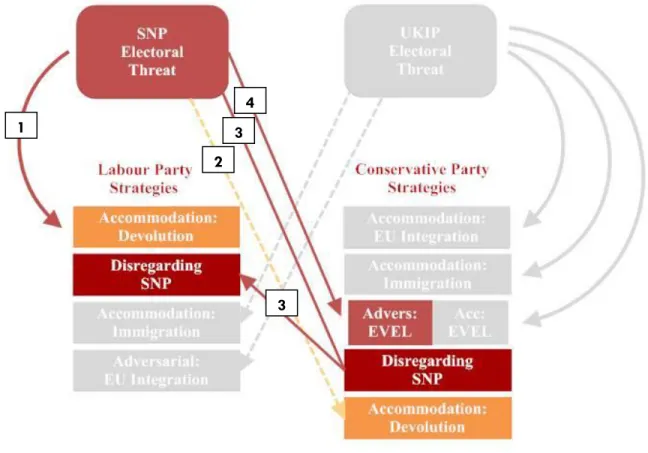
Figure 1 represents the expected interaction between the four parties. The two boxes
titled ‘electoral threat’ represent the starting point of the causal chain. The degree to which a
niche party can present an electoral threat depends on factors such as the rules of the electoral
system and voter distribution (Meguid 2007). The perceived electoral threat of the niche parties
is expected to influence the adoption of strategies by the mainstream parties. The light arrows in
the model represent the influence that the niche parties can have on the non-proximal mainstream
party. This is based on Meguid’s notion that non-proximal parties also influence each other.
However, this influence is expected to be less significant. The arrow between the mainstream
parties’ strategies and the niche parties’ electoral success represents the influence that the former
can have on the electoral success or failure of the latter. This influence partly depends on the
effectiveness of the mainstream parties’ strategies8 .
7 Meguid has defined SNP as an ethnoterritorial niche party (2007, 70). UKIP has been classified as a niche party by
Lynch and Whitaker (4).
| 9 Figure 1: Conceptual Framework
2.3 Hypotheses
A set of two hypotheses arises from the framework outlined above. They concern the strategies
(accommodative, adversarial or dismissive) that the mainstream parties, the Conservatives and
Labour, adopt in the face of a threat by UKIP and/or the SNP, and the resulting electoral success
or failure of these niche parties.
H1: The electoral threat that UKIP and the SNP pose influences the adoption of strategies by the Conservatives and Labour.
H2: The electoral performance of UKIP and the SNP is influenced by the strategies of the Conservatives and Labour.
The second hypothesis is drawn directly from Meguid’s work (2005, 2007), but adapted to the
case studies and scope of this thesis. The last section of this thesis will test the second hypothesis
in order to provide an indication whether Meguid’s theory regarding the influence of mainstream
| 10 2.4 Methodology
For the first hypothesis, figures representing voting intentions will be used to analyse the
electoral threat. Voter distribution and the rules of the electoral system will also be considered.
The strategies of the Conservatives and Labour, important for both hypotheses, will be derived
from the positions of the parties as expressed in their 2010 and 2015 manifestos. In addition,
public statements, debates, and other events from the electoral campaigns will be used to assess
the positions and strategies of the parties further. For the second hypothesis, the electoral
performance of the niche parties will be based on the amount of seats that they obtain as well as
their share of the votes in total.
Both primary sources, such as party manifestos, as well as secondary sources such as
newspaper articles will be used. Two secondary sources will be employed generally: BBC News
and the Independent. These two sources have been selected given that they provide information
on events from a relatively central, non-partisan perspective. Other newspapers, whether
affiliated to a political party or known to have a clear political position, are less suitable for the
purpose of this thesis.
| 11
S
ECTION3:
C
OMPETING FORV
OTES3.1: Party Competition in British Politics
3.1.1 Voter Perception, Voter Distribution and Electoral Rules
As aforementioned, Meguid has pointed out that the competition between political parties is
restricted by the context in which it takes place (2007, 97). Three factors are significant when
considering whether a niche party forms a threat for mainstream parties; voter perception, the
rules of the electoral system and voter distribution (Meguid 2007). The first factor, voter
perception, can be seen as the most crucial, as without an indication of the levels of party support
in general, the influence of voter distribution and the electoral rules cannot be determined.
Opinion polls are central in assessing the voting intentions of the electorate. The second factor is
significant because “the rules by which voters are counted and seats are allocated alter the
perceived significance of electoral threat” (Meguid 2007, 97). The rules of the electoral system
are thus an influential factor for the dynamics of party competition.
This is certainly the case in Britain, which has a first-past-the-post electoral system
(FPTP system). This means that “a candidate only needs to win the most votes in their constituency to win the seat” (BBC “Glossary”). A party does not need to obtain a majority
(51%) of the popular vote in order to form a government; it needs a majority of parliamentary
seats. This electoral system is also referred to as “the single-member plurality electoral system”
(Curtice 624). The rules of this electoral system play a determining role in shaping party
competition, as multiple parties can compete over votes but there is only one winner per
constituency. In addition, the British electoral system has created so-called ‘safe seats’. These
seats generally remain under control of the holding party because of a large lead over opponents
(BBC “Glossary”). Conversely, marginal seats are “[s]eats where the gap between the two or
more leading parties is relatively small” (BBC “Glossary”). The control of these seats can switch
relatively easy each election.
The third factor, voter distribution, also plays a significant role in Britain. How support
for a party is distributed geographically is important. It influences the ability of a party to turn
votes into parliamentary seats. Due to the FPTP system, the electoral boundaries and the size of
| 12 of electoral boundaries in Britain after the 2010 election. Electoral boundaries are normally
redrawn every couple of years in order to account for demographic changes and to decrease
electoral biases. The proposed revision of electoral boundaries, which would be installed before
the 2015 election, did not receive a majority in the House of Commons (BBC “Boundaries”).
The proposal was blocked by the Lib Dems, due to an earlier row with the Conservatives,
concerning a revision of the House of Lords (BBC “Boundaries”). Consequently, the review of
electoral boundaries was postponed until after the 2015 election (BBC “Boundaries”). This could
have been unfavourable for the Conservatives, as population movements usually tend to favour
Labour (Ukpollingreport). Yet, a revision of the electoral boundaries might not necessarily have
lifted Labour’s advantage over the Conservatives (Borisyuk et al. 20). Voter distribution is not
the only factor in Labour’s favour; the party is “also benefitting more than other parties from the general decline in electoral turnout, requiring fewer votes for its victories” (Borisyuk et al. 20).
It is thus this combination of voter perception, the distribution of these perceived votes
and the rules of the electoral system that determine to what extent parties like UKIP and the SNP
can be threatening to the Conservatives and Labour. But in what way are these parties actually
posing a threat to a mainstream party? The Conservatives and Labour both seek to maximise
their relative power over the other (Meguid 2007, 94) and both pursue a government majority. If
a niche party is able to steal votes from one of two mainstream parties, this can ultimately help
the other mainstream party beat its opponent and achieve a majority. In other words, niche
parties can impede a mainstream party from achieving its goal of forming a new government.
Consequently, the rise of support for niche parties like UKIP and the SNP prior to an election
| 13 3.1.2 Electoral Threats
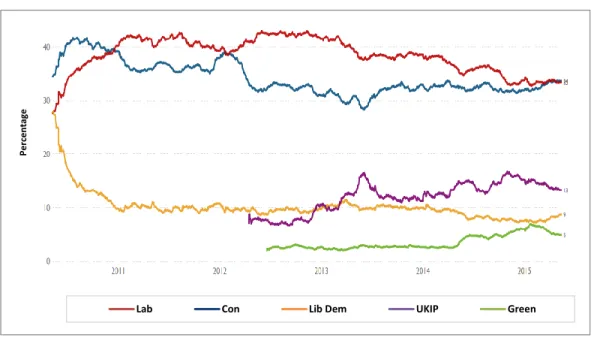
Figure 2 below illustrates the perceived levels of party support between the elections
(2010-2015), represented in a so-called ‘poll of polls’. Striking, although not central to the analysis
here, is the drop in support for the Lib Dems following their role as a coalition party. What also
stands out is the peak in support for UKIP in mid-2013. This might be correlated with the drop in
support for the Conservatives in the same period. However, support for the Conservatives
recovered after the drop in mid-2013 and their support did not fall to the low-water mark again.
For UKIP the levels of support dropped significantly after the peak in 2013, but recovered again
in the course of 2014. Although Labour support does demonstrate some fluctuations, it shows
less dramatic swings than the Conservatives overall. This is can be attributed to the fact that
opposition parties are generally more popular in polls between elections than government parties.
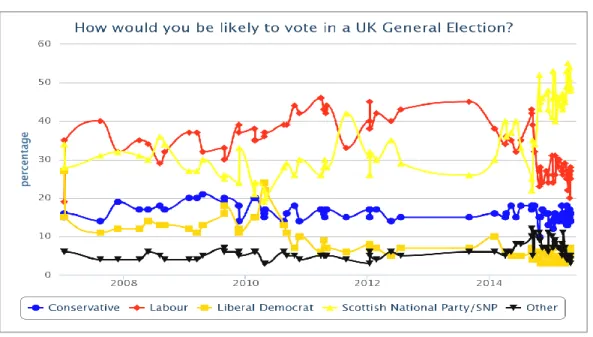
Figure 2 does not account for the levels of perceived support for the SNP, since the poll of polls
only contain parties that are eligible nation-wide. Figure 3 is included in order to illustrate the
voter perception for Scotland, which elects 59 MPs to Westminster parliament.
Figure 2: Voting Intentions
0 10 20 30 40 50 60
2014 2015
June 25-26 October 27-30
Dec 9-11 Jan 29- Feb 2
March 10-12
Marc 26-31 April 8-9 April 16-20 April 29-May 1
P
e
rce
nt
age
Lab Con Lib Dem UKIP Green
| 14 When looking at the period after the 2010 election, three major swings can be identified in 2011,
2012 and 2014. Although the increases of support for the SNP seemed to go hand in hand with
dips in Labour’s support, this did not necessarily have to mean that the SNP posed a direct threat
to Labour. High levels of SNP support only form a challenge for Labour if it results in the loss of
seats. The same is true for UKIP. This where electoral rules and voter distribution comes in.
Of the total of 650 seats in Westminster, 194 were marginal after the 2010 election (BBC
“Battleground”). Most of these seats were held by the Conservatives, Labour or the Lib Dems. In
the face of the 2015 election, the parties were contesting each other in these constituencies. In
order to obtain a government majority, Labour needed a swing of 5% of the votes or 68
additional seats, while the Conservatives needed a 2% swing of the votes or 20 additional seats
(BBC “Battleground”). Both parties were competing in constituencies held by other parties while
defending the seats they had been holding with only a small lead. Competition from niche parties
in these marginal constituencies could have impeded the Conservatives or Labour from obtaining
the required swing needed for a government majority.
For instance, in the constituency of Thurrock a Conservative MP was elected in 2010 by
a mere 0.2% majority over Labour’s candidate (see Figure 4). In the 2015 election a swing of
0.1% of the votes would have resulted in the loss of this Conservative seat to Labour. The fact
Figure 3: Voting Intentions (Scotland)
| 15 that this constituency is one of UKIP’s top target seats increased the challenge of the
Conservatives to maintain their lead over Labour (BBC “Battleground”). Likewise, Bolton West,
a seat that Labour obtained with a mere 0.2% lead over the Conservatives in 2010, faced a
similar challenge from UKIP (see Figure 4) (BBC “Battleground”). Aberdeen South is an
example of a marginal Labour constituency in Scotland, in which the SNP presented a challenge
(see Figure 4). Labour controlled it with a lead of 8.15% over the Lib Dems (BBC
“Battleground”). The SNP and Labour were also targeting marginal constituencies under control
of the Lib Dems. This created a second electoral battleground between the two parties, the first
being competition over Labour held seats.
In summary, in the period between 2010-2015 both UKIP and the SNP could be
perceived as threatening to the mainstream parties, although to different degrees at different
times. The next two sections will discuss this in more detail and assess what the reactions of the
Conservatives and Labour were.
| 16
3.2: The UKIP Challenge
3.2.1 UKIP’s Threat
UKIP’s share of the vote has increased steadily over the last sixteen years. In general elections,
UKIP moved from 1.5% of the vote share in 2001, to 2.3% in 2005 and 3.2% in 2010 (BBC
“UKIP”). In European elections, UKIP saw its vote share increase from 7% in 1999, to 16.5% in
2009 and 27.5% in 2014 (BBC “UKIP”). UKIP’s win in two by-elections can be added to this
list of growing success9. Notably, the by-elections were triggered as the result of two Conservative MP’s defecting to UKIP and regaining their seat as UKIP MP’s (The Independent “By-election”). Therefore, the challenge that UKIP poses to the Conservatives became relatively
clear. UKIP’s policy pledges not only focus on withdrawal from the EU but also on issues
related to this matter, such as immigration and taxation (Hayton 2010, 27). Consequently, the
party had the ability to attract right-wing voters who are not only discontent with the EU but
whom were also dissatisfied with the policies of the Conservatives on those related issues. UKIP
presented right-wing voters in Britain with “an increasingly acceptable alternative” (Hayton
2010, 32).
UKIP’s policies also have an appeal beyond right-wing voters and this is evidenced by
the Heywood and Middleton by-election (see Figure 4), in which Labour nearly lost its seat to
UKIP (Independent “Labour”). Yet, it is important to note that by-elections are generally
considered to be a good time for protest votes. Voters know that the MP will not be in office for
long. This is evidenced by Mark Reckless winning in the Rochester and Strood by-election for
UKIP in 2014 but losing his seat in the 2015 election10.The logic of protest votes also applies to European Parliament elections, in which UKIP did well in 2014. Although voters might return to
the mainstream parties in general elections, protest votes can serve as warnings to the parties.
In order to assess whether the issues that UKIP has highlighted found resonance in public
opinion, a YouGov poll is presented below.
9 See Clacton, and Rochester and Strood in Figure 4.
| 17
Figure 5 shows that in June 2014 the issue of immigration temporarily surpassed the economy as
the most important issue facing Britain. In June 2010, it was still 30 points below the issue of the
economy. Since the importance of the economy dropped significantly, immigration has become
equally or even more salient. In the polls conducted between January and April 2015, the
importance of the issues fluctuated between 47 and 54 (immigration) and 45 and 55 (economy)
(YouGov “Issues”). What this means is that immigration became a more prominent issue for the
electorate. The increase in salience could to some extent be the result of the strategy of the
Conservatives and/or Labour on this issue. Before looking whether the parties indeed attributed
more attention to the issue, a second YouGov poll on immigration should be considered.
Figure 5:
| 18 Figure 6 shows a descending line for the Conservatives, which means that the electorate
perceived the party as increasingly less capable of handling immigration effectively. The fact
that Labour remained constant can be attributed to the fact that they were not in government and
are therefore not seen responsible for the implementation of legislation on immigration. What is
most striking is that the line representing ‘other’ parties surpasses both mainstream parties. It
experiences a peak in the same period in which Figure 5 is showing a peak of the importance of
immigration. The reason behind this trend could be the attention that UKIP was attracting to the
issue. UKIP criticized the policies of the coalition government on immigration, for instance the
fact that the immigration cap was not met (BBC “Migration”). Given UKIP’s vote share in the
last elections and the perceived growth of its support in the last two years (Figure 2), it is not
surprising that the Conservatives engaged in strategies to mitigate the niche party’s threat. Add
to this UKIP’s success in two by-elections and its near success in a third, and both the
Conservatives and Labour tactics should show evidence of UKIP’s imminent threat. Since UKIP
holds the belief that controlling immigration is not possible while remaining an EU member, it
often discusses immigration in the context of the EU and vice-versa (UKIP Manifesto 2015).
Therefore, increased mainstream party attention to both issues was likely to come up.
Figure 6:
| 19 3.2.2 The Strategies
A comparison of the 2010 and 2015 manifestos of the mainstream parties shows that the
Conservatives and Labour devoted significantly more attention to UKIP’s key issues (Labour
Manifesto 2015; Conservative Manifesto 2015). First of all, the Conservatives dedicated a larger
section to immigration in 2015 than in 2010. The issue is also mentioned more often throughout
the latest manifesto. The same is true for Labour, which also paid more attention to the issue and
even cited it in its manifesto’s foreword. Secondly, the issue of EU integration is very present in
the 2015 manifestos. Labour’s position on the issue has remained relatively similar. The
Conservatives, on the other hand, have repositioned themselves. The discussion of the EU is
more negative in the Conservative manifesto of 2015 and the policies have moved closer to those
advocated by UKIP. This is also the case for immigration. This suggests that the Conservatives
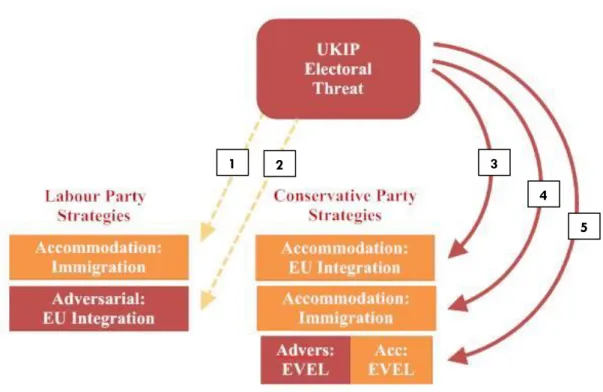
have sought to appease UKIP on both immigration and EU integration (represented by arrows 3
and 4 in Figure 7).
Speeches and announcements in the period between the elections provide additional
evidence of the Conservatives’ tactics. In January 2013, the party leader, David Cameron,
announced that his party would hold a referendum if it were to win the 2015 election (Lynch and
Whitaker 11). This pledge has been regarded as a direct response to Eurosceptic pressure from
both UKIP and Eurosceptic Conservatives (Gruber 241; Hayton 2013, 16). A group of these
hard-line Conservatives, often referred to as backbenchers, feared that voters would defect to
UKIP if the party’s position towards the EU was not toughened (Hayton 2013, 16). Therefore,
the referendum-card was played. The intention was to neutralize UKIP and end its ownership
over the issue, by providing an alternative to Eurosceptic voters. During the budget crisis, the
Conservatives again toughened their stance towards the EU (BBC “EU”; Reuters “EU”). In front of the Question Time audience, Cameron repeated that the EU referendum would be a “red line”
in case of coalition negotiations after the election (BBC “QT”). The pledge to hold a referendum
on EU membership is also clearly expressed in the Conservative manifesto (Conservative
Manifesto 2015). Additionally, the manifesto states that the Conservatives will keep the UK out
of the Eurozone, “reclaim powers from Brussels” and scrap the Human Rights Act (Conservative
Manifesto 2015). This relatively harsh narrative that the Conservatives have employed towards
| 20 The Conservatives’ policy pledges for more and stricter controls on immigration show
how the party has sought to play another card against UKIP. Notably, “a bill including stricter
measures on immigration (…) followed UKIP’s stunning local and by-election performances in early 2013” (Gruber 241). This bill is a clear illustration of how the Conservatives sought to
secure their place in government after the election by shifting a little in the direction of UKIP
(Gruber 241). Other examples of this are “high-profile stop-and-search campaigns” for illegal immigrants, “attempts to limit free movement for unqualified immigrants” and “plans to cut back social security and child benefit for selected groups of foreigners” (Gruber 241). Although the
Conservatives have employed restrictive policies and anti-immigration rhetoric before, “the
ratcheting up of already fairly restrictive measures is an obvious response to UKIP’s rise in the
opinion polls” (Gruber 242). In addition, the Conservatives received damning critiques from
UKIP due to the fact that the promised cap on net immigration was not met (BBC “Migration”). This was emphasized again by UKIP’s leader Nigel Farage during the Leader debates (BBC
“Debate”). As a result the Conservatives’ attention to the issue has only increased further.
When turning to Labour, a comparison of the manifestos shows that its position on EU
integration is divergent from both UKIP and the Conservatives. Although, the 2015 manifesto
expresses a firmer stance towards the EU, it clearly states that the party remains in favour of EU
membership (Labour Manifesto 2015). This position of Labour was expressed soon after
Cameron’s referendum pledge. The party positioned itself against such a referendum, by stating
that it sees it as a “huge gamble” (BBC “Gamble”). Instead, the party called for an improvement of EU-UK relations and larger role for Britain in the EU.11 In terms of immigration, Labour has also adopted a stricter tone in its 2015 manifesto. UKIP’s threat to Labour became more evident
as a result of the Heywood and Middleton by-election: the party sought to toughen its stance on
immigration (BBC “Labour”). Shortly after the by-election in October 2014, the party’s leader,
Ed Miliband, promised to start immigration reforms as soon as Labour would get into
government (Independent “Labour”). Labour’s backbenchers believed that a tougher stance was
necessary in order “to combat UKIP’s growing appeal to the party’s traditional working class
supporters” (Independent “Labour”). The fact that Labour realised that it could be outbid on the
issue of immigration by other parties is also evidenced by Miliband’s pledge stone. Three days
| 21 prior to the election, the party leader revealed Labour’s six key pledges, carved in a stone tablet;
number four being ‘controls on immigration’ (BBC “Stone”).
Yet, it is difficult to speak of accommodation. Mainstream parties like Labour are
“restricted from accommodating parties with positions opposite to their own” and “cannot pursue
policy positions that conflict with their previous positions on the same issue” (Meguid 2007, 35).
Labour receives a large share of the ethnic minority vote, in areas such as London (Ashcroft).
The party cannot radically reposition itself without risking a loss of support from these
communities. Besides, Labour is largely depended on support from trade unions and the working
class vote, which is now more diverse than ever (Economist). Therefore, Labour would not have
been able to adopt a fully accommodative strategy towards UKIP on this issue (represented by
arrow 1 in Figure 7). Labour’s narrative on immigration has still remained relatively vague, with
promises such as ‘controls on immigration’ without outlining the specifics of such policies
(Labour Manifesto 2015). Besides, the attempt to accommodate possible defectors to UKIP came
fairly late.
3
4
5
1 2
Note: Arrows 1 and 2 have dotted lines as these strategies are less prominent. The logic behind the dual EVEL strategy and arrow 5 will be discussed in the next section.
| 22
3.3: The SNP Challenge
3.3.1 SNP’s Threat
Figure 3 in section 3.1 shows large swings in Labour and SNP support in Scotland between 2010
and 2015. For most of this period it remained unclear to what extent the SNP would solidify its
support in a way that would be threatening to the mainstream parties. However, this situation
changed in the period leading up to the Scottish independence referendum. Pro-independence
supporters started moving from Labour to the SNP shortly before the official polling date (BES
“Referendum”). More importantly, SNP support did not seem to collapse after the no-vote.
Labour did not only become unpopular among yes-voters but also among no-voters because they
felt that the party aligned too closely with the Conservatives during the referendum campaign
(Independent “Referendum”). In the aftermath of the referendum, pollsters started observing a
surge of SNP support. Polls suggested that the party would gain 34 seats while Scottish Labour
was at risk of losing 15 seats (BBC “Fatal”). In addition, SNP’s membership numbers were
increasing substantially post-referendum (BBC “Fatal”). The surge of the SNP in late 2014 and
the beginning of 2015 could be seen as threatening to Labour. But why does the level of SNP
support actually matter to Labour and not so much to the Conservatives?
Scotland has traditionally been Labour’s heartland (BBC “Fatal”). It generally held a
number of key constituencies here, such as the one in which Gordon Brown, the former Labour
leader and PM, was elected in 2010: Kirkcaldy and Cowdenbeath (see Figure 4) (BBC
“Battleground”). Without these constituencies, Labour faced a greater struggle in England and
Wales to obtain enough seats for a government majority in 2015. The Conservatives, on the other
hand, do traditionally not perform well in Scotland and only hold one or two seats. Thus, the
SNP does not represent a direct challenge. Yet, a certain degree of accommodation of the
Scottish voters can be expected from not only Labour but also from the Conservatives. Both the
Conservatives and Labour are unionist parties that do not desire the breakup of the UK. In the
face of the Scottish referendum in September 2014, the parties reinstated their pledges for more
devolution to the Scottish parliament (BBC “Referendum”). As the support of the SNP only
| 23 3.3.2 The Strategies
Devolution is the SNP’s prime objective besides its advocation for Scottish independence. A
comparison of the mainstream parties’ manifestos of 2010 and 2015 on this topic suggests that
the issue has become increasingly salient for both parties. For the Conservatives, the salience of
devolution has indeed increased in its 2015 manifesto. The party states that they will remain
faithful to their devolution pledges (Conservative Manifesto 2015). Labour’s position has not changed dramatically between 2010 and 2015 either, and devolution is also more present in its
latest manifesto. It is clearly mentioned in the foreword and throughout the text. Similar to the
Conservatives, Labour has renewed its pledges to devolve more powers to the Scottish
parliament. This has become evident in their party statements. For instance, in January 2015
Labour’s Scottish leader, Jim Murphy, promised “stronger welfare powers to Scotland” (BBC
“Pledges”). He went on to say that Labour would go further than this and previous pledges, since the party seeks to deliver Home Rule to the Scottish (BBC “Pledges”). With this tactic, Labour
tried to accommodate and appease Scottish voters (represented by arrow 1 in Figure 9). In
particular, those who perceive devolution as an important issue to themselves and/or their
country.
The position that the Conservatives took on the issue can to some extent also be seen as
accommodative. However, since the SNP did not pose a significant threat to the Conservatives,
this strategy was not one of the party’s key tactics (represented by arrow 2 in Figure 9). The
Conservatives were actively involved in another strategic game that involved the SNP. The party
has tried to use the surge of support for the niche party against its direct opponent, Labour. In its
manifesto, the SNP stated that it sought to lock the Conservatives out of government, or more
phrased resolutely: “Let’s lock the Tories out of number 10” (SNP Manifesto 2015). The SNP
was willing to offer its alliance to Labour, in order to prevent another Conservative government.
The Conservatives quickly appropriated the possibility of this deal as a means through which to
attack Labour and undermine its support. The party used the deal as an opportunity to play the
SNP off against Labour. At first, the Conservatives were running a relatively negative campaign,
focused on discrediting Labour’s fiscal credibility. As a result of the SNP’s proposal to lock
them out of office, the Conservatives could now focus on instigating fear regarding a
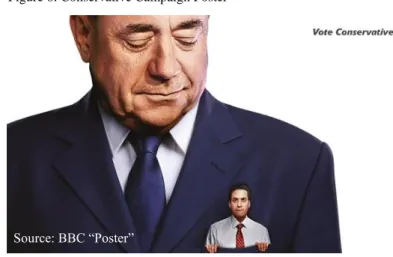
| 24 poster pictured Labour’s leader Ed Miliband in the pocket of the Scottish former PM and deputy
party leader, Alex Salmond (see Figure 8).
In turn, Labour stated that it would not be willing to form an alliance with the SNP (BBC
“SNP”). In the Leaders debate, the possibility of a Labour-SNP coalition was again brought
forward but dismissed by Miliband (BBC “Debate”). However, Labour’s stance on the subject
became unreliable, when a senior party member stated that Labour could still use the SNP to
obtain enough votes to pass certain policies in Westminster parliament (BBC “Vote-by-vote”).
Miliband then came out in front of the Question Time audience with a very clear statement that
“there [would] be no Labour government if it [involved] a coalition or a deal with SNP” (BBC “QT”). In this way, Miliband exclaimed that it did not consider the SNP as an acceptable
coalition partner. Consequently, Labour disregarded SNP’s legitimacy as a fellow political party
in Westminster. Labour was more or less forced to do so after the Conservatives’ allegations
regarding the likelihood of a deal with the SNP. By conveying the idea that it would be
unacceptable to work with the SNP, both the Conservatives and Labour engaged in the
disregarding of the party (represented by arrow 3 in Figure 9). Yet, the tactic was more crucial to
Labour as its own seats were at stake. It serves as a good example of the use of a niche party as a
‘weapon’ against an opposing mainstream party (Meguid 2007, 33). This is exactly what the
Conservatives pursued here. Meguid has called this tactic “the political embodiment of the adage
‘the enemy of my enemy is my friend’” (2007, 33). The Conservatives were “helping the niche
Source: BBC “Poster”
| 25 party – the enemy of its enemy in this case – gain votes from the other mainstream party” (2007,
33).12
A final strategy related to devolution is one that the Conservatives picked up in the
aftermath of the Scottish referendum. It can be explained in two ways; it addresses the UKIP
challenge but also involves the SNP. As a result of the surge of Scottish nationalism, culminating
in the independence referendum, as well as a surge of nationalism in England, the Conservatives
have engaged in a strategy based on the principle of English votes for English laws (EVEL). This
pledge by the Conservatives was articulated hours after the Scottish referendum. Unlike
Scotland, England does not have its own parliament to which powers can be devolved. As
English matters are discussed in Westminster, votes are not always cast by English MP’s only.
The discussion of further devolution of power to the Scottish parliament reawakened the
discussion concerning the way that English legislation is passed in parliament. EVEL represents
the idea that English MPs should be able to veto laws and regulations, especially financial ones,
which only involve England (BBC “EVEL”).
The Conservatives took EVEL on in order “to ensure that [they] rather than UKIP could
play the English card” (Independent “Gamble”).Yet, this strategy would not only be useful to “undermine the appeal of UKIP” in England but also “to bolster the SNP in Scotland to the disadvantage” of Labour (BBC “EVEL”)13
. Indeed, the proposal was greatly condemned by both
the SNP’s deputy leader and the Scottish Labour leader (Guardian “EVEL”). It is seen as
endangering the Barnett Formula that “is used to decide the allocation of public funds between
Scotland, Wales and Northern Ireland” as well as the consensus that was created through the
Smith Commission on possible devolution reforms (Guardian “EVEL”). Consequently, Scottish
voters that were already discontent with their representation by the UK parliament were driven
further into the arms of the SNP.
12 Meguid discusses this as part of an adversarial strategy. However, in this case, the Conservatives’ strategy
towards SNP was not really adversarial. It is not a dismissive strategy either since it focusses on dismissing the niche party itself rather than the issue. Instead, it has been labelled as disregarding (see Lynch and Whitaker 2013). 13 Because this card turned out to have two faces, one directed towards UKIP, the other towards the SNP, it is
| 26
Figure 9: Applied Conceptual Framework (2)
1
2 3
4
3
| 27
Source: Independent “UKIP”
S
ECTION4:
T
HEE
LECTIONR
ESULTSIn the months leading up to the 2015 election, it was already expected that it would become “the
most complex and unpredictable British election in living memory” (Guardian “Guide”). The
figures below illustrate the surprising results that most bookmakers, pollsters and political
journalists had not foreseen.
Figure 11:
Figure 12
Source: www.bbc.com/news/election-2015-32633008
Source: http://www.bbc.com/news/election/2015/results
| 28 The first question to ask is what happened to the Lib Dems? The party experienced the most
dramatic defeat; their vote share fell with -15.2% and they lost 49 of their 57 seats (see Figure 11
and 12). Four factors can account for this. First of all, “those who backed the Lib Dems as a
left-wing alternative to Labour were aghast at the very formation of a Conservative-Lib Dem
coalition” in 2010 (Newstatesman). Secondly, the party managed to alienate centre-left
supporters in the beginning of its term in government, while centre-right voters might have been
alienated by its negative message towards the Conservatives in the second half of its term
(Newstatesman). In addition, the party leader, Nick Clegg, suffered from a loss of legitimacy as
he was scapegoated for the party’s betrayal of its electoral promises in 2010 (Guardian “Clegg”).
Then there is the opinion polls. As these polls did not show the possibility of a Conservative
majority government during the campaign period, voters were less inclined to listen to the anti-
Conservative message of the Lib Dems (Newstatesman). Fears regarding a Labour-SNP
coalition, instigated by the Conservatives based on the opinion polls, were also damaging to the
Lib Dems (Newstatesman). The last reason that accounts for the Lib Dems’ loss is the
disappearance of a tactic that the Conservatives had used in 201014. Back then, Conservatives purposely did not target seats in which the Lib Dems were doing well. This way, the Lib Dems
could help undermine Labour. The Conservatives reversed this tactic in the 2015 election, which
resulted in more competition in Lib Dem’s target seats.
The second thing to consider is why the Conservatives did so well, while Labour stayed
far behind? First of all, the SNP’s landslide was a crucial blow to Labour. It lost traditional
strongholds like Kirkcaldy and Cowdenbeath and marginal seats like Aberdeen South. Most of
Scotland turned bright SNP yellow (Figure 10) as the party won in 56 of the 59 constituencies
(Figure 11). Secondly, UKIP was able to attract more Labour voters than expected by pollsters
and the party itself (Independent “UKIP”). Labour came second in large areas of England and
Wales (Figure 10). In many of the constituencies that Labour lost to the Conservatives, such as
Bolton West, UKIP came third (see Figure 10) (Independent “UKIP”). The loss of votes to the
SNP as well as UKIP diminished Labour’s chance of beating the Conservatives. Therefore,
Labour’s defeat cannot be blamed on the SNP alone (Independent “UKIP”). According to
Matthew Goodwin, an associate professor of politics at Nottingham University, it “is also about
| 29 an English nationalism that deserted Labour at the prospect of a Labour-SNP alliance”
(Independent “UKIP”). Labour’s defeat can thus be attributed to its failure to deal with the two
nationalisms between which it found itself squashed (The Observer).
Now, let us turn to the electoral performance of the niche parties. How can their success
or failure be explained and to what extent has this been influenced by the strategies of the
mainstream parties? In the case of UKIP, it is difficult to speak of an electoral success. While
UKIP’s vote share was relatively impressive, its failure to obtain more than one seat stands out
(BES). It held on to its Clacton seat but lost the constituency of Rochester and Strood. The main
factors that contributed to this are the rules of the electoral system and voter distribution. These
factors affected UKIP unfavourably and impeded the party from turning votes into seats.
Consequently, UKIP’s deputy leader outed large critiques on the FPTP system (Independent “FPTP”). This is not a new complaint and UKIP is not the only party affected that has expressed
its grievance about the system. Yet, the same electoral rules have allowed the SNP to gain seats
at the expense of Labour.
UKIP’s high vote share can be explained by looking at other factors. First of all, the combination of the Conservatives’ immigration- and EU referendum- card seem to have been
effective. The Conservatives were able to limit the loss of their supporters to the niche party. It
managed to hold on to marginal seats like Thurrock. Labour, on the other hand, suffered a harder
blow from UKIP (Independent “UKIP”). Its adversarial stance on EU integration and its attempt
to paint itself as a party able to control immigration failed to stop a share of its voters dissecting
to UKIP. In nine of the constituencies that turned Conservative blue, “UKIP won more votes
than the size of the Conservative majority” over Labour (Independent “UKIP”). “Although not
all of these UKIP voters would have switched from Labour, defections from Labour could have
tipped the balance” in favour of the Conservatives (Independent “UKIP”). What this means is
that Labour might have been able to match or surpass the Conservatives’ vote share in these
constituencies, if it had not lost supporters to UKIP. In addition, the Conservatives’ anti-coalition
card may have swayed many Conservative “defectors to UKIP to ‘return home’” (Independent “UKIP”). These voters would have done so to impede a Labour-SNP coalition, “while Labour switchers stuck with” UKIP for this same reason (Independent “UKIP”). The fact that the
anti-coalition-card played an influential role in the election results supports the argument that the
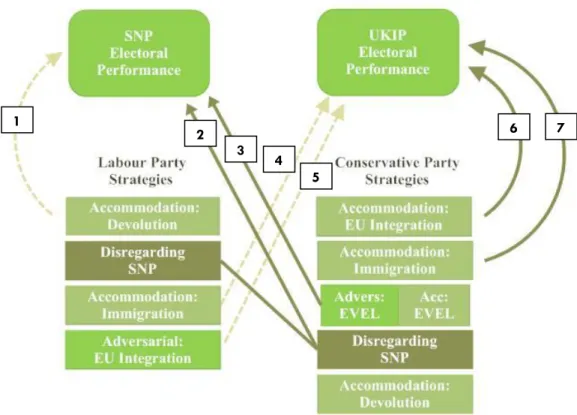
| 30 to attain seats is mostly explained by other factors, but UKIP’s high vote share is largely
influenced by competition from and between the Conservatives and Labour (represented by
arrows 4, 5, 6 and 7 in Figure 13).
The SNP’s electoral performance was a real bolt from the blue. To what extent did the
mainstream parties strategies contribute to this astounding result? Labour’s attempt to
accommodate Scottish nationalists with continued devolution promises was fairly weak. The
message was not articulated very powerfully. Their promise to go beyond existing devolution
pledges could be perceived as a fairly abstract and hollow. Besides, Labour’s position on another
issue conflicted with Scottish interests. Labour was in favour of the renewal of Trident (Labour
Manifesto 2015). This is the UK’s nuclear deterrent, which is based in Scotland. The SNP has
advocated against Trident’s renewal (SNP Manifesto 2015). This will have been picked up by
Scottish voters, since most Scots seem opposed to the program (Survation Poll). The Trident
issue and other contradictions in Labour’s campaign, made its devolution message towards
Scotland more ambiguous and less credible (represented by arrow 1 in Figure 13). The effects of
the Conservatives’ accommodation tactics might not be very visible, but the impact of its two
other strategies is (represented by arrows 2 and 3 in Figure 13). The party played the
anti-coalition-card to prompt fear that the SNP would influence a Labour government overly in major
policy decisions. This might have helped swing voters in England and Wales towards the
Conservatives. Furthermore, the Conservatives’ allegations concerning a Labour-SNP deal led to
Labour’s disregarding of the SNP as an acceptable coalition partner. This might ultimately have
pushed many Scottish voters to abandon the party. The SNP has benefitted from the combination
of Conservative and Labour strategies in the past (Meguid 2007, 231). It seems like this has
again been the case in this election.
| 31
1
2 3
4 5
6 7
Figure 13: Applied Conceptual Framework (3)
| 32
C
ONCLUSIONThis thesis has presented two arguments. First of all, the electoral threat of niche parties
influences the strategies of mainstream parties. The case studies of UKIP and the SNP illustrate
these dynamics. The Conservatives responded to UKIP not with one or two, but with three
different tactics. They played the EU referendum-card in early 2013. When faced by the
increasing importance of immigration in the public opinion as well as the increasing popularity
of UKIP, they toughened their stance and pledged for stricter and more controls; the
immigration-card was played. Then, as a by-effect of the Scottish referendum, the Conservatives
used the EVEL-card. This was initially aimed at appeasing English nationalists and possible
UKIP voters, but it also helped the SNP gain voters at the expense of Labour. Altogether, the
Conservatives employed five different strategies15.
Labour engaged in four different tactics. The party responded to the surge of SNP support
with an attempt to accommodate defectors to the SNP with more devolution pledges. However,
when faced by Conservative allegations regarding a Labour-SNP alliance, Labour completely
disregarded the SNP as an acceptable coalition partner. In response to UKIP’s threat, Labour
sought to appease defectors by adopting a firmer stance on immigration, but this tactic came
relatively late and could not fully be executed without risking the alienation of other Labour
supporters. The fourth strategy, Labour’s adversarial stance on the EU issue was a less prominent
and a less direct response to UKIP. In the same way, the accommodative behaviour of the
Conservatives vis-à-vis the devolution issue was less prominent. But all in all, the influence of
the niche party threats on the strategies has certainly become clear.
Secondly, this thesis has argued that strategies of mainstream parties influenced the
electoral performance of niche parties. The majority of the observed strategies proved that this is
indeed the case. The combination of the anti-coalition- and EVEL- card that the Conservatives
played, together with Labour’s disregarding of the SNP contributed to its landslide. The
anti-coalition-card was also a factor in UKIP’s electoral failure, as it helped Conservative defectors to
UKIP return to the fold. On the other hand, the strategies that Labour adopted vis-à-vis UKIP
were mostly ineffective. They did not impede UKIP for luring voters away. But these examples
do not disconfirm the second hypothesis. It was expected that Labour would be less able to deal
| 33 with a non-proximal niche party since the party cannot radically alter its position on certain
issues. The combination of the strategies of the mainstream parties was very influential in terms
of the SNP’s electoral success. Of course this success is also the product of other factors, such as
the role of the SNP in the recent independence referendum. However, without Labour’s failed
accommodation of the SNP, together with the Conservatives’ coalition- and EVEL-strategies, the
SNP might have not been able to turn as many seats over. The mainstream parties’ strategies also
influenced UKIP’s electoral performance, although to a lesser extent. Labour’s weak
accommodation contributed to UKIP’s ability to gain votes, while the Conservatives’ effective
accommodation as well as voter distribution and electoral rules were factors that contributed to
UKIP’s failure to turn its votes into seats.
Thus, B.M. Meguid’s theory regarding the influence of mainstream party strategies on
niche party performance has also proven to be valid in the case of the British elections of 2015.
Furthermore, most of the mainstream party strategies dealt with a proximal niche party. Yet, the
Conservatives used two strategies that involved the SNP, a non-proximal niche party. Labour
also responded to a non-proximal niche party through its tactics vis-à-vis UKIP. This confirms
Meguid’s notion that non-proximal parties also influence each other. The election results have
also shown the impact that niche parties can have on a mainstream party. It can diminish the
mainstream party’s ability to beat its mainstream opponent. Finally, Meguid’s idea that
mainstream parties can choose to help the enemy of its enemy was visible in the interaction
between the Conservatives, Labour and the SNP.
The Conservatives, in part due to the fact that their electoral strategies were most
efficient, were able to secure a government majority. Consequently, Britain passed on from the
political crossroad, at which it found itself after the 2010 election. However, it remains unclear in
which direction British politics has proceeded. The 2015 election has not confirmed that the
creation of coalition governments is ‘a lasting trend’. Yet, it has also not completely disregarded
the 2010 election as an ‘exceptional one-off event’. Nor has it confirmed the increased influence
of niche parties in England and Wales, as parties like UKIP were unable to turn votes into seats.
The SNP in Scotland might form an exception, but it remains to be seen whether its support will
| 34
W
ORKSC
ITEDAdams, James, Michael Clark, Lawrence Ezrow, and Garrett Glasgow. "Are Niche Parties
Fundamentally Different from Mainstream Parties? The Causes and the Electoral
Consequences of Western European Parties' Policy Shifts, 1976-1998." American Journal of Political Science 50.3 (2006): 513-29. Web. 20 Feb. 2015.
Borisyuk, Galina, Colin Rallings, Michael Thrasher, and Ron Johnston. "Parliamentary
Constituency Boundary Reviews and Electoral Bias: How Important Are Variations in
Constituency Size?" Parliamentary Affairs 63.1 (2009): 4-21. Oxford University Press. Web. 12 Apr. 2015.
Curtice, John. "So what went wrong with the electoral system? The 2010 election result and the
debate about electoral reform." Parliamentary Affairs 63.4 (2010): 623-638. Web. 21 Feb. 2015
Downs, Anthony. "An economic theory of political action in a democracy." The Journal of Political Economy (1957): 135-150. Web. 20 Feb. 2015
Ezrow, Lawrence. "Research note: On the inverse relationship between votes and proximity for
niche parties." European Journal of Political Research 47.2 (2008): 206-220. Web. 20 Feb. 2015
Franzmann, Simon T. "Competition, contest, and cooperation: The analytic framework of the
issue market." Journal of Theoretical Politics 23.3 (2011): 317-343. Web. 20. Feb. 2015 Green‐Pedersen, Christoffer. "The growing importance of issue competition: The changing
nature of party competition in Western Europe." Political Studies 55.3 (2007): 607-628. Web. 06 March 2015
Gruber, Oliver, and Tim Bale. "And It's Good Night Vienna. How (not) to Deal with the Populist
Radical Right: The Conservatives, UKIP and Some Lessons from the Heartland." British Politics 9 (2014): 237-54. Web. 22 Feb. 2015.
Hayton, Richard. "Towards the Mainstream? UKIP and the 2009 Elections to the European
Parliament." Politics 30.1 (2010): 26-35. Web. 22 Feb. 2015.