This is a repository copy of
Self-interaction in Green's-function theory of the hydrogen
atom
.
White Rose Research Online URL for this paper:
http://eprints.whiterose.ac.uk/4030/
Article:
Nelson, W., Bokes, P., Rinke, Patrick et al. (1 more author) (2007) Self-interaction in
Green's-function theory of the hydrogen atom. Physical Review A. 032505. -. ISSN
1094-1622
https://doi.org/10.1103/PhysRevA.75.032505
[email protected] https://eprints.whiterose.ac.uk/ Reuse
Items deposited in White Rose Research Online are protected by copyright, with all rights reserved unless indicated otherwise. They may be downloaded and/or printed for private study, or other acts as permitted by national copyright laws. The publisher or other rights holders may allow further reproduction and re-use of the full text version. This is indicated by the licence information on the White Rose Research Online record for the item.
Takedown
If you consider content in White Rose Research Online to be in breach of UK law, please notify us by
promoting access to White Rose research papers
Universities of Leeds, Sheffield and York
http://eprints.whiterose.ac.uk/
White Rose Research Online URL for this paper:
http://eprints.whiterose.ac.uk/4030
Published paper
Nelson, W, Bokes, P, Rinke, P, Godby, R.W et al (2007) Self-interaction in
Green's-function theory of the hydrogen atom
Physical Review A 75 (032505 - 4 pages)
arXiv:cond-mat/0701592v1 [cond-mat.mtrl-sci] 24 Jan 2007
submitted to Phys. Rev. A
Self-interaction in Green’s-function theory of the hydrogen atom
W. Nelson,1,∗ P. Bokes,2, 3 Patrick Rinke,3, 4 and R. W. Godby1, 3,†
1Department of Physics, University of York, Heslington, York YO10 5DD, United Kingdom 2Department of Physics, Faculty of Electrical Engineering and Information Technology,
Slovak University of Technology, Ilkoviˇcova 3, 841 04 Bratislava, Slovak Republic 3European Theoretical Spectroscopy Facility (ETSF)
4Fritz-Haber-Institut der Max-Planck-Gesellschaft, Faradayweg 4–6, 14195 Berlin, Germany
(Dated: February 6, 2008)
Atomic hydrogen provides a unique test case for computational electronic structure methods, since its electronic excitation energies are known analytically. With only one electron, hydrogen contains no electronic correlation and is therefore particularly susceptible to spurious self-interaction errors introduced by certain computational methods. In this paper we focus on many-body perturbation-theory (MBPT) in Hedin’s GW approximation. While the Hartree-Fock and the exact MBPT self-energy are free of self-interaction, the correlation part of theGW self-energy does not have this property. Here we use atomic hydrogen as a benchmark system for GW and show that the
self-interaction part of theGW self-energy, while non-zero, is small. The effect of calculating theGW
self-energy from exact wavefunctions and eigenvalues, as distinct from those from the local-density approximation, is also illuminating.
PACS numbers: 31.25.Jf, 31.15.Lc, 31.15.Ar
I. INTRODUCTION
Ab initiomany-body quantum mechanical calculations are crucially important to our understanding of the be-havior of atomic, molecular and condensed matter sys-tems. It is well known that prediction of the behavior of these systems requires the description of electronic correlation. Whilst density-functional theory (DFT) in the local-density approximation (LDA) does this with startling success in many cases, it does so at the expense of a non-physical electron self-interaction. For delocal-ized electron systems this self-interaction becomes negli-gible, but in atomic or strongly localized electronic sys-tems it plays an important role. If one is interested in the calculation of quasiparticle excitation spectra, many-body perturbation-theory (MBPT) is formally a correct way to proceed. For solids, MBPT in Hedin’s GW ap-proximation [1] has become the method of choice, but it is also increasingly being applied to molecular systems and clusters. The GW self-energy can be decomposed into correlation and exchange parts, where the latter is the same as the Fock operator encountered in Hartree-Fock theory and thus self-interaction free. While the exact self-energy must also be free of self-interaction, the cor-relation part of the GW self-energy does not have this property. To investigate the influence of self-interaction in theGWapproach the hydrogen atom provides an ideal case, because the exact solution is known analytically.
Hydrogen in its solid phase has previously been stud-ied within the GW approximation by Li et al. [2], who
∗Present address: Department of Physics, King’s College London, Strand, London WC2R 2LS, United Kingdom
†Electronic address: [email protected]
analyzed the transition between the high-pressure solid phase and the low density, atomic-like limit. For indi-vidual atoms, GW electron removal and addition ener-gies (we use the term “quasiparticle” enerener-gies by analogy with the solid-state situation) have been investigated by Shirley and Martin [3], Dahlenet al. [4, 5], Stanet al. [6] and Delaneyet al. [7], although hydrogen was not con-sidered. These studies have shown thatGW, in general, gives quasiparticle properties which are much improved over DFT and Hartree-Fock methods, even for atoms.
In this paper we use the hydrogen atom as a benchmark system to quantify the self-interaction error in theGW
approach. Since the self-energy diagrams beyond GW, known as the vertex correction, must by definition cor-rect this self-interaction error, our findings are relevant for research into vertex functions for the many-electron problem.
Attention has recently focused on the prospects for im-proving the usual non-self-consistentGW calculations by choosing an initial Green’s function, G0, that is
physi-cally more reasonable than the LDA (e.g. [2, 8, 9]). We explore this here by determining the sensitivity of the self-interaction error to the use of the exact hydrogenic orbitals and energies in place of those from the local-density approximation (LDA). We also assess the error introduced intoGWcalculations by employing first-order perturbation theory in solving the quasiparticle equation (as opposed to the full numerical solution), and we ana-lyze the quasiparticle wavefunctions that emerge from a full solution.
II. HARTREE-FOCK VS. DFT-LDA
so-2
lutions of the quasiparticle equation
H0(r)ψiσ(r)+
X
σ′ Z
dr′Mσσ′(r,r′;ǫ
qp
iσ)ψiσ′(r′) =ǫ
qp
iσψiσ(r)
(1) where, in Hartree atomic units,H0(r) =−12∇
2+
vext(r)
and vext(r) is the external potential. It is customary
to divide the mass operator M into the local Hartree potential (vH) and the non-local self-energy (Σ)
Mσσ′(r,r′;ǫ) =vH(r)δ(r−r′)δσσ′ + Σσσ′(r,r′;ǫ). (2)
Omitting correlation contributions from Σ yields the exact-exchange or Hartree-Fock case, where the self-energy takes the form
Σxσσ′(r,r′) =− occ X
i
ψiσ(r)ψ∗iσ(r′)
|r−r′|
δσσ′ (3)
and the Hartree potential is given by
vH(r) =
occ X
i,σ Z
dr′ψiσ(r
′)ψ∗
iσ(r′)
|r−r′| . (4)
Since the sum runs over all occupied states the Hartree potential contains an artificial interaction of electrons with themselves. For the hydrogen atom this so-called self-interaction of the electron is the onlycontent of the Hartree potential and may be calculated analytically us-ing the exact ground-state wavefunction
ψ1↑s(r) =
1 √ πe −r (5) as
vH(r) = 1
r
1−(1 +r)e−2r . (6) The self-interaction is a positive, decreasing function and hence tends to delocalize the wavefunction (i.e. incor-rectly pushes its weight away from the nucleus).
In Hartree-Fock the self-interaction terms introduced in the Hartree potential are exactly canceled by the Fock operator Σx. This makes Hartree-Fock exact for
one-electron systems such as the hydrogen atom. However, the lack of correlation renders Hartree-Fock unsuitable for many polyatomic systems of interest.
Of more practical use is Kohn-Sham [10] density-functional theory, which by virtue of the Hohenberg-Kohn theorem [11] establishes an exact and universal functional relationship between the ground-state density
n(r) and the total energy E of a system. Mapping the
system of interacting electrons onto a fictitious system of non-interacting electrons, that reproduces the exact density, yields the Kohn-Sham equations:
[H0(r) +vH(r) +vxc(r)]φiσ(r) =ǫKSiσ φiσ(r). (7)
All electron-electron interactions beyond the Hartree mean field are encompassed by the exchange-correlation
potential vxc, which is formally given as the functional derivative of the exchange-correlation energyExc:
vxc(r) = δExc[n]
δn(r) . (8)
In analogy to the quasiparticle equation (1) the Kohn-Sham eigenvaluesǫKSiσ are often interpreted as excitation
energies, although this is not formally justified.
One of the most common approximations for Exc is the local-density approximation (LDA) [10], in which the many-body exchange and correlation contributions to the total energy (Exc) are included by comparison with the homogeneous electron gas (HEG):
ELDAxc [n] = Z
drn(r)ǫHEGxc [n(r)] . (9)
Here [12] we follow the parameterization of Perdew and Zunger [13] for the exchange-correlation energy density
ǫHEGxc [n(r)] of the homogeneous electron gas based on the
data of Ceperley and Alder [14].
The LDA has been remarkably successful at accounting for correlation even in systems that are highly inhomoge-neous. However, it is well known that the introduction of correlation in the LDA comes at the expense of the exact treatment of the self-interaction. Because the exchange functional is taken from the homogeneous electron gas it no-longer cancels the spurious self-interaction present in the Hartree term. In most systems this is a minor effect and is more than compensated by the improved treatment of the electron correlation. The LDA can be improved by explicitly removing the self-interaction [13], however this becomes increasingly difficult as the sys-tem’s complexity is increased.
III. THEGW APPROXIMATION
In Hedin’s GW approximation [1] the self-energy in Eq.2is given by
Σσσ(r,r′;ǫ) = i
2π Z ∞
−∞
dǫ′eiǫ′δGσσ(r,r′;ǫ+ǫ′)W(r,r′;ǫ)
(10) whereδis an infinitesimal positive time. At the level of
GW, spin flips are not accounted for [2], and the input Green’s function is diagonal in its spin representation
Gσσ =Gσσ′δσσ′
In common with usualGW calculations, a Kohn-Sham Green’s functionG0 is used forG, given by [15]
G0σσ(r,r′, ǫ) = X
i
φiσ(r)φ∗iσ(r′) ǫ−ǫKS
iσ ∓iδ
, (11)
and makes the non-interacting polarizability
χ0σσ(r,r′, ǫ) =− i π
Z ∞
−∞
dǫ′G0σσ(r,r′;ǫ′−ǫ)G
0
σσ(r′,r;ǫ′)
3
and the dielectric function dependent (though spin-diagonal). The inverse dielectric function in the random-phase approximation
ε−1(r,r′, ǫ) =
"
δ(r−r′)−
Z
dr′′v(r,r′′)
X
σ
χ0σσ(r′′,r′, ǫ) #−1
(13) and thus the screened Coulomb interaction
W0(r,r′, ǫ) =
Z
dr′′ε−1(r,r′′, ǫ)v(r′′,r′). (14)
then emerge as spin-independent quantities, giving rise to the simple spin dependence in the GW self-energy (Eq.10).
For numerical convenience and physical insight we sep-arate theGW self-energy (10) according to
Σσσ=−i[Gσσv+Gσσ(W −v)] = Σxσσ+ Σ c
σσ . (15)
The first term (Σx
σσ) corresponds to the Fock operator
in Eq.3and will exactly cancel the self-interaction intro-duced by the Hartree potential. It is therefore immedi-ately clear that any deviation from the exact result for hydrogen can only come from the correlation part of the self-energy (Σc
σσ).
The incorrect self-interaction affects the electron re-moval energies (here, the ionization potential). For elec-tron addition energies such as the elecelec-tron affinity, the entire Hartree potential has a physically reasonable inter-pretation, since it acts on the wavefunction of the origi-nally unoccupied state which has not contributed to the electron density.
IV. COMPUTATIONAL APPROACH
We solve the quasiparticle equation (1) with theG0W0
self-energy (10) for the quasiparticle energies and wave-functions by fully diagonalizing the quasiparticle Hamil-tonian in the basis of the single particle orbitals of the non-interacting system. Since the ground state of the hydrogen atom (Eq. 5) is spherically symmetric, it is sufficient to describe all non-local operators in the GW
formalism by two radial and one spin coordinates,r, r′, σ
and one angular coordinate, θ, that denotes the angle between the vectors rand r′. The self-energy (Eq. 10)
then assumes the much simpler form
Σσσ(r, r′, θ;ω) =
∞
X
l=0
[Σlσ(r, r′;ω)]Pl(cosθ)δσ,σ (16)
wherePl(cosθ) is a Legendre polynomial of orderl. The Legendre expansion coefficients of the self-energy are calculated directly, thereby surpassing the need for a numerical treatment of the angular dependence. We use a real-space and imaginary time representation [16] to calculate the self-energy from the non-interacting Green’s
0
1
2
3
4
5
radius [bohr]
0.0
0.1
0.2
0.3
0.4
0.5
radial probability
exact+GWexact LDA+GW LDA0 1 2 3 4
[image:5.612.317.562.52.241.2]radius [bohr] -0.06 -0.04 -0.02 0.00 0.02 difference to exact
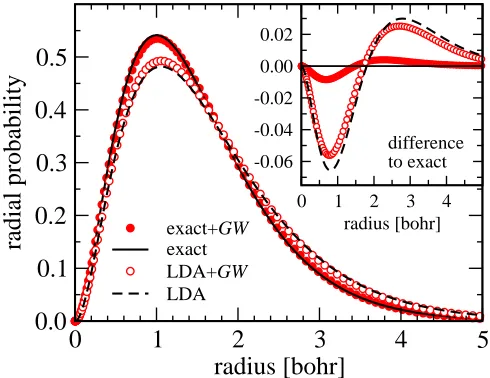
FIG. 1: Radial probability distributions of the hydrogen 1s state: the quasiparticle wavefunction deviates only slightly from the exact wavefunction, when the latter is used as a starting point (exact+GW). The LDA wavefunction, on the other hand, is more delocalized as a result of the inherent self-interaction. Adding quasiparticle corrections (LDA+GW) brings the resulting quasiparticle wavefunction slightly closer to the exact one again. The inset shows the difference to the exact wavefunction.
functionG0. The expression for the self-energy on the
real frequency axis is obtained by analytic continuation [16]. The current implementation has been successfully applied to jellium clusters [17] and light atoms [7].
Our code allows us to solve the quasiparticle equation (1) for the GW self-energy with no further approxima-tion. However, in order to separate the contribution that arises from the correlation part of the self-energy from that of the exchange part and the Hartree and exchange-correlation potential wealsosolve the quasiparticle equa-tion with the frequently made approximaequa-tion that the quasiparticle wavefunctions are given by the Kohn-Sham wavefunctions. The resulting equation for the quasipar-ticle energies is
ǫqpiσ =ǫ
KS
iσ +hΣ x σσi+hΣ
c σσ(ǫ
qp iσ)i − hv
xc
σ i, (17)
where the brackets hi denote matrix elements with re-spect to the Kohn-Sham wavefunctionφiσ.
In order to explore the role of the starting points for a
GW calculation, two possible Kohn-Sham input Green’s functions are chosen. First, the familiar LDA, and, sec-ond, the exact Kohn-Sham solution for the hydrogen atom which has the exact wavefunction of the hydrogen 1s state (5) and vxc(r) = −vH(r). (This exact
4
Exact HF LDA LDA+GW Exact+GW
[image:6.612.53.300.175.213.2]−13.61 −13.61 −6.36 −12.66 −13.40
TABLE I: Quasiparticle energies (eV) for the 1sstate of hy-drogen (the ionization potential) obtained by diagonalizing the quasiparticle Hamiltonian (1). TwoGW calculations are shown, starting from the LDA and from exact Kohn-Sham, re-spectively. For comparison, the Hartree-Fock (HF) and LDA eigenvalues are also shown.
Kohn-ShamG0 ǫ
GW
1s hΣxi hvxci hΣci
LDA −12.93 −15.38 −8.25 0.56
Exact −13.35 −17.00 −17.00 0.25
TABLE II: Quasiparticle energies (eV) for the 1sstate of hy-drogen obtained by solving Eq. (17). The contributions from the exchangehΣxiand correlationhΣcipart of the self-energy
are compared to that of the exchange-correlation potential
hvxcifor the LDA and the exact case (vxc=−vH) as a
start-ing point. Exact value forǫ1s is−13.61 eV.
V. RESULTS AND DISCUSSION
The calculated ionization potentials (from a full solu-tion of the quasiparticle equasolu-tion) are shown in Table I. The self-interaction errors in the two GW quasipar-ticle energies are seen to be fairly small: 0.95 eV when the approximate LDA Kohn-Sham starting point is used, and the much smaller 0.21 eV when the exact Kohn-Sham starting point is used. Clearly the LDA is such a physically poor representation of the correct physics in this extreme system (owing to the large self-interaction present in the LDA calculation itself, as reflected in the large error in the LDA Kohn-Sham eigenvalue) that it forms a very unsuitable starting point for GW. How-ever, a physically reasonable starting point reduces the
GW self-interaction error to a small size.
Since hΣci gives a non-vanishing contribution to the
hydrogen 1sstate, even if the analytic solution is used as a starting point, the quasiparticle wavefunction will differ from the exact one. Figure 1shows that the GW corre-lation gives rise to a slight delocalization of the quasipar-ticle wavefunction in this case. This relaxation, however, now makes the quasiparticle wavefunction an eigenfunc-tion of the quasiparticle Hamiltonian and reduces the deviation from the exact energy of the 1sstate to 0.2 eV, as shown in TableI. In the LDA the self-interaction error is much more pronounced and the wavefunction becomes
significantly more delocalized. TheGW self-energy cor-rects this to a small extent (as reflected in the quasipar-ticle wavefunction), but the remaining discrepancy reit-erates the unsuitability of the LDA as a starting point forGW in this self-interaction-dominated atom.
For an analysis of the contributions to the self-energy we turn to the perturbative solution of the quasiparti-cle equation using Eq. 17, shown in Table II. When the exact Kohn-Sham wavefunction and eigenvalues are used, as in the Hartree-Fock case the exchange part of the self-energy is seen to cancel the self-interaction contribu-tion from the Hartree potential exactly. The correlacontribu-tion part, on the other hand, is not zero, but amounts to a self-polarization of 0.25 eV. When the LDA is used as starting point the influence of the LDA wavefunction on the exchange operator becomes apparent and it reduces from−17.00 eV in the exact case to−15.38 eV. This cor-rects the highly overestimated LDA eigenvalue for the 1s
state of−6.36 eV (see TableI) to−13.49 eV. However, in this case the contribution from the correlation part of the
GW self-energy is even larger than when starting from the exact case and increases the quasiparticle energy to
−12.93 eV.
VI. CONCLUSION
We have performed spin-resolved benchmark calcula-tions for theGW formalism using the analytically known solutions of the hydrogen atom as a reference, making the self-interaction error introduced by the correlation part of theGW self-energy directly assessable. When the ex-act Kohn-Sham Green’s function is used as the input toGW, the self-interaction error is small (0.21 eV, one-thirtieth the size of that in the LDA), but not negligible. If the LDA Kohn-Sham Green’s function is used, as done in many GW calculations for more complex systems, a larger self-interaction error remains, inherited from the LDA starting point.
Acknowledgments
This work was supported by the NATO Security Through Science Programme (EAP.RIG.981521), the Slovak grant agency VEGA (project No. 1/2020/05) and the EU’s 6th Framework Programme through the NANOQUANTA Network of Excellence (NMP4-CT-2004-500198).
[1] L. Hedin, Phys. Rev.139, A796 (1965).
[2] J.-L. Li, G.-M. Rignanese, E. K. Chang, X. Blase, and S. G. Louie, Phys. Rev. B66, 035102 (2002).
[3] E. L. Shirley and R. M. Martin, Phys. Rev. B47, 15404 (1992).
[4] N. E. Dahlen and U. Barth, Phys. Rev. B 69, 195102 (2004).
[5] N. E. Dahlen and R. van Leeuwen, J. Chem. Phys.122, 164102 (2005).
5
Lett.76, 298 (2006).
[7] K. Delaney, P. Garc´ıa-Gonz´alez, A. Rubio, P. Rinke, and R. W. Godby, Phys. Rev. Lett.93, 249701 (2004).
[8] P. Rinke, A. Qteish, J. Neugebauer, C. Freysoldt, and M. Scheffler, New J. Phys.7, 126 (2005).
[9] J.-L. Li, G.-M. Rignanese, and S. G. Louie, Phys. Rev. B71, 193102 (2005).
[10] W. Kohn and K. J. Sham, Phys. Rev.140, A1133 (1965).
[11] P. Hohenberg and W. Kohn, Phys. Rev. 136, B864 (1964).
[12] A local spin density [18] calculation improves the eigenen-ergy of the hydrogen 1sonly slightly [18].
[13] J. Perdew and A. Zunger, Phys. Rev. B23, 5048 (1981).
[14] D. Ceperley and B. Alder, Phys. Rev. Lett. 45, 566 (1980).
[15] The minus (plus) sign in the denominator applies to oc-cupied (unococ-cupied) states.
[16] H. N. Rojas, R. W. Godby, and R. J. Needs, Phys. Rev. Lett.74, 1827 (1995).
[17] P. Rinke, K. Delaney, P. Garc´ıa-Gonz´alez, and R. W. Godby, Phys. Rev. A70, 063201 (2004).
[18] S. Kotochigova, Z. H. Levine, E. L. Shirley, M. D. Stiles and C. W. Clark, Phys. Rev. A 55, 191 (1997), ibid. Phys. Rev. A 56, 5191 (1997),