Teach Yourself
Electricity and
Teach Yourself
Electricity and
Electronics
Fourth Edition
Stan Gibilisco
McGraw-Hill
New York Chicago San Francisco Lisbon London Madrid Mexico City Milan New Delhi San Juan Seoul
Copyright © 2006, 2002, 1997, 1993 by The McGraw-Hill Companies, Inc. All rights reserved. Manufactured in the United States of America. Except as permitted under the United States Copyright Act of 1976, no part of this publication may be repro-duced or distributed in any form or by any means, or stored in a database or retrieval system, without the prior written permis-sion of the publisher.
0-07-148709-3
The material in this eBook also appears in the print version of this title: 0-07-145933-2.
All trademarks are trademarks of their respective owners. Rather than put a trademark symbol after every occurrence of a trade-marked name, we use names in an editorial fashion only, and to the benefit of the trademark owner, with no intention of infringe-ment of the trademark. Where such designations appear in this book, they have been printed with initial caps.
McGraw-Hill eBooks are available at special quantity discounts to use as premiums and sales promotions, or for use in corpo-rate training programs. For more information, please contact George Hoare, Special Sales, at [email protected] or (212) 904-4069.
TERMS OF USE
This is a copyrighted work and The McGraw-Hill Companies, Inc. (“McGraw-Hill”) and its licensors reserve all rights in and to the work. Use of this work is subject to these terms. Except as permitted under the Copyright Act of 1976 and the right to store and retrieve one copy of the work, you may not decompile, disassemble, reverse engineer, reproduce, modify, create derivative works based upon, transmit, distribute, disseminate, sell, publish or sublicense the work or any part of it without McGraw-Hill’s prior consent. You may use the work for your own noncommercial and personal use; any other use of the work is strictly prohib-ited. Your right to use the work may be terminated if you fail to comply with these terms.
We hope you enjoy this
McGraw-Hill eBook! If
you’d like more information about this book,
its author, or related books and websites,
please
click here.
Professional
Preface xvii
Part 1 Direct Current
1 Basic Physical Concepts 3
Atoms 3
Protons, Neutrons, and Atomic Numbers 3
Isotopes and Atomic Weights 4
Electrons 4
Ions 6
Compounds 6
Molecules 7
Conductors 8
Insulators 8
Resistors 9
Semiconductors 9
Current 10
Static Electricity 11
Electromotive Force 12
Nonelectrical Energy 13
Quiz 14
2 Electrical Units 17
The Volt 17
Current Flow 18
The Ampere 19
Resistance and the Ohm 20
Conductance and the Siemens 22
Power and the Watt 23
vii
Contents
A Word about Notation 24
Energy and the Watt-Hour 25
Other Energy Units 26
Alternating Current and the Hertz 27
Rectification and Pulsating Direct Current 28
Safety Considerations in Electrical Work 30
Magnetism 30
Magnetic Units 32
Quiz 32
3 Measuring Devices 36
Electromagnetic Deflection 36
Electrostatic Deflection 38
Thermal Heating 39
Ammeters 39
Voltmeters 41
Ohmmeters 43
Multimeters 44
FET Voltmeters 44
Wattmeters 45
Watt-Hour Meters 46
Digital Readout Meters 46
Frequency Counters 47
Other Meter Types 47
Quiz 51
4 Direct-Current Circuit Basics 55
Schematic Symbols 55
Schematic and Wiring Diagrams 56
Voltage/Current/Resistance Circuits 57
Ohm’s Law 58
Current Calculations 59
Voltage Calculations 60
Resistance Calculations 60
Power Calculations 61
Resistances in Series 62
Resistances in Parallel 63
Division of Power 64
Resistances in Series-Parallel 64
Quiz 65
5 Direct-Current Circuit Analysis 69
Current through Series Resistances 69
Voltages across Series Resistances 70
Voltage across Parallel Resistances 72
Power Distribution in Series Circuits 74
Power Distribution in Parallel Circuits 74
Kirchhoff ’s First Law 75
Kirchhoff ’s Second Law 77
Voltage Divider Networks 78
Quiz 80
6 Resistors 85
Purpose of the Resistor 85
Fixed Resistors 88
The Potentiometer 90
The Decibel 93
Resistor Specifications 94
Quiz 98
7 Cells and Batteries 102
Electrochemical Energy 102
Grocery Store Cells and Batteries 105
Miniature Cells and Batteries 106
Lead-Acid Batteries 107
Nickel-Based Cells and Batteries 108
Photovoltaic Cells and Batteries 109
Fuel Cells 110
Quiz 111
8 Magnetism 115
The Geomagnetic Field 115
Causes and Effects 116
Magnetic Field Strength 120
Electromagnets 120
Magnetic Properties of Materials 122
Practical Magnetism 123
Quiz 128
Test: Part 1 132
Part 2 Alternating Current
9 Alternating-Current Basics 143
Definition of Alternating Current 143
Period and Frequency 143
The Sine Wave 144
Square Waves 145
Sawtooth Waves 146
Complex and Irregular Waveforms 147
Frequency Spectrum 148
Fractions of a Cycle 150
Expressions of Amplitude 151
The Generator 154
Why Alternating and Not Direct? 155
Quiz 156
10 Inductance 160
The Property of Inductance 160
Practical Inductors 161
The Unit of Inductance 162
Inductors in Series 162
Inductors in Parallel 163
Interaction among Inductors 164
Air-Core Coils 166
Ferromagnetic Cores 166
Inductors at RF 169
Unwanted Inductances 171
Quiz 171
11 Capacitance 175
The Property of Capacitance 175
Practical Capacitors 176
The Unit of Capacitance 177
Capacitors in Series 177
Capacitors in Parallel 178
Fixed Capacitors 179
Variable Capacitors 182
Capacitor Specifications 184
Interelectrode Capacitance 184
Quiz 185
12 Phase 188
Instantaneous Values 188
Instantaneous Rate of Change 189
Circles and Vectors 190
Expressions of Phase Difference 192
Vector Diagrams of Phase Difference 195
Quiz 196
13 Inductive Reactance 200
Coils and Direct Current 200
Coils and Alternating Current 201
Reactance and Frequency 202
Points in the RLPlane 203
Current Lags Voltage 205
How Much Lag? 208
Quiz 210
14 Capacitive Reactance 214
Capacitors and Direct Current 214
Capacitors and Alternating Current 215
Capacitive Reactance and Frequency 216
Points in the RCPlane 218
Vectors in the RCPlane 219
Current Leads Voltage 220
How Much Lead? 222
Quiz 225
15 Impedance and Admittance 229
Imaginary Numbers 229
Complex Numbers 229
TheRXPlane 233
Characteristic Impedance 236
Conductance 238
Susceptance 238
Admittance 240
TheGBplane 240
Quiz 242
16 RLCandGLCCircuit Analysis 245
Complex Impedances in Series 245
Series RLCCircuits 248
Complex Admittances in Parallel 250
Parallel GLCCircuits 253
Putting It All Together 256
Reducing Complicated RLCCircuits 257
Ohm’s Law for AC Circuits 259
Quiz 261
17 Power and Resonance in Alternating-Current Circuits 265
Forms of Power 265
True Power, VA Power, and Reactive Power 268
Power Transmission 273
Resonance 276
Resonant Devices 280
Quiz 282
18 Transformers and Impedance Matching 286
Principle of the Transformer 286
Geometries 289
Power Transformers 292
Isolation and Impedance Matching 294
Radio-Frequency Transformers 297
Quiz 299
Test: Part 2 303
Part 3 Basic Electronics
19 Introduction to Semiconductors 315
The Semiconductor Revolution 315
Semiconductor Materials 316
Doping and Charge Carriers 317
The P-N Junction 318
Quiz 321
20 How Diodes Are Used 325
Rectification 325
Detection 326
Frequency Multiplication 326
Signal Mixing 327
Switching 328
Voltage Regulation 328
Amplitude Limiting 329
Frequency Control 330
Oscillation and Amplification 330
Energy Emission 331
Photosensitive Diodes 332
Quiz 333
21 Power Supplies 337
Power Transformers 337
Rectifier Diodes 338
Half-Wave Circuit 338
Full-Wave Center-Tap Circuit 340
Full-Wave Bridge Circuit 340
Voltage-Doubler Circuit 341
Filtering 342
Voltage Regulation 344
Protection of Equipment 345
Quiz 348
22 The Bipolar Transistor 352
NPN versus PNP 352
Biasing for Amplification 355
Gain versus Frequency 357
Common Emitter Circuit 358
Common Base Circuit 359
Common Collector Circuit 359
Quiz 361
23 The Field Effect Transistor 365
Principle of the JFET 365
Amplification 369
The MOSFET 370
Common Source Circuit 373
Common Gate Circuit 374
Common Drain Circuit 375
Quiz 376
24 Amplifiers and Oscillators 379
The Decibel 379
Basic Bipolar Transistor Amplifier 381
Basic JFET Amplifier 382
Amplifier Classes 383
Efficiency in Power Amplifiers 386
Drive and Overdrive 388
Audio Amplification 389
Radio-Frequency Amplification 391
How Oscillators Work 393
Common Oscillator Circuits 394
Oscillator Stability 399
Audio Oscillators 400
Quiz 402
25 Wireless Transmitters and Receivers 407
Oscillation and Amplification 407
Modulation 407
Pulse Modulation 414
Analog-to-Digital Conversion 415
Image Transmission 416
The Electromagnetic Field 419
Wave Propagation 421
Transmission Media 423
Two Basic Receiver Designs 424
Predetector Stages 427
Detectors 429
Audio Stages 433
Television Reception 433
Specialized Wireless Modes 434
Quiz 437
26 Digital Basics 441
Numbering Systems 441
Logic 443
Digital Circuits 444
Binary Digital Communications 448
The RGB Color Model 453
Quiz 454
Test: Part 3 458
Part 4 Specialized Devices and Systems
27 Antennas 471
Radiation Resistance 471
Half-Wave Antennas 473
Quarter-Wave Verticals 474
Loops 476
Ground Systems 477
Gain and Directivity 478
Phased Arrays 480
Parasitic Arrays 482
Antennas for Ultrahigh and Microwave Frequencies 483
Safety 486
Quiz 486
28 Integrated Circuits 491
Advantages of IC Technology 491
Limitations of IC Technology 492
Linear ICs 492
Digital ICs 496
Component Density 498
IC Memory 499
Quiz 499
29 Electron Tubes 504
Tube Forms 504
Electrodes in a Tube 505
Circuit Configurations 508
Cathode-Ray Tubes 509
Camera Tubes 511
Tubes for Use above 300 MHz 513
30 Transducers, Sensors, Location, and Navigation 517
Wave Transducers 517
Displacement Transducers 519
Detection and Measurement 523
Location Systems 527
Navigational Methods 531
Quiz 534
31 Acoustics, Audio, and High Fidelity 538
Acoustics 538
Loudness and Phase 540
Technical Considerations 541
Components 541
Specialized Systems 546
Recorded Media 547
Electromagnetic Interference 549
Quiz 550
32 Personal and Hobby Wireless 554
Cellular Communications 554
Satellites and Networks 556
Amateur and Shortwave Radio 559
Security and Privacy 561
Quiz 566
33 A Computer and Internet Primer 569
The Central Processing Unit 569
Units of Digital Data 570
The Hard Drive 571
External Storage 573
Memory 574
The Display 575
The Printer 577
The Scanner 578
The Modem 580
The Internet 581
Quiz 584
34 Monitoring, Robotics, and Artificial Intelligence 587
Keeping Watch 587
Robot Generations and Laws 591
Robot Arms 592
Robot Hearing and Vision 597
Robot Navigation 600
Telepresence 603
The Mind of the Machine 605
Quiz 606
Test: Part 4 610
Final Exam 621
Appendix A Answers to Quiz, Test, and Exam Questions 645
Appendix B Schematic Symbols 653
Suggested Additional Reading 671
This book is for people who want to learn the fundamentals of electricity, electronics, and related fields without taking a formal course. The book can also serve as a classroom text. This edition con-tains new material on transducers, sensors, antennas, monitoring, security, and navigation. Material from previous editions has been updated where appropriate.
As you take this course, you’ll encounter hundreds of quiz, test, and exam questions that can help you measure your progress. They are written like the questions found in standardized tests used by educational institutions.
There is a short multiple-choice quiz at the end of every chapter. The quizzes are “open-book.” You may refer to the chapter texts when taking them. When you have finished a chapter, take the quiz, write down your answers, and then give your list of answers to a friend. Have the friend tell you your score, but not which questions you got wrong. Because you’re allowed to look at the text when taking the quizzes, some of the questions are rather difficult.
At the end of each section, there is a multiple-choice test. These tests are easier than chapter-ending quizzes. Don’t look back at the text when taking the tests. A satisfactory score is at least three-quarters of the answers correct.
You will find a final exam at the end of this course. As with the section-ending tests, the ques-tions are not as difficult as those in the chapter-ending quizzes. Don’t refer back to the text while taking the final exam. A satisfactory score is at least three-quarters of the answers correct.
The answers to all of the multiple-choice quiz, test, and exam questions are listed in an appen-dix at the back of this book.
You don’t need a mathematical or scientific background for this course. Middle-school algebra, geometry, and physics will suffice. There’s no calculus here! I recommend that you complete one chapter a week. That way, in a few months, you’ll finish the course. You can then use this book, with its comprehensive index, as a permanent reference.
Suggestions for future editions are welcome.
Stan Gibilisco
xvii
Preface
1
PART
Direct Current
IT IS IMPORTANT TO UNDERSTAND SOME SIMPLE,GENERAL PHYSICS PRINCIPLES IN ORDER TO HAVE A
full grasp of electricity and electronics. It is not necessary to know high-level mathematics. In sci-ence, you can talk about qualitative things or quantitative things, the “what” versus the “how much.” For now, we are concerned only about the “what.” The “how much” will come later.
Atoms
All matter is made up of countless tiny particles whizzing around. These particles are extremely dense; matter is mostly empty space. Matter seems continuous because the particles are so small, and they move incredibly fast.
Each chemical elementhas its own unique type of particle, known as its atom.Atoms of ent elements are always different. The slightest change in an atom can make a tremendous differ-ence in its behavior. You can live by breathing pure oxygen, but you can’t live off of pure nitrogen. Oxygen will cause metal to corrode, but nitrogen will not. Wood will burn furiously in an atmos-phere of pure oxygen, but will not even ignite in pure nitrogen. Yet both are gases at room temper-ature and pressure; both are colorless, both are odorless, and both are just about of equal weight. These substances are so different because oxygen has eight protons, while nitrogen has only seven. There are many other examples in nature where a tiny change in atomic structure makes a major dif-ference in the way a substance behaves.
Protons, Neutrons, and Atomic Numbers
The part of an atom that gives an element its identity is the nucleus.It is made up of two kinds of particles, the protonand the neutron.These are extremely dense. A teaspoonful of either of these par-ticles, packed tightly together, would weigh tons. Protons and neutrons have just about the same mass, but the proton has an electric charge while the neutron does not.
The simplest element, hydrogen, has a nucleus made up of only one proton; there are usually no neutrons. This is the most common element in the universe. Sometimes a nucleus of hydrogen
3
1
CHAPTER
Basic Physical Concepts
has a neutron or two along with the proton, but this does not occur very often. These “mutant” forms of hydrogen do, nonetheless, play significant roles in atomic physics.
The second most abundant element is helium. Usually, this atom has a nucleus with two pro-tons and two neutrons. Hydrogen is changed into helium inside the sun, and in the process, energy is given off. This makes the sun shine. The process, called fusion, is also responsible for the terrific explosive force of a hydrogen bomb.
Every proton in the universe is just like every other. Neutrons are all alike, too. The number of protons in an element’s nucleus, the atomic number, gives that element its identity. The element with three protons is lithium, a light metal that reacts easily with gases such as oxygen or chlorine. The el-ement with four protons is beryllium, also a metal. In general, as the number of protons in an ele-ment’s nucleus increases, the number of neutrons also increases. Elements with high atomic numbers, like lead, are therefore much denser than elements with low atomic numbers, like carbon. Perhaps you’ve compared a lead sinker with a piece of coal of similar size, and noticed this difference.
Isotopes and Atomic Weights
For a given element, such as oxygen, the number of neutrons can vary. But no matter what the num-ber of neutrons, the element keeps its identity, based on the atomic numnum-ber. Differing numnum-bers of neutrons result in various isotopesfor a given element.
Each element has one particular isotope that is most often found in nature. But all elements have numerous isotopes. Changing the number of neutrons in an element’s nucleus results in a dif-ference in the weight, and also a difdif-ference in the density, of the element. Thus, hydrogen contain-ing a neutron or two in the nucleus, along with the proton, is called heavy hydrogen.
Theatomic weightof an element is approximately equal to the sum of the number of protons and the number of neutrons in the nucleus. Common carbon has an atomic weight of about 12, and is called carbon 12 or C12. But sometimes it has an atomic weight of about 14, and is known as car-bon 14 or C14.
Electrons
Surrounding the nucleus of an atom are particles having opposite electric charge from the protons. These are the electrons. Physicists arbitrarily call the electrons’ charge negative, and the protons’ chargepositive.An electron has exactly the same charge quantity as a proton, but with opposite po-larity. The charge on a single electron or proton is the smallest possible electric charge. All charges, no matter how great, are multiples of this unit charge.
One of the earliest ideas about the atom pictured the electrons embedded in the nucleus, like raisins in a cake. Later, the electrons were seen as orbiting the nucleus, making the atom like a miniature solar system with the electrons as the planets (Fig. 1-1). Still later, this view was modified further. Today, the electrons are seen as so fast-moving, with patterns so complex, that it is not even possible to pinpoint them at any given instant of time. All that can be done is to say that an elec-tron will just as likely be inside a certain sphere as outside. These spheres are known as elecelec-tron
Electrons can move rather easily from one atom to another in some materials. In other sub-stances, it is difficult to get electrons to move. But in any case, it is far easier to move electrons than it is to move protons. Electricity almost always results, in some way, from the motion of electrons in a material. Electrons are much lighter than protons or neutrons. In fact, compared to the nucleus of an atom, the electrons weigh practically nothing.
Generally, the number of electrons in an atom is the same as the number of protons. The neg-ative charges therefore exactly cancel out the positive ones, and the atom is electrically neutral. But
Electrons 5
1-1 An early model of the atom, developed around the year 1900,
resembled a miniature solar system. The electrons were held in their orbits around the nucleus by electrostatic attraction.
under some conditions, there can be an excess or shortage of electrons. High levels of radiant energy, extreme heat, or the presence of an electric field (discussed later) can “knock” or “throw” electrons loose from atoms, upsetting the balance.
Ions
If an atom has more or less electrons than protons, that atom acquires an electrical charge. A shortage of electrons results in positive charge; an excess of electrons gives a negative charge. The element’s identity remains the same, no matter how great the excess or shortage of electrons. In the extreme case, all the electrons might be removed from an atom, leaving only the nucleus. However, it would still represent the same element as it would if it had all its electrons. A charged atom is called anion.When a substance contains many ions, the material is said to be
ionized.
A good example of an ionized substance is the atmosphere of the earth at high altitudes. The ultraviolet radiation from the sun, as well as high-speed subatomic particles from space, re-sult in the gases’ atoms being stripped of electrons. The ionized gases tend to be found in lay-ers at certain altitudes. These laylay-ers are responsible for long-distance radio communications at some frequencies.
Ionized materials generally conduct electricity well, even if the substance is normally not a good conductor. Ionized air makes it possible for a lightning stroke to take place, for example. The ion-ization, caused by a powerful electric field, occurs along a jagged, narrow channel. After the light-ning flash, the nuclei of the atoms quickly attract stray electrons back, and the air becomes electrically neutral again.
An element might be both an ion and an isotope different from the usual isotope. For example, an atom of carbon might have eight neutrons rather than the usual six, thus being the isotope C14, and it might have been stripped of an electron, giving it a positive unit electric charge and making it an ion.
Compounds
Different elements can join together to share electrons. When this happens, the result is a chemical
compound.One of the most common compounds is water, the result of two hydrogen atoms join-ing with an atom of oxygen. There are literally thousands of different chemical compounds that occur in nature.
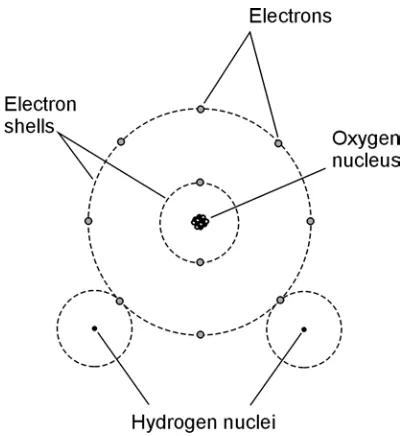
A compound is different than a simple mixture of elements. If hydrogen and oxygen are mixed, the result is a colorless, odorless gas, just like either element is a gas separately. A spark, however, will cause the molecules to join together; this will liberate energy in the form of light and heat. Under the right conditions, there will be a violent explosion, because the two elements join eagerly. Water is chemically illustrated in Fig. 1-3.
Another common example of a compound is rust. This forms when iron joins with oxygen. While iron is a dull gray solid and oxygen is a gas, rust is a maroon-red or brownish powder, com-pletely unlike either of the elements from which it is formed.
Molecules
[image:27.482.140.342.61.279.2]When atoms of elements join together to form a compound, the resulting particles are molecules.
Figure 1-3 is an example of a molecule of water, consisting of three atoms put together.
The natural form of an element is also known as its molecule. Oxygen tends to occur in pairs most of the time in the earth’s atmosphere. Thus, an oxygen molecule is sometimes denoted by the symbol O2. The “O” represents oxygen, and the subscript 2 indicates that there are two atoms per
molecule. The water molecule is symbolized H2O, because there are two atoms of hydrogen and one
atom of oxygen in each molecule.
Sometimes oxygen atoms exist all by themselves; then we denote the molecule simply as O. Sometimes there are three atoms of oxygen grouped together. This is the gas called ozone, which has received much attention lately in environmental news. It is written O3.
All matter, whether solid, liquid, or gas, is made of molecules. These particles are always mov-ing. The speed with which they move depends on the temperature. The hotter the temperature, the more rapidly the molecules move around. In a solid, the molecules are interlocked in a sort of rigid pattern, although they vibrate continuously (Fig. 1-4A). In a liquid, they slither and slide around (Fig. 1-4B). In a gas, they rush all over the place, bumping into each other and into solids and liq-uids adjacent to the gas (Fig. 1-4C).
Molecules 7
Conductors
In some materials, electrons move easily from atom to atom. In others, the electrons move with dif-ficulty. And in some materials, it is almost impossible to get them to move. An electrical conductor
is a substance in which the electrons are mobile.
The best conductor at room temperature is pure elemental silver. Copper and aluminum are also excellent electrical conductors. Iron, steel, and various other metals are fair to good conductors of electricity. In most electrical circuits and systems, copper or aluminum wire is used. (Silver is im-practical because of its high cost.)
Some liquids are good electrical conductors. Mercury is one example. Salt water is a fair con-ductor. Gases or mixtures of gases, such as air, are generally poor conductors of electricity. This is because the atoms or molecules are usually too far apart to allow a free exchange of electrons. But if a gas becomes ionized, it can be a fair conductor of electricity.
Electrons in a conductor do not move in a steady stream, like molecules of water through a gar-den hose. Instead, they are passed from one atom to another right next to it (Fig. 1-5). This happens to countless atoms all the time. As a result, literally trillions of electrons pass a given point each sec-ond in a typical electrical circuit.
Insulators
Aninsulatorprevents electrical currents from flowing, except occasionally in tiny amounts. Most gases are good electrical insulators. Glass, dry wood, paper, and plastics are other examples. Pure water is a
good electrical insulator, although it conducts some current with even the slightest impurity. Metal oxides can be good insulators, even though the metal in pure form is a good conductor.
Electrical insulators can be forced to carry current. Ionization can take place; when electrons are stripped away from their atoms, they move more or less freely. Sometimes an insulating material gets charred, or melts down, or gets perforated by a spark. Then its insulating properties are lost, and some electrons flow. An insulating material is sometimes called a dielectric.This term arises from the fact that it keeps electrical charges apart, preventing the flow of electrons that would equalize a charge difference between two places. Excellent insulating materials can be used to advantage in cer-tain electrical components such as capacitors, where it is important that electrons not flow.
Porcelain or glass can be used in electrical systems to keep short circuits from occurring. These devices, called insulators, come in various shapes and sizes for different applications. You can see them on high-voltage utility poles and towers. They hold the wire up without running the risk of a short circuit with the tower or a slow discharge through a wet wooden pole.
Resistors
Some substances, such as carbon, conduct electricity fairly well but not really well. The conductiv-ity can be changed by adding impurities like clay to a carbon paste, or by winding a thin wire into a coil. Electrical components made in this way are called resistors.They are important in electronic circuits because they allow for the control of current flow. The better a resistor conducts, the lower itsresistance;the worse it conducts, the higher the resistance.
Electrical resistance is measured in units called ohms.The higher the value in ohms, the greater the resistance, and the more difficult it becomes for current to flow. For wires, the resistance is some-times specified in terms of ohms per unit length (foot, meter, kilometer, or mile). In an electrical system, it is usually desirable to have as low a resistance, or ohmic value, as possible. This is because resistance converts electrical energy into heat.
Semiconductors
In a semiconductor, electrons flow, but not as well as they do in a conductor. Some semiconductors carry electrons almost as well as good electrical conductors like copper or aluminum; others are al-most as bad as insulating materials.
Semiconductors 9
Semiconductors are not the same as resistors. In a semiconductor, the material is treated so that it has very special properties.
Semiconductors include certain substances such as silicon, selenium, or gallium, that have been “doped” by the addition of impurities such as indium or antimony. Have you heard of such things asgallium arsenide,metal oxides, or silicon rectifiers?Electrical conduction in these materials is always a result of the motion of electrons. But this can be a quite peculiar movement, and sometimes engi-neers speak of the movement of holesrather than electrons. A hole is a shortage of an electron—you might think of it as a positive ion—and it moves along in a direction opposite to the flow of elec-trons (Fig. 1-6).
When most of the charge carriersare electrons, the semiconductor is called N-type, because elec-trons are negatively charged. When most of the charge carriers are holes, the semiconductor mate-rial is known as P-typebecause holes have a positive electric charge. But P-type material does pass some electrons, and N-type material carries some holes. In a semiconductor, the more abundant type of charge carrier is called the majority carrier.The less abundant kind is known as the minority carrier.Semiconductors are used in diodes,transistors, and integrated circuits.These substances are what make it possible for you to have a computer or a television receiver in a package small enough to hold in your hand.
Current
Whenever there is movement of charge carriers in a substance, there is an electric current.Current is measured in terms of the number of electrons or holes passing a single point in 1 second.
A great many charge carriers go past any given point in 1 second, even if the current is small. In a household electric circuit, a 100-watt light bulb draws a current of about six quintillion(6 followed by 18 zeros) charge carriers per second. Even the smallest bulb carries quadrillions(numbers fol-lowed by 15 zeros) of charge carriers every second. It is impractical to speak of a current in terms of charge carriers per second, so it is measured in coulombs per secondinstead. A coulomb is equal to approximately 6,240,000,000,000,000,000 electrons or holes. A current of 1 coulomb per second
is called an ampere, and this is the standard unit of electric current. A 100-watt bulb in your desk lamp draws about 1 ampere of current.
When a current flows through a resistance—and this is always the case because even the best con-ductors have resistance—heat is generated. Sometimes light and other forms of energy are emitted as well. A light bulb is deliberately designed so that the resistance causes visible light to be generated.
Electric current flows at high speed through any conductor, resistor, or semiconductor. Never-theless, it is considerably less than the speed of light.
Static Electricity
Charge carriers, particularly electrons, can build up, or become deficient, on things without flow-ing anywhere. You’ve experienced this when walkflow-ing on a carpeted floor durflow-ing the winter, or in a place where the humidity was low. An excess or shortage of electrons is created on and in your body. You acquire a chargeofstatic electricity.It’s called “static” because it doesn’t go anywhere. You don’t feel this until you touch some metallic object that is connected to earth ground or to some large fix-ture; but then there is a discharge, accompanied by a spark.
If you were to become much more charged, your hair would stand on end, because every hair would repel every other. Like charges are caused either by an excess or a deficiency of electrons; they repel. The spark might jump an inch, 2 inches, or even 6 inches. Then it would more than startle you; you could get hurt. This doesn’t happen with ordinary carpet and shoes, fortunately. But a de-vice called a Van de Graaff generator, found in physics labs, can cause a spark this large (Fig. 1-7). Be careful when using this device for physics experiments!
Static Electricity 11
1-7 Simplified illustration of a Van de Graaff
In the extreme, lightning occurs between clouds, and between clouds and ground in the earth’s atmosphere. This spark, called a stroke, is a magnified version of the spark you get after shuffling around on a carpet. Until the stroke occurs, there is a static charge in the clouds, between different clouds or parts of a cloud, and the ground. In Fig. 1-8, cloud-to-cloud (A) and cloud-to-ground (B) static buildups are shown. In the case at B, the positive charge in the earth follows along beneath the storm cloud. The current in a lightning stroke is usually several tens of thousands, or hundreds of thousands, of amperes. But it takes place only for a fraction of a second. Still, many coulombs of charge are displaced in a single bolt of lightning.
Electromotive Force
Current can only flow if it gets a “push.” This can be caused by a buildup of static electric charges, as in the case of a lightning stroke. When the charge builds up, with positive polarity (shortage of electrons) in one place and negative polarity (excess of electrons) in another place, a powerful elec-tromotive force(EMF) exists. This force is measured in units called volts.
Ordinary household electricity has an effective voltage of between 110 and 130; usually it is about 117. A car battery has an EMF of 12 to 14 volts. The static charge that you acquire when walking on a carpet with hard-soled shoes is often several thousand volts. Before a discharge of light-ning, millions of volts exist. An EMF of 1 volt, across a resistance of 1 ohm, will cause a current of 1 ampere to flow. This is a classic relationship in electricity, and is stated generally as Ohm’s Law.If
the EMF is doubled, the current is doubled. If the resistance is doubled, the current is cut in half. This important law of electrical circuit behavior is covered in detail later in this book.
It is possible to have an EMF without having any current. This is the case just before a light-ning stroke occurs, and before you touch a metal object after walking on a carpet. It is also true be-tween the two wires of an electric lamp when the switch is turned off. It is true of a dry cell when there is nothing connected to it. There is no current, but a current is possible given a conductive path between the two points. Voltage, or EMF, is sometimes called potentialorpotential difference
for this reason.
Even a huge EMF does not necessarily drive much current through a conductor or resistance. A good example is your body after walking around on the carpet. Although the voltage seems deadly in terms of numbers (thousands), there are not many coulombs of static-electric charge that can ac-cumulate on an object the size of your body. Therefore, in relative terms, not that many electrons flow through your finger when you touch a radiator. This is why you don’t get a severe shock.
If there are plenty of coulombs available, a small voltage, such as 117 volts (or even less) can cause a lethal current. This is why it is dangerous to repair an electrical device with the power on. The power plant will pump an unlimited number of coulombs of charge through your body if you are not careful.
Nonelectrical Energy
In electricity and electronics, there are phenomena that involve other forms of energy besides elec-trical energy. Visible light is an example. A light bulb converts electricity into radiant energy that you can see. This was one of the major motivations for people like Thomas Edison to work with electricity. Visible light can also be converted into electric current or voltage. A photovoltaic cell
does this.
Light bulbs always give off some heat, as well as visible light. Incandescent lamps actually give off more energy as heat than as light. You are certainly acquainted with electric heaters, designed for the purpose of changing electricity into heat energy. This heat is a form of radiant energy called
infrared(IR). It is similar to visible light, except that the waves are longer and you can’t see them. Electricity can be converted into other radiant-energy forms, such as radio waves,ultraviolet
(UV), and X rays.This is done by specialized devices such as radio transmitters, sunlamps, and elec-tron tubes. Fast-moving protons, neuelec-trons, elecelec-trons, and atomic nuclei are an important form of energy. The energy from these particles is sometimes sufficient to split atoms apart. This effect makes it possible to build an atomic reactor whose energy can be used to generate electricity.
When a conductor moves in a magnetic field, electric current flows in that conductor. In this way, mechanical energy is converted into electricity. This is how an electric generatorworks. Gener-ators can also work backward. Then you have a motorthat changes electricity into useful mechani-cal energy.
A magnetic field contains energy of a unique kind. The science of magnetismis closely related to electricity. Magnetic phenomena are of great significance in electronics. The oldest and most uni-versal source of magnetism is the geomagnetic fieldsurrounding the earth, caused by alignment of iron atoms in the core of the planet.
A changing magnetic field creates a fluctuating electric field, and a fluctuating electric field pro-duces a changing magnetic field. This phenomenon, called electromagnetism, makes it possible to send wireless signals over long distances. The electric and magnetic fields keep producing one an-other over and over again through space.
Chemical energy is converted into electricity in dry cells,wet cells, and batteries.Your car battery is an excellent example. The acid reacts with the metal electrodes to generate an electromotive force. When the two poles of the batteries are connected, current results. The chemical reaction contin-ues, keeping the current going for a while. But the battery can only store a certain amount of chem-ical energy. Then it “runs out of juice,” and the supply of chemchem-ical energy must be restored by
charging.Some cells and batteries, such as lead-acid car batteries, can be recharged by driving cur-rent through them, and others, such as most flashlight and transistor-radio batteries, cannot.
Quiz
Refer to the text in this chapter if necessary. A good score is at least 18 correct answers out of these 20 questions. The answers are listed in the back of this book.
1. The atomic number of an element is determined by (a) the number of neutrons.
(b) the number of protons.
(c) the number of neutrons plus the number of protons. (d) the number of electrons.
2. The atomic weight of an element is approximately determined by (a) the number of neutrons.
(b) the number of protons.
(c) the number of neutrons plus the number of protons. (d) the number of electrons.
3. Suppose there is an atom of oxygen, containing eight protons and eight neutrons in the nucleus, and two neutrons are added to the nucleus. What is the resulting atomic weight?
(a) 8 (b) 10 (c) 16 (d) 18 4. An ion
(a) is electrically neutral. (b) has positive electric charge. (c) has negative electric charge.
(d) can have either a positive or negative charge. 5. An isotope
(a) is electrically neutral. (b) has positive electric charge. (c) has negative electric charge.
6. A molecule
(a) can consist of a single atom of an element. (b) always contains two or more elements. (c) always has two or more atoms. (d) is always electrically charged. 7. In a compound,
(a) there can be a single atom of an element. (b) there must always be two or more elements.
(c) the atoms are mixed in with each other but not joined. (d) there is always a shortage of electrons.
8. An electrical insulator can be made a conductor (a) by heating it.
(b) by cooling it. (c) by ionizing it. (d) by oxidizing it.
9. Of the following substances, the worst conductor is (a) air.
(b) copper. (c) iron. (d) salt water.
10. Of the following substances, the best conductor is (a) air.
(b) copper. (c) iron. (d) salt water.
11. Movement of holes in a semiconductor
(a) is like a flow of electrons in the same direction. (b) is possible only if the current is high enough. (c) results in a certain amount of electric current. (d) causes the material to stop conducting. 12. If a material has low resistance, then
(a) it is a good conductor. (b) it is a poor conductor.
(c) the current flows mainly in the form of holes. (d) current can flow only in one direction. 13. A coulomb
(a) represents a current of 1 ampere. (b) flows through a 100-watt light bulb. (c) is equivalent to 1 ampere per second.
(d) is an extremely large number of charge carriers.
14. A stroke of lightning
(a) is caused by a movement of holes in an insulator. (b) has a very low current.
(c) is a discharge of static electricity. (d) builds up between clouds. 15. The volt is the standard unit of
(a) current. (b) charge.
(c) electromotive force. (d) resistance.
16. If an EMF of 1 volt is placed across a resistance of 2 ohms, then the current is (a) half an ampere.
(b) 1 ampere. (c) 2 amperes.
(d) impossible to determine.
17. A backward-working electric motor, in which mechanical rotation is converted to electricity, is best described as
(a) an inefficient, energy-wasting device.
(b) a motor with the voltage connected the wrong way. (c) an electric generator.
(d) a magnetic field.
18. In a battery, chemical energy can sometimes be replenished by (a) connecting it to a light bulb.
(b) charging it. (c) discharging it.
(d) no means known; when a battery is dead, you must throw it away. 19. A fluctuating magnetic field
(a) produces an electric current in an insulator. (b) magnetizes the earth.
(c) produces a fluctuating electric field. (d) results from a steady electric current. 20. Visible light is converted into electricity
(a) in a dry cell. (b) in a wet cell.
THIS CHAPTER EXPLAINS,IN MORE DETAIL,STANDARD UNITS THAT DEFINE THE BEHAVIOR OF DIRECT
-current (dc) circuits. Many of these rules also apply to utility alternating--current (ac) circuits.
The Volt
In Chap. 1, you learned a little about the volt, the standard unit of electromotive force (EMF) or
potential difference.
An accumulation of electrostatic charge, such as an excess or shortage of electrons, is always as-sociated with a voltage. There are other situations in which voltages exist. Voltage can be generated at a power plant, produced in an electrochemical reaction, or caused by light rays striking a semi-conductor chip. It can be produced when an object is moved in a magnetic field, or is placed in a fluctuating magnetic field.
A potential difference between two points produces an electric field, represented by electric lines of flux(Fig. 2-1). There is a pole that is relatively positive, with fewer electrons, and one that is rel-atively negative, with more electrons. The positive pole does not necessarily have a deficiency of electrons compared with neutral objects, and the negative pole does not always have a surplus of electrons relative to neutral objects. But the negative pole always has more electrons than the posi-tive pole.
The abbreviation for volt (or volts) is V. Sometimes, smaller units are used. The millivolt(mV) is equal to a thousandth (0.001) of a volt. The microvolt(µV) is equal to a millionth (0.000001) of a volt. It is sometimes necessary to use units larger than the volt. One kilovolt(kV) is one thousand volts (1000 V). One megavolt (MV) is 1 million volts (1,000,000 V) or one thousand kilovolts (1000 kV).
In a dry cell, the voltage is usually between 1.2 and 1.7 V; in a car battery, it is 12 to 14 V. In household utility wiring, it is a low-frequency alternating current of about 117 V for electric lights and most appliances, and 234 V for a washing machine, dryer, oven, or stove. In television sets, transformers convert 117 V to around 450 V for the operation of the picture tube. In some broad-cast transmitters, the voltage can be several kilovolts.
17
2
CHAPTER
Electrical Units
The largest voltages on our planet occur between clouds, or between clouds and the ground, in thundershowers. This potential difference can build up to several tens of megavolts. The existence of a voltage always means that charge carriers, which are electrons in a conventional circuit, flow be-tween two points if a conductive path is provided. Voltage represents the driving force that impels charge carriers to move. If all other factors are held constant, high voltages produce a faster flow of charge carriers, and therefore larger currents, than low voltages. But that’s an oversimplification in most real-life scenarios, where other factors are hardly ever constant!
Current Flow
If a conducting or semiconducting path is provided between two poles having a potential difference, charge carriers flow in an attempt to equalize the charge between the poles. This flow of current con-tinues as long as the path is provided, and as long as there is a charge difference between the poles.
Sometimes the charge difference is equalized after a short while. This is the case, for example, when you touch a radiator after shuffling around on the carpet while wearing hard-soled shoes. It is also true in a lightning stroke. In these instances, the charge is equalized in a fraction of a second. In other cases, the charge takes longer to be used up. This happens if you short-circuit a dry cell. Within a few minutes, the cell “runs out of juice” if you put a wire between the positive and nega-tive terminals. If you put a bulb across the cell, say with a flashlight, it takes an hour or two for the charge difference to drop to zero.
In household electric circuits, the charge difference is never equalized, unless there’s a power failure. Of course, if you short-circuit an outlet (don’t!), the fuse or breaker will blow or trip, and the charge difference will immediately drop to zero. But if you put a 100-watt bulb at the outlet, the charge difference will be maintained as the current flows. The power plant can keep a potential dif-ference across a lot of light bulbs indefinitely.
Have you heard that it is current, not voltage, that kills? This is a literal truth, but it plays on semantics. It’s like saying “It’s the heat, not the fire, that burns you.” Naturally! But there can only be a deadly current if there is enough voltage to drive it through your body. You don’t have to worry when handling flashlight cells, but you’d better be extremely careful around household utility cir-cuits. A voltage of 1.2 to 1.7 V can’t normally pump a dangerous current through you, but a volt-age of 117 V almost always can.
In an electric circuit that always conducts equally well, the current is directly proportional to the applied voltage. If you double the voltage, you double the current. If the voltage is cut in half, the current is cut in half too. Figure 2-2 shows this relationship as a graph in general terms. It as-sumes that the power supply can provide the necessary number of charge carriers.
The Ampere
Current is a measure of the rate at which charge carriers flow. The standard unit is the ampere.This represents one coulomb (6,240,000,000,000,000,000) of charge carriers flowing every second past a given point.
An ampere is a comparatively large amount of current. The abbreviation is A. Often, current is specified in terms of milliamperes, abbreviated mA, where 1 mA =0.001 A, or a thousandth of an ampere. You will also sometimes hear of microamperes(µA), where 1 µA = 0.000001 A or 0.001 mA, which is a millionth of an ampere. It is increasingly common to hear about nanoam-peres(nA), where 1 nA =0.001µA=0.000000001 A, which is a thousandth of a millionth of an ampere.
A current of a few milliamperes will give you a startling shock. About 50 mA will jolt you se-verely, and 100 mA can cause death if it flows through your chest cavity. An ordinary 100-watt light bulb draws about 1 A of current in a household utility circuit. An electric iron draws approximately
The Ampere 19
10 A; an entire household normally uses between 10 and 50 A, depending on the size of the house and the kinds of appliances it has, and also on the time of day, week, or year.
The amount of current that flows in an electrical circuit depends on the voltage, and also on the
resistance.There are some circuits in which extremely large currents, say 1000 A, can flow. This will happen through a metal bar placed directly at the output of a massive electric generator. The resistance is extremely low in this case, and the generator is capable of driving huge numbers of charge carriers through the bar every second. In some semiconductor electronic devices, such as microcomputers, a few nanoamperes will suffice for many complicated processes. Some electronic clocks draw so little current that their batteries last as long as they would if left on the shelf without being put to any use.
Resistance and the Ohm
Resistance is a measure of the opposition that a circuit offers to the flow of electric current. You can compare it to the diameter of a hose. In fact, for metal wire, this is an excellent analogy: small-diameter wire has high resistance (a lot of opposition to current), and large-small-diameter wire has low resistance (not much opposition to current). The type of metal makes a difference too. For example, steel wire has higher resistance for a given diameter than copper wire.
The standard unit of resistance is the ohm.This is sometimes symbolized by the uppercase Greek letter omega (Ω). You’ll sometimes hear about kilohms(symbolized k or kΩ), where 1 kΩ = 1000Ω, or about megohms(symbolized M or MΩ), where 1 MΩ =1000 kΩ =1,000,000Ω.
Electric wire is sometimes rated for resistivity.The standard unit for this purpose is the ohm per foot(ohm/ft or Ω/ft) or the ohm per meter(ohm/m or Ω/m). You might also come across the unit
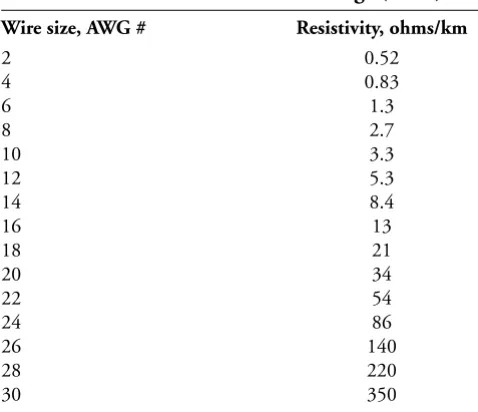
[image:40.483.121.360.419.625.2]ohm per kilometer(ohm/km or Ω/km). Table 2-1 shows the resistivity for various common sizes of solid copper wire at room temperature, as a function of the wire size as defined by a scheme known as the American Wire Gauge(AWG).
Table 2-1. Approximate resistivity at room temperature for solid copper wire as a function of
the wire size in American Wire Gauge (AWG).
Wire size, AWG # Resistivity, ohms/km
2 0.52
4 0.83
6 1.3
8 2.7
10 3.3
12 5.3
14 8.4
16 13
18 21
20 34
22 54
24 86
26 140
28 220
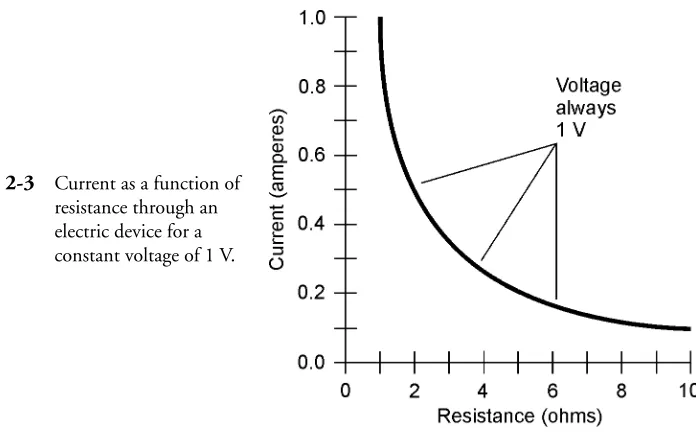
When 1 V is placed across 1 Ωof resistance, assuming that the power supply can deliver an un-limited number of charge carriers, there is a current of 1 A. If the resistance is doubled to 2 Ω, the current decreases to 0.5 A. If the resistance is cut by a factor of 5 to 0.2 Ω, the current increases by the same factor, to 5 A. The current flow, for a constant voltage, is said to be inversely proportional
to the resistance. Figure 2-3 is a graph that shows various currents, through various resistances, given a constant voltage of 1 V across the whole resistance.
[image:41.482.65.413.58.279.2]Resistance has another property. If there is a current flowing through a resistive material, there is always a potential difference across the resistive component (called a resistor). This is shown in Fig. 2-4. In general, this voltage is directly proportional to the current through the resistor. This be-havior of resistors is useful in the design of electronic circuits, as you will learn later in this book.
Electrical circuits always have some resistance. There is no such thing as a perfect conductor. When some metals are chilled to temperatures near absolute zero, they lose practically all of their re-sistance, but they never become absolutely perfect, resistance-free conductors. This phenomenon, about which you might have heard, is called superconductivity.
Resistance and the Ohm 21
2-4 Whenever current passes through a component having resistance, a voltage exists across that component.
Just as there is no such thing as a perfectly resistance-free substance, there isn’t a truly infinite resistance, either. Even air conducts to some extent, although the effect is usually so small that it can be ignored. In some electronic applications, materials are selected on the basis of how “nearly infi-nite” their resistance is.
In electronics, the resistance of a component often varies, depending on the conditions under which it is operated. A transistor, for example, might have high resistance some of the time, and low resistance at other times. High/low resistance variations can be made to take place thousands, mil-lions, or billions of times each second. In this way, oscillators, amplifiers, and digital devices func-tion in radio receivers and transmitters, telephone networks, digital computers, and satellite links (to name just a few applications).
Conductance and the Siemens
Electricians and electrical engineers sometimes talk about the conductanceof a material, rather than about its resistance. The standard unit of conductance is the siemens, abbreviated S. When a com-ponent has a conductance of 1 S, its resistance is 1 Ω. If the resistance is doubled, the conductance is cut in half, and vice versa. Therefore, conductance is the reciprocal of resistance.
If you know the resistance of a component or circuit in ohms, you can get the conductance in siemens: divide 1 by the resistance. If you know the conductance in siemens, you can get the resist-ance: divide 1 by the conductance. Resistance, as a variable quantity, is denoted by an italicized, up-percase letter R.Conductance, as a variable quantity, is denoted as an italicized, uppercase letter G.If we express Rin ohms and Gin siemens, then the following two equations describe their relationship:
G=1/R R=1/G
Units of conductance much smaller than the siemens are often used. A resistance of 1 kΩis equal to 1 millisiemens(1 mS). If the resistance is 1 MΩ, the conductance is one microsiemens(1µS). You’ll sometimes hear about kilosiemens(kS) or megasiemens(MS), representing resistances of 0.001
Ωand 0.000001 Ω(a thousandth of an ohm and a millionth of an ohm, respectively). Short lengths of heavy wire have conductance values in the range of kilosiemens. Heavy metal rods can have con-ductances in the megasiemens range.
Suppose a component has a resistance of 50 Ω. Then its conductance, in siemens, is 1/50 S, which is equal to 0.02 S. We can call this 20 mS. Or imagine a piece of wire with a conductance of 20 S. Its resistance is 1/20 Ω, which is equal to 0.05 Ω. You will not often hear the term mil-liohm.But you could say that this wire has a resistance of 50 mΩ, and you would be technically right.
Determining conductivityis tricky. If wire has a resistivity of 10 Ω/km, you can’t say that it has a conductivity of 1/10, or 0.1, S/km. It is true that a kilometer of such wire has a conductance of 0.1 S, but 2 km of the wire has a resistance of 20 Ω(because there is twice as much wire). That is not twice the conductance, but half. If you say that the conductivity of the wire is 0.1 S/km, then you might be tempted to say that 2 km of the wire has 0.2 S of conductance. That would be a mis-take! Conductance decreases with increasing wire length.
Power and the Watt
Whenever current flows through a resistance, heat results. The heat can be measured in watts (sym-bolized W) and represents electrical power.(As a variable quantity in equations, power is denoted by the uppercase italic letter P.) Power can be manifested in many forms, such as mechanical motion, radio waves, visible light, or noise. But heat is always present, in addition to any other form of power, in an electrical or electronic device. This is because no equipment is 100 percent efficient. Some power always goes to waste, and this waste is almost all in the form of heat.
Look again at Fig. 2-4. There is a certain voltage across the resistor, not specifically indicated. There’s also a current flowing through the resistance, and it is not quantified in the diagram, either. Suppose we call the voltage Eand the current I, in volts (V) and amperes (A), respectively. Then the power in watts dissipated by the resistance, call it P, is the product of the voltage in volts and the current in amperes:
P=EI
If the voltage Eacross the resistance is caused by two flashlight cells in series, giving 3 V, and if the current Ithrough the resistance (a light bulb, perhaps) is 0.1 A, then E=3 V and I=0.1 A, and we can calculate the power Pin watts as follows:
P=EI=3×0.1=0.3 W
Suppose the voltage is 117 V, and the current is 855 mA. To calculate the power, we must con-vert the current into amperes: 855 mA =855/1000 A =0.855 A. Then:
P=EI=117×0.855=100 W
Power and the Watt 23
2-5 Resistance and
You will often hear about milliwatts(mW), microwatts(µW), kilowatts(kW), and megawatts
(MW). By now, you should be able to tell from the prefixes what these units represent. Otherwise, you can refer to Table 2-2. This table lists the most commonly used prefix multipliersin electricity and electronics.
Sometimes you need to use the power equation to find currents or voltages. Then you should useI=P/Eto find current, or E=P/Ito find voltage. Always remember to convert, if necessary, to the standard units of volts, amperes, and watts before performing the calculations.
A Word about Notation
Have you noticed some strange things about the notation yet? If you’re observant, you have! Why, you might ask, are italics sometimes used, and sometimes not used? Something should be said early in this course about notation, because it can get confusing with all the different symbols and abbre-viations. Sometimes, symbols and abbreviations appear in italics, and sometimes they do not. You’ll see subscripts often, and sometimes even they are italicized! Here are some rules that apply to nota-tion in electricity and electronics:
• Symbols for specific units, such as volts, amperes, and ohms, are not italicized.
• Symbols for objects or components, such as resistors, batteries, and meters, are not italicized.
• Quantifying prefixes, such as “kilo-” or “micro-,” are not italicized.
• Labeled points in drawings might or might not be italicized; it doesn’t matter as long as a di-agram is consistent with itself.
• Symbols for mathematical constants and variables, such as time, are italicized.
• Symbols for electrical quantities, such as voltage, current, resistance, and power, are itali-cized.
• Symbols and abbreviations for modifiers might or might not be italicized; it doesn’t matter as long as a document is consistent with itself.
• Numeric subscripts are not italicized.
• For nonnumeric subscripts, the same rules apply as for general symbols.
Some examples are R (not italicized) for resistor, R(italicized) for resistance, P(italicized) for power, W (not italicized) for watts, V (not italicized) for volts, EorV(italicized) for voltage, A (not itali-cized) for amperes, I(italicized) for current, f(italicized) for frequency, and t(italicized) for time.
Table 2-2. Prefix multipliers from 0.000000000001 (trillionths, or units of 10−12) to 1,000,000,000,000
(trillions, or units of 1012).
Prefix Symbol Multiplier
pico- p 0.000000000001 (or 10−12)
nano- n 0.000000001 (or 10−9)
micro- µ 0.000001 (or 10−6)
milli- m 0.001 (or 10−3)
kilo- k 1000 (or 103)
mega- M 1,000,000 (or 106)
giga- G 1,000,000,000 (or 109)
Once in a while you will see the same symbol italicized in one place and not in another—in the same circuit diagram or discussion! We might, for example, talk about “resistor number 3” (symbol-ized R3), and then later in the same paragraph talk about its value as “resistance number 3”
(Sym-bolized R3). Still later we might talk about “the nth resistor in a series connection” (Rn) and then “the
nth resistance in a series combination of resistances” (Rn).
These differences in notation, while subtle (and, some people will say, picayune) are followed in this book, and they are pretty much agreed upon by convention. They are important because they tell the reader exactly what a symbol stands for in a diagram, discussion, or mathematical equation. “Resistor” and “resistance” are vastly different things—as different from each other as a garden hose (the object) and the extent to which it impedes the flow of water (the phenomenon). With this in mind, let us proceed!
Energy and the Watt-Hour
Have you heard the terms “power” and “energy” used interchangeably, as if they mean the same thing? They don’t! Energyis power dissipated over a length of time. Poweris the rate at which energy is expended. Physicists measure energy in units called joules.One joule (1 J) is the equivalent of a
watt-second, which is the equivalent of 1 watt of power dissipated for 1 second of time (1 W ⭈s or Ws). In electricity, you’ll more often encounter the watt-hour(symbolized W ⭈ h or Wh) or the
kilowatt-hour(symbolized kW ⭈h or kWh). As their names imply, a watt-hour is the equivalent of 1 W dissipated for 1 h, and 1 kWh is the equivalent of 1 kW of power dissipated for 1 h.
[image:45.482.59.419.421.638.2]A watt-hour of energy can be dissipated in an infinite number of different ways. A 60-W bulb consumes 60 Wh in 1 h, the equivalent of a watt-hour per minute (1 Wh/min). A 100-W bulb con-sumes 1 Wh in 1/100 h, or 36 s. Besides these differences, the rate of power dissipation in real-life circuits often changes with time. This can make the determination of consumed energy compli-cated, indeed.
Figure 2-6 illustrates two hypothetical devices that consume 1 Wh of energy. Device A uses its power at a constant rate of 60 W, so it consumes 1 Wh in 1 min. The power consumption rate of
Energy and the Watt-Hour 25
device B varies, starting at zero and ending up at quite a lot more than 60 W. How do you know that this second device really consumes 1 Wh of energy? You must determine the area under the curve in the graph. In this case, figuring out this area is easy, because the enclosed object is a trian-gle. The area of a triangle is equal to half the product of the base length and the height. Device B is powered up for 72 s, or 1.2 min; this is 1.2/60 =0.02 h. Then the area under the curve is 1/2 × 100×0.02=1 Wh.
When calculating energy values, you must always remember the units you’re using. In this case the unit is the watt-hour, so you must multiply watts by hours. If you multiply watts by minutes, or watts by seconds, you’ll get the wrong kind of units in your answer.
Often, the curves in graphs like these are complicated. Consider the graph of power consump-tion in your home, versus time, for a day. It might look like the curve in Fig. 2-7. Finding the area under this curve is not easy. But there is another way to determine the total energy burned by your household over a period of time. That is by means of a meter that measures electrical energy in kilo-watt-hours. Every month, without fail, the power company sends its representative to read your electric meter. This person takes down the number of kilowatt-hours displayed, subtracts the num-ber from the reading taken the previous month, and a few days later you get a bill. This meter au-tomatically keeps track of total consumed energy, without anybody having to go through high-level mathematical calculations to find the areas under irregular curves such as the graph of Fig. 2-7.
Other Energy Units
The joule, while standard among scientists, is not the only energy unit in existence! Another unit is theerg, equivalent to one ten-millionth (0.0000001) of a joule. The erg is used in lab experiments involving small amounts of expended energy.
2-7 A graph showing the amount of power consumed by a