This is a repository copy of
Rarefaction shocks, shock errors, and low order of accuracy in
ZEUS
.
White Rose Research Online URL for this paper:
http://eprints.whiterose.ac.uk/1265/
Article:
Falle, S.A.E.G. (2002) Rarefaction shocks, shock errors, and low order of accuracy in
ZEUS. The Astrophysical Journal Letters, 577 (2). L123-L126. ISSN 0004-637X
[email protected] https://eprints.whiterose.ac.uk/
Reuse
See Attached
Takedown
If you consider content in White Rose Research Online to be in breach of UK law, please notify us by
L123
RAREFACTION SHOCKS, SHOCK ERRORS, AND LOW ORDER OF ACCURACY IN ZEUS
S. A. E. G. Falle
Department of Applied Mathematics, University of Leeds, Woodhouse Lane, Leeds LS2 9JT, UK
Received 2002 July 9; accepted 2002 August 22; published 2002 August 28
ABSTRACT
We show that there are simple one-dimensional problems for which the MHD code, ZEUS, generates significant errors, whereas upwind conservative schemes perform very well on these problems.
Subject headings: hydrodynamics — methods: numerical — MHD
1.INTRODUCTION
ZEUS is a freely available MHD code that is widely used by the astrophysical community. Although Stone & Norman (1992a, 1992b) give results for the Sod problem (Sod 1978) and its MHD equivalent, the Brio & Wu problem (Brio & Wu 1988), ZEUS does not appear to have been tested on a wide range of Riemann problems such as those described in, e.g., Dai & Woodward (1994), Ryu & Jones (1995), Falle, Kom-issarov, & Joarder (1998), and Balsara (1998).
Since ZEUS is neither upwind for all characteristic fields nor conservative, we might expect it to perform significantly less well than upwind conservative codes (e.g., Brio & Wu 1988; Dai & Woodward 1994; Ryu & Jones 1995; Falle et al. 1998; Balsara 1998; Powell et al. 1999). As we shall see, this is indeed true in the sense that there are a number of simple problems for which the ZEUS solution contains significant er-rors that are absent in solutions calculated with an upwind conservative scheme.
2.RAREFACTION SHOCKS
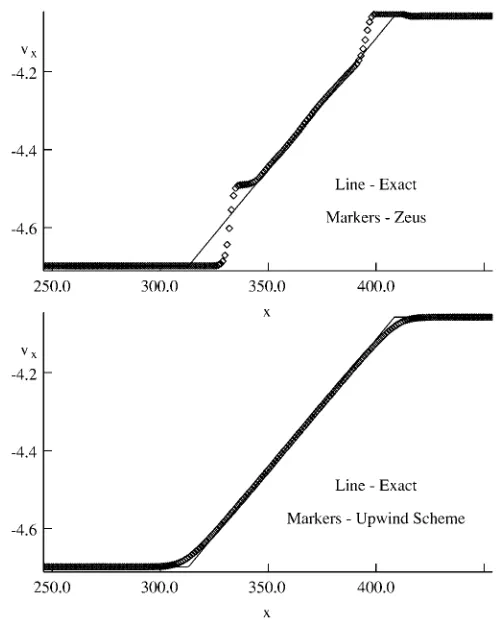
Figures 1 and 2 show that ZEUS generates rarefaction shocks for both pure gas rarefactions and fast magnetosonic rarefac-tions, whereas the upwind conservative scheme described in Falle et al. (1998) gives quite satisfactory results. In both cases, the ZEUS solutions are sensitive to the inertial frame, and the rarefaction shocks can be removed by a Galilean transformation that increases the x-velocity sufficiently.
These rarefaction shocks are steady structures whose width does not increase with time. Since the effect of the nonlinear terms is to spread such structures, it is clear that the truncation errors in ZEUS must be antidiffusive in these cases. The most obvious explanation for this is that ZEUS is second order in space but first order in time since this can lead to an antidif-fusive term in the truncation error. For example, the upwind scheme can be made first order in time and second order in space by omitting the preliminary first-order step, and in that case it can be shown to be antidiffusive and also produces rarefaction shocks.
Although ZEUS is second order in space and time for linear advection, the use of a partially updated velocity in the ad-vection step means that it is only first order in time if the velocity is not constant. Further evidence that this is the cause of the problem is provided by the sensitivity of the rarefaction shocks to the Galilean frame and the fact that they disappear when the Courant number is reduced from 0.5 to 0.1, whereas they become much worse if the Courant number is increased above 0.5.
ZEUS has a facility for adding a linear artificial viscosity whose magnitude is determined by the parameter qlin. The addition of such a viscosity removes the antidiffusive terms by reducing the scheme to first order in space for everything except linear advection. For the gas rarefaction,qlinp0.25cures the problem and seems to be optimal for a global Courant number of 0.5, but it is too large if the local Courant number associated with the wave is small. Since the linear viscous term must balance an antidiffusive term that scales like the time step, it would be better if the viscous term that is implemented in ZEUS were multiplied by the local Courant number associated with the wave that is causing the problem. Since rarefaction shocks arise only for rarefactions associated with the sound wave with the largest speed relative to the grid, it is the smallest local Courant number that is appropriate.
In MHD, the situation is even worse since, although the rarefaction shocks in the fast rarefaction can be removed by settingqlinp1, this makes the scheme very diffusive for other waves. Furthermore, the required value of qlin depends on the particular problem. It might be possible to avoid such a large value of qlin by adding an appropriate artificial resistivity, but the code has no facility for this.
Figures 3 and 4 show that, even for an initially smooth rarefaction wave, ZEUS is significantly less accurate than an upwind scheme. The results are forqlinp0.25, but Figure 4 shows that ZEUS is still first order even without this. In con-trast, it is evident from Figure 4 that the rate of convergence of the upwind scheme is second order. Note that the upwind scheme also has an artificial viscosity as described in Falle et al. (1998), but since this is applied in the Riemann solver, it does not reduce the order in smooth regions. Incidentally, ZEUS performs even worse if one does not take the staggered grid into account in setting up the initial solution. Furthermore, for both codes, point samples were used to project the exact solution onto the grid, which is reasonable for ZEUS but is somewhat unfair to a conservative scheme.
The upwind scheme produces reasonable results at the lowest resolution, even though this corresponds to only two cells in the rarefaction at the initial time, whereas ZEUS needs at least four cells for the same accuracy. For a three-dimensional cal-culation, this would require 24 times the computing time and 8 times the memory since ZEUS is about 2 times the speed
3
L124 ERRORS IN ZEUS Vol. 577
Fig.1.—Gas rarefaction attp80. Left state:rp1 p, p10,v p⫺3.
g x
Right state: rp0.87469 p, gp8,vxp⫺2.46537. The discontinuity is at at and .
xp700 tp0 Dxp1.0
Fig. 2.—Fast rarefaction at tp100. Left state: rp1 p, gp0.2327, , , , . Right state: vxp⫺4.6985 vyp⫺1.085146 Bxp⫺0.7 Byp1.9680 rp
, , , , ,
0.7270 p p0.1368 v p⫺4.0577 v p⫺0.8349 B p⫺0.7 B p
g x y x y
. The discontinuity is at at and . 1.355 xp1000 tp0 Dxp1.0
of ZEUS also means that the situation would be even worse if greater accuracy were required.
3.SHOCK ERRORS
Since ZEUS is not conservative, we expect it to generate errors at shocks that cannot be reduced by increasing the res-olution. As it turns out, these errors are small (!5%) for pure
gasdynamics and are entirely absent for an isothermal equation of state. However, they can be significant for adiabatic MHD. Figure 5 shows that, for a nearly perpendicular fast shock, the postshock gas pressure in the ZEUS solution is too low by a factor of 2. In contrast, the conservative upwind scheme gets the solution exact to rounding. It is true that this is a somewhat extreme case since the plasmab is negligible upstream of the shock andbp0.037downstream. However, such low values ofbdo occur in dense molecular clouds and protostellar disks (e.g., Crutcher 1999). Furthermore, even though b is small, such errors in the gas pressure can have a significant effect on the dynamics because the gas pressure provides a force parallel to the field, whereas the Lorentz force does not.
Finally, Figure 6 shows that a relatively small error at a fast shock can be amplified by a slow shock following on behind. In this case, the ZEUS solution has an error of 22% in the density behind the slow shock traveling to the right. This is not caused by small bsincebp0.16behind the fast shock, behind the slow shock, and the error in the gas pressure
bp6.1
is much smaller than in the density.
Like Balsara (2001), we find that ZEUS produces large postshock oscillations for strong MHD shocks but that these can be reduced substantially by adding the same linear artificial
viscosity that removes gasdynamic rarefaction shocks. This is presumably because a quadratic viscosity leads to algebraic decay of these oscillations, whereas a linear viscosity gives exponential decay. The calculation shown in Figure 6 used this value of the linear artificial viscosity, and it can be seen that the amplitude of the postshock oscillations is quite small.
The calculations presented are all coplanar (
v
pBzp0),z
but we have also looked at some noncoplanar problems in order to see whether the presence of Alfve´n waves causes any ad-ditional difficulties for ZEUS. This is not the case, at least for the problems that we have considered.
4.CONCLUSION
It is evident from these results that ZEUS can be made just about acceptable for pure gasdynamics if the linear artificial viscosity is multiplied by the smallest local Courant number since the shock errors are small in this case. However, it is not satisfactory for adiabatic MHD, at least in its present form. The shock errors do not occur for an isothermal equation of state, but, since the rarefaction shocks do, ZEUS is also not reliable for isothermal MHD. It is possible that the rarefaction shocks in MHD waves can be removed without using an ex-cessive linear artificial viscosity by the addition of an appro-priate linear artificial resistivity. The shock errors might also be reduced by advecting the total energy rather than the internal energy. However, even with such improvements, the low order of accuracy makes ZEUS very inefficient compared with a modern upwind scheme.
[image:3.612.43.289.62.376.2] [image:3.612.315.564.64.374.2]Fig. 3.—Smooth gas rarefaction at tp50. At tp0, v p0.5{1⫹ x
, , as . The ZEUS calculation is with tanh [0.1(x⫺400)]} rr1 pgr1 xr⫺⬁
. qlinp0.25
Fig.5.—Gas pressure in a stationary fast shock. Left state:rp1 p, gp , , , , . Right state: ,
⫺6
10 vxp1.5 vyp0.0 Bxp0.1 Byp1.0 rp1.6111 pgp
, , , , .
0.04847 v p0.9310 v p0.04104 Bxp0.1 Byp1.6156
x y
Fig.4.—Convergence rates:eis theL1norm of the error in the density for the smooth rarefaction in200≤x≤700. Lines with slopes 1 and 2 are also shown.
Fig. 6.—Density in a Riemann problem attp30. Left state: rp0.5, , , , , . Right state: , ,
pgp10 vxp0 vyp2 Bxp2 Byp2.5 rp0.1 pgp0.1 , , , . The exact solution was calculated using v p⫺10 v p0 B p2 B p2
x y
x y
the Riemann solver described in Falle et al. (1998)
codes are in any sense perfect. For example, it is necessary to introduce some extra dissipation in the Riemann solver to re-move the serious errors discussed by Quirk (1994), and some desirable properties, such as strict conservation, may have to be sacrificed in order to satisfy the constraint · Bp0 in multidimensional MHD (see, e.g., Powell et al. 1999; Balsara 2001).
These results obviously have implications for the reliability of the numerous calculations in the literature that have used ZEUS. Although these effects are likely to be present in many cases, the associated errors are not necessarily so serious as to
completely invalidate the calculations. Whether or not they make any qualitative difference in any particular case can only be decided either by a thorough examination of the results to see whether any of these errors are present or by repeating the calculations using a modern code.
L126 ERRORS IN ZEUS Vol. 577
although we used the scheme described by Falle et al. (1998), similar results would probably have been obtained with any modern upwind code.
The author would like to thank both the editor and an anon-ymous referee for a number of helpful comments on the original version.
REFERENCES
Balsara, D. S. 1998, ApJS, 116, 133 ———. 2001, J. Comput. Phys., 174, 614
Brio, M., & Wu, C. C. 1988, J. Comput. Phys., 75, 400 Crutcher, R. M. 1999, ApJ, 520, 706
Dai, W., & Woodward, P. R. 1994, J. Comput. Phys., 111, 354
Falle, S. A. E. G., Komissarov, S. S., & Joarder, P. 1998, MNRAS, 297, 265 Powell, K. G., Roe, P. L., Linde, T. J., Gombosi, T. I., & De Zeeuw, D. L.
1999, J. Comput. Phys., 154, 284
Quirk, J. J. 1994, Int. J. Numer. Methods Fluids, 18, 555 Ryu, D., & Jones, T. W. 1995, ApJ, 442, 228
Sod, G. A. 1978, J. Comput. Phys., 27, 1